
Life, 1914-04-16 · page 20 of 44
Life — April 16, 1914 — page 20: what you’re looking at
What you’re looking at
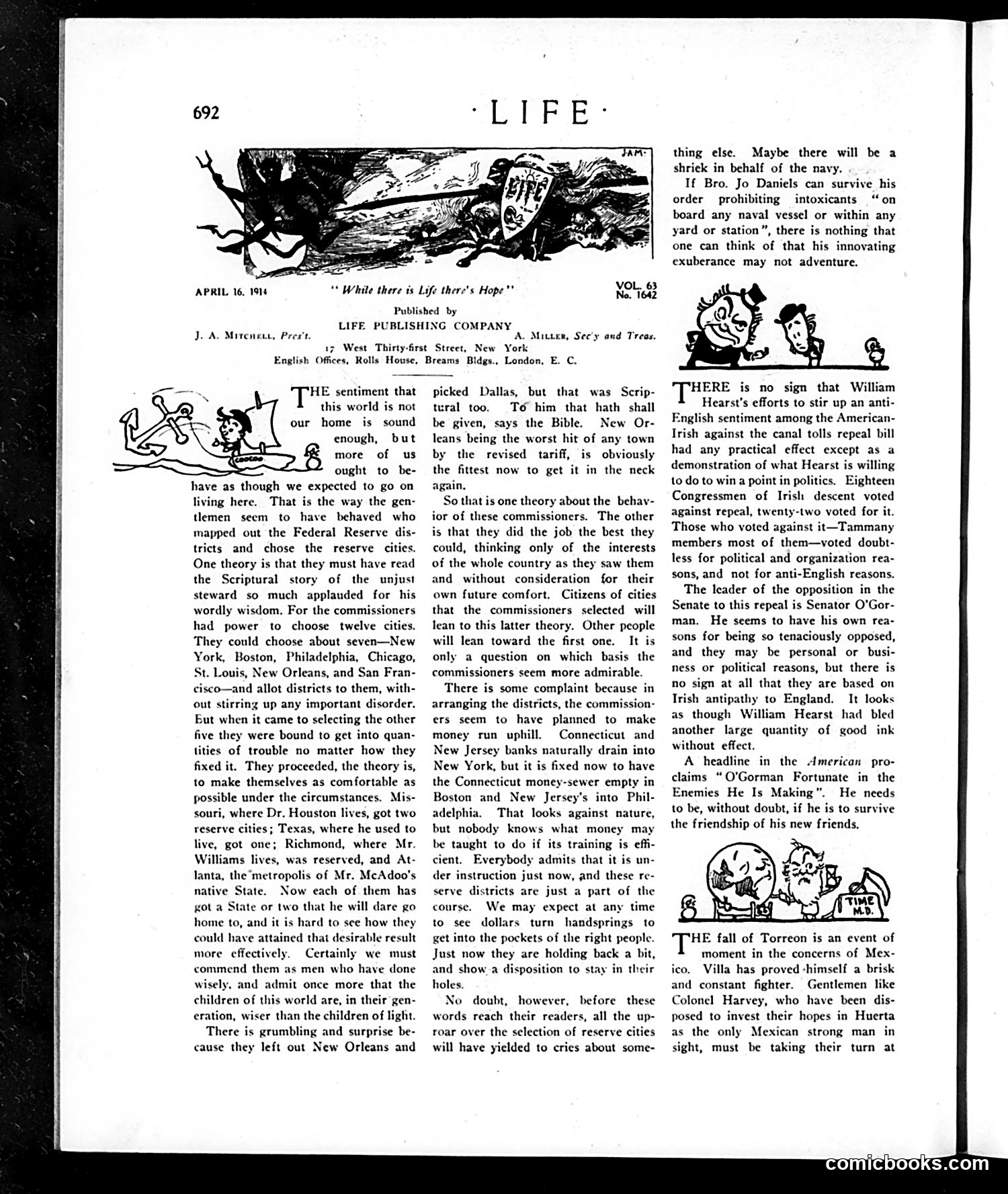
This page satirizes the Federal Reserve commissioners' selection of reserve cities (financial centers) established under the 1913 Federal Reserve Act. The article argues the commissioners chose cities suspiciously aligned with where they personally lived or had ties—Dr. Houston (Missouri), Mr. Williams (Richmond), Mr. McAdoo (Atlanta)—suggesting self-interested rather than impartial decision-making. The piece sardonically praises them as "children of this world" wise in worldly concerns, contrasting them with "children of light" (the genuinely virtuous). The satire also mocks the artificial rerouting of financial flows (Connecticut and New Jersey funds diverted from New York to Boston and Philadelphia), suggesting money can be "trained" like an obedient subject if given proper instruction. A separate item jokes about Secretary of the Navy Josephus Daniels's temperance order banning alcohol aboard naval vessels—questioning whether anything could be more controversial than such a radical innovation.
📄 Transcribed text from this page (OCR, searchable)
Machine-transcribed from the original scan — historical spelling and the odd misread are preserved.
APRIL 16, 1916 LIFE J. A. Miteneet, Pres't. 17 West Thirty-first Street, “\ While there is Life there's Hope” Published by PUBLISHING COMPANY A. Mittxe, See’y and Treas. New York English Offices, Rolls House, Breams Bldgs., London, E. C. HE sentiment that this world is not our home is sound enough, but more of us ought to be- have as though we expected to go on living here. That is the way the gen- tlemen seem to have behaved who mapped out the Federal Reserve dis tricts and chose the reserve cities. One theory is that they must have read the Scriptural story of the unjust steward so much applauded for his wordly wisdom, For the commissioners had power to choose twelve S. They could choose about seven—New York, Boston, Philadelphia, Chicago, St. Louis, New Orleans, and San Fran- cisco—and allot districts to them, with- out stirring up any important disorder. But when it came to selecting the other five they were bound to get into quan- tities of trouble no matter how they fixed it. They proceeded, the theory is, to make themselves as comfortable as possible under the circumstances. Mis- souri, where Dr. Houston lives, got two. reserve cities; Texas, where he used to live, got one; Richmond, where Mr. Williams lives, was reserved, and At- Janta, the"metropolis of Mr. McAdoo’s native State. Now each of them has got a State or two that he will dare go home to, and it is hard to see how they could have attained that desirable result more effectively. Certainly we must commend them as men who have done wisely, and admit once more that the children of this world are, in their gen- eration, wiser than the children of light. There is grumbling and surprise be- cause they left out New Orleans and picked Dallas, but that was Scrip- tural too. To him that hath shall be given, says the Bible. New Or- leans being the worst hit of any town by the revised tariff, is obviously the fittest now to get it in the neck again. So that is one theory about the behav- ior of these commissioners. The other is that they did the job the best they could, thinking only of the interests of the whole country as they saw them and without consideration for their own future comfort. Citizens of cities that the commissioners selected will lean to this latter theory. Other people will lean toward the first one. It is only a question on which basis the commissioners seem more admirable. There is some complaint because in arranging the districts, the commission- ers seem to have planned to make money run uphill. Connecticut and New Jersey banks naturally drain into New York, but it is fixed now to have the Connecticut money-sewer empty in Boston and New Jersey’s into Phil- adelphia. That looks against nature, but nobody knows what money m be taught to do if its training is effi- cient. Everybody admits that it is un- der instruction just now, and these re- serve districts are just a part of the cours We may expect at any time to see dollars turn handsprings to get into the pockets of the right people. Just now they are holding back a bit, and show a disposition to stay in their holes. No doubt, however, before these words reach their readers, all the up- roar over the selection of reserve cities will have yielded to cries about some- thing else. Maybe there will be a shriek in behalf of the navy. If Bro. Jo Daniels can survive his order prohibiting intoxicants “on board any naval vessel or within any yard or station”, there is nothing that one can think of that his innovating exuberance may not adventure. 'HERE is no sign that William Hearst's efforts to stir up an anti- English sentiment among the American- Irish against the canal tolls repeal bill had any practical effect except as a demonstration of what Hearst is willing to do to win a point in politics. Eighteen Congressmen of Irish descent voted against repeal, twenty-two voted for it. Those who voted against it—Tammany members most of them—voted doubt- less for political and organization rea- sons, and not for anti-English reasons. The leader of the opposition in the Senate to this repeal is Senator O’Gor- man. He seems to have his own rea- sons for being so tenaciously opposed, and they may be personal or busi- ness or political reasons, but there is no sign at all that they are based on Trish antipathy to England. It looks as though William Hearst had bled another large quantity of good ink without effect. A headline in the American claims “O'Gorman Fortunate in the Enemies He Is Making”. He needs to be, without doubt, if he is to survive the friendship of his new friends, pro- 'HE fall of Torreon is an event of moment in the concerns of Mex- ico. Villa has proved -himself a brisk and constant fighter. Gentlemen like Colonel Harvey, who have been dis- posed to invest their hopes in Huerta as the only Mexican strong man in sight, must be taking their turn at