
Life, 1914-04-16 · page 27 of 44
Life — April 16, 1914 — page 27: what you’re looking at
What you’re looking at
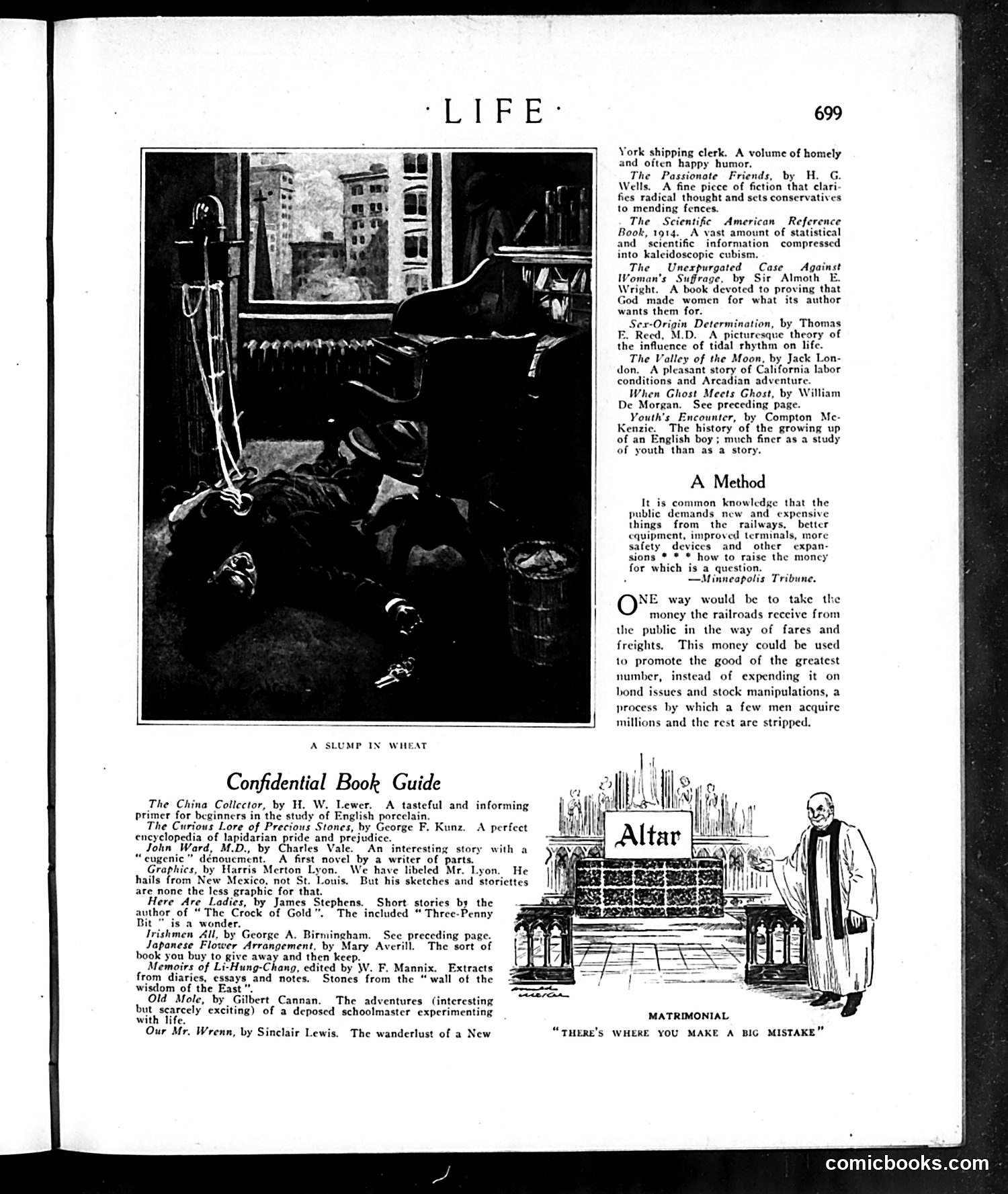
This page combines book reviews with social commentary and advertising. The main editorial content critiques railroads' financial practices, arguing they should reinvest passenger fares into public infrastructure rather than use profits for "bond issues and stock manipulations" that enrich a few wealthy men. This reflects Progressive Era concerns about corporate monopolies and wealth inequality. The "Confidential Book Guide" section reviews contemporary literature, including H.G. Wells's *The Passionate Friends* (praised for its radical ideas) and Almoth Wright's *Case Against Woman's Suffrage* (sarcastically noted as claiming God made women for specific purposes). The matrimonial cartoon at bottom right depicts an altar scene with the caption "THERE'S WHERE YOU MAKE A BIG MISTAKE"—a cynical joke about marriage, likely aimed at male readers. The overall page reflects 1914 anxieties about capitalism, women's rights, and social reform.
📄 Transcribed text from this page (OCR, searchable)
Machine-transcribed from the original scan — historical spelling and the odd misread are preserved.
699 York shipping clerk. A volume of homely and often happy humor. The Passionate Friends, by H. G. Wells. A fine picce of fiction that clari. fies radical thought and sets conservatives to mending fences. The Scientific American Reference Book, 1914. A vast amount of statistical and scientific information compressed into kaleidoscopic cubism. The Unexpurgated Case Against Woman's Suffrage, by Sir Almoth E. Wright. A book devoted to proving that Gi made women for what its author wants them for. Sex-Origin Determination, by Thomas =. Reed, M.D. A picturesque theory of the influence of tidal rhythm on life. The Valley of the Moon, by Jack Lon- don. A pleasant story of California labor conditions and Arcadian adventure When Ghost Meets Ghost, by William De Morgan. See preceding page. Youth's Encounter, by Compton Me- Kenzie. The history of the growing up of an English boy ; much finer as a study of youth than asa story. A Method It_is common knowledge that the public demands new and expensive things from the railways, better equipment, improved terminals, more safety devices and other expan- sions * * * how to raise the moncy for which is a question. j —Minneapolis Tribune. O*E way would be to take the money the railroads receive from the public in the way of fares and freights, This money could be used 1o promote the good of the greatest number, instead of expending it on bond issues and stock manipulations, a process by which a few men acquire millions and the rest are stripped. A SLUMP IN WHEAT Confidential Book Guide The China Coltcctor, by H. W. Lewer. <A tasteful and informing primer for beginners in the study of English porcelain. The Curious Lore of Precious Stones, by George F. Kunz. <A perfect encyclopedia of lapidarian pride and prejudice. John Ward, M.D., by Charles Vale. An interesting story with a “cugenic” denouement. A first novel by a writer of parts. Graphics, by Harris Merton Lyon. We have libeled Mr. Lyon. He hails from New Mexico, not St. Louis, But his sketches and storicttes are none the less graphic for that. Here Are Ladies, by James Stephens. Short. stories by the author of “ The Crock of Gold". The included “ Three-Penny Bit " is a wonder. Irishmen All, by George A. Birmingham. See preceding page. Japanese Flower Arrangement, by Mary Averill. The sort of book you buy to give away and then keep. Memoirs of Li-Hung-Chang, edited by W. F. Mannix. Extracts from diaries, essays and notes. Stones from the “wall of the wisdom of the East”. ud, Mote, by. Gilbert Cannan. The adventures (interesting be ueely exciting) of a deposed schoolmaster experimenting MATRIMONIAL Our Mr. Wrenn, by Sinclair Lewis. The wanderlust of a New “THERE'S WHERE YOU MAKE A BIG MISTAKE” comicbooks.com