
Life, 1914-04-16 · page 25 of 44
Life — April 16, 1914 — page 25: what you’re looking at
What you’re looking at
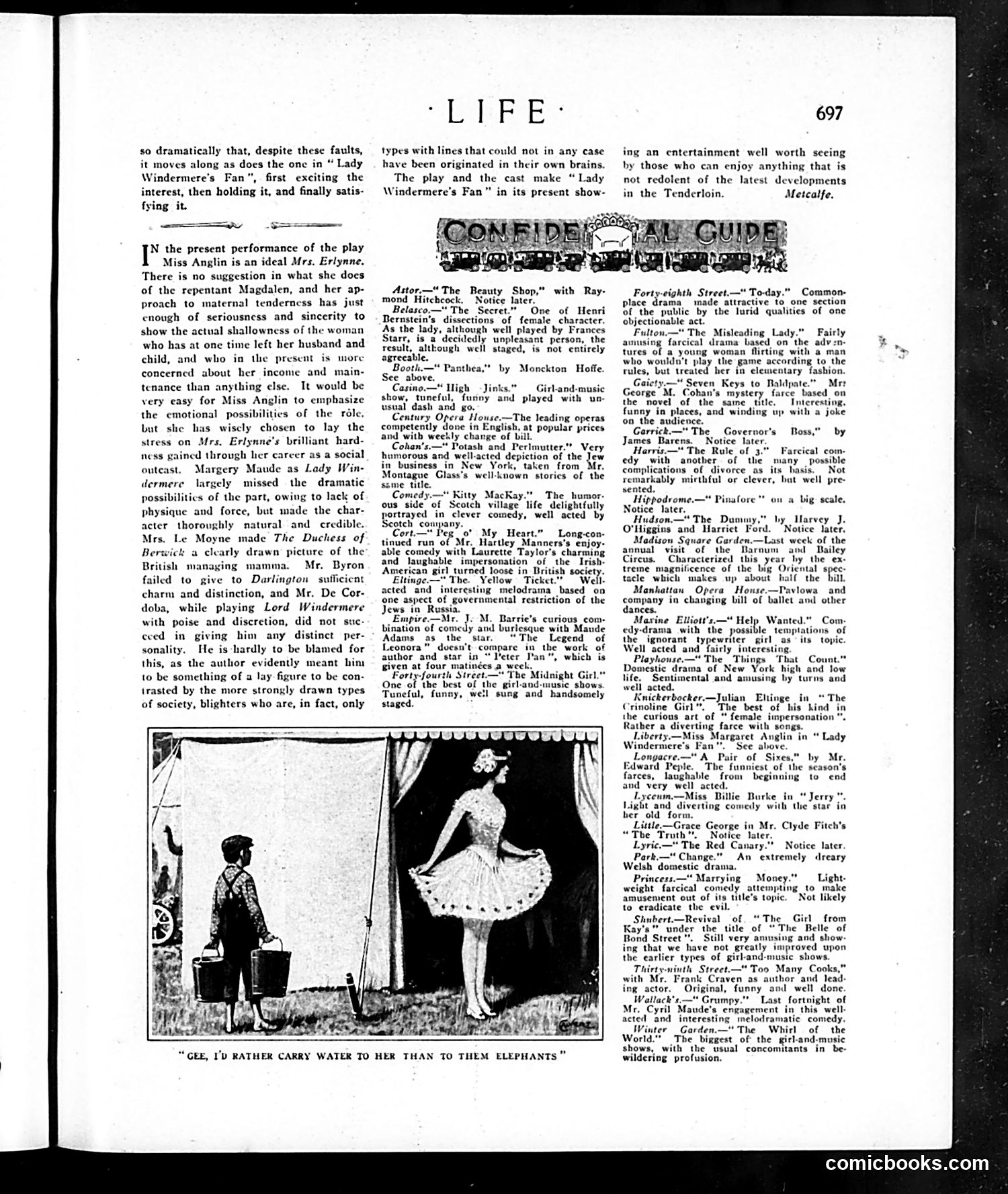
This page reviews theatrical productions, primarily Oscar Wilde's "Lady Windermere's Fan." The review praises actress Margaret Anglin's performance as Mrs. Erlynne, a morally compromised woman, noting she wisely emphasizes the character's "brilliant hardness" gained through her career as a "social outcast" rather than playing her as emotionally vulnerable. The cartoon depicts a man carrying water buckets, saying he'd "rather carry water to her than to them elephants"—likely a visual gag about preferring menial labor for an attractive woman (shown in theatrical costume) over working with actual elephants. This reflects early 1900s humor about masculine preference and workplace hierarchies. The page also lists other Broadway productions: comedies, musicals, and melodramas popular at the time, with brief critical assessments of their merit and casts.
📄 Transcribed text from this page (OCR, searchable)
Machine-transcribed from the original scan — historical spelling and the odd misread are preserved.
so dramatically that, despite these faults, it moves along as does the one in “ Lady Windermere’s Fan", first exciting the interest, then holding it, and finally satis- fying it —Sw N the present performance of the play I Miss Anglin is an ideal Mrs. Erlynne. There is no suggestion in what she docs of the repentant Magdalen, and her ap- proach to maternal tenderness has just enough of seriousness and sincerity to show the actual shallowness of the woman who has at one time left her husband and child, and who in the present is more concerned about her income and main- tenance than anything clse. It would be very easy for Miss Anglin to emphasize the emotional possibilities of the réle, Lut she has wiscly chosen to lay the stress on Mrs. Erlynne’s brilliant hard- ness gained through her career as a social outeast. Margery Maude as Lady Win- dermere largely missed the dramatic possibilitics of the part, owing to lack of physique and force, but made the char- acter thoroughly natural and credible. Mrs. Le Moyne made The Duchess of Berwick a clearly drawn picture of the British managing mamma. Mr. Byron failed to give to Darlington sufficient charm and distinction, and Mr. De Cor- doba, while playing Lord Windermere with poise and discretion, did not suc- ceed in giving him any distinct per- sonality. He is hardly to be blamed for this, as the author evidently meant him to be something of a Jay figure to be con- trasted by the more strongly drawn types of society, blighters who are, in fact, only “Ee ]eBrE < types with lines that could not in any case have been originated in their own brains. The play and the cast make “Lady Windermere’s Fan” in its present show- Astor.—" The mond Hitchcock. Notice later. Belasco,—" The Secret.” One of Henri Bernstein's dissections of female, character. As the lady, although well played by Frances Starr, is a ‘decidedly unpleasant person, the result, although well staged, is not entirely agreeable. Beauty Shop," with Ray- by Monckton Hoffe. —"“ High Jinks.” Girland-musie show, tuneful, funny and played with un usual dash and go. Century Opera House.—The leading operas competently done in English, at popular prices and with weebly change of bill. Cohan's.—" Potash and Perlmutter.” Very humorous and well-acted depiction of the Jew in business in New York, taken from Mr. Montague Glass’s well-known stories of the some title. Comedy tty MacKay.” The humor. ous side of Scotch village life delightfully portrayed in clever comedy, well acted by Scotch company. Cort.—" Peg ‘ot My Heart.” Long-con- tinued run of Mr. Hartley Manners’s enjoy- able comedy with Laurette Taylor's charming and laughable impersonation of the Irish American girl turned loose in British society. Eltinge—" The. Yellow. Ticket.” Well- acted and interesting melodrama based on one aspect of governmental restriction of the Jews in Russia. Empire—Mr. J. M. Barrie's curious com bination of comedy and burlesque with Maude Adams as the star. “The Legend of Leonora” doesn't compare in the work of author and star in “Veter Pan”, which is given at four matinées a web. Forty-fourth Street—" The ight Girl.” One of the best of the girlaod-music shows Tuneful, funny, weil sung and handsomely staged. “GEE, I'D RATHER CARRY WATER TO HER THAN TO THEM ELEPHANTS” 697 ing an entertainment well worth seeing by those who can enjoy anything that is not redolent of the latest developments in the Tenderloin. Metcalfe. Forty-eighth Street.—"* To-day.” Common place drama made attractive to one section of the public by the lurid qualities of one objectionable act. Fultou.—" The Misleading Lady." Fai amusing farcical drama based on the adv:n- tures of a young woman flirting with a man who wouldn't play the game according to the rules, but treated her in elementary fashion. Keys to Baldpate.”” | M George M. Cohan's mystery farce based on the novel of the same title. Interesting. funny in places, and winding up with a joke on the audience. Garrick.—" The Governor's James Barens. Notice later: Harris.—" The Rule of 3." Farcical com- edy with another of the many possible complications of divorce as its hasis. Not remarkably mirthful or clever, but well pre- sented. Hippodrome. Notice later. Hudson.—" The Dummy,” hy Harvey J. O'Higgins and Harriet Ford. Notice later. ison Square Garden.—Last week of the annual visit’ of the Barnum and Bailey Cireus. Characterized this year hy the ex- treme magnificence of the big Oriental spec- tacle which makes up about half the is Manhattan Opera House.—Pavlowa and company in changing bill of ballet and other dances. Maxine Eltiott's—" Help Wanted.” Com: edy-drama with the possible temptations of the ignorant typewriter girl as. its topic. Well acted and fairly, interesting. Playhouse-—" The Things ‘That Count. Domestic drama of New York high and low life. Sentimental and amusing by turns and well acted. Knickerbocker.—Julian Eltinge |i Crinoline Girl”! “The best of his ki the curious art ‘of ‘female impersonati Rather a diverting farce with songs. Liberty.—Miss Margaret Anglin in “ Lady Windermere’s Fan". See above. _Longacre.—" A Pair of Sixes," by Mr. Edward Peple. | The funniest of the season's farces, laughable from beginning to end and very well acted Lycenm.—Miss. Billie Burke in “ Jerry". Light and diverting comedy with the star in her old form. Little.—Grace George in Mr. Clyde Fitch's “The Truth’. Notice later. Lyric.— The Red Canary.” Notice later Park.—" Change.” An extremely dreary Welsh domestic drama. Princess.—" Marrying Money.” Light- weight farcical comedy attempting to make amusement out of its title’s topic. Not likely to eradicate the evil. Shubert-—Revival of “The Girl from Kay's” under the title of “The Belle of Bond Street". Still very amusing and show: ing that we have not greatly improved upon the earlier types of girland-music shows. Thirty-ninth Street.—" Too Many Cooks,” with Mr. raven as author and lead: ing actor. inal, funny and well done. Wallack's.—" Grumpy.” Last fortnight of Mr. Cyril Maude's engagement in this well- acted and interesting imelodramatic comedy. Winter Garden.—* The Whirl of the World.” The biggest of the gitl-and-music shows, with the usual concomitants in be- wildering profusion. Ross," by * Pinafore on a big: scale, “The comicbooks.com