
Life, 1914-04-16 · page 10 of 44
Life — April 16, 1914 — page 10: what you’re looking at
What you’re looking at
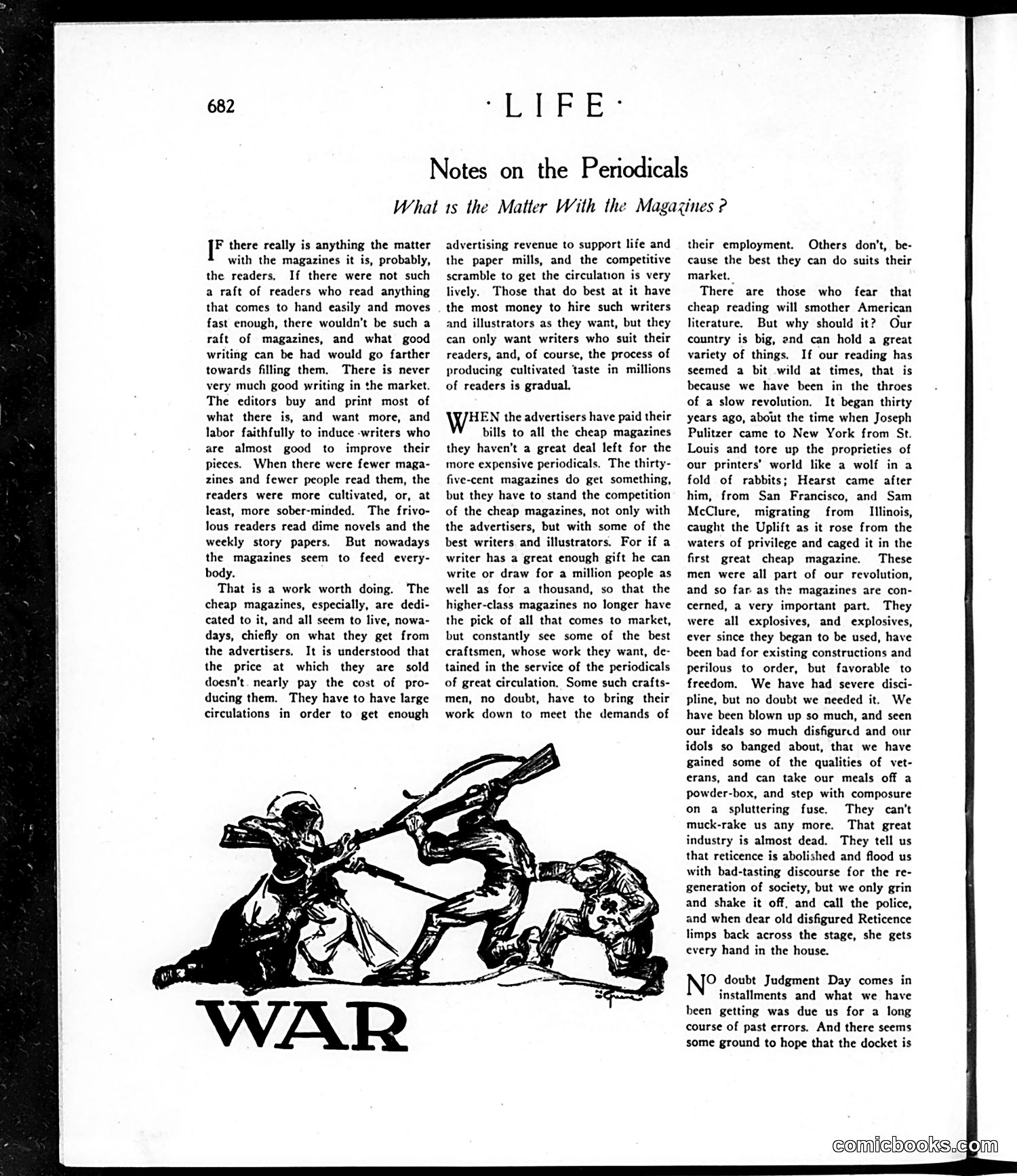
This political cartoon illustrates the article's critique of cheap magazines' decline. The large "WAR" illustration depicts a chaotic battle scene with soldiers fighting—a visual metaphor for the competitive struggle among magazines for survival and advertising revenue. The accompanying text discusses how higher-priced magazines maintain quality by attracting top writers and advertisers, while cheaper magazines ("the thirty-five-cent magazines") must compete fiercely but cannot afford the best talent. The "war" represents this brutal market competition that supposedly forces cheaper publications toward sensationalism and lower standards. The cartoon suggests the magazine industry's internal conflict is as destructive as literal warfare, emphasizing the author's concern that economic pressures undermine literary quality and American reading culture.
📄 Transcribed text from this page (OCR, searchable)
Machine-transcribed from the original scan — historical spelling and the odd misread are preserved.
What IF there really is anything the matter with the magazines it is, probably, the readers, If there were not such a raft of readers who read anything that comes to hand easily and moves fast enough, there wouldn't be such a raft of magazines, and what good writing can be had would go farther towards filling them. There is never very much good writing in the market. The editors buy and print most of what there is, and want more, and labor faithfully to induce -writers who are almost good to improve their pieces. When there were fewer maga- zines and fewer people read them, the readers were more cultivated, or, at least, more sober-minded. The frivo- lous readers read dime novels and the weekly story papers. But nowadays the magazines seem to feed every- body. That is a work worth doing. The cheap magazines, especially, are dedi- cated to it, and all seem to live, nowa- days, chiefly on what they get from the advertisers, It is understood that the price at which they are sold doesn’t. nearly pay the cost of pro- ducing them. They have to have large circulations in order to get enough SR Es Notes on the Periodicals 1s the Matter With the Magazines ? advertising revenue to support life and the paper mills, and the competitive scramble to get the circulation is very lively. Those that do best at it have the most money to hire such writers and illustrators as they want, but they can only want writers who suit their readers, and, of course, the process of producing cultivated taste in millions of readers is gradual. HEN the advertisers have paid their bills to all the cheap magazines they haven't a great deal left for the more expensive periodicals, The thirty- five-cent magazines do get something, but they have to stand the competition of the cheap magazines, not only with the advertisers, but with some of the best writers and illustrators. For if a writer has a great enough gift he can write or draw for a million people as well as for a thousand, so that the higher-class magazines no longer have the pick of all that comes to market, but constantly sce some of the best craftsmen, whose work they want, de- tained in the service of the periodicals of great circulation. Some such crafts- men, no doubt, have to bring their work down to meet the demands of their employment. Others don’t, be- cause the best they can do suits their market. There are those who fear that cheap reading will smother American literature. But why should it? Our country is big, and can hold a great variety of things. If our reading has seemed a bit wild at times, that is because we have been in the throes of a slow revolution. It began thirty years ago, about the time when Joseph Pulitzer came to New York from St. Louis and tore up the proprieties of our printers’ world like a wolf in a fold of rabbits; Hearst came after him, from San Francisco, and Sam McClure, migrating from Illinois, caught the Uplift as it rose from the waters of privilege and caged it in the first. great cheap magazine. These men were all part of our revolution, and so far as the magazines are con- cerned, a very important part. They were all explosives, and explosives, ever since they began to be used, have been bad for existing constructions and perilous to order, but favorable to freedom. We have had severe disci- pline, but no doubt we needed it. We have been blown up so much, and seen our ideals so much disfigured and our idols so banged about, that we have gained some of the qualities of vet- erans, and can take our meals off a powder-box, and step with composure on a spluttering fuse. They can't muck-rake us any more. That great industry is almost dead. They tell us that reticence is abolished and flood us with bad-tasting discourse for the re- generation of society, but we only grin and shake it off, and call the police, and when dear old disfigured Reticence limps back across the stage, she gets every hand in the house. N° doubt Judgment Day comes in installments and what we have been getting was due us for a long course of past errors. And there seems some ground to hope that the docket is comichooks.com