
Life, 1914-04-16 · page 18 of 44
Life — April 16, 1914 — page 18: what you’re looking at
What you’re looking at
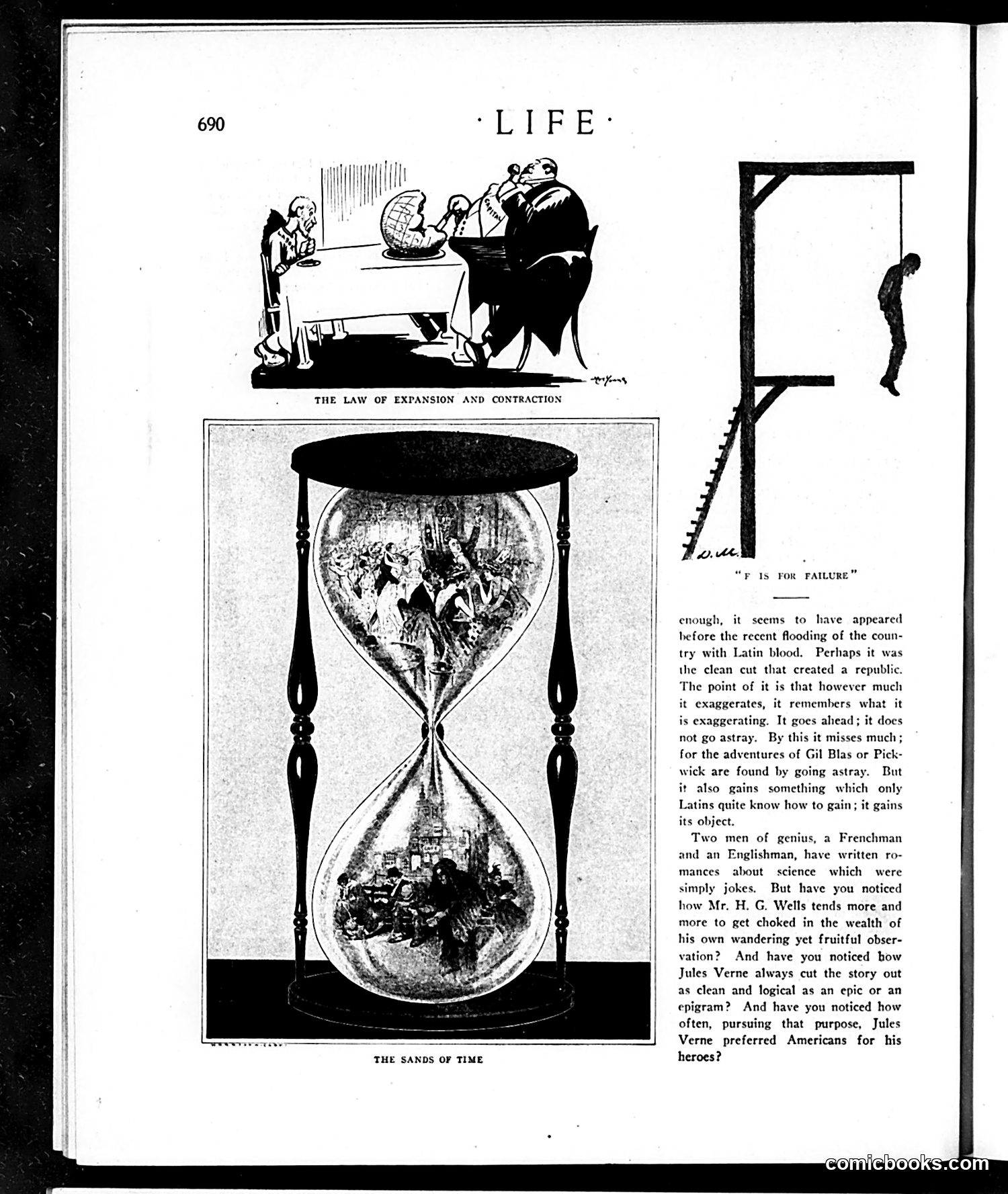
This page contains three distinct images satirizing different subjects: **"The Law of Expansion and Contraction"** (top): Shows a thin woman and portly men at a dining table with a globe-shaped dish, satirizing how wealth/resources distribute unevenly—the rich expand while others contract. **"The Sands of Time"** (center): An hourglass symbolizing mortality, with crowds of people in each chamber, representing how time passes and civilizations rise and fall. **"F is for Failure"** (right): A figure hanging from a gallows, representing failure or defeat. The accompanying text discusses literary giants H.G. Wells and Jules Verne, praising Verne's logical storytelling and noting his preference for American heroes. The passage also contains a now-offensive reference to "flooding of the country with Latin blood," reflecting period anxieties about immigration. The overall theme appears to critique both artistic excess and societal concerns about change and decline.
📄 Transcribed text from this page (OCR, searchable)
Machine-transcribed from the original scan — historical spelling and the odd misread are preserved.
THE SANDS OF TIME whe. F IS FOR FAILURE” enough, it seems to have appeared before the recent flooding of the coun- try with Latin blood. Perhaps it was the clean cut that created a republic. The point of it is that however much it exaggerates, it remembers what it is exaggerating. It goes ahead; it does not go astray. By this it misses much; for the adventures of Gil Blas or Pick- wick are found by going astray. But it also gains something which only Latins quite know how to gain; it gains its object. Two men of genius, a Frenchman and an Englishman, have written ro- mances about science which were simply jokes. But have you noticed how Mr. H. G. Wells tends more and more to get choked in the wealth of his own wandering yet fruitful obser- vation? And have you noticed bow Jules Verne always cut the story out as clean and logical as an epic or an epigram? And have you noticed how often, pursuing that purpose, Jules Verne preferred Americans for his heroes?