
Life, 1914-04-16 · page 12 of 44
Life — April 16, 1914 — page 12: what you’re looking at
What you’re looking at
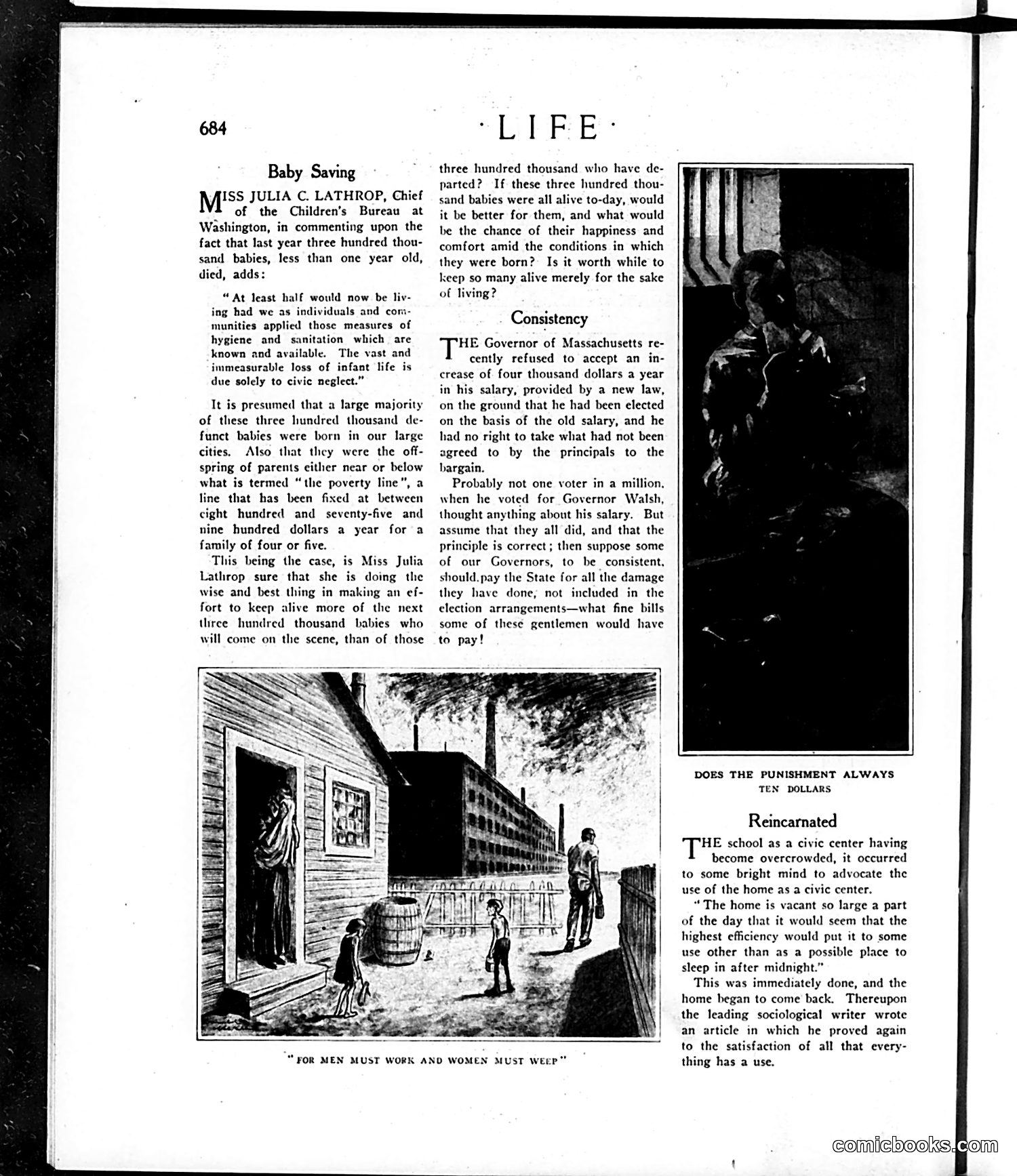
This page contains three separate pieces addressing social issues: **"Baby Saving"** discusses infant mortality among poor families living below the "poverty line" (set at $875-895 annually for families of 4-5). Miss Julia C. Lathrop of the Children's Bureau argues that 300,000 infant deaths annually could be prevented through hygiene and sanitation measures—a criticism of inadequate public health infrastructure. **"Consistency"** satirizes a Massachusetts Governor who refused a salary increase while claiming to have been "elected on the basis of the old salary." The piece mocks this selective consistency, suggesting if applied universally, governors should repay damage caused during their tenure. **"Reincarnated"** discusses schools becoming civic centers, proposing homes serve community functions when not in use—a Progressive-era idea about maximizing social utility.
📄 Transcribed text from this page (OCR, searchable)
Machine-transcribed from the original scan — historical spelling and the odd misread are preserved.
Baby Saving M'ss JULIA C. LATHROP, Chief of the Children’s Bureau at Washington, in commenting upon the fact that last year three hundred thou- sand babies, less than one year old, died, adds: “At least half would now be liv- ing had we as individuals and com- munities applied those measures of hygiene and sanitation which are known and available. The vast and immeasurable loss of infant life is due solely to civic neglect.” It is presumed that a large majority of these three hundred thousand de- funct babies were born in our large cities. Also that they were the off- spring of parents either near or below what is termed “the poverty line", a line that has been fixed at between cight hundred and seventy-five and nine hundred dollars a year for a family of four or five. This being the case, is Miss Julia Lathrop sure that she is doing the wise and best thing in making an ef- fort to keep alive more of the next three hundred thousand babies who will come on the scene, than of those “LIFE: three hundred thousand who have de- parted? If these three hundred thou- sand babies were all alive to-day, would it be better for them, and what would be the chance of their happiness and comfort amid the conditions in which they were born? Is it worth while to keep so many alive merely for the sake of living? Consistency HE Governor of Massachusetts re- cently refused to accept an in- crease of four thousand dollars a year in his salary, provided by a new law, on the ground that he had been elected on the basis of the old salary, and he had no right to take what had not been agreed to by the principals to the bargain. Probably not one voter in a million, when he voted for Governor Walsh, thought anything about his salary. But assume that they all did, and that the principle is correct; then suppose some of our Governors, to be consistent, should. pay the State for all the damage they have done, not included in the election arrangements—what fine bills some of these gentlemen would have “FOR MEN MUST WORK AND WOMEN MUST WEEP” DOES THE PUNISHMENT ALWAYS TEN DOLLARS Reincarnated 'HE school as a civic center having become overcrowded, it occurred to some bright mind to advocate the use of the home as a civic center. “The home is vacant so large a part of the day that it would seem that the highest efficiency would put it to some use other than as a possible place to sleep in after midnight.” This was immediately done, and the home began to come back. Thereupon the leading sociological writer wrote an article in which he proved again to the satisfaction of all that every- thing has a use. comichooks.{eom