
Life, 1914-04-16 · page 26 of 44
Life — April 16, 1914 — page 26: what you’re looking at
What you’re looking at
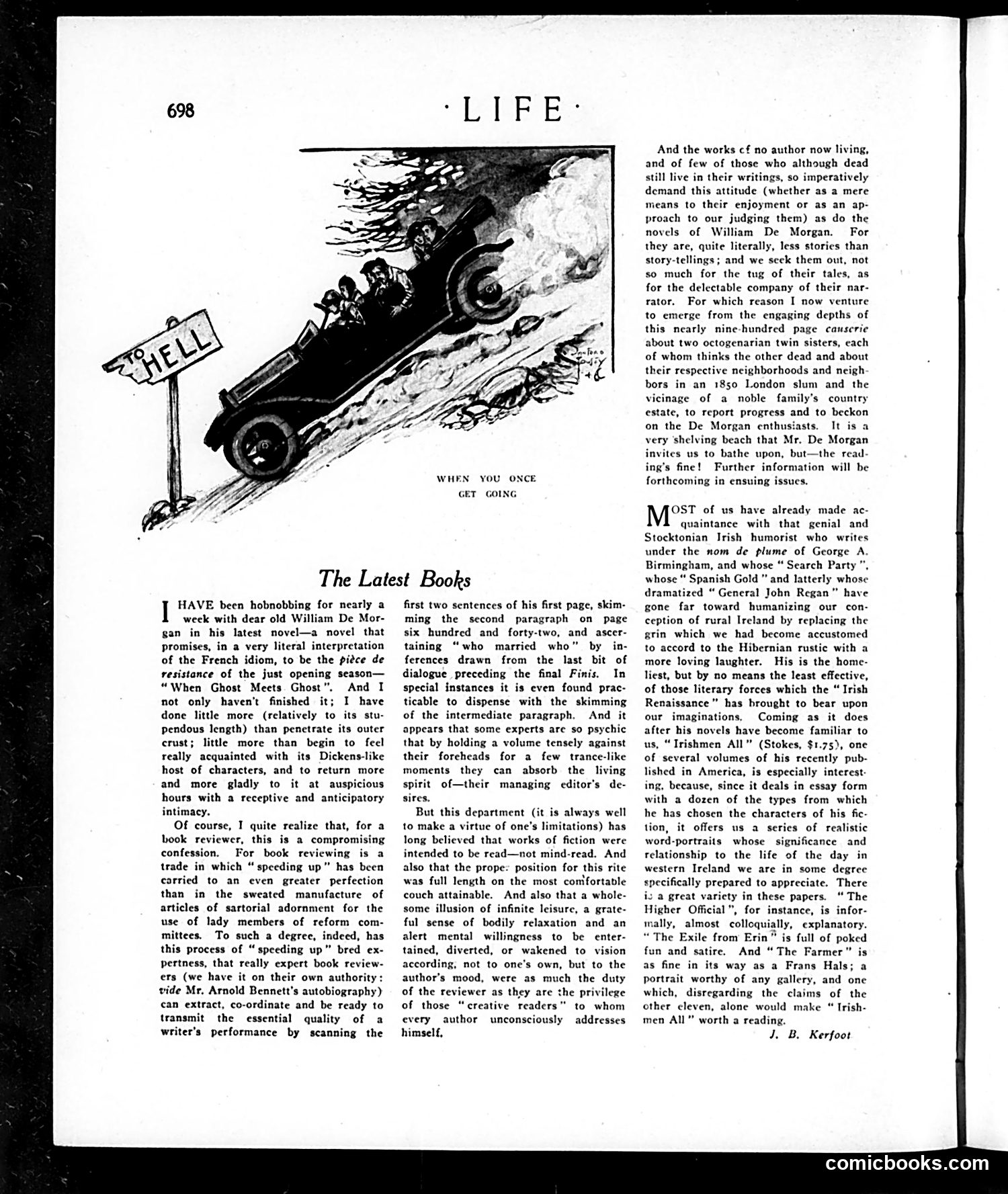
This page from *Life* magazine consists primarily of a book review by J. D. Kerfoot discussing William De Morgan's novel *When Ghost Meets Ghost*. **The Cartoon:** The small illustration labeled "WHEN YOU ONCE GET GOING" depicts a car careening down a slope toward a "HELL" sign—a visual joke about speed and momentum that satirizes book reviewers' rush to finish books. This complements Kerfoot's critique of the publishing industry's "speeding up" culture. **The Satire's Point:** Kerfoot mocks expert reviewers (particularly naming Arnold Bennett) who claim they can extract a book's essence by skimming mere fragments—reading opening sentences, scattered pages, or allegedly absorbing books psychically by holding them to their foreheads. He contrasts this with proper reading: leisurely, on a comfortable couch, allowing the author to set the mood. **De Morgan Context:** The review praises De Morgan's novels as "story-tellings" rather than mere stories, valuing the narrator's voice over plot—requiring patient, attentive reading. This positions De Morgan as the antidote to rushed reviewing culture.
📄 Transcribed text from this page (OCR, searchable)
Machine-transcribed from the original scan — historical spelling and the odd misread are preserved.
WHEN YOU ONCE GET GOING The Latest Books HAVE been hobnobbing for nearly a week dear old William De Mor- gan in his latest novel—a novel that promises, in a very literal interpretation of the French idiom, to be the pitce de resistance of the just opening season— “When Ghost Meets Ghost”. And I not only haven't finished it; I have done little more (relatively to its stu- pendous length) than penetrate its outer crust; little more than begin to feel really acquainted with its Dickens-like host of characters, and to return more and more gladly to it at auspicious hours with a receptive and anticipatory intimacy. Of course, I quite realize that, for a book reviewer, this is a compromising confession. For book reviewing is a trade in which “speeding up” has been carried to an even greater perfection than in the sweated manufacture of articles of sartorial adornment for the use of lady members of reform com- mittees. To such a degree, indeed, has this process of “speeding up” bred ex- pertness, that really expert book review- ers (we have it on their own authority: vide Mr. Arnold Bennett's autobiography) can extract, co-ordinate and be ready to transmit the essential quality of writer's performance by scanning the first two sentences of his first page, skim- ming the second paragraph on page six hundred and forty-two, and ascer- taining “who married who” by in- ferences drawn from the last bit of dialogue preceding the final Finis. In special instances it is even found prac- ticable to dispense with the skimming of the intermediate paragraph, And it appears that some experts are so psychic that by holding a volume tensely against their foreheads for a few trance-like moments they can absorb the living spirit of—their managing editor's de- sires. But this department (it is always well to make a virtue of one’s limitations) has long believed that works of fiction were intended to be read—not mind-read. And also that the prope: position for this rite was full length on the most comfortable couch attainable. And also that a whole- some illusion of infinite leisure, a grate- ful sense of bodily relaxation and an alert mental willingness to be enter- tained, diverted, or wakened to vision according, not to one’s own, but to the author’s mood, were as much the duty of the reviewer as they are the privilege of those “creative readers" to whom every author unconsciously addresses himself, And the works cf no author now living, and of few of those who although dead still live in their writings, so imperatively demand this attitude (whether as a mere means to their enjoyment or as an ap- proach to our judging them) as do the novels of William De Morgan. For they are, quite literally, less stories than story-tellings ; and we seek them out, not so much for the tug of their tales, as for the delectable company of their nar- rator. For which reason I now venture to emerge from the engaging depths of this nearly nine-hundred page causcrie about two octogenarian t sisters, each of whom thinks the other dead and about their respective neighborhoods and neigh bors in an 1850 London slum and the vicinage of a noble family’s country estate, to report progress and to beckon on the De Morgan enthusiasts. It is a very ‘shelving beach that Mr. De Morgan invites us to bathe upon, but—the read- ing’s fine! Further information will be forthcoming in ensuing issues. OST of us have already made ac- quaintance with that genial and Stocktonian Irish humorist who writes under the nom de plume of George A Birmingham, and whose “ Search Party", whose “ Spanish Gold " and latterly whose dramatized “ General John Regan” have gone far toward humanizing our con- ception of rural Ireland by replacing the grin which we had become accustomed to accord to the Hibernian rustic with a more loving laughter. His is the home- liest, but by no means the least effective, of those literary forces which the “ Irish Renaissance" has brought to bear upon our imaginations, Coming as it does after his novels have become familiar to us, “Irishmen All” (Stokes, $1.75), one of several volumes of his recently pub- lished in America, is especially interest- ing, because, since it deals in essay form with a dozen of the types from which he has chosen the characters of his fic- tion, it offers us a series of realistic word-portraits whose significance and relationship to the life of the day in western Ireland we are in some degree specifically prepared to appreciate. There is a great variety in these papers. “ The Higher Official”, for instance, is infor- mally, almost colloquially, explanatory. “ The Exile from Erin” is full of poked fun and satire. And “The Farmer” is as fine in its way as a Frans Hals; a portrait worthy of any gallery, and one which, disregarding the claims of the other cleven, alone would make “ Irish- men All” worth a reading. J. Bo Kerfoot comicbooks.com