
Life, 1914-04-16 · page 17 of 44
Life — April 16, 1914 — page 17: what you’re looking at
What you’re looking at
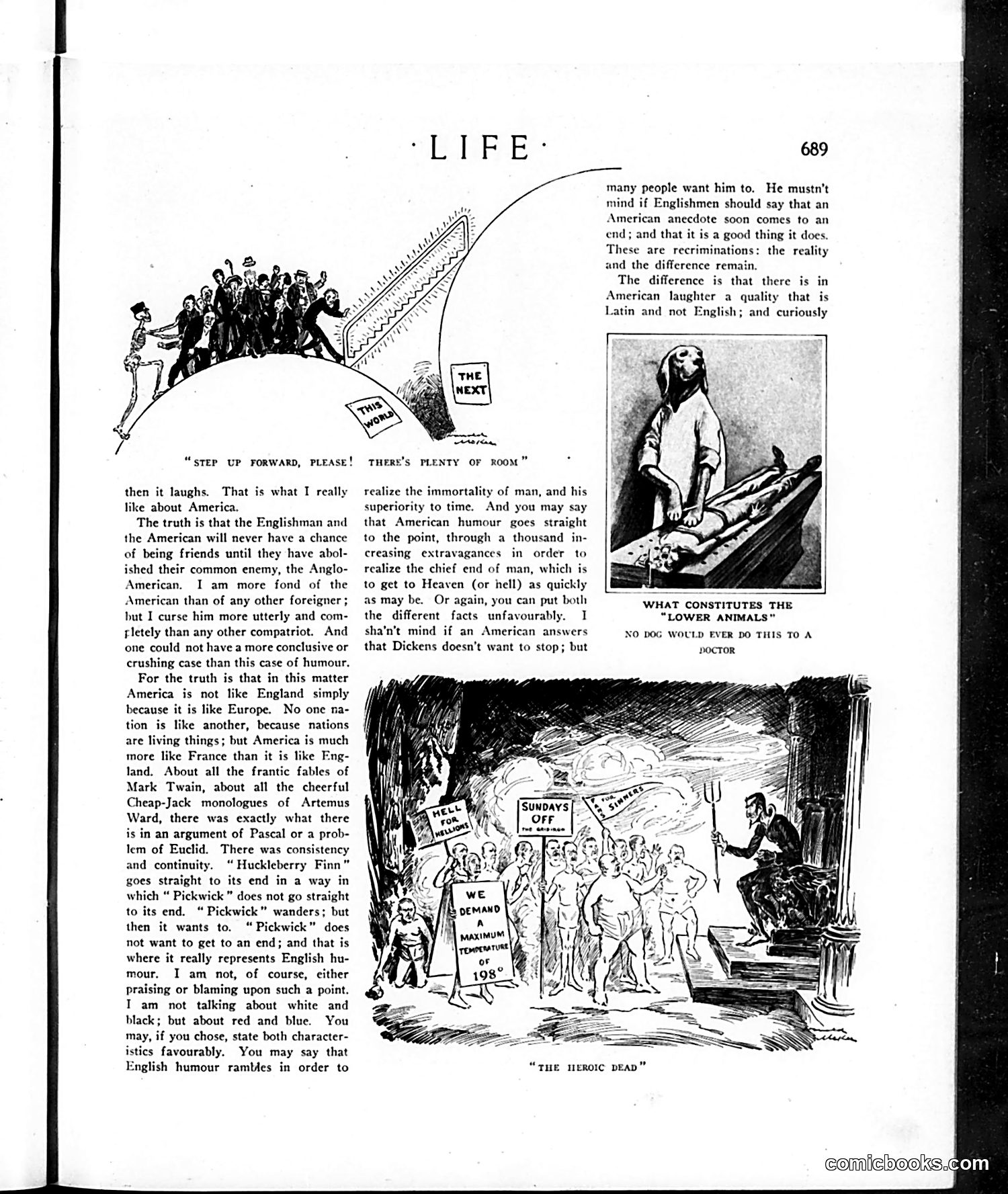
This page contains an essay on Anglo-American humor differences, accompanied by three satirical cartoons. **Top cartoon:** Depicts a crowded staircase labeled "THIS WORLD" and "THE NEXT," with figures climbing upward—satirizing American optimism and forward momentum versus English wandering humor. **Middle cartoon:** Shows a person examining an animal, captioned "What Constitutes the 'Lower Animals'—No Dog Would Ever Do This to a Doctor," mocking the pretensions of medical professionals or suggesting humans behave worse than animals. **Bottom cartoon:** "The Heroic Dead" depicts workers demanding "Sundays Off" and "Maximum Temperature of 108°"—satirizing labor disputes and working conditions, possibly during a heat wave, while management ignores their suffering. The essay argues American humor is direct and Latin-influenced, while English humor (exemplified by Dickens's *Pickwick Papers*) meanders purposefully. The cartoons illustrate this distinction through class commentary and social criticism typical of early 20th-century satire.
📄 Transcribed text from this page (OCR, searchable)
Machine-transcribed from the original scan — historical spelling and the odd misread are preserved.
“STEP UP FORWARD, PLEASE! then it laughs. That is what I really like about America. The truth is that the Englishman and the American will never have a chance of being friends until they have abol- ished their common enemy, the Anglo- American. I am more fond of the American than of any other foreigner ; but I curse him more utterly and com- fletely than any other compatriot. And one could not have a more conclusive or crushing case than this case of humour. For the truth is that in this matter America is not like England simply because it is like Europe. No one na- tion is like another, because nations are living things; but America is much more like France than it is like Eng- land. About all the frantic fables of Mark Twain, about all the cheerful Cheap-Jack monologues of Artemus Ward, there was exactly what there is in an argument of Pascal or a prob- lem of Euclid. There was consistency and continuity. “ Huckleberry Finn” goes straight to its end in a way in which “ Pickwick” does not go straight to its end. “ Pickwick” wanders; but then it wants to. “ Pickwick” does not want to get to an end; and that is where it really represents English hu- mour. I am not, of course, either praising or blaming upon such a point. T am not talking about white and black; but about red and blue. You may, if you chose, state both character- istics favourably. You may say that English humour ramtdes in order to THERE'S PLENTY OF ROOM” realize the immortality of man, and his superiority to time. And you may say that American humour goes straight to the point, through a thousand in- creasing extravagances in order to realize the chief end of man, which is to get to Heaven (or hell) as quickly as may be. Or again, you can put both the different facts unfavourably. I sha’n’t mind if an American answers that Dickens doesn’t want to stop; but 689 many people want him to. He mustn't mind if Englishmen should say that an American anecdote soon comes to an end; and that it is a good thing it does. These are recriminations: the reality and the difference remain, The difference is that there is in American laughter a quality that is Latin and not English; and curiously WHAT CONSTITUTES THE “LOWER ANIMALS” NO DOG WOULD EVER DO THIS TO A “THE IEROIC DEAD” comichooks.