
A complete issue · 48 pages · 1912
Life — May 9, 1912
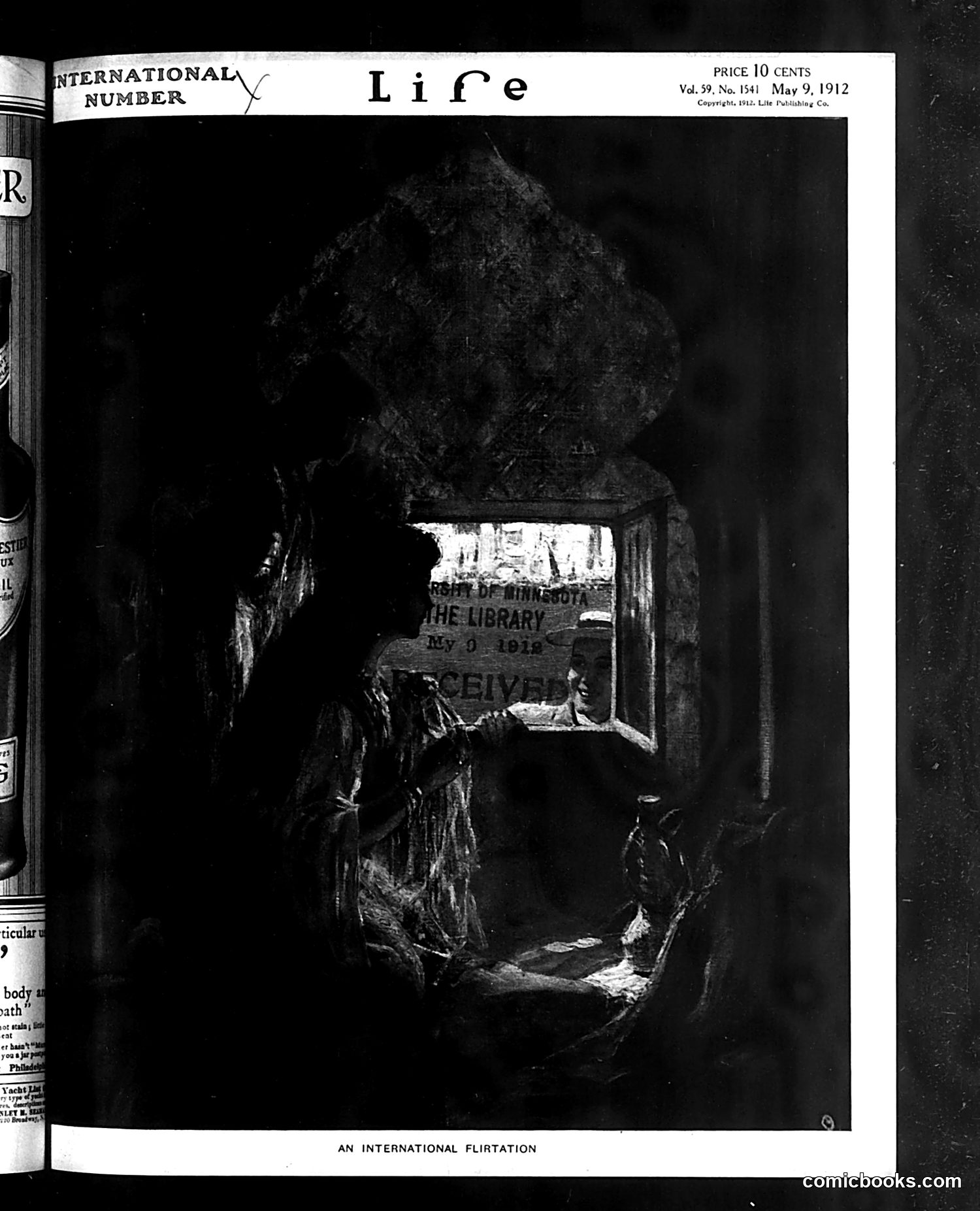
This 1912 *Life* magazine cover depicts a silhouetted figure gazing through a window at another figure beyond it. The caption "An International Flirtation" suggests romantic or diplomatic intrigue between nations. The image likely satirizes early 20th-century international relations, possibly referencing tensions or negotiations between powers. The window framing creates distance between the figures—a visual metaphor for the barrier between nations engaged in tentative, indirect communication. Without clearer identification of the specific figures or dated context clues, the exact nations or diplomatic situation referenced remains unclear. However, the tone suggests *Life*'s typical satirical commentary on global affairs, treating serious international matters with wry humor through the "flirtation" metaphor.
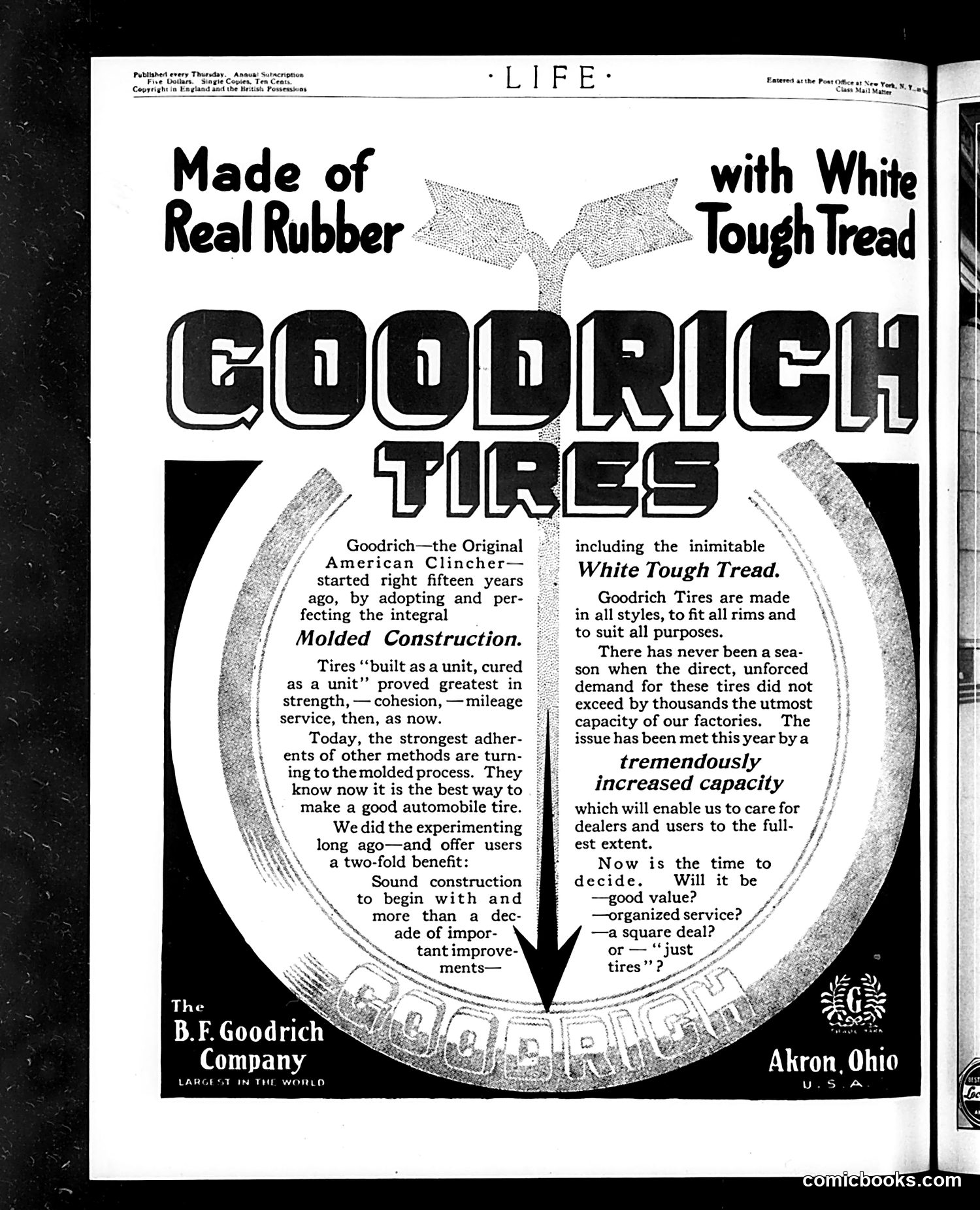
This page is **primarily an advertisement**, not satirical content. It's a full-page ad for Goodrich Tires, published in *Life* magazine. The ad promotes Goodrich's "molded construction" tire technology and their signature "White Tough Tread" feature. The company emphasizes their tire's durability through sound engineering, claiming they've perfected integral construction methods over years of experimentation. The advertisement highlights increased factory capacity to meet demand, positioning Goodrich as a reliable American manufacturer (based in Akron, Ohio). The messaging targets both dealers and consumers, asking rhetorical questions about value, service, and fair dealing—essentially positioning Goodrich as the trustworthy choice. There is no political satire or caricature present. This is straightforward early 20th-century automotive advertising.
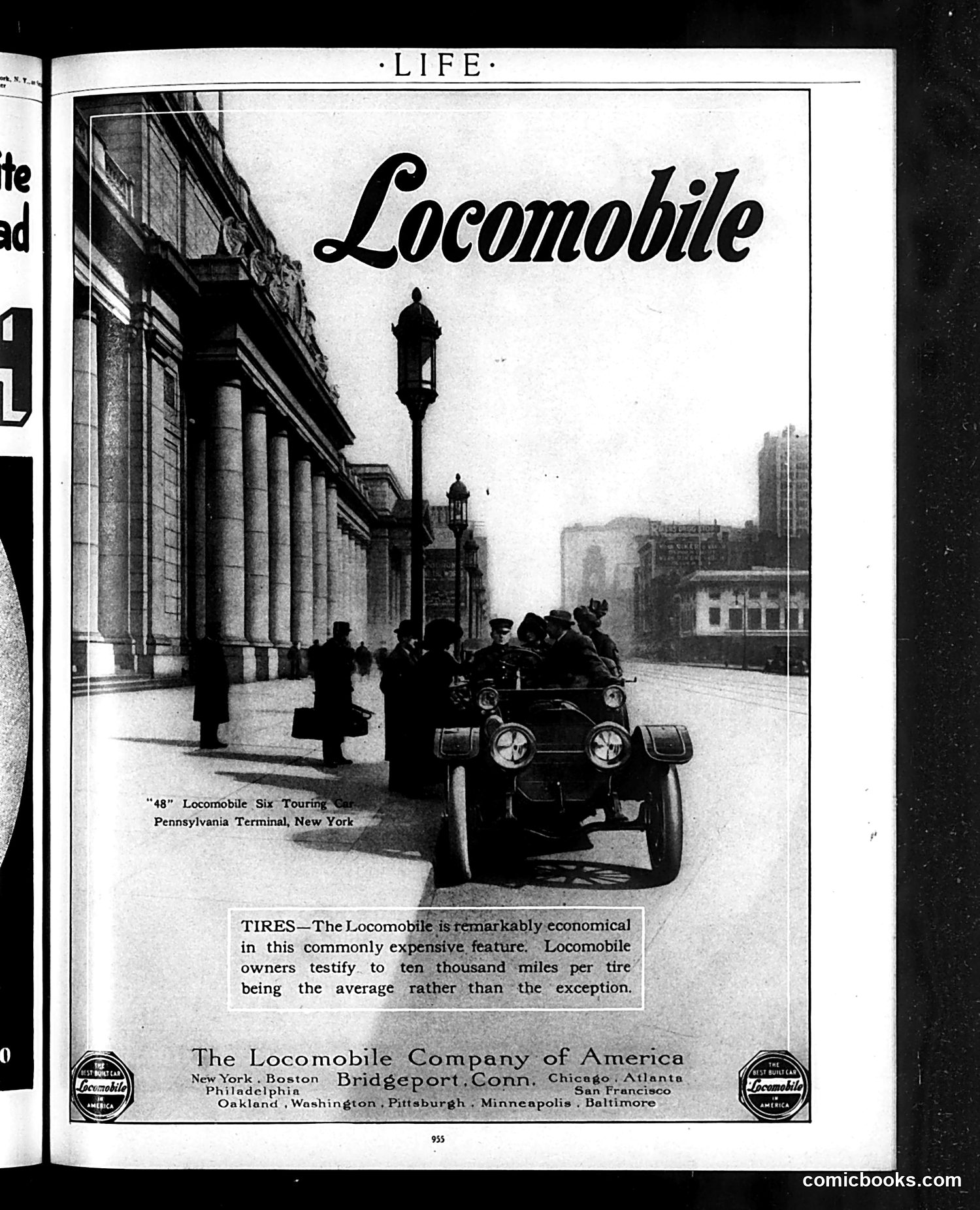
This page is **primarily an advertisement**, not political satire. It promotes the Locomobile, a luxury automobile manufactured by the Locomobile Company of America. The image shows a "48" Locomobile Six Touring Car photographed at Pennsylvania Terminal in New York, with elegantly dressed passengers and pedestrians in period clothing (appearing early 20th century). The advertisement emphasizes the vehicle's economic value, specifically highlighting tire durability—claiming owners typically achieve ten thousand miles per tire, presented as an exceptional selling point rather than standard performance. The classical architectural setting and well-dressed figures suggest the Locomobile was marketed as a prestigious, upscale vehicle for affluent Americans. The company lists multiple locations, indicating nationwide distribution.
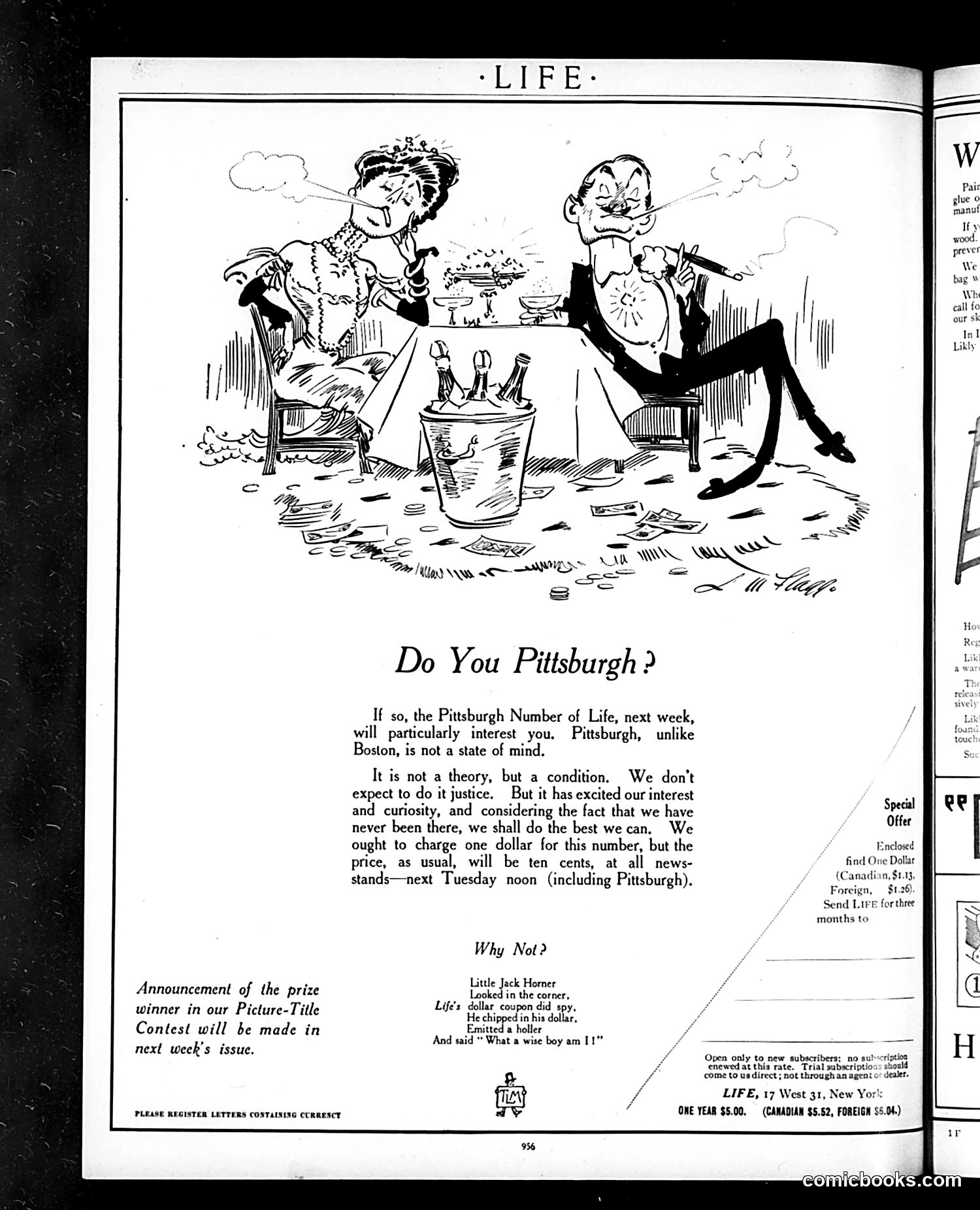
This page promotes an upcoming Pittsburgh edition of *Life* magazine. The cartoon depicts two exaggerated figures at a dining table surrounded by scattered money and champagne bottles—likely representing wealthy industrialists or businessmen, suggesting Pittsburgh's association with steel and industrial wealth. The satire plays on Pittsburgh's reputation: the text states "Pittsburgh, unlike Boston, is not a state of mind. It is not a theory, but a condition." This suggests Pittsburgh is defined by tangible wealth and industry rather than intellectual or cultural pretension. The joke appears to mock both Pittsburgh's nouveau-riche character and the magazine's commercial interest in covering the city's prosperous market. The announcement emphasizes the Pittsburgh issue will cost ten cents—standard price—indicating *Life*'s confidence in reader interest.
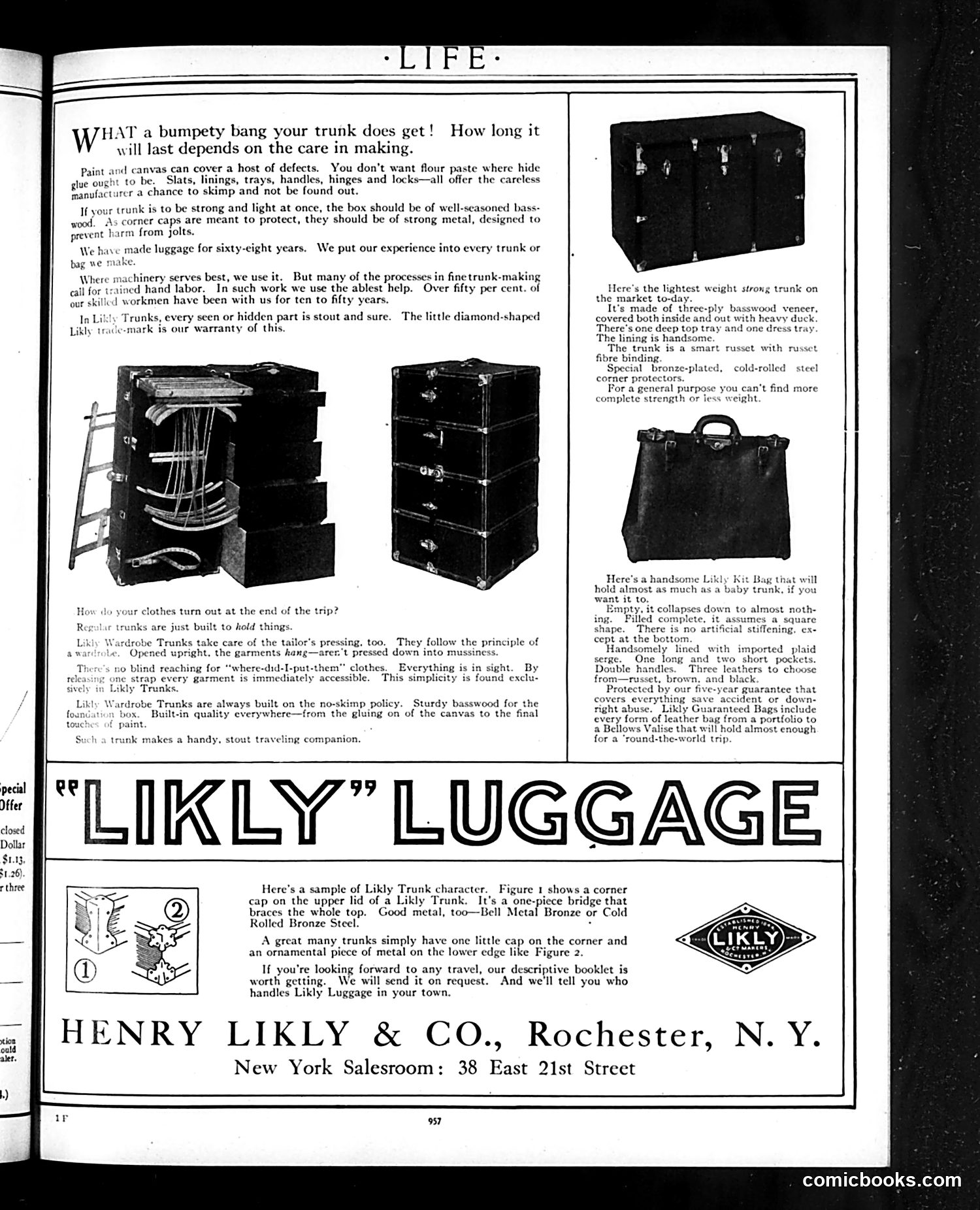
This page is **primarily an advertisement**, not satirical content. It promotes "Likly Luggage" trunks and travel bags manufactured by Henry Likly & Co. of Rochester, New York. The ad emphasizes practical durability for travelers, noting the trunks' strong construction, quality materials, and longevity ("sixty-eight years" of manufacturing experience). It addresses common traveler concerns: protecting clothes, organizing belongings, and ensuring trunks survive rough handling during trips. The visual demonstration shows a wardrobe trunk with hanging space and multiple compartments—a practical innovation for travelers of the era. The "Likly Kit Bag" is also featured as a compact alternative. This represents early 20th-century advertising focused on product reliability and functionality rather than humor or social commentary.
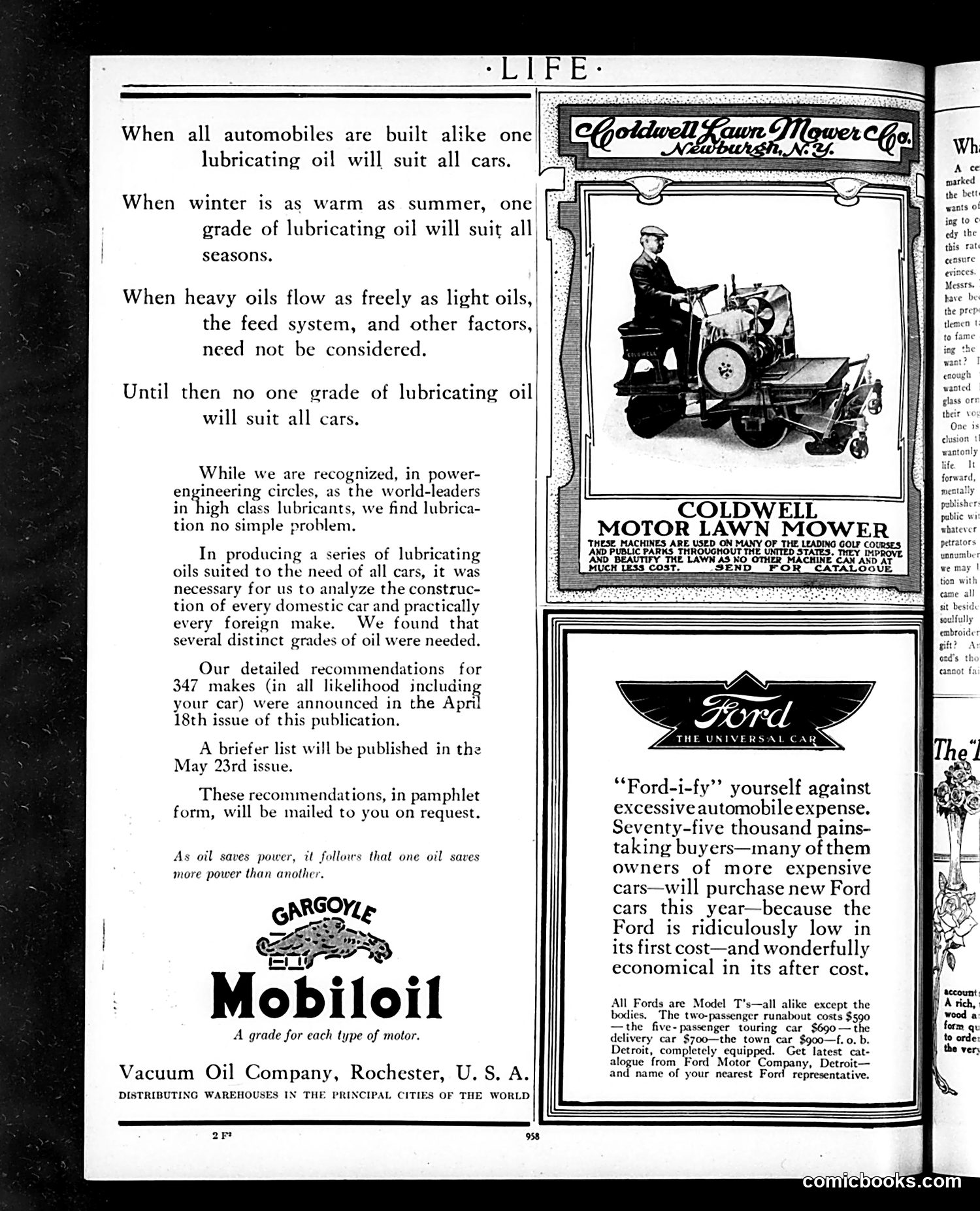
This page contains **no political cartoons or satire**—it's primarily advertising from the 1910s-1920s era. The left side features a **Mobiloil advertisement** (Vacuum Oil Company) discussing lubricating oil grades for different automobiles. The text argues that while various car models exist, no single oil grade suits all vehicles, positioning Mobiloil as offering solutions for different motor types. The right side advertises two products: the **Coldwell Motor Mower** (a motorized lawn mower for golf courses and parks) and the **Ford Model T**, emphasizing its low cost and economical operation compared to more expensive cars. These are straightforward commercial advertisements targeting early automotive consumers, with no satirical or political content.
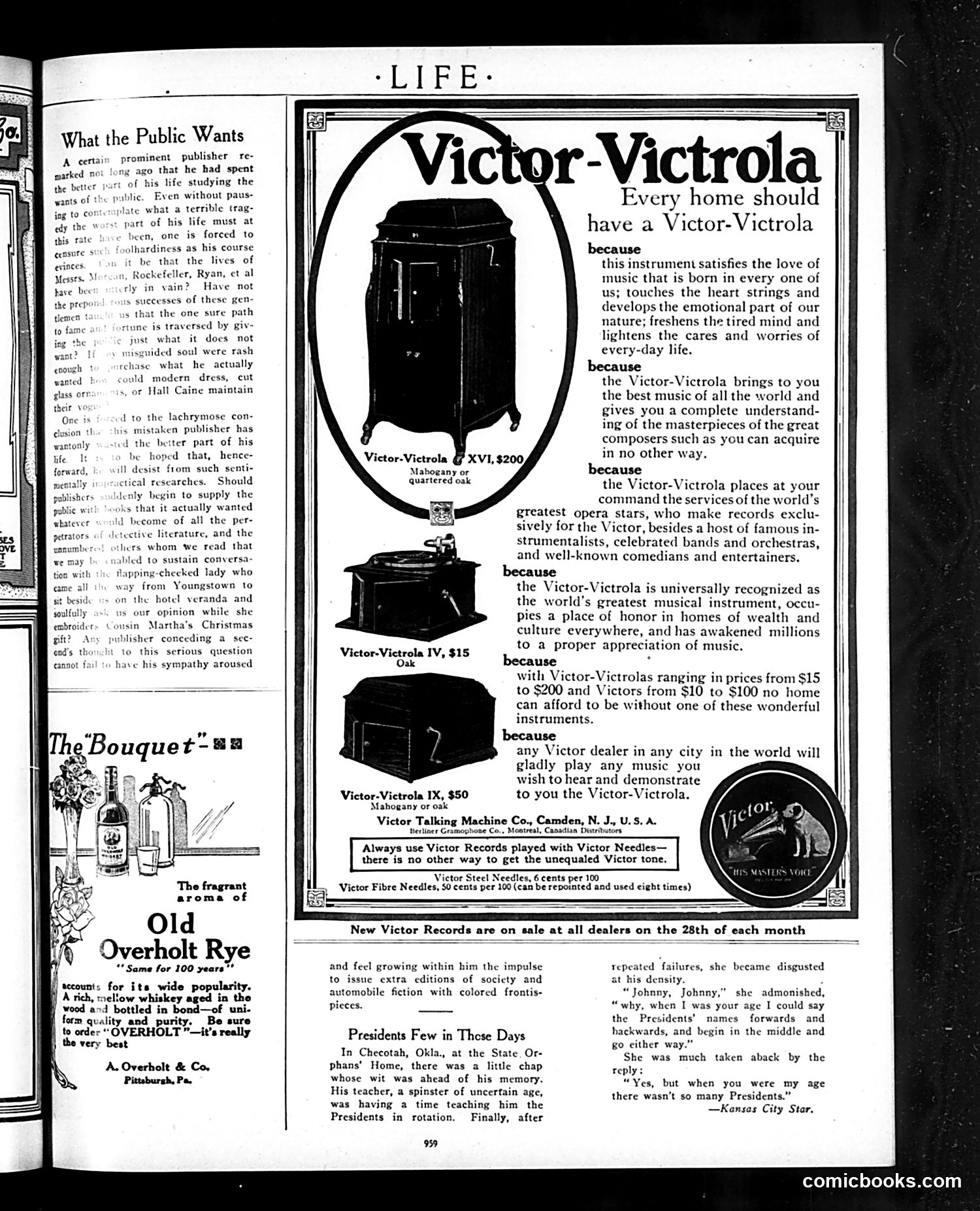
This page is primarily **advertising**, not political satire. The dominant content is a Victor-Victrola phonograph advertisement, occupying roughly two-thirds of the right side with product images and pricing ($15-$200 models). The ad emphasizes the device's cultural prestige and emotional appeal. On the left are two smaller ads: one for "The Bouquet" fragrance (Old Overholt Rye whiskey) and one discussing "What the Public Wants" regarding publishers—though this text appears incomplete/cut off. At bottom right, there's a brief fictional piece titled "Presidents Few in These Days," likely humorous commentary about presidential history. The page represents typical early 20th-century Life magazine format: mixing satirical editorial content with luxury consumer advertising targeted at affluent readers.
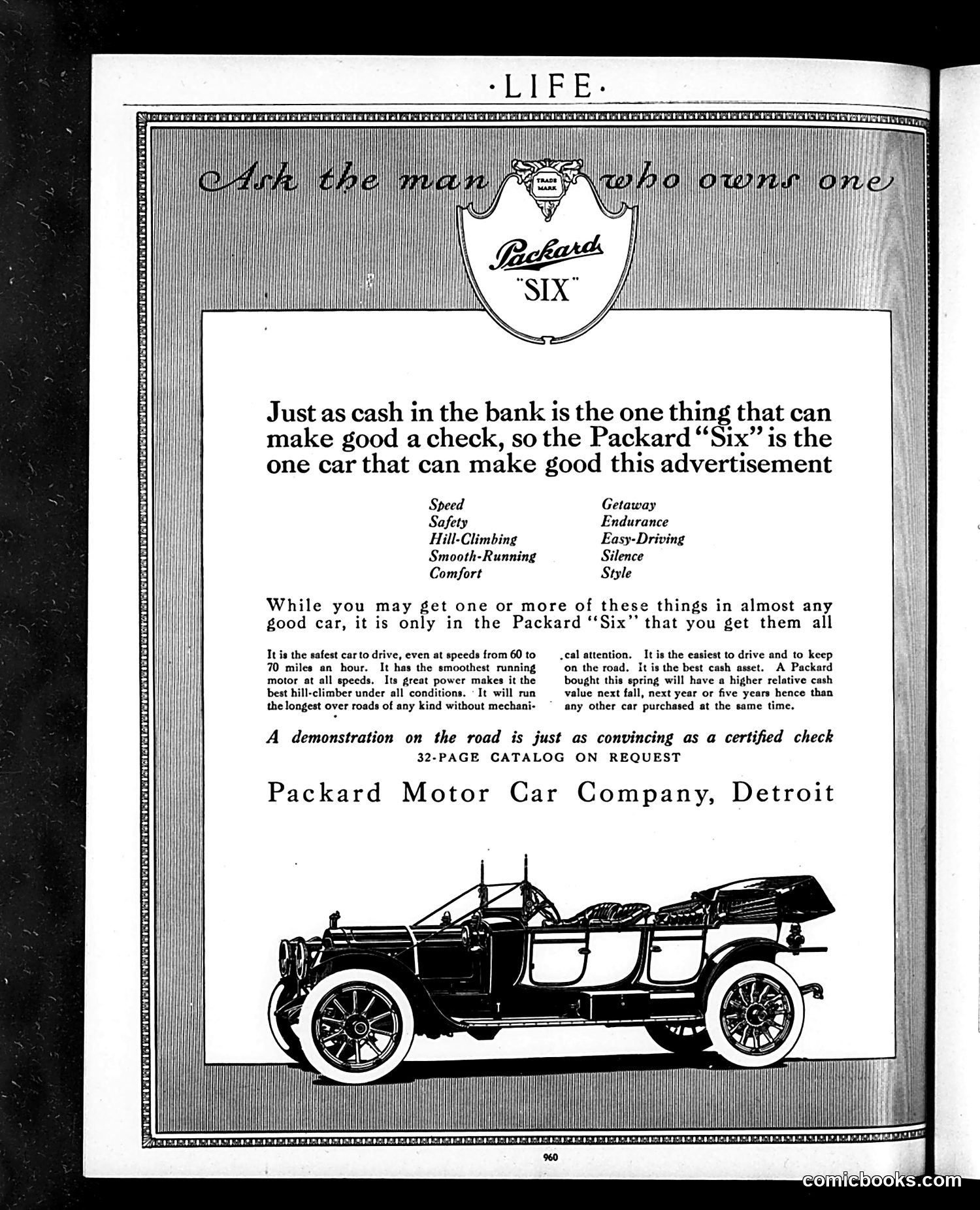
This is a **Packard Motor Car Company advertisement**, not political satire. The page uses a banking metaphor to market the Packard "Six" automobile. The ad's central conceit compares owning a Packard to having "cash in the bank"—implying the car is a reliable financial investment. It lists qualities (Speed, Safety, Hill-Climbing, Smooth-Running, Comfort, Getaway, Endurance, Easy-Driving, Silence, Style) claiming the Packard "Six" uniquely combines all of them, whereas competitors offer only some. The tagline suggests a test drive is "just as convincing as a certified check," continuing the financial trustworthiness metaphor. An illustration shows the car's open touring design. A 32-page catalog is offered on request. This reflects early automotive-era advertising targeting affluent buyers.
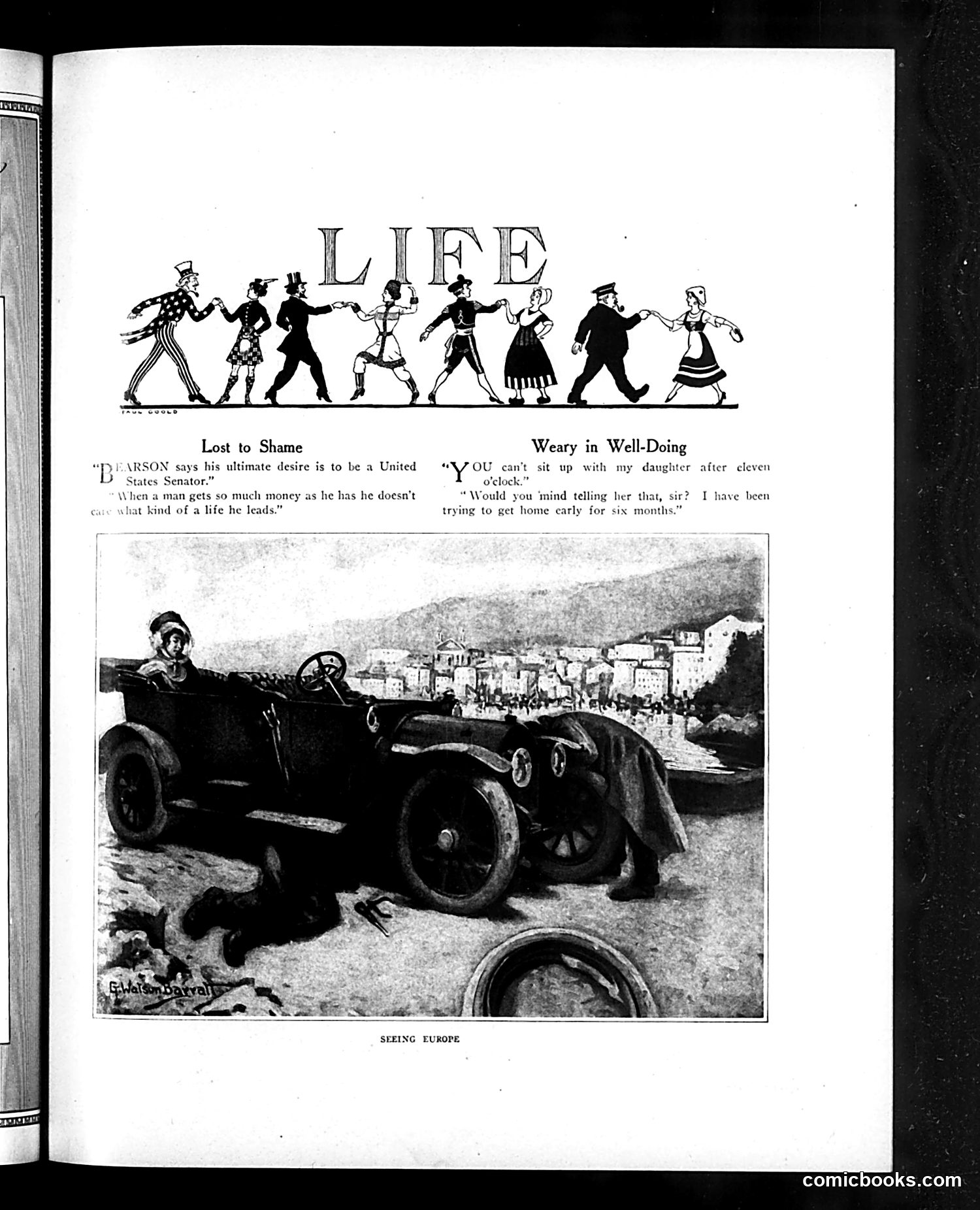
This page from *Life* magazine presents satirical commentary on American social issues through two sections: **Top illustration ("LIFE"):** A parade of figures representing different social types or classes, establishing the page's theme of examining American life. **Two captioned jokes:** - "Lost to Shame": Pearson criticizes a U.S. Senator who spends excessive money without earning proportionally, suggesting his lifestyle contradicts his public position - "Weary in Well-Doing": A domestic complaint about a daughter staying out past eleven o'clock, with the father frustrated after six months of attempting to enforce curfew **Bottom illustration ("SEEING EUROPE"):** Shows a wealthy person in a luxury automobile, touring a European city—likely satirizing American affluence and leisure travel abroad, contrasting with the domestic concerns above. The page collectively mocks wealth disparities, political hypocrisy, and generational conflicts in early 20th-century America.
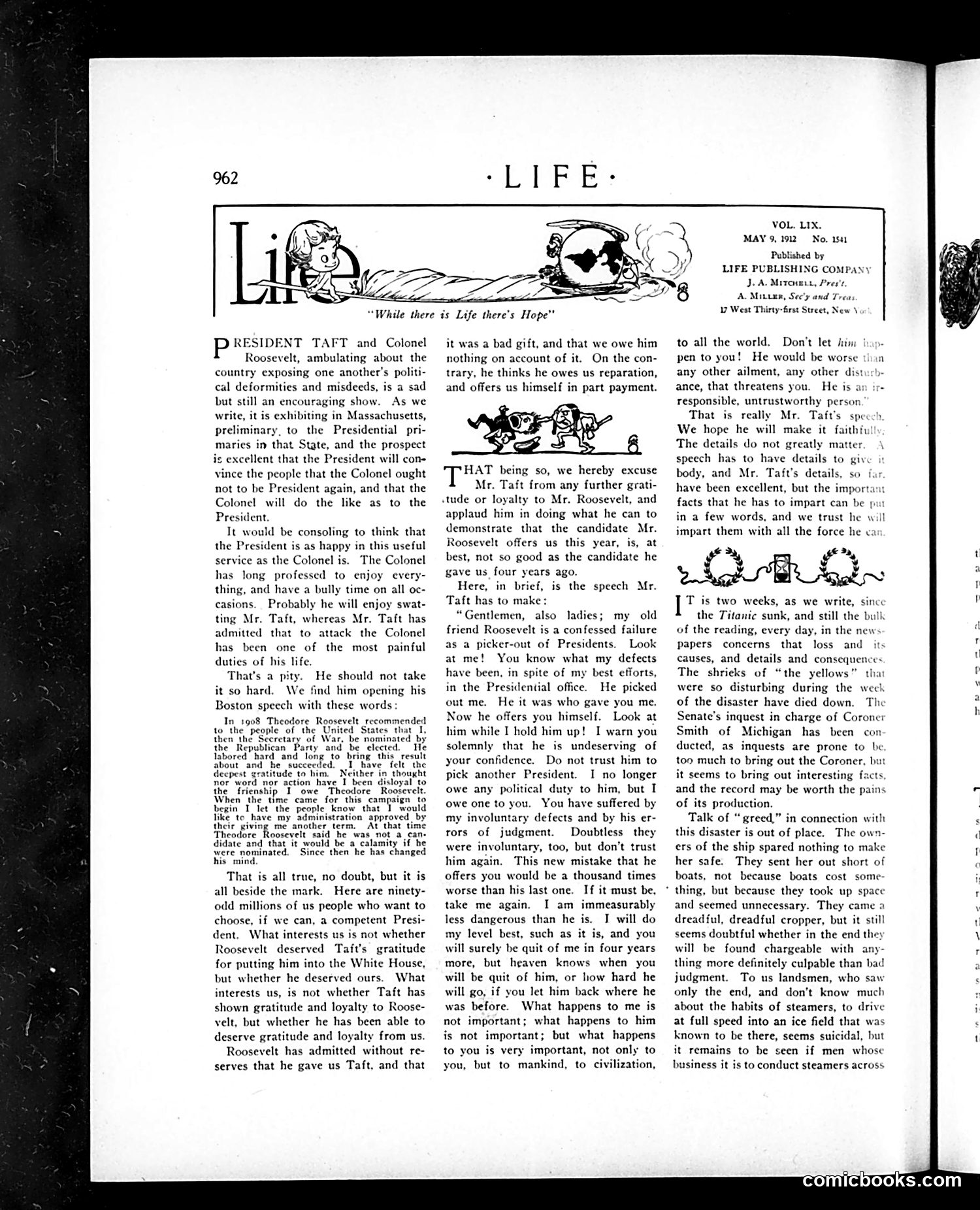
This page discusses President Taft and Colonel Roosevelt's political conflict during the 1912 presidential campaign. The text criticizes Taft's position, asserting he owes Roosevelt gratitude for his presidency but should not receive "further gratitude or loyalty." It presents Roosevelt's candidacy as superior to Taft's, implying Taft was a disappointing successor. The cartoon at top (captioned "While there is Life there's Hope") appears to depict these two political figures in conflict, using Life magazine's characteristic satirical humor. The page also discusses the recent Titanic sinking, connecting maritime disaster management to broader questions about trustworthiness in leadership—a metaphorical link between Taft's competence and ship captains' judgment.
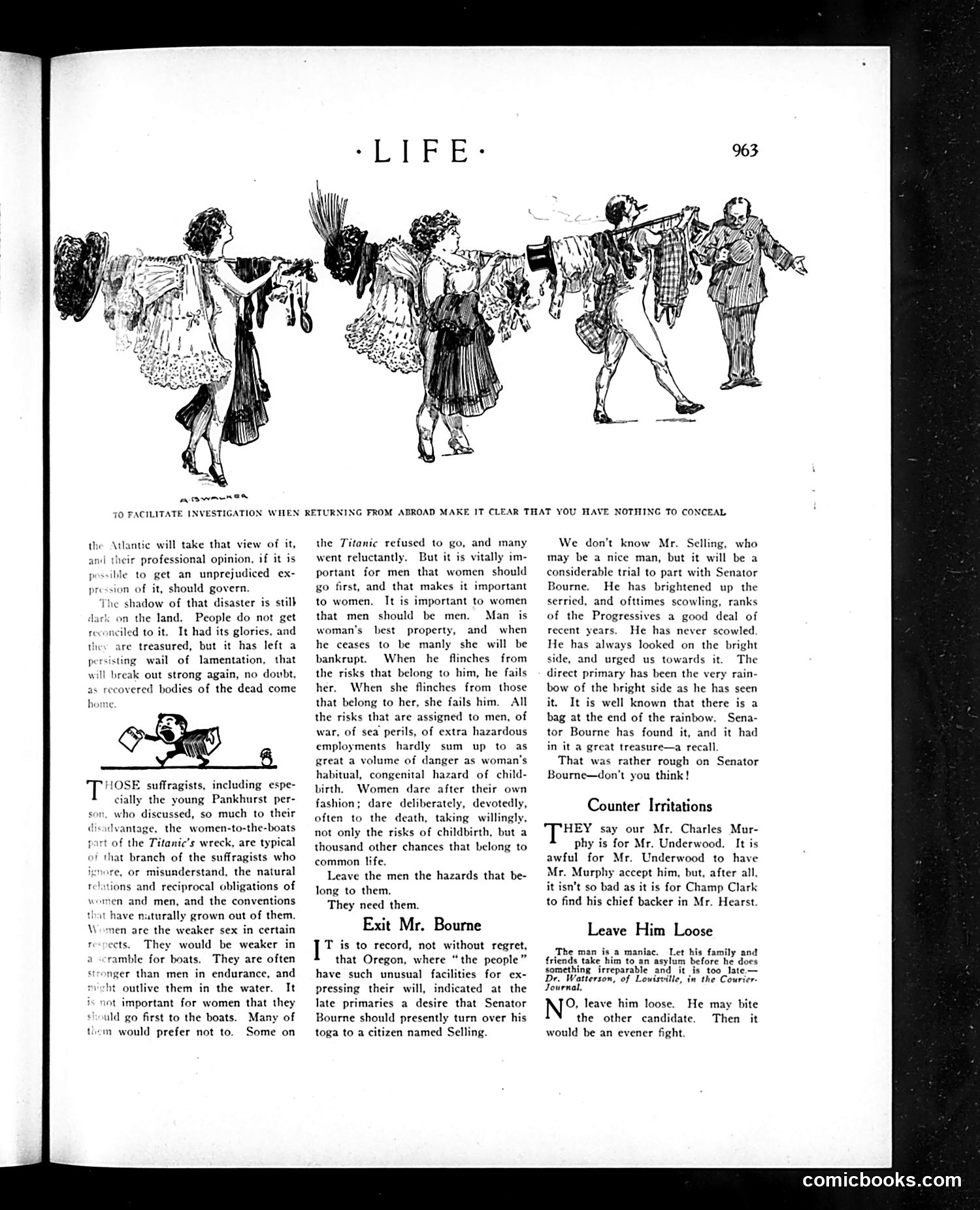
This 1963 *Life* magazine page satirizes early 20th-century gender politics and the Titanic disaster. The cartoon at top shows women returning from abroad displaying their purchases—a visual jab at women as consumers. The main text critiques suffragists and debates proper gender roles following the Titanic wreck. It argues that women should prioritize femininity and domesticity over activism, claiming "women are the weaker sex in certain respects." The piece sarcastically suggests women shouldn't board lifeboats first, contradicting actual Titanic protocol ("women and children first"). The sections "Exit Mr. Bourne" and "Counter Irritations" appear to be brief satirical notes about political figures, though specific identities remain unclear from this excerpt alone.
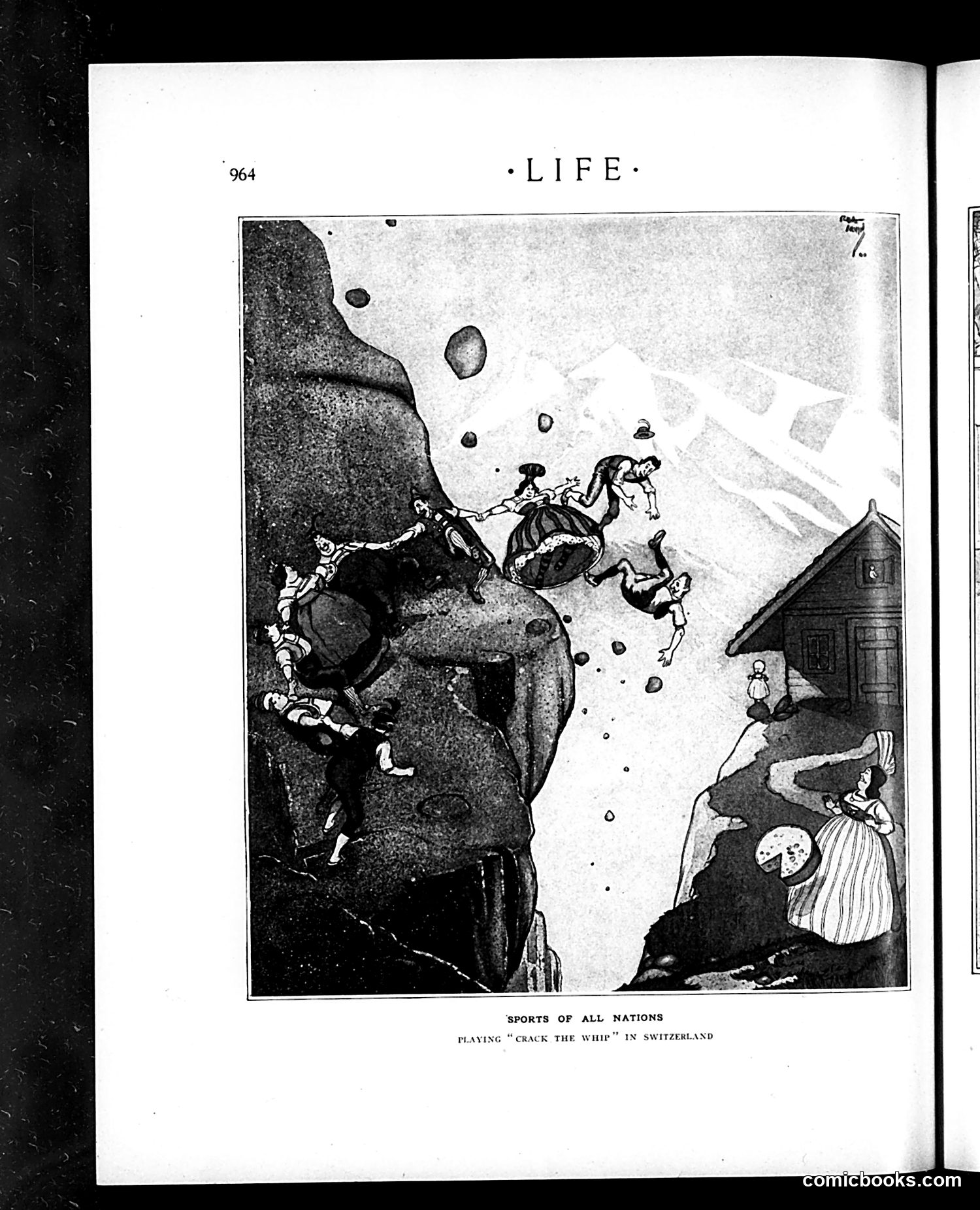
This satirical illustration depicts people playing the children's game "crack the whip" on a snowy Swiss mountainside. The humor appears to derive from contrasting the genteel, peaceful image of Switzerland with the chaotic, violent tumbling of players being whipped around. The figures on the right—appearing to be well-dressed observers or Swiss citizens—watch as the chain of players on the left are violently flung about, some airborne. The joke seems to comment on Switzerland's neutral reputation through ironic juxtaposition: depicting their "sport" as surprisingly rough and undignified. The "Sports of All Nations" framing suggests this was part of a series mocking different countries' pastimes, using exaggeration and visual comedy for satirical effect.
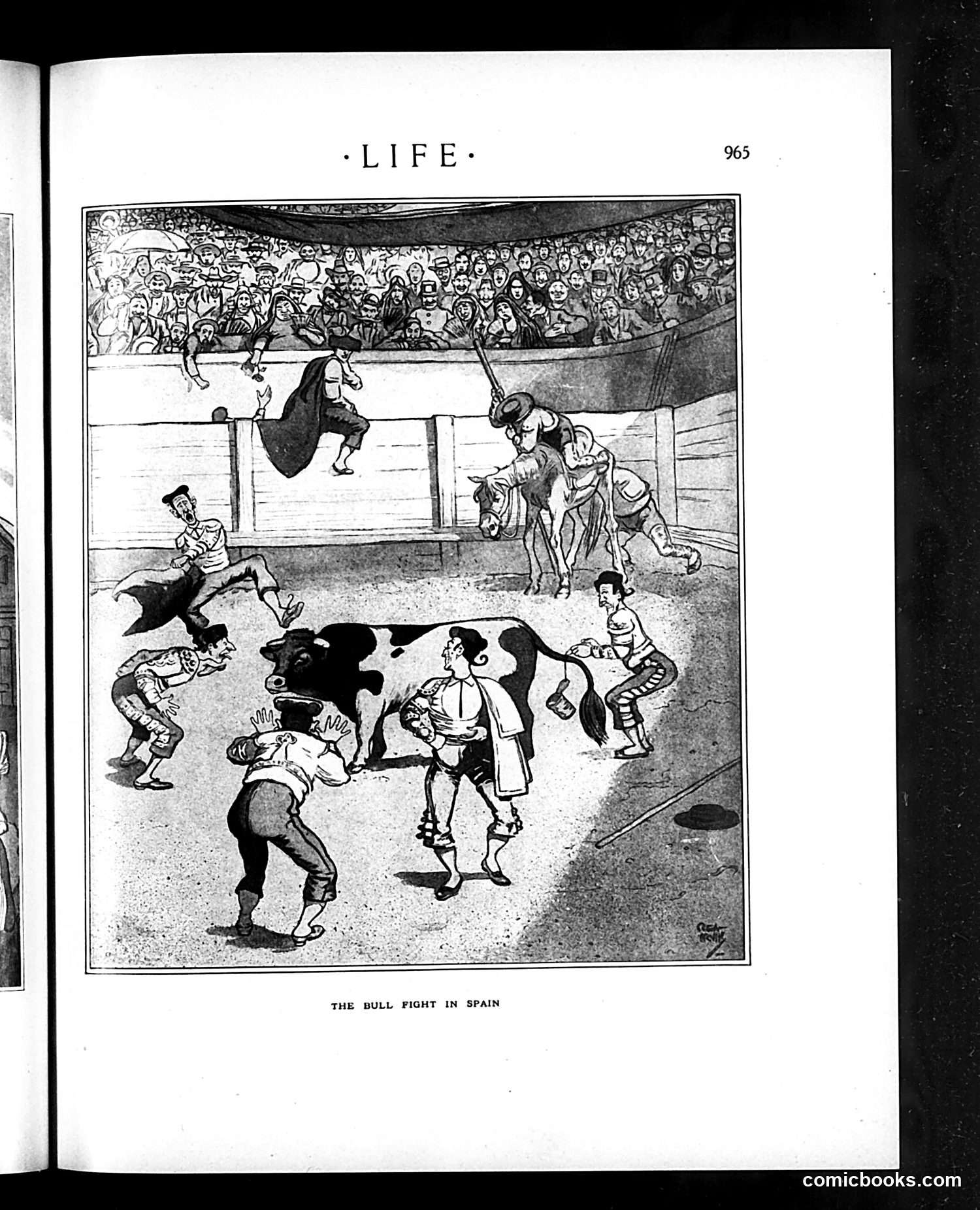
This satirical illustration depicts a bullfighting arena in Spain. The image shows matadors and picadors engaging with a large bull in the center of the ring, while spectators crowd the stands above. The satire appears to target Spanish bullfighting culture itself—a practice many viewed as cruel and barbaric. By depicting the spectacle in dramatic detail with crowds watching intently, the cartoonist likely critiques both the brutality of the sport and the audience's appetite for violence as entertainment. The exaggerated, theatrical style typical of Life magazine's satirical approach emphasizes the sensationalism and pageantry surrounding bullfighting, suggesting the cartoonist viewed it as a barbaric practice dressed up as tradition and spectacle. The specific political or social critique remains unclear without additional context about publication date or contemporary debates.
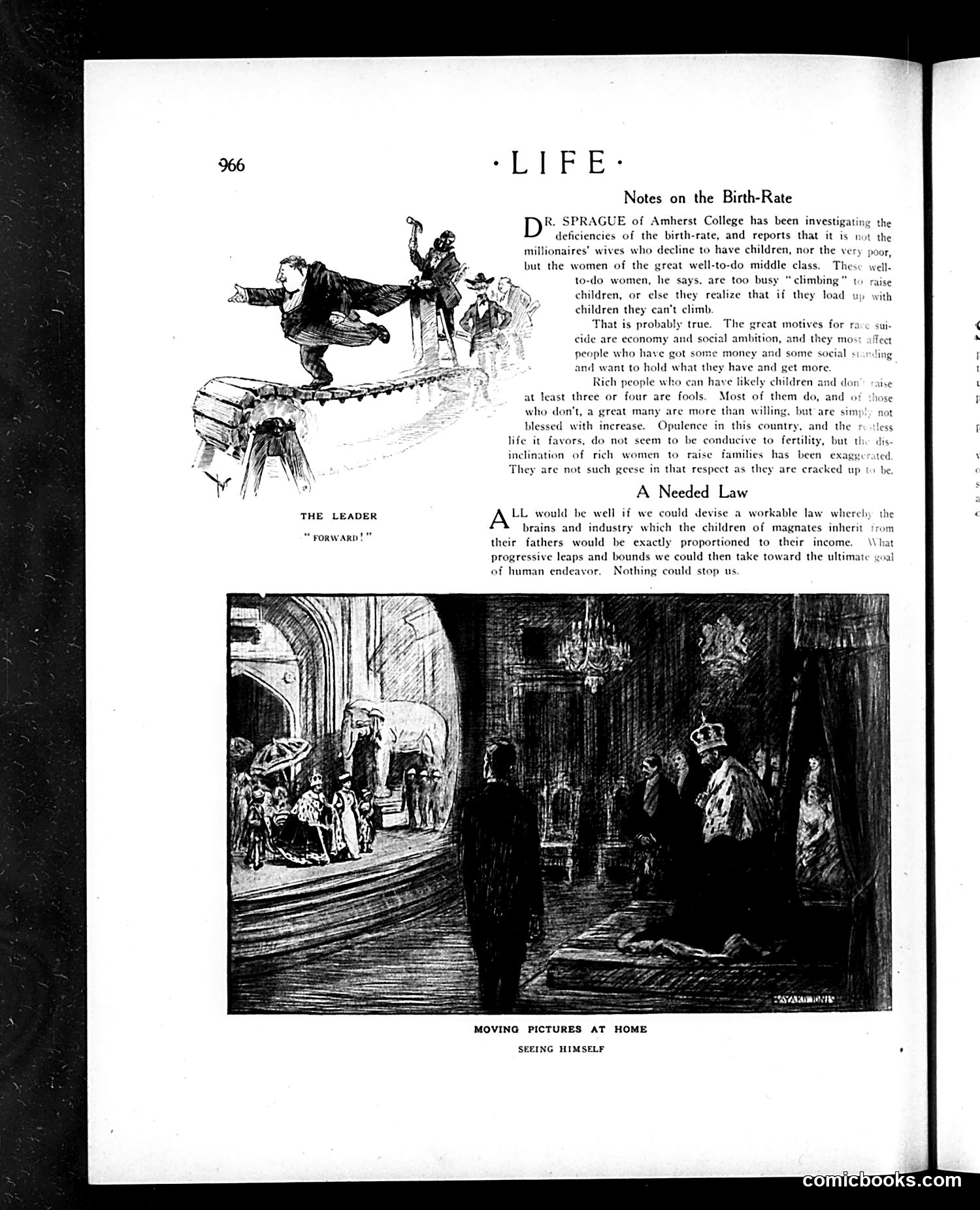
This page contains social commentary on birth rates among different classes. The text discusses Dr. Sprague's investigation into why wealthy women have fewer children than poorer women, attributing this to the burden of child-rearing on women's time and social ambitions. The top cartoon titled "THE LEADER / FORWARD!" depicts a figure leading others—likely satirizing social reformers or politicians advocating for population policies. The bottom illustration, captioned "MOVING PICTURES AT HOME / SEEING HIMSELF," appears to show a domestic scene, likely satirizing how wealthy people view themselves through entertainment or self-reflection. The overall page argues for progressive taxation linking child support to parental income, framing this as necessary social policy. The satire critiques both wealthy women's reluctance to bear children and the broader economic inequalities affecting family formation.
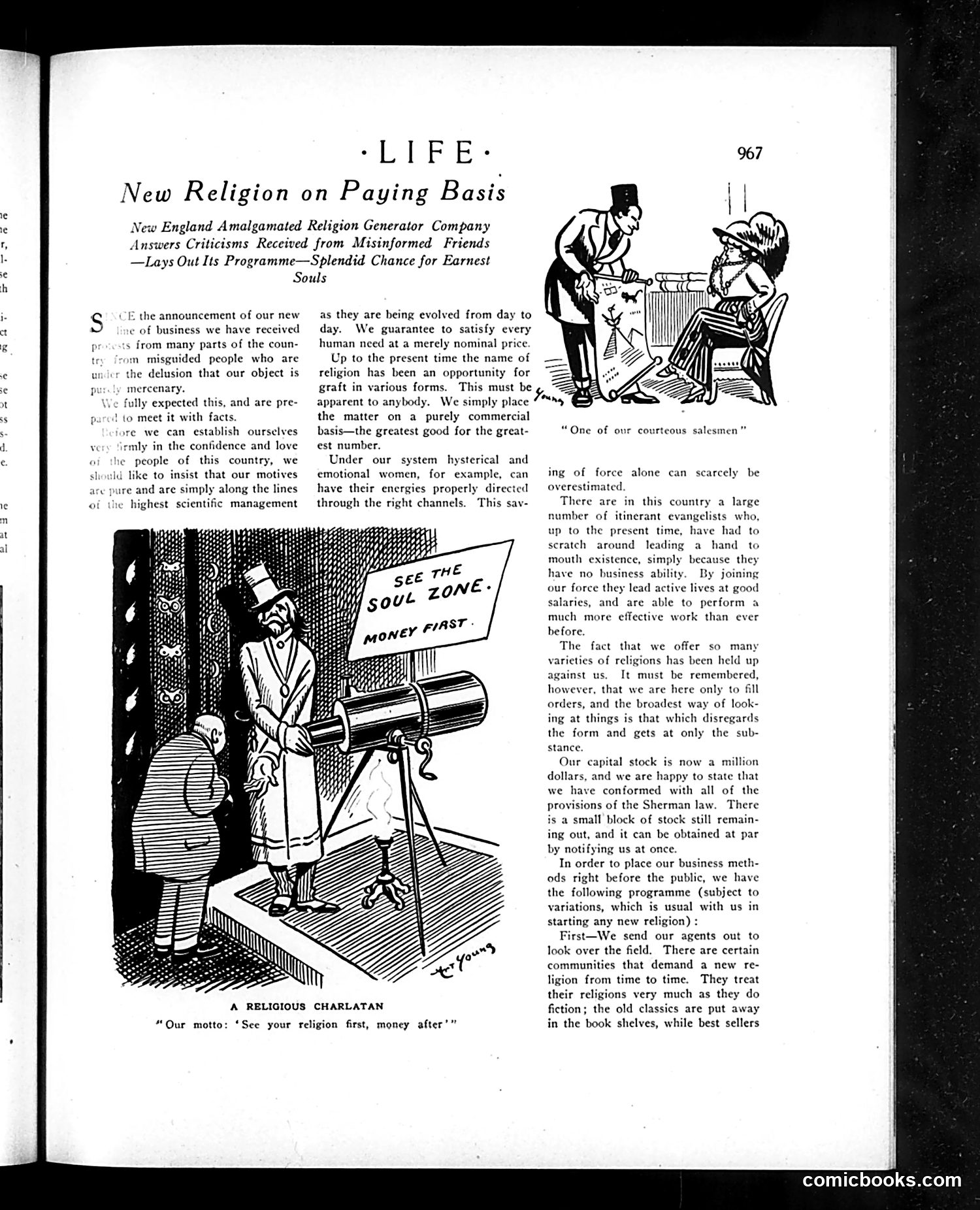
This 1910s *Life* magazine article satirizes the commercialization of American religion and religious evangelism. The fictional "New England Amalgamated Religion Generator Company" mocks how religion had become a business enterprise, with preachers and evangelists treated as salesmen peddling spiritual products. The satire targets several real abuses: 1. **Itinerant evangelists** who made their living traveling and preaching without stable employment or legitimate business practices 2. **Religious variety as commodity**—the company offers multiple "religions" like consumer products, suggesting Americans shopped for faith based on trends rather than conviction 3. **"Scientific management" applied to spirituality**—treating emotional, spiritual needs as efficiency problems to be solved commercially 4. **Sherman Law compliance**—sardonic reference suggesting even this fraudulent "religion corporation" follows antitrust law while exploiting people The cartoons show a charlatan pitchman and a "courteous salesman" using high-pressure sales tactics. The critique: organized religion had become indistinguishable from any other commercial enterprise, prioritizing profit and growth over genuine spiritual concern.
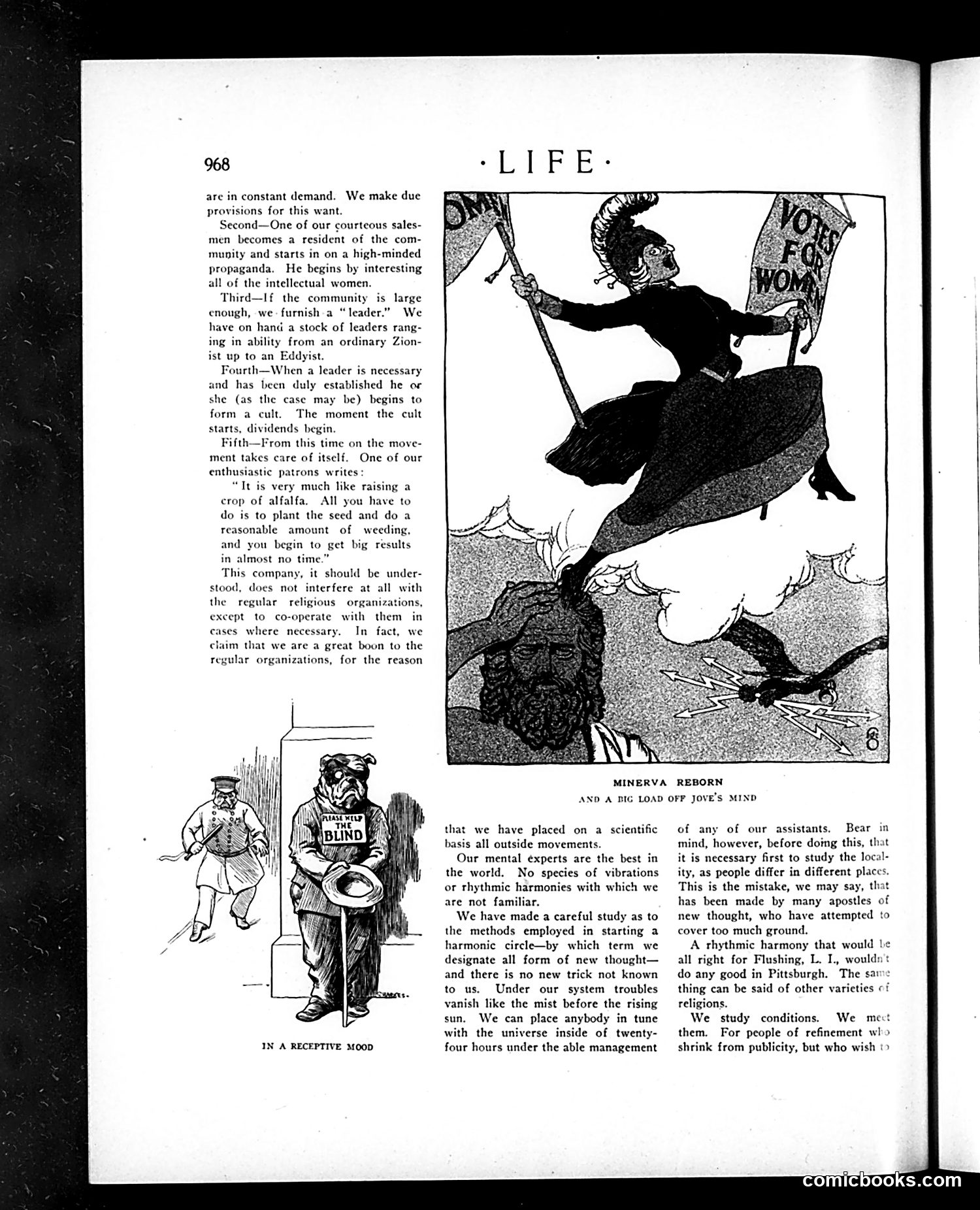
This satirical piece mocks new religious and spiritual movements of the early 20th century—particularly "New Thought," Christian Science (referenced as "Eddyism"), and Zionism. The text describes a cynical formula for manufacturing cults: recruit salesmen to propagandize to "intellectual women," install a charismatic "leader," and watch profits flow. The cartoons reinforce the satire. "In a Receptive Mood" shows a gullible man reading propaganda. "Minerva Reborn and a Big Load off Jove's Mind" depicts a woman riding astride with a "Votes for Women" banner—linking suffrage movements to the broader critique of new thought movements attracting women. The satirist argues these movements are business schemes exploiting people's spiritual seeking, cynically adapting their pitch to local demographics ("wouldn't work in Pittsburgh"). The humor targets both the movements' emptiness and their appeal to women seeking intellectual engagement outside traditional religion.
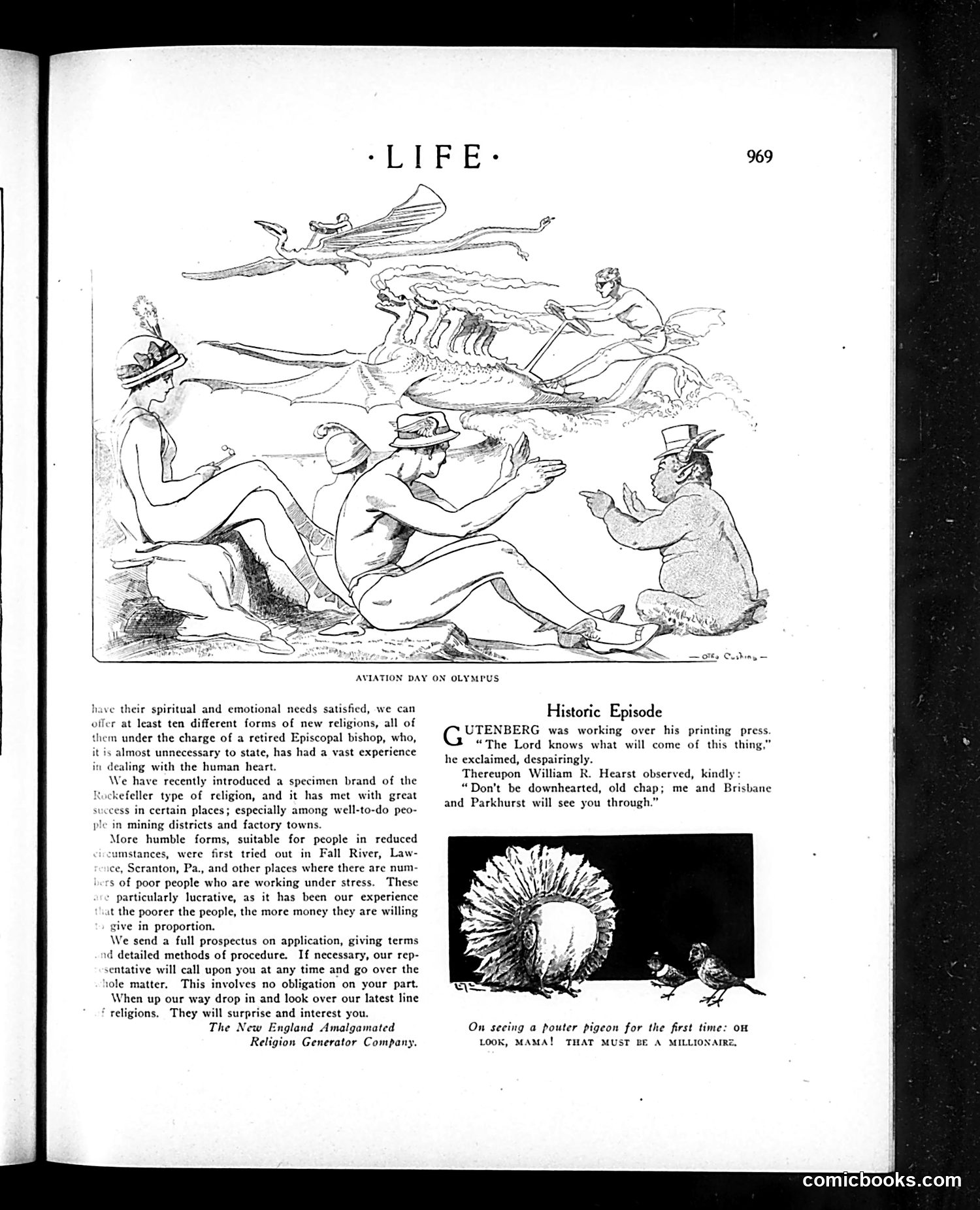
**Top cartoon ("Aviation Day on Olympus"):** Depicts wealthy figures on a beach watching early aircraft. The satire mocks the commercialization of religion through the accompanying text advertising the "New England Amalgated Religion Generator Company"—a fake firm "selling" religion like a product. It specifically targets Rockefeller-style "philanthropic religion" and exposes how churches deliberately target poor workers in mining and factory towns, noting these communities are "particularly lucrative" because desperate poor people give more generously. The satire attacks both corporate hypocrisy and religious manipulation of the working class. **Bottom ("Historic Episode"):** References Gutenberg (printing press inventor) meeting newspaper magnate William Randolph Hearst and his associate Brisbane, plus reformer Parkhurst—suggesting these media figures will "help" Gutenberg's invention succeed. The joke implies Hearst's sensationalist journalism represents the dubious legacy of the printing press. **Pouter pigeon joke:** Visual pun—the bird's inflated appearance resembles a wealthy, self-important millionaire.
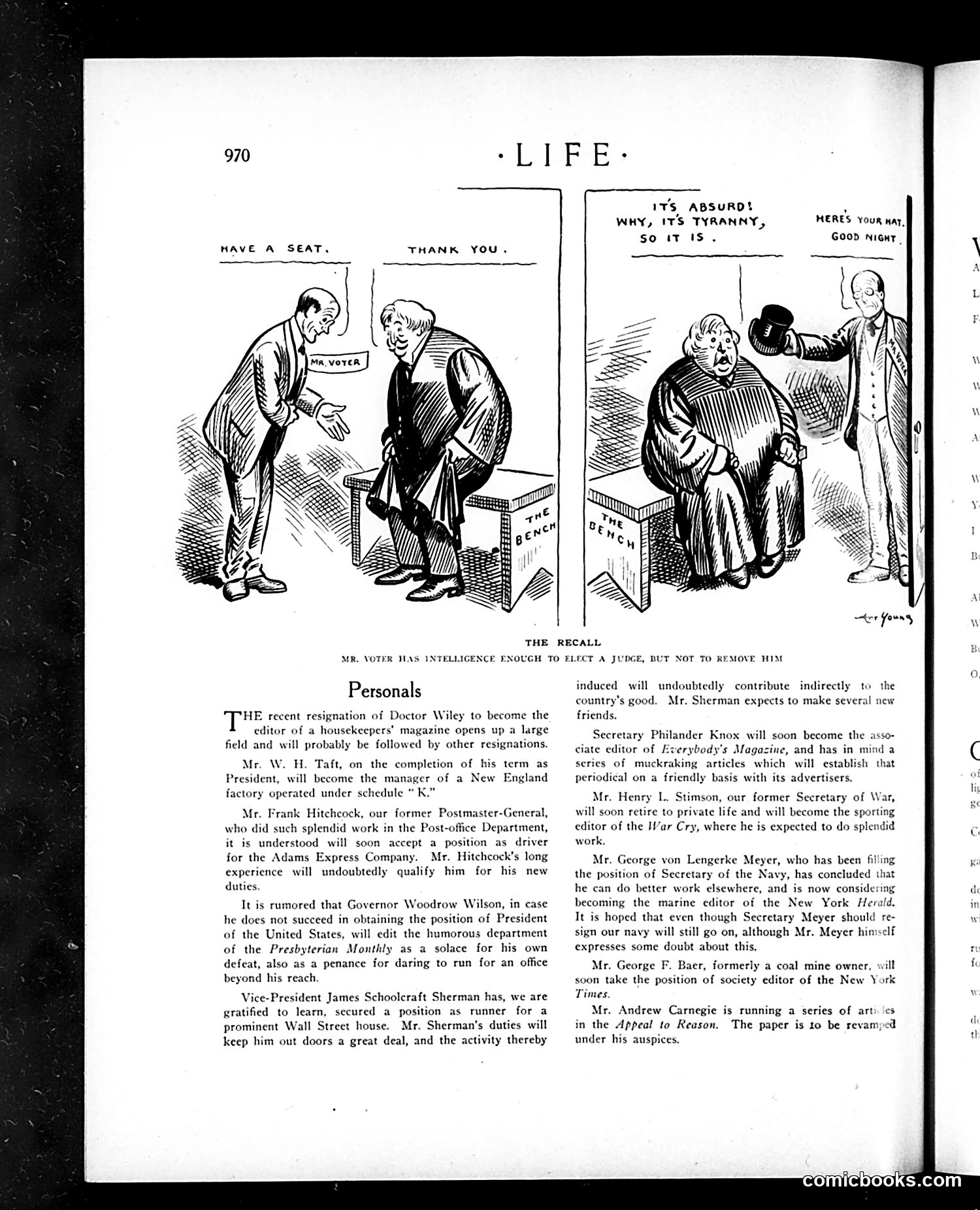
This cartoon satirizes the progressive-era "recall" movement—a reform allowing voters to remove elected officials before their term ended. The caption's point is caustic: voters supposedly have enough judgment to *elect* judges but not enough to *remove* them—a logical absurdity the cartoon highlights through contrasting scenes. The left panel shows "Mr. Voter" deferentially accepting a seat, thanking an official. The right panel reverses this: the same voter sits while being told "it's absurd! Why, it's tyranny, so it is"—mocking the arguments opponents made against recall provisions. The cartoon suggests such objections were hypocritical: if citizens are trusted to choose judges initially, denying them removal power is indeed arbitrary. The "Personals" section below uses satirical mock-promotions of real Taft administration officials, imagining their supposed post-office employment in comically unsuitable roles—a separate but contemporary jab at political figures.
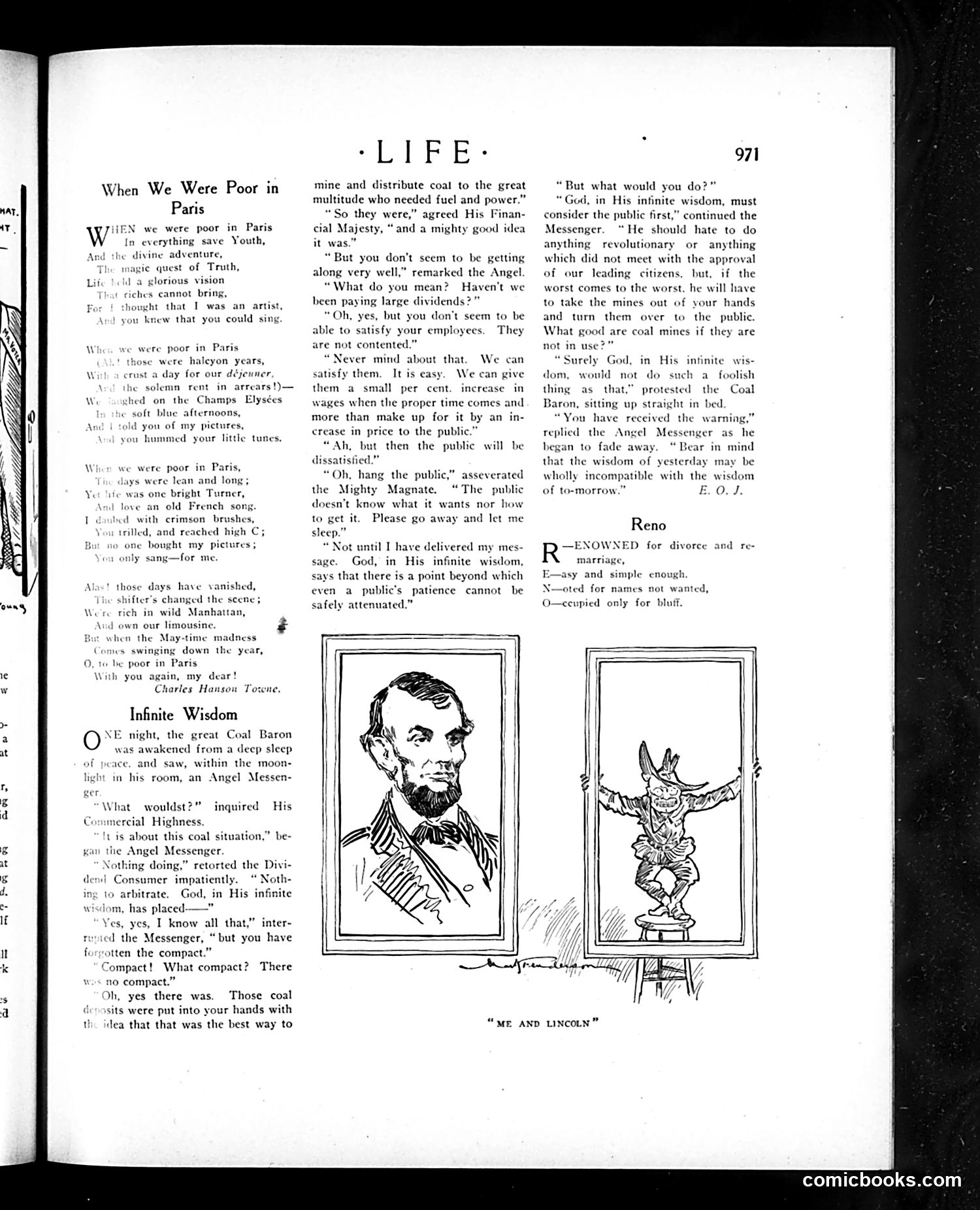
This page contains two distinct pieces of satire: **"When We Were Poor in Paris"** is a nostalgic poem by Charles Hanson Towne contrasting romantic poverty in Paris with wealthy but empty modern life in Manhattan—a commentary on lost artistic authenticity amid material success. **"Infinite Wisdom"** is the primary satire. It depicts a Coal Baron being visited by an Angel Messenger who warns him that God demands he treat coal workers and the public fairly. The Baron dismissively refuses, prioritizing profits over workers' wages and public welfare. The Angel threatens divine intervention—God will seize the coal mines if the Baron doesn't reform. This satirizes early 20th-century industrialists' arrogant disregard for labor rights and public needs during labor unrest and coal strikes. **"Me and Lincoln"** shows two illustrations labeled as such—likely contrasting the Coal Baron's portrait with Lincoln's, implying the Baron lacks Lincoln's moral character or leadership. The overall page critiques wealthy industrialists' callousness toward workers and consumers during this era of significant labor conflict.
This is a satirical essay by J.B. Kerfoot critiquing how modern commercial publishing has transformed the relationship between artists and inspiration. Kerfoot argues that in classical tradition, poets were subservient to their Muses—waiting obediently for divine inspiration. Today's popular novelists, however, have inverted this hierarchy. Economic pressure to produce bestsellers has forced writers to treat their Muse as an employee—a stenographer who generates ideas on demand, which the author then approves or rejects. The writer now "discharges her if she fails to make good on the job." The essay uses Robert W. Chambers as a contemporary example of an author who maintains such a "thoroughly competent and very wide-awake" Muse. The satire critiques how commercialism has reduced artistic inspiration from sacred mystery to factory-floor efficiency, with the writer as boss managing subordinate creativity.
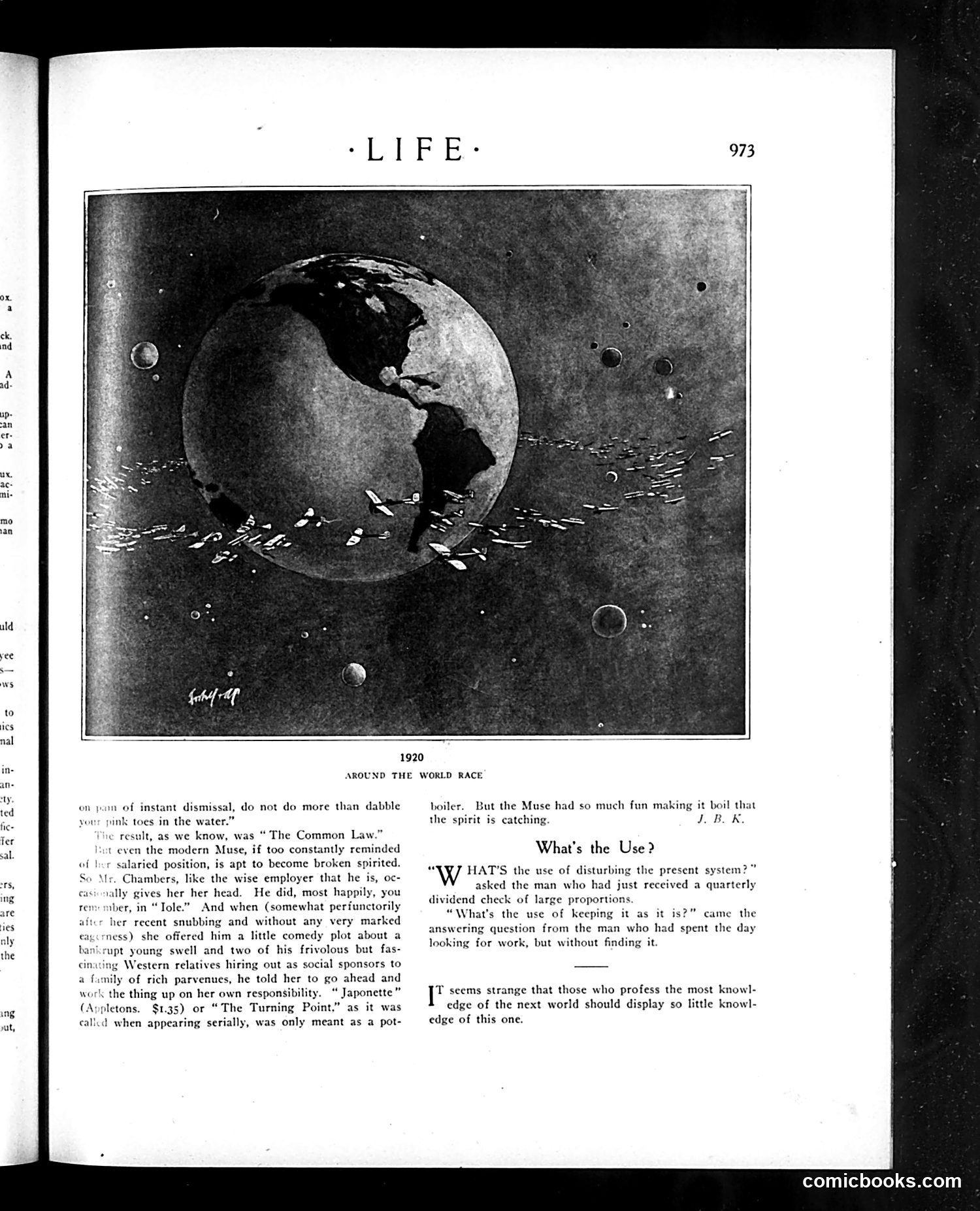
This illustration depicts Earth surrounded by celestial bodies (planets or moons), with ships or vessels circling the globe—visualizing an "around the world race," likely referencing early 20th-century aviation or maritime competitive expeditions that captured public imagination. The accompanying text discusses a Muse (artistic inspiration) and Mr. Chambers's management of creative work, praising his decision to let her develop a comedy plot ("Japonette") independently rather than micromanaging her. It's a light editorial on creative freedom in commercial publishing. Below, "What's the Use?" presents a satirical dialogue contrasting two men: one wealthy, complacently accepting the existing economic system after receiving dividend income, and another poor, questioning why maintain a system that leaves him unemployed. The satire critiques privilege's blindness to systemic inequality—those benefiting from the status quo see no need for change, while those suffering question everything.
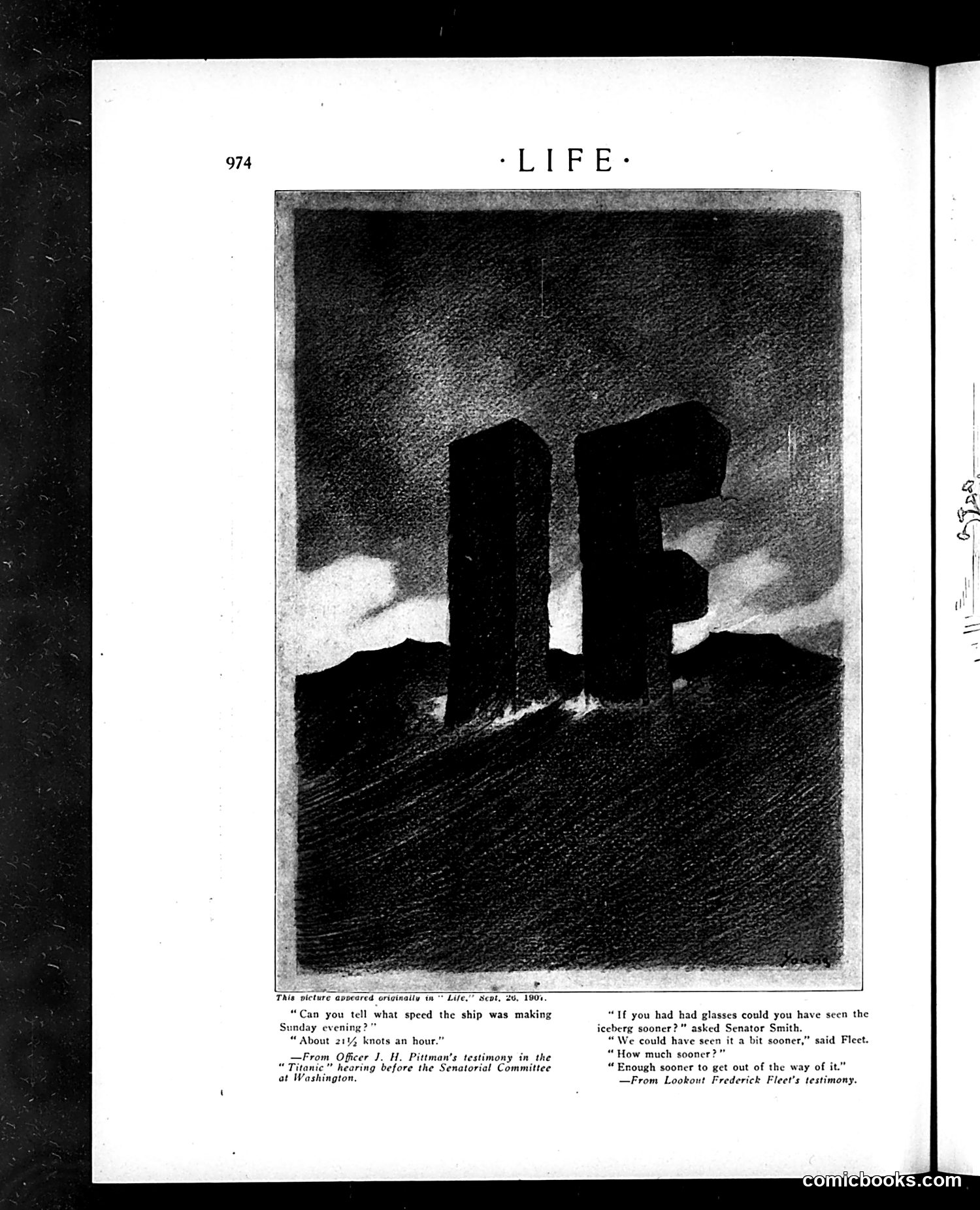
This **Life magazine page** satirizes the Titanic congressional hearings (1912) through a stark illustration of two ship smokestacks silhouetted against a dramatic sky—evoking the ship's final moments. The quoted testimonies mock the inadequate explanations offered by ship officers and lookouts. Officer Pittman claims the ship traveled at 21.5 knots Sunday evening, while lookout Frederick Fleet admits they could have spotted the iceberg "sooner" if he'd had glasses—yet gives no specific timeline. The satire's bite: these vague, evasive answers from maritime professionals highlight how unprepared the ship was for disaster and how the hearings failed to extract accountability. The haunting image of the sinking funnels underscores the tragedy these hollow testimonies were meant to explain, contrasting the men's bureaucratic non-answers with the human cost of their negligence.
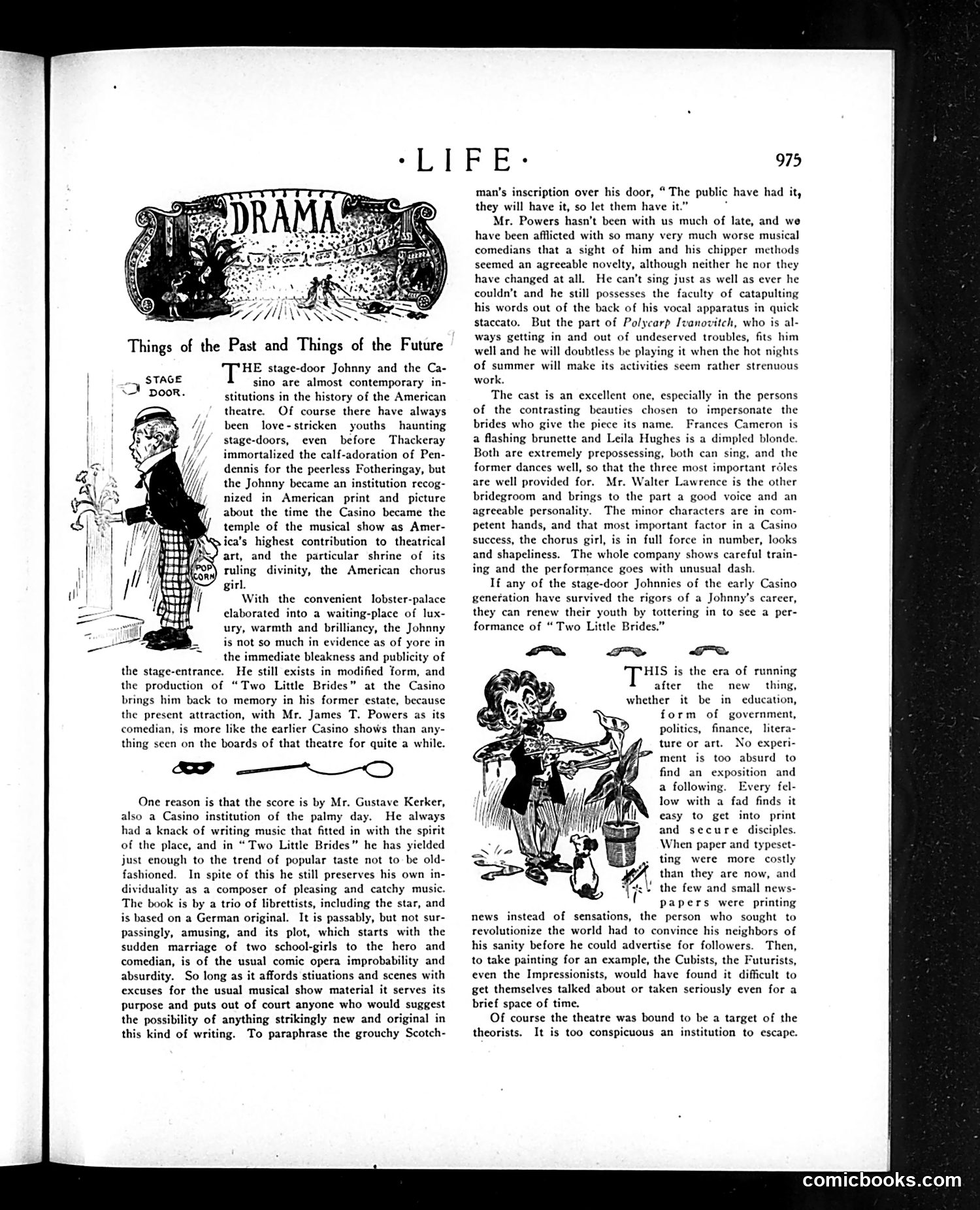
This page reviews the Broadway musical comedy "Two Little Brides" at the Casino Theatre, starring James T. Powers. The "Stage Door" illustration shows a stereotypical "stage-door Johnny"—a wealthy, lovestruck man who frequented theater stage entrances hoping to court chorus girls, a recognizable figure in late 19th-century American popular culture. The review nostalgia contrasts the current production with earlier Casino shows, noting Powers' unchanged comedic style (singing poorly but delivering jokes rapidly in "staccato"). The critic praises the female leads' looks and abilities, particularly praising the chorus girls—the Casino's "ruling divinity"—reflecting period attitudes valuing female performers' appearance alongside talent. The concluding cynicism—adapting a Scottish saying that audiences want familiar entertainment, not innovation—captures the critic's resigned acceptance that commercial theater prioritizes repetition over originality.
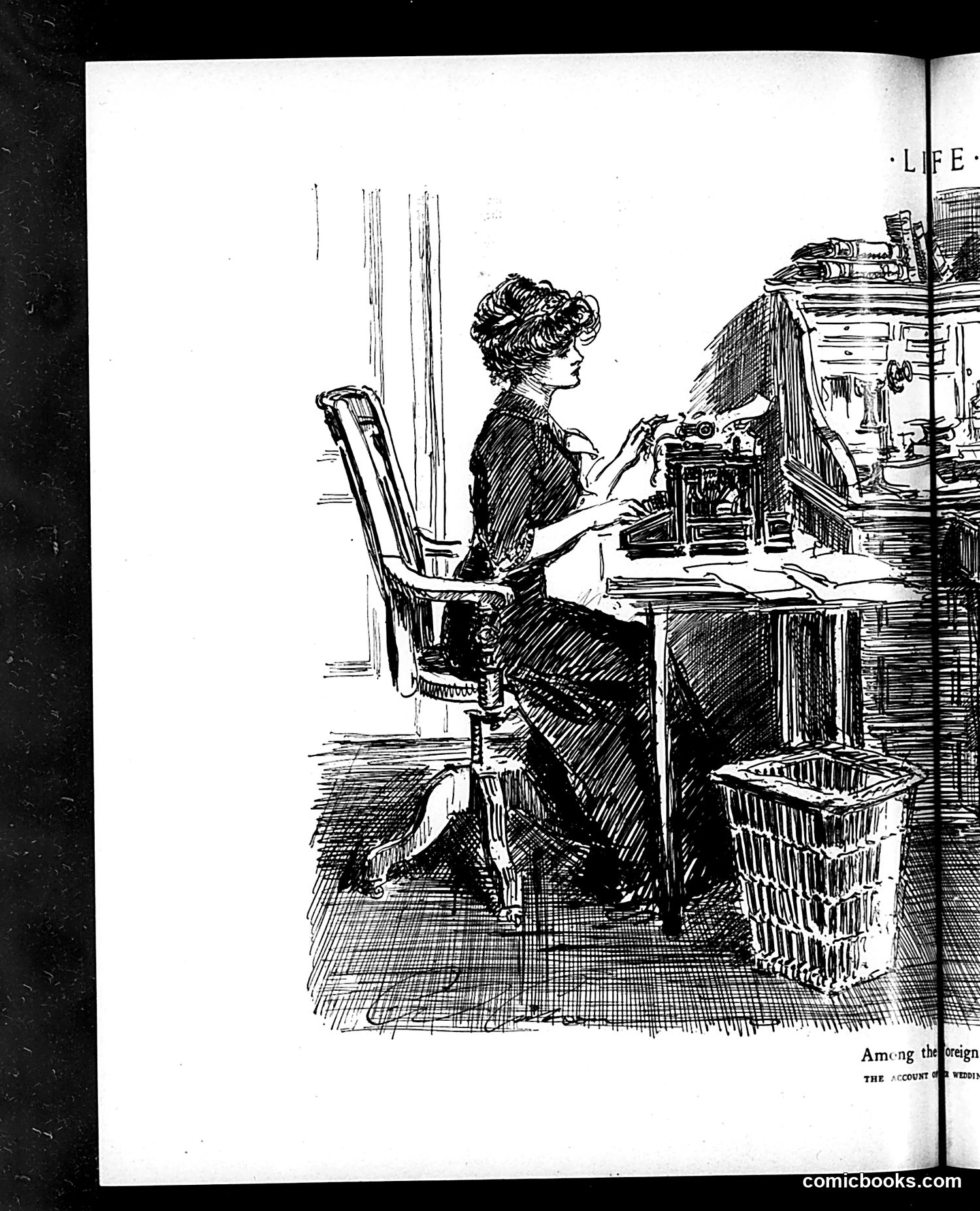
This pen-and-ink illustration depicts a woman seated at a desk with a typewriter, surrounded by office supplies and filing materials. She appears to be a secretary or administrative worker, dressed in early 20th-century business attire. The partial text "Among the foreign" and caption fragment suggest this is likely satirizing women's entry into white-collar office work—a significant social shift of that era. The cartoon probably comments on the novelty or changing gender dynamics of professional employment, a common subject for *Life* magazine's social satire. However, without the complete caption or fuller context, the specific satirical point remains unclear. The image could be celebrating women's professional advancement or mocking it, depending on the missing text.
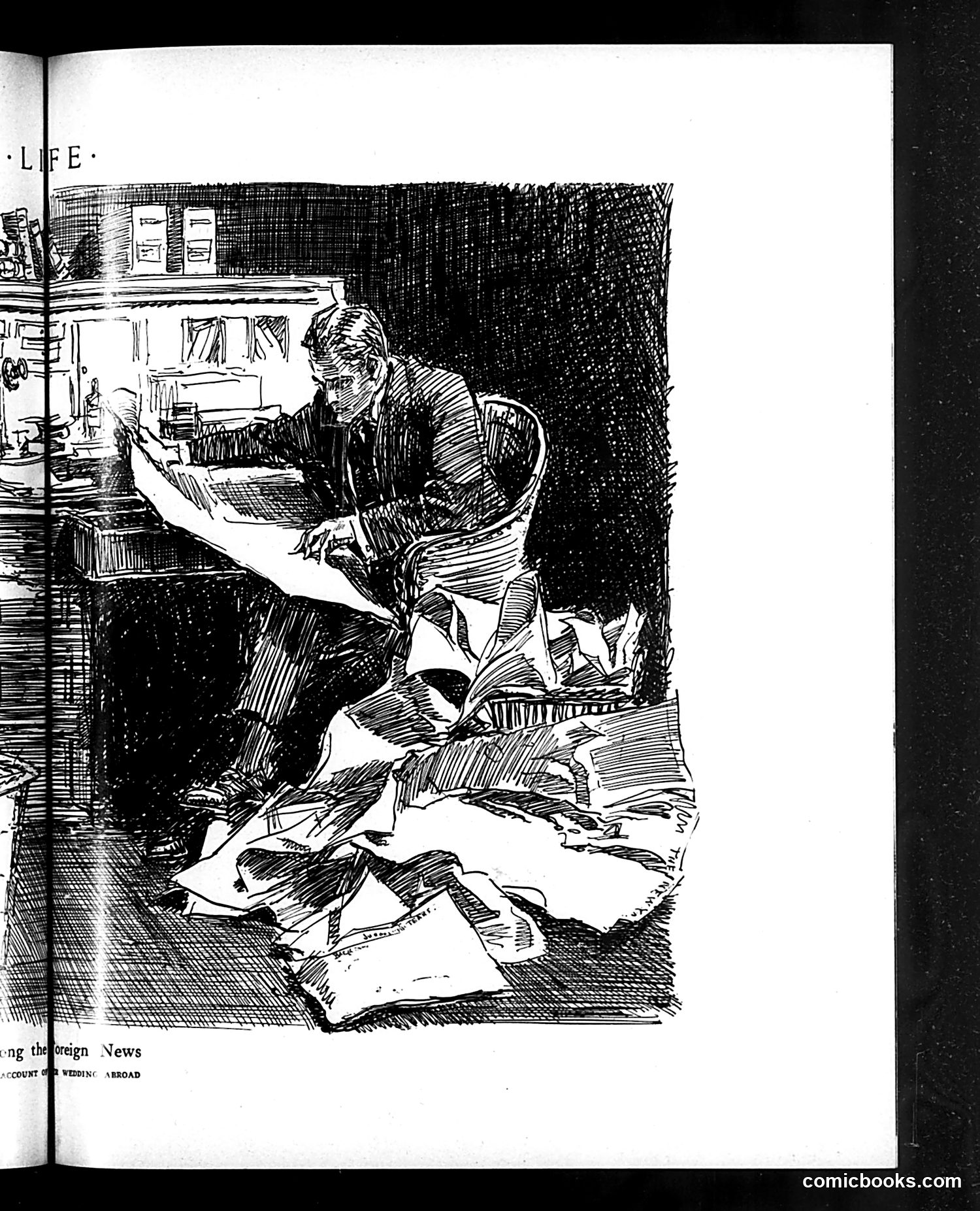
This appears to be a page from *Life* magazine's "Foreign News" section. The illustration shows a man in formal attire sitting at a desk, reviewing or sorting through numerous papers and documents scattered across the floor around him. The cartoon likely satirizes a political or diplomatic figure overwhelmed by international correspondence, reports, or bureaucratic paperwork related to foreign affairs. The pile of documents suggests chaos, excessive workload, or perhaps criticism of how foreign policy matters are being handled. However, the OCR text is too fragmentary to identify the specific figure being caricatured or the exact historical event referenced. Without a visible date or more legible caption, I cannot definitively explain which foreign news situation or political figure this targets.
This page contains theater criticism without cartoons. The main article debates stage design philosophy between theatrical innovators Gordon Craig and Walter P. Eaton versus traditional practitioners. **The Satire:** Life mocks Craig and Eaton's avant-garde theory that audiences should imagine scenery rather than see realistic sets. The critic argues this logic taken to extremes would eliminate actors, costumes, and even theater buildings themselves—reducing theater to "a man in a corner being his own theatre." **The Point:** Life defends balanced theatrical realism, arguing that while elaborate production shouldn't sacrifice artistry, completely bare stages don't enhance imagination—they undermine it. The piece uses reductio ad absurdum, extending Craig's minimalist philosophy to absurd conclusions to expose its flaws. The secondary item briefly reviews a visiting French opera company, noting their productions seemed shabby compared to Metropolitan Opera standards, though they offered atmospheric qualities in works like "Manon."
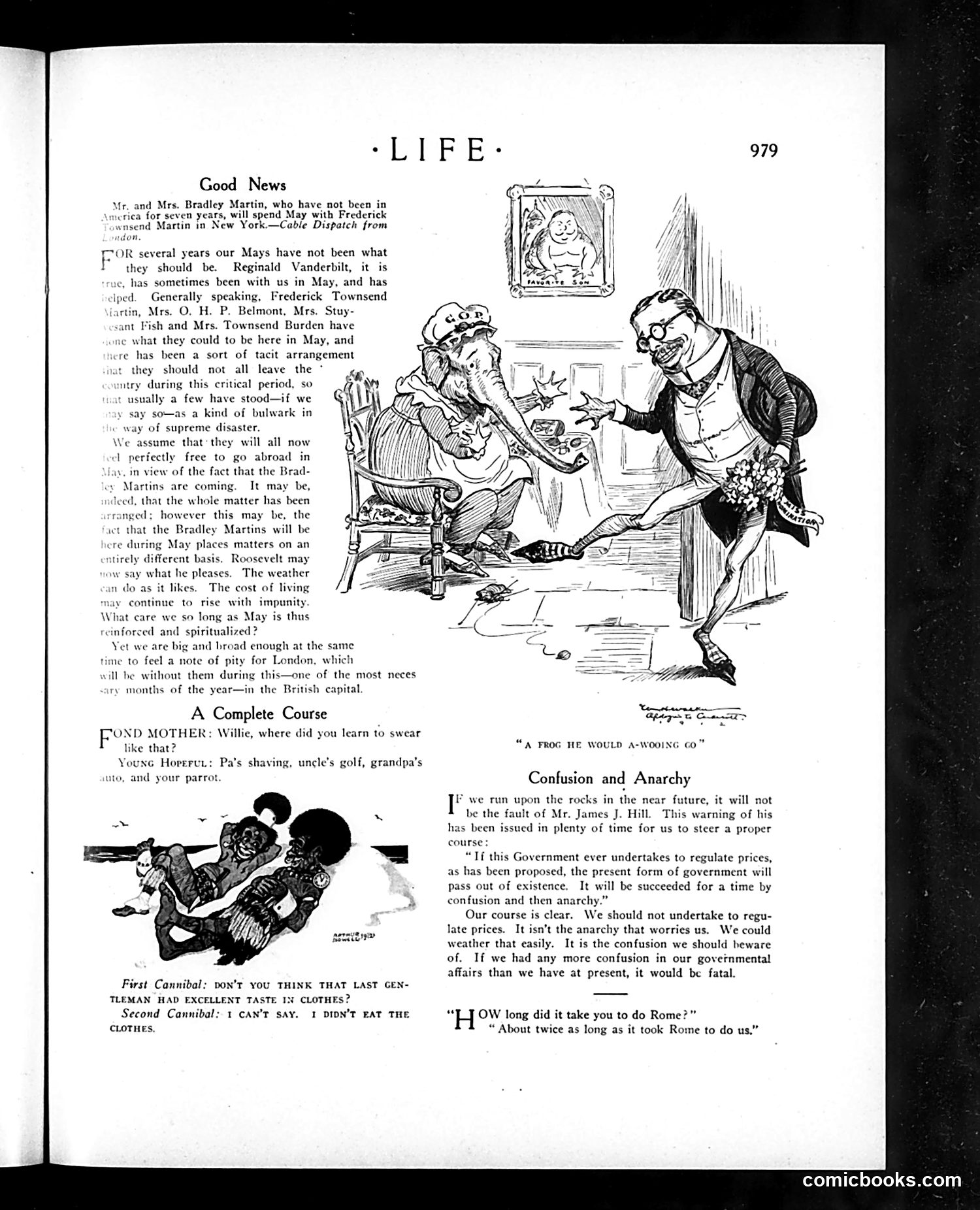
This page mocks wealthy American elites and contemporary political anxieties: **"Good News"**: Satirizes New York's high society, where the Bradley Martin family's return to America in May is treated as a stabilizing force comparable to "a kind of bulwark" against disaster. The satire suggests the wealthy believe their mere presence sustains the nation during critical periods—absurdly overestimating their importance. **"A Complete Course"**: A joke about a child learning profanity from multiple sources (his father shaving, uncle's golf, grandfather's car troubles, and the parrot)—satirizing modern frustrations. **"Confusion and Anarchy"**: Responds to railroad magnate James J. Hill's warning that government price regulation would cause societal collapse. Life sardonically agrees the real problem isn't anarchy but "confusion"—implying the government is already chaotic, so Hill's apocalyptic prediction rings hollow. The cannibals' joke plays on similar satirical themes about consumption and propriety.
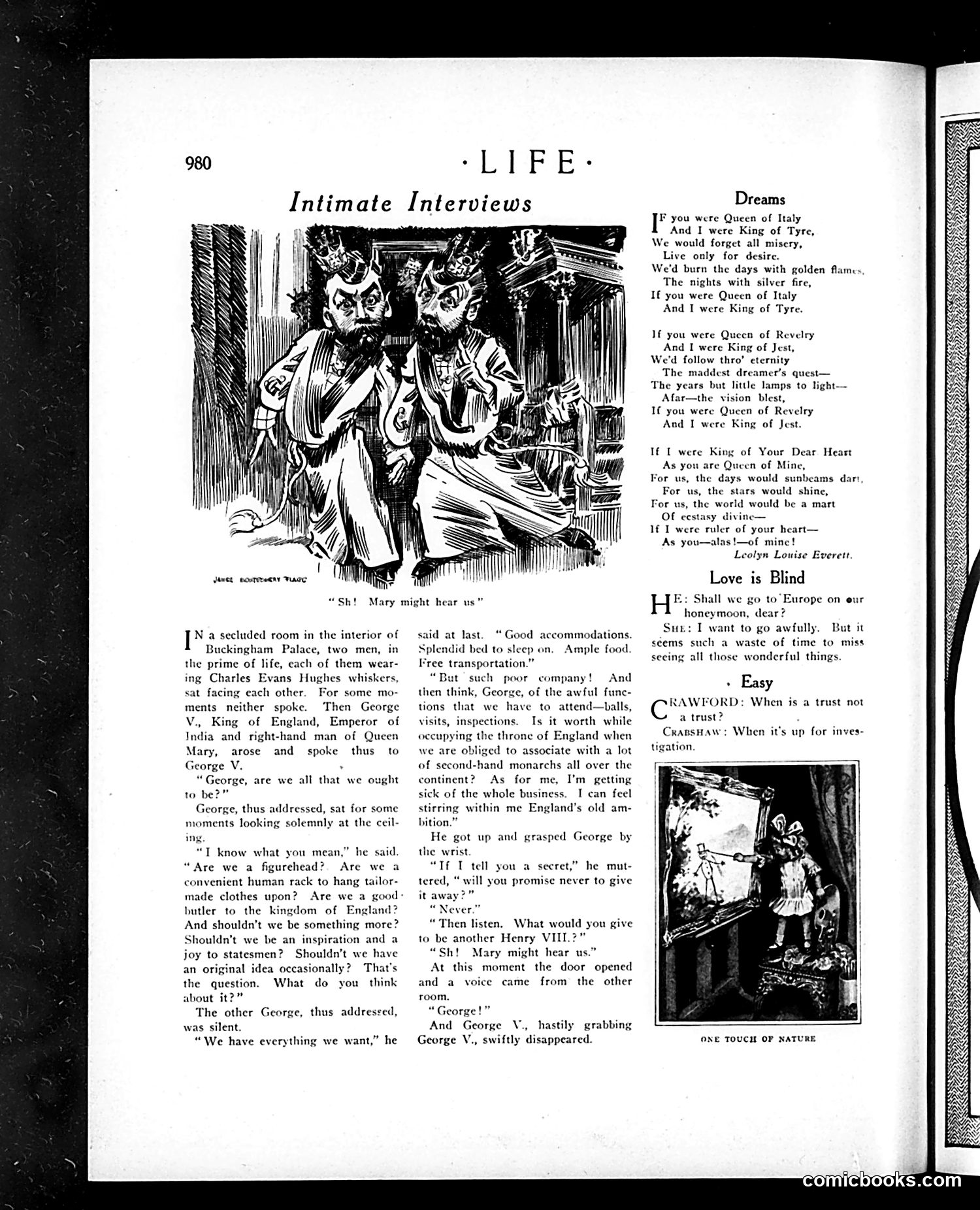
This page satirizes **King George V and Queen Mary** of England through a fictional "Intimate Interview" dialogue. Two men wearing identical "Charles Evans Hughes whiskers" (a contemporary political figure's distinctive facial hair style) represent George V discussing their royal dissatisfaction. The satire mocks the British monarchy's constraints: they have material comfort but suffer "poor company," tedious official duties, and lack genuine power or originality. One George fantasizes about being "another Henry VIII"—suggesting desire for the absolute authority of that Tudor king. The punchline, "Sh! Mary might hear us," ridicules their subordination to Queen Mary's dominance. The accompanying poetry and humor sections ("Love is Blind," "Easy") are typical Life magazine filler content unrelated to the main cartoon. **Context**: This appears to critique early-20th-century British monarchy as ornamental and powerless—useful only as ceremonial figureheads required to attend endless social obligations among "second-hand monarchs."
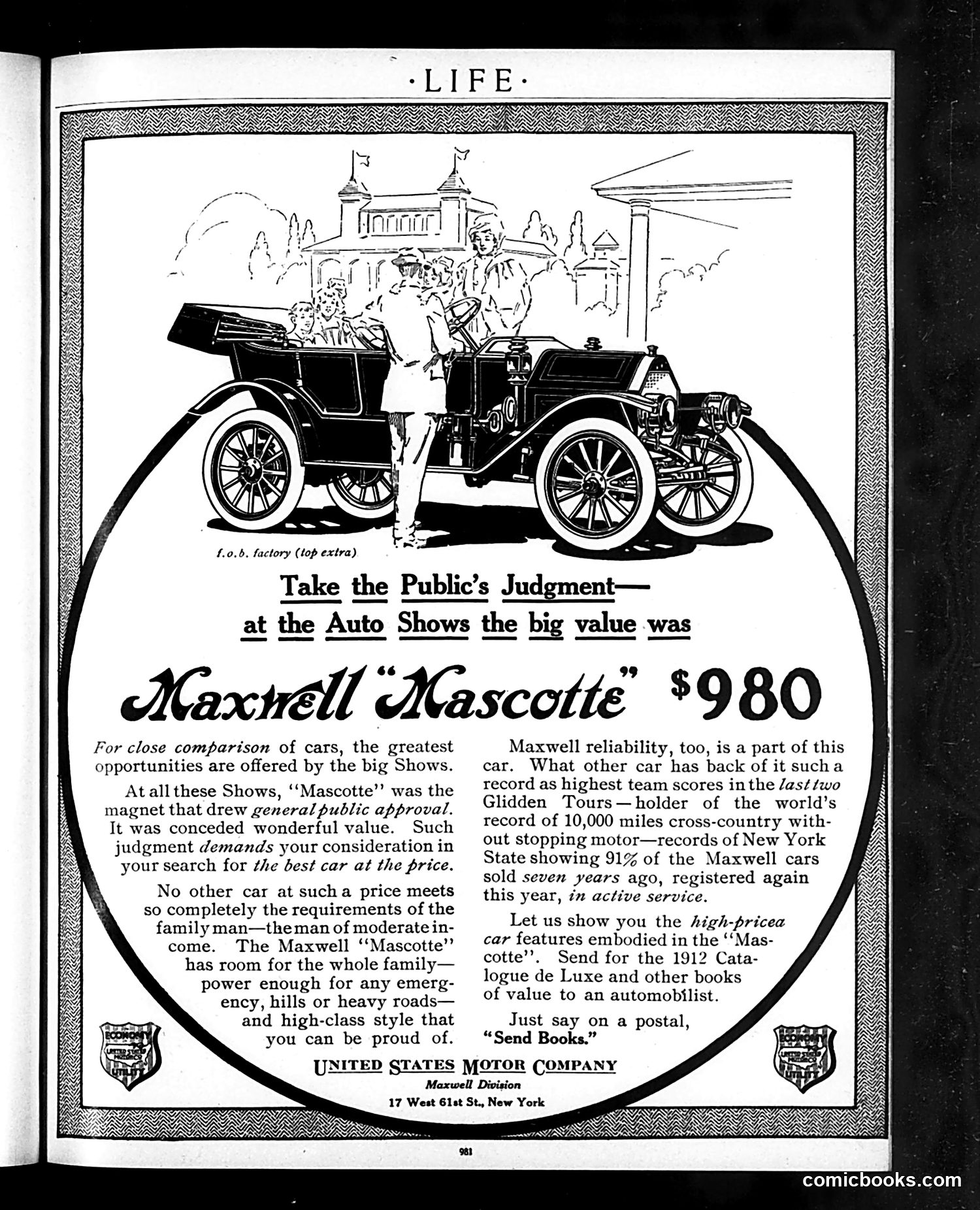
This is **not a cartoon or satire** — it's a straightforward automobile advertisement from Life magazine, circa 1912. The Maxwell "Mascotte" was a real car priced at $980 (approximately $33,000 in 2024 dollars). The ad uses the framing device of "public judgment at auto shows" to claim the Mascotte won consumer approval and offers exceptional value for middle-class families. The advertisement emphasizes reliability through specific claims: high scores in the Glidden Tours (a famous cross-country reliability race), and a statistic that 91% of Maxwell cars sold seven years prior remained in active service. The illustration shows two early automobiles and elegantly-dressed passengers near a castle-like building, suggesting both practicality and aspirational lifestyle appeal. This represents typical early automotive advertising strategy: leveraging competition results and durability claims to justify the price to budget-conscious buyers seeking quality.
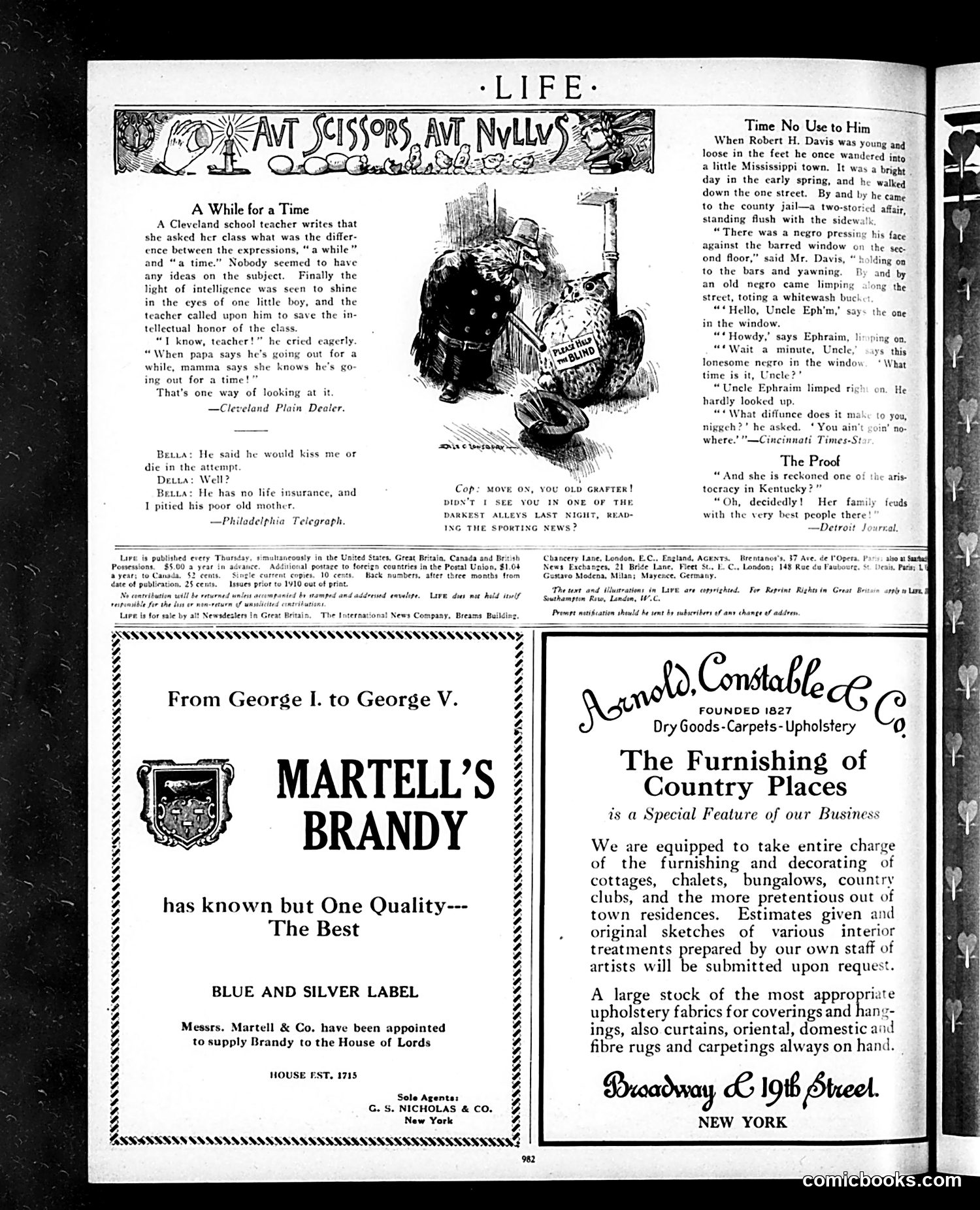
This page mixes humor pieces with advertisements, primarily focusing on wordplay and social observation typical of early 20th-century American satire. **The Humor Pieces:** Three short jokes appear: a Cleveland teacher's anecdote about "a while" vs. "a time" (suggesting men take longer when claiming brief outings), a Philadelphia story about a woman avoiding a potentially dangerous suitor due to his lack of insurance, and a piece about Robert H. Davis encountering a Mississippi jail prisoner—the prisoner's indifference suggesting time holds no meaning in confinement. A police cartoon depicts an officer confronting someone in dark alleys at night while discussing "sporting news." **The Advertisements:** Martell's Brandy emphasizes unbroken quality tradition ("From George I to George V"); Arnold, Constable & Co. advertises furnishing services for country estates. The content reflects genteel humor aimed at the magazine's educated, urban readership, with light social commentary on marriage, class status, and human nature.
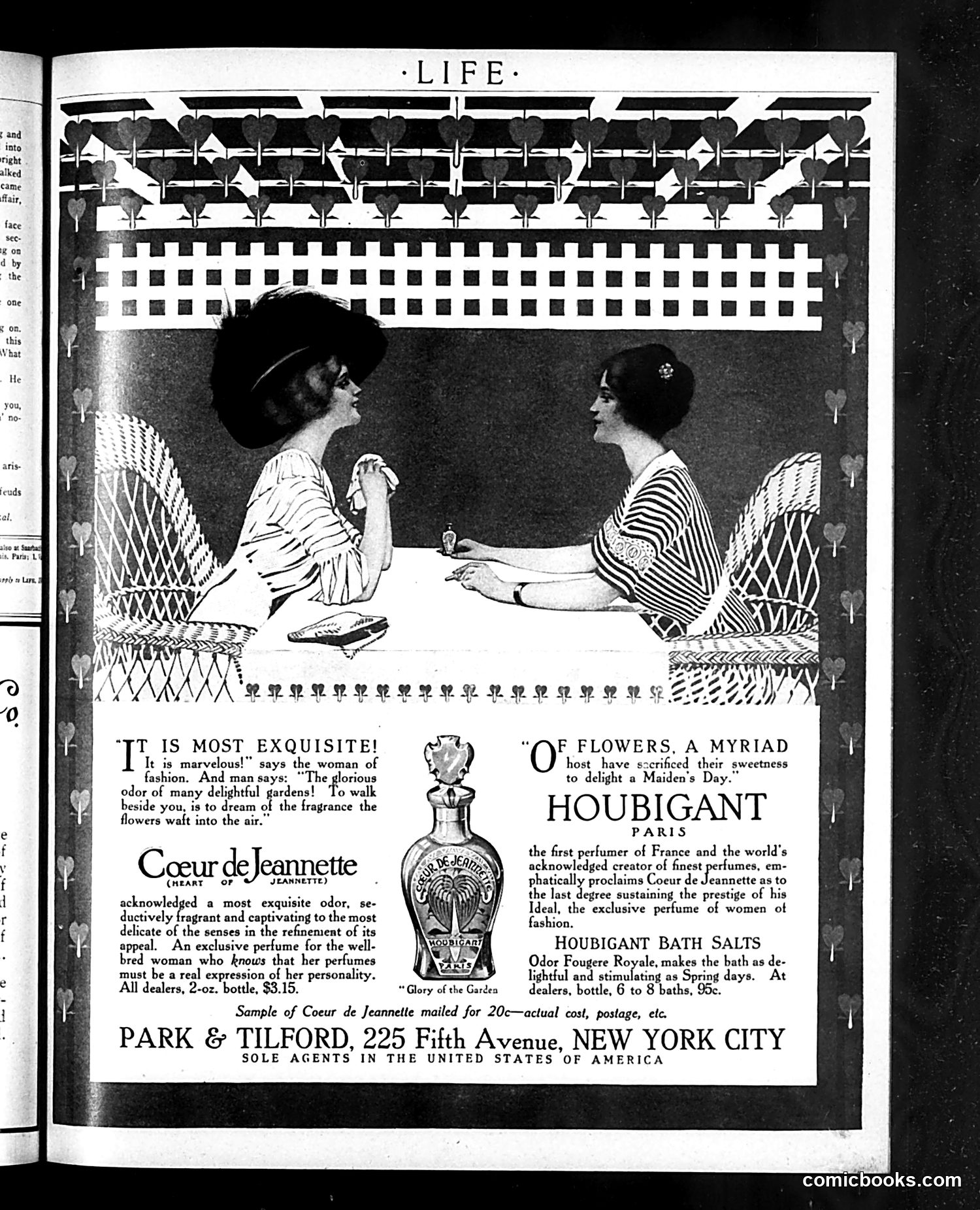
This is primarily a **perfume advertisement** for Houbigant's "Coeur de Jeannette," not political satire. The illustration shows two fashionable women in 1920s dress conversing in a garden setting, exemplifying the target demographic: wealthy, refined women concerned with personal grooming and status. The "humor" is genteel rather than satirical—it relies on exaggerated compliments about fragrance ("glorious odor," "dream of fragrance") and appeals to class anxiety. The ad emphasizes exclusivity: the perfume is for "well-bred women" whose fragrances must express "personality," suggesting that purchasing this product signals sophistication and social standing. The poetic language about flowers and "Maiden's Day" romanticizes femininity for affluent consumers. This reflects 1920s marketing conventions targeting upper-class women through appeals to refinement rather than functionality.
This page features reader correspondence—a standard magazine section. Key letters address social inconsistencies: **The Doctor's Satire**: A physician sarcastically proposes the government abolish public health measures (quarantine, vaccination, antitoxin) to keep doctors perpetually busy. The bitter joke critiques the medical profession for supposedly opposing their own interests—suggesting doctors secretly resist disease prevention that would eliminate their patient base. **The Clergyman's Complaint**: A minister attacks Life's hypocrisy: the magazine champions animal welfare and opposes vivisection while simultaneously running liquor advertisements. He cites a 1911 cartoon showing a drunk man sprawled on the ground with caption "One of the Lower Animals"—arguing the liquor industry, not the animal, deserves blame. The editor's response defends advertising standards: ads need only avoid fraud, not promote morality. **Context**: This reflects Progressive Era debates about corporate responsibility, public health, and editorial ethics. The clergyman's moral argument—that publications shouldn't profit from substances causing crime and poverty—was common temperance-movement rhetoric circa 1912.
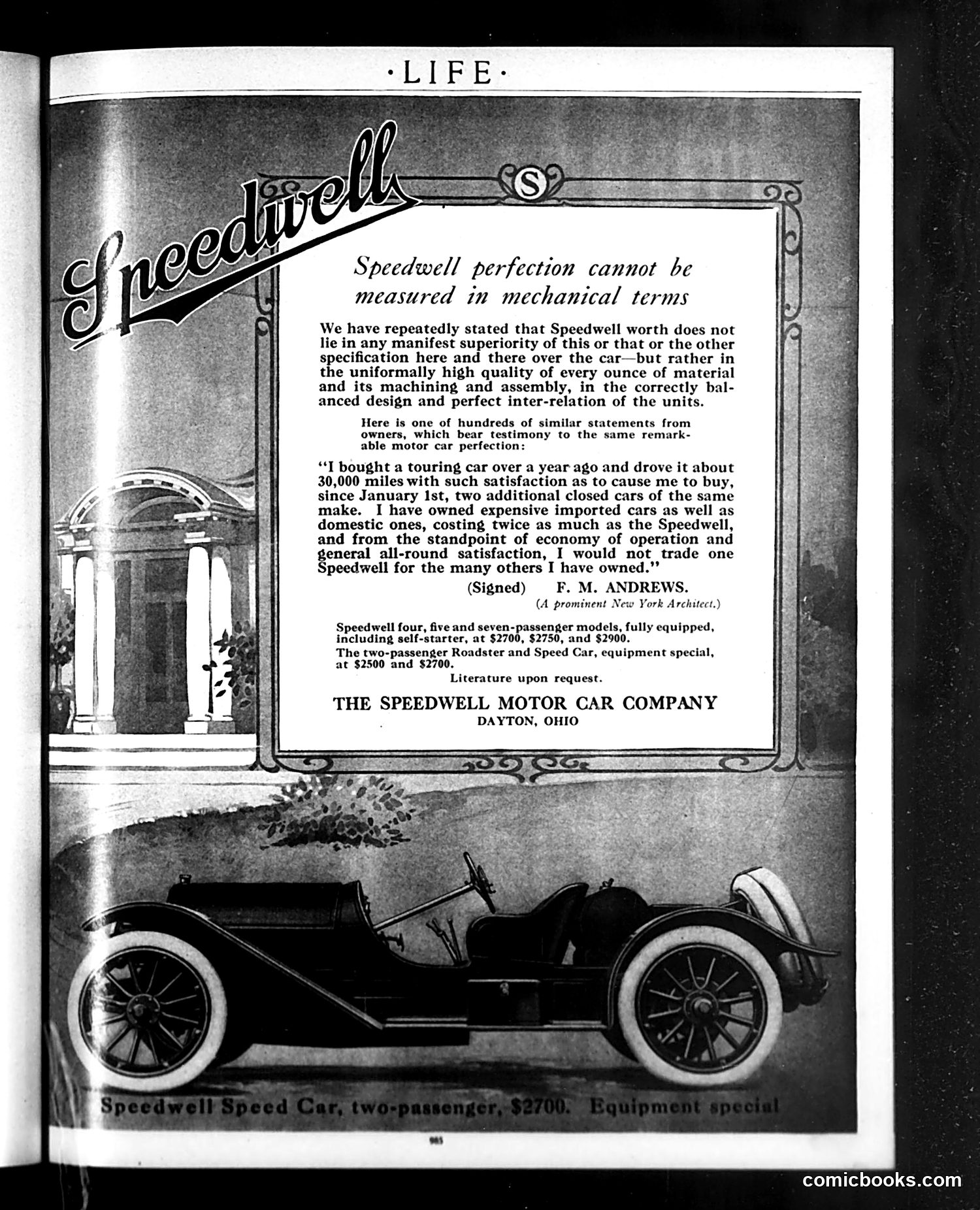
This page is **not a cartoon or satire**—it's a straightforward automobile advertisement from *Life* magazine, likely from the 1910s-1920s. The Speedwell Motor Car Company of Dayton, Ohio is advertising their vehicles by emphasizing quality and reliability rather than mechanical specifications. The ad features a testimonial from F. M. Andrews, a prominent New York architect, claiming he was so satisfied with his Speedwell touring car after 30,000 miles that he bought two additional models, despite owning more expensive imported cars. The accompanying images show a Speedwell Speed Car (two-passenger model at $2,700) alongside an architectural column, visually comparing the car's craftsmanship to classical structural design—suggesting durability and timeless quality. Pricing ranges from $2,500 to $2,900 for various models with self-starters included. This represents typical early automotive advertising strategy: using wealthy, credible customer testimonials to build brand prestige.
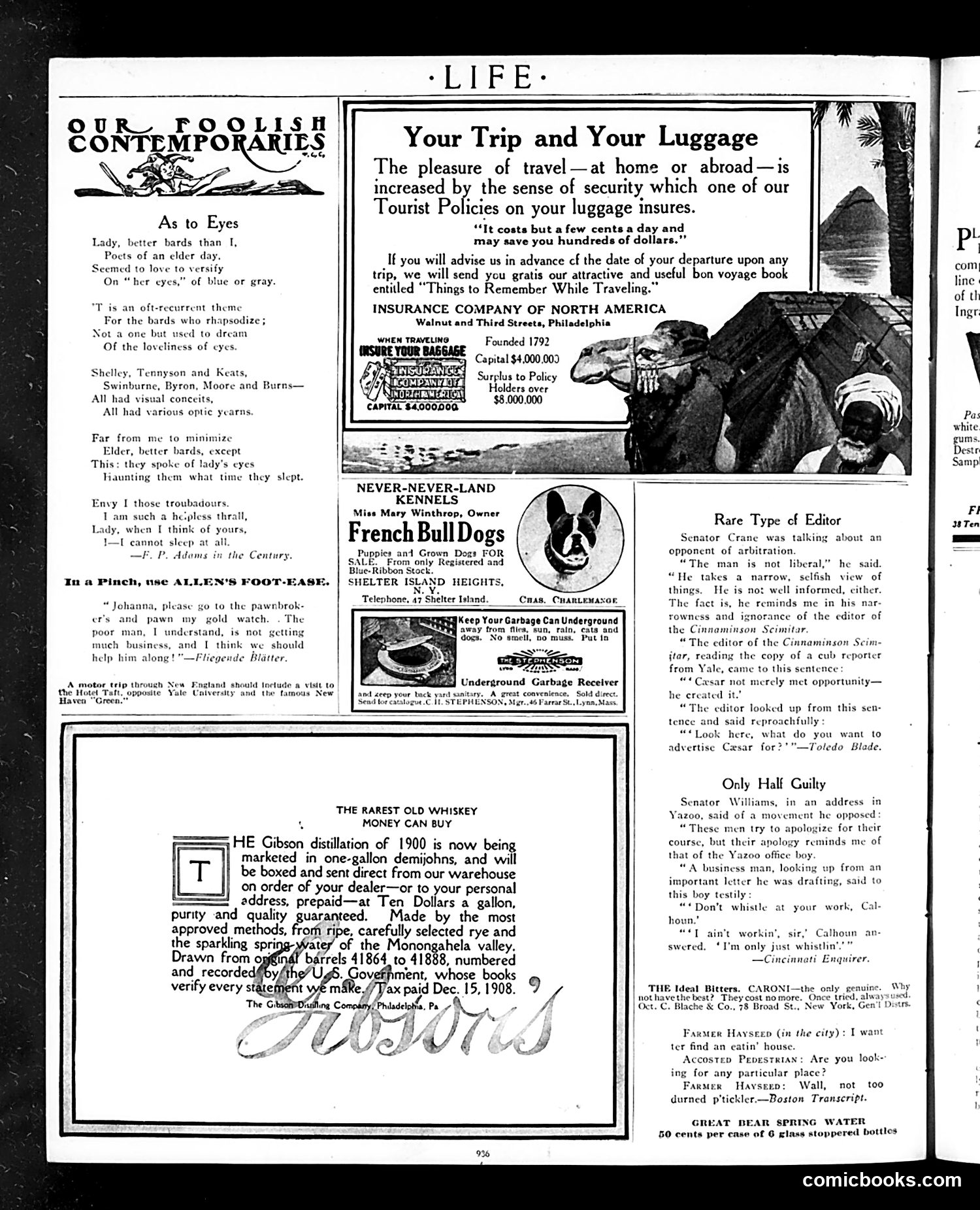
This is primarily an **advertising page** with some satirical content interspersed. The main elements include: **Advertisements**: Insurance coverage for luggage, French Bulldogs, whiskey, garbage receivers, and various consumer products dominate the space. **Satirical Content**: - "Our Foolish Contemporaries" section at top left contains poetry mocking Romantic-era poets (Shelley, Keats, Byron) for their obsession with describing women's eyes—the author claims superiority by NOT doing this. - "Rare Type of Editor" and "Only Half Guilty" sketch two newspaper editors displaying narrow-mindedness and defensive behavior—satirizing journalistic pomposity and thin-skinned responses to criticism. - "In a Pinch" and other small vignettes mock everyday absurdities. **Context**: This reflects *Life* magazine's early 1900s formula: mixing consumer advertisements with light social satire targeting literary pretension, journalistic vanity, and middle-class foibles. The humor is genteel and mildly biting rather than politically pointed.
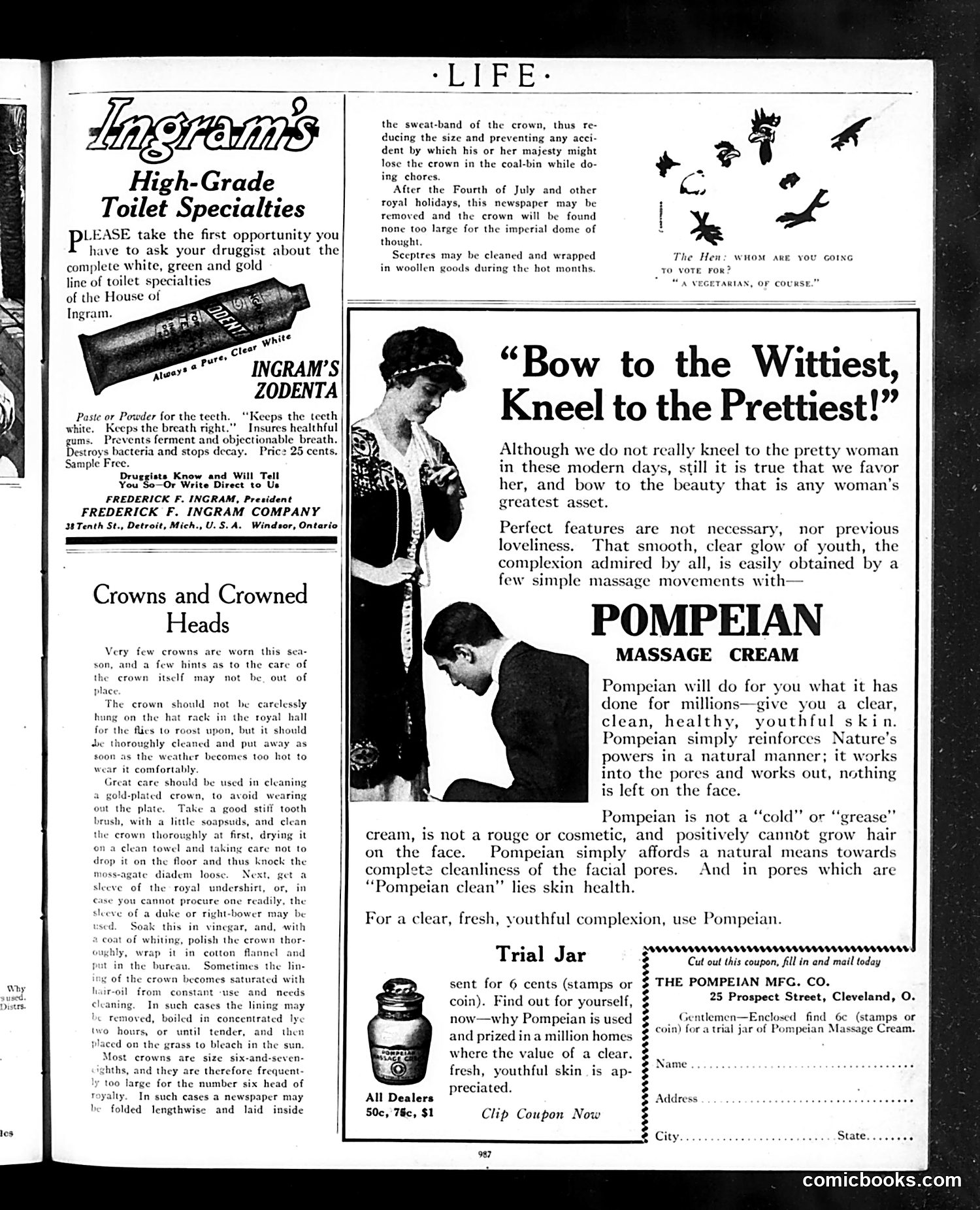
This page is primarily **advertising**, not political satire. The main content includes: 1. **"Crowns and Crowned Heads"** - A humorous, tongue-in-cheek advice column about caring for actual crowns (royal regalia). It's satirizing fussy etiquette guides by treating crown maintenance with exaggerated seriousness—warning against leaving crowns on hat racks where "ics" (likely "chickens") roost, and suggesting newspaper padding for oversized crowns. The joke: practical domestic tips applied to royal objects. 2. **"Bow to the Wittiest, Kneel to the Prettiest!"** - An advertisement for Pompeian Massage Cream featuring an illustration of a woman being courted. The tagline ironically acknowledges that modern society still favors beautiful women despite claims of progress, then pivots to selling facial cream as the path to beauty and social advantage. The page reflects early 20th-century advertising that mixed humor with beauty standards and gender expectations.
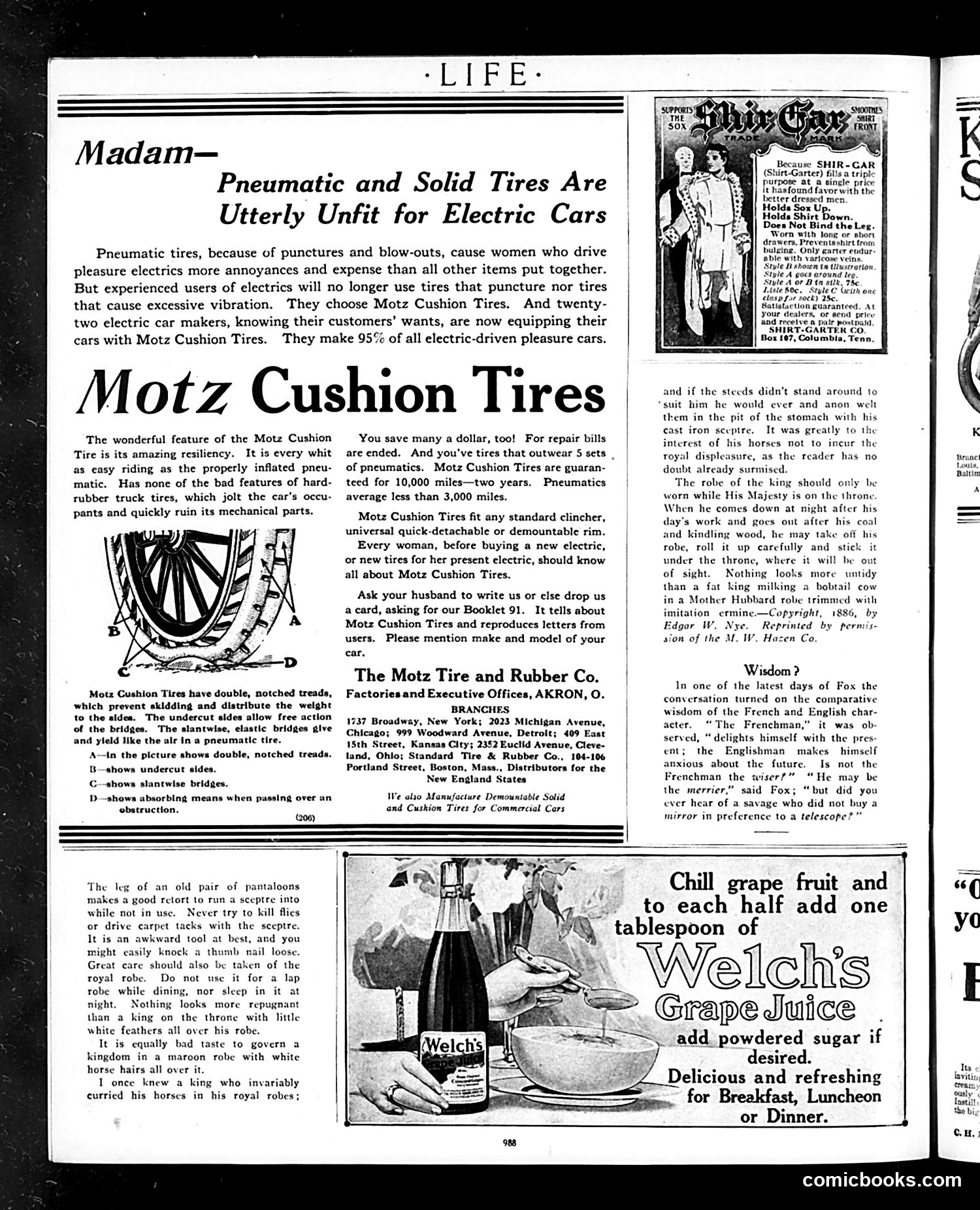
This page is primarily **advertising**, not satire or political commentary. The dominant content is a multi-section advertisement for Motz Cushion Tires, targeting women who drive electric cars—a significant market in the early 1900s. The ad's pitch is straightforward: pneumatic tires puncture and vibrate excessively, causing annoyance to female drivers. Motz Cushion Tires solve this by offering resilience, durability (10,000 miles guaranteed), and smooth riding. The ad notes that 22 electric car manufacturers and 95% of electric pleasure cars use these tires, positioning them as the industry standard. The page also includes smaller advertisements for Shir-Garter (a shirt holder) and Welch's Grape Juice, plus a humorous column about proper etiquette for kings in royal robes—unrelated content typical of Life's variety format. There is **no political cartoon or satire** here—just period advertising reflecting early automotive history and women's emerging role as consumers and drivers.
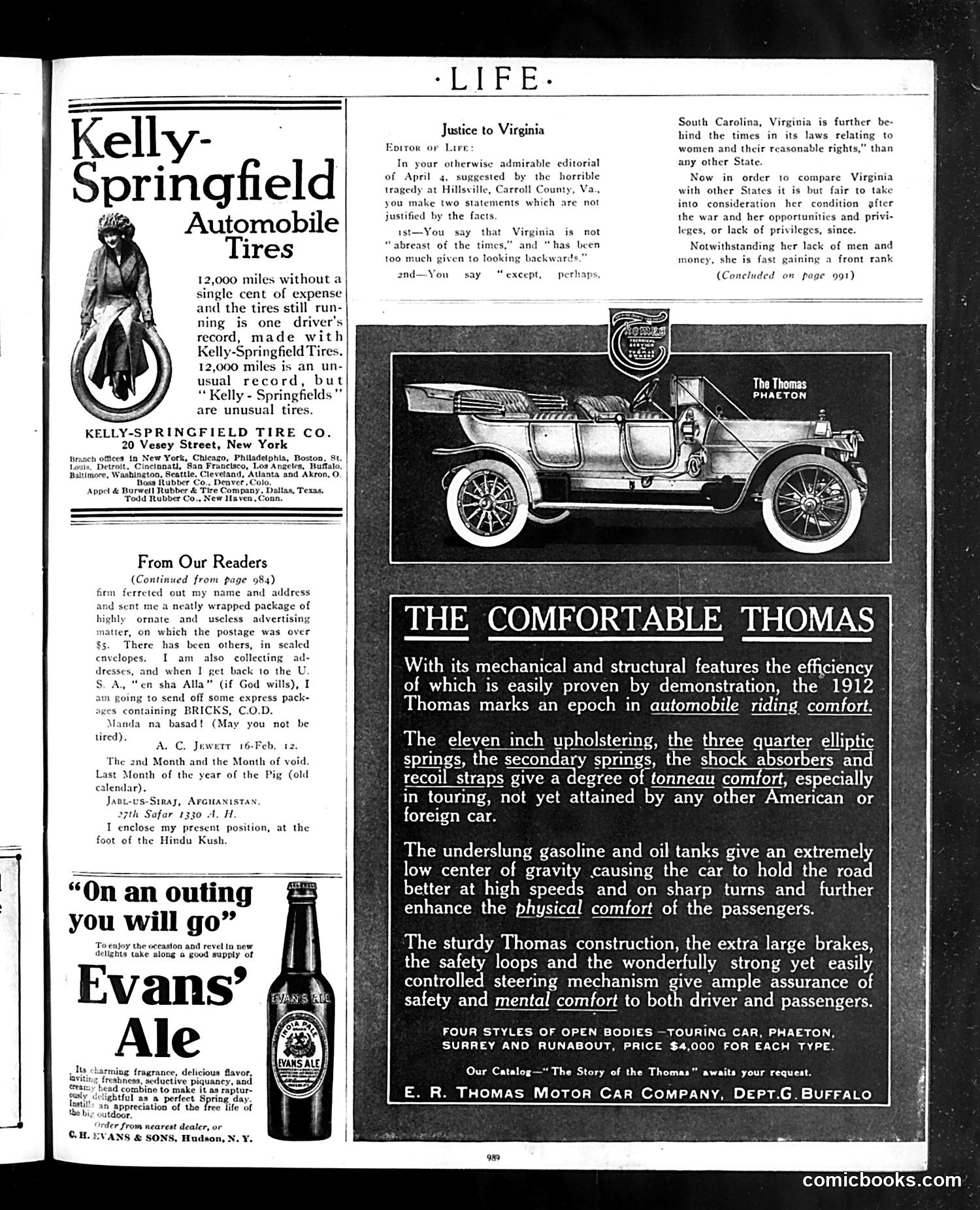
This is primarily an **advertising page** from Life magazine, circa 1912, containing no political cartoons or satire. The page features three unrelated advertisements: 1. **Kelly-Springfield Tires**: Claims 12,000-mile durability without expense—standard tire marketing emphasizing reliability and value. 2. **Evans' Ale**: Promotes beer as an ideal beverage for outdoor outings, emphasizing pleasure and leisure—typical early-20th-century alcohol advertising before Prohibition. 3. **Thomas Motor Car Company**: Showcases the 1912 Thomas Phaeton automobile, emphasizing mechanical comfort features (suspension, upholstering, safety mechanisms) at $4,000—luxury marketing for wealthy buyers. The page also includes a small "From Our Readers" letters section and an editorial response titled "Justice to Virginia" addressing women's rights, but these are brief and non-satirical. The page represents standard commercial magazine content of the era, not satirical commentary.
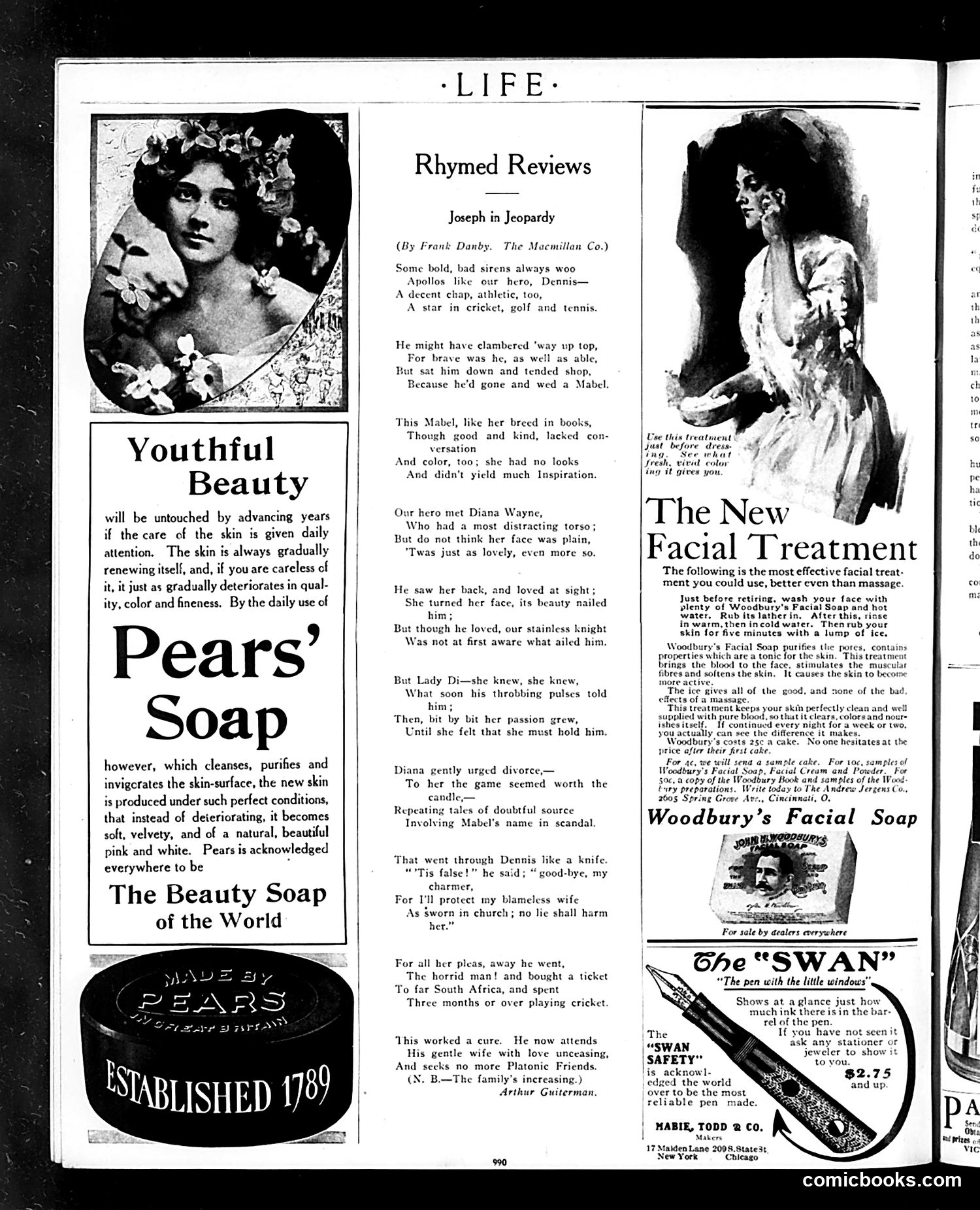
This page is primarily **advertising**, not political satire. The central content consists of three product advertisements (Pears' Soap, Woodbury's Facial Soap, and Swan pens) surrounding a literary review. The "Rhymed Reviews" section by Arthur Guiterman reviews a novel called *Joseph in Jeopardy* by Frank Danby. It's a humorous poem about a virtuous married man named Dennis who resists seduction by the attractive Lady Diana Wayne. She attempts to manipulate him into divorcing his plain but good wife Mabel by spreading rumors, but Dennis remains faithful, leaves for South Africa, and eventually reconciles with his wife. The satire here mocks melodramatic romance novels—specifically the stock character of the temptress and the conventional moral ending rewarding virtue. The advertisements reflect early 20th-century consumer culture focused on beauty products, promoting soap as the solution to maintaining youthful skin through daily care. These were standard commercial messages in *Life* magazine during this period.
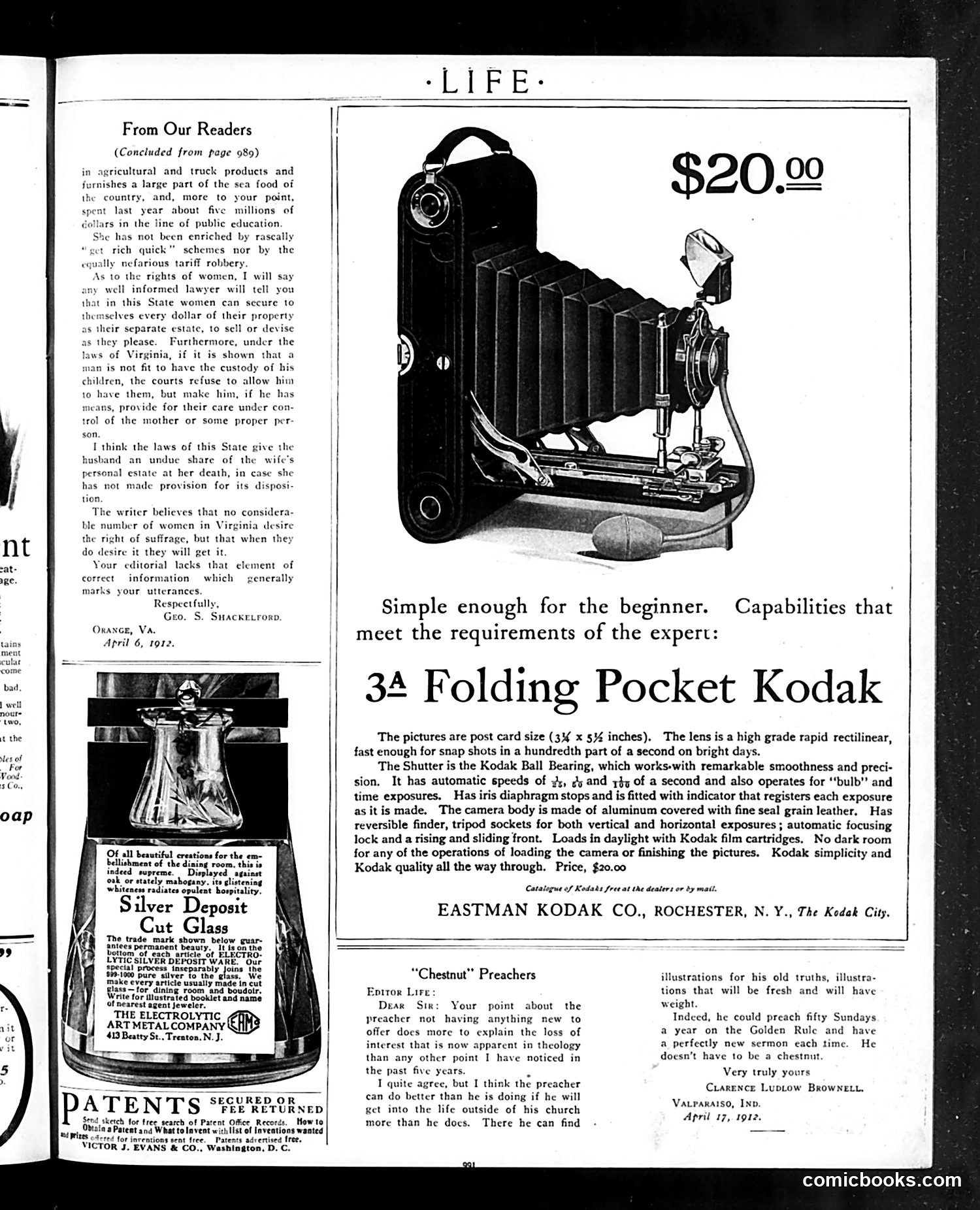
This is primarily an **advertising page** rather than political satire. The main content features a Kodak camera advertisement prominently displaying the "3A Folding Pocket Kodak" for $20.00, emphasizing its simplicity for beginners while meeting expert requirements. The left column contains reader letters addressing **women's property rights in Virginia**. One correspondent argues against women's suffrage, claiming Virginia law already protects women's property interests and that "no considerable number of women in Virginia desire the right of suffrage." This reflects the **pre-suffrage era debates** of 1912, when women's voting rights remained contested. Additional advertisements include **Silver Deposit Cut Glass** and a **Patents legal service**. A brief letter about "Chestnut Preachers" discusses whether preachers need fresh material—a minor cultural observation about sermon repetition rather than satire. The page reflects early 20th-century advertising culture and gender politics before the 19th Amendment (1920).
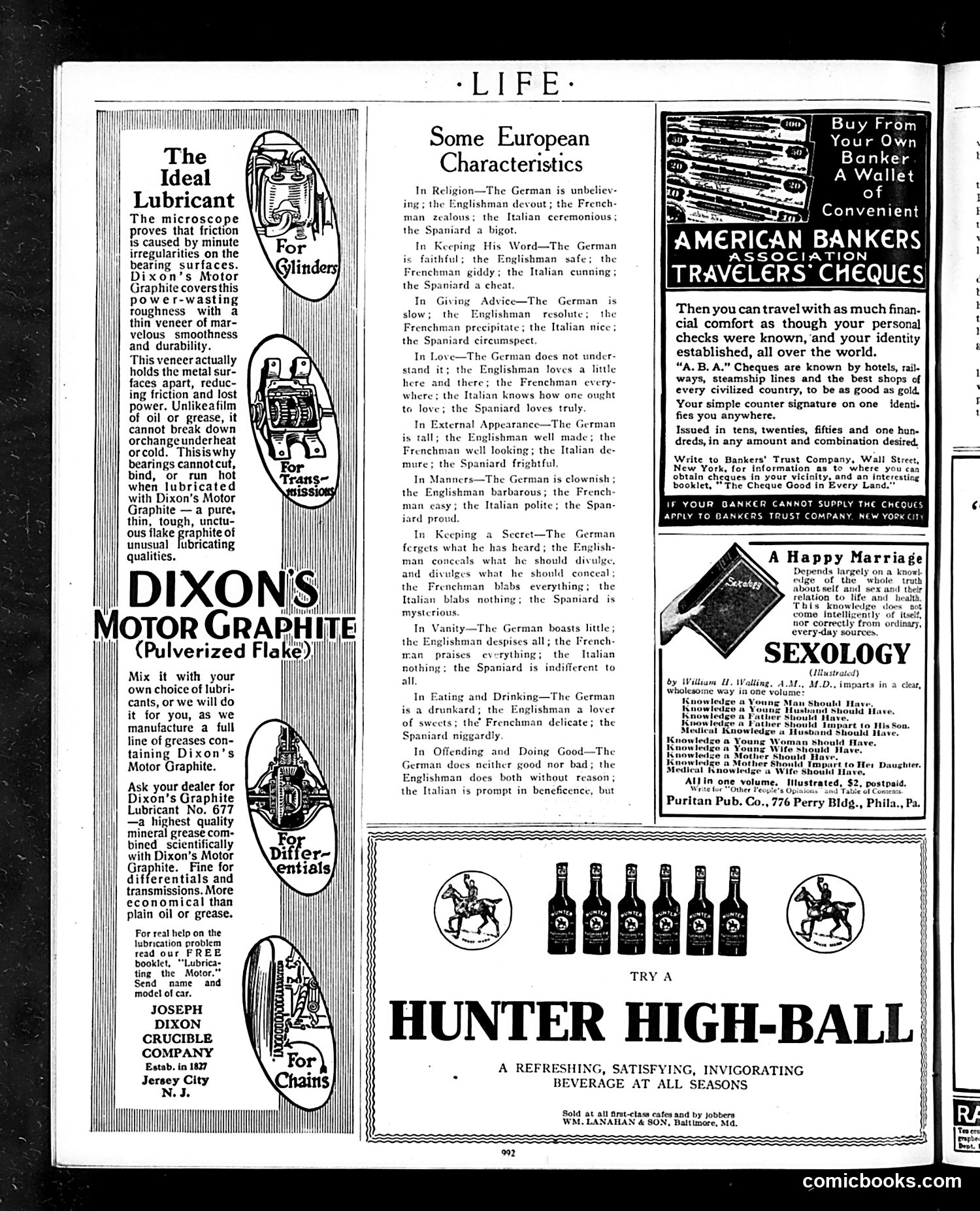
This page presents a satirical catalog of national stereotypes about European peoples—Germans, English, French, Italians, and Spanish. The text offers caricatured generalizations across multiple categories: religion, honesty, advice-giving, love, appearance, manners, secrecy, vanity, eating/drinking, and charity. The satire works through exaggeration and contradiction. For example, Germans are simultaneously "unbelieving" yet "slow" in advice; the English are "devout" but "barbarous"; the French "easy" in manner but compulsively talkative. The Spaniard emerges as uniformly negative—"frightful," "proud," "niggardly." This reflects early 20th-century European ethnic stereotyping common in American publications. The piece mocks these oversimplifications themselves, exposing how national caricatures collapse under their own contradictions—the real satirical target being audiences who believed such generalizations.
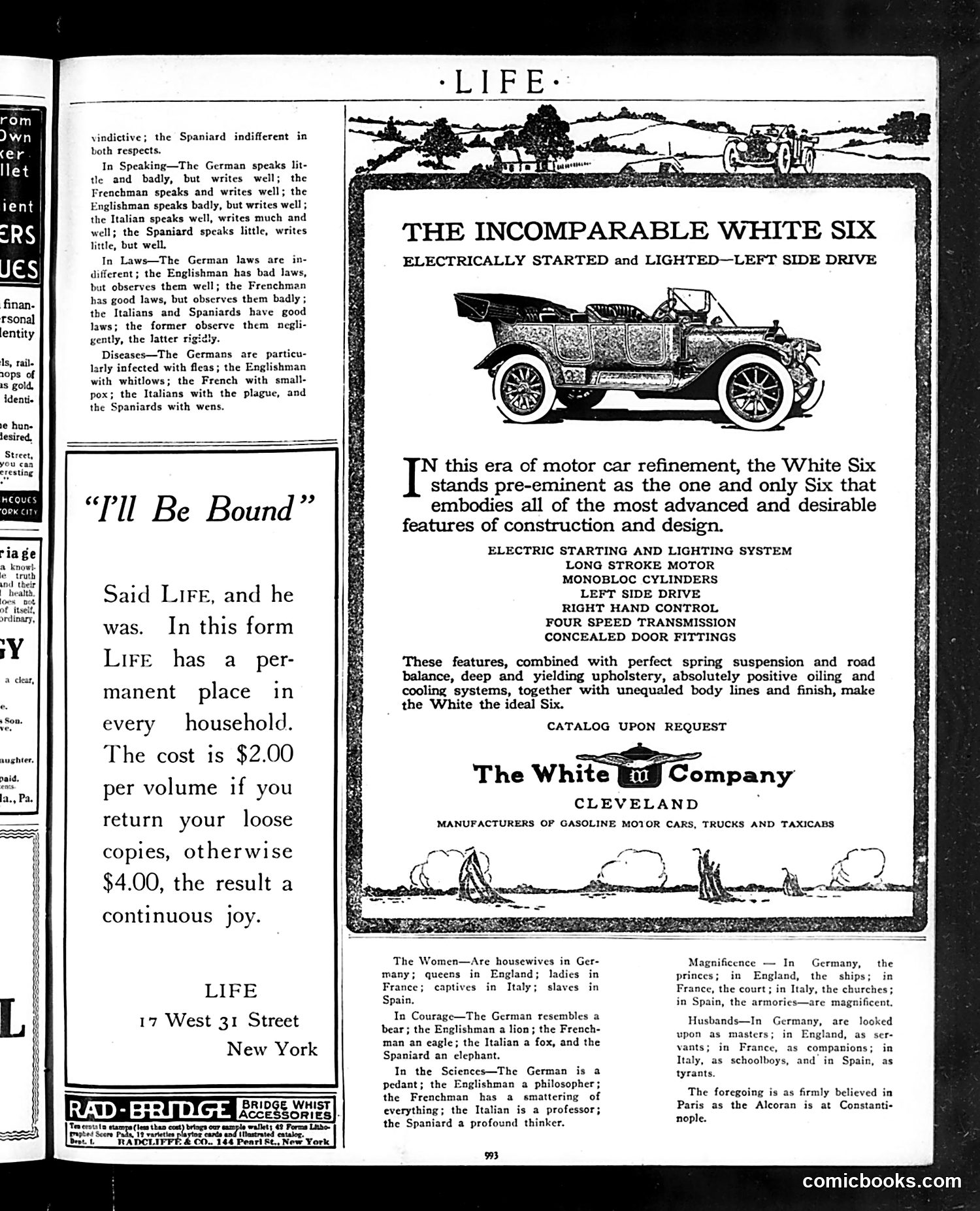
This page combines satirical content with automotive advertising. The left side presents ethnic stereotypes—a text block comparing Germans, French, English, Italians, and Spanish across categories like speaking ability, law-abidingness, and diseases. The satire lies in presenting these broad generalizations as fact, mocking both the stereotypes themselves and the Victorian-era tendency to rank European nationalities by supposed national character traits. The right side advertises the White Six automobile, emphasizing modern features (electric starting, left-side drive, four-speed transmission). The juxtaposition is notable: Life places crude ethnic caricature alongside celebration of industrial progress, suggesting the magazine's dual nature as both satirical social commentary and commercial vehicle. The stereotypes, presented with mock-serious tone, were typical of early-20th-century humor that modern readers would recognize as offensive rather than witty.
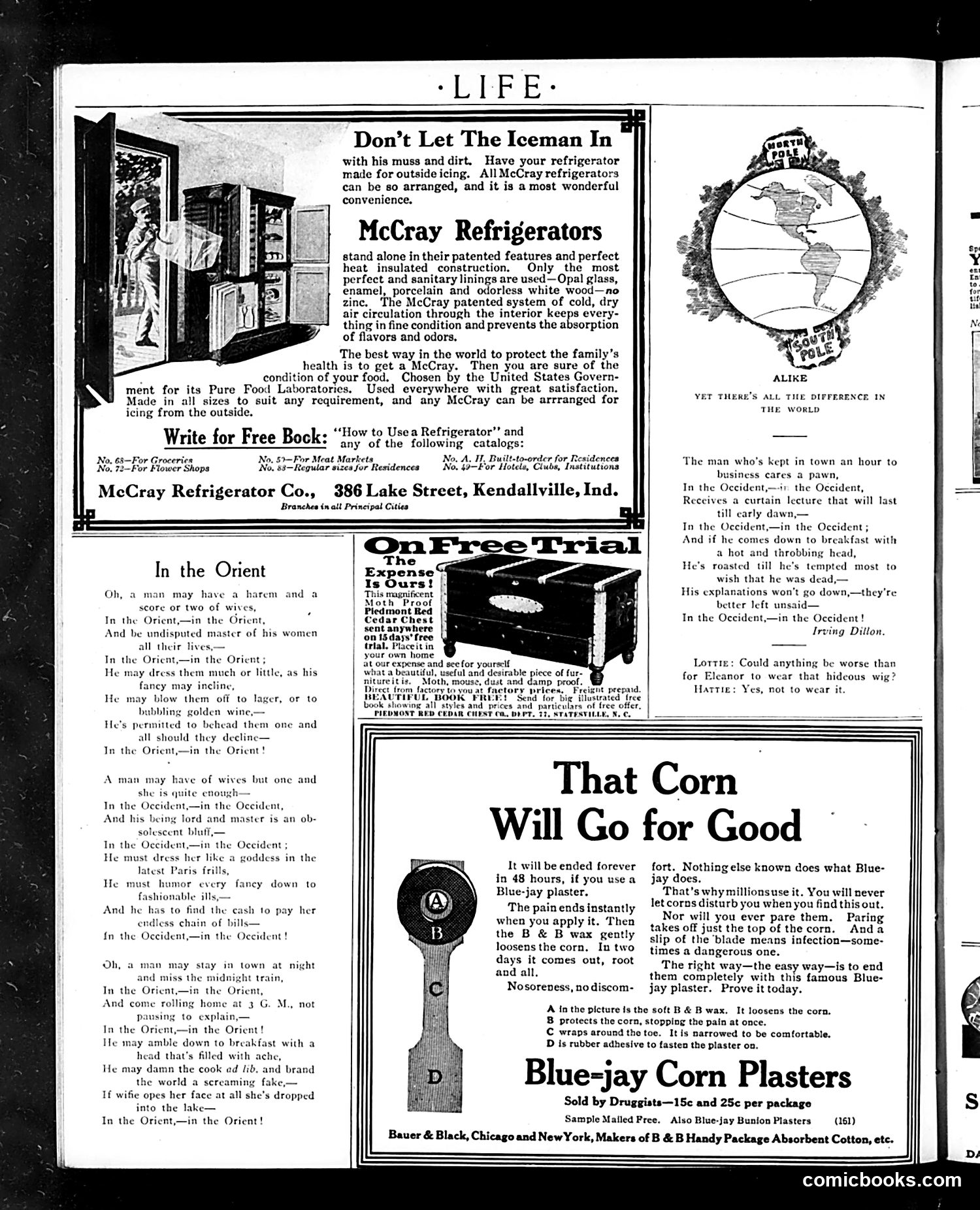
This page is primarily **advertising** with minimal editorial content. The main satirical piece is a poem titled "In the Orient" that contrasts marital customs between Eastern and Western cultures. **The poem's satire:** It presents a double standard, suggesting Oriental men enjoy unlimited domestic power (harems, the right to discipline wives), while Western men are trapped by expectations to indulge their wives financially and romantically. The joke relies on Orientalist stereotypes common to the era—portraying the East as exotic and permissive, the West as emasculating through consumerism and female power. **Supporting content:** A brief dialogue between "Lottie" and "Hattie" about wearing wigs extends the theme of Western women's vanity and foolish fashion choices. **Advertisements:** McCray Refrigerators, Blue-Jay Corn Plasters, and a Cedar Chest dominate the page, with no connection to the satirical content. The satire reflects early-20th-century anxieties about gender roles and Western modernity viewed as feminizing.
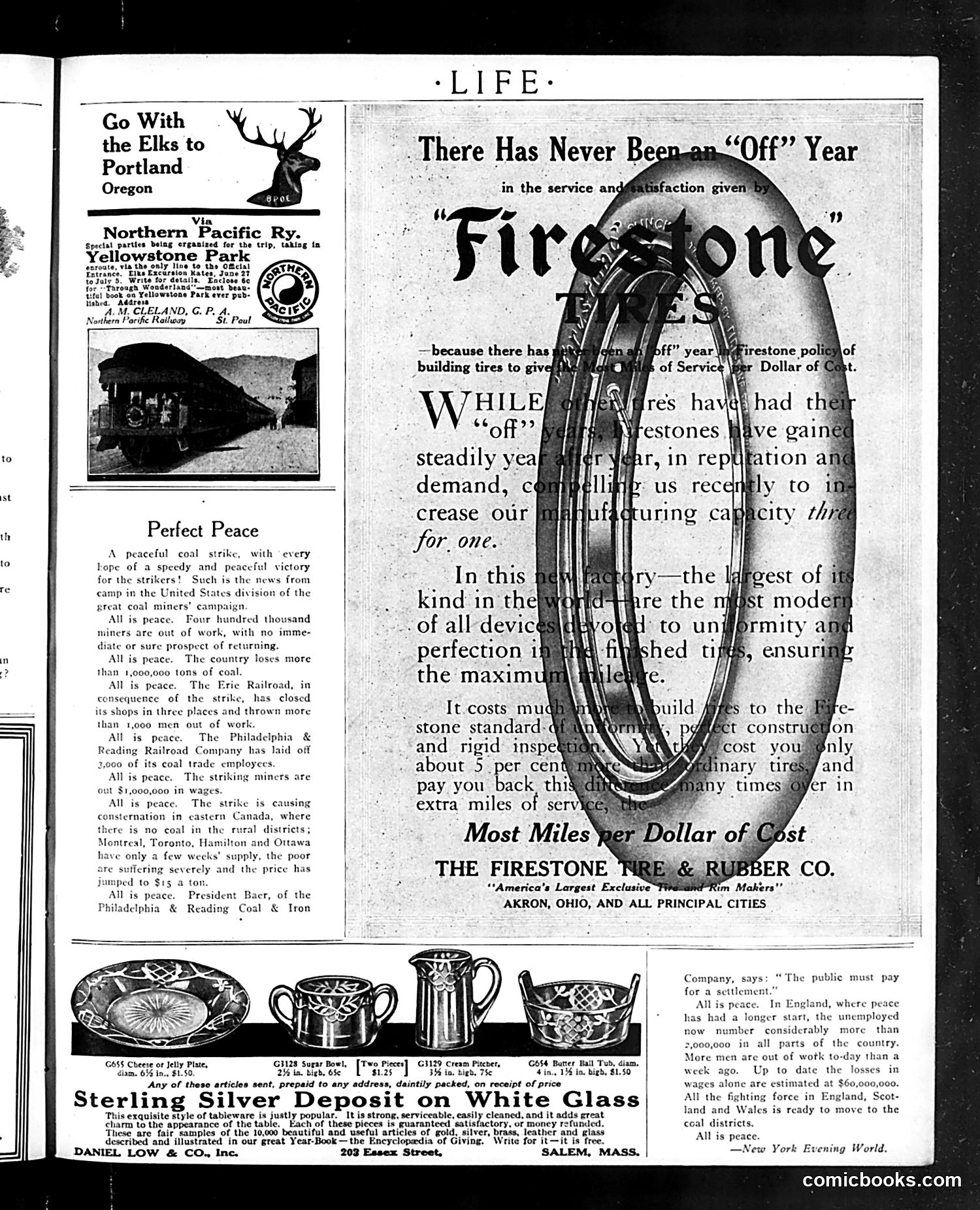
This page is primarily **advertising with political commentary**, not a cartoon. The main content is a Firestone Tire advertisement (center-right) claiming their tires deliver superior value and durability—"Most Miles per Dollar of Cost." The political satire appears in the left column under "Perfect Peace," which ironically catalogs the human and economic devastation of an ongoing coal miners' strike. The passage lists consequences: 400,000 miners out of work, the Erie Railroad closing shops and laying off 1,000 workers, the Philadelphia & Reading Railroad laying off 3,000 employees, and rural Canadian communities freezing without coal. The repeated phrase "All is peace" sarcastically undercuts each grim fact. A quote attributed to President Baer of the Philadelphia & Reading Coal Company—"The public must pay for a settlement"—appears to be the satirical target, suggesting corporate indifference to workers' suffering. The page thus uses irony to criticize labor unrest and corporate callousness during what appears to be the 1902 anthracite coal strike.
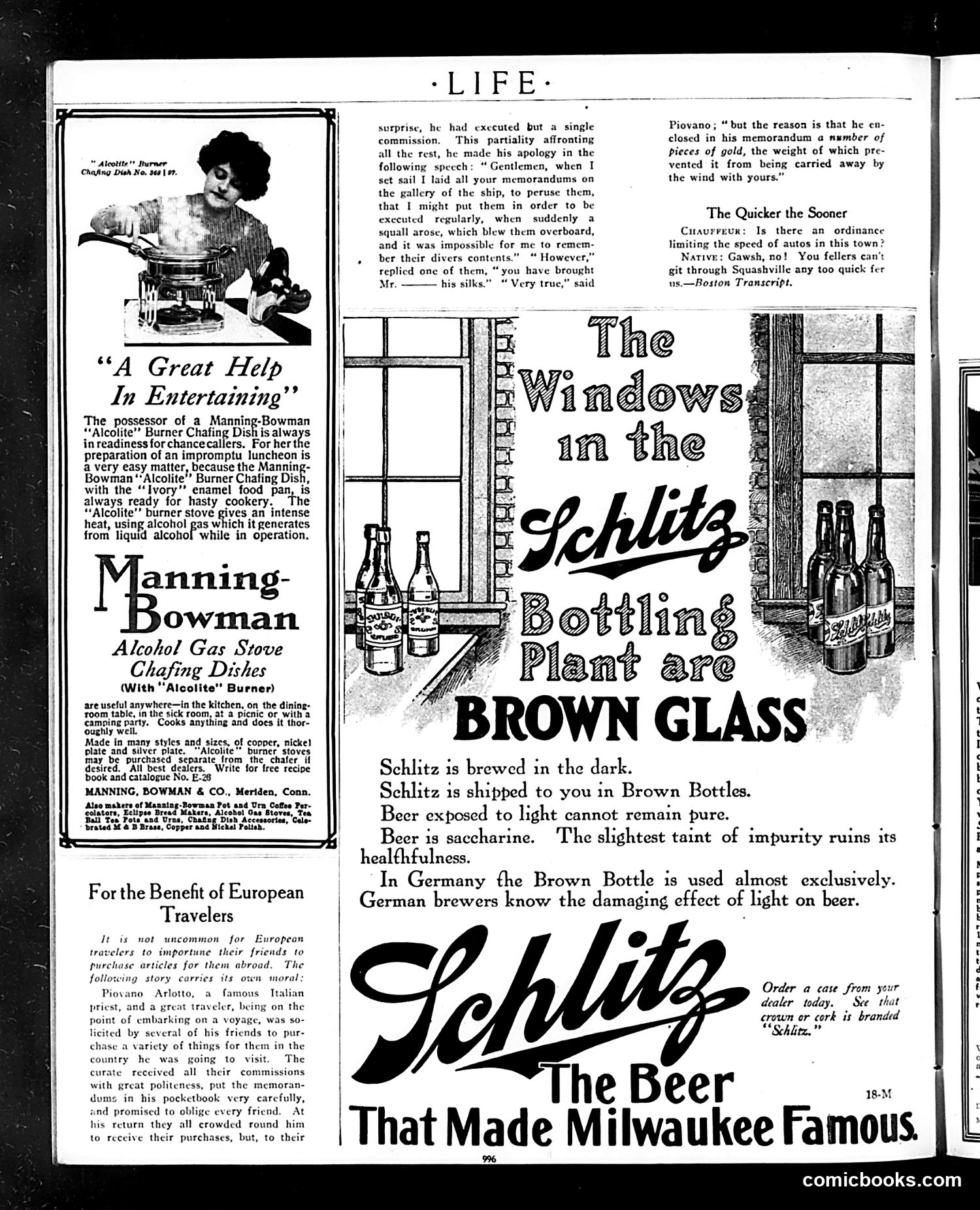
This page mixes advertisements with satirical content typical of early 20th-century *Life* magazine. **The Cartoon**: "The Quicker the Sooner" mocks rural attitudes toward automobiles. A native of "Squashville" tells a city visitor there's no speed limit because visitors can't drive through town fast *enough*—implying the town is so remote and undesirable that even speeding wouldn't get you out quickly enough. It's gentle satire on small-town life and the automobile era's disruption of rural America. **Advertisements**: The page features two product ads—a Manning-Bowman alcohol-burning chafing dish (for entertaining) and Schlitz beer in brown bottles. The Schlitz ad emphasizes brown glass protects beer from light damage, claiming this German brewing practice ensures purity. This reflects pre-Prohibition American beer marketing. **"For the Benefit of European Travelers"**: An anecdote about an Italian priest receiving commissions from friends, then losing the memoranda in a squall—except one friend's note weighted with gold coins survived. Light satire on greed versus friendship.
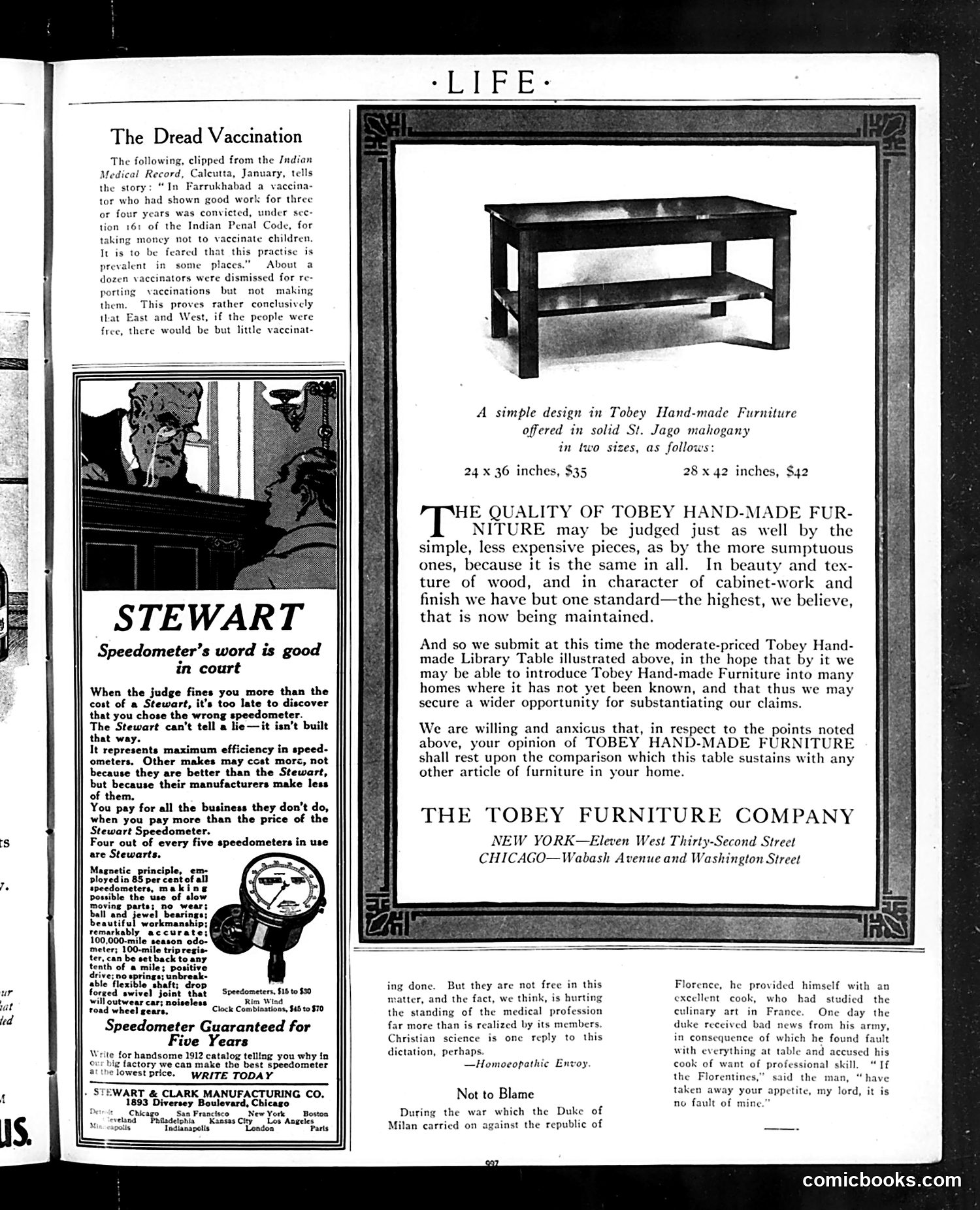
This article satirizes vaccine fraud in colonial India. According to the clipping from the Indian Medical Record, vaccinators in Farrukhabad were caught accepting bribes to *skip* vaccinating children while falsely reporting the work completed. About a dozen such corrupt officials were dismissed. The piece uses this scandal to mock the vaccination enterprise generally. The author suggests that if people were "free" rather than compelled, vaccination would be unpopular—implying the practice itself (not just its corruption) is suspect. This reflects early-20th-century anti-vaccination sentiment, when vaccine safety remained genuinely controversial. The satire targets both the dishonest vaccinators and the broader colonial medical apparatus that enforces unwanted medical intervention on the Indian population. The irony: authorities intended to protect public health through mandatory vaccination, but the system's corruption undermined that goal entirely.
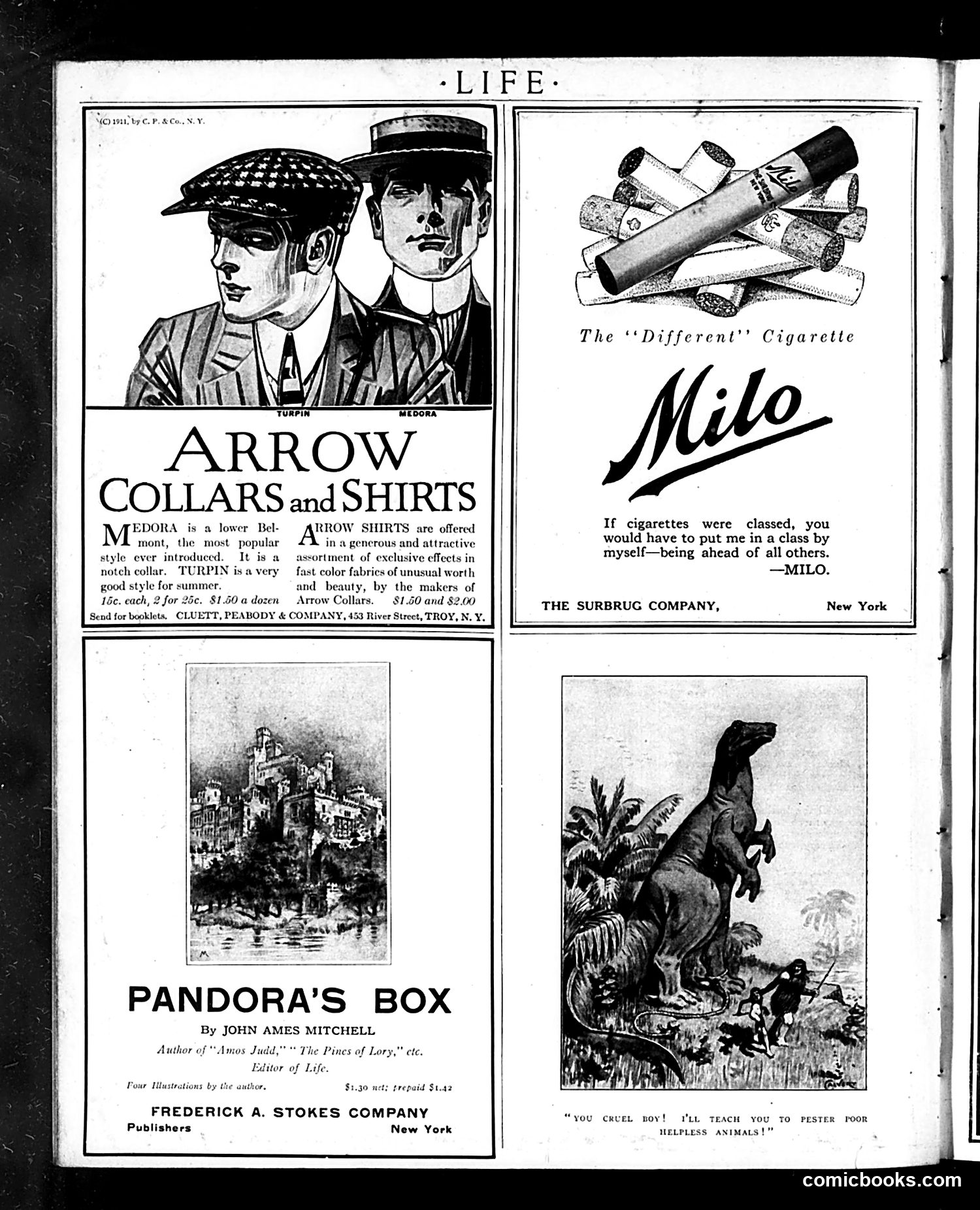
This is primarily an **advertising page** from Life magazine, with one narrative illustration. **The Advertisements:** - **Arrow Collars and Shirts**: Shows two men modeling fashionable neckwear styles (Medora and Turpin collars), promoting Arrow as the popular choice for gentlemen. - **Milo Cigarettes**: Features the brand's slogan claiming superiority over competitors—a common advertising trope of the era when cigarettes were heavily marketed without health warnings. **The Editorial Content:** The bottom right shows an illustration for serialized fiction: *Pandora's Box* by John Ames Mitchell (Life's editor). The image depicts a dinosaur menacing small figures, with a caption about cruelty to animals. This appears to be a pulp-adventure story illustration typical of early 20th-century periodical fiction. The page reflects the mixed advertising-and-content model of early Life magazine, blending commercial pitches with entertainment and literary serialization to appeal to middle and upper-class male readers.
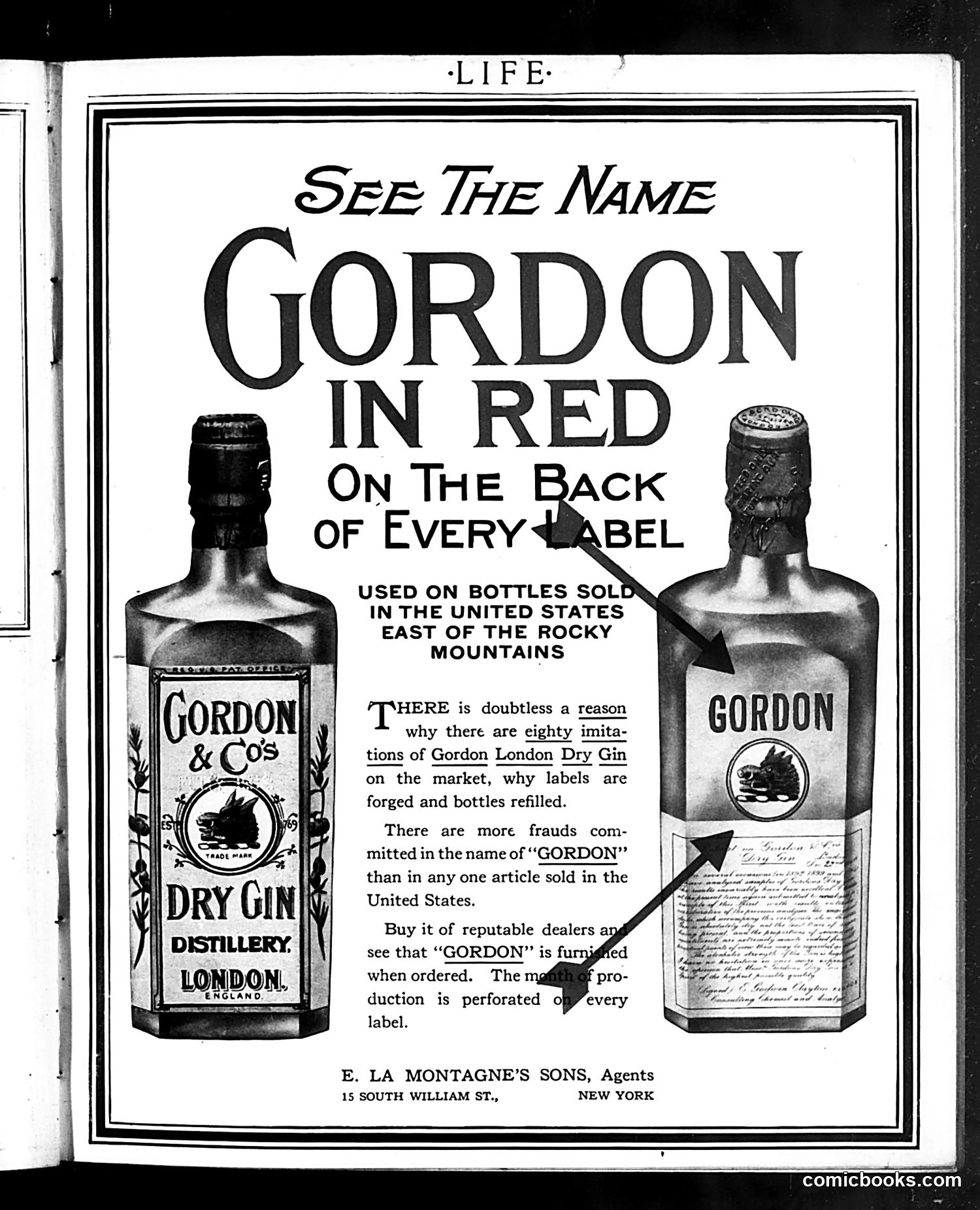
This is a **product advertisement**, not a political cartoon. Gordon's London Dry Gin warns consumers about counterfeit products flooding the American market east of the Rocky Mountains. The ad claims eighty imitations exist, with forged labels and refilled bottles circulating widely. The page shows two gin bottles side-by-side—apparently to help readers distinguish genuine from fake Gordon's. The advertisement advises purchasing from reputable dealers and checking that bottles are properly sealed and labeled. E. La Montagne's Sons, the New York agents, emphasize that more frauds occur under the "Gordon" name than any other product sold in the United States. This reflects early 20th-century concerns about product authenticity and counterfeit alcohol, particularly relevant during Prohibition-era smuggling and bootlegging.
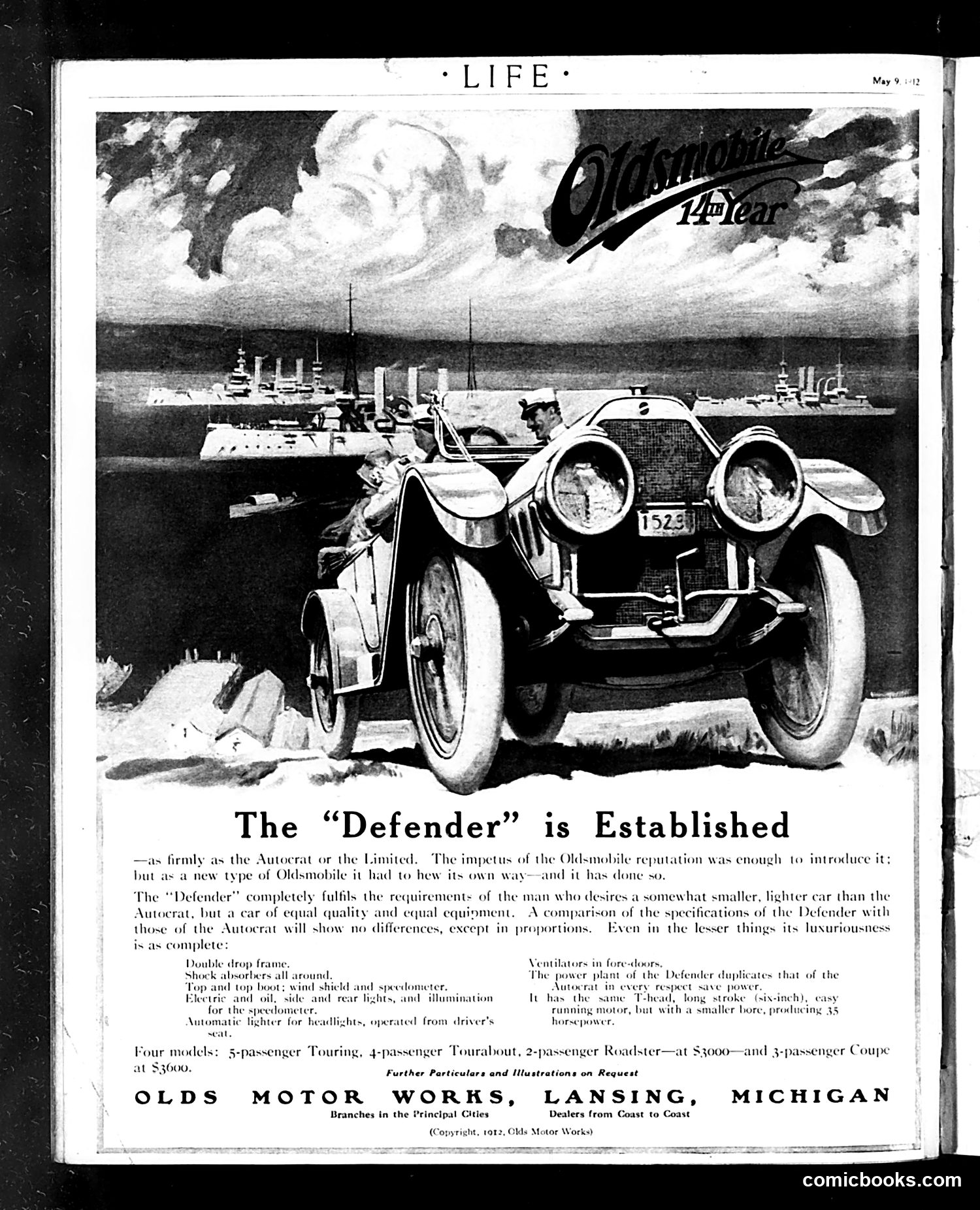
This is primarily **automobile advertising**, not political satire. The page promotes Oldsmobile's new "Defender" model (1912). The image shows two early automobiles positioned against a naval backdrop with battleships. The "Defender" name appears intentionally patriotic—evoking naval defense and American industrial strength during an era of international tension. The text emphasizes that the Defender is a smaller, lighter alternative to Oldsmobile's "Autocrat" model, offering equal quality at lower cost ($3,000). The naval setting suggests American technological prowess and reliability. There is **no political cartoon or satire** here. The military imagery serves purely as advertising rhetoric: positioning the car as a worthy American product comparable to military vessels. This reflected common early-1900s advertising practice of linking consumer goods to national pride and industrial capability. The page is straightforward product promotion dressed in patriotic symbolism.