
Life, 1912-05-09 · page 19 of 48
Life — May 9, 1912 — page 19: what you’re looking at
What you’re looking at
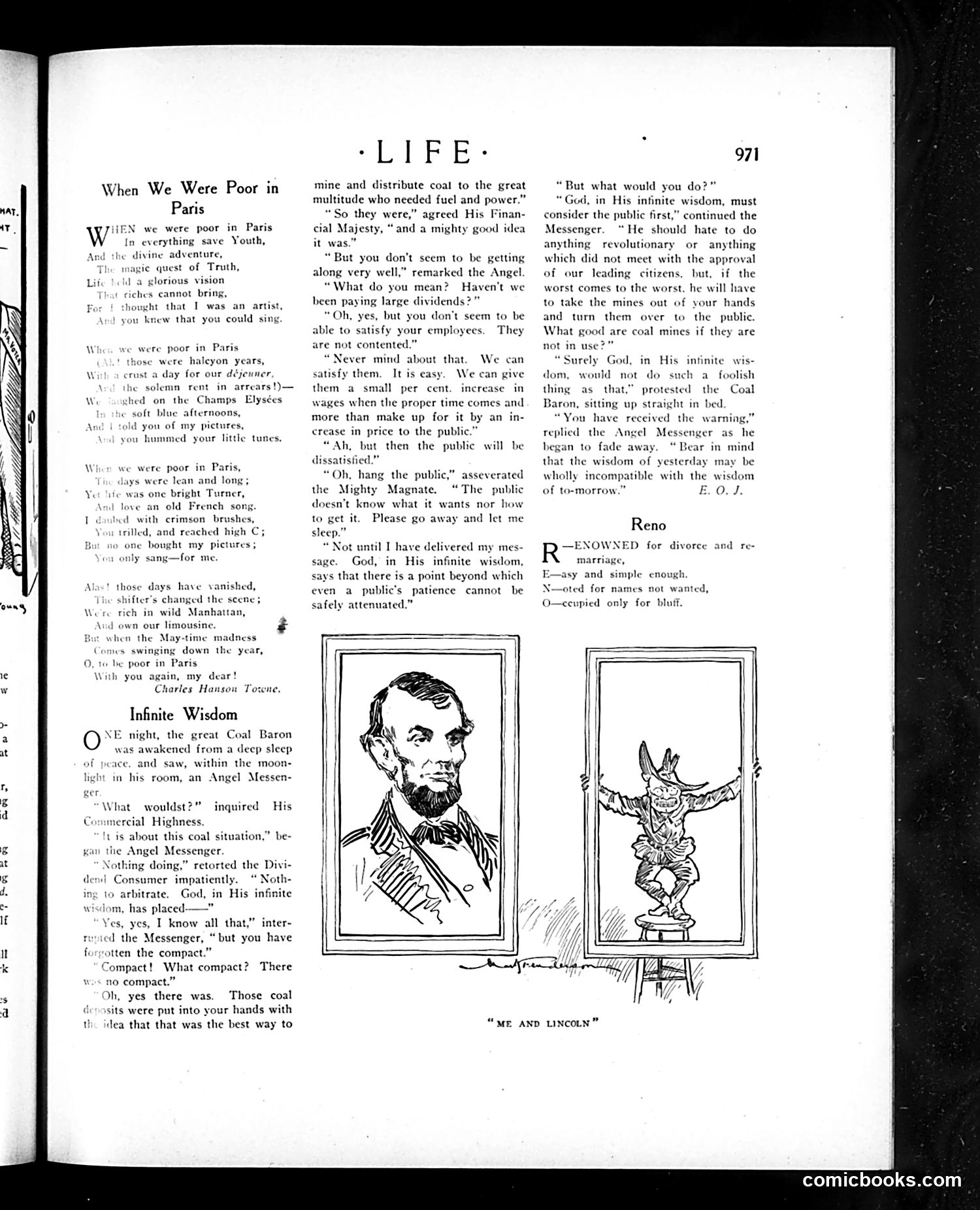
This page contains two distinct pieces of satire: **"When We Were Poor in Paris"** is a nostalgic poem by Charles Hanson Towne contrasting romantic poverty in Paris with wealthy but empty modern life in Manhattan—a commentary on lost artistic authenticity amid material success. **"Infinite Wisdom"** is the primary satire. It depicts a Coal Baron being visited by an Angel Messenger who warns him that God demands he treat coal workers and the public fairly. The Baron dismissively refuses, prioritizing profits over workers' wages and public welfare. The Angel threatens divine intervention—God will seize the coal mines if the Baron doesn't reform. This satirizes early 20th-century industrialists' arrogant disregard for labor rights and public needs during labor unrest and coal strikes. **"Me and Lincoln"** shows two illustrations labeled as such—likely contrasting the Coal Baron's portrait with Lincoln's, implying the Baron lacks Lincoln's moral character or leadership. The overall page critiques wealthy industrialists' callousness toward workers and consumers during this era of significant labor conflict.
📄 Transcribed text from this page (OCR, searchable)
Machine-transcribed from the original scan — historical spelling and the odd misread are preserved.
When We Were Poor in Paris iEN we were poor in Paris And the divine adventure, ic quest of Truth, a glorious vision | riches cannot bring, ght that I was an artist, } you knew that you could sing. ve were poor in Paris ' those were haleyon years, crust a day for our déjeuner © solemn rent in arrears !)— hed on the Champs Elysées © soft blue afternoons, you of my pictur you hummed your little tunes. we were poor in Paris, days were lean and long; was one bright Turner, love an old French song. | with crimson brushes, irilled, and reached high C; one bought my pictures; y sang—for me t those days have vanished, shifter’s changed the scen rich in wild Manhattan, own our limousine. Fs B when the May-time madness Comes swinging down the year, 0, te be poor in Paris With you again, my dear! Charles Hanson To Infinite Wisdom Or night, the great Coal Baron was awakened from a deep sleep of peace, and saw, within the moon- light in his room, an Angel Messen- ger What wouldst?” inquired His mercial Highness. {is about this coal situation,” be- the Angel Messenger. Nothing doing,” retorted the Divi- den! Consumer impatiently.“ Noth- ing to arbitrate. God, in His infinite iom, has placed — Yes, yes, I know all that,” inter ed the Messenger, “but you have forvotten the compact.” Compact! What compact? There no compact.” Dh, yes there was. Those coal sits were put into your hands with dea that that was the best way to ‘LIP EB mine and distribute coal to the great multitude who needed fuel and power.” “So they were,” agreed His Finan- cial Majesty, “and a mighty good idea it was.” “But you don’t seem to be getting along very well,” remarked the Angel “What do you mean? Haven't we been paying large dividends “Oh, yes, but you don’t seem to be able to satisfy your employees. They are not contented.’ “Never mind about that satisfy them. It is easy them a small per cent. increase in wages when the proper time comes and more than make up for it by an in- crease in price to the public.” “Ah, but then the public will be dissatisfied.” “Oh, hang the public, the Mighty Magnate, doesn’t know what it wants nor how to get it. Please go away and let me We can We can give sseverated “The public sleet Not until I have delivered my mes- sage. God, in His infinite wisdom, says that there is a point beyond which even a public’s patience cannot be safely attenuated.” “But what would you do? “God, in His infinite wisdom, must consider the public first,” continued the Messenger. “He should hate to do anything revolutionary or anything which did not meet with the approval of our leading citizens, but, if the worst comes to the worst. he will have to takerthe eines out of your bands and turn them over to. the public. What good are coal mines if they are not in use?” “Surely God, in His intinite wis- dom, would not do such a_ foolish thing as that,” protested the Coal Baron, sitting up straight in bed. “You have received the warning,” replied the Angel Messenger as he began to fade away dear in mind that the wisdom of yesterday may be wholly incompatible with the wisdom of to-morrow.” BE. OWS. Reno —ENOWNED for divorce marriage, —asy and simple enough. N—oted for names not wanted, O—ceupied only for bluff. “ME AND LINCOLN” comicbooks.com