
Life, 1912-05-09 · page 26 of 48
Life — May 9, 1912 — page 26: what you’re looking at
What you’re looking at
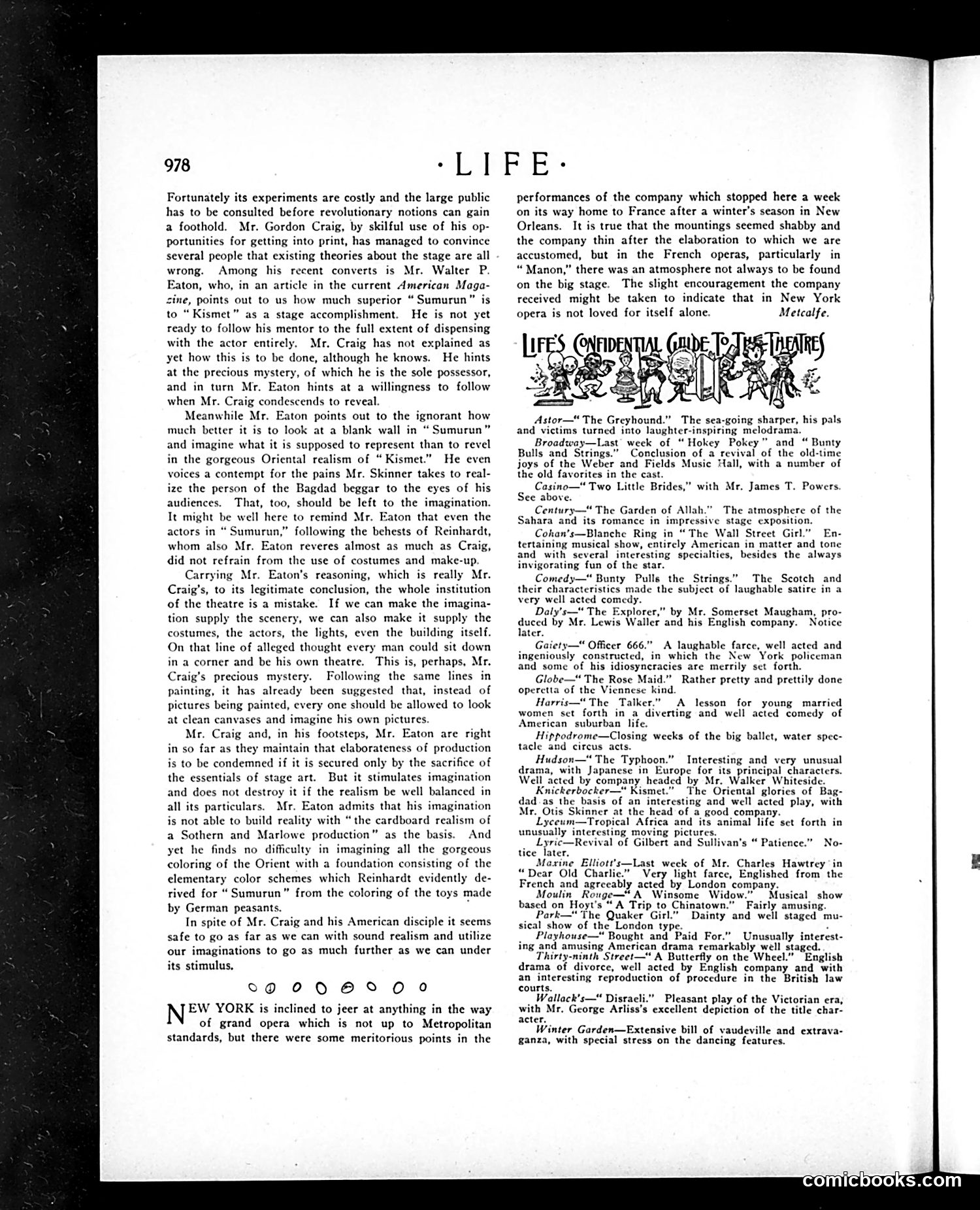
This page contains theater criticism without cartoons. The main article debates stage design philosophy between theatrical innovators Gordon Craig and Walter P. Eaton versus traditional practitioners. **The Satire:** Life mocks Craig and Eaton's avant-garde theory that audiences should imagine scenery rather than see realistic sets. The critic argues this logic taken to extremes would eliminate actors, costumes, and even theater buildings themselves—reducing theater to "a man in a corner being his own theatre." **The Point:** Life defends balanced theatrical realism, arguing that while elaborate production shouldn't sacrifice artistry, completely bare stages don't enhance imagination—they undermine it. The piece uses reductio ad absurdum, extending Craig's minimalist philosophy to absurd conclusions to expose its flaws. The secondary item briefly reviews a visiting French opera company, noting their productions seemed shabby compared to Metropolitan Opera standards, though they offered atmospheric qualities in works like "Manon."
📄 Transcribed text from this page (OCR, searchable)
Machine-transcribed from the original scan — historical spelling and the odd misread are preserved.
978 -LIFE- Fortunately its experiments are costly and the large public has to be consulted before revolutionary notions can gain a foothold. Mr. Gordon Craig, by skilful use of his op- portunities for getting into print, has managed to convince several people that existing theories about the stage are all wrong. Among his recent converts is Mr. Walter P. Eaton, who, in an article in the current American Maga- sine, points out to us how much superior “ Sumurun” is to “Kismet” as a stage accomplishment. He is not yet ready to follow his mentor to the full extent of dispensing with the actor entirely, Mr. Craig has not explained as yet how this is to be done, although he knows. He hints at the precious mystery, of which he is the sole possessor, and in turn Mr. Eaton hints at a willingness to follow when Mr. Craig condescends to reveal. Meanwhile Mr. Eaton points out to the ignorant how much better it is to look at a blank wall in “ Sumurun” and imagine what it is supposed to represent than to revel in the gorgeous Oriental realism of “Kismet.” He even voices a contempt for the pains Mr. Skinner takes to real- ize the person of the Bagdad beggar to the eyes of his audiences. That, too, should be left to the imagination. It might be well here to remind Mr. Eaton that even the actors in “ Sumurun,” following the behests of Reinhardt, whom also Mr. Eaton reveres almost as much as Craig, did not refrain from the use of costumes and make-up. Carrying Mr. Eaton's reasoning, which is really Mr. Craig’s, to its legitimate conclusion, the whole institution of the theatre is a mistake. If we can make the imagina- tion supply the scenery, we can also make it supply the costumes, the actors, the lights, even the building itself. On that line of alleged thought every man could sit down in a corner and be his own theatre. This is, perhaps, Mr. Craig’s precious myster, Following the same lines in painting, it has already been suggested that, instead of pictures being painted, every one should be allowed to look at clean canvases and imagine his own pictures. Mr. Craig and, in his footsteps, Mr. Eaton are right in so far as they maintain that elaborateness of production is to be condemned if it is secured only by the sacrifice of the essentials of stage art. But it stimulates imagination and does not destroy it if the realism be well balanced in all its particulars. Mr. Eaton admits that his imagination is not able to build reality with “the cardboard realism of a Sothern and Marlowe production” as the basis. And yet he finds no difficulty in imagining all the gorgeous coloring of the Orient with a foundation consisting of the elementary color schemes which Reinhardt evidently de- rived for “Sumurun” from the coloring of the toys made by German peasants. In spite of Mr. Craig and his American disciple it seems safe to go as far as we can with sound realism and utilize our imaginations to go as much further as we can under its stimulus, ca 00688900 EW YORK is inclined to jeer at anything in the way of grand opera which is not up to Metropolitan standards, but there were some meritorious points in the performances of the company which stopped here a week on its way home to France after a winter's season in New Orleans. It is true that the mountings seemed shabby and the company thin after the elaboration to which we are accustomed, but in the French operas, particularly in “Manon,” there was an atmosphere not always to be found on the big stage. The slight encouragement the company received might be taken to indicate that in New York opera is not loved for itself alone. Metcalfe. Astor—" The Greyhound.” The sea-going sharper, his pals and victims turned into laughter-inspiring melodrama. Broadway—Last week of “Hokey Pokey” and “ Bunty Bulls and Strings.” Conclusion of a revival of the old-time joys of the Weber and Fields Music Hall, with a number of the old favorites in the cast. Casino—" Two Little Brides,” with Mr. James T. Powers. See above. Century—" The Garden of Allah.” The atmosphere of the Sahara and its romance in impressive stage exposition. Cohan’s—Blanche Ring in “The Wall Street Girl.” En- tertaining musical show, entirely American in matter and tone and with several interesting specialties, besides the always invigorating fun of the star. Comedy—“ Bunty Pulls the Strings.” The Scotch and their characteristics made the subject of laughable satire in a very well acted comedy. Daly’s—" The Explorer,” by Mr. Somerset Maugham, pro- duced by Mr. Lewis Waller and his English company. Notice later. Gaiety—“ Officer 666.” A laughable farce, well acted and ingeniously constructed, in which the New York policeman and some of his idiosyncracies are merrily set forth. Globe—" The Rose Maid.” Rather pretty and prettily done operctta of the Viennese kind. Harris— The Talker.” A lesson for young married women set forth in a diverting and well acted comedy of American suburban life. Hippodrome—Closing wecks of the big ballet, water spec- tacle and circus acts. Hudson— The Typhoon.” Interesting and very unusual drama, with Japanese in Europe for its principal characters. Well acted by company headed by Mr. Walker Whiteside. Knickerbocker— Kismet.” The Oriental glories of Bag- dad-as the basis of an interesting and well acted play, with Mr. Otis Skinner at the head of a good company. Lyceum—Tropical Africa and its animal life set forth in unusually interesting moving pictures. Lyric—Revival of Gilbert and Sullivan's “ Patience.” No- tice later. Maxine Elliott's—Last week of Mr. Charles Hawtrey’in “Dear Old Charlie.” “Very light farce, Englished from the French and agreeably acted by London ‘company. Moulin Rouge—" A Winsome Widow.” Musical show based on Hoyt's “A Trip to Chinatown.” Fairly amusing. Park—"‘The Quaker Girl.” Dainty and well staged mu- sical show of the London type. : Playhouse—" Bought and Paid For.” Unusually interest- ing and amusing American drama remarkably well staged. Thirty-ninth Street— A Butterfly on the Wheel.” English drama of divorce, well acted by English company and with an interesting reproduction of procedure in the British law courts. _ Wallack's— Disracli.” Pleasant play of the Victorian era, with Mr. George Arliss’s excellent depiction of the title char- acter, Winter Garden—Extensive bill of vaudeville and extrava- ganza, with special stress on the dancing features. Comicbooks.com