
Life, 1912-05-09 · page 11 of 48
Life — May 9, 1912 — page 11: what you’re looking at
What you’re looking at
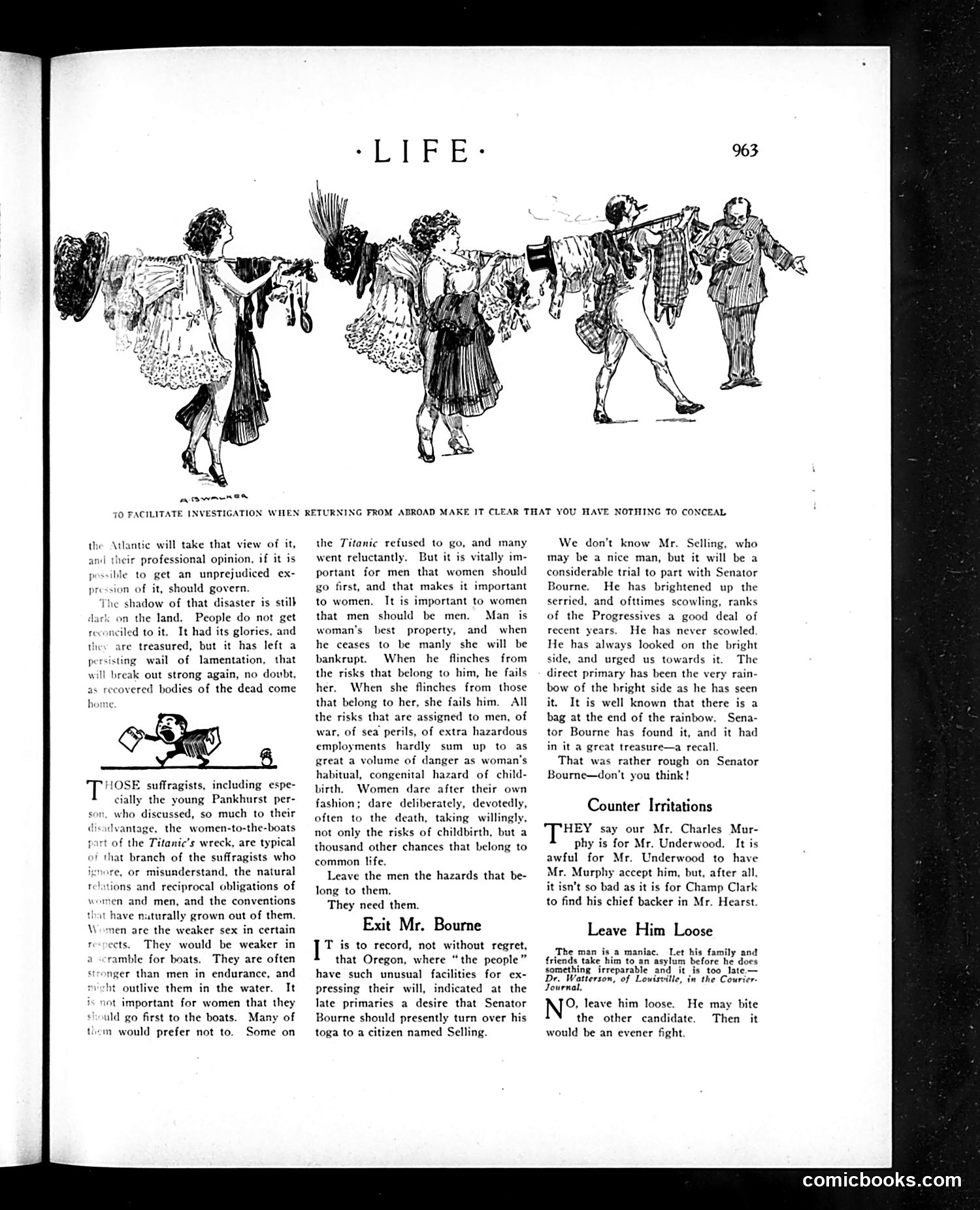
This 1963 *Life* magazine page satirizes early 20th-century gender politics and the Titanic disaster. The cartoon at top shows women returning from abroad displaying their purchases—a visual jab at women as consumers. The main text critiques suffragists and debates proper gender roles following the Titanic wreck. It argues that women should prioritize femininity and domesticity over activism, claiming "women are the weaker sex in certain respects." The piece sarcastically suggests women shouldn't board lifeboats first, contradicting actual Titanic protocol ("women and children first"). The sections "Exit Mr. Bourne" and "Counter Irritations" appear to be brief satirical notes about political figures, though specific identities remain unclear from this excerpt alone.
📄 Transcribed text from this page (OCR, searchable)
Machine-transcribed from the original scan — historical spelling and the odd misread are preserved.
WRENS TO FACILITATE INVESTIGATION WHEN RETURD the Atlantic will take that view of it, anil their professional opinion, if it is possible to get an unprejudiced ex- sion of it, should govern. adow of that disaster is stilh People do not get dark on the land. reconciled to it. It had its glories, and they are treasured, but it has left a persisting wail of lamentation, that will k out strong again, no doubt, recovered bodies of the dead come home 2 suffragists, including espe- the young Pankhurst per- who discussed, so much to their dvantage, the women-to-the-boats. of the Titanic’s wreck, are typical t branch of the suffragists who . or misunderstand, the natural ns and reciprocal obligations of n and men, and the conventions ave nutttrally grown out of them. men are the weaker sex in certain ects. They would be weaker in ramble for boats. They are often nger than men in endurance, and pveht outlive them in the water. It ot important for women that they should go first to the boats. Many of tiem would prefer not to. Some on the Titanic refused to go, and many went reluctantly, But it is vitally im- portant for men that women should go first, and that makes it important to women. It is important to women that men should be men. Man is woman's best property, and when he ceases to be manly she will be bankrupt. When he flinches from the risks that belong to him, he fails her. When she flinches from those that belong to her, she fails him. All the risks that are assigned to men, of war, of sea perils, of extra hazardous employments hardly sum up to as great a volume of danger as woman's habitual, congenital hazard of child- birth. Women dare after their own fashion; dare deliberately, devotedly, often to the death, taking willingly, not only the risks of childbirth, but a thousand other chances that belong to common life. Leave the men the hazards that be- long to them. They need them. Exit Mr. Bourne T is to record, not without regret, that Oregon, where “the people” have such unusual facilities for ex- pressing their will, indicated at the late primaries a desire that Senator Bourne should presently turn over his toga to a citizen named Selling. NG FROM ABROAD MAKE IT CLEAR THAT YOU HAVE NOTHING TO CONCEAL We don’t know Mr. Selling, who may be a nice man, but it will be a considerable trial to part with Senator Bourne. He has brightened up the serried, and ofttimes scowling, ranks of the Progressives a good deal of recent years. He has never scowled He has alw: looked on the bright side, and urged us towards it. The direct primary has been the very rain- bow of the bright side as he has seen it. It is well known that there is a bag at the end of the rainbow. Sena- tor Bourne has found it, and it had in it a great treasure—a recall. That was rather rough on Senator Bourne—don't you think! Counter Irritations THEY say our Mr. Charles Mur- phy is for Mr. Underwood. It is awful for Mr. Underwood to have Mr. Murphy accept him, but, after all, it isn’t so bad as it is for Champ Clark to find his chief backer in Mr. Hearst. Leave Him Loose The man is a maniac. Let his family and friends take him to an asylum before he does something irreparable and it is too late— Dr. Watterson, of Lowisville, in the Courier journal, O, leave him loose. He may bite the other candidate. Then it would be an evener fight. comicbooks.com