
Life, 1912-05-09 · page 20 of 48
Life — May 9, 1912 — page 20: what you’re looking at
What you’re looking at
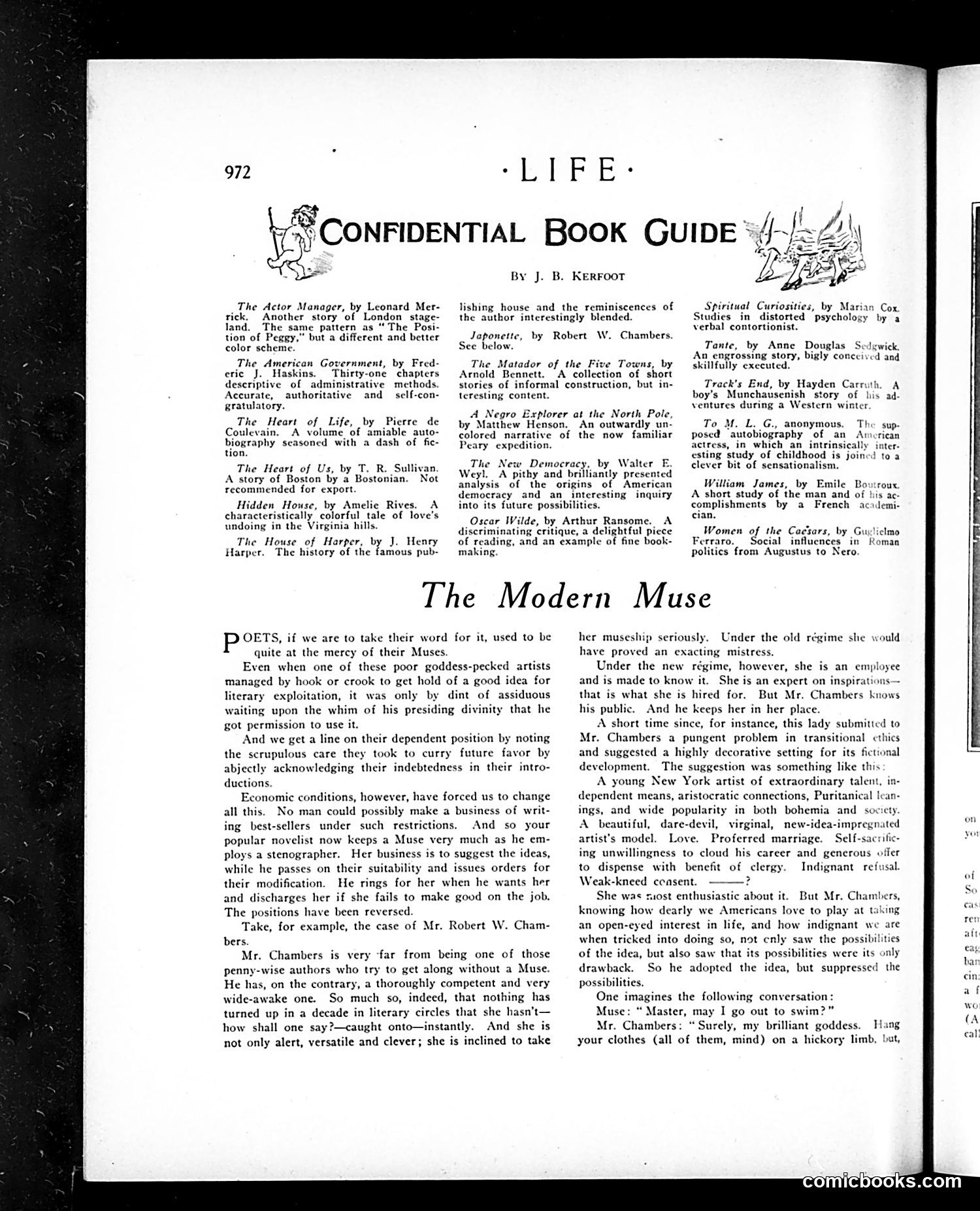
This is a satirical essay by J.B. Kerfoot critiquing how modern commercial publishing has transformed the relationship between artists and inspiration. Kerfoot argues that in classical tradition, poets were subservient to their Muses—waiting obediently for divine inspiration. Today's popular novelists, however, have inverted this hierarchy. Economic pressure to produce bestsellers has forced writers to treat their Muse as an employee—a stenographer who generates ideas on demand, which the author then approves or rejects. The writer now "discharges her if she fails to make good on the job." The essay uses Robert W. Chambers as a contemporary example of an author who maintains such a "thoroughly competent and very wide-awake" Muse. The satire critiques how commercialism has reduced artistic inspiration from sacred mystery to factory-floor efficiency, with the writer as boss managing subordinate creativity.
📄 Transcribed text from this page (OCR, searchable)
Machine-transcribed from the original scan — historical spelling and the odd misread are preserved.
© CONFIDENTIAL BOOK GUIDE * 4 The Actor Manager, by Leonard Mer- rick, Another story ‘of London stag land. The same pattern as “The Posi tion of Peggy,” but a different and better color scheme. The American Government, by Fred- eric J. Haskins. Thirty-one chapters descriptive of administrative methods. Accurate, authoritative and self-con- gratulatory. The Heart of Life, by Pierre de Coulevain, A volume of amiable auto- biography seasoned with a dash of fic- tion, The Heart of Us, by T. R. Sullivan A story of Boston by a Bostonian. Not recommended for export Hidden House, by Amelie Rives. A characteristically' colorful tale of love's undoing in the Virginia hills. The House of Harper, vy J. Henry Harper. The history of the famous pub- “EES By J. B. KERFOOT lishing house and the reminiscences of the author interestingly blended. Japonette, by Robert W. Chambers. See below. The Matador of the Five Towns, by Arnold Bennett. A collection of short stories of informal construction, but in- teresting content. A Negro Explorer at the North Pole, by Matthew Henson. An outwardly un- colored rative of the now familiar Peary expedition. The New Democracy, by Walter E, Weyl. A pithy and brilliantly presented analysis of the origins of American democracy and an interesting inquiry into its future possibilities. Oscar Wilde, by Arthur Ransome. A discriminating critique, a delightful piece of reading, and an example of fine book- making. Wa Spiritual Curiosities, by Marian Cox Studies in distorted ‘psychology by a verbal contortionist. Tante, by Anne Douglas Sedgwick. An engrossing story, bigly conceived and skillfully executed. Track's End, by Hayden Carr boy’s Munchausenish story of lis ad- ventures during a Western winter To M. L. G., anonymous. The sup- posed autobiography of an Anicriean actress, in which an intrinsically inter- esting study of childhood is joined to a clever bit of sensationalism. William James, by Emile Boutrour A short study of the man and of his ac- complishments by a French academi- cian, Women of the Cacsars, by Guyliclmo Ferraro. Social influences in Roman politics from Augustus to Nero. The Modern Muse OETS, if we are to take their word for it, used to be her museship seriously. Under the old régime she would quite at the mercy of their Muses. Even when one of these poor goddess-pecked artists managed by hook or crook to get hold of a good idea for literary exploitation, it was only by dint of assiduous waiting upon the whim of his presiding divinity that he got permission to use it. And we get a line on their dependent position by noting the scrupulous care they took to curry future favor by abjectly acknowledging their indebtedness in their intro- ductions. Economic conditions, however, have forced us to change all this. No man could possibly make a business of writ- ing best-sellers under such restrictions. And so your popular novelist now keeps a Muse very much as he em- ploys a stenographer. Her business is to suggest the ideas, while he passes on their suitability and issues orders for their modification. He rings for her when he wants her and discharges her if she fails to make good on the job. The positions have been reversed. Take, for example, the case of Mr. Robert W. Cham- bers. Mr. Chambers is very ‘far from being one of those penny-wise authors who try to get along without a Muse. He has, on the contrary, a thoroughly competent and very wide-awake one. So much so, indeed, that nothing has turned up in a decade in literary circles that she hasn’t— how shall one say?—caught onto—instantly. And she is not only alert, versatile and clever; she is inclined to take have proved an exacting mistress. Under the new régime, however, she is an employee and is made to know it. She is an expert on inspirations— that is what she is hired for. But Mr. Chambers knows his public. And he keeps her in her place. A short time since, for instance, this lady submitted to Mr. Chambers a pungent problem in transitional and suggested a highly decorative setting for its ficti development. The suggestion was something like this A young New York artist of extraordinary talent dependent means, aristocratic connections, Puritanical lean- ings, and wide popularity in both bohemia and society A. beautiful, dare-devil, virginal, new-idea-impregnated artist's model. Love. Proferred marriage. Self-sacrilic- ing unwillingness to cloud his career and generous « to dispense with benefit of clergy. Indignant refusal. Weak-kneed ceasent. ——— She was ruost enthusiastic about it. But Mr. Chambers, knowing how dearly we Americans love to play at is an open-eyed interest in life, and how indignant we are when tricked into doing so, not cnly saw the possibilities of the idea, but also saw that its possibilities were its only drawback. So he adopted the idea, but suppressed the possibilities. One imagines the following conversation Muse: “ Master, may I go out to swim?” Mr. Chambers: “Surely, my brilliant goddess. Hang your clothes (all of them, mind) on a hickory limb, but, Comicbooks.com