
Life, 1912-05-09 · page 23 of 48
Life — May 9, 1912 — page 23: what you’re looking at
What you’re looking at
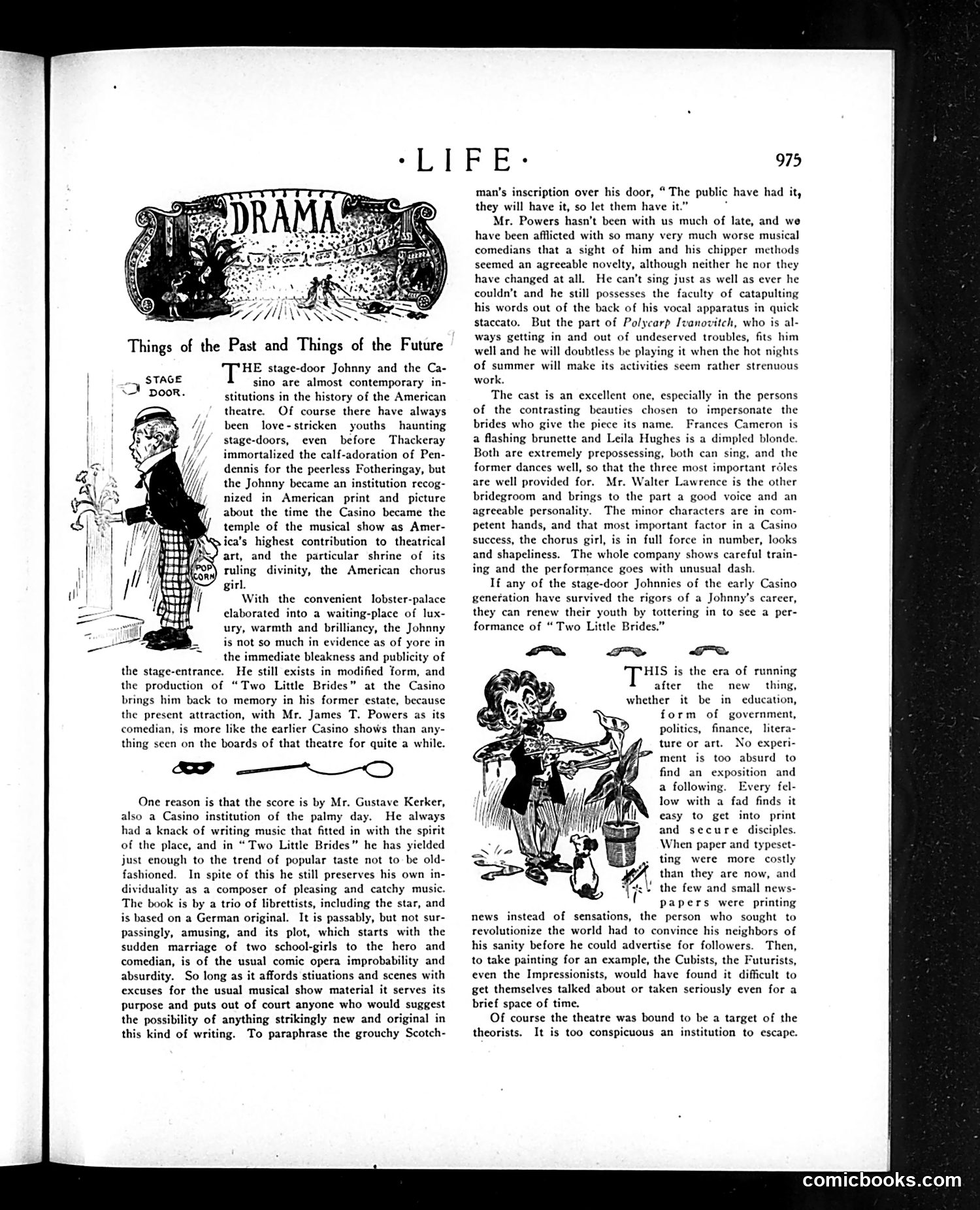
This page reviews the Broadway musical comedy "Two Little Brides" at the Casino Theatre, starring James T. Powers. The "Stage Door" illustration shows a stereotypical "stage-door Johnny"—a wealthy, lovestruck man who frequented theater stage entrances hoping to court chorus girls, a recognizable figure in late 19th-century American popular culture. The review nostalgia contrasts the current production with earlier Casino shows, noting Powers' unchanged comedic style (singing poorly but delivering jokes rapidly in "staccato"). The critic praises the female leads' looks and abilities, particularly praising the chorus girls—the Casino's "ruling divinity"—reflecting period attitudes valuing female performers' appearance alongside talent. The concluding cynicism—adapting a Scottish saying that audiences want familiar entertainment, not innovation—captures the critic's resigned acceptance that commercial theater prioritizes repetition over originality.
📄 Transcribed text from this page (OCR, searchable)
Machine-transcribed from the original scan — historical spelling and the odd misread are preserved.
*-LIFE-: Things of the Past and Things of the Future Ee stage-door Johnny and the Ca- sino are almost contemporary in- stitutions in the history of the American theatre. Of course there have always been love-stricken youths haunting stage-doors, even before Thackeray immortalized the calf-adoration of Pen- dennis for the peerless Fotheringay, but the Johnny became an institution recog- nized in American print and picture about the time the Casino became the temple of the musical show as Amer- ica’s highest contribution to theatrical art, and the particular shrine of its ruling divinity, the American chorus girl. With the convenient lobster-palace elaborated into a waiting-place of lux- ury, warmth and brilliancy, the Johnny is not so much in evidence as of yore in the immediate bleakness and publicity of the stage-entrance. He still exists in modified form, and the production of “Two Little Brides” at the Casino brings him back to memory in his former estate, because the present attraction, with Mr. James T. Powers as its comedian, is more like the earlier Casino shows than any- thing seen on the boards of that theatre for quite a while. er o_O One reason is that the score is by Mr. Gustave Kerker, also a Casino institution of the palmy day. He always had a knack of writing music that fitted in with the spirit of the place, and in “ Two Little Brides” he has yielded just enough to the trend of popular taste not to be old- fashioned. In spite of this he still preserves his own in- dividuality as a composer of pleasing and catchy music. The book is by a trio of librettists, including the star, and is based on a German original. It is passably, but not sur- passingly, amusing, and its plot, which starts with the sudden marriage of two school-girls to the hero and comedian, is of the usual comic opera improbability and absurdity. So long as it affords stiuations and scenes with excuses for the usual musical show material it serves its purpose and puts out of court anyone who would suggest the possibility of anything strikingly new and original in this kind of writing. To paraphrase the grouchy Scotch- STAGE 975 man’s inscription over his door, “ The public have had it, they will have it, so let them have it.” . Mr. Powers hasn't been with us much of late, and we have been afflicted with so many very much worse musical comedians that a sight of him and his chipper methods seemed an agreeable novelty, although neither he nor they have changed at all. He can’t sing just as well as ever he couldn't and he still possesses the faculty of catapulting his words out of the back of his vocal apparatus in quick staccato. But the part of Polycarp Ivanovitch, who is al- ways getting in and out of undeserved troubles, fits him well and he will doubtless be playing it when the hot nights of summer will make its activities seem rather strenuous work, The cast is an excellent one, especially in the persons of the contrasting beauties chosen to impersonate the brides who give the piece its name. Frances Cameron is a flashing brunette and Leila Hughes is a dimpled blonde. Both are extremely prepossessing, both can sing, and the former dances well, so that the three most important réles are well provided for. Mr. Walter Lawrence is the other bridegroom and brings to the part a good voice and an agreeable personality. The minor characters are in com- petent hands, and that most important factor in a Casino success, the chorus girl, is in full force in number, looks and shapeliness. The whole company shows careful train- ing and the performance goes with unusual dash. If any of the stage-door Johnnies of the early Casino generation have survived the rigors of a Johnny’s career, they can renew their youth by tottering in to see a per- formance of “ Two Little Brides,” Fu Fe HIS is the era of running after the new thing, whether it be in education, form of government, politics, finance, litera- ture or art. No experi- ment is too absurd to find an exposition and a following. Every fel- low with a fad finds it easy to get into print and secure disciples. When paper and typeset- ting were more costly than they are now, and the few and small news- papers were printing aid cad of sensations, the person who sought to revolutionize the world had to convince his neighbors of his sanity before he could advertise for followers. Then, to take painting for an example, the Cubists, the Futurists, even the Impressionists, would have found it difficult to get themselves talked about or taken seriously even for a brief space of time. Of course the theatre was bound to be a target of the theorists. It is too conspicuous an institution to escape. comicbooks.com