
Life, 1912-05-09 · page 18 of 48
Life — May 9, 1912 — page 18: what you’re looking at
What you’re looking at
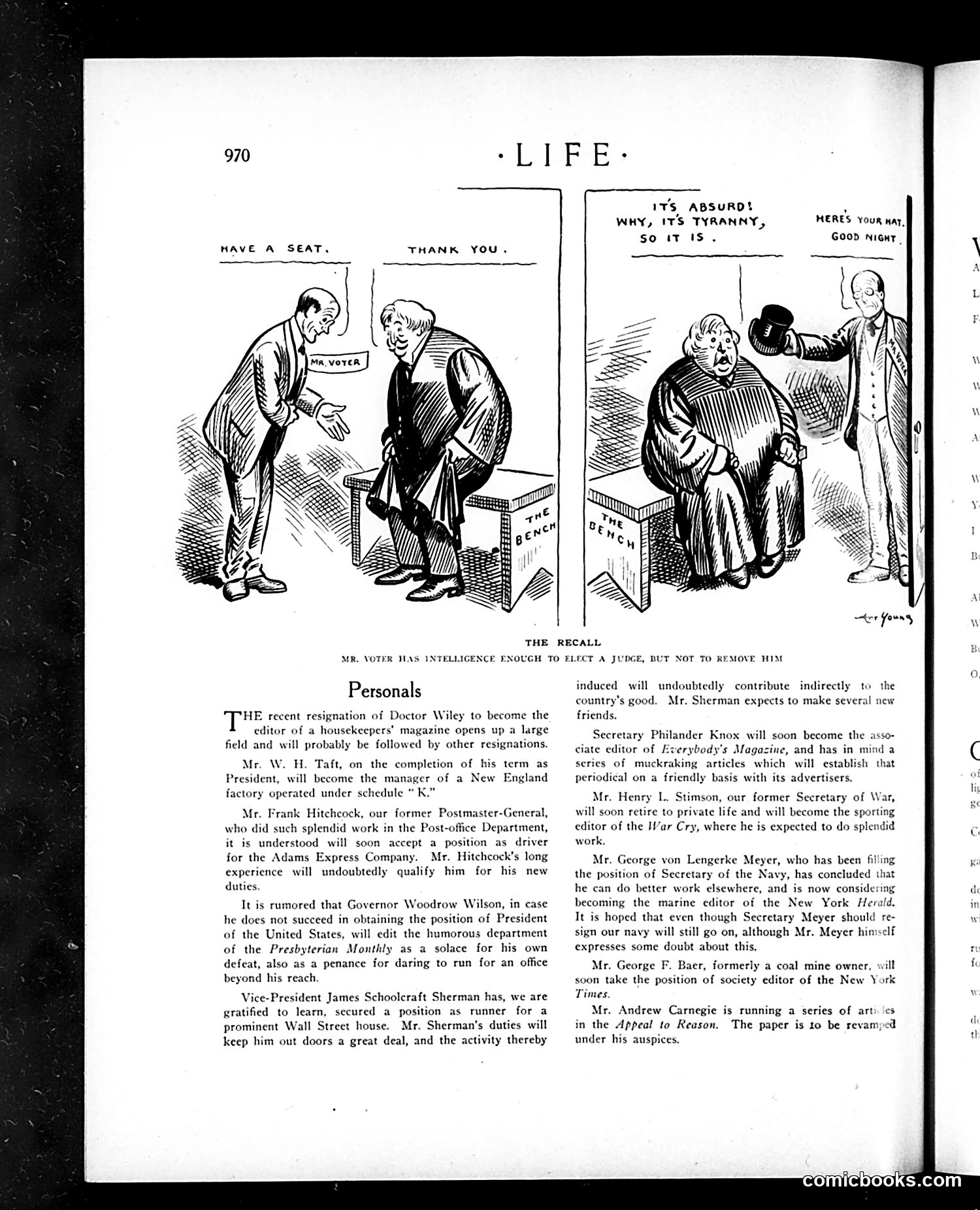
This cartoon satirizes the progressive-era "recall" movement—a reform allowing voters to remove elected officials before their term ended. The caption's point is caustic: voters supposedly have enough judgment to *elect* judges but not enough to *remove* them—a logical absurdity the cartoon highlights through contrasting scenes. The left panel shows "Mr. Voter" deferentially accepting a seat, thanking an official. The right panel reverses this: the same voter sits while being told "it's absurd! Why, it's tyranny, so it is"—mocking the arguments opponents made against recall provisions. The cartoon suggests such objections were hypocritical: if citizens are trusted to choose judges initially, denying them removal power is indeed arbitrary. The "Personals" section below uses satirical mock-promotions of real Taft administration officials, imagining their supposed post-office employment in comically unsuitable roles—a separate but contemporary jab at political figures.
📄 Transcribed text from this page (OCR, searchable)
Machine-transcribed from the original scan — historical spelling and the odd misread are preserved.
HAVE A SEAT, THANK YOU. ITS ABSURD WHY, ITS TYRANNY, so its. HERES Your nar, Good NiGHT er fous THE RECALL MR. VOTER HAS INTELLIGENCE ENOUGH TO ELECT A JUDGE, BUT NOT TO REMOVE HIM Personals HE recent resignation of Doctor Wiley to become the editor of a housekeepers’ magazine opens up a large field and will probably be followed by other resignations. Mr. W. H. Taft, on the completion of his term as President, will become the manager of a New England ory operated under schedule * K.” Mr. Frank Hitchcock, our former Postmaster-General, who did such splendid work in the Post-office Department, it is understood will soon accept a position as driver for the Adams Express Company. Mr. Hitchcock's long experience will undoubtedly qualify him for his new duties. It is rumored that Governor Woodrow Wilson, in case he does not succeed in obtaining the position of President of the United States, will edit the humorous department of the Presbyterian Monthly as a solace for his own defeat, also as a penance for daring to run for an office beyond his reach. Vice-President James Schoolcraft Sherman has, we are gratified to learn, secured a position as runner for a prominent Wall Street house. Mr. Sherman's duties will keep him out doors a great deal, and the activity thereby induced will undoubtedly contribute indirectly to the country’s good. Mr, Sherman expects to make several new friends. Secretary Philander Knox will soon become the asso- ciate editor of Everybody's Magazine, and has in mind a series of muckraking articles which will establish that periodical on a friendly basis with its advertisers. Mr. Henry L. Stimson, our former Secretary of War, will soon retire to private life and will become the sporting editor of the War Cry, where he is expected to do splendid work. Mr. George von Lengerke Meyer, who has been filling the position of Secretary of the Navy, has concluded that he can do better work elsewhere, and is now considering becoming the marine editor of the New York Herald. It is hoped that even though Secretary Meyer should re- sign our navy will still go on, although Mr. Meyer himself expresses some doubt about this. Mr. George F. Baer, formerly a coal mine owner, soon take the position of society editor of the New Y Times. Mr. Andrew Carnegie is running a series of art in the Appeal to Reason. The paper is to be revampe under his auspices.