
Life, 1912-05-09 · page 10 of 48
Life — May 9, 1912 — page 10: what you’re looking at
What you’re looking at
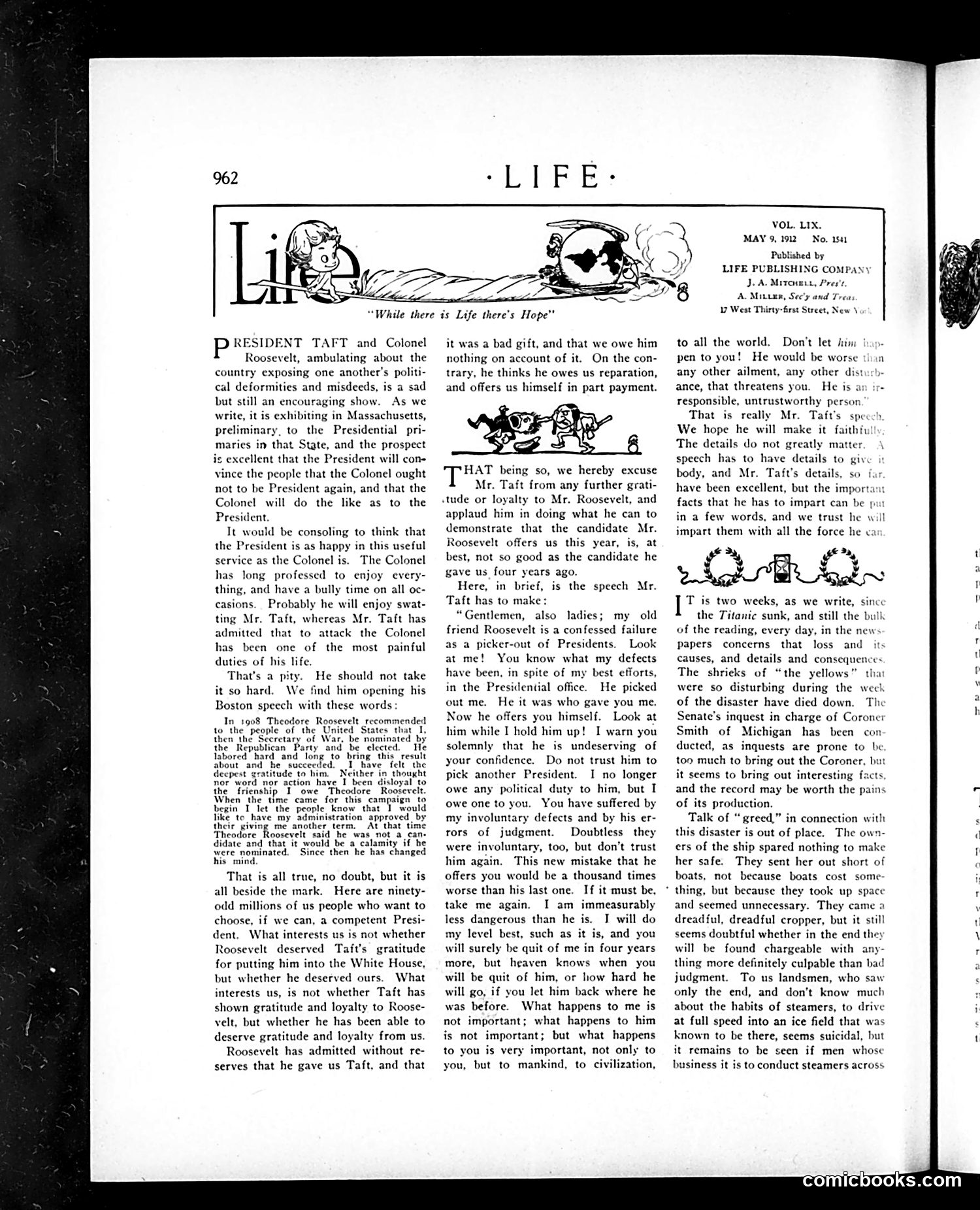
This page discusses President Taft and Colonel Roosevelt's political conflict during the 1912 presidential campaign. The text criticizes Taft's position, asserting he owes Roosevelt gratitude for his presidency but should not receive "further gratitude or loyalty." It presents Roosevelt's candidacy as superior to Taft's, implying Taft was a disappointing successor. The cartoon at top (captioned "While there is Life there's Hope") appears to depict these two political figures in conflict, using Life magazine's characteristic satirical humor. The page also discusses the recent Titanic sinking, connecting maritime disaster management to broader questions about trustworthiness in leadership—a metaphorical link between Taft's competence and ship captains' judgment.
📄 Transcribed text from this page (OCR, searchable)
Machine-transcribed from the original scan — historical spelling and the odd misread are preserved.
“While there is Life there's Hope" P RESIDENT TAFT and Colonel Roosevelt, ambulating about the country exposing one another's politi- cal deformities and misdeeds, is a sad but still an encouraging show. As we write, it is exhibiting in Massachusetts, preliminary, to the Presidential pri- maries in that State, and the prospect is excellent that the President will con- vince the people that the Colonel ought not to be President again, and that the Colonel will do the like as to the President. It would be consoling to think that the President is as happy in this useful service as the Colonel is. The Colonel has long professed to enjoy ever, thing, and have a bully time on all oc- casions. Probably he will enjoy swat- ting Mr. Taft, whereas Mr. Taft has admitted that to attack the Colonel has been one of the most painful duties of his life. That's a pity. He should not tal it so hard. We find him opening his Boston speech with these words: In 1908 Theodore Roosevelt recommended to the people of the United States that 1, then the Secretary of War, be nominated by the Republican Party and be elected. He labored hard and long to bring this result about and he succeeded. I have felt. the deepest gratitude to him. | Neither in thought nor word nor action haye I been disloyal to the frienship I owe Theodore Roosevelt. When the time came for this campaign to begin I let the people know that 1 would like to have my administration approved. by their giving me another, term, At that time Theodore Roosevelt said he was not a can- didate and that it would be a calamity if he were nominated. “Since then he has changed That is all true, no doubt, but it is all beside the mark. Here are ninety- odd millions of us people who want to choose, if we can, a competent Presi- dent, What interests us is not whether Roosevelt deserved Taft’s gratitude for putting him into the White House, but whether he deserved ours. What interests us, is not whether Taft has shown gratitude and loyalty to Roose- velt, but whether he has been able to deserve gratitude and loyalty from us. Roosevelt has admitted without re- serves that he gave us Taft, and that it was a bad gift, and that we owe him nothing on account of it. On the con- trary, he thinks he owes us reparation, and offers us himself in part payment. HAT being so, we hereby excuse Mr. Taft from any further gra stude or loyalty to Mr. Roosevelt, and applaud him in doing what he can to demonstrate that the candidate Mr. Roosevelt offers us this year, is, at best, not so good as the candidate he gave us four years ago. Here, in brief, is the speech Mr. Taft has to make: “Gentlemen, also ladies; my old friend Roosevelt is a confessed failure as a picker-out of Presidents. Look at me! You know what my defects have been, in spite of my best efforts, in the Presidential office. He picked out me. He it was who gave you me. Now he offers you himself. Look at him while I hold him up! I warn you solemnly that he is undeserving of your confidence. Do not trust him to pick another President. I no longer owe any political duty to him, but I owe one to you. You have suffered by my involuntary defects and by his er- rors of judgment. Doubtless they were involuntary, too, but don’t trust him again. This new mistake that he offers you would be a thousand times worse than his last one. If it must be, take me again. I am immeasurably less dangerous than he is. I will do my level best, such as it is, and you will surely be quit of me in four years more, but heaven knows when you will be quit of him, or how hard he will go, if you let him back where he was before. What happens to me is not important; what happens to him is not important; but what happens to you is very important, not only to you, but to mankind, to civilization, VOL. LIX. MAY 9, 1912. No. 1si1 Published by LIFE PUBLISHING COMPAN) J. A. Mirounne, Pres’ A. Minune, See’y and Treas W West Thirty-first Street, New \ to all the world. Don’t let hin pen to you! He would be worse any other ailment, any other dist ance, that threatens you. He is a: responsible, untrustworthy person. That is really Mr. Taft's spe We hope he will make it faithfy The details do not greatly matter speech has to have details to giv body, and Mr. Taft's details, so i have been excellent, but the importa: facts that he has to impart can be 1 in a few words, and we trust he will impart them with all the force he ca 2, “ny ~ T is two weeks, as we write, since the Titanic sunk, and still the bulk of the reading, every day, in the new Papers concerns that and its causes, and details and consequences The shrieks of “the yellows” that were so disturbing during the week of the disaster have died down. The Senate's inquest in charge of Coroner Smith of Michigan has been con ducted, as inquests are prone to be too much to bring out the Coroner, but it seems to bring out interesting facts and the record may be worth the pains of its production. Talk of “greed,” in connection with this disaster is out of place. The own- ers of the ship spared nothing to make her safe. They sent her out short of boats, not because boats cost some- thing, but because they took up space and seemed unnecessary. They came dreadful, dreadful cropper, but it still seems doubtful whether in the end they will be found chargeable with any- thing more definitely culpable than bad judgment. To us landsmen, who saw only the end, and don’t know much about the habits of steamers, to drive at full speed into an ice field that was known to be there, seems suicidal, but it remains to be seen if men whose business it is to conduct steamers across loss Comicbooks.com