
Life, 1912-05-09 · page 45 of 48
Life — May 9, 1912 — page 45: what you’re looking at
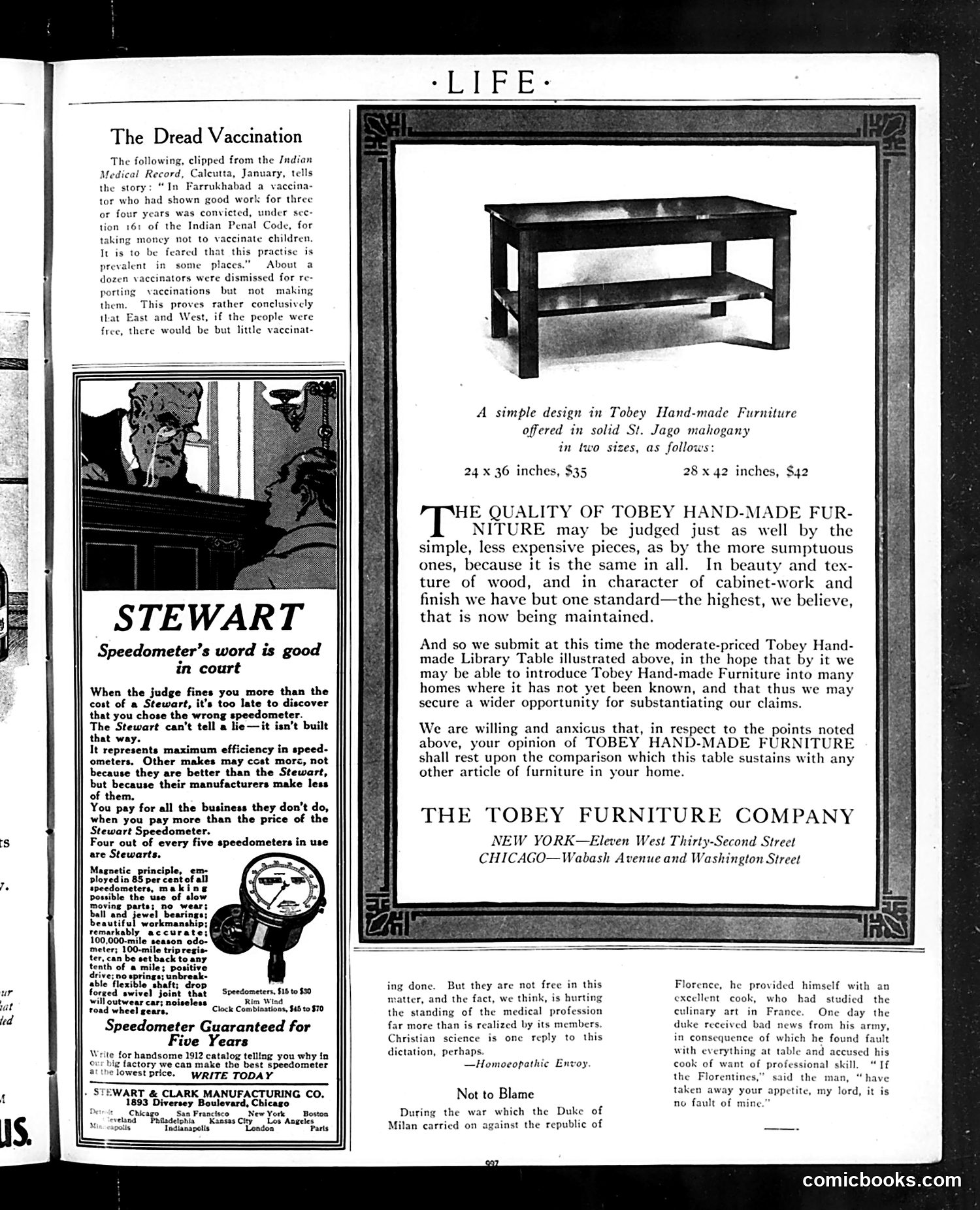
What you’re looking at
This article satirizes vaccine fraud in colonial India. According to the clipping from the Indian Medical Record, vaccinators in Farrukhabad were caught accepting bribes to *skip* vaccinating children while falsely reporting the work completed. About a dozen such corrupt officials were dismissed. The piece uses this scandal to mock the vaccination enterprise generally. The author suggests that if people were "free" rather than compelled, vaccination would be unpopular—implying the practice itself (not just its corruption) is suspect. This reflects early-20th-century anti-vaccination sentiment, when vaccine safety remained genuinely controversial. The satire targets both the dishonest vaccinators and the broader colonial medical apparatus that enforces unwanted medical intervention on the Indian population. The irony: authorities intended to protect public health through mandatory vaccination, but the system's corruption undermined that goal entirely.
📄 Transcribed text from this page (OCR, searchable)
Machine-transcribed from the original scan — historical spelling and the odd misread are preserved.
The Dread Vaccination The following, clipped from the Indian Medical Record, Caleutta, January, tells the story: “In Farrukhabad a vaceina- tor who had shown good work for three or four years was convicted, under sec- tion 161 of the Indian Penal Code, for taking money not to vaccinate children. It is to be feared that this practise is prevalent in some places."” About a dozen vaccinators were dismissed for re- porting vaccinations but not making them. This proves rather conclusively that and West, if the people were free, there would be but little vaccinat- STEWART Speedometer’s word is good in court When the judge fines you more than the cost of a Stewart, it’s too late to discover that you chose the wrong speedometer. The Stewart can’t tell a lie—it isn’t built that way. It represents maximum efficiency in speed- ometers. Other makes may cost morc, not because they are better than the Stewart, but because their manufacturers make less of them. You pay for all the business they don’t do, when you pay more than the price of the Stewart Speedometer. Four out of every five speedometers in use are Stewarts. tenth of a mile; positive drive; no springs; unbreak- able flexible shaft; drop forged swivel joint that — Speedometers. $16 to $50 will outwear car; noiseless Rim Wiad road wheel gears. Clock Combinations, $45 to 570 Speedometer Guaranteed for Five Years Write for handsome 1912 catalog telling you why in ovr big factory we can make the best speedometer lowest price. WRITE TODAY ‘WART & CLARK MANUFACTURING CO. 1893 Diversey Boulevard, Chicas: Derst | Chicago San Francisco en oeghedPhaadeton A simple design in Tobey Hand-made Furniture offered in solid St. Jago mahogany in two sizes, as follows: 24 x 36 inches, $35 28 x 42 inches, $42 HE QUALITY OF TOBEY HAND-MADE FUR- NITURE may be judged just as well by the simple, less expensive pieces, as by the more sumptuous ones, because it is the same in all. In beauty and tex- ture of wood, and in character of cabinet-work and finish we have but one standard—the highest, we believe, that is now being maintained. And so we submit at this time the moderate-priced Tobey Hand- made Library Table illustrated above, in the hope that by it we may be able to introduce Tobey Hand-made Furniture into many homes where it has not yet been known, and that thus we may secure a wider opportunity for substantiating our claims. We are willing and anxicus that, in respect to the points noted above, your opinion of TOBEY HAND-MADE FURNITURE shall rest upon the comparison which this table sustains with any other article of furniture in your home. THE TOBEY FURNITURE COMPANY NEW YORK—Eleven West Thirty-Second Street CHICAGO—Wabash Avenue and Washington Street ing done. But they are not free in this matter, and the fact, the standing of the medical profession ¢ think, is hurting excellent cook, who had ied Florence, he provided himself with an culinary art in France. One day the far more than is realized by its members. Christian science is one reply to this dictation, perhaps. —Homoeopathic Envoy Not to Blame During the war which the Duke of Milan carried on against the republic of duke received bad news from his army, in consequence of which he found fault with everything at table and accused his cook of want of professional skill. “If the Florentines,” said the man, “have taken away your appetite, my lord, it is no fault of mine.” comicbooks.com