
A complete issue · 54 pages · 1912
Life — April 18, 1912
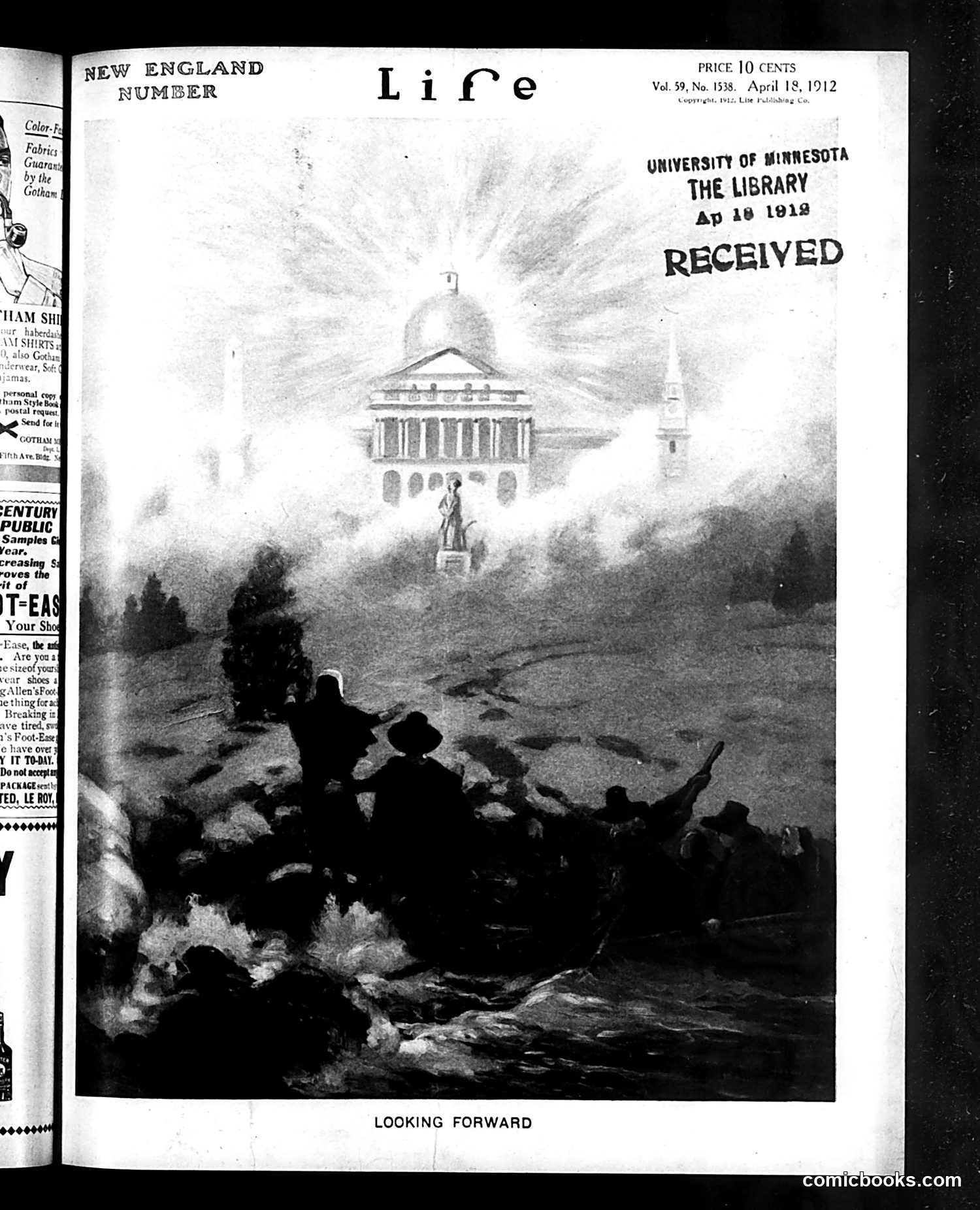
This is the cover illustration for Life's "New England Number." The image depicts a prophetic or visionary scene: silhouetted figures in the foreground gaze upward at a glowing State House (likely Massachusetts's capitol building), which appears suspended in clouds with a statue below it. The radiating light suggests divine or transcendent significance. The title "Looking Forward" indicates optimism about New England's future. Given the 1912 date, this likely reflects Progressive Era aspirations—reform movements, civic improvement, and faith in American institutions. The classical imagery (capitol, statue) and heavenly treatment suggest reverence for democratic ideals and regional heritage, positioning New England as a beacon of American values and progress.
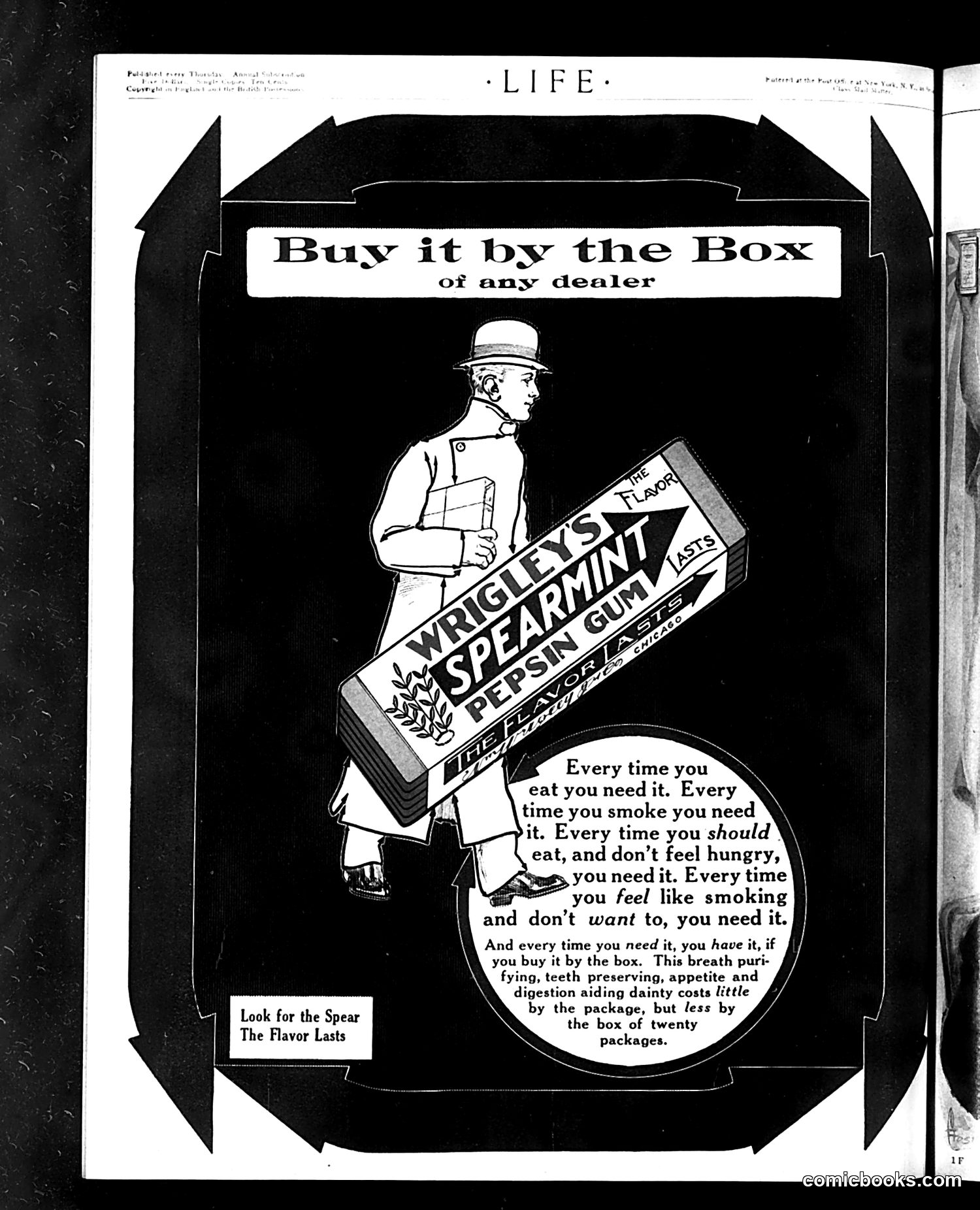
This is a **Wrigley's Spearmint Gum advertisement**, not political satire. The ad promotes buying gum "by the box" and features a delivery man or vendor carrying an oversized gum package. The circular text makes exaggerated health claims typical of early 20th-century advertising: the gum supposedly aids digestion, preserves teeth, freshens breath, and suppresses appetite. It claims buying by the box costs "little by the package, but less by the box of twenty packages"—a bulk-purchase incentive. The tagline "The Flavor Lasts" emphasizes product durability. This reflects pre-regulation advertising practices when companies made unsubstantiated medical claims freely. Modern readers would recognize this as misleading health marketing that would violate today's FDA standards.
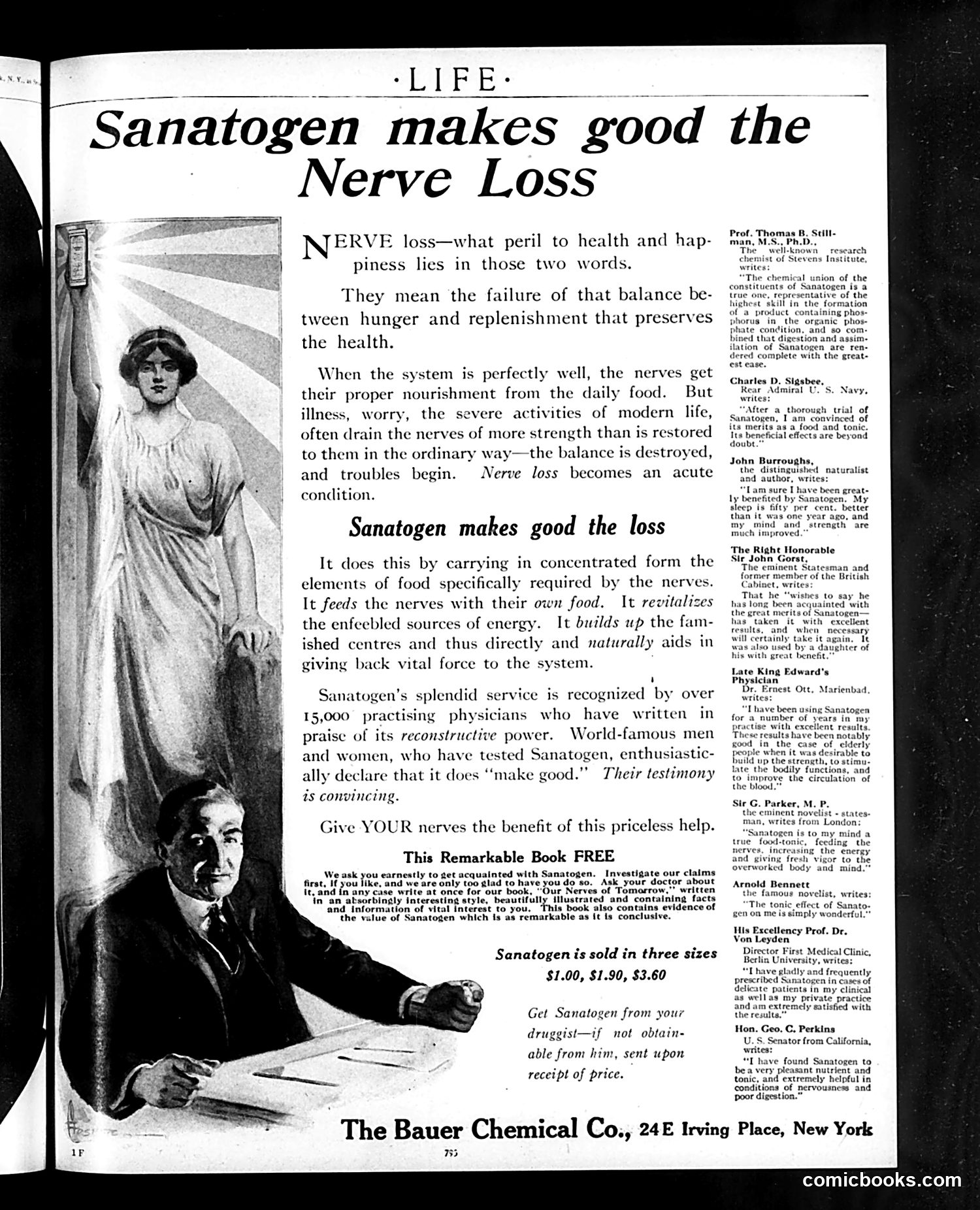
This is primarily **advertising, not satire or editorial content**. The page promotes "Sanatogen," a patent medicine marketed as a nerve tonic to combat "nerve loss" caused by modern life's stress and strain. The two illustrations show a healthy woman and an ill, exhausted man—visual contrasts suggesting the product's restorative effects. The text emphasizes that Sanatogen replenishes depleted nervous energy through concentrated nutrients. Most notably, the ad features endorsements from prominent figures: a U.S. Senator, a Navy officer, physicians, and authors like John Burroughs. These celebrity testimonials were standard advertising practice of the era, lending credibility to dubious health claims. The page reflects early 20th-century medical pseudoscience and the widespread marketing of patent medicines before FDA regulation.
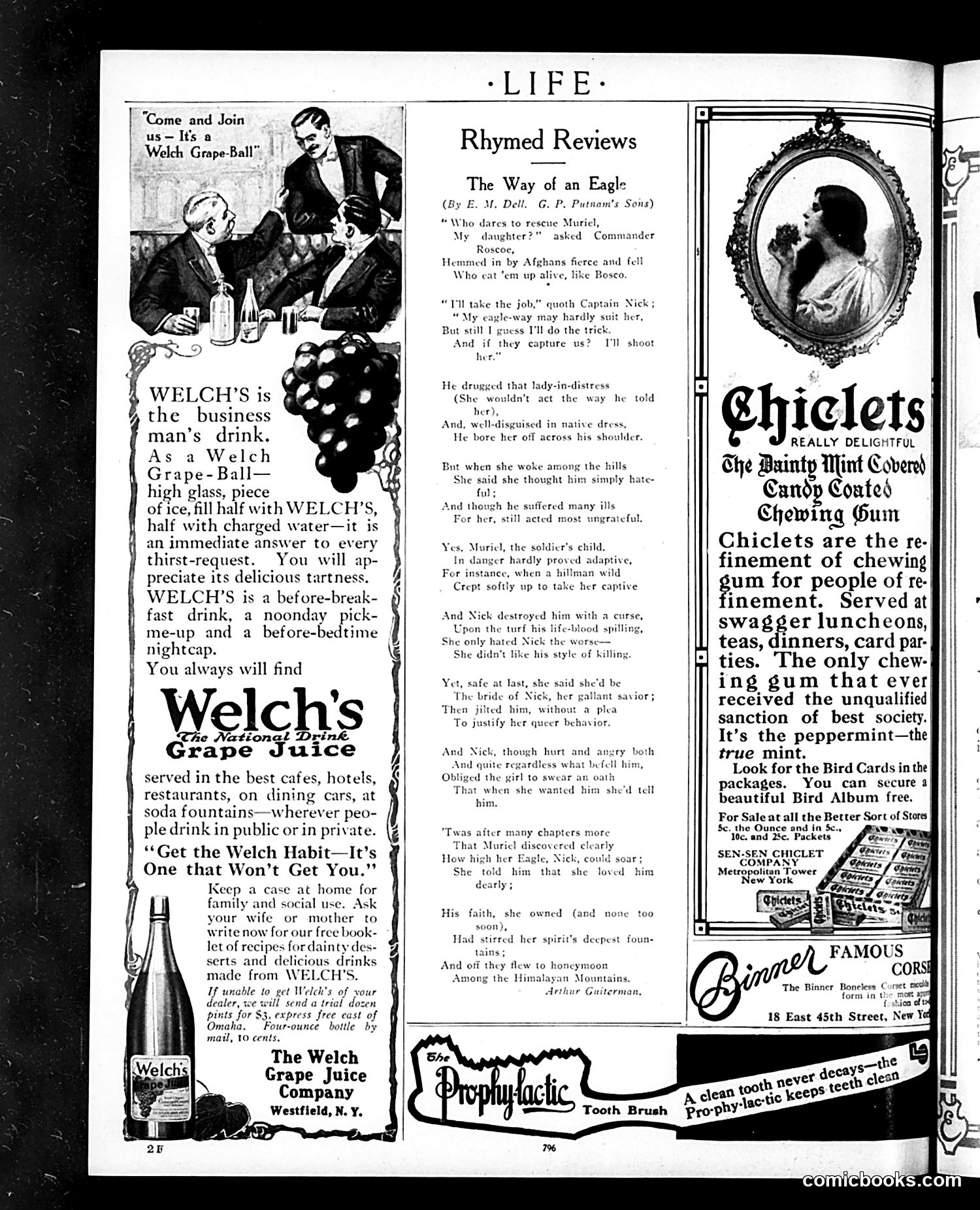
This page is primarily **advertisements** with one literary feature. The left side advertises Welch's Grape Juice as an all-purpose beverage for any occasion ("before-breakfast drink, a noonday pick-me-up and a before-bedtime nightcap"). The right features ads for Chiclets chewing gum and Binner Famous Corsets, plus a Prophylactic toothbrush ad. The center contains "Rhymed Reviews" — a poem called "The Way of an Eagle" by E.M. Dell, about a soldier's daughter named Muriel and a Captain Nick. It's a sentimental narrative poem about romance and duty, typical serialized entertainment in early 20th-century magazines. **This is not primarily satirical content** — it's a commercial/entertainment page representative of Life magazine's mixed advertorial format of the era.
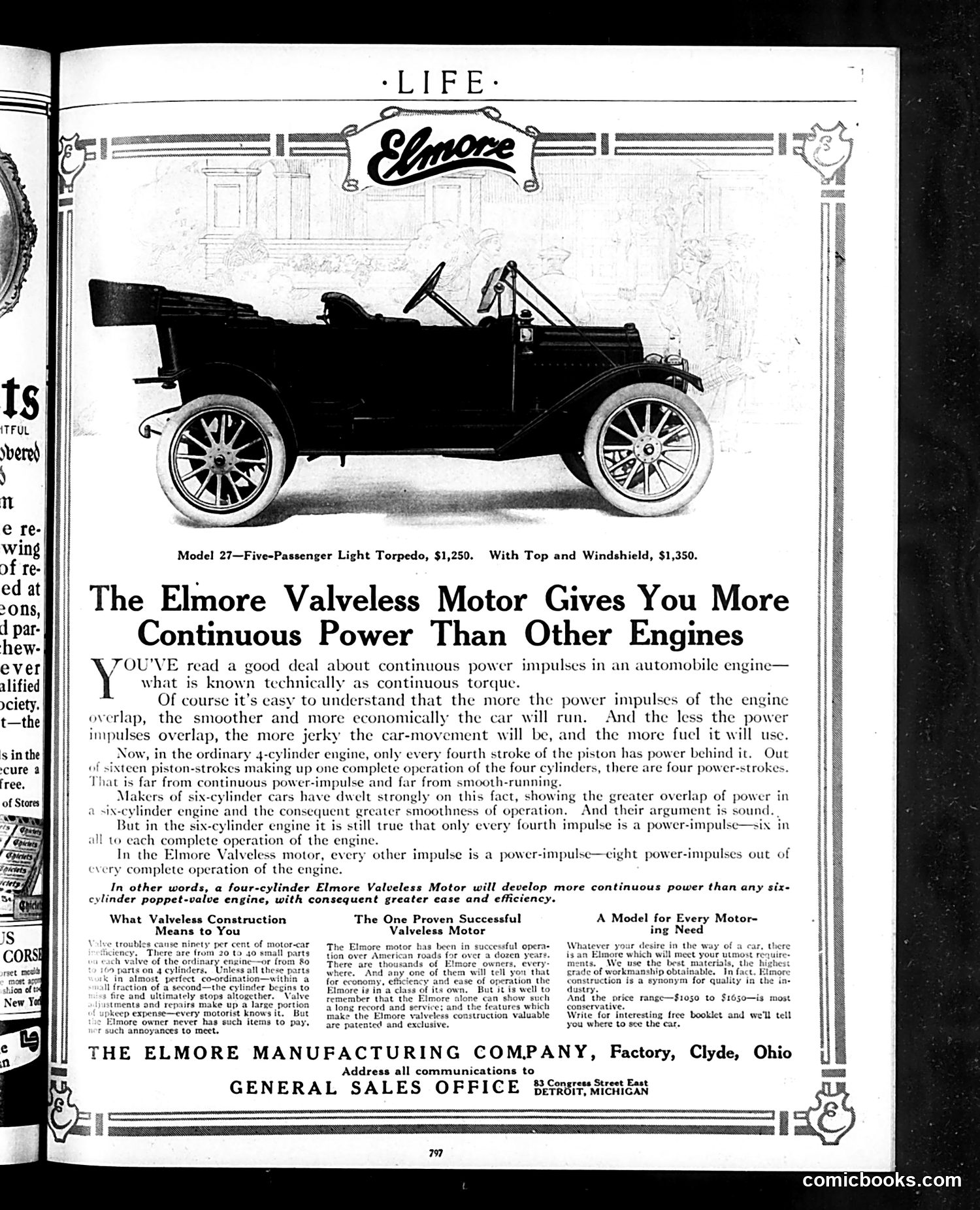
This is **not a political cartoon or satire page** — it's a straightforward automobile advertisement from Life magazine. The page features an **Elmore Model 27 automobile** (a five-passenger light torpedo priced at $1,250, or $1,350 with top and windshield). The ad's main claim is that the Elmore's "Valveless Motor" provides superior continuous power compared to conventional engines because it delivers eight power impulses per engine cycle rather than four. The text explains technical engine advantages to appeal to early 1900s motorists. There's no satire, political commentary, or caricature — this is genuine product marketing from the Elmore Manufacturing Company, based in Clyde, Ohio, with sales offices in Detroit.
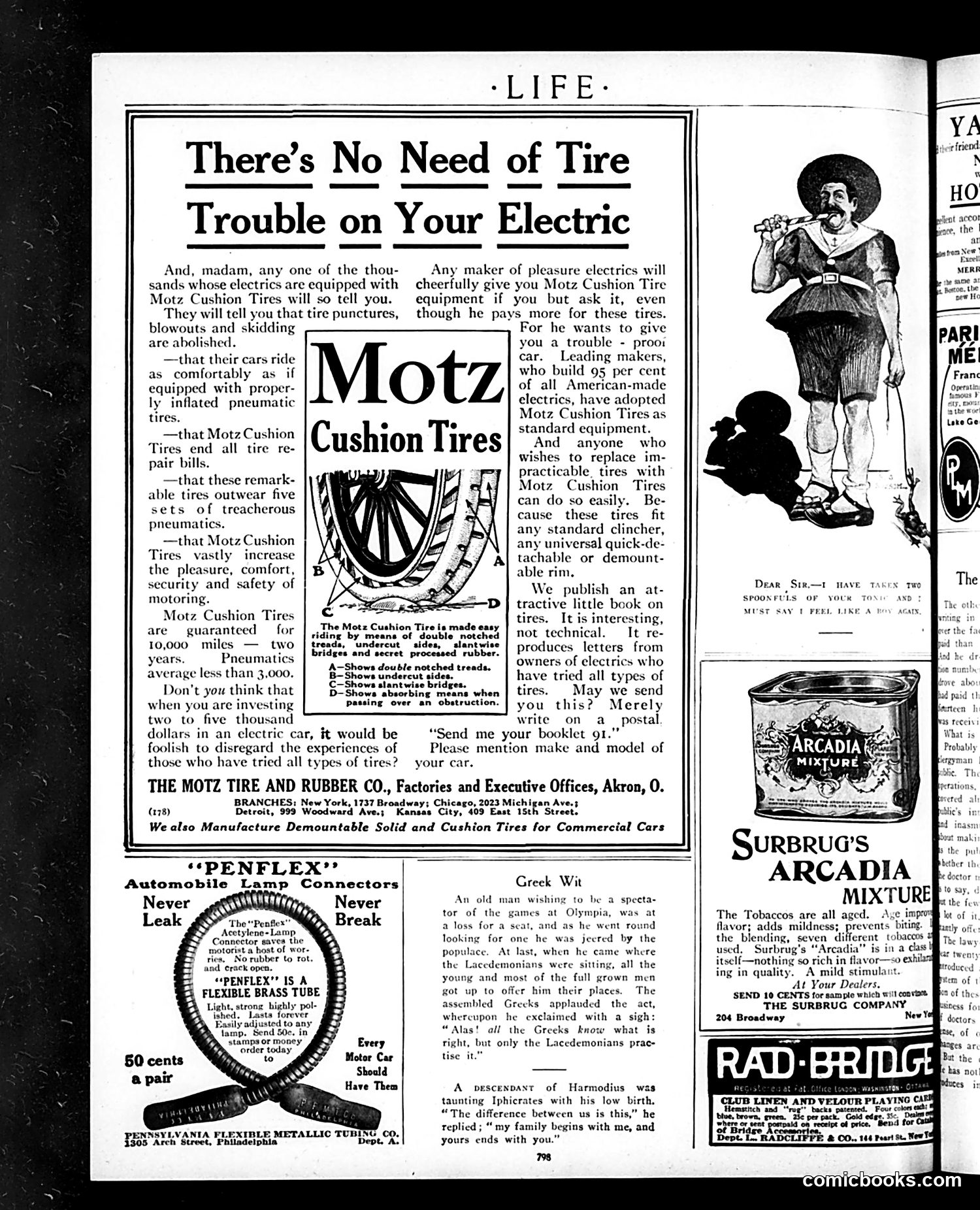
This page is **primarily advertising** rather than satirical content. The dominant feature is a large Motz Cushion Tires advertisement claiming these tires eliminate punctures and blowouts on electric cars—a significant concern for early automobile owners. The right side contains minor content: a small illustration labeled "Dear Sir" about spoonsful, and advertisements for Surburg's Arcadia Mixture tobacco and Rad-Bridge playing cards. Below the main tire ad is a brief humorous anecdote titled "Greek Wit" about an old man at Olympia, and a story fragment about Harmodius (a historical Athenian figure). These are filler content rather than political satire. **The page reflects early 1900s consumer culture**, emphasizing reliability concerns for emerging automobile technology.
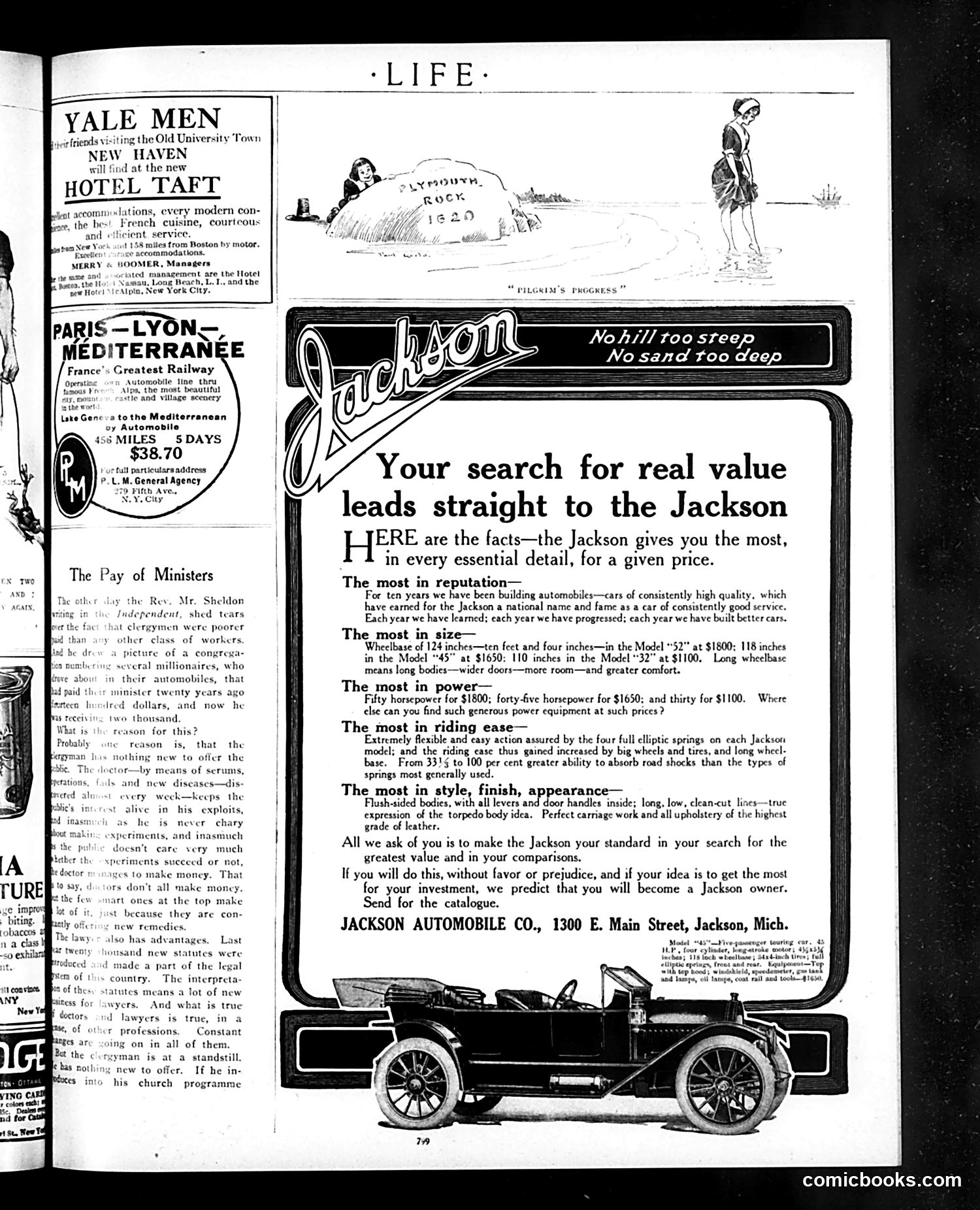
This page is primarily **advertising content** rather than satire or political commentary. The main feature is a large Jackson Automobile advertisement emphasizing value propositions: "reputation," "size," "power," "riding ease," and "style/finish." The ad targets middle-class buyers seeking practical automobiles. A small cartoon titled **"Pilgrim's Progress"** appears at top right, showing a figure climbing a rocky hill—likely a visual pun on John Bunyan's allegory, though the specific satirical point is unclear from the image alone. Left-side advertisements include Hotel Taft (New Haven) and a Paris-Lyon-Méditerranée railway tour. A text article on "The Pay of Ministers" discusses clergy salaries and automobiles, but appears unrelated to the visual content. The page is typical early-20th-century *Life* magazine: mixing commercial ads with light humor.
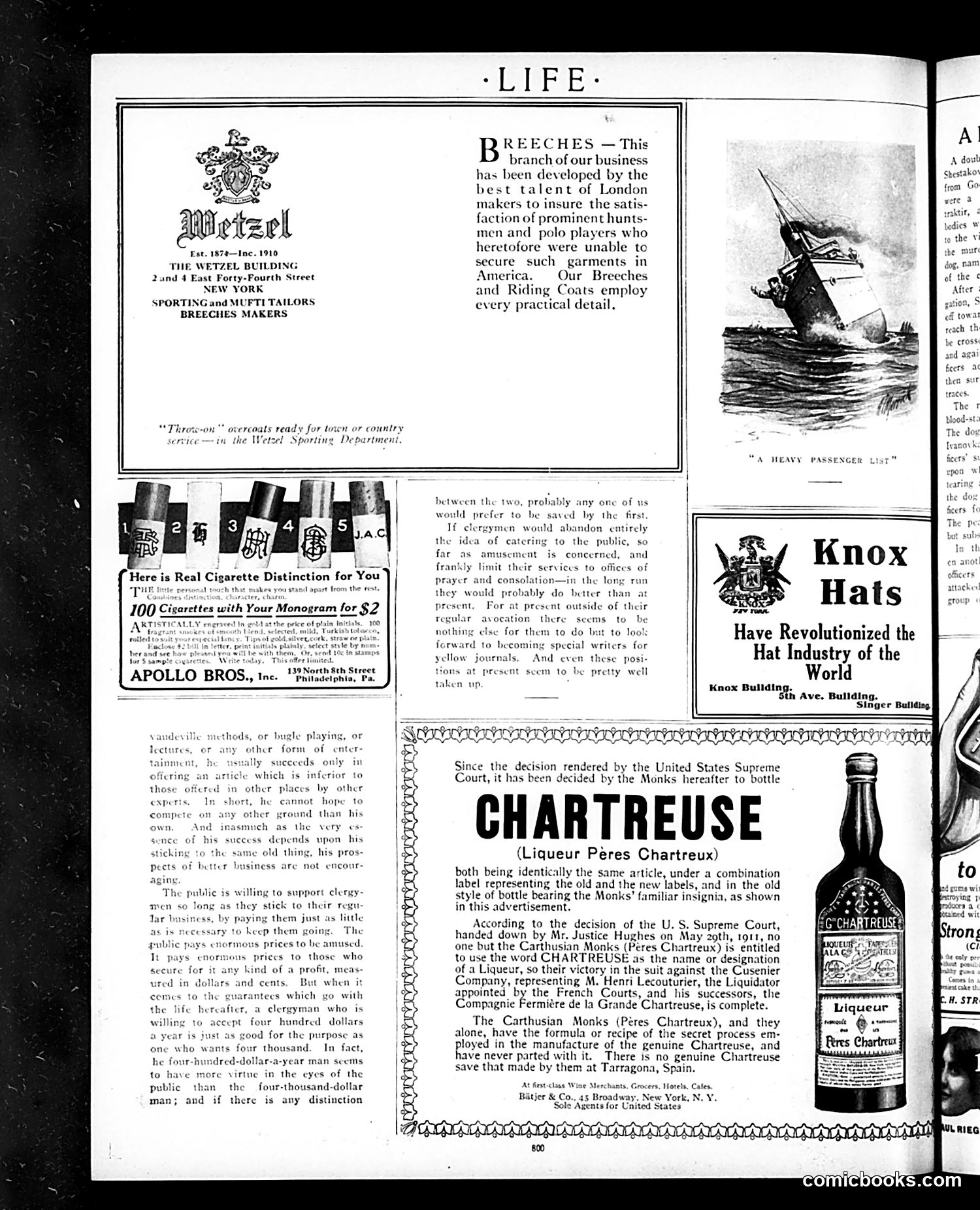
This page is primarily **advertising and commercial content** rather than political satire or editorial cartooning. It features: 1. **Wetzel advertisement** (top left): Promotes sporting breeches and riding coats for hunters and polo players 2. **Apollo Bros. cigarette ad**: Claims superior quality and artistic merit 3. **Knox Hats advertisement**: Claims to have "revolutionized the Hat Industry of the World" 4. **Chartreuse liqueur advertisement** (center-bottom): Discusses a U.S. Supreme Court decision confirming the Carthusian Monks' right to use the "Chartreuse" name/label for their liqueur The only quasi-editorial content is the Chartreuse section, which explains a legal victory rather than offering satire. The sailing ship illustration appears decorative rather than satirical.
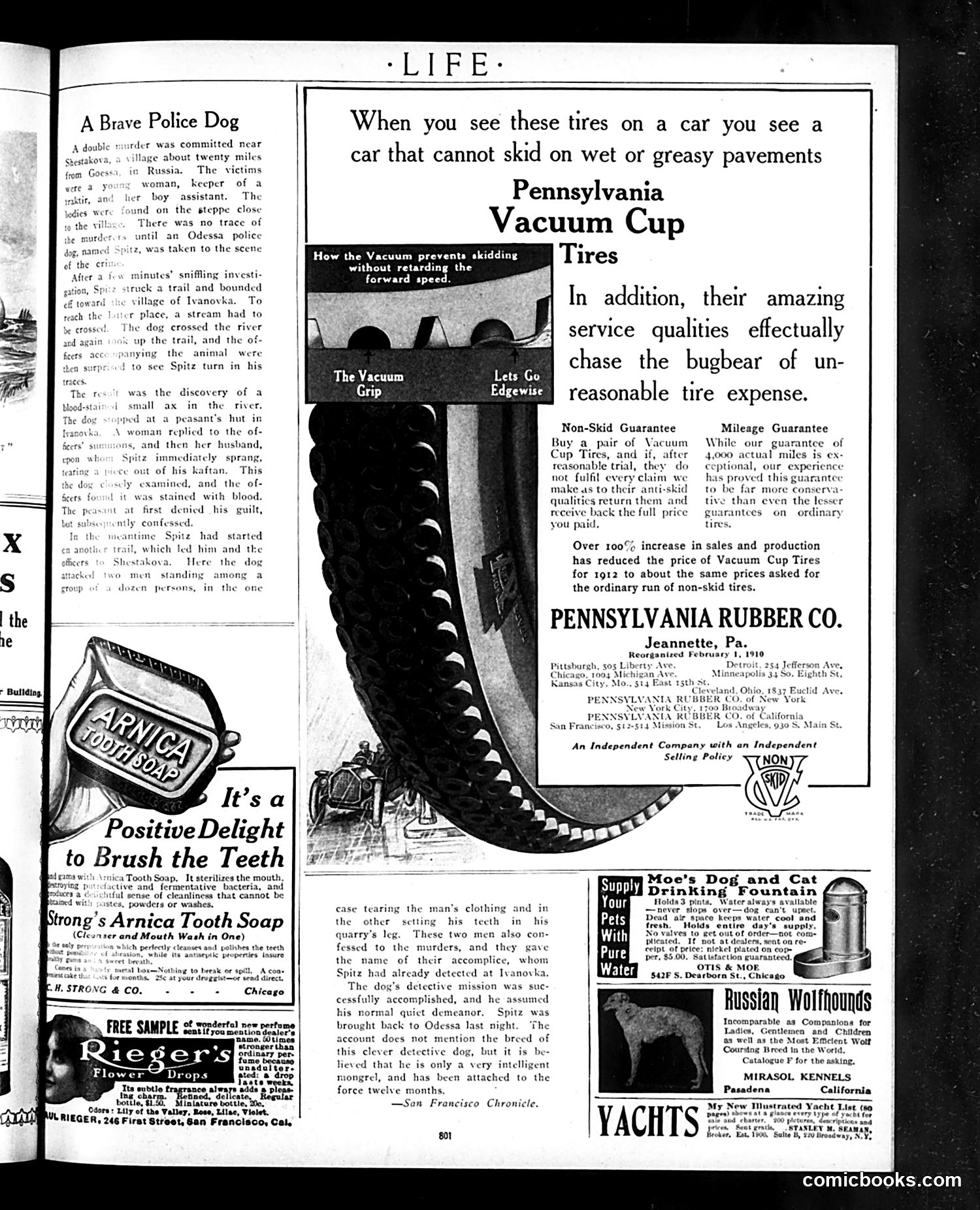
This *Life* magazine page is primarily **advertising content** rather than satire or political commentary. The main feature is a **Pennsylvania Vacuum Cup Tires advertisement**, prominently displaying a large tire tread. The ad emphasizes the tire's non-skid properties and "amazing service qualities," claiming it "effectively chase[s] the bugbear of unreasonable tire expense." The left column contains a brief story titled "A Brave Police Dog," crediting the *San Francisco Chronicle*, describing how a dog named Spite helped solve a double murder in Russia by tracking a killer. **Supporting advertisements** include Arnica Tooth Soap, Rieger's Flower Drops (candy), Moe's Dog and Cat Drinking Fountain, Russian Wolfhounds (dogs), Mirasol Kennels, and a yacht listing. The page demonstrates early 1910s magazine layout mixing editorial content with commercial messaging.
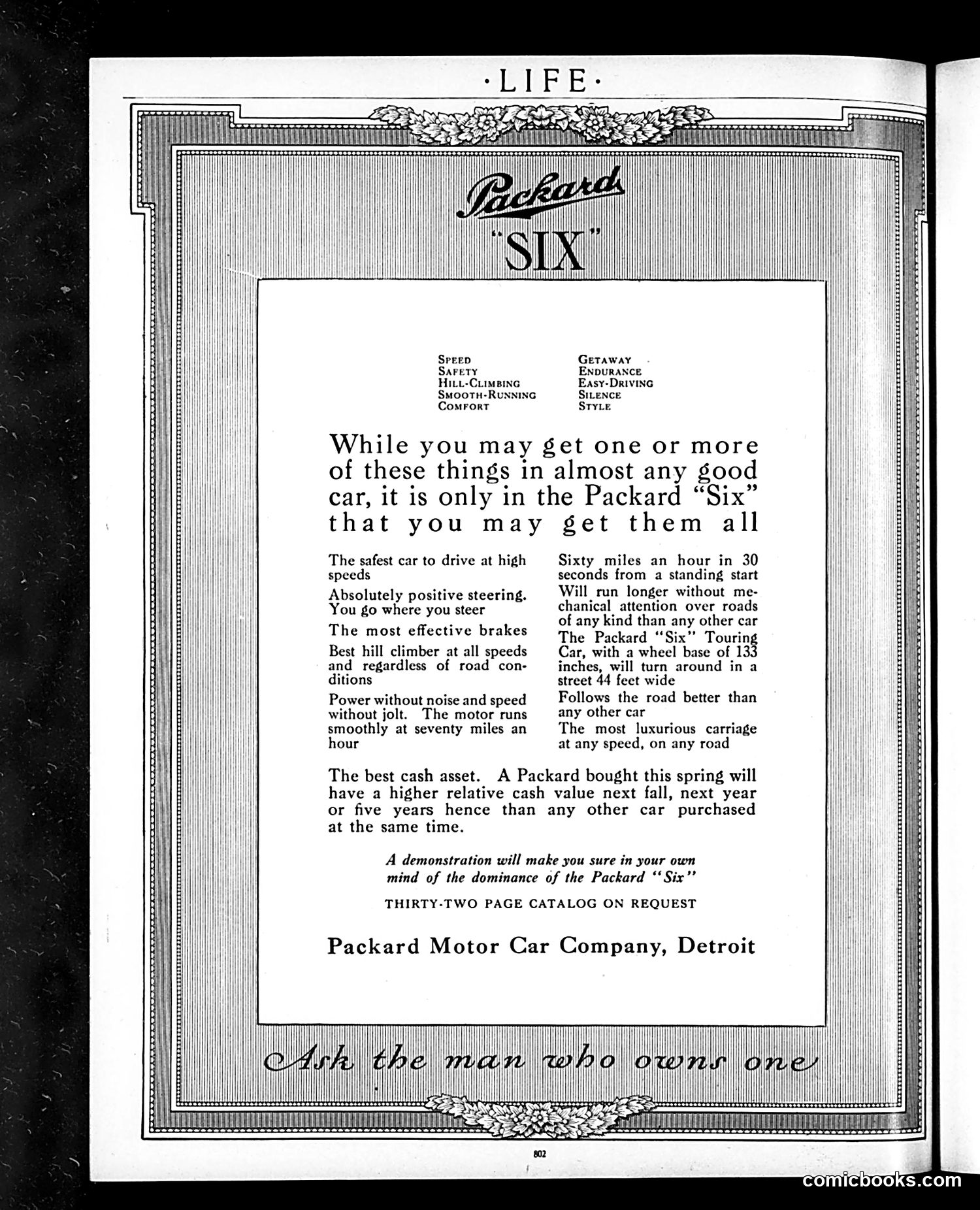
This is an advertisement for the Packard "Six" automobile, published in *Life* magazine. It's not a cartoon or satirical content, but rather a straightforward product advertisement from the early automotive era. The ad lists the car's claimed features—speed, safety, hill-climbing ability, smooth running, comfort, getaway capability, endurance, easy driving, silence, and style—asserting that while other cars might offer one or two of these qualities, only the Packard "Six" provides all of them. The copy emphasizes performance claims (60 mph in 30 seconds from standing start) and practical advantages like brake effectiveness and fuel efficiency. It concludes by noting the car's resale value—a significant selling point for expensive vehicles. The tagline "Ask the man who owns one" was Packard's actual marketing slogan.
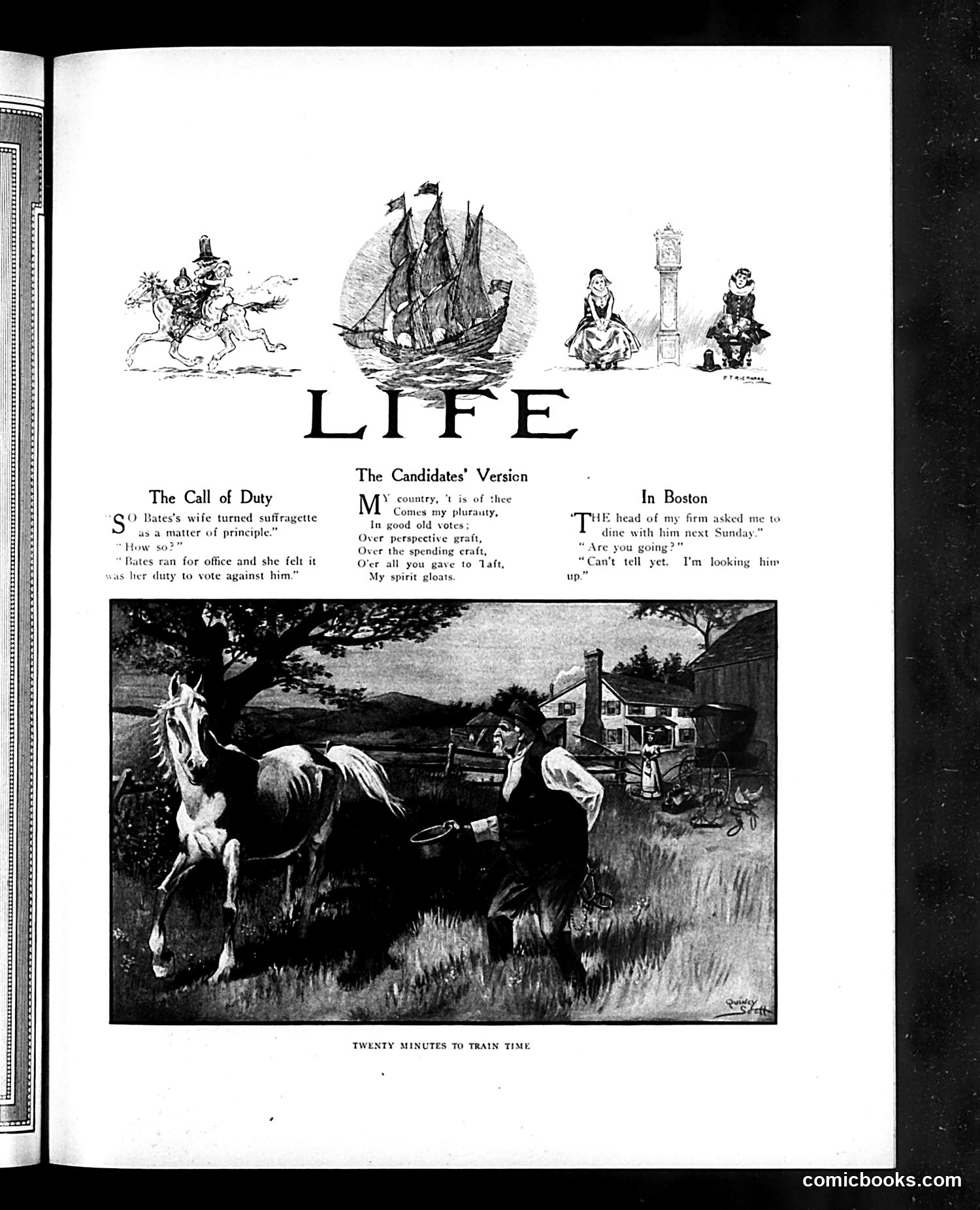
This page contains three satirical vignettes about civic duty and social obligation: 1. **"The Call of Duty"**: Mocks a woman (Bates's wife) who became a suffragette "as a matter of principle," yet her husband ran for office while she voted against him—questioning the sincerity of women's political activism. 2. **"The Candidates' Version"**: A poem suggesting politicians speak grandly about serving the nation while actually profiting from graft and corruption. 3. **"In Boston"**: Brief dialogue about a business dinner invitation, with someone reluctant to accept. The bottom illustration titled "TWENTY MINUTES TO TRAIN TIME" depicts a rural scene where someone appears to be hastily training a horse, satirizing poor time management or last-minute preparation. The overall theme critiques hypocrisy in politics and social life.
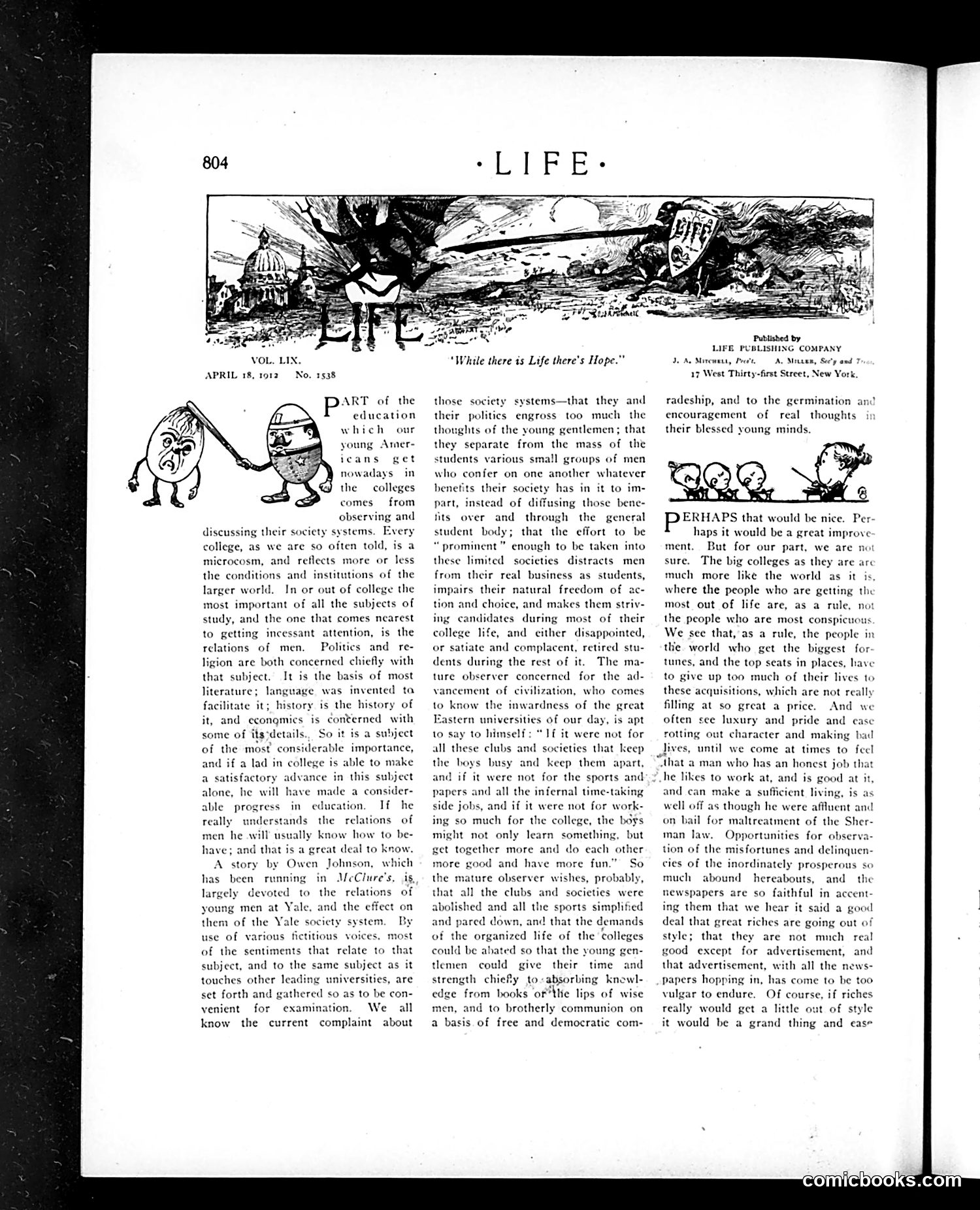
This page contains editorial commentary on American college life, specifically criticizing the proliferation of exclusive social societies and clubs at universities like Yale. The cartoon shows two anthropomorphized figures (possibly representing different college factions) in conversation, illustrating the editorial's point about social division. The text argues that college societies distract students from their real academic mission, fragment the student body, and undermine democratic principles through elitism. The author suggests these clubs keep students "busy and keep them apart" and advocates for their abolition. The piece references Yale's society system by name as a cautionary example, criticizing how such organizations separate wealthy, privileged students from the broader student body and discourage meritocratic advancement based on genuine intellectual merit.
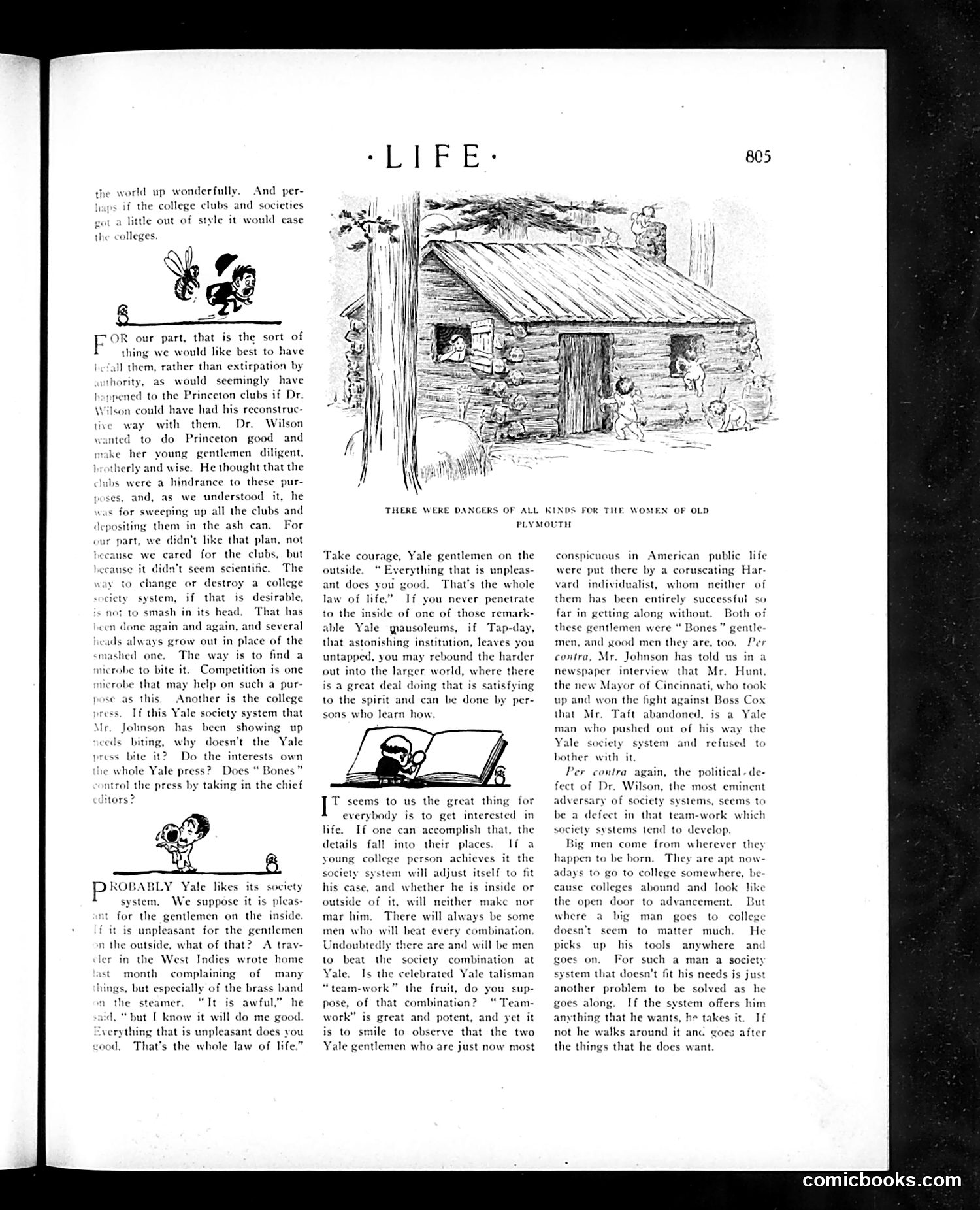
This page discusses Yale University's social system and college clubs. The text critiques Dr. Wilson's (likely President Woodrow Wilson) attempts to reform Princeton's club culture, arguing such efforts are ineffective. The author advocates instead for competition and individual achievement to naturally adjust social hierarchies. The small illustrations show casual scenes—children playing, figures reading—rather than political cartoons. The main illustration depicts "dangers of all kinds for the women of old Plymouth," showing a colonial-era log cabin with multiple figures, which appears to be a humorous historical reference unrelated to the Yale discussion. The satire targets institutional reform efforts, suggesting that social structures resist top-down change and that individual merit matters more than administrative intervention.
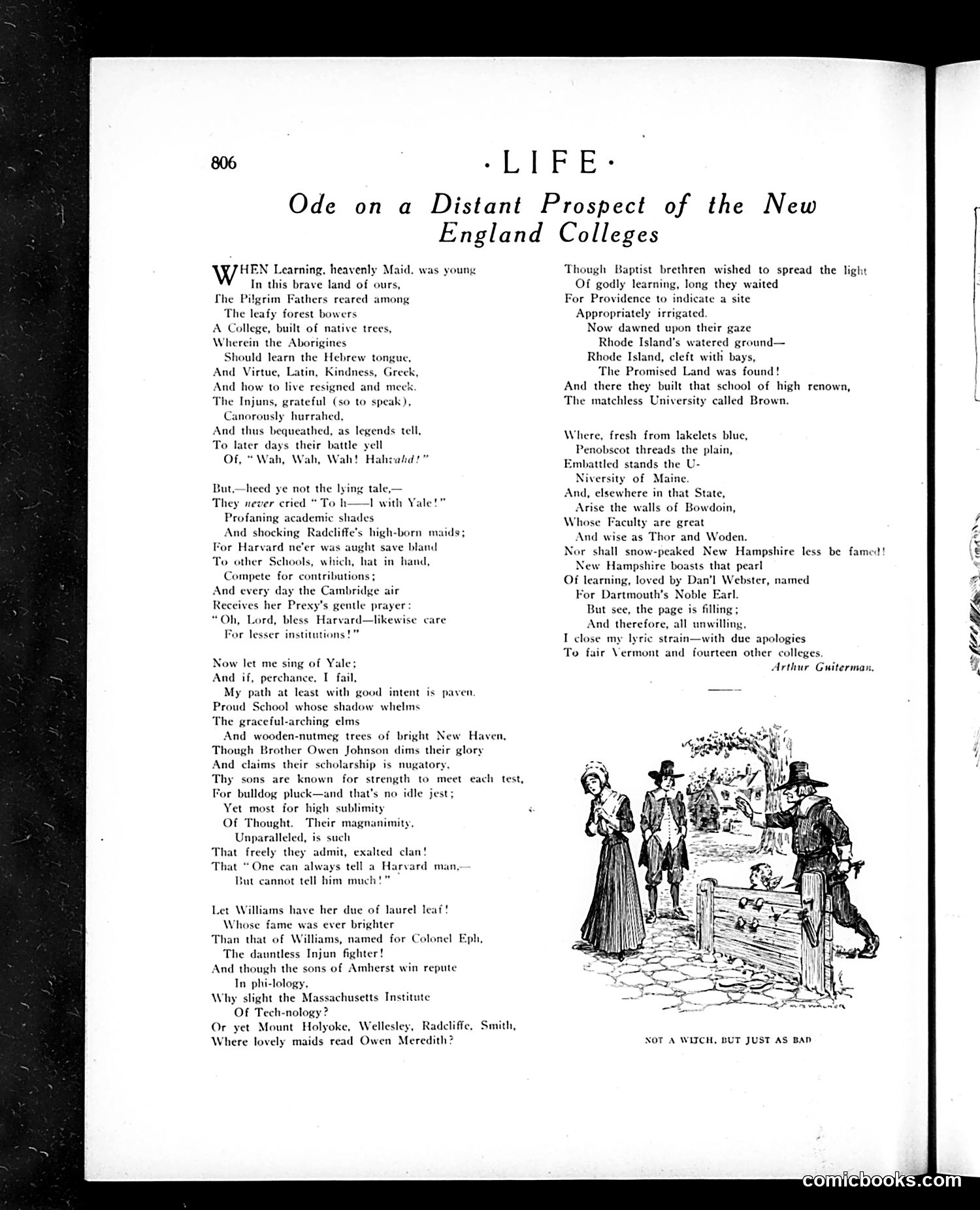
This is a satirical poem mocking New England colleges, particularly Harvard and Yale. The verse humorously disparages Harvard's arrogance ("One can always tell a Harvard man—but cannot tell him much"), celebrates Yale's supposed superiority, and takes shots at other institutions like Brown, the University of Maine, Bowdoin, and Williams. The accompanying illustration, captioned "NOT A WITCH, BUT JUST AS BAD," depicts a woman being confronted by colonial-era figures, likely referencing the Salem witch trials. The joke appears to link academic pomposity with historical New England hysteria—suggesting these colleges embody the same intolerant, judgmental spirit as their Puritan predecessors. The satire critiques intellectual elitism disguised as education.
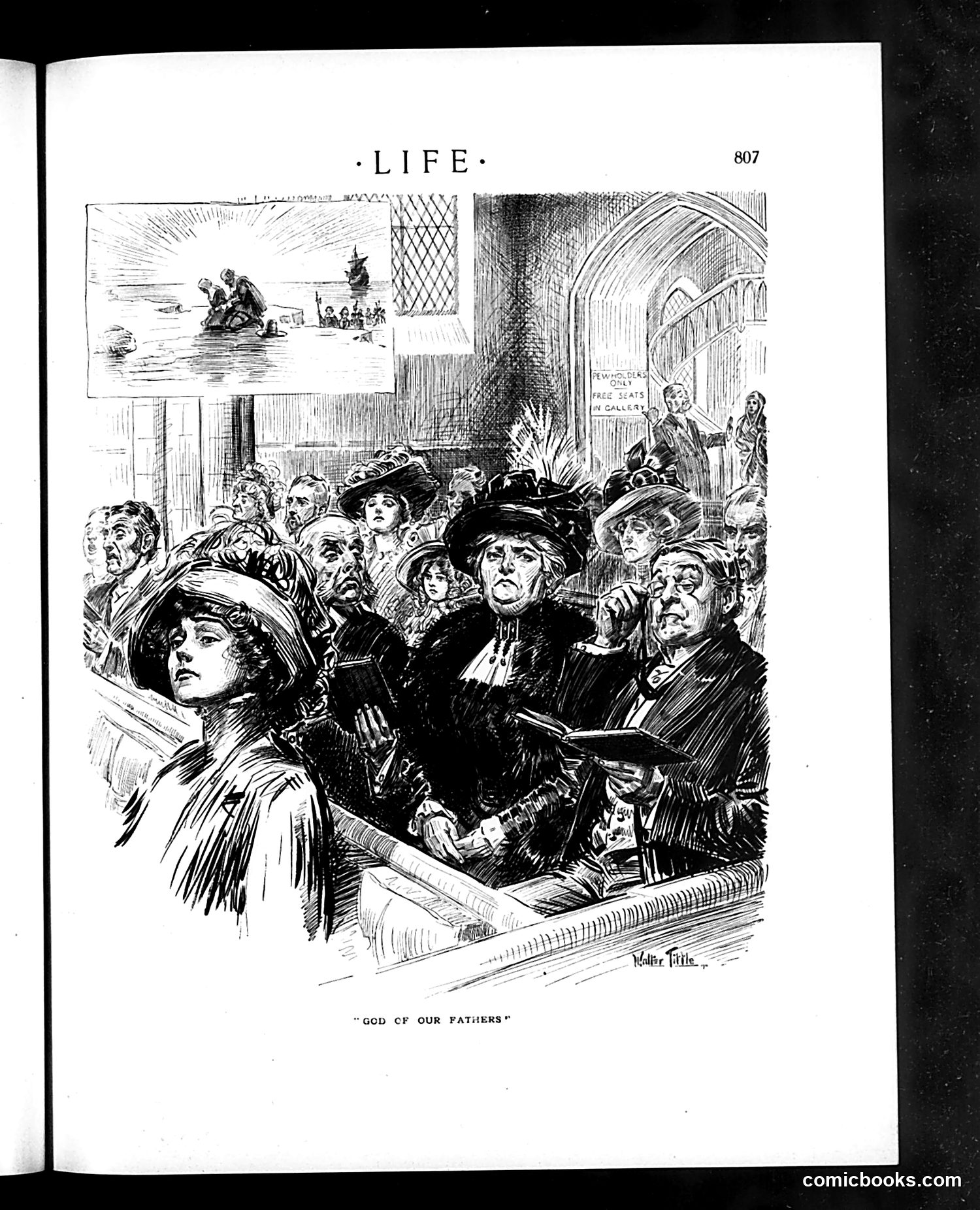
This Walter Tittle illustration satirizes a formal religious or civic ceremony, likely in a cathedral (visible Gothic architecture). A diverse crowd of military officers, civilians, and society figures gathers solemnly. The title's ironic quotation suggests the cartoon critiques how different groups invoke patriotic or religious authority to justify their positions. The composition emphasizes class and military hierarchy among attendees. A small inset shows a maritime scene, possibly referencing naval/colonial matters. The satire appears to mock the gap between stated ideals ("God of Our Fathers") and actual social divisions visible in the assembled crowd's expressions and formal posturing. Without specific dating, the exact historical reference remains unclear, though the style and subject suggest early-20th-century American politics or social commentary.
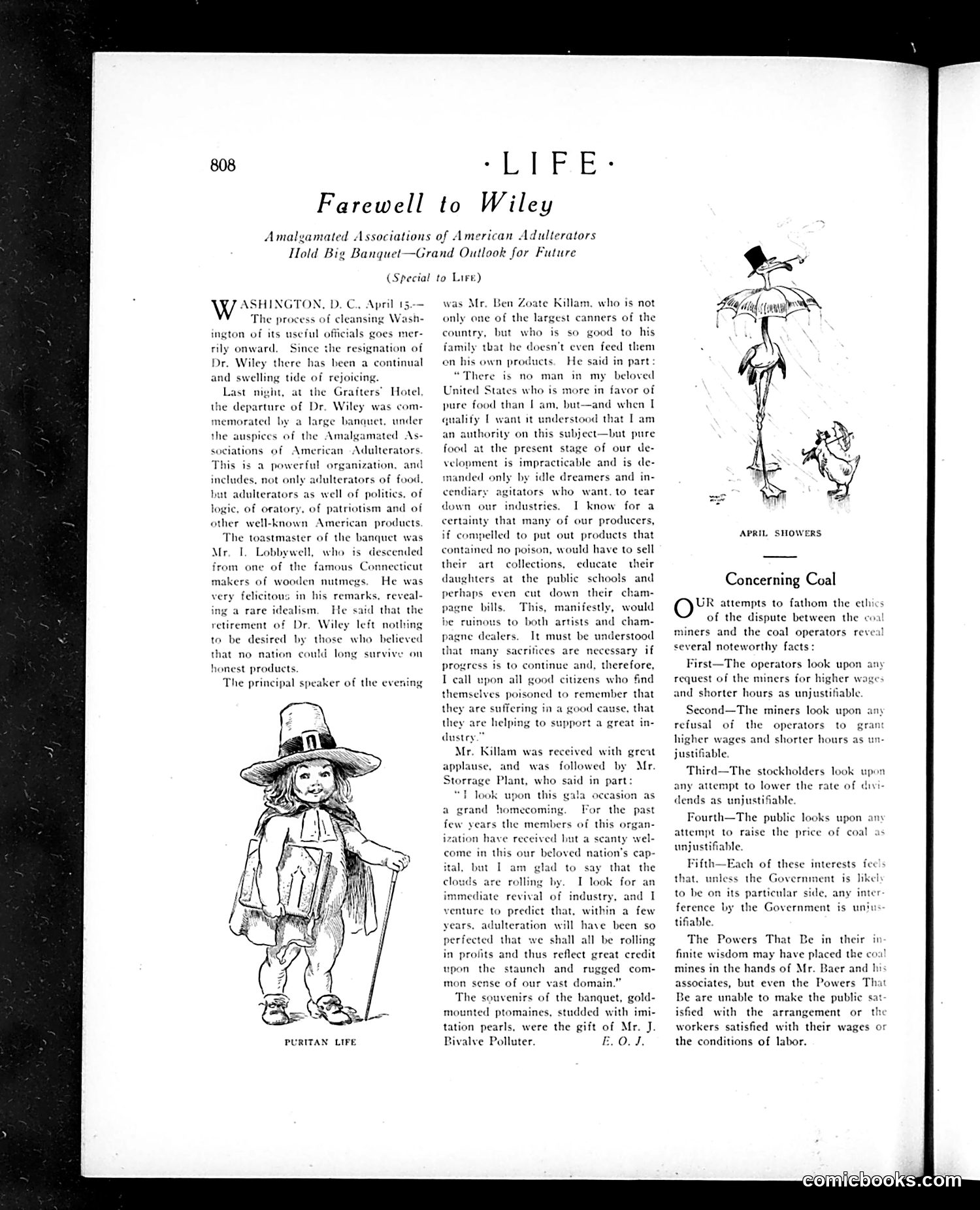
This page satirizes the resignation of **Dr. Harvey Wiley**, the U.S. Department of Agriculture chemist who championed food safety regulation and the Pure Food and Drug Act (1906). Life depicts his departure as celebrated by corrupt food industry figures at a mock "Amalgamated Associations of American Adulterators" banquet. The cartoon features a Puritan figure—symbolic of honest American values—appearing distressed or abandoned, illustrating Life's view that Wiley's exit represents a victory for dishonest food producers over public health. The satirical speakers (fictional characters like "Ben Zoate Killam" and "Storrage Plant") grotesquely justify food adulteration as economically necessary, claiming pure food would force industrialists to sell art collections and cut champagne budgets. Life mocks both their brazen arguments and their celebration of poisoning citizens for profit. The "gold-mounted ptomaines" (disease-causing bacteria) as party favors perfectly encapsulates the satire: corruption presented as refined celebration. This attacks the food industry's influence over government policy and Wiley's marginalization.
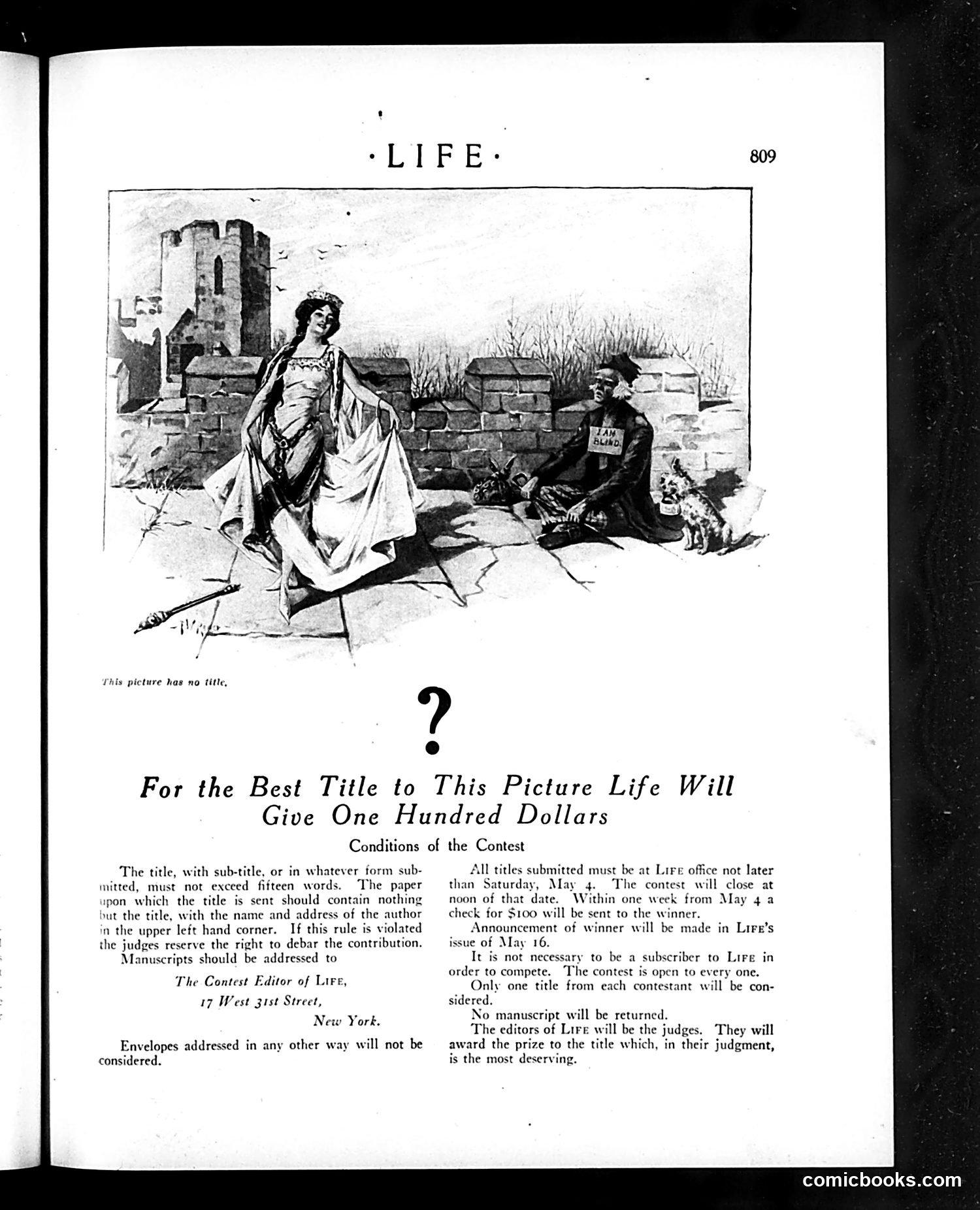
This page from *Life* magazine (page 809) presents a untitled satirical illustration with a $100 contest prize for readers to suggest the best caption. **The Image:** A woman in classical/allegorical dress stands dramatically before a castle or fortification, gesturing toward a seated figure (appearing male, possibly representing a beggar or common person) who holds a sign reading "LAW" and sits with a small dog. The woman appears to be Lady Justice or Liberty personified. **The Satire's Point:** The cartoon likely critiques the relationship between law/legal systems and ordinary people—suggesting either that justice is theatrical performance disconnected from reality, or that laws protect the privileged while ignoring the common person's plight. The contrast between the noble woman's grand posture and the humble seated figure emphasizes social inequality. **The Contest:** *Life* invited readers to title this image, offering substantial prize money ($100, significant in this era), demonstrating the magazine's interactive engagement with audiences and confidence in readers' wit.
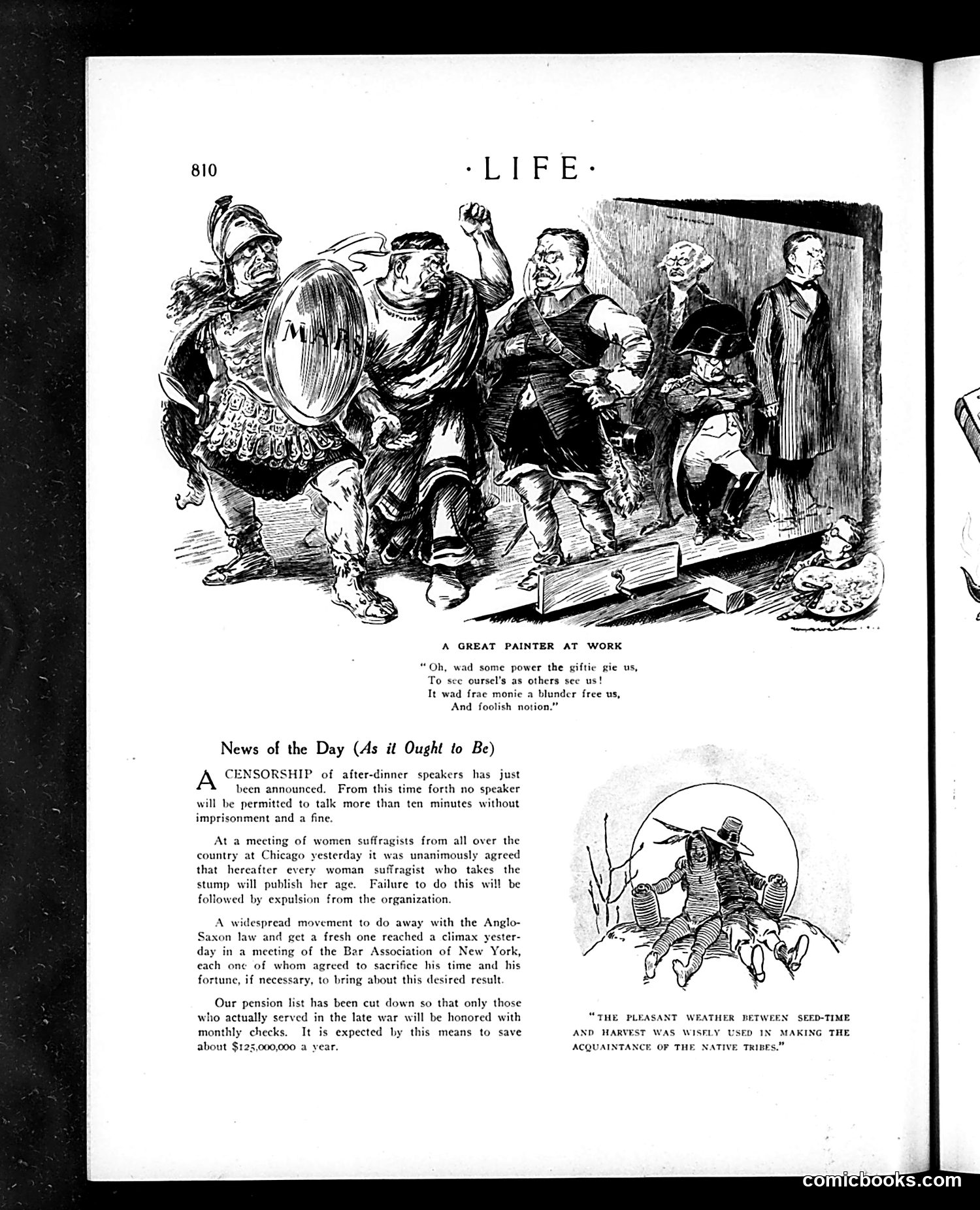
**The Main Cartoon ("A Great Painter at Work"):** Shows a grotesque artist painting a portrait, surrounded by caricatured figures (appearing to include various social types and possibly politicians). The satirical poem quoted is Burns's "To a Louse," suggesting the artist—and by extension society—cannot see itself clearly. The joke: we're blind to our own flaws while judging others. **"News of the Day" Section:** This is satirical fake news inverting actual grievances into absurd "solutions": - **After-dinner speaker censorship**: Mocks complaints about long-winded speakers by proposing draconian punishment - **Suffragist age publication**: Satirizes women suffragists (likely referencing their perceived vanity or ageism debates within the movement) - **Anglo-Saxon law reform**: References progressive legal reform efforts - **Pension cuts**: Comments on post-WWI veteran benefits policy The satire appears to mock both the reformers pushing these causes and public sentiment against them, presenting "solutions" so extreme they expose the underlying tensions.
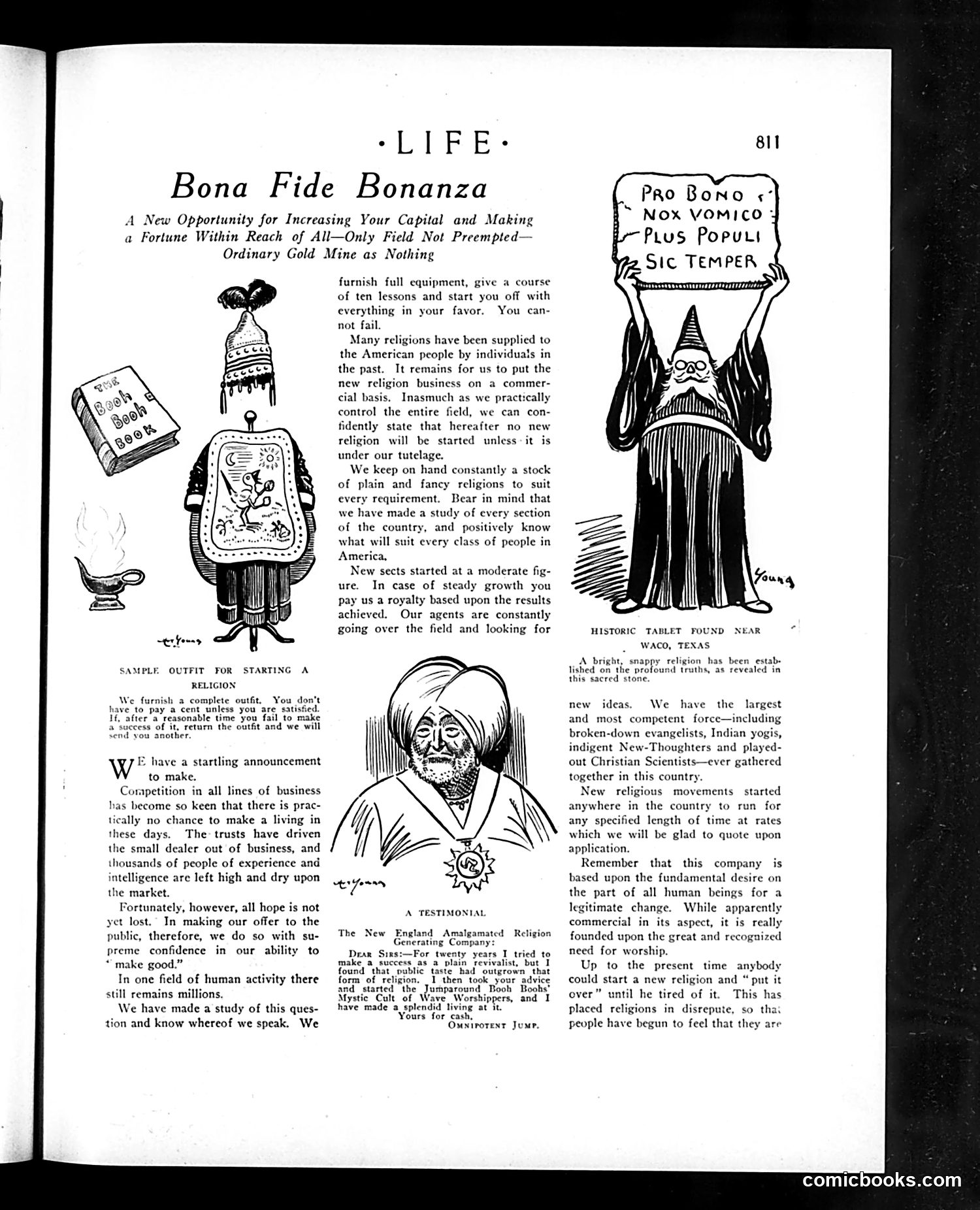
This satirical piece mocks the proliferation of new religious movements in early 20th-century America by treating religion as a franchisable business. The "New England Amalgamated Religion Generating Company" offers startup kits to would-be religious entrepreneurs—complete with equipment, training, and inventory of "plain and fancy religions" tailored to different American demographics. The satire targets several targets: unscrupulous entrepreneurs profiting from spiritual seekers, the oversupply of competing sects and cults, and mainstream anxiety about religious experimentation. The testimonial from a successful "jumparound" cult leader and the "historic tablet" found in Texas (mocking fabricated spiritual authenticity) underscore the mockery. The illustrations show sample religious attire and iconography. This reflects genuine Gilded Age concerns about charlatan revivalists and new religious movements (like Christian Science, which emerged decades earlier) being treated as commercial enterprises rather than genuine faith traditions.
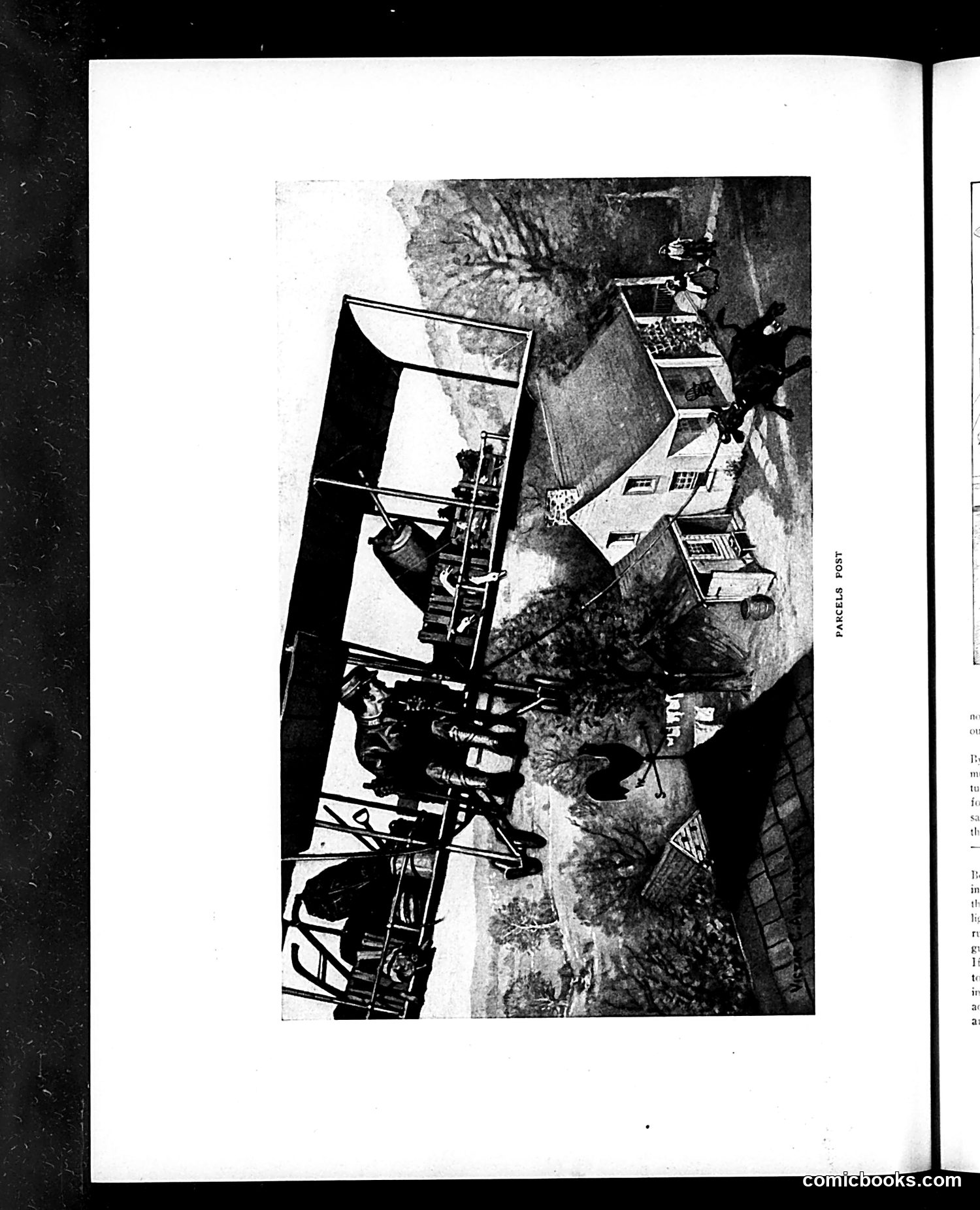
This page appears to be titled "PARCELS POST" and contains a black-and-white photograph or illustration rotated 90 degrees, showing what looks like an early mechanical or industrial device with framework and some structures in the background. Without clearer visibility of specific text or identifying details in the image itself, I cannot confidently identify the particular political figures, satirical targets, or the specific joke being made. The "Parcels Post" title suggests commentary on mail delivery or shipping services, possibly critiquing bureaucratic inefficiency or government services—common subjects for *Life* magazine satire. I cannot reliably explain the specific satire intended without risking inaccuracy. More legible accompanying text would be needed for proper interpretation.
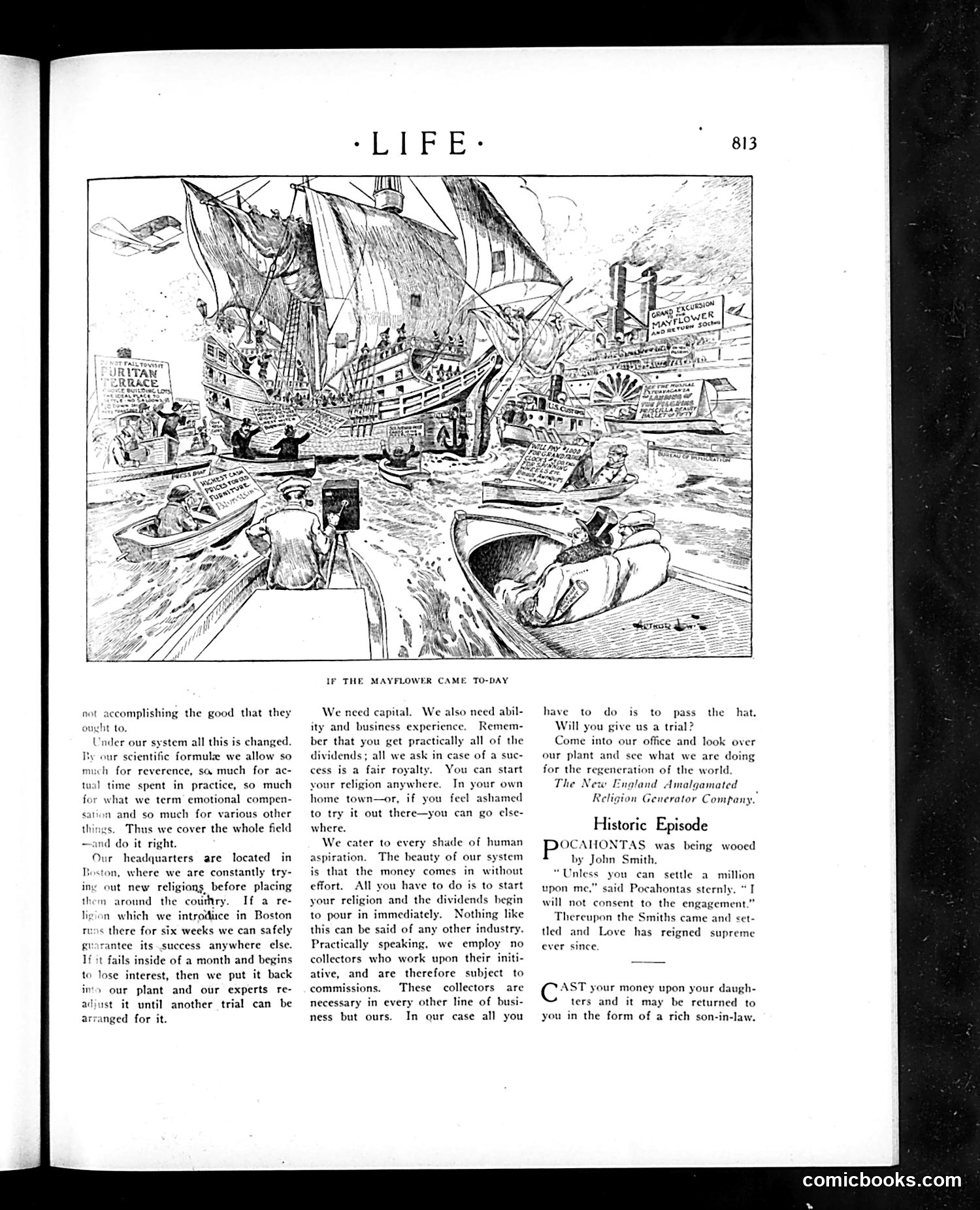
This 1910s *Life* page satirizes the commercialization of religion. The main cartoon "If the Mayflower Came To-Day" depicts the Mayflower arriving in a modern industrial harbor, juxtaposing Puritan pilgrimage with capitalist mass production. The accompanying text mocks a fictional "England Amalgamated Religion Generator Company" that manufactures and test-markets religions like consumer products, calculating profit margins on "emotional compensation." The satire targets how American entrepreneurs were treating spirituality as a franchise business—starting religions cheaply, collecting donations ("pass the hat"), and scaling successful ones nationwide without genuine conviction. The secondary "Pocahontas" joke plays on materialism in marriage, suggesting even historical romance has been reduced to financial transaction. The overall message: American business culture has corrupted authentic religious experience into manufactured, profit-driven enterprise.
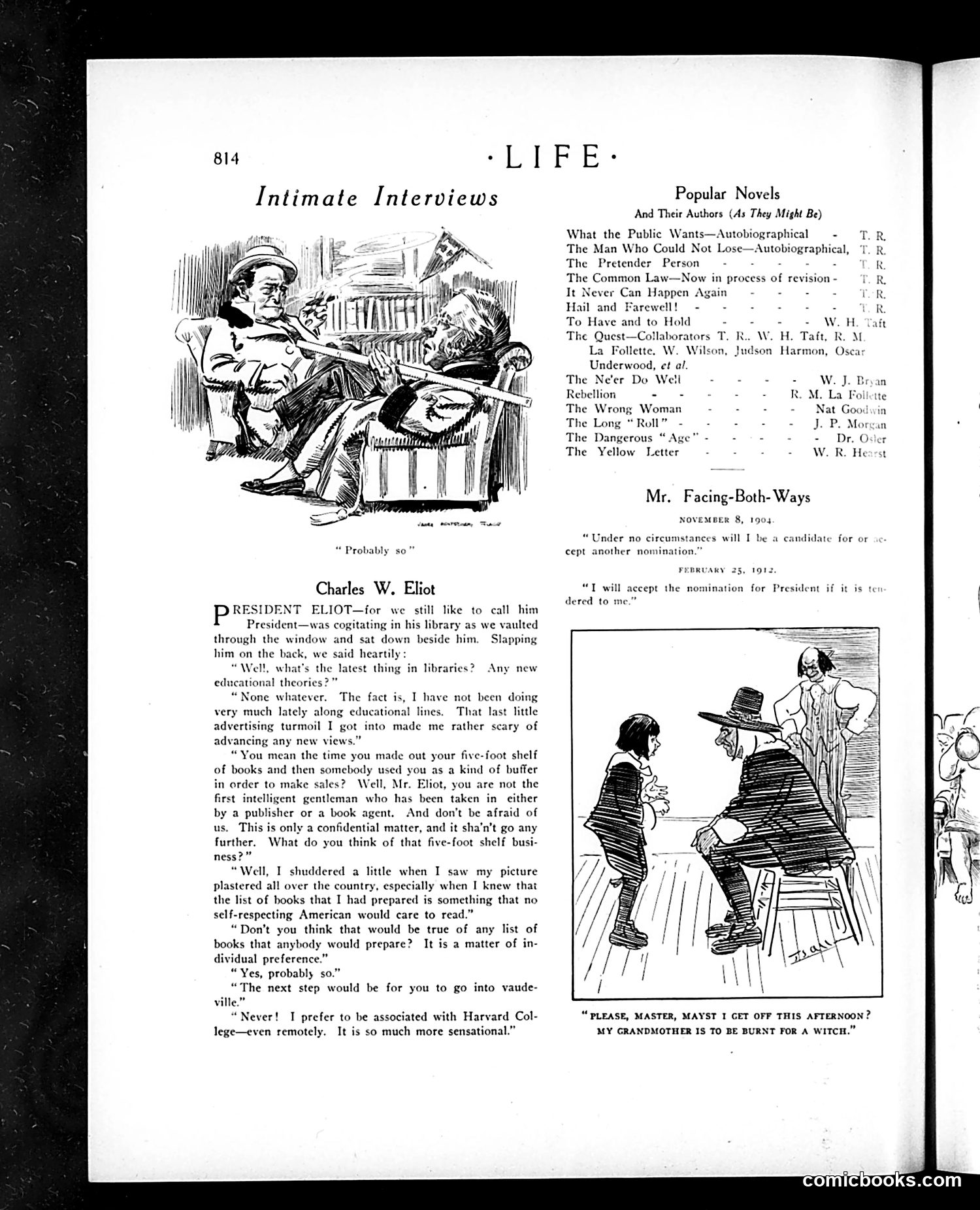
This page contains two satirical pieces from *Life* magazine (early 1900s): **"Charles W. Eliot" Interview:** Eliot was Harvard's famous president. Life mocks his "five-foot shelf" of essential books—a real educational initiative that became commercialized for marketing purposes. The satire ridicules how his serious academic idea was weaponized for sales, embarrassing him. The joke is that Eliot is now so gun-shy about publicity that he refuses vaudeville (then popular entertainment) because even Harvard's remote association sounds "more sensational" than show business—absurd logic that undercuts his dignity. **"Mr. Facing-Both-Ways":** This appears to reference someone (unclear from text alone) who contradicted himself on presidential candidacy, first refusing nomination (November 1904) then accepting it if offered (February 1912). The cartoon caption about a grandmother being "burnt for a witch" is a period-appropriate joke about hypocrisy or absurd reasoning. Both pieces use *Life's* signature approach: mocking public figures through exaggerated dialogue and inconsistent statements.
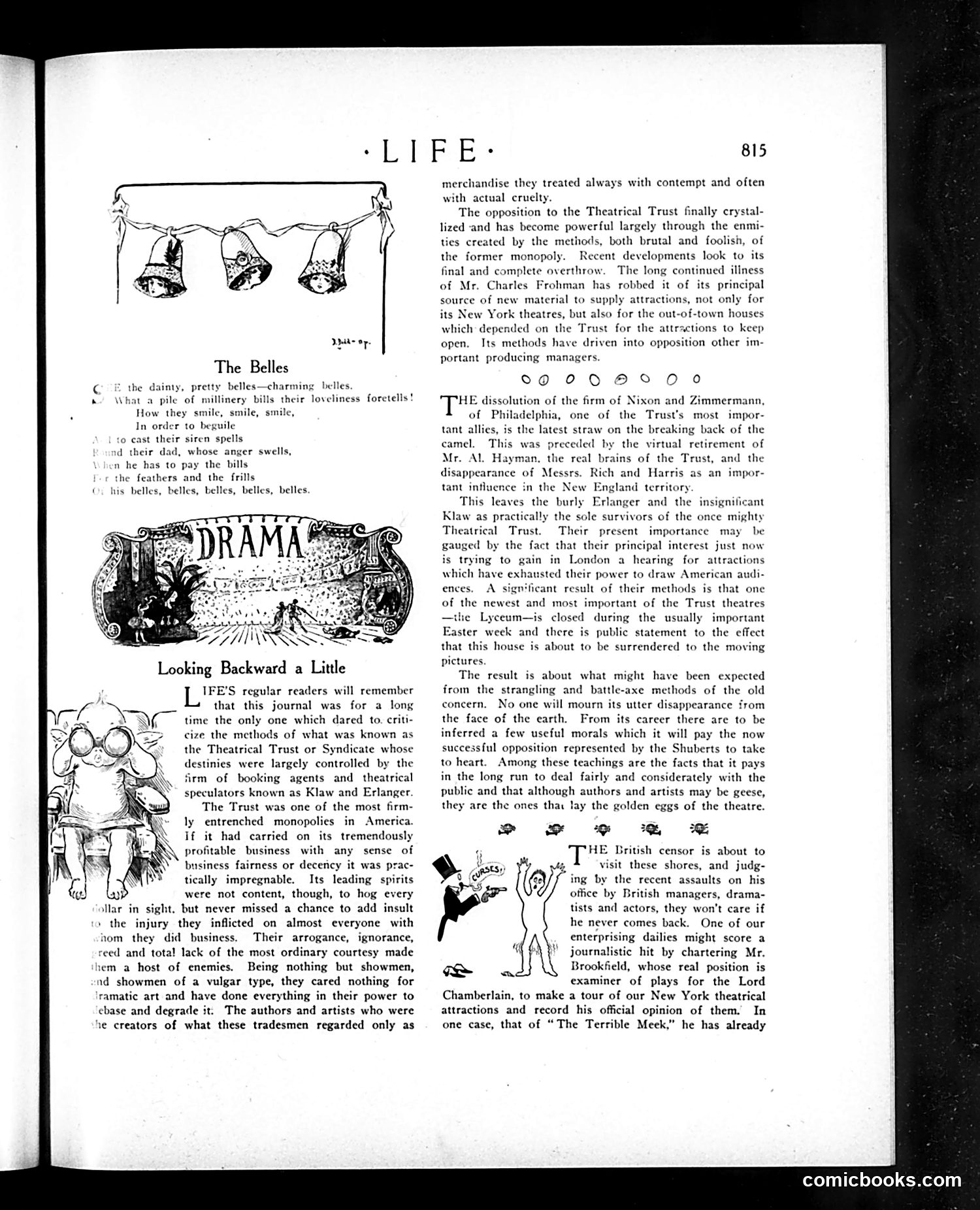
This page contains two satirical pieces about early 1900s American theater: **"The Belles"** (top) is a humorous poem mocking wealthy young women whose expensive tastes in fashionable hats and clothing drive their fathers to financial ruin. The joke centers on the contrast between their charm and the bills their extravagance generates. **"Looking Backward a Little"** (main article) discusses the collapse of the **Theatrical Trust** (also called the Syndicate)—a monopoly controlled by booking agents **Klaw and Erlanger** that dominated American theater. Life claims to have been the only publication brave enough to criticize their brutal, contemptuous treatment of playwrights and artists, their arrogance, and their neglect of dramatic art in favor of profit. The article celebrates the Trust's disintegration through the dissolution of allied firms (Nixon and Zimmermann) and retirement of key figures. It argues their ruthless methods created enemies and ultimately caused their downfall, with even their flagship Lyceum theater closing during Easter and facing conversion to moving pictures. The satire celebrates the monopoly's defeat as a moral victory for fair dealing in theater.
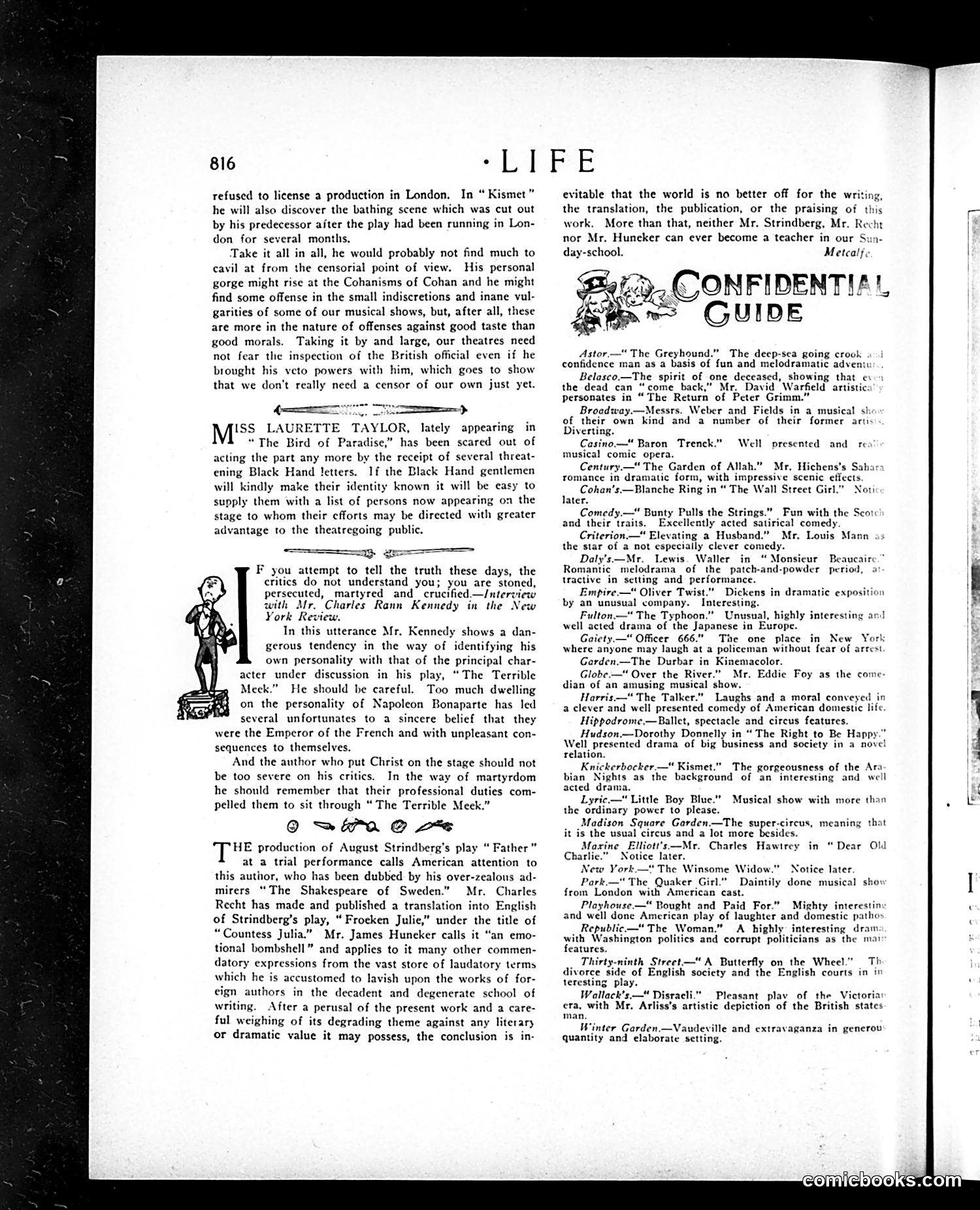
This page contains theatre reviews and satirical commentary typical of Life magazine's cultural criticism. The main satirical pieces mock: 1. **Charles Rann Kennedy** - criticized for identifying too personally with his play's protagonist (comparing himself to Napoleon/Christ), suggesting dangerous delusion in the author 2. **August Strindberg and his advocates** - the review dismisses "Countess Julia" as morally degrading despite critical praise, sarcastically noting that Strindberg and translator James Huneker couldn't teach Sunday school 3. **Laurette Taylor/Black Hand threats** - a sardonic jab suggesting that if the Black Hand wants to intimidate someone, they should target worse actors currently performing The "Confidential Guide" section lists current Broadway shows with brief descriptions. The overall tone reflects turn-of-the-century American cultural conservatism—dismissing European avant-garde drama as decadent while defending American theatrical standards against foreign "degenerate" influences.
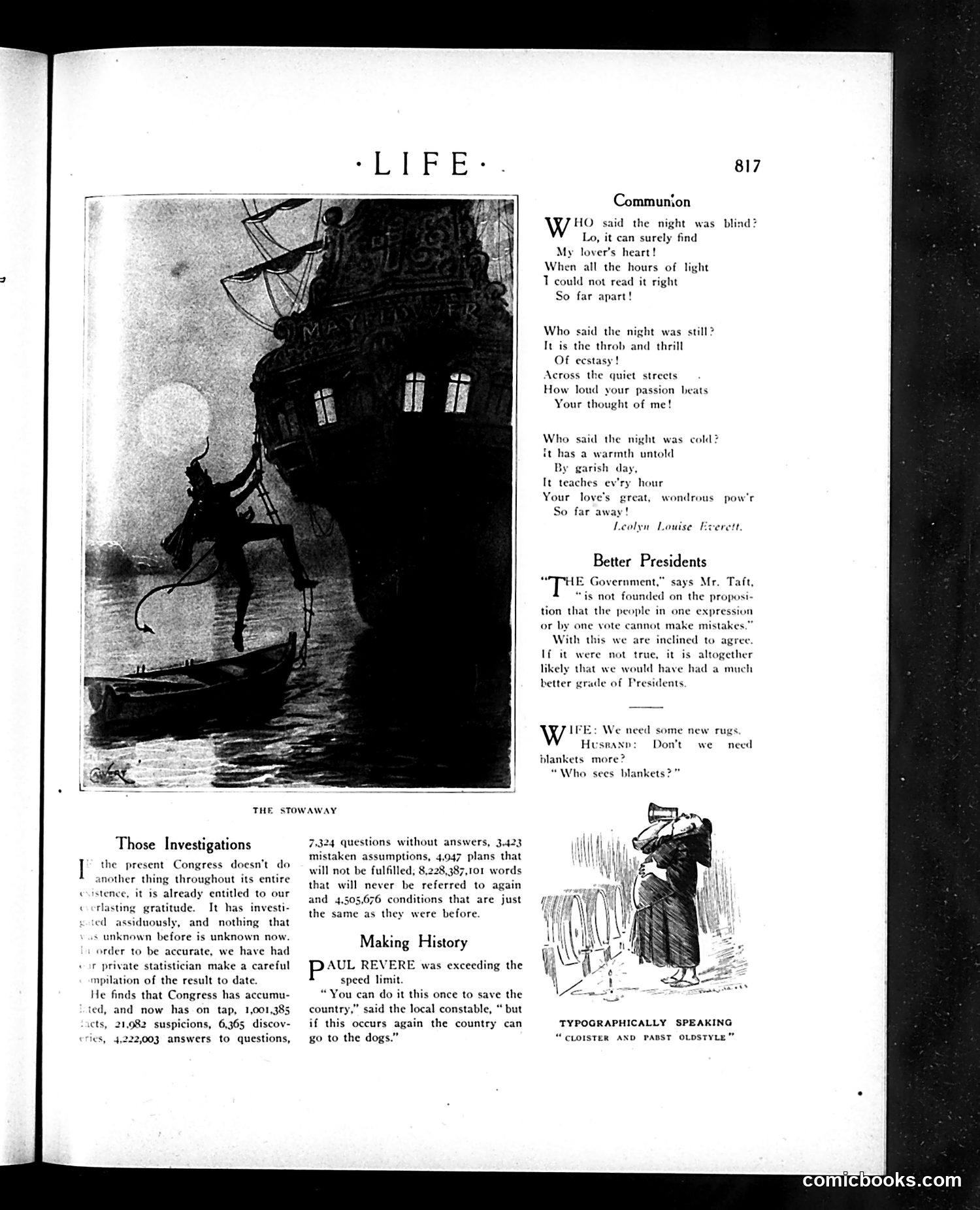
**"The Stowaway" cartoon** (left): Silhouette shows a figure climbing a building at night with a moon above. The accompanying text satirizes Congressional investigations, mockingly tallying their alleged outputs: over a million "facts," thousands of questions, and millions of words—yet concluding that conditions remain unchanged. The joke: Congress investigates exhaustively but accomplishes nothing; the "stowaway" represents their ineffectual work sneaking through without real impact. **"Making History"** parodies Paul Revere's midnight ride by having a constable permit him to exceed the speed limit once "to save the country," but warn future violations mean abandonment. It satirizes how rules bend for historical necessity, then revert—commentary on selective law enforcement or political expediency. The remaining items are lighter humor: a poem about romance at night, commentary that poor presidential quality results from voters' fallibility, and domestic banter about household needs—typical magazine filler content of the era.
This is **not a cartoon page**, but rather a lengthy editorial essay analyzing regional variations among New England Yankees. The author catalogs four main "types" of Yankees based on their home states: Massachusetts, Connecticut, Vermont, and Maine—each with distinct characteristics shaped by geography, settlement history, and local culture. The piece humorously notes that while Massachusetts and Connecticut Yankees share common ancestry and traits, they've developed different traits through isolation and varying influences (Connecticut's proximity to New York, maritime communities in Massachusetts, etc.). The author distinguishes the Maine Yankee and Green Mountain (Vermont) Yankee as separate, defined types. The satire targets New England's self-conscious regional pride and the tendency to create rigid social classifications based on ancestry and local origin—a distinctly American form of "aristocracy" based on genealogy rather than wealth or breeding.
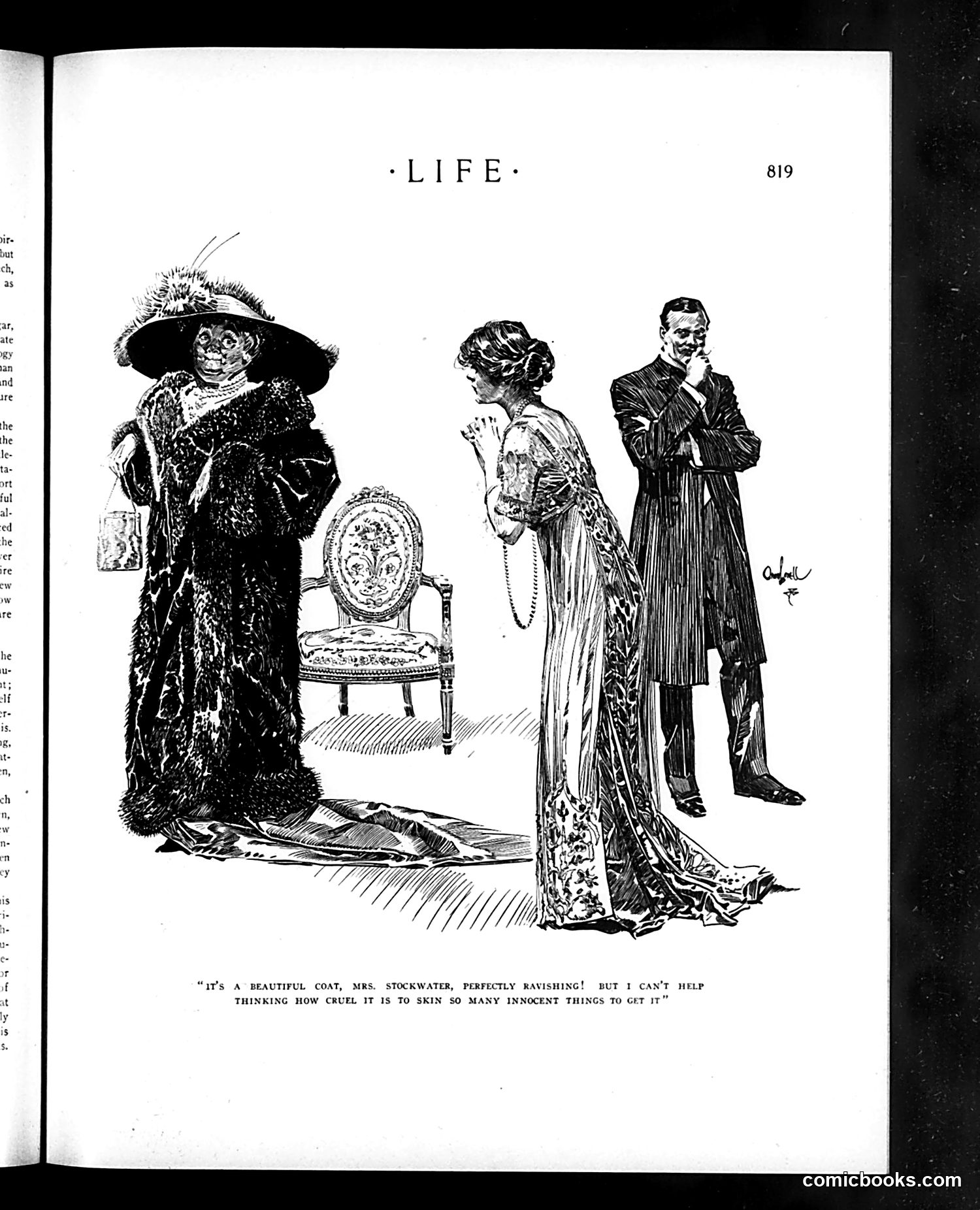
This is a satirical cartoon about the fur coat trade. The dialogue criticizes the ethics of fur fashion: a well-dressed man compliments a woman (Mrs. Stockwater) on her luxurious fur coat while simultaneously expressing moral disapproval of the animal cruelty required to produce it. The satire targets the hypocrisy of early 20th-century high society—praising expensive fur garments while ignoring or dismissing their gruesome origins. The man's comment suggests gentle social disapproval mixed with resigned acceptance of the practice, reflecting contemporary debates about animal welfare and fashion ethics. The ornate chair visible in the scene indicates wealthy, upper-class settings where such conversation would occur.
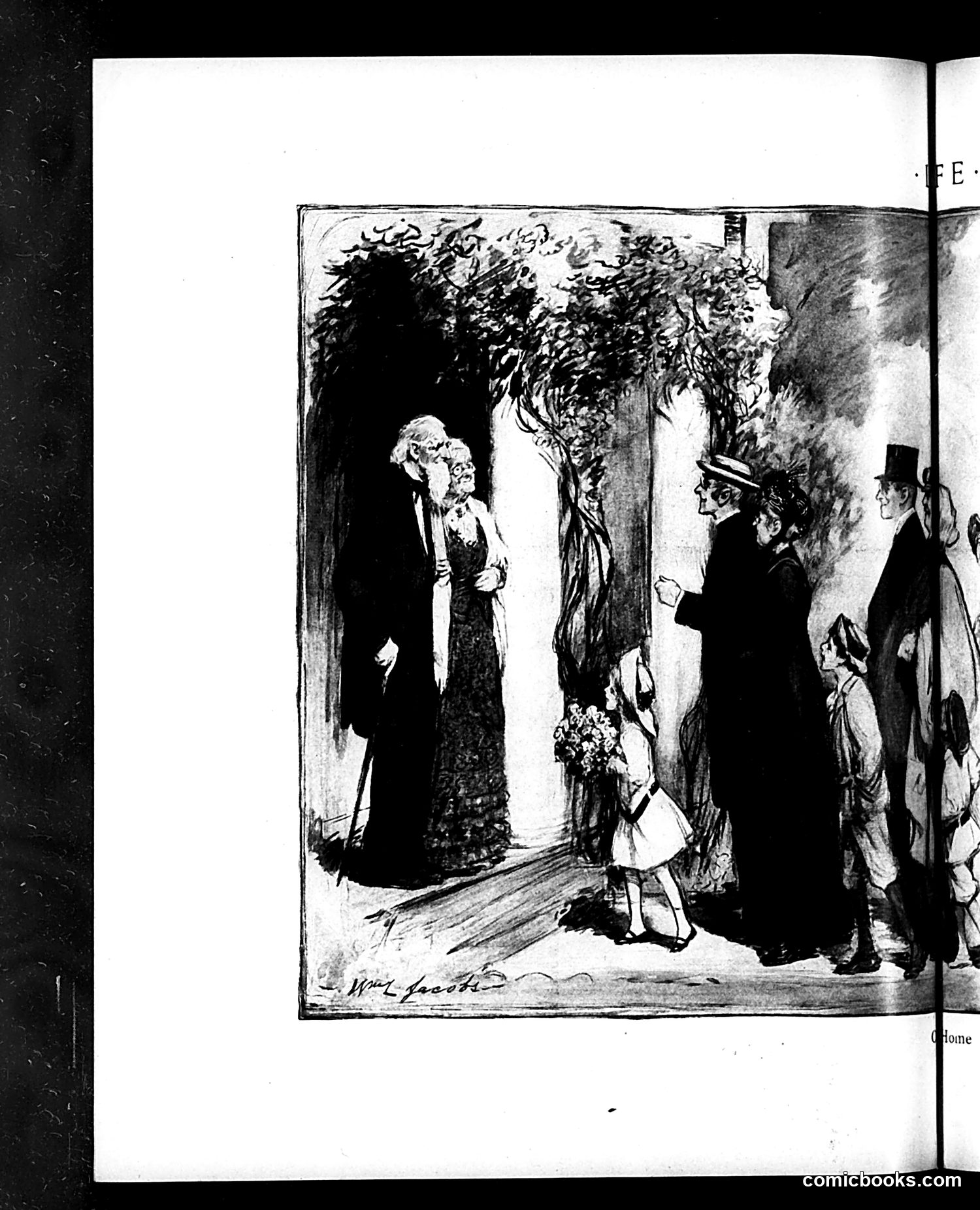
This appears to be a satirical illustration from *Life* magazine showing a social scene at what looks like a formal garden party or outdoor gathering. The cartoon depicts well-dressed Victorian-era figures in top hats and formal dress, with an older couple on the left appearing to greet or observe younger guests. A small child is visible in the center foreground. The artist's signature appears to read "Wal Jacobs" (lower left). Without clearer OCR text or identifying captions, the specific political or social satire remains unclear. The scene likely mocks upper-class social pretensions, fashion, or etiquette customs of the period, but the exact target cannot be determined from the image alone. The formal, somewhat stiff postures of the figures suggest commentary on Victorian social formality.
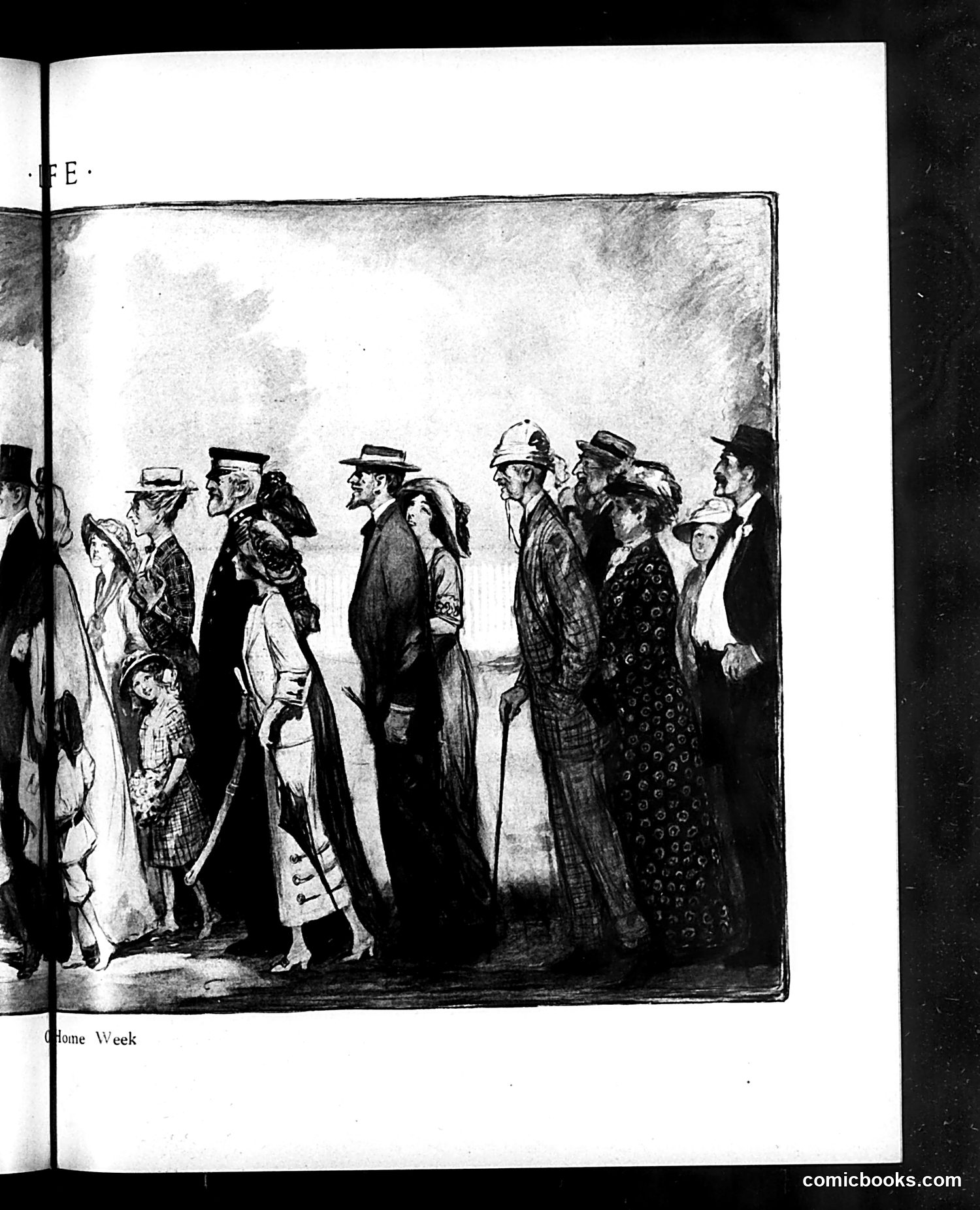
This satirical sketch depicts a line of immigrants or working-class figures arriving at or gathering in America, labeled "Home Week." The caricatures—with exaggerated features common to early 20th-century American satirical art—appear to represent various ethnic groups, wearing period clothing including hats, coats, and traditional garments. The cartoon likely satirizes the massive wave of immigration to the United States during this era, playing on the phrase "homecoming week." The ironic title suggests these newcomers are being welcomed to their "home," mocking either American attitudes toward immigrants or the immigrants' own sense of belonging. The diverse group composition emphasizes the variety of nationalities arriving, a common topic of contemporary social and political debate regarding assimilation, labor, and national identity.
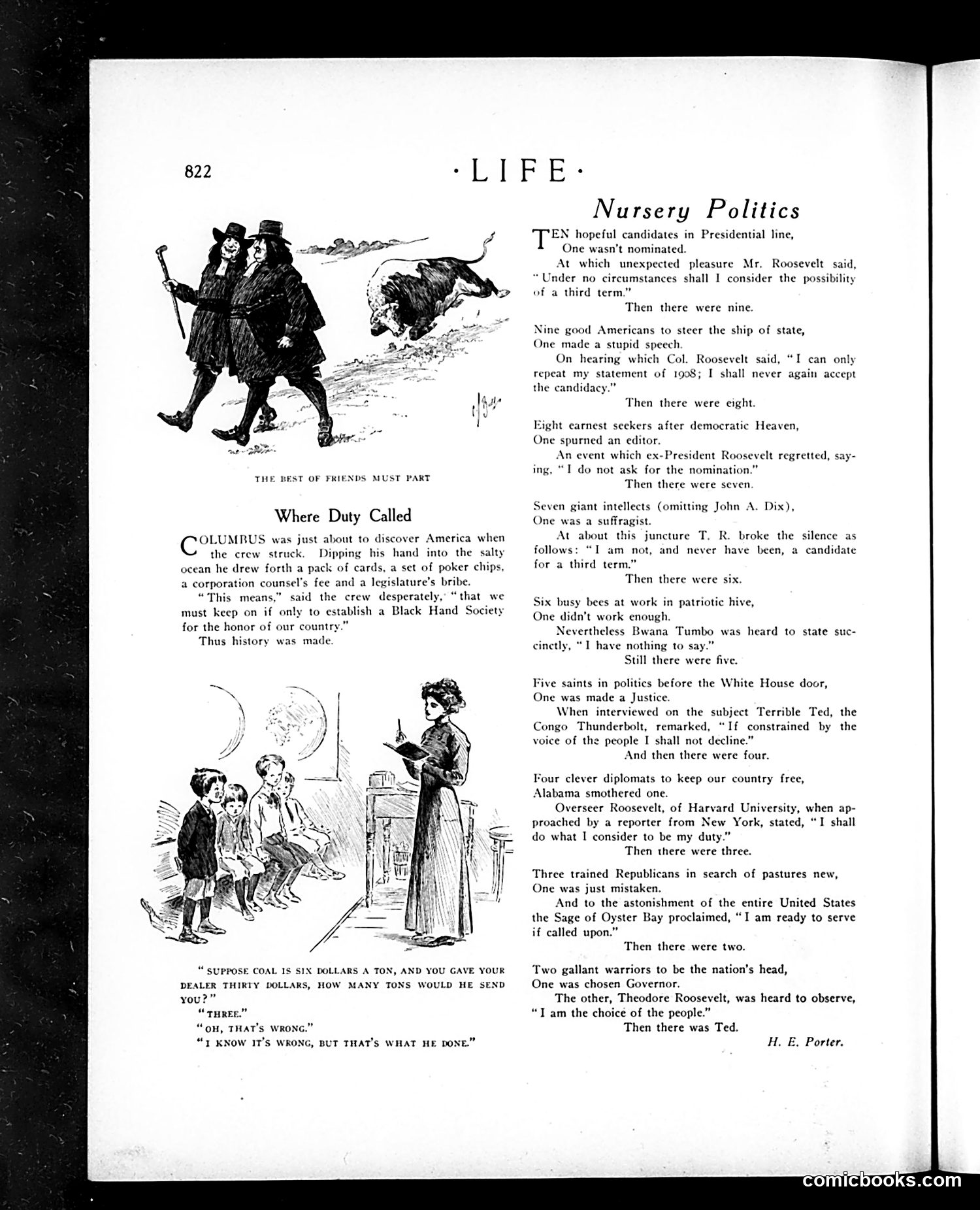
This poem by H.E. Porter satirizes Theodore Roosevelt's contradictory denials about seeking a third presidential term. Using a "ten little Indians" countdown structure, it mocks how Roosevelt repeatedly claimed he wouldn't run for president—"Under no circumstances shall I consider the possibility of a third term"—while simultaneously inserting himself into the race, eventually declaring "I am ready to serve if called upon." Each stanza eliminates a candidate through various mishaps (stupid speeches, supporting suffrage, spurning editors), with Roosevelt's name constantly reappearing despite his protestations. The final reveal—"Then there was Ted"—reveals his inevitability. The accompanying illustration shows two figures parting, likely representing Roosevelt and his chosen successor, visually reinforcing the theme of broken political promises. The satire targets Roosevelt's transparent political maneuvering during the 1912 election cycle.
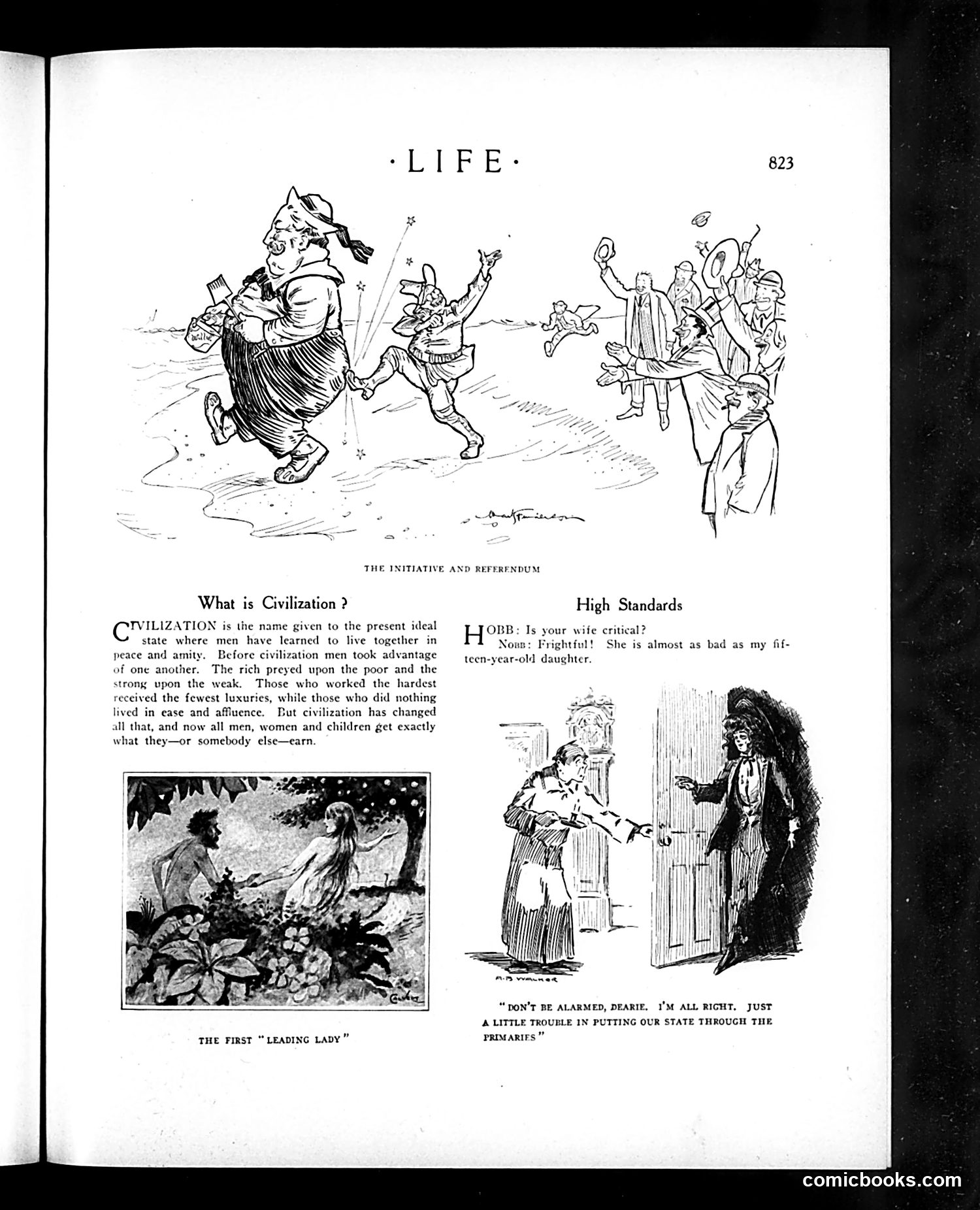
This page satirizes early 20th-century American progressive politics, specifically the "initiative and referendum" movement—direct democracy reforms allowing voters to bypass legislatures. The top cartoon mocks the initiative/referendum as chaotic mob rule: a fat politician flees while crowds of ordinary citizens pursue him with weapons and chaos, suggesting these democratic reforms create disorder rather than improvement. The "What is Civilization?" text uses ironic understatement: civilization supposedly ended exploitation, yet "now all men...get exactly what they...earn"—implying the opposite actually occurred; the wealthy still prosper while workers remain exploited. The bottom cartoon jokes about marital discord using political metaphor: a wife tells her husband he's having "trouble putting our state through the primaries"—equating domestic strife with the messy primary election process, suggesting both involve similar chaos and difficulty. Overall, the page expresses skepticism toward progressive democratic reforms and highlights class inequality persisting despite claims of civilization's progress.
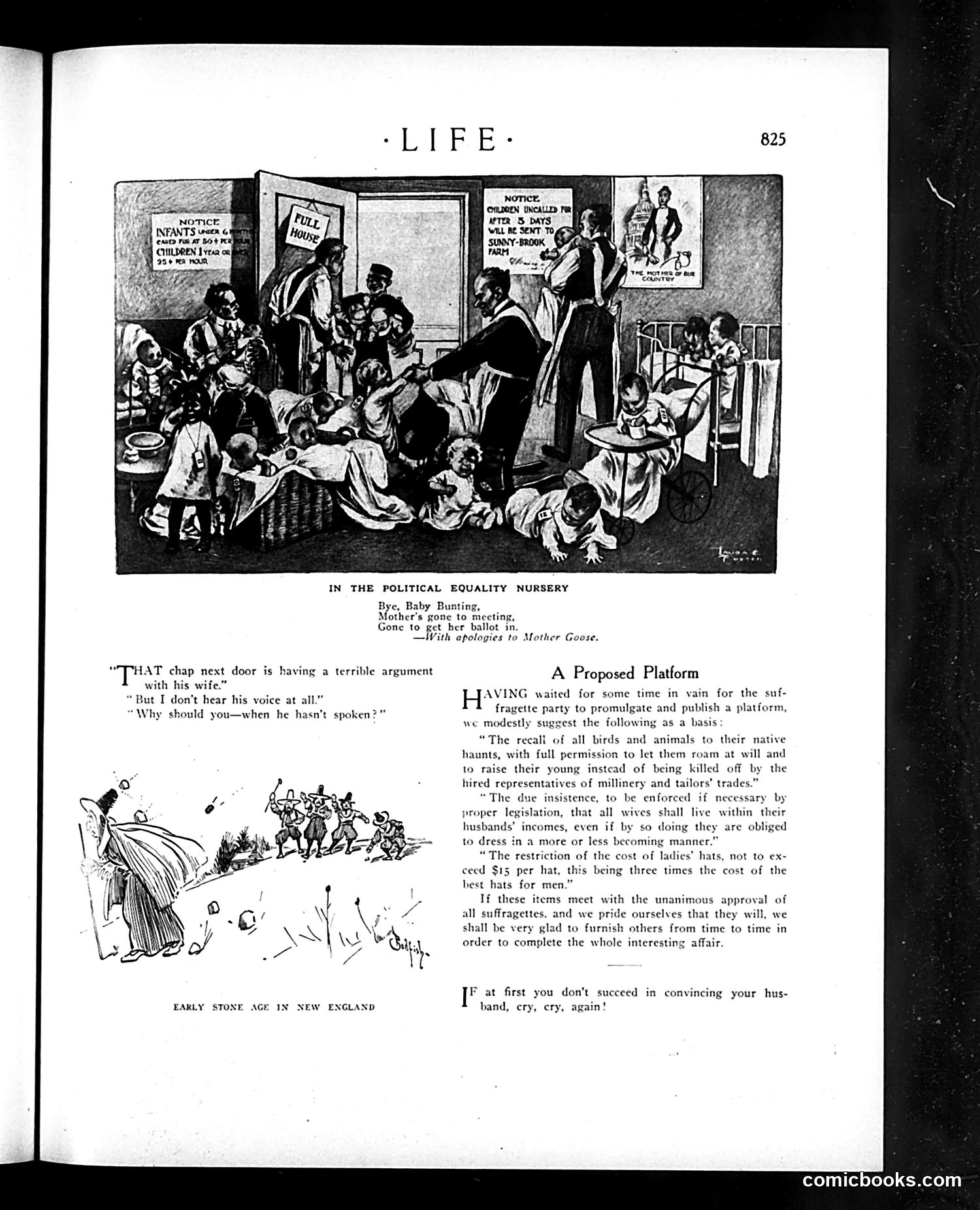
This Life magazine page satirizes the early 1900s women's suffrage movement through multiple angles: **Top cartoon** ("Political Equality Nursery"): Depicts a chaotic nursery where women hold political meetings while children run wild—mocking the argument that women entering politics would neglect domestic duties. **"Proposed Platform"**: Fakes a suffragette platform with absurd demands: animal rights, wives living within husbands' incomes, and limiting ladies' hats to $15. The satire positions feminists as simultaneously concerned with trivial matters (hat prices) and radical restrictions on women's independence. **Bottom cartoon** ("Early Stone Age in New England"): Suggests that gender conflict over voting rights represents societal regression. **The joke**: The magazine ridicules suffragettes by portraying their concerns as either domestic neglect or frivolous consumption, while the final quip—"cry, cry, again"—dismisses women's political ambitions. The satire exemplifies anti-suffrage propaganda common in early-20th-century American media.
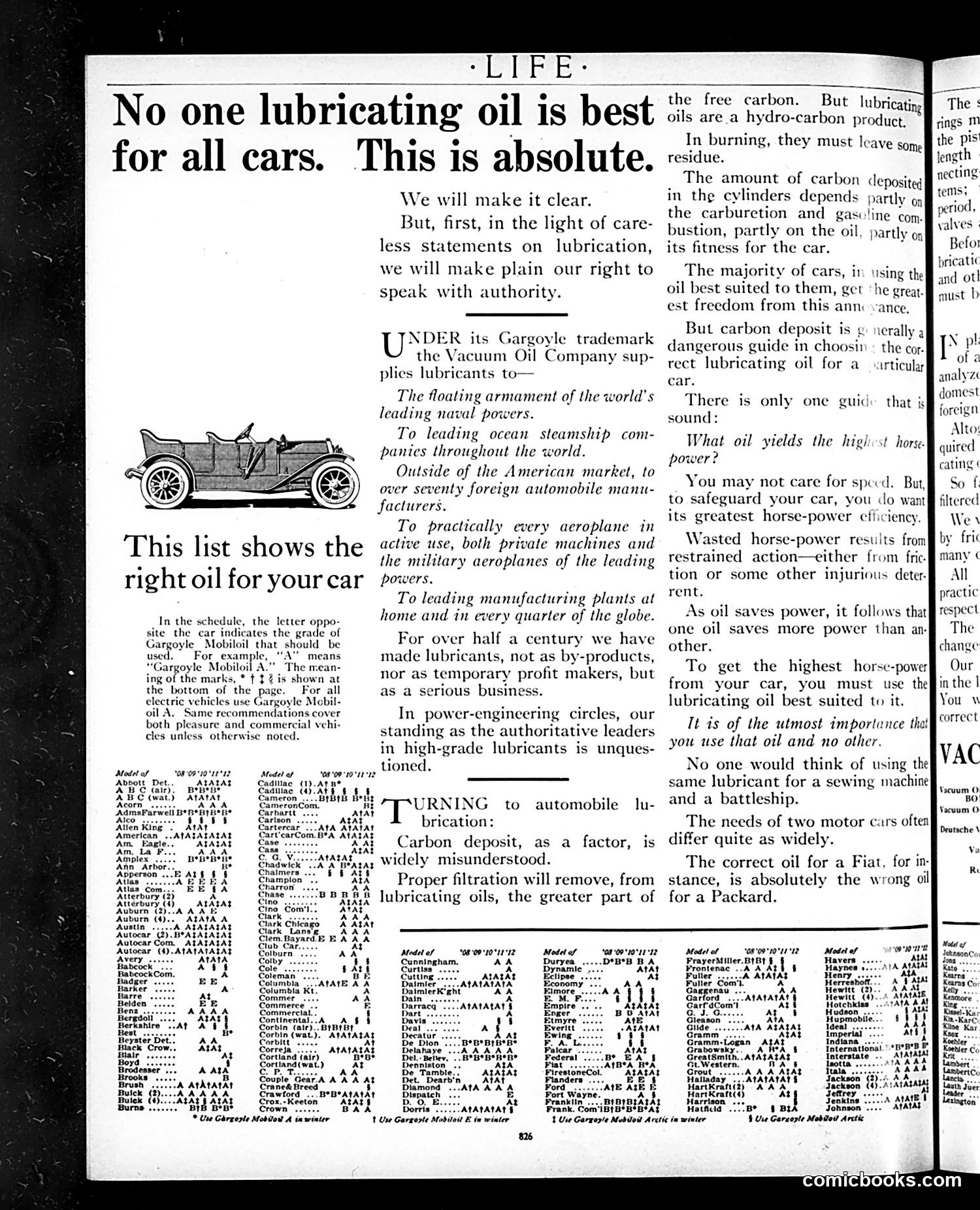
This is **primarily a Vacuum Oil Company advertisement** for Gargoyle Mobiloil, not a political cartoon or satire. The page uses early 20th-century marketing rhetoric to establish authority. The small **illustration of an early automobile** at top-left serves as a visual anchor—not caricature, but a contemporary product reference showing the machines requiring their lubricant. The advertisement's **argumentative tone** is notable: it defensively asserts the company's expertise by citing contracts with navies, steamships, 70+ foreign auto manufacturers, and military aircraft. This suggests competitive claims about lubricant superiority were common in the era. The lengthy **tables listing automobile models** with corresponding oil grades (A, B, etc.) occupy most of the page—this is technical product information, not satire. The humor, if any, lies in the **deadpan analogy**: "No one would think of using the same lubricant for a sewing machine and a battleship. The needs of two motor cars often differ quite as widely." This uses absurdist comparison for persuasion—treating oil selection with almost military-grade seriousness. **Context**: Early automotive standardization required convincing consumers that different cars needed different oils.
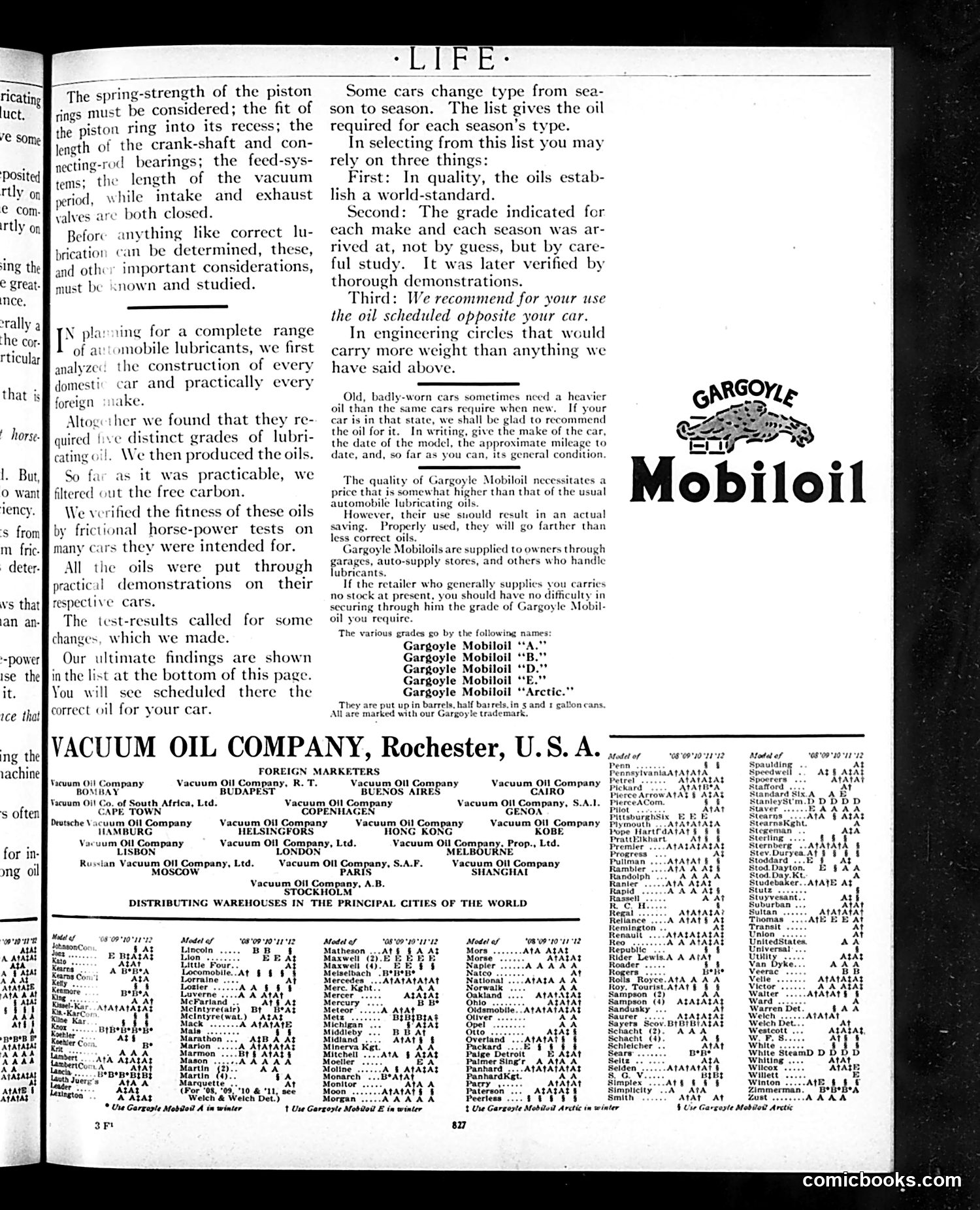
This is primarily a **Vacuum Oil Company advertisement** for Gargoyle Mobiloil motor oil, not a satirical cartoon page. The content explains the company's methodical approach to developing different oil grades for various car models and seasons. **The Sales Pitch:** The left column describes how Vacuum Oil scientifically analyzed automobile engines to create five distinct lubricating oil grades, tested them through "practical demonstrations," and adjusted formulations based on results. This pseudo-scientific rigor was meant to persuade buyers that Gargoyle Mobiloil was superior to competitors. **The Product Line:** Five grades (A, B, D, E, and Arctic) were offered, with a detailed chart specifying which grade suited each car make and season. The company emphasized that proper oil selection would save money long-term. **The Marketing:** The advertisement lists Vacuum Oil Company's international distribution network across major world cities, establishing credibility through global presence. There is **no political satire** on this page—it's purely commercial advertising typical of early-20th-century Life magazine, which carried substantial advertising alongside editorial content.
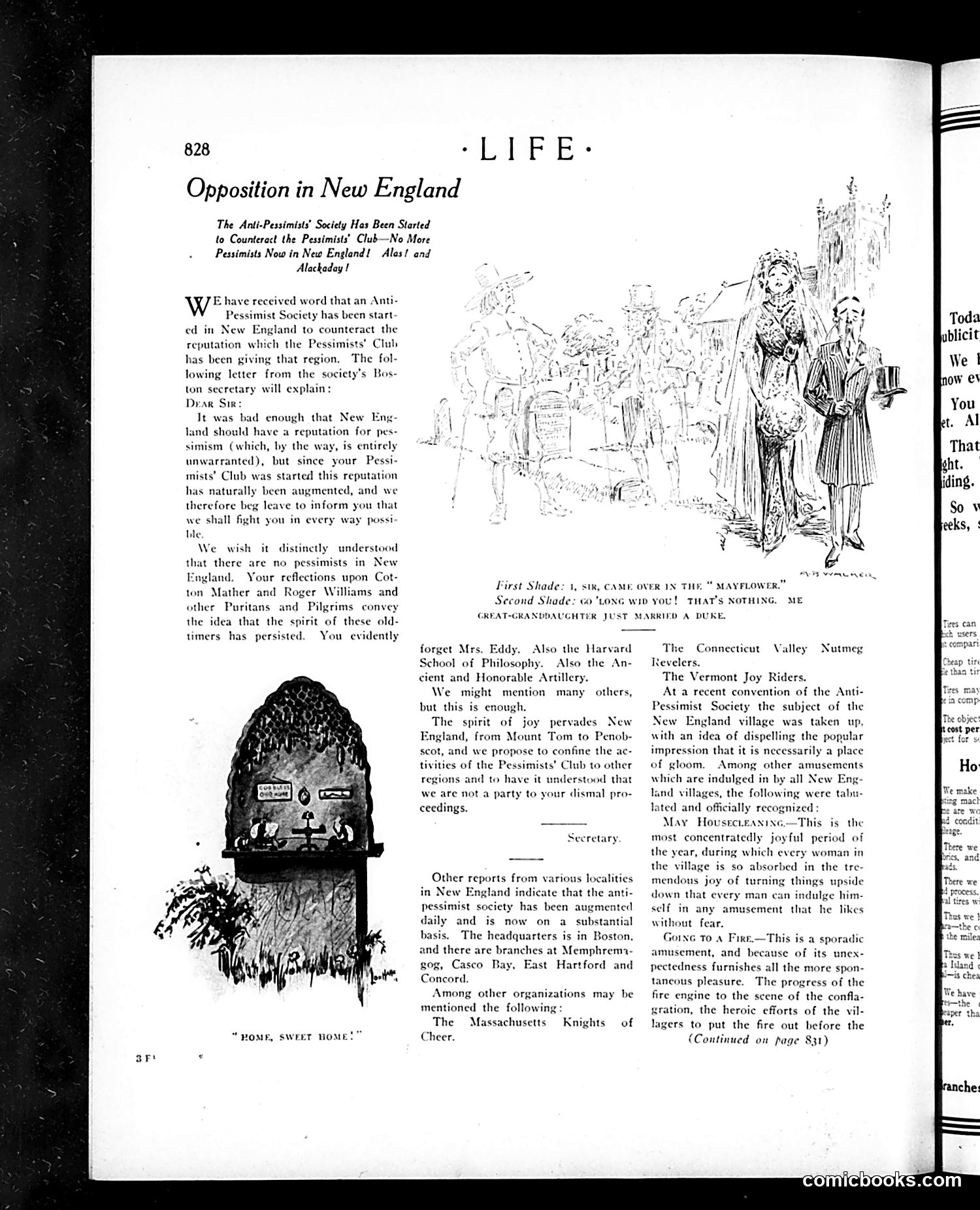
This satirical piece mocks New England's reputation for pessimism by reporting on an "Anti-Pessimist Society" formed to counteract a "Pessimists' Club." The humor lies in the absurdity of organizing to deny pessimism exists—the very act of creating such a society proves the opposite. The letter from the society's Boston secretary ironically attempts to demonstrate New England's joy by referencing figures like Mary Baker Eddy (Christian Science founder) and Harvard's School of Philosophy, while dismissing earlier Puritan tradition as outdated. The satire suggests New Englanders' relentless self-promotion of cheerfulness actually confirms their dour reputation. The cartoons above show two women competing in genealogical boasting—one claiming Mayflower ancestry, the other one-upping with a great-granddaughter who married a duke. This satirizes New England's obsession with pedigree and social status as markers of superiority, further mocking the region's self-congratulatory nature.
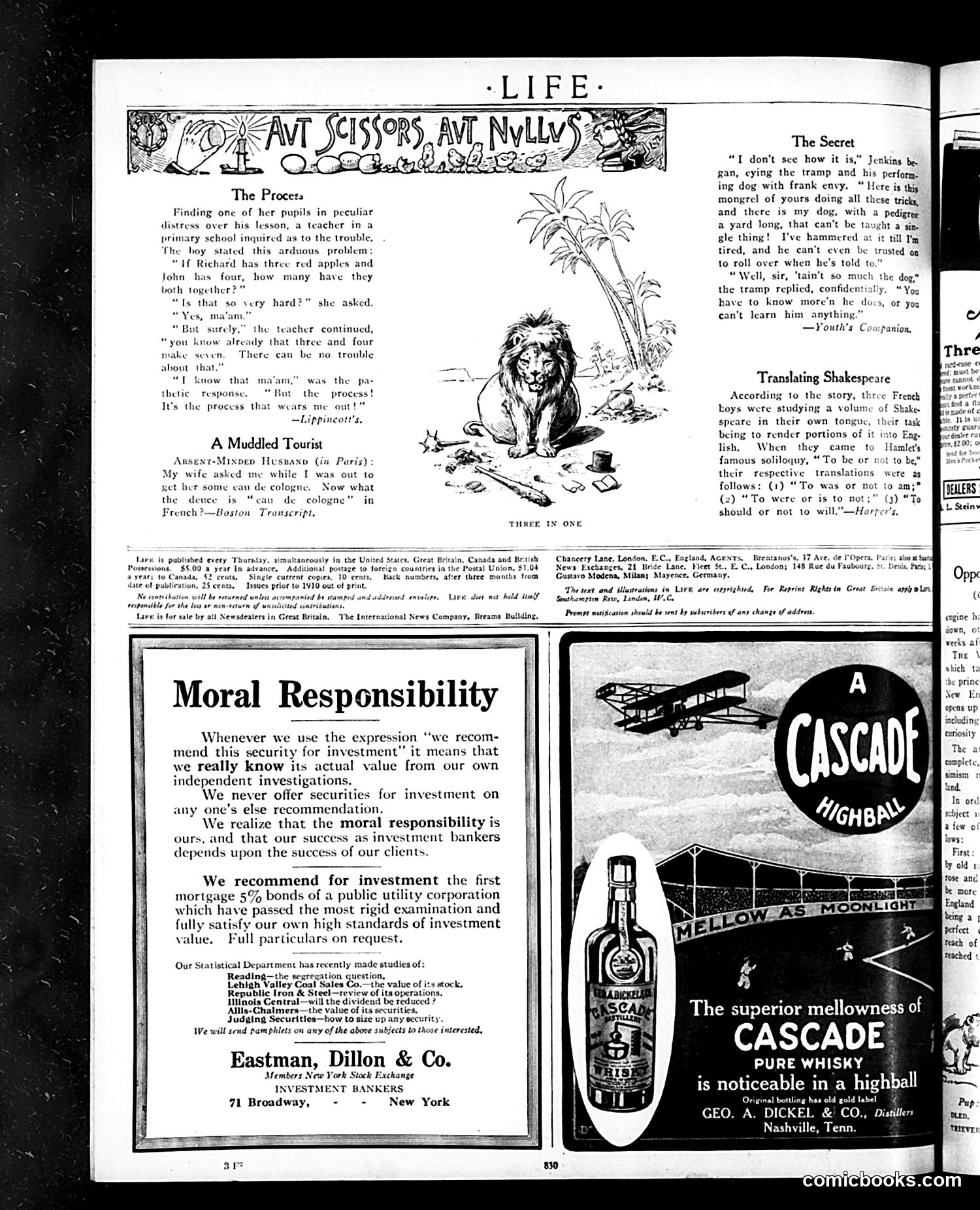
This page contains four unrelated humorous sketches typical of *Life* magazine's satirical content: **"The Process"**: A schoolboy finds arithmetic traumatic—not because 3+4≠7 is difficult, but because the *method* of learning it exhausts him. The humor lies in modern educational pedagogy frustrating a child even when the actual math is simple. **"A Muddled Tourist"**: A husband in Paris misunderstands "eau de cologne" as French, when it's already the French name. The joke mocks American tourists' ignorance abroad. **"The Secret"**: A tramp explains his mongrel dog's superior trick-learning isn't the dog's ability—it's that the trainer must know *more* than the dog. Social commentary suggesting success depends on knowledge, not breeding. **"Translating Shakespeare"**: Three French students butcher translating Hamlet's soliloquy, each producing grammatical nonsense ("To was or no am"; "To were or is to not"). Satirizes mechanical, literal translation lacking comprehension. The illustrated advertisements below are period product marketing (investment banking, whisky), not satirical content.
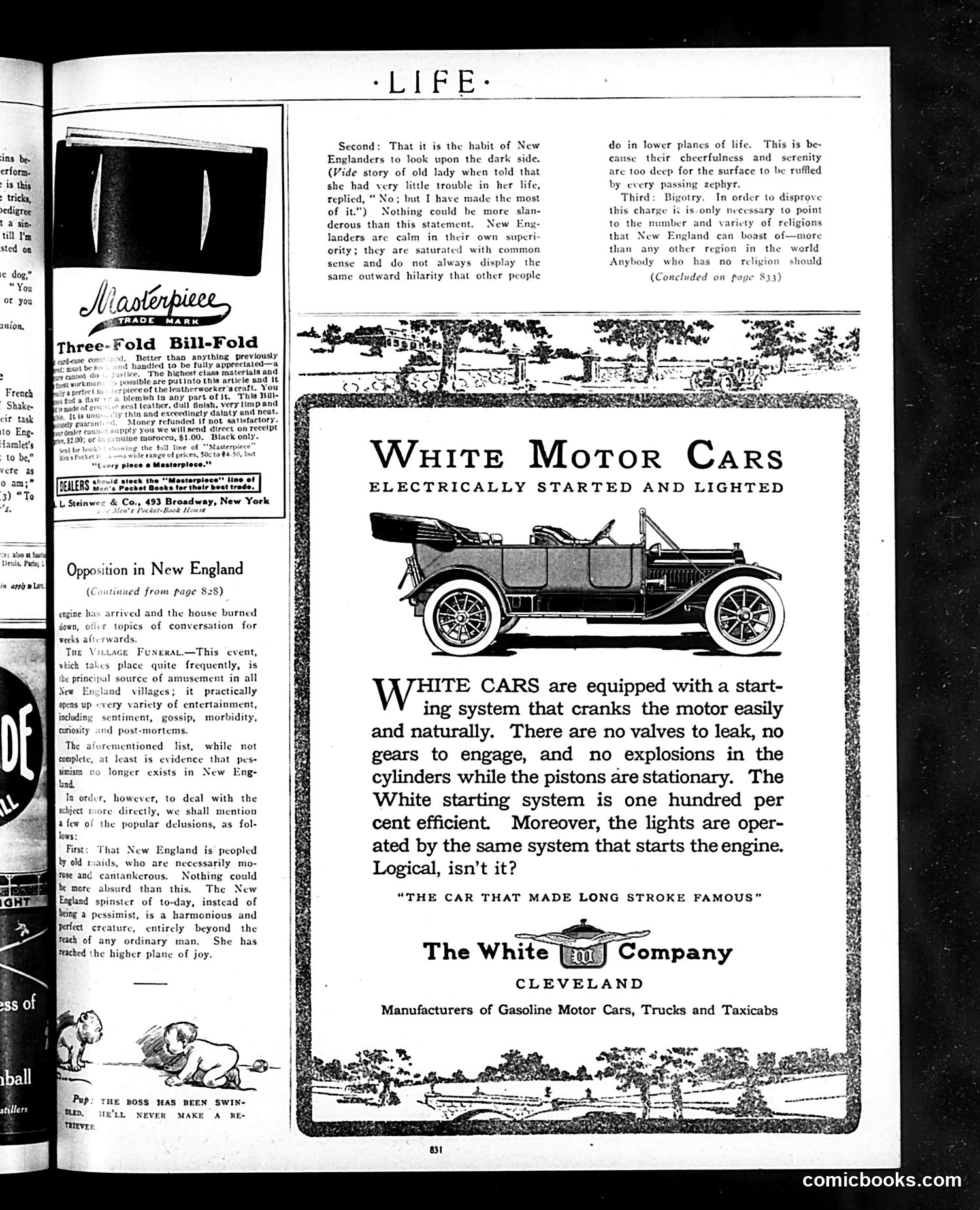
This page is primarily **advertising** for White Motor Cars, with supporting editorial content about New England attitudes. The main article ("Opposition in New England," continued from page 828) rebuts stereotypes about New Englanders—specifically that they are pessimistic old maids. The writer argues New Englanders are actually calm, sensible, and possess deep cheerfulness that doesn't require outward display. The piece defends regional character against popular mockery. The **White Motor Cars advertisement** occupies the right column, promoting electrically-started vehicles as modern, efficient, and logical. The tagline "The Car That Made Long Stroke Famous" references White's engineering innovation. The small cartoon at bottom left (captioned "THE BOSS HAS BEEN SWINDLING. I'LL NEVER MAKE A RE-") appears unrelated satire about workplace deception, likely continuing from another page. The **Three-Fold Bill-Fold** advertisement on the left sells a leather wallet product. Overall: a mixed editorial/advertising page typical of early 20th-century Life magazine format.
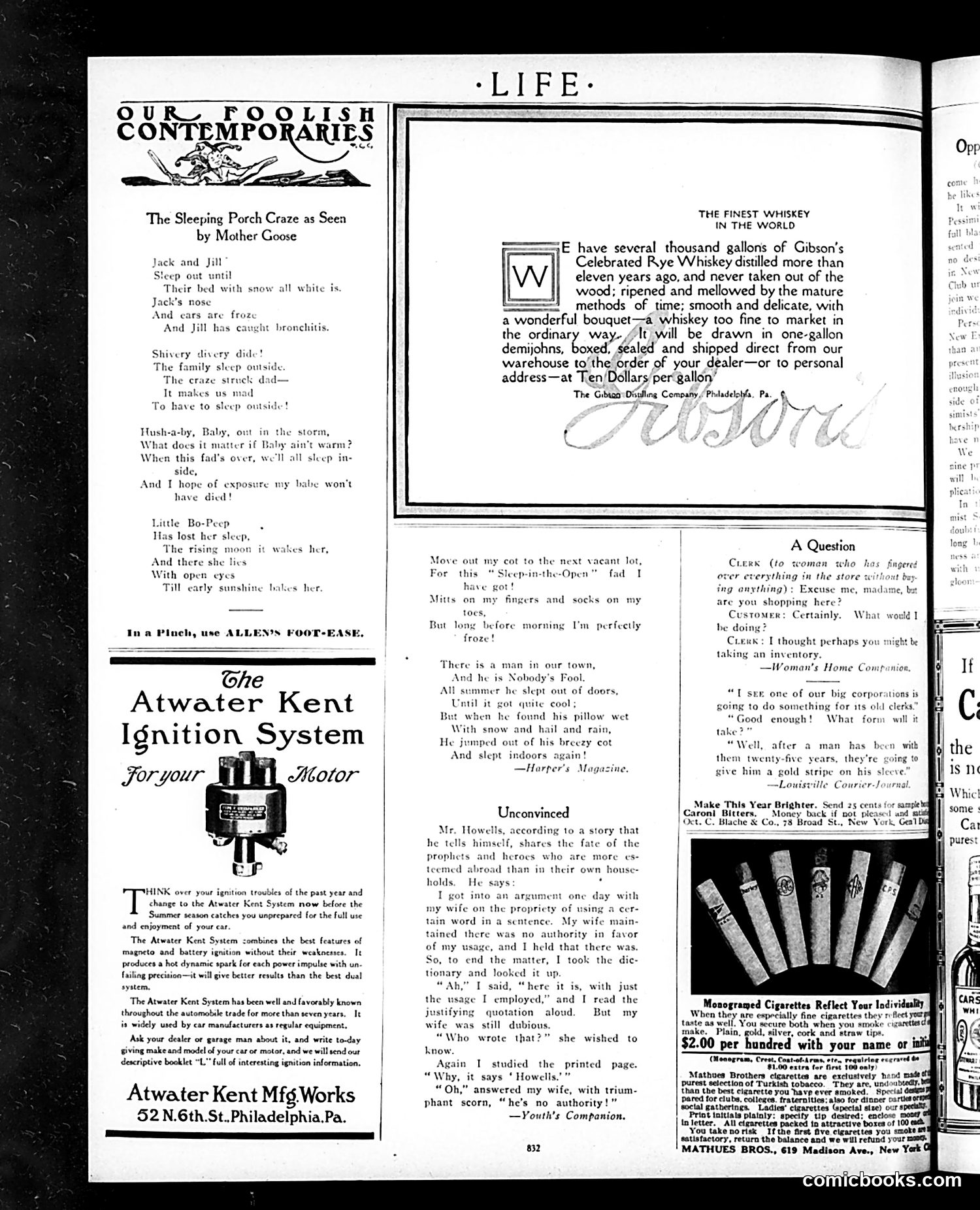
This page satirizes the early 1900s fad of outdoor "sleeping porches"—a health trend promoting fresh-air sleeping as cure for tuberculosis and bronchitis. The left section mocks this craze through Mother Goose parodies, showing families freezing in winter storms while pursuing this fashionable but impractical health practice. The humor lies in the contradiction: people expose babies and themselves to dangerous cold believing it healthful, while the verses imply illness and death may result. The cartoons undercut the craze's logic—"Little Bo-Peep" loses sleep from moonlight; one poem sarcastically hopes the baby survives exposure. The implicit critique: blind adherence to medical fads, regardless of common sense, reflects broader Progressive-era skepticism about unproven health theories being marketed to the public. The page otherwise contains advertisements (Atwater Kent ignitions, Gibson's whiskey) and humor columns typical of *Life* magazine's mix.
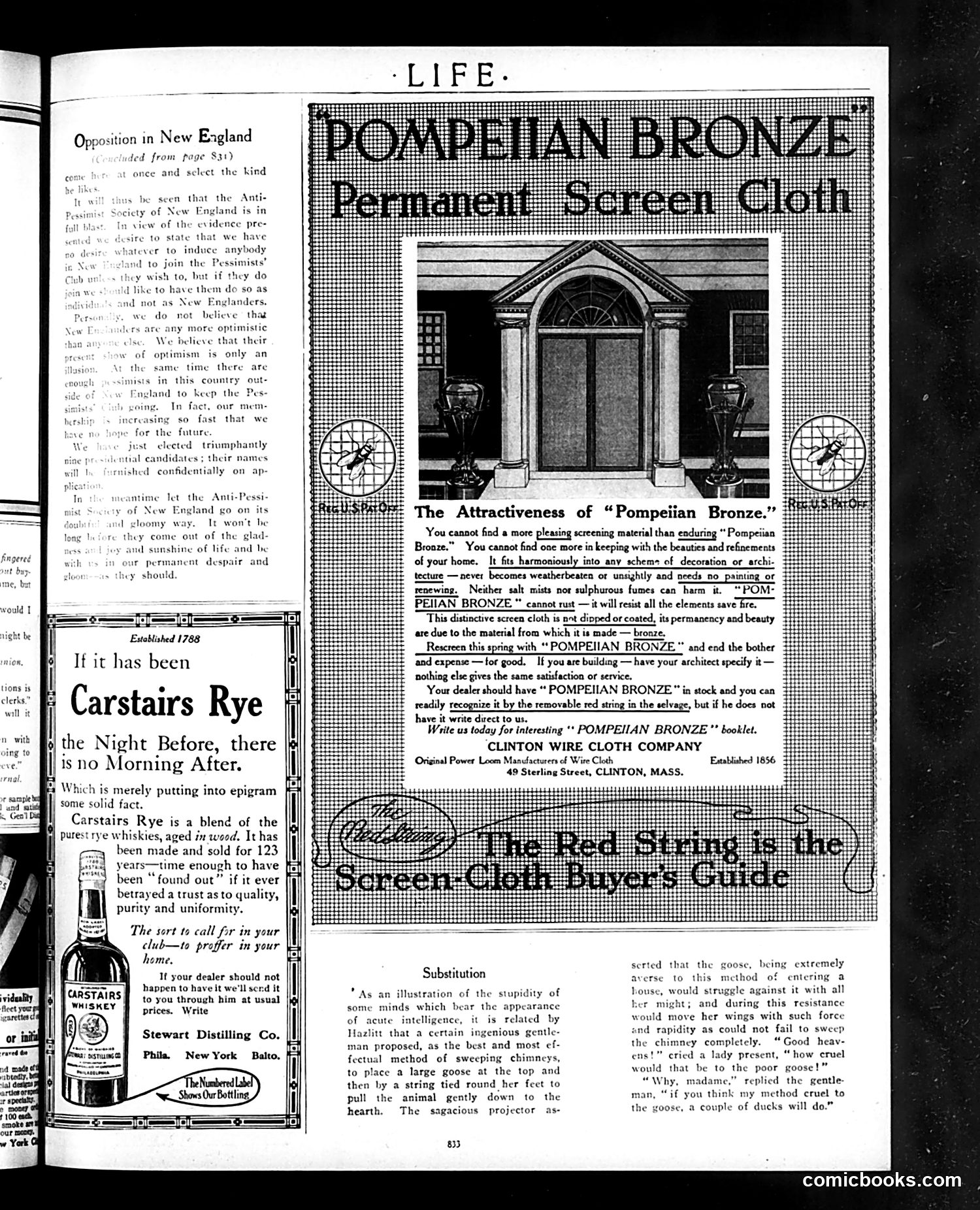
This page contains primarily **advertisements** rather than political cartoons. The main content includes: **Pompeian Bronze advertisement** (center-right): Promotes wire mesh screening material for windows and doors, emphasizing its durability, aesthetic appeal, and resistance to rust and weather damage. **Carstairs Rye whisky advertisement** (left): Highlights a 123-year-old blended rye whiskey brand, emphasizing its established quality and purity through longevity. **Political content** (upper left): Brief text discussing the "Anti-Pessimist Society of New England," apparently criticizing pessimistic attitudes in the region while defending optimism—though context is limited. **"Substitution" anecdote** (bottom): A humorous historical story about an 18th-century proposal to use a greased goose as a chimney-sweeping method, mocking absurd "ingenious" solutions. The page is primarily a commercial publication mixing light humor with product promotions rather than satirical commentary.
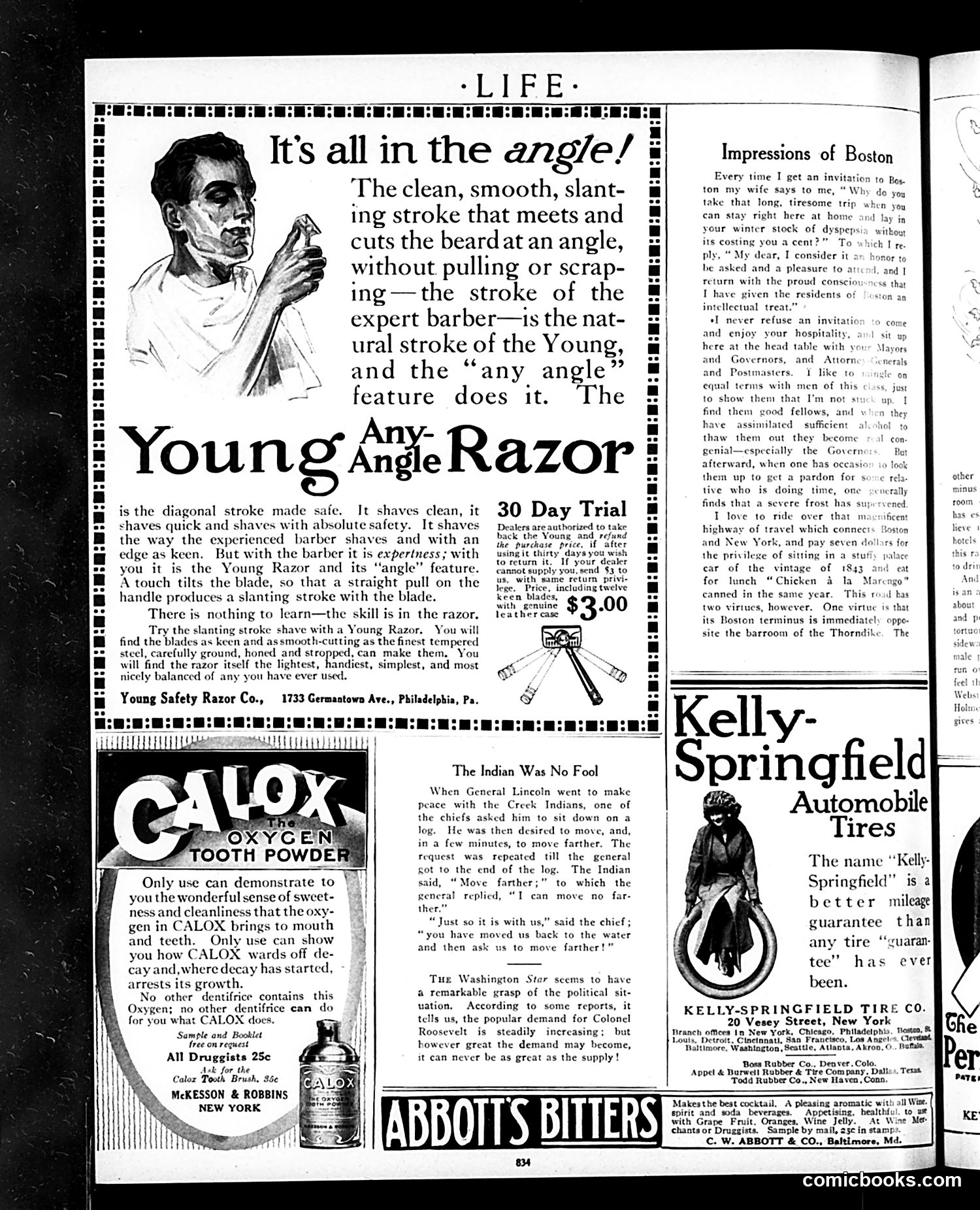
This page is primarily **advertising**, not satire or political commentary. The main content consists of three product advertisements: 1. **Young Angle Razor** (dominant): Markets a safety razor emphasizing its angled blade design, claiming it replicates expert barber technique without requiring skill. The illustration shows a man shaving. 2. **Calox Tooth Powder**: Advertises an oxygen-based dentifrice claiming to prevent decay. 3. **Kelly-Springfield Automobile Tires**: Promotes superior mileage. The editorial content includes two brief pieces: "The Indian Was No Fool" (a historical anecdote about General Lincoln and Creek Indians illustrating negotiation tactics) and "Impressions of Boston" (a humorous personal essay about visiting Boston). Neither contains identifiable political figures or satire requiring historical context—they're general-interest humor typical of the era. The page represents early 20th-century *Life* magazine's mixed advertising and editorial format.
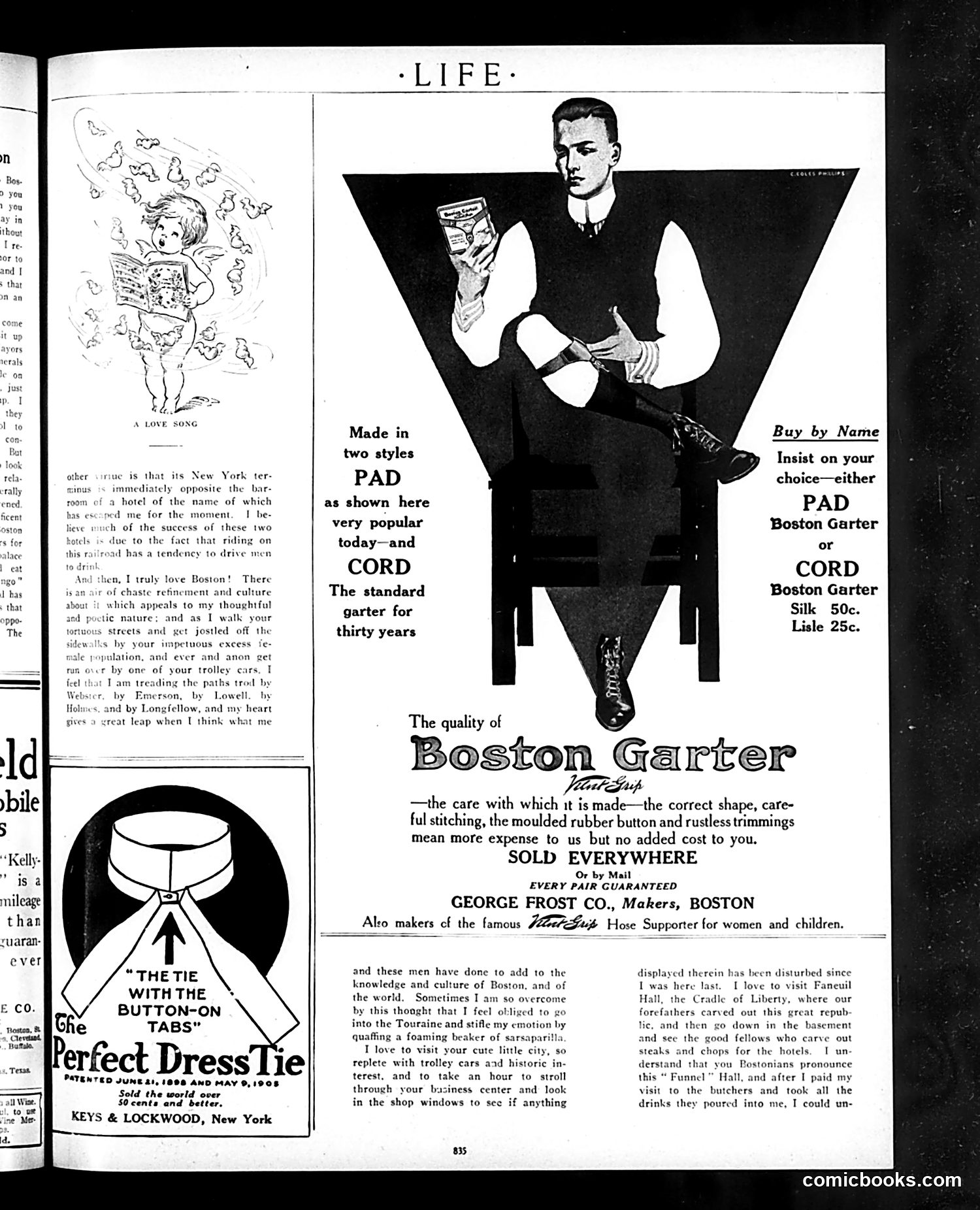
This page is primarily **advertising**, featuring two vintage product ads (Boston Garter hosiery and Perfect Dress Tie) alongside partial editorial text about Boston. The visible text celebrates Boston's cultural heritage—referencing Emerson, Lowell, and Longfellow as intellectual touchstones. The author expresses affection for the city's refinement while humorously noting its chaotic present (trolley cars, crowded streets, aggressive pedestrians). There's a brief satirical jab at Boston pronunciation: the author notes locals say "Funnel" Hall instead of "Faneuil" Hall, a gentle joke about regional accents. The cartoons are minimal—a small illustration labeled "A Love Song" appears on the left, and the dress-tie ad includes a diagram showing proper tie-tying technique. These aren't political cartoons but rather decorative/instructional graphics accompanying advertisements. The page reflects early 20th-century magazine design: content and ads heavily intermixed, nostalgic reverence for American cultural institutions, and genteel humor about regional quirks.
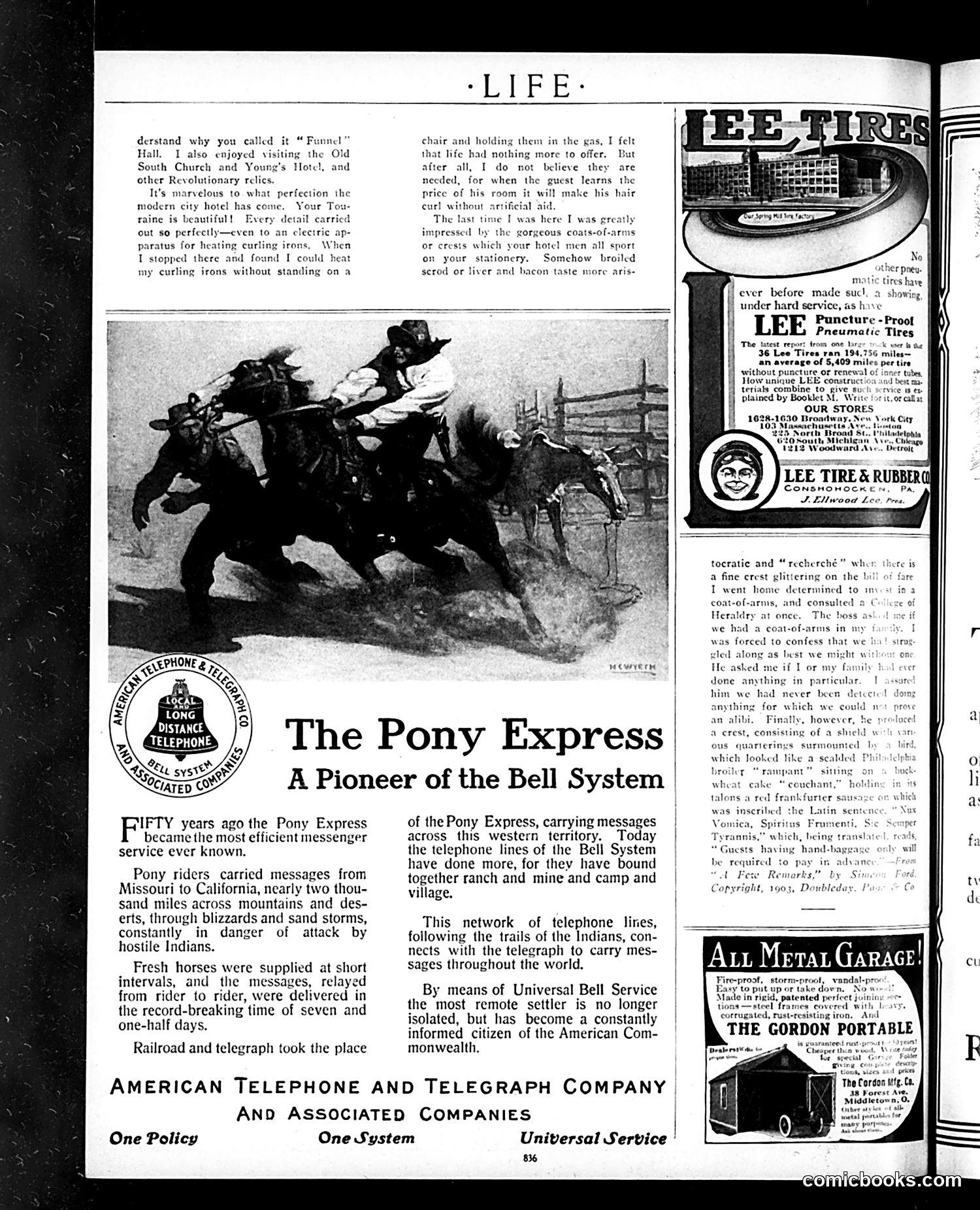
This page features an advertisement for the American Telephone and Telegraph Company (AT&T) dressed as historical editorial content. The main image shows the Pony Express—the famous 1860s mail service that carried messages across the American West on horseback—which the text describes as delivering mail in 7.5 days. The advertisement's message: **telephone and telegraph have replaced the Pony Express**, delivering messages faster and more reliably across the same western territories. The copy celebrates how Bell System phones now connect isolated ranches, mines, and villages, making remote settlers "constantly informed citizens." This is corporate mythology-building—presenting AT&T's infrastructure as a natural evolution of American frontier progress. The Pony Express image evokes nostalgia and pioneering spirit, while the text argues that telecommunications represent the next chapter of westward expansion and national connection. The page also contains unrelated period advertisements (Lee Tires, All Metal Garage) and text fragments about hotel visits—typical of Life magazine's mixed editorial/advertising format.
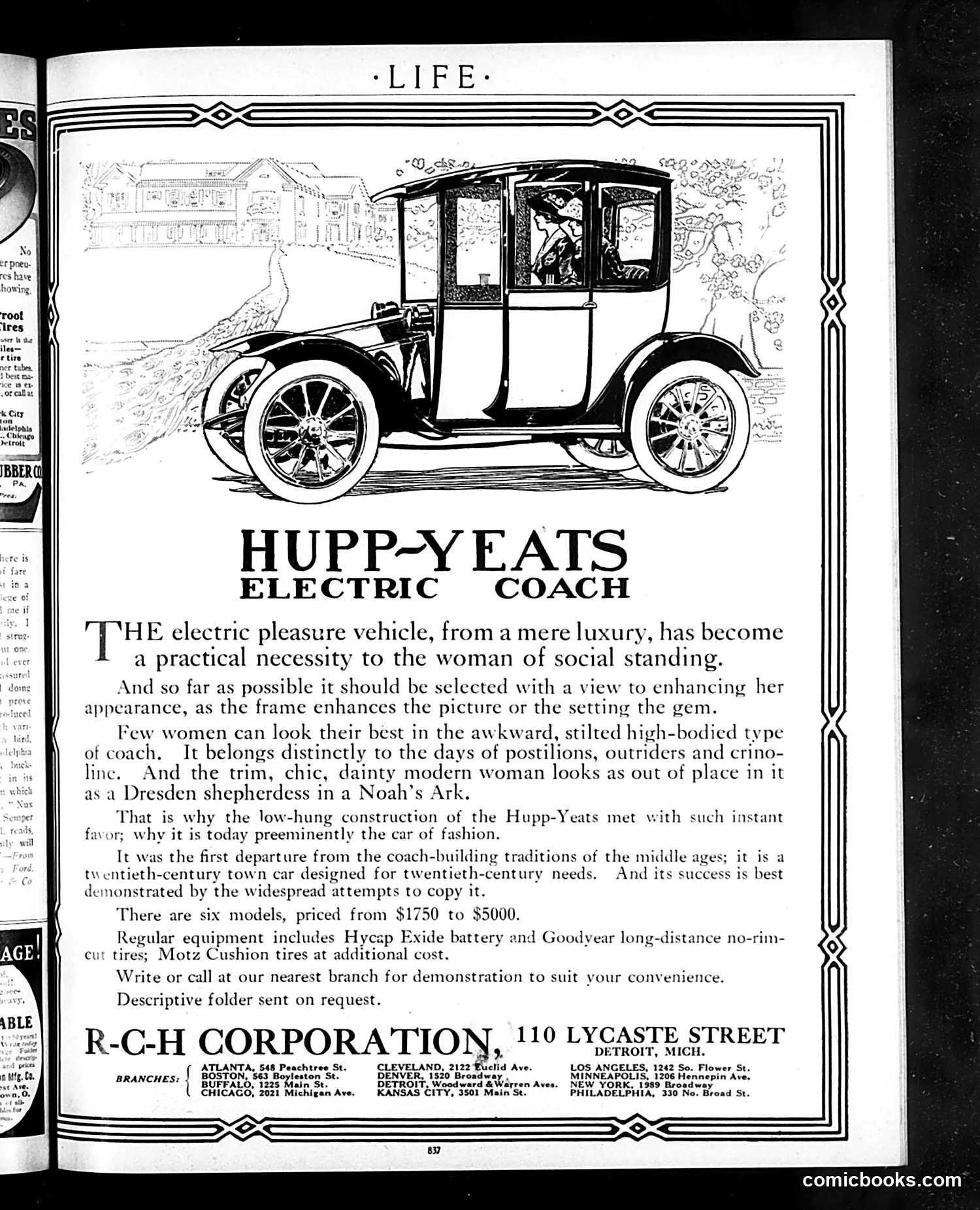
This is **not satire or a cartoon**, but a straightforward advertisement from Life magazine's advertising pages. It promotes the Hupp-Yeats electric automobile, positioning it as a status symbol for wealthy women. The ad's pitch is notably gendered: it argues that modern women of "social standing" need electric cars not for practicality, but because they look better in them. The text dismisses older, high-bodied carriages as unfashionable relics—comparing a woman in one to "a Dresden shepherdess in a Noah's Ark"—and praises the Hupp-Yeats's low-hung, "chic" design as flattering and fashionable. Prices range from $1,750 to $5,000 (substantial sums in this era), emphasizing exclusivity. The ad demonstrates early 20th-century marketing targeting affluent women, framing automobiles as fashion accessories rather than mere transportation—a notable shift in how cars were being sold to consumers.
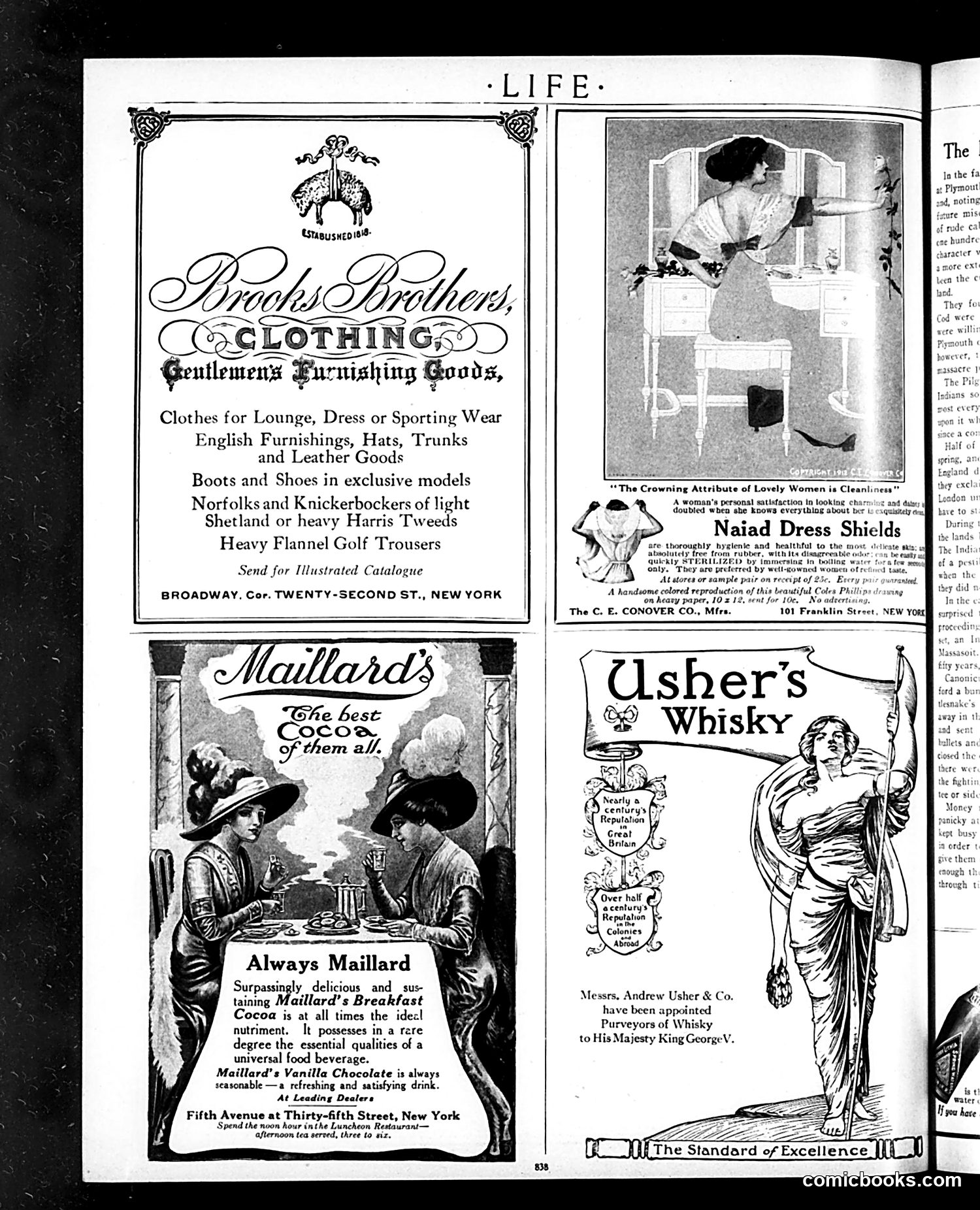
This page is primarily **advertising**, not satirical content. It contains four commercial advertisements from the early 20th century: 1. **Brooks Brothers** (top left): Menswear and furnishings retailer advertising clothing, shoes, and sporting goods. 2. **Maillard's Cocoa** (bottom left): Hot chocolate product featuring two women in period dress, emphasizing it as a nutritious beverage. 3. **Naiad Dress Shields** (top right): A women's hygiene product protecting clothing, marketed around "cleanliness"—reflecting era anxieties about women's bodies and propriety. 4. **Usher's Whisky** (bottom right): Spirits advertisement highlighting royal patronage ("Purveyors of Whisky to His Majesty King George V"), a common marketing tactic using elite endorsement. The page reflects early 1900s consumer culture, gender norms (distinct men's and women's products), and class aspirations through luxury branding and royal associations. No political satire is present.
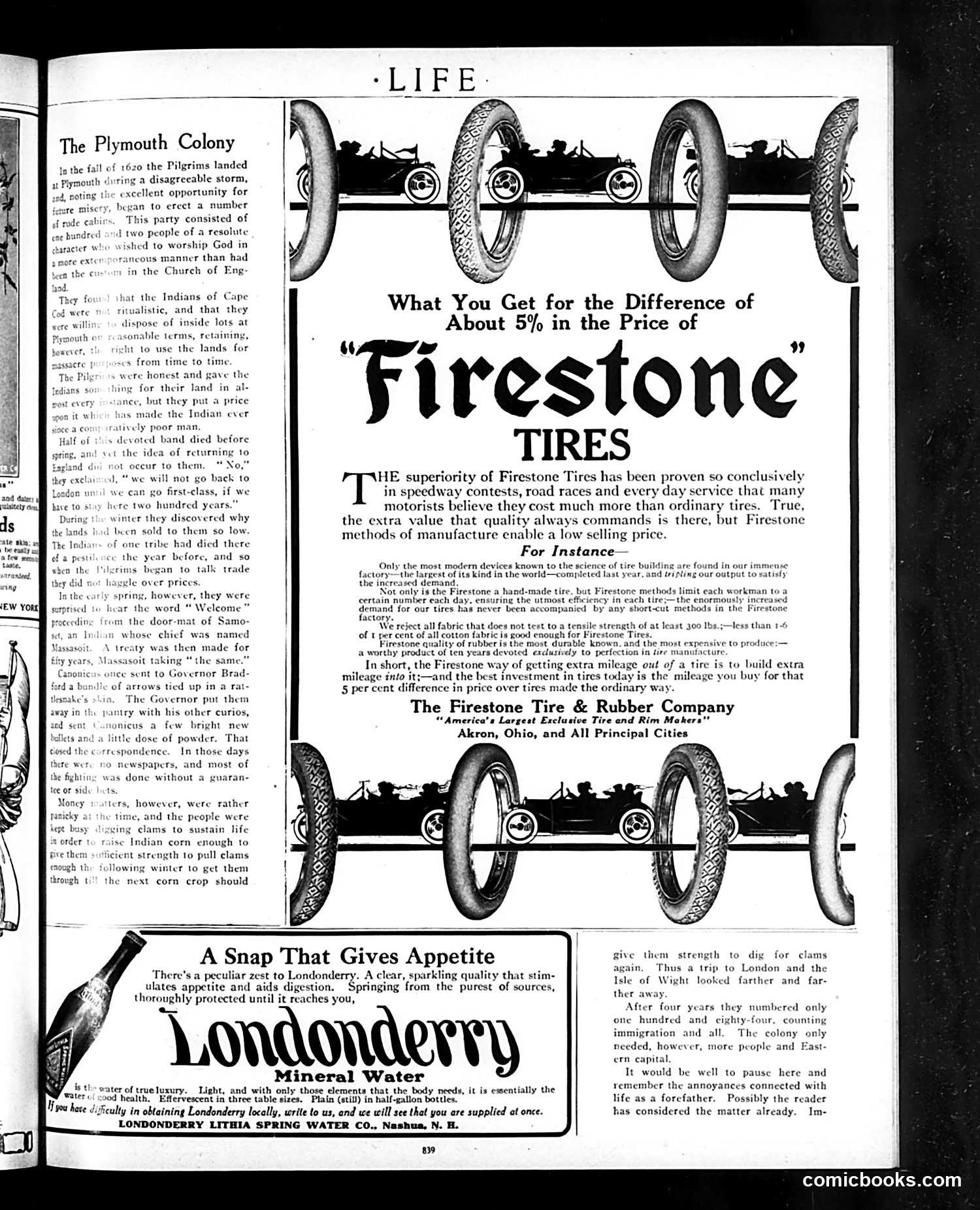
This page is primarily **advertising**, not political satire. The main content consists of three commercial advertisements: 1. **Firestone Tires** (center, dominant): A straightforward product ad claiming Firestone tires offer superior value despite a 5% price premium. It emphasizes modern manufacturing, quality control, and durability—typical early automotive advertising. 2. **Londonderry Mineral Water** (bottom): A small ad promoting the health benefits of this bottled water. The left column contains **"The Plymouth Colony,"** a humorous historical essay about the 1620 Pilgrims, recounting their dealings with Native Americans and early colonial struggles. It's lighthearted commentary on early American history, not satire targeting contemporary politics. The page reflects early 20th-century *Life* magazine's format: mixing editorial humor with substantial advertising. No political figures or specific contemporary events are caricatured here.
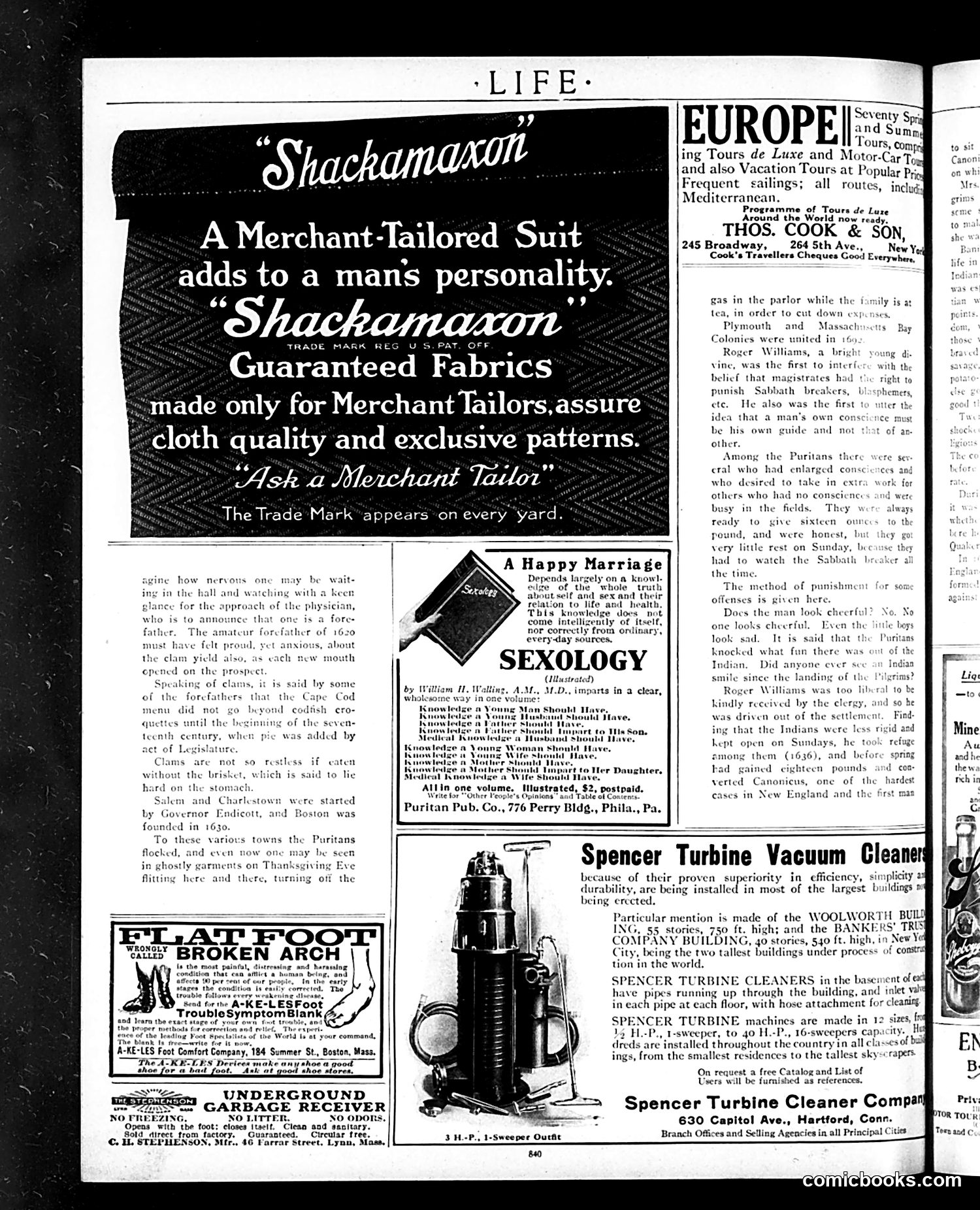
This page is primarily **advertising**, not satire or political commentary. The main content consists of commercial advertisements for various products: **Key advertisements visible:** 1. **Shachamaxon** — A merchant-tailored suit fabric brand promising quality and exclusive patterns for tailors 2. **Sexology book** — An illustrated guide about marriage and sexual knowledge, pitched as educational 3. **Spencer Turbine Vacuum Cleaner** — Highlighting its use in major buildings like the Woolworth Building and Bankers Trust Company, emphasizing modern technological advancement 4. **Flatfoot/Broken Arch treatment** — A medical remedy advertisement 5. **Underground Garbage Receiver** — A sanitation product The page also contains some historical text about Puritan settlements and early American colonists, but this appears to be editorial content accompanying advertisements rather than satirical commentary. There are no identifiable political cartoons or caricatures on this page.
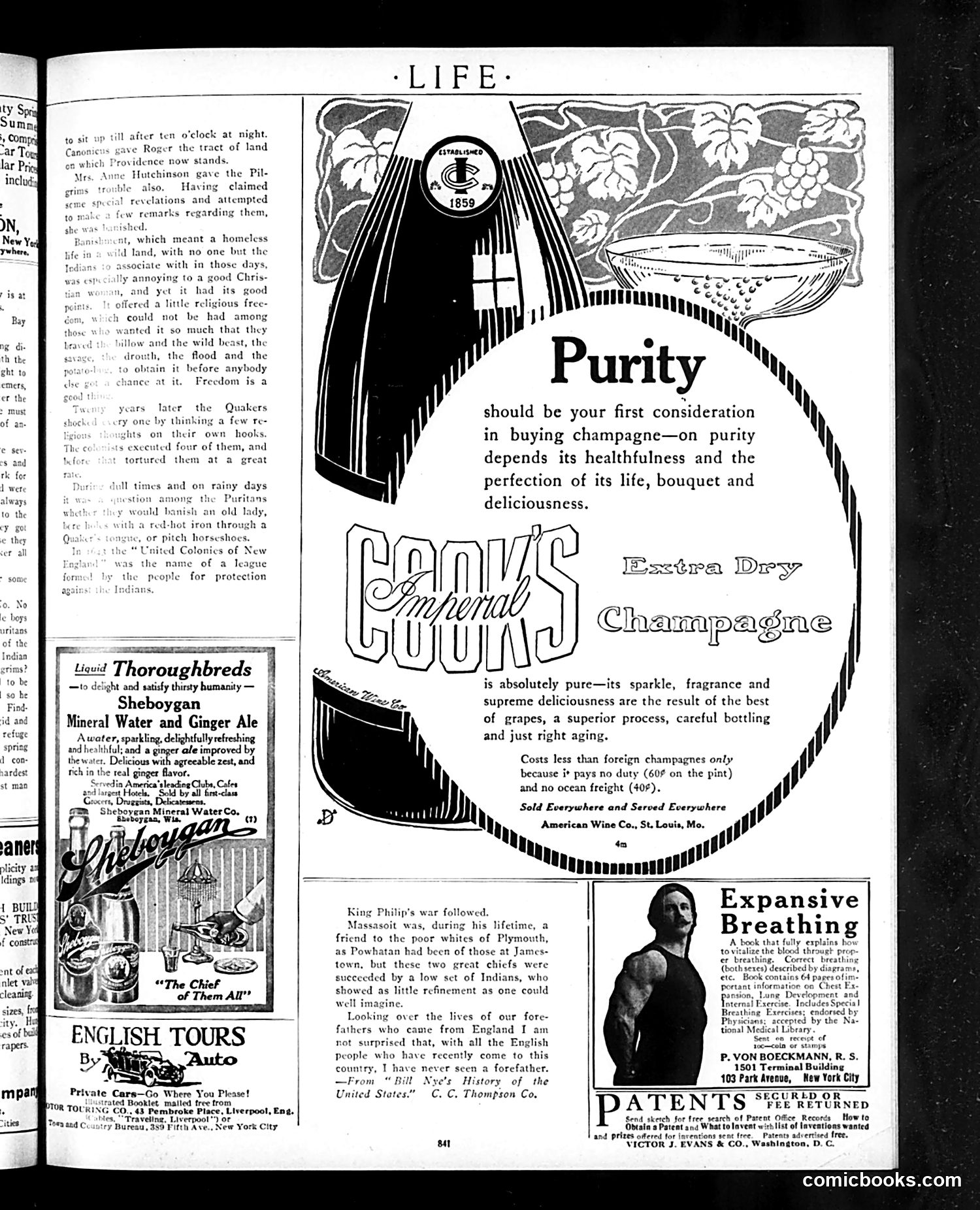
This page is primarily **advertising**, not satire or political commentary. The dominant content is a large advertisement for Cook's Imperial Champagne, emphasizing "purity" as the key selling point and highlighting its affordability compared to foreign brands (no import duty or ocean freight costs). The left side contains smaller ads for Sheboygan Mineral Water and English Tours by Auto. The bottom features advertisements for breathing exercises and patent information services. The article text visible at left discusses early American colonial history—Quakers, King Philip's War, and Native American leaders like Massasoit—but this is largely obscured by the advertisements overlaid on the page. **The page reflects early 20th-century magazine design** where advertising revenue dominated layout, often interrupting editorial content. There is **no discernible political cartoon or satire** on this particular page.
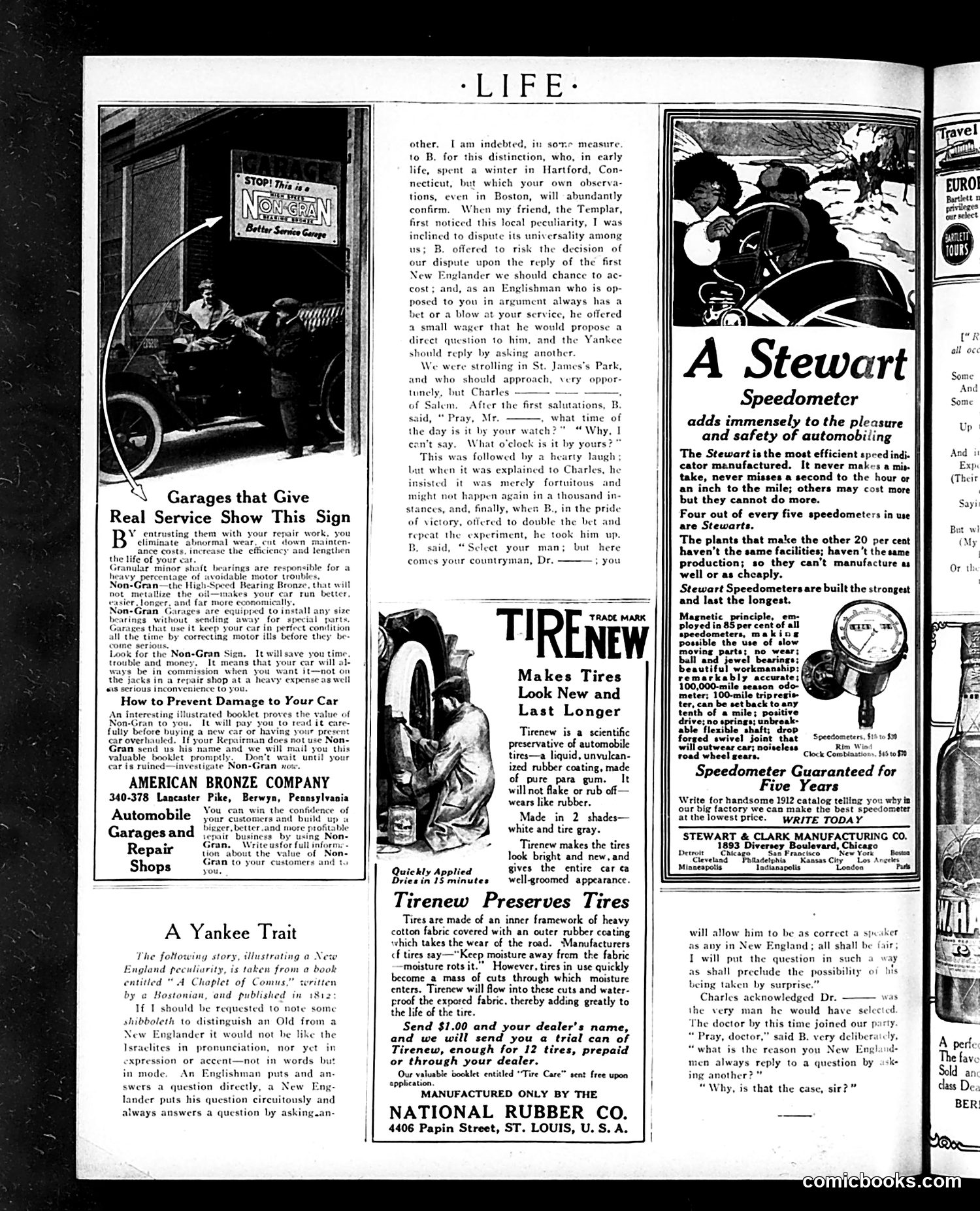
This page features a humorous story titled "A Yankee Trait" illustrating a supposed New England characteristic: answering questions with questions. The narrative describes an English gentleman's wager with a friend that any New Englander will respond to a direct question by posing one in return. When tested in St. James's Park with "What o'clock is it by your watch?" a Yankee replies "Why, I don't know. What o'clock is it by yours?" The anecdote humorously suggests this as a distinctly regional trait, confirming the stereotype. The satire mocks both the supposed peculiarity of New Englanders and the English habit of making bets on trivial observations about regional behavior. It plays on period stereotypes of Yankees as evasive or cleverly argumentative—a lighthearted ethnic/regional humor common to early-20th-century American magazines. The surrounding advertisements (speedometers, tires, garage services) are unrelated to the satirical content.
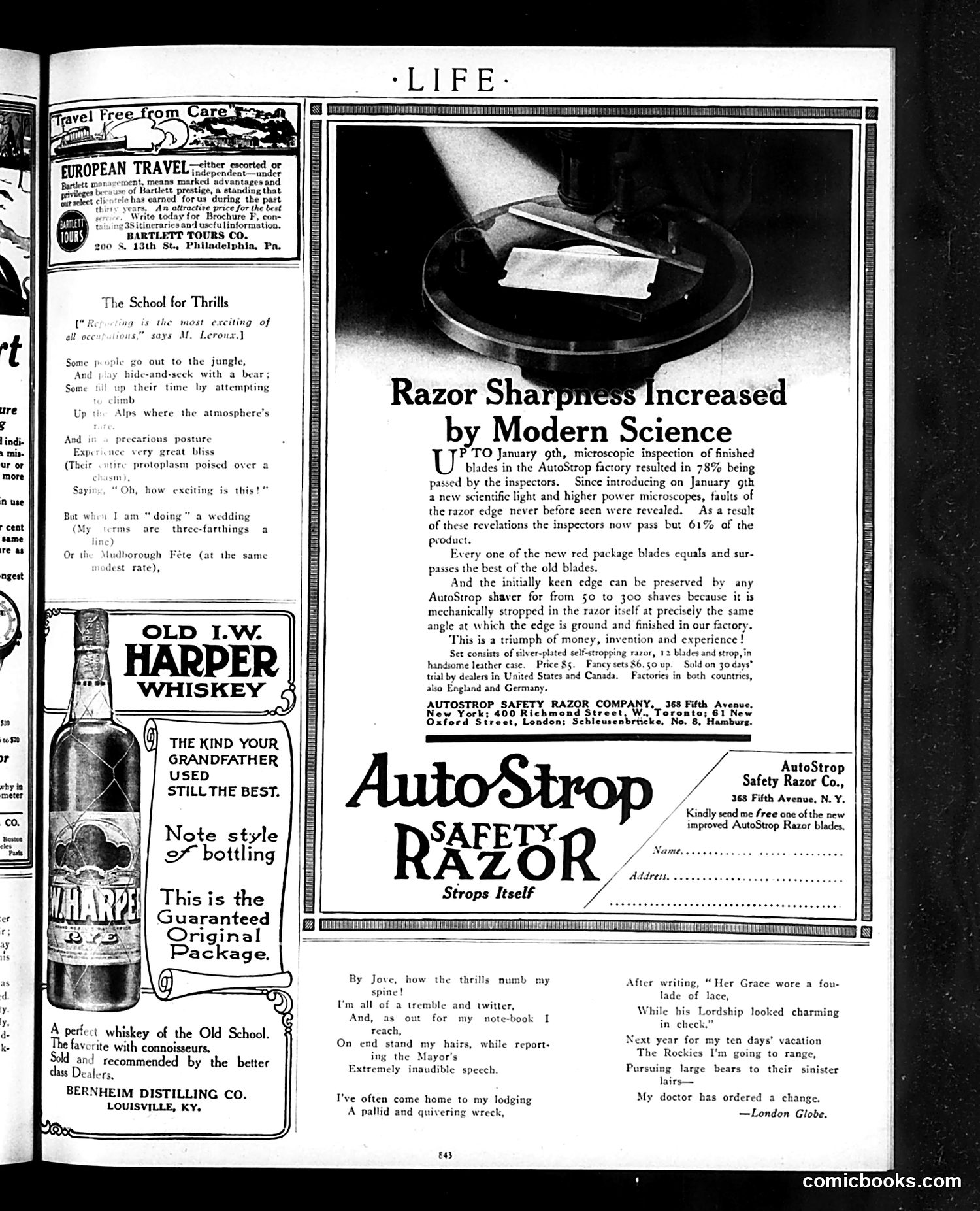
This page is primarily **advertising**, not political satire. The dominant content is a large advertisement for AutoStrop Safety Razors, emphasizing modern scientific quality control. The ad claims that new microscopic inspection standards (introduced January 9th) initially rejected 78% of blades, but after improving their process, now only reject 39%—framed as proof of superior manufacturing. The razor features self-stropping technology. Supporting ads include Old I.W. Harper Whiskey ("the kind your grandfather used") and Bartlett Tours travel services. A minor satirical poem titled "The School for Thrills" appears on the left, mocking wealthy people who seek excitement through risky adventures (hide-and-seek with bears, climbing Alps) but find everyday social events equally thrilling. This light social commentary is typical of Life's satirical approach to upper-class leisure pursuits. The page reflects early 20th-century consumer culture emphasizing technological innovation and scientific progress as selling points.
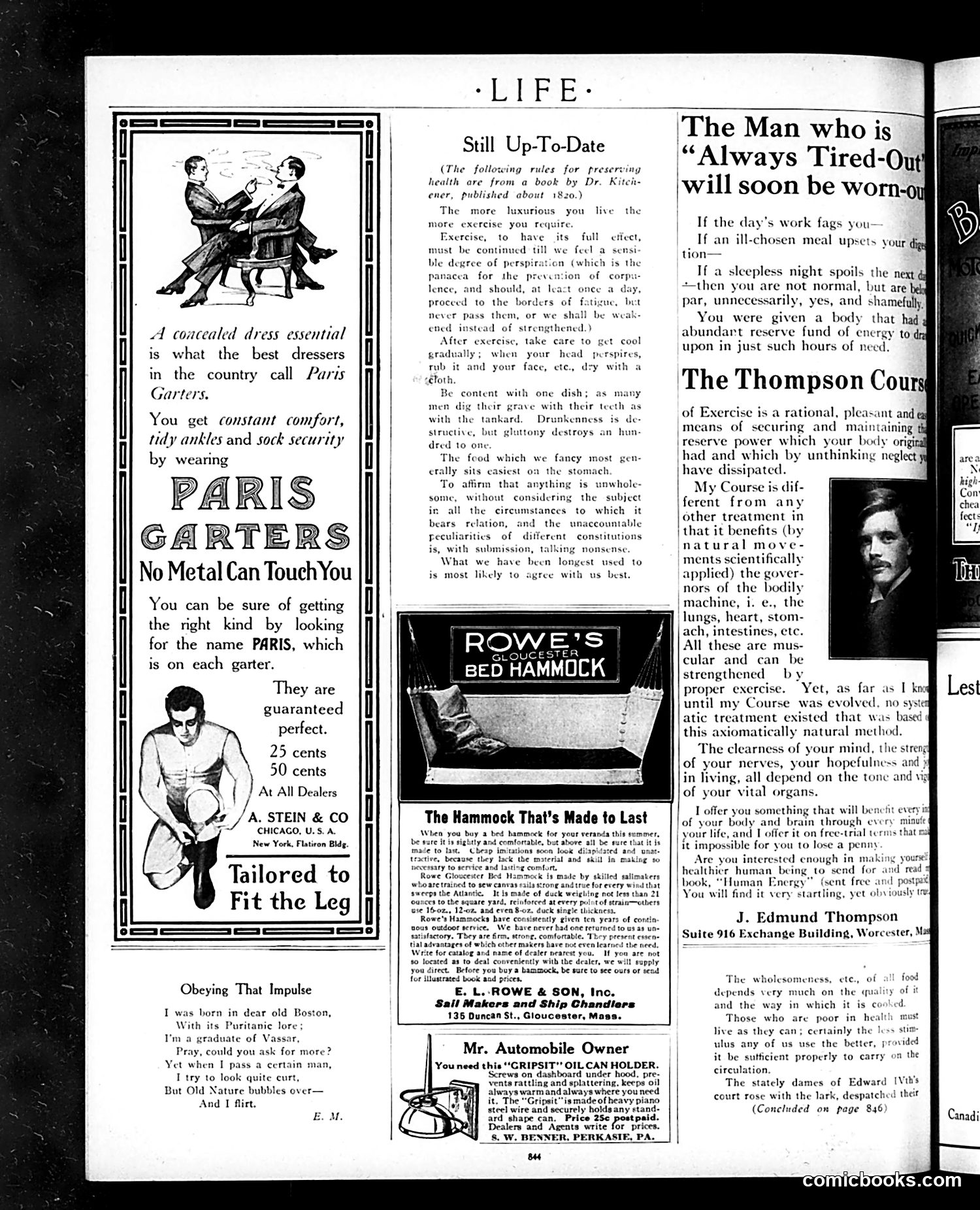
This is primarily an **advertising page** from Life magazine, not a political cartoon. The dominant content is commercial rather than satirical. The page features ads for **Paris Garters** (elastic sock supporters—no metal touching skin), **Rowe's Bed Hammock**, and **The Thomson Course of Exercise**. These reflect early 1900s consumer goods and health concerns. The only editorial content is a brief humorous poem titled "Obeying That Impulse" about a Vassar-educated Boston woman who tries to act proper but flirts uncontrollably—gentle satire on conflicting social expectations for women. The "Still Up-To-Date" section reprints archaic 1820s health advice (exercise until perspiring, single meals, avoid drunkenness) seemingly to contrast old-fashioned remedies with modern products advertised below. There are **no political figures or caricatures**. This is a commercial magazine page using light humor to sell products reflecting period anxieties about health, propriety, and modern conveniences.
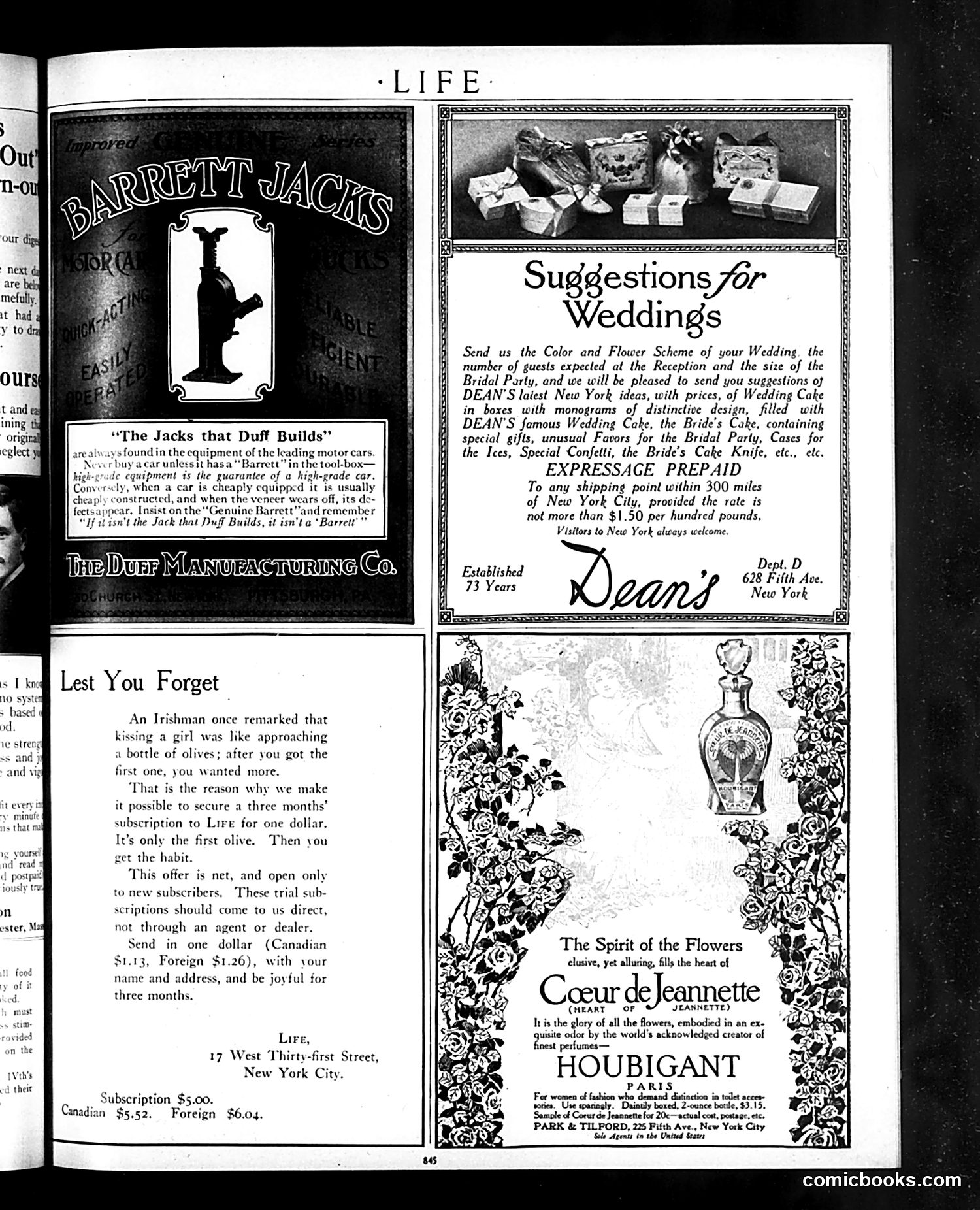
This page contains mostly **advertisements rather than satire or political cartoons**. The top left shows a **Barrett Jacks ad** for auto equipment—a straightforward product pitch claiming Barrett jacks are found in quality motorcar toolboxes. The remaining content is wedding and luxury goods advertising: **Dean's catering service** offers customized wedding cakes and favors; **Houbigant perfume** ("Coeur de Jeannette") markets French fragrance to fashionable women; and **Life magazine itself** advertises discounted three-month subscriptions using an Irish joke comparing kissing to eating olives—the "first olive" is the teaser to create habit. There are no political figures, caricatures, or satirical commentary visible. The page reflects early 20th-century consumer culture targeting wealthy New York audiences interested in upscale goods and services.
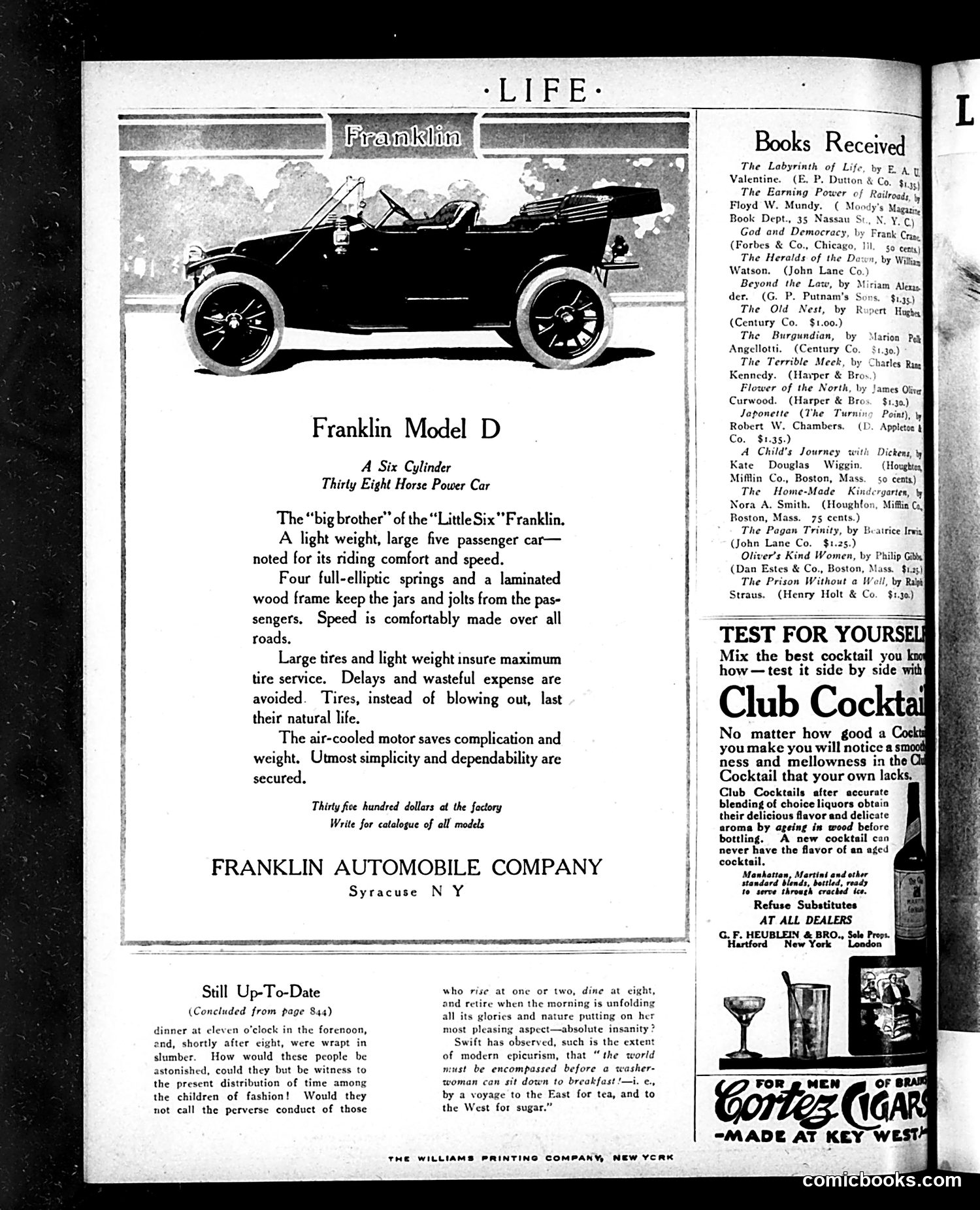
This page is primarily **advertising and book reviews**, not satire or political commentary. The main content features a **Franklin Model D automobile advertisement**—a six-cylinder, thirty-eight horsepower car marketed as the "big brother" of Franklin's "Little Six." The ad emphasizes practical features: comfort, speed, durable tires, and an air-cooled motor requiring less maintenance. It targets middle-class buyers concerned with reliability and economy. The right column lists **new book releases** (titles like *God and Democracy* and *The Old Nest*) and includes advertisements for **Club Cocktails** (a bottled cocktail brand) and **Cortez Cigars**. Below the Franklin ad, a section titled **"Still Up-To-Date"** gently satirizes modern dining habits—mocking the fashion-conscious wealthy for eating dinner at eleven p.m. and conducting elaborate tea and sugar imports, contrasting this with older, simpler eating schedules. This is light social humor rather than sharp political satire.