
Life, 1912-04-18 · page 26 of 54
Life — April 18, 1912 — page 26: what you’re looking at
What you’re looking at
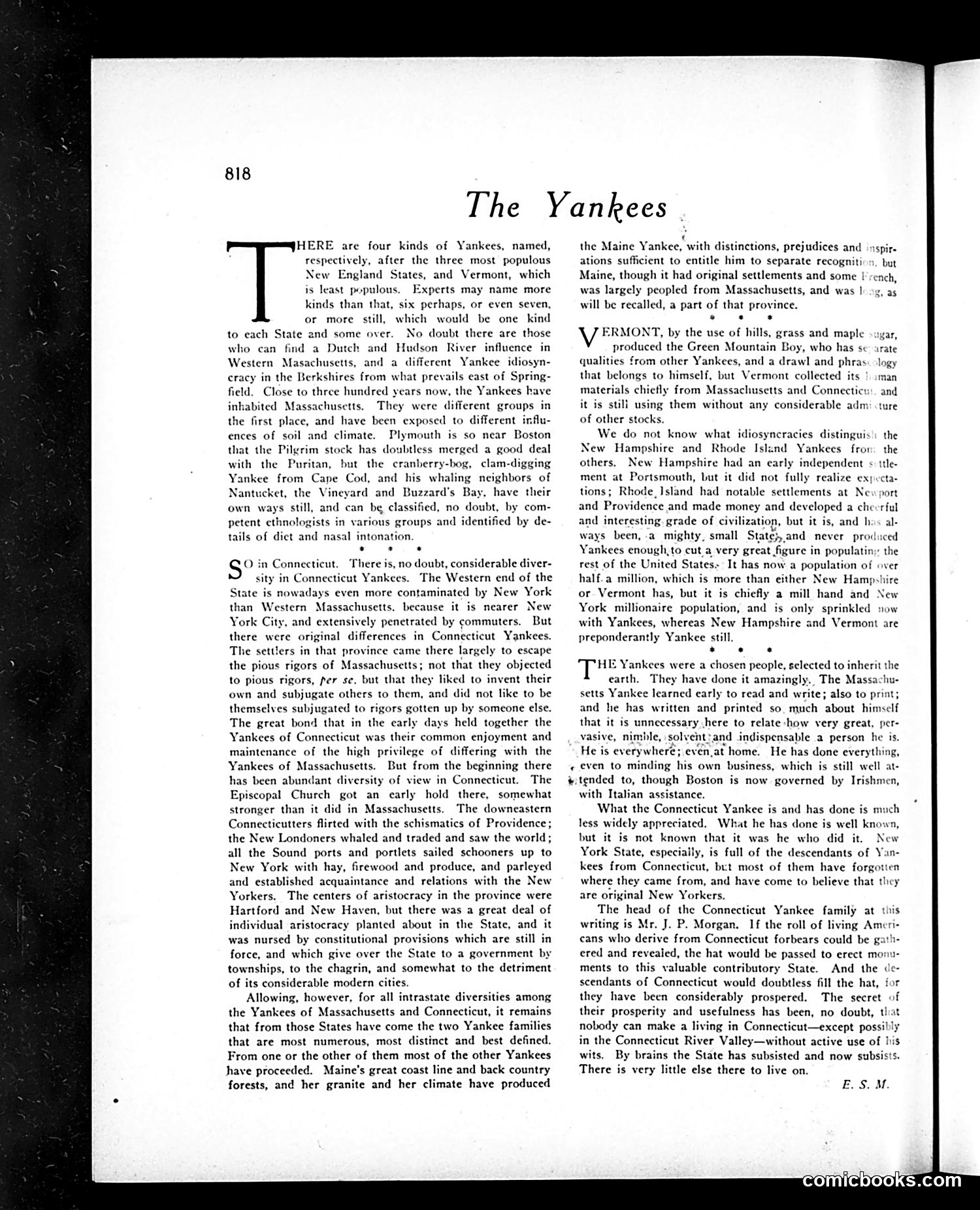
This is **not a cartoon page**, but rather a lengthy editorial essay analyzing regional variations among New England Yankees. The author catalogs four main "types" of Yankees based on their home states: Massachusetts, Connecticut, Vermont, and Maine—each with distinct characteristics shaped by geography, settlement history, and local culture. The piece humorously notes that while Massachusetts and Connecticut Yankees share common ancestry and traits, they've developed different traits through isolation and varying influences (Connecticut's proximity to New York, maritime communities in Massachusetts, etc.). The author distinguishes the Maine Yankee and Green Mountain (Vermont) Yankee as separate, defined types. The satire targets New England's self-conscious regional pride and the tendency to create rigid social classifications based on ancestry and local origin—a distinctly American form of "aristocracy" based on genealogy rather than wealth or breeding.
📄 Transcribed text from this page (OCR, searchable)
Machine-transcribed from the original scan — historical spelling and the odd misread are preserved.
The Yankees HERE are four kinds of Yankees, named, respectively, after the three most populous New England States, and Vermont, which is least populous. Experts may name more kinds than that, six perhaps, or even seven, or more still, which would be one kind to each State and some over. No doubt there are those who ¢ find a Dutch and Hudson River influence in Western Masachusetts, and a different Yankee idiosyn- cracy in the Berkshires from what prevails east of Spring- field. Close to three hundred years now, the Yankees have inhabited Massachusetts. They were different groups in the first place, and have been exposed to different influ- ences of soil and climate. Plymouth is so near Boston that the Pilgrim stock has doubtless merged a good deal with the Puritan, but the cranberry-bog, clam-digging Yankee from Cape Cod, and his whaling neighbors of Nantucket, the Vineyard and Buzzard's Bay, have their own ways still, and can be classified, no doubt, by com- petent ethnologists in various groups and identified by de- tails of dict and nasal intonation. * * « S° in Connecticut. There is, no doubt, considerable diver- sity in Connecticut Yankees. The Western end of the State is nowadays even more contaminated by New York than Western Massachusetts. because it is nearer New York City, and extensively penetrated by commuters. But there were original differences in Connecticut Yankees. The settlers in that province came there largely to escape the pious rigors of Massachusetts; not that they objected to pious rigors, per se. but that they liked to invent their own and subjugate others to them, and did not like to be themselves subjugated to rigors gotten up by someone else. The great bond that in the early days held together the Yankees of Connecticut was their common enjoyment and maintenance of the high privilege of differing with the Yankees of Massachusetts. But from the beginning there has been abundant diversity of view in Connecticut. The Episcopal Church got an carly hold there, somewhat stronger than it did in Massachusetts. The downeastern Connecticutters flirted with the schismatics of Providence ; the New Londoners whaled and traded and saw the world; all the Sound ports and portlets sailed schooners up to New York with hay, firewood and produce, and parleyed and established acquaintance and relations with the New Yorkers. The centers of aristocracy in the province were Hartford and New Haven, but there was a great deal of individual aristocracy planted about in the State, and it was nursed by constitutional provisions which are still in force, and which give over the State to a government by townships, to the chagrin, and somewhat to the detriment of its considerable modern cities. Allowing, however, for all intrastate diversities among the Yankees of Massachusetts and Connecticut, it remains that from those States have come the two Yankee families that are most numerous, most distinct and best defined. From one or the other of them most of the other Yankees have proceeded. Maine's great coast line and back country forests, and her granite and her climate have produced the Maine Yankee, with distinctions, prejudices and inspir- ations sufficient to entitle him to separate recognition. but Maine, though it had original settlements and some !'ench, was largely peopled from Massachusetts, and was |) og, as will be recalled, a part of that province. . ee 8 ERMONT, by the use of hills, grass and maple agar, produced the Green Mountain Boy, who has se: arate qualities from other Yankees, and a drawl and phras« logy that belongs to himself, but Vermont collected its } iman materials chiefly from Massachusetts and Connectict:. and it is still using them without any considerable adm: ture of other stocks. We do not know what idiosyncracies distinguis': the New Hampshire and Rhode Island Yankees fron. the others. New Hampshire had an early independent s ttle- ment at Portsmouth, but it did not fully realize expecta- tions; Rhode, Island had notable settlements at Newport and Providence and made money and developed a cheerful and interesting. grade of civilization, but it is, and hos al- ways been,-a mighty, small State>and never produced Yankees enough,to cut a very great figure in populatiny: the rest of the United States- It has now a population of over half.a million, which is more than either New Hampshire or Vermont has, but it is chiefly a mill hand and New York millionaire population, and is only sprinkled now with Yankees, whereas New Hampshire and Vermont are preponderantly Yankee still. oe 8 HE Yankees were a chosen people, selected to inherit the earth. They have done it amazingly. The Massachu- setts Yankee learned early to read and write; also to print; and he has written and printed so. much about himself that it is unnecessary here to relate how very great, per- vasive, nimble, solvent}and indispensable a person he is. He is everywhere; even,at home. He has done everything, even to minding his own business, which is still well at- tended to, though Boston is now governed by Irishmen, with Italian assistance. What the Connecticut Yankee is and has done is much less widely appreciated, What he has done is well kno: but it is not known that it was he who did it. New York State, especially, is full of the descendants of Yan- kees from Connecticut, bet most of them have forgotten where they came from, and have come to believe that they are original New Yorkers. The head of the Connecticut Yankee family at this writing is Mr. J. P. Morgan. If the roll of living Ameri- cans who derive from Connecticut forbears could be gath- ered and revealed, the hat would be passed to erect monu- ments to this valuable contributory State. And the de- scendants of Connecticut would doubtless fill the hat, for they have been considerably prospered. The secret of their prosperity and usefulness has been, no doubt, that nobody can make a living in Connecticut—except possibly in the Connecticut River Valley—without active use of his wits, By brains the State has subsisted and now subsists. There is very little else there to live on. E. S. M.