
Life, 1912-04-18 · page 23 of 54
Life — April 18, 1912 — page 23: what you’re looking at
What you’re looking at
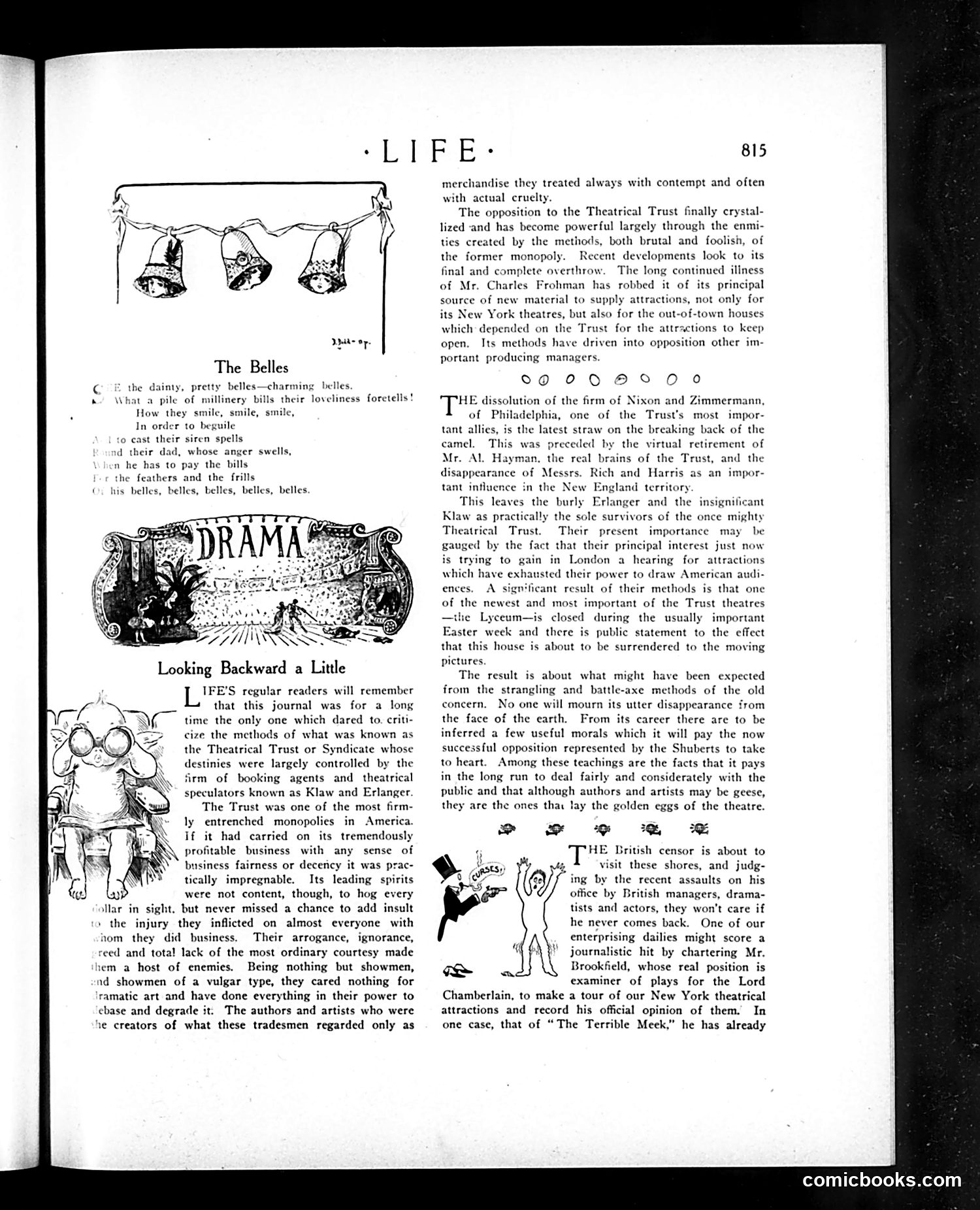
This page contains two satirical pieces about early 1900s American theater: **"The Belles"** (top) is a humorous poem mocking wealthy young women whose expensive tastes in fashionable hats and clothing drive their fathers to financial ruin. The joke centers on the contrast between their charm and the bills their extravagance generates. **"Looking Backward a Little"** (main article) discusses the collapse of the **Theatrical Trust** (also called the Syndicate)—a monopoly controlled by booking agents **Klaw and Erlanger** that dominated American theater. Life claims to have been the only publication brave enough to criticize their brutal, contemptuous treatment of playwrights and artists, their arrogance, and their neglect of dramatic art in favor of profit. The article celebrates the Trust's disintegration through the dissolution of allied firms (Nixon and Zimmermann) and retirement of key figures. It argues their ruthless methods created enemies and ultimately caused their downfall, with even their flagship Lyceum theater closing during Easter and facing conversion to moving pictures. The satire celebrates the monopoly's defeat as a moral victory for fair dealing in theater.
📄 Transcribed text from this page (OCR, searchable)
Machine-transcribed from the original scan — historical spelling and the odd misread are preserved.
LIFE: 815 The Belles the dainty, pretty belles—charming belles. What a pile of millinery bills their loveliness foretells! How they smile, smile, In order to beguile © cast their siren spells id their dad, whose anger swells, n he has to pay the bills the feathers and the frills his belles, belles, belles, belles, belles, Looking Backward a Little IFE’S regular readers will remember f by that this journal was for a long (fee \ Ss time the only one which dared to. criti- cize the methods of what was known as the Theatrical Trust or Syndicate whose destinies were largely controlled by the m of booking agents and_ theatrical speculators known as Klaw and Erlanger. The Trust was one of the most firm- ly entrenched monopolies in America. if it had carried on its tremendously profitable business with any sense of business fairness or decency it was prac- tically impregnable. Its leading spirits were not content, though, to hog every ar in sight. but never missed a chance to add insult » the injury they inflicted on almost everyone with tom they did business. Their arrogance, ignorance, reed and total lack of the most ordinary courtesy made rem a host of enemies. Being nothing but showmen, nd showmen of a vulgar type, they cared nothing for ramatic art and have done everything in their power to cbase and degrade it. The authors and artists who were ie creators of what these tradesmen regarded only as merchandise they treated always with contempt and often with actual cruelty. The opposition to the Theatrical Trust finally crystal- lized and has become powerful largely through the enmi- ties created by the methods, both brutal and foolish, of the former monopoly. Recent developments look to its final and complete overthrow. The long continued illness of Mr. Charles Frohman has robbed it of its principal source of new material to supply attractions, not only for its New York theatres, but also for the out-of-town houses which depended on the Trust for the attractions to keep open, Its methods have driven into opposition other im- portant producing managers. °0g000 60800 HE dissolution of the firm of Nixon and Zimmermann, of Philadelphia, one of the Trust's most impor- tant allies, is the latest straw on the breaking back of the camel. This was preceded by the virtual retirement of Mr. Al. Hayman, the real brains of the Trust, and the disappearance of Messrs. Rich and Harris as an impor- tant influence in the New England territory This leaves the burly Erlanger and the insignificant Klaw as practically the sole survivors of the once mighty Theatrical Trust. Their present importance may 1 gauged by the fact that their principal interest just now is trying to gain in London a hearing for attractions which have exhausted their power to draw American audi- ences. A sig ‘ant result of their methods is that one of the newest and most important of the Trust theatres —ihe Lyceum—is closed during the usually important Easter week and there is public statement to the effect that this house is about to be surrendered to the moving pictures. The result is about what might have been expected from the strangling and battle-axe methods of the old No one will mourn its utter disappearance from the face of the earth. From its career there are to be inferred a few useful morals which it will pay the now successful opposition represented by the Shuberts to take to heart. Among these teachings are the ‘ts that it pays in the long run to deal fairly and considerately with the public and that although authors and artists may be geese, they are the ones tha lay the golden eggs of the theatre. HE British censor is about to visit these shores, and judg- ing by the recent assaults on his office by British managers, drama- tists and actors, they won't care if he never comes back. One of our enterprising dailies might score a journalistic hit by chartering Mr. Brookfield, whose real position is examiner of plays for the Lord Chamberlain, to make a tour of our New York theatrical attractions and record his official opinion of them. In one case, that of “The Terrible Meek,” he has already concern, comicbooks.com