
Life, 1912-04-18 · page 12 of 54
Life — April 18, 1912 — page 12: what you’re looking at
What you’re looking at
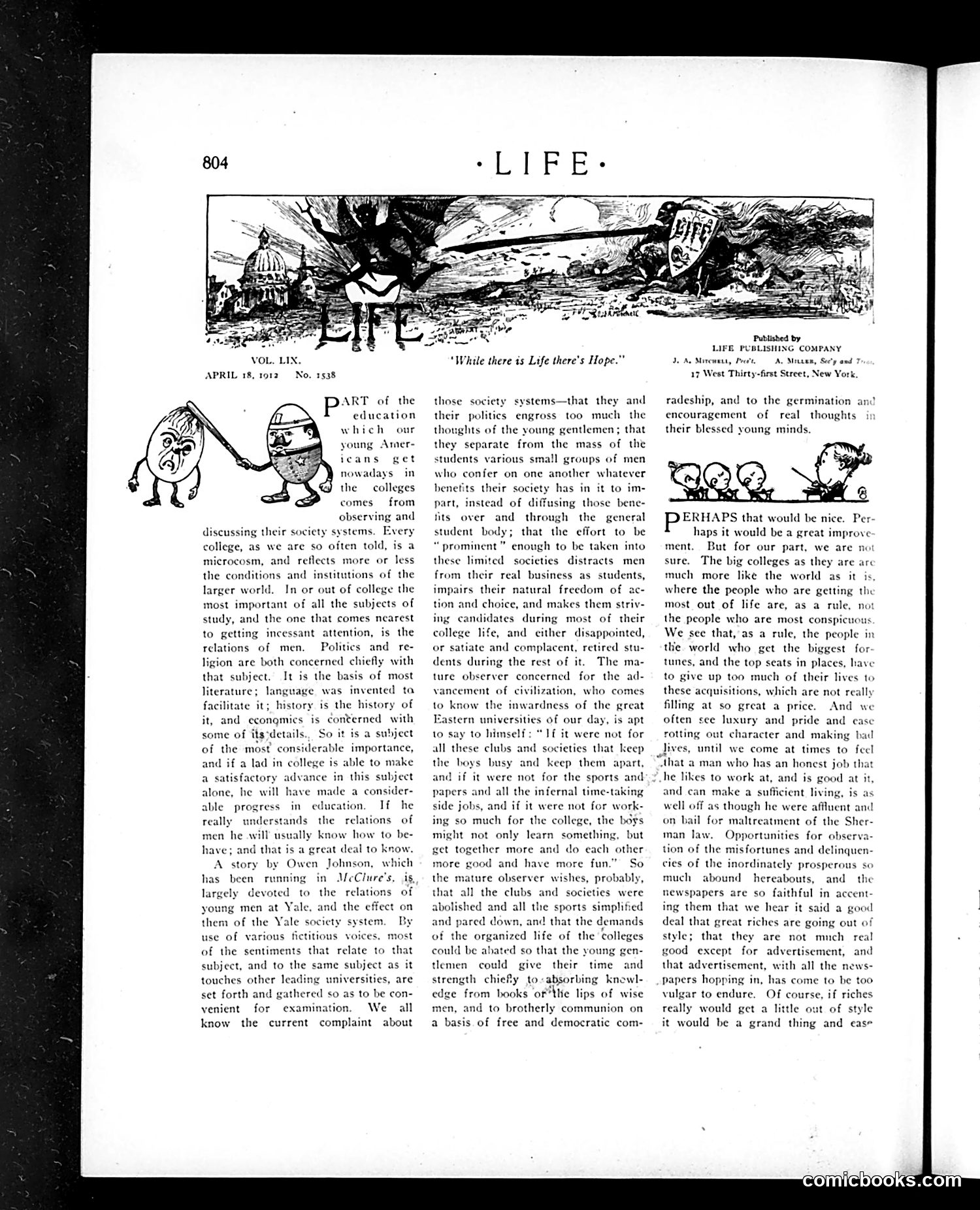
This page contains editorial commentary on American college life, specifically criticizing the proliferation of exclusive social societies and clubs at universities like Yale. The cartoon shows two anthropomorphized figures (possibly representing different college factions) in conversation, illustrating the editorial's point about social division. The text argues that college societies distract students from their real academic mission, fragment the student body, and undermine democratic principles through elitism. The author suggests these clubs keep students "busy and keep them apart" and advocates for their abolition. The piece references Yale's society system by name as a cautionary example, criticizing how such organizations separate wealthy, privileged students from the broader student body and discourage meritocratic advancement based on genuine intellectual merit.
📄 Transcribed text from this page (OCR, searchable)
Machine-transcribed from the original scan — historical spelling and the odd misread are preserved.
APRIL 18, 1912 No, 1538 ART of the education which our young Amer- jcans get nowadays. in the colleges comes from observing and discussing their society systems. Every colleg we are so often told, is a microcosm, and reflects more or less the conditions and institutions of the larger world, In or out of college the most important of all the subjects of study, and the one that comes nearest to getting incessant attention, is the relations of men. Politics and re- ligion are both concerned chiefly with that subject. It is the basis of most literature; language was invented ta facilitate it; history is the history of it, and econgmics is conterned with some of itscdetails., So it is a sudject of the most considerable importance, and if a lad in college is able to make a satisfactory advance in this sub alone, he will have made a consider- able education. If he really men he w have; and that is a great deal to know. A story by Owen Johnson, which has been running McClure’s, is, devoted to the relations of and the effect on progress in understands the } usually know how to be relations of largely young men at Yale them of the Yale society system. By use of various fictitious voices, most of the sentiments that relate to that subject, and to the same subject as it touches other leading universities, are set forth and gathered so as to be con- venient for examination. We all know the current complaint about “While there is Life there's Hope. those society systems—that they and their politics engross too much the thoughts of the young gentlemen; that they separate from the mass of the students various small groups of men who confer on one another whatever henetits their society has in it to im- part, instead of diffusing those bene- and through the general student body; that the effort to be “ prominent” enough to be taken into these limited societies distracts men from their real business as students, impairs their natural freedom of ac- tion and choice, and makes them stri ing candidates during most of their college life, and cither disappointed, or satiate and complacent, retired stu- dents during the rest of it. The ma- ture observer concerned for the vancement of civilization, who comes to know the inwardness of the great Eastern universities of our day, is apt to himself: “If it were not for all these clubs and societies that keep the boys busy and keep them apart, and if it were not for the sports and papers and all the infernal time-taking side jobs, and if it were not for work- ing so much for the college, the boys might not only learn something, but get together more and do each other fits over more good and have more fun.” So the mature observer wishes, probably that all the clubs and societies were abolished and all the sports simplified and pared down, and that the demands of the organized life of the colleges could be abated so that the young gen- tlemen could give their time and strength chiefly to-absorbing knowl- edge from books ‘ofthe lips of wise men, and to brotherly communion on a basis of free and democratic com- LIFE PUBLISHING COMPANY J. As Moreen, Mieen, Sey and 7 17 West Thirty-first Street, New York, radeship, and to the germination and encouragement of real thoughts their blessed young minds. ERHAPS that would be nice. Per- haps it would be a great improve ment. But for our part, we are no sure, The big colleges as they much more like the world as it is where the people who are getting the most out of life are, as a rule, not the people who are most consp; We sce that, as a rule, the people in the world who get the biggest for tunes, and the top seats in place: to give up too much of their lives to these acquisitions, which are not really filling at so great a price. And we often see luxury and pride and case rotting out character and making bad ives, until we come at times to feel © arc 10)us have “that a man who has an honest job that he likes to work at, and is good at it, and can make a sufficient living, is as well off as though he were affluent and on bail for maltreatment of the Sher- man law. Opportunitie tion of the misfortunes and delinquen- cies of the inordinately prosperous so much abound hereabouts, and the newspapers are so faithful in accent- ing them that we hear it said a good deal that great riches are going out of style; that they are not much real good except for advertisement, and that advertisement, with all the news- papers hopping in, has come to be too vulgar to endure. Of course, if riches really would get a little out of style it would be a grand thing and case for observa-