
Life, 1912-04-18 · page 24 of 54
Life — April 18, 1912 — page 24: what you’re looking at
What you’re looking at
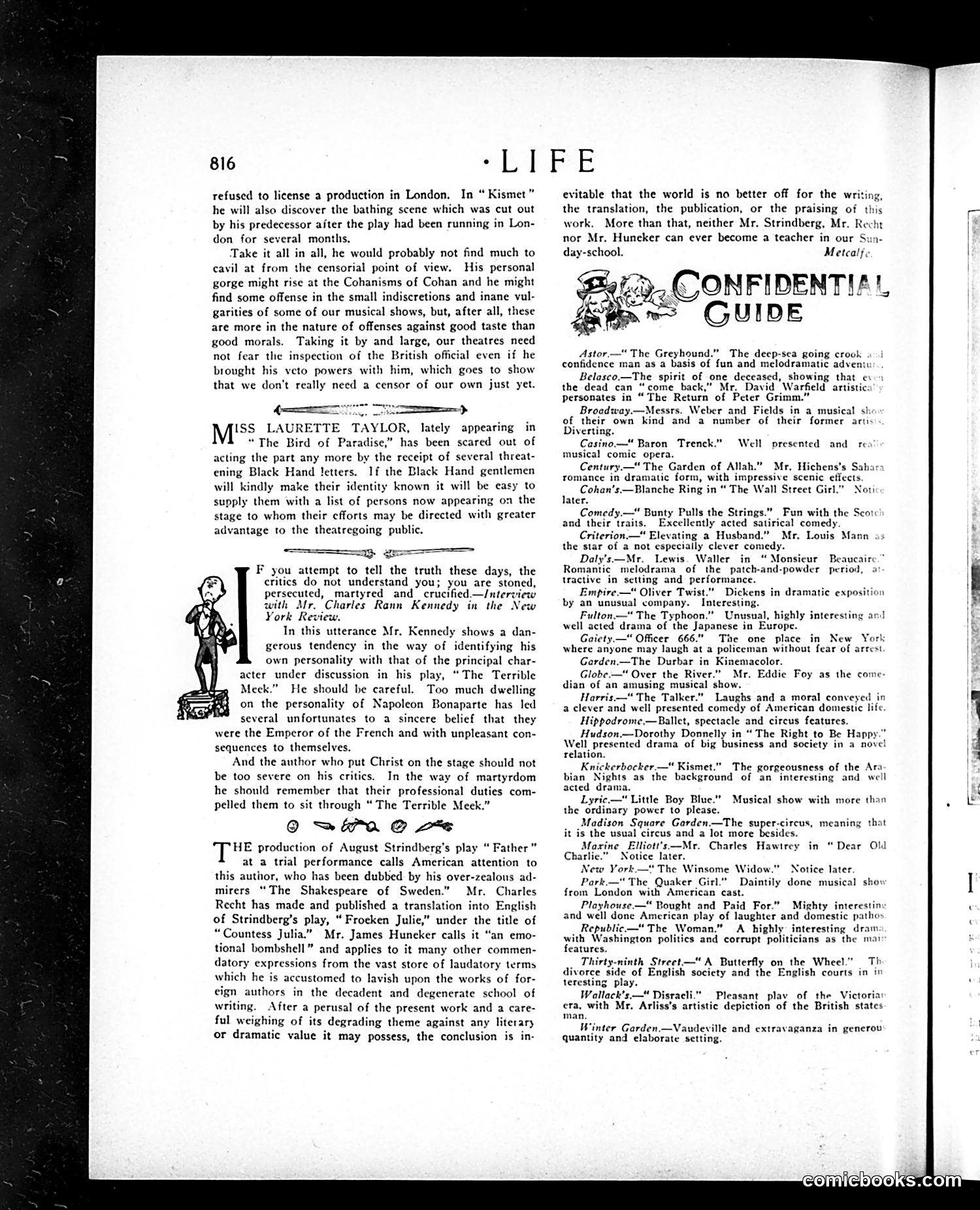
This page contains theatre reviews and satirical commentary typical of Life magazine's cultural criticism. The main satirical pieces mock: 1. **Charles Rann Kennedy** - criticized for identifying too personally with his play's protagonist (comparing himself to Napoleon/Christ), suggesting dangerous delusion in the author 2. **August Strindberg and his advocates** - the review dismisses "Countess Julia" as morally degrading despite critical praise, sarcastically noting that Strindberg and translator James Huneker couldn't teach Sunday school 3. **Laurette Taylor/Black Hand threats** - a sardonic jab suggesting that if the Black Hand wants to intimidate someone, they should target worse actors currently performing The "Confidential Guide" section lists current Broadway shows with brief descriptions. The overall tone reflects turn-of-the-century American cultural conservatism—dismissing European avant-garde drama as decadent while defending American theatrical standards against foreign "degenerate" influences.
📄 Transcribed text from this page (OCR, searchable)
Machine-transcribed from the original scan — historical spelling and the odd misread are preserved.
816 -LIFE refused to license a production in London. In “ Kismet” he will also discover the bathing scene which was cut out by his predecessor after the play had been running in Lon- don for several months, Take it all in all, he would probably not find much to cavil at from the censorial point of view. His personal gorge might rise at the Cohanisms of Cohan and he might find some offense in the small indiscretions and inane vul- garities of some of our musical shows, but, after all, these are more in the nature of offenses against good taste than good morals. Taking it by and large, our theatres need not fear the inspection of the British official even if he brought his veto powers with him, which goes to show that we don't really need a censor of our own just yet. —== =) ISS LAURETTE TAYLOR, lately appearing in “The Bird of Paradise,” has been scared out of acting the part any more by the receipt of several threat- ening Black Hand letters. 1f the Black Hand gentlemen will kindly make their identity known it will be easy to supply them with a list of persons now appearing on the stage to whom their efforts may be directed with greater advantage to the theatregoing public. F you attempt to tell the truth these days, the critics do not understand you; you are stoned, persecuted, martyred and_crucified.—Z/nterv with Mr. Charles Rann Kennedy in the } York Review. In this utterance Mr. Kennedy shows a dan- gerous tendency in the way of identifying his own personality with that of the principal char- acter under discussion in his play, “The Terrible Meck.” He should be careful. Too much dwelling on the personality of Napoleon Bonaparte has led several unfortunates to a sincere belief that they were the Emperor of the French and with unpleasant con- sequences to themselves. And the author who put Christ on the stage should not be too severe on his critics. In the way of martyrdom he should remember that their professional duties com- pelled them to sit through “The Terrible Meek.” Oo >. O 2s HE production of August Strindberg’s play “ Father” at a trial performance calls American attention to this author, who has been dubbed by his over-zealous ad- mirers “The Shakespeare of Sweden.” Mr. Charles Recht has made and published a translation into English of Strindberg’s play, “ Froeken Julie,” under the title of “Countess Julia.” Mr. James Huneker calls it “an emo- tional bombshell” and applies to it many other commen- datory expressions from the vast store of laudatory terms which he is accustomed to lavish upon the works of for- eign authors in the decadent and degenerate school of writing. After a perusal of the present work and a care- ful weighing of its degrading theme against any literary or dramatic value it may possess, the conclusion is in- evitable that the world is no better off for the wri the translation, the publication, or the praising of this work, More than that, neither Mr. Strindberg, Mr. Recht nor Mr, Huneker can ever become a teacher in our Sun- day-school. Metcalf. CONFIDENT!! = GUIDE Astor.—" The Greyhound.” The deep-sea going crook confidence man as a basis of fun and melodramatic advent. Belasco.—The spirit of one deceased, showing that e\ the dead can “come back,” Mr. David Warfield artistics Personates in “ The Return of Peter Grimm.” Broadway.—Messrs. Weber and Fields in a musical sh of their own kind and a number of their former artis Diverting. Casino.—“ Baron Trenck." Well presented andre musical comic opera. Century.—* The Garden of Allah.” Mr. Hichens’s Saha: romance in dramatic form, with impressive scenic effects. Cohan's.—Blanche Ring in “ The Wall Street Girl.” Noti later. Comedy.—" Bunty Pulls the Strings.” Fun with the Scot and their traits. Excellently acted satirical comedy Criterion.—" Elevating a Husband. Mr. Louis Mann ss the star of a not especially clever comedy. . Lewis. Waller in “ Monsieur Beaucaire” melodrama of the patch-and-powder period, a tractive in setting and performance. i ist Dickens in dramatic exposi by an unusual company. Interesting. Fulton.— The Typhoon.” Unusual, highly intere: well acted drama of the Japanese in Europe. Gaiety.—“ Officer 666." The one place in ew Yi where anyone may laugh at a policeman without fear of arrest Garden.—The Durbar in Kinemacolor. Globe.-—" Over the River.” Mr. Eddie Foy as the come- dian of an amusing musical show. Harris—“ The Talker.” Laughs and a moral conveyed in a clever and well presented comedy of American domestic life Hippodrome,—Ballet, spectacle and circus features. Hudson.—Dorothy Donnelly in “ The Right to Be Happy.” Well presented drama of big business and society in a novel relation. Knickerbocker —" Kismet.” The gorgeousness of the Ara bian Nights as the background of an interesting and well acted drama. Lyric.—“ Little Boy Blue.” Musical show with more than the ordinary power to please. _ Madison Square Garden.—The super-circus, meaning it is the usual circus and a lot more besides Maxine Elliott’s—Mr. Charles Hawtr in “Dear Old Charli Notice later. New York.— The Winsome Widow.” Notice later. Park.—" The Quaker Girl.” Daintily done musical sho from London with American cast. Playhouse —“ Bought and Paid For.” Mighty interestin and well done Amcrican play of laughter and domestic pathos Republic. A highly: interesting dram with Washington politics and corrupt politicians as the ma features. _ Thirty-ninth Street—"“ A Butterfly on the Wheel.” — Th divorce side of English society and the English courts in in teresting play. Wallack era, with Mr. Ai man Winter Garden.—Vaudeville and extravaganza in generou quantity and elaborate setting. Disracli.” Pleasant plav of the Victoria 's artistic depiction of the British states