
A complete issue · 52 pages · 1911
Life — April 20, 1911
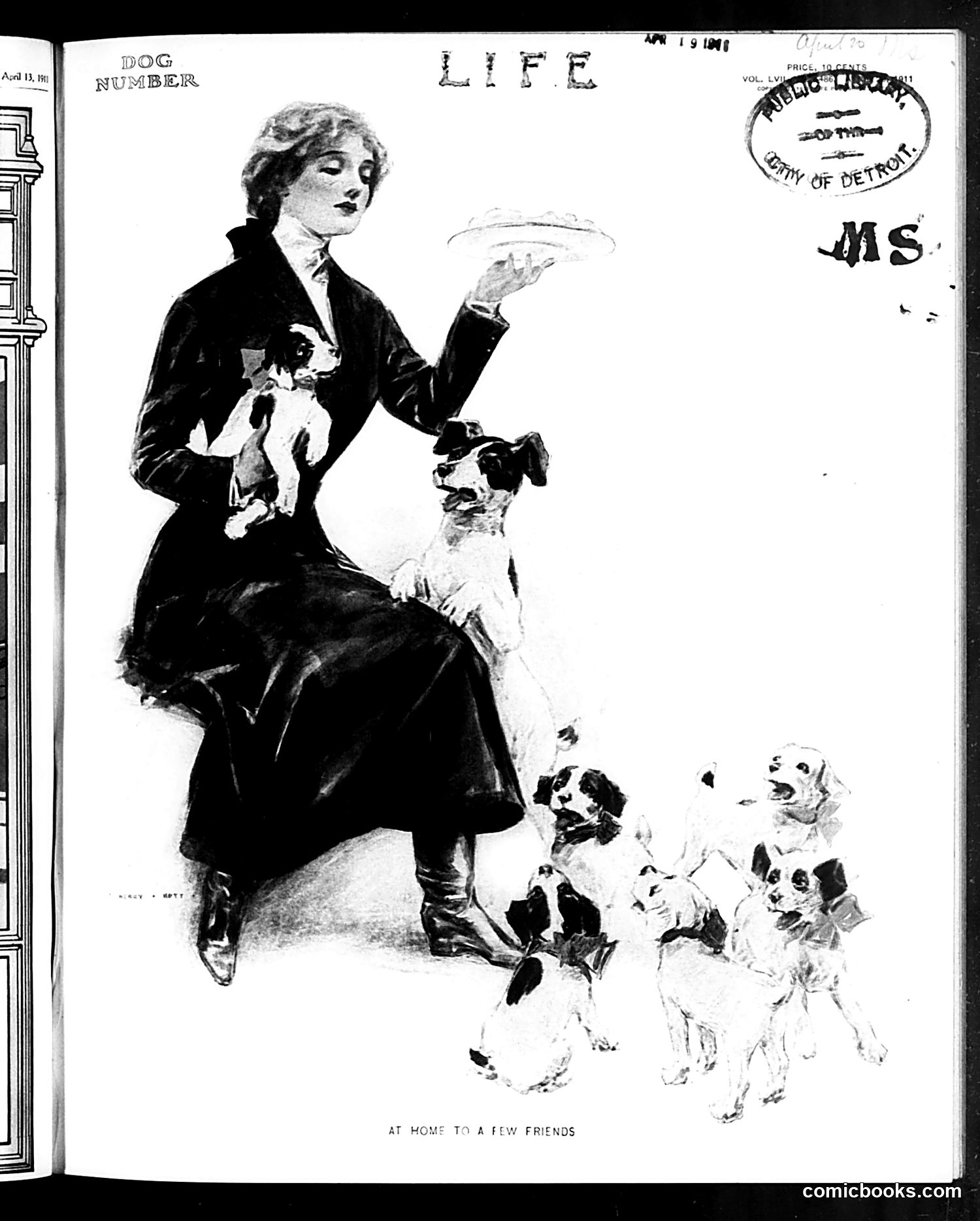
This early-20th-century satirical illustration depicts a fashionable woman at home entertaining several small dogs as if they were human guests. The caption "At Home to a Few Friends" is the joke's punchline. The satire targets wealthy society women who treated their pet dogs as substitute companions and social equals—a practice Life's editors apparently viewed as absurd and symptomatic of upper-class eccentricity. The woman's elaborate dress, composed posture, and the formal tea-service presentation all underscore the mockery: she's hosting these animals with the same etiquette typically reserved for human callers. This reflects turn-of-the-century anxieties about idle rich women prioritizing pets over more "productive" social roles.
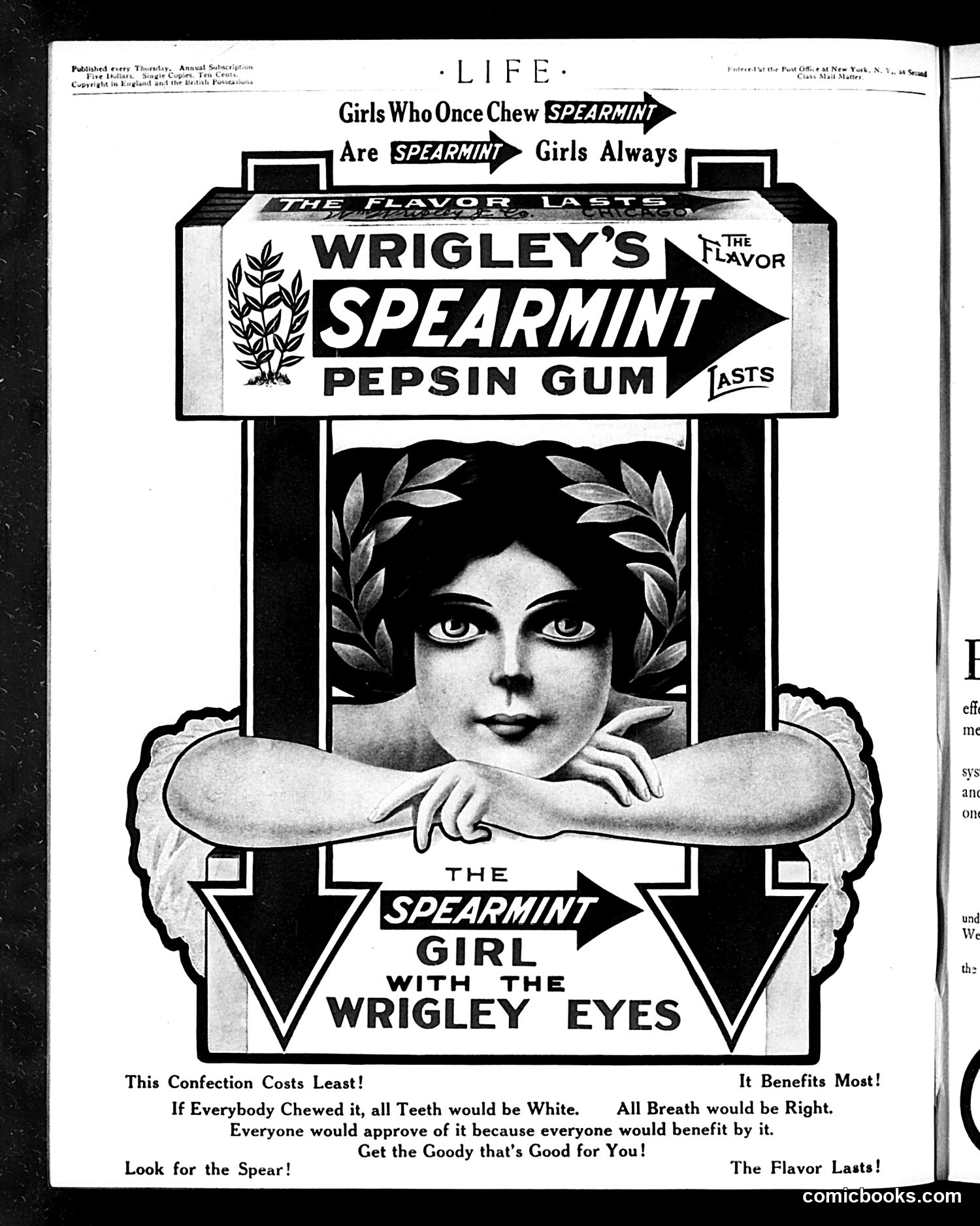
This is a **Wrigley's Spearmint Gum advertisement**, not political satire. The headline claims "Girls Who Once Chew SPEARMINT Are SPEARMINT Girls Always," presenting a woman with striking eyes framed by decorative laurel leaves as "The Spearmint Girl with the Wrigley Eyes." The advertisement uses common early 20th-century marketing tactics, emphasizing dental and breath benefits ("all Teeth would be White," "All Breath would be Right"). The accompanying copy promises universal approval and health benefits if everyone chewed the gum. The artistic style and gendered marketing approach—targeting girls specifically—reflect period advertising conventions, though modern readers would find the gender-specific messaging and health claims questionable.
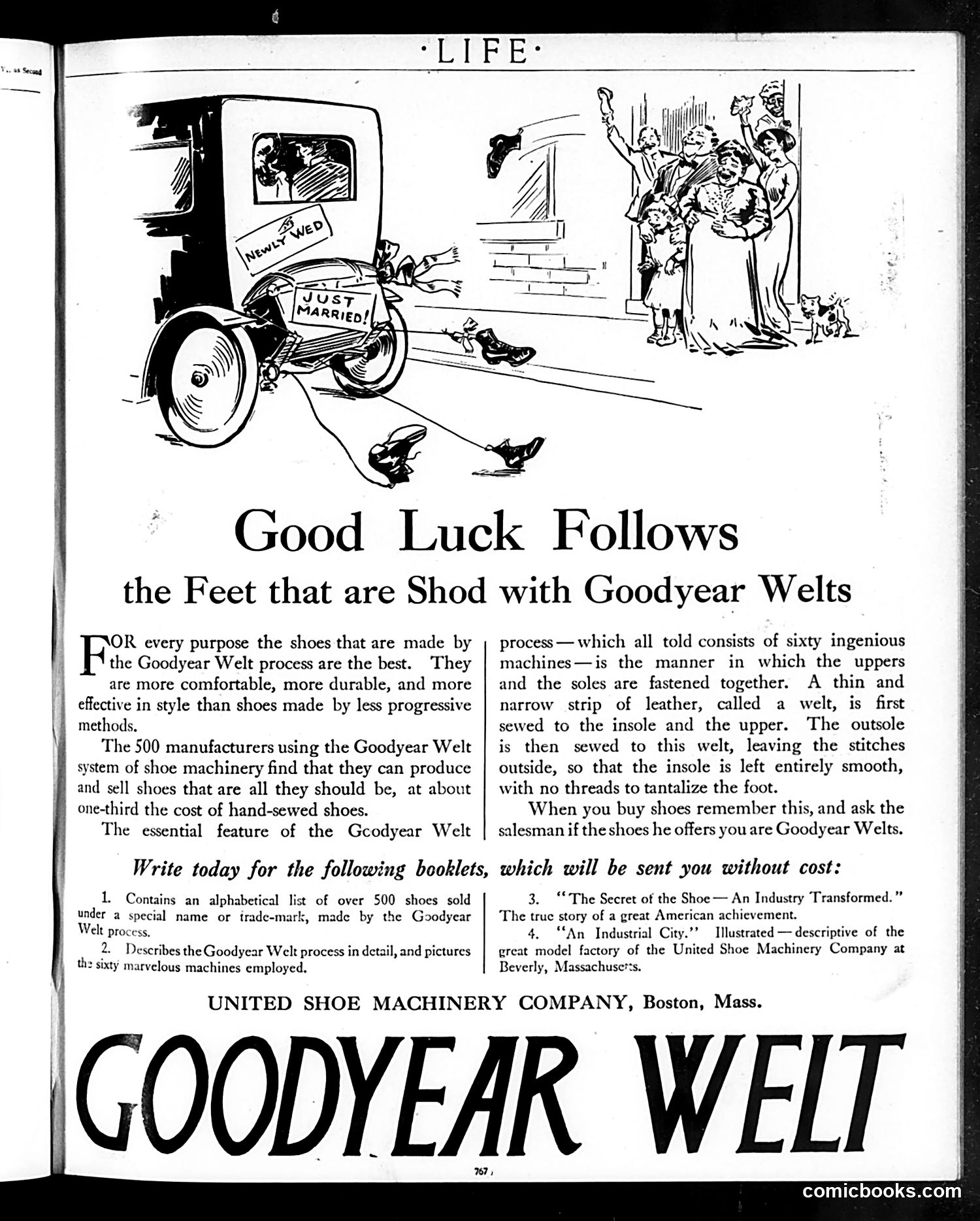
This page is primarily **advertising, not satire or political commentary**. It's a Goodyear Welt shoe advertisement from *Life* magazine. The cartoon depicts a newlywed couple in a car labeled "JUST MARRIED" with tin cans trailing behind—a common wedding tradition. The bride throws a shoe from the vehicle while wedding guests wave from a building doorway. This visual is purely celebratory, not satirical. The ad copy explains the Goodyear Welt manufacturing process: a leather strip (the "welt") is sewn between the insole and upper, then the outsole is stitched on. This technique allegedly produced superior shoes at roughly one-third the cost of hand-sewn alternatives. The humor is incidental; the page's purpose is selling shoes to readers.
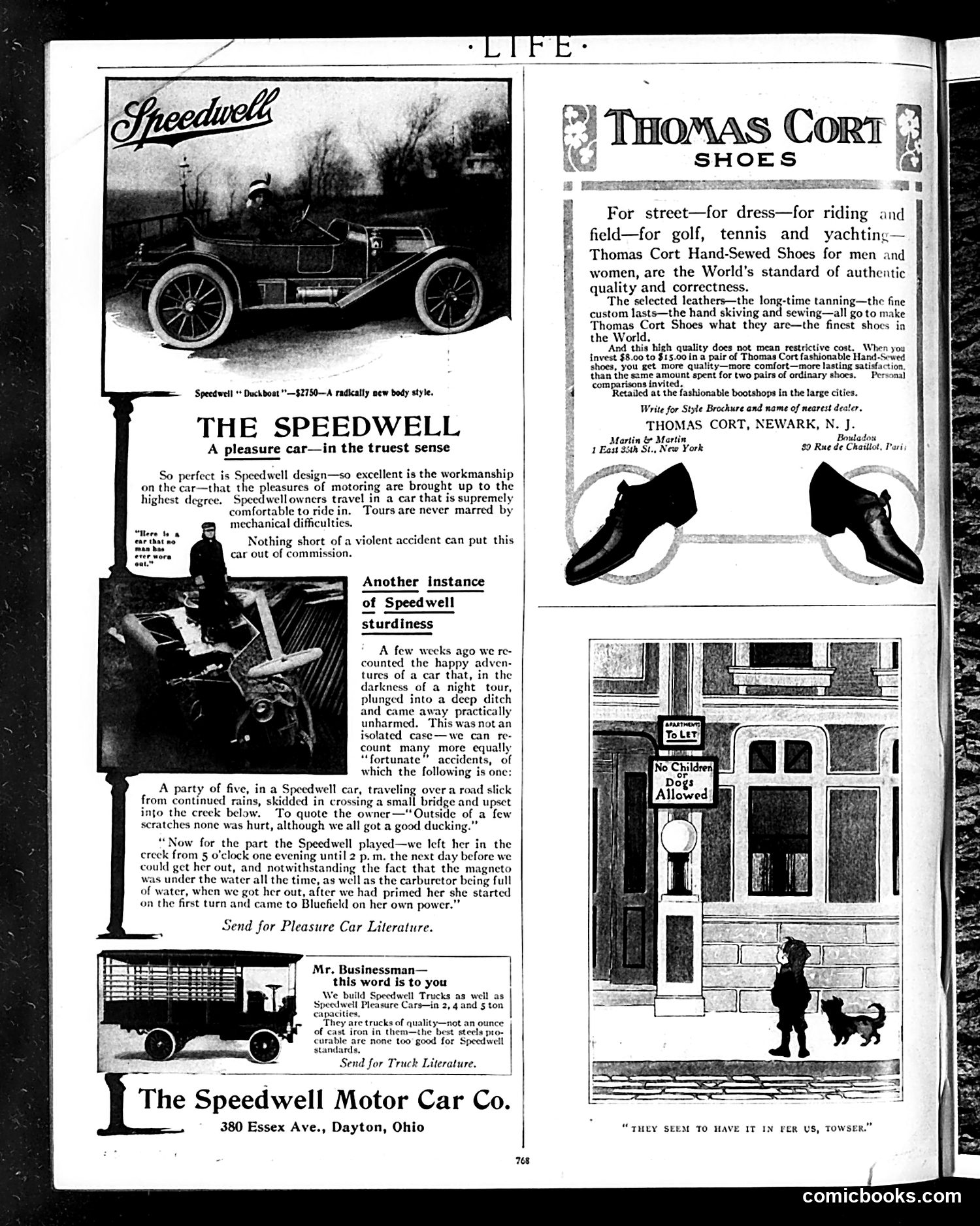
This page is **primarily advertising**, not satire or political commentary. The left side advertises the **Speedwell Motor Car** (made in Dayton, Ohio), emphasizing its durability and reliability through testimonials about accident survival and mechanical resilience. The accompanying photographs show the vehicle in various situations—crossing ditches, traveling rough terrain. The right side features a **Thomas Cort Shoes advertisement**, promoting hand-sewn shoes for various activities (street wear, golf, tennis, yachting). At bottom right is a **cartoon** showing a man and dog outside a building marked "No Children or Dogs Allowed," with the caption "They seem to have it in for us, towser"—a gentle joke about pet and child exclusion policies in urban housing of the era.
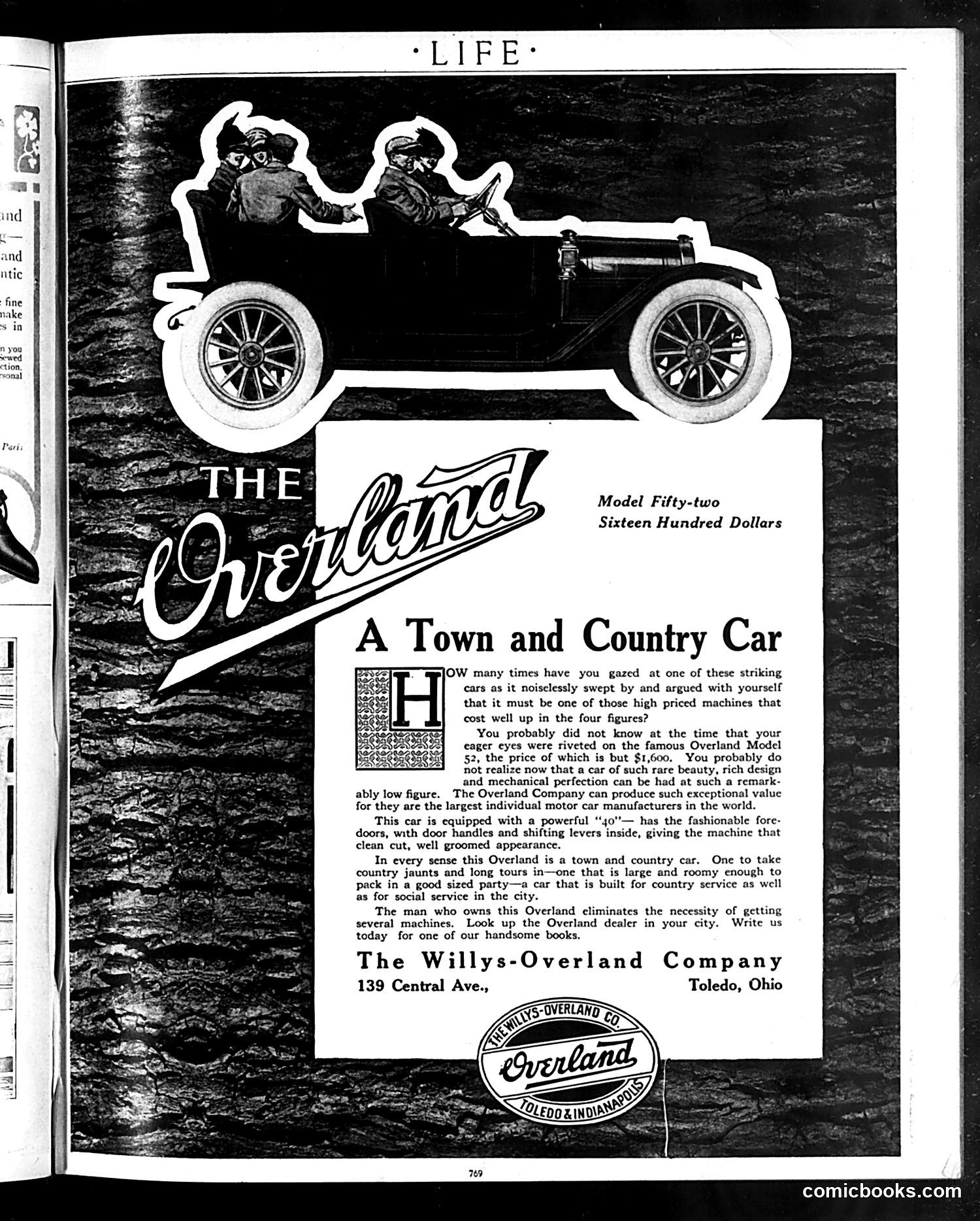
This page is **primarily an advertisement**, not satire or political commentary. It promotes the Overland Model 52 automobile, priced at $1,600, manufactured by the Willys-Overland Company of Toledo, Ohio. The ad uses a striking visual of a early 1900s touring car with two well-dressed passengers to appeal to middle-class buyers. The sales pitch emphasizes the car's versatility as both a "town and country car" suitable for social occasions and rural travel—a luxury vehicle positioned as reasonably priced for its quality. The ad claims the Overland Company is "the largest individual motor car manufacturers in the world," positioning it against competitors. There is no political satire present; this is straightforward period advertising leveraging lifestyle aspirations.
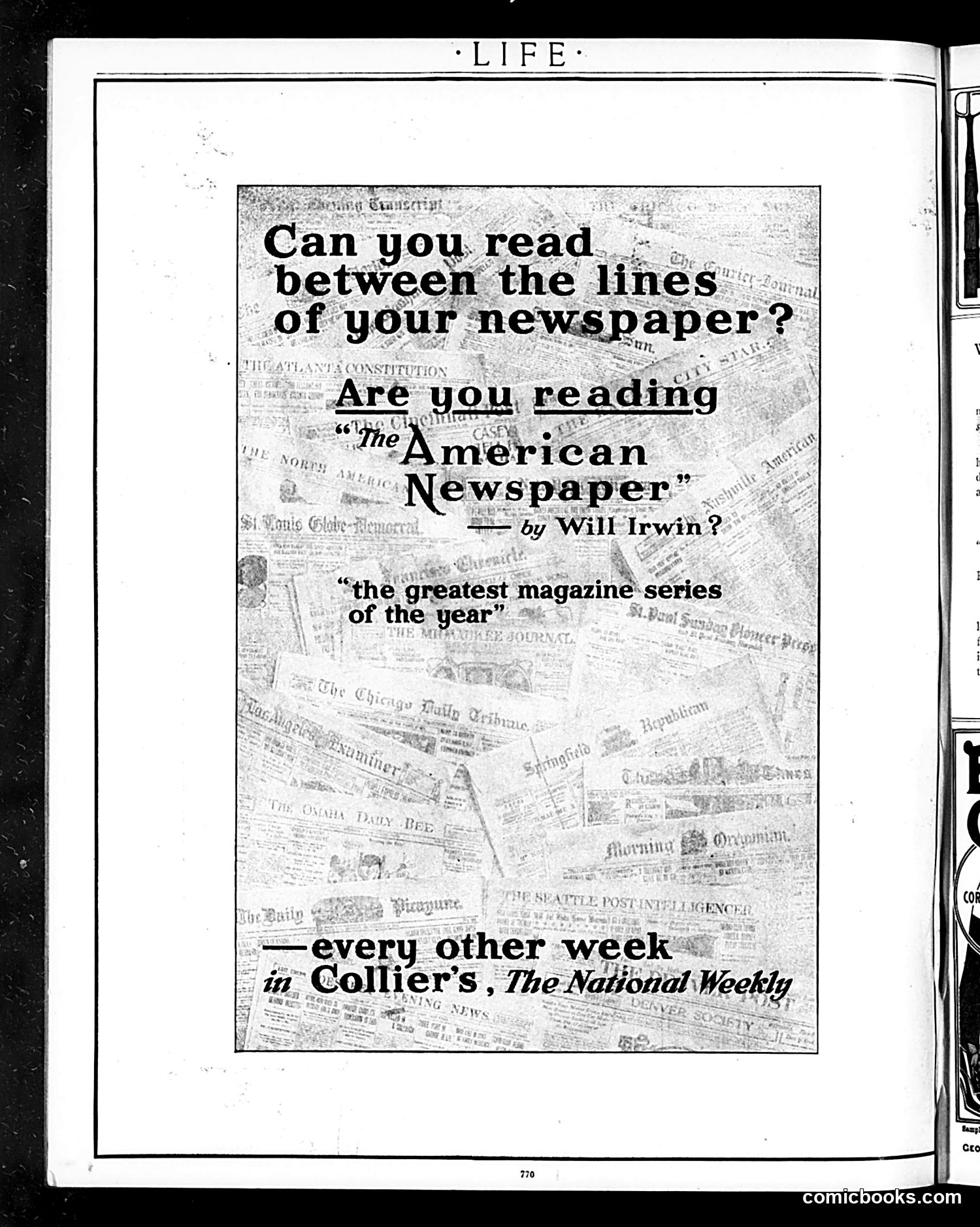
This page is entirely **advertising**, not editorial content or satire. It promotes "The American Newspaper," a magazine series by Will Irwin published in *Collier's, The National Weekly*. The ad uses a collage of actual newspaper mastheads as background imagery to visually reinforce its subject matter. The copy poses rhetorical questions to readers: can you read between the lines of newspapers? Are you reading Irwin's analysis? The advertisement claims the series represents "the greatest magazine series of the year" and ran "every other week" in *Collier's*. This is a straightforward promotional piece targeting readers interested in media criticism and journalism analysis—a common early 20th-century magazine topic. No satire or political cartoon is present on this page.
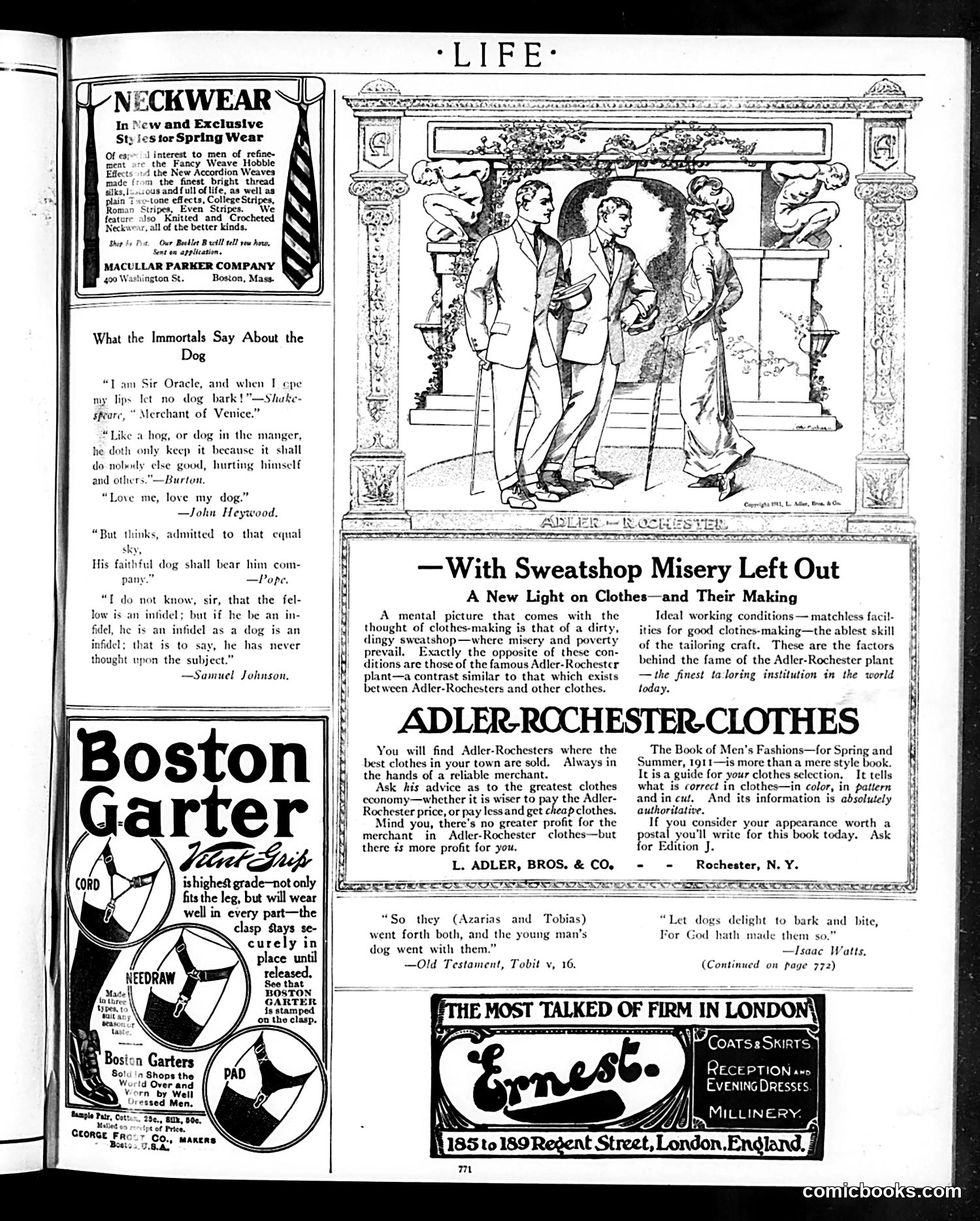
This page is primarily **advertising**, not satire or political cartoons. The main content includes: 1. **Neckwear advertisement** (top left) - for spring fashion styles from Maccullar Parker Company in Boston 2. **"What the Immortals Say About the Dog"** (left column) - classical literary quotes about dogs from Shakespeare, Burton, Pope, Johnson, and Watts, presented as decorative filler 3. **Boston Garter advertisement** (large, left side) - promoting men's garters with emphasis on comfort and durability, showing product diagrams 4. **Adler-Rochester Clothes advertisement** (center/right) - promoting men's clothing, emphasizing superior working conditions versus "sweatshop misery" 5. **Ernest advertisement** (bottom right) - London clothing firm The page reflects early 1910s menswear marketing and appears designed to fill advertising space with period-appropriate content and classic literary references.
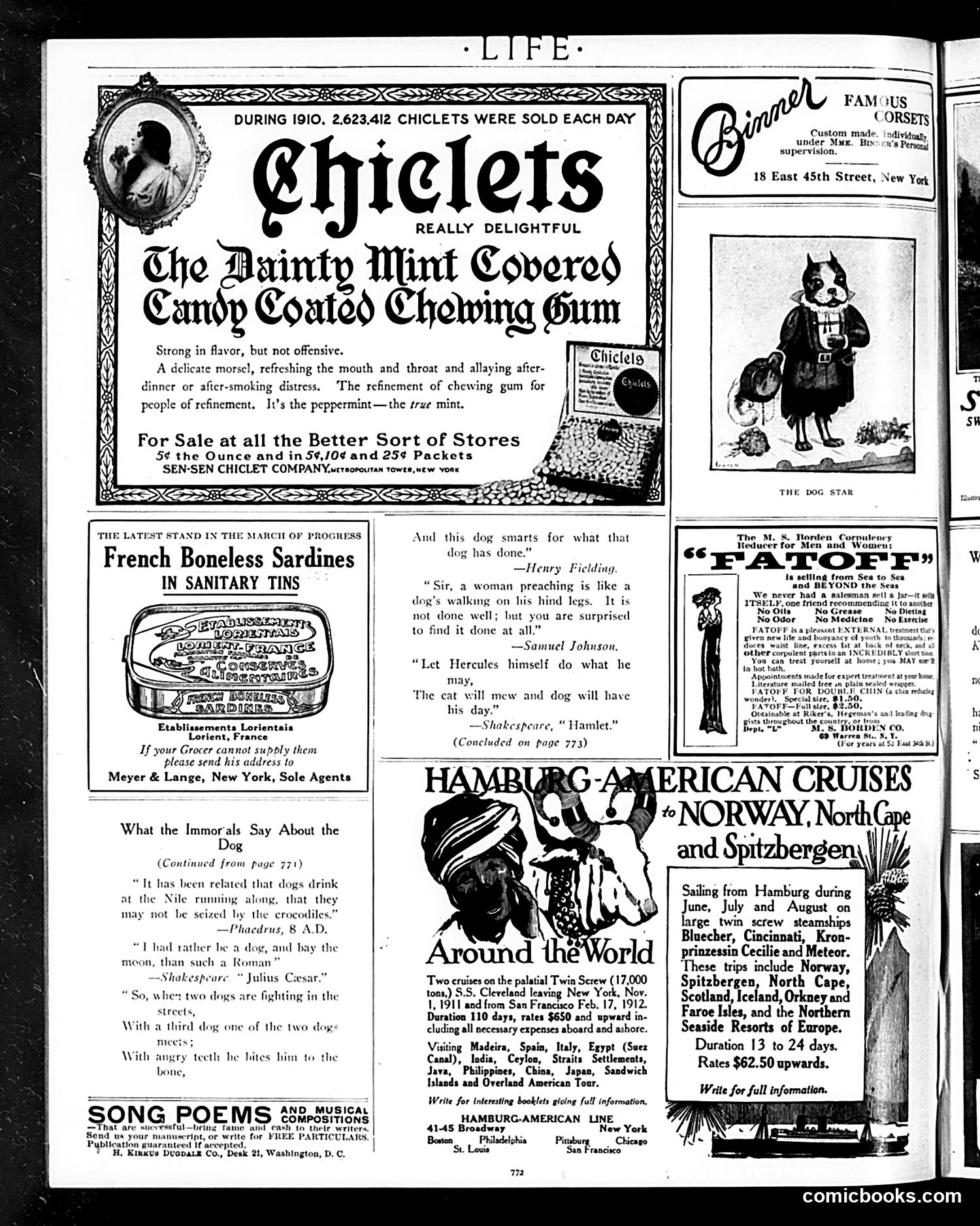
This page is primarily **advertising and miscellaneous content** rather than political satire. The main elements include: 1. **Chiclets chewing gum ad** (top): Claims 2.6 million units sold daily in 1910, marketing peppermint-flavored gum as refined and non-offensive. 2. **"The Dog Star" illustration** (right): A cartoon dog in formal dress, accompanying quotations about dogs from Shakespeare, Fielding, and Johnson—a lighthearted literary comparison. 3. **Travel and product ads**: French sardines, corsets, and Hamburg-American cruise line advertisements to Norway and Spitzbergen. 4. **"What the Immortals Say About the Dog"** (bottom): Classical literary quotes about dogs, presented without satirical intent. The page lacks political cartoons or social satire—it's a typical early-1900s magazine layout mixing modest humor with commercial advertisements.
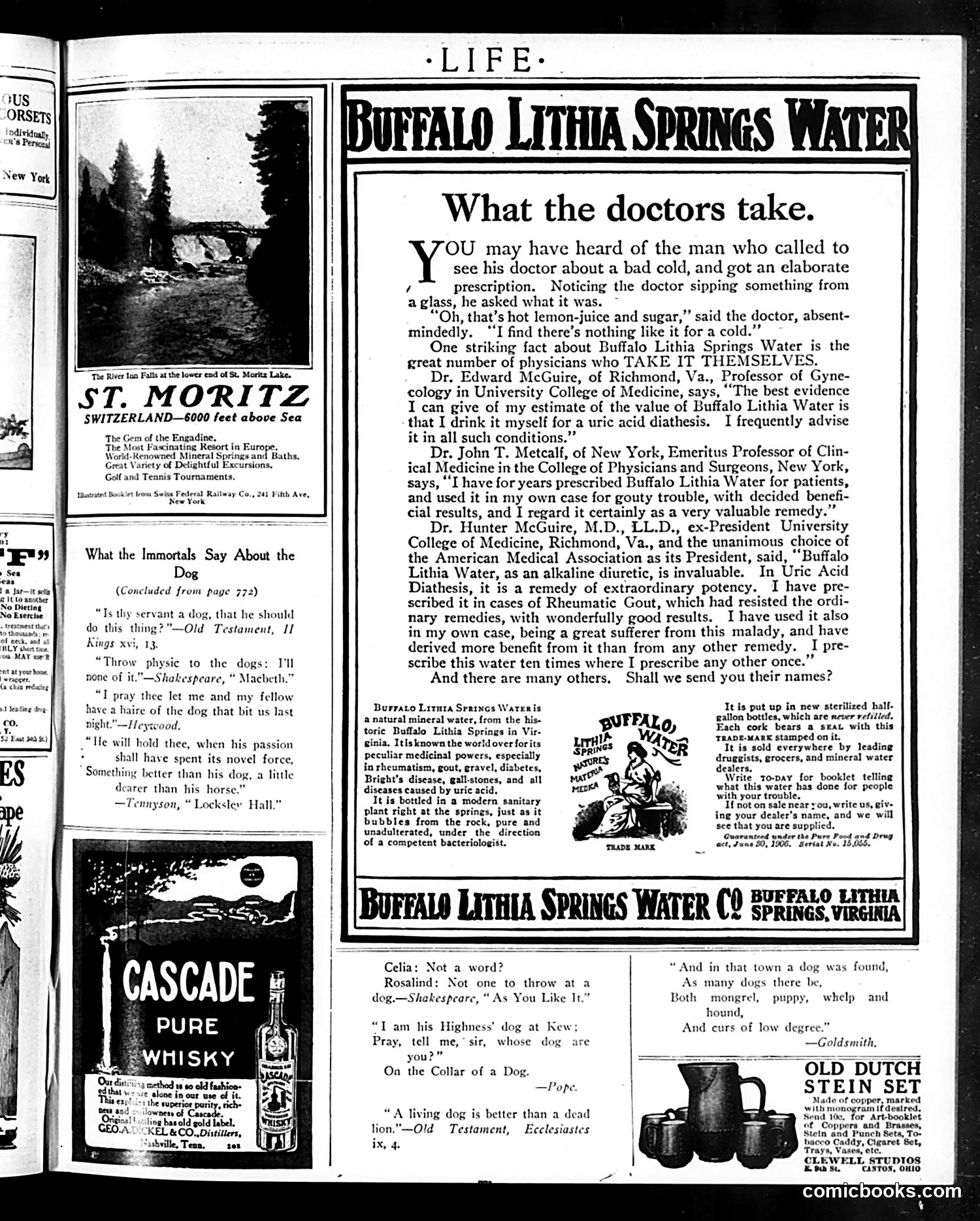
This page is primarily **advertising**, not political satire. The dominant feature is a large advertisement for Buffalo Lithia Springs Water, a patent medicine marketed to physicians and the public. The ad quotes several doctors claiming the water cures various ailments—uric acid diathesis, rheumatism, and kidney disease. This reflects early 20th-century medical marketing practices where mineral spring waters were widely promoted as cure-alls. Supporting advertisements include Cascade Pure Whisky and an "Old Dutch Stein Set" (copper vessels). A secondary section titled "What the Immortals Say About the Dog" contains literary quotations about dogs, appearing to be filler content rather than satire. The page demonstrates how Life magazine mixed editorial content with extensive advertising—common practice for periodicals of this era.
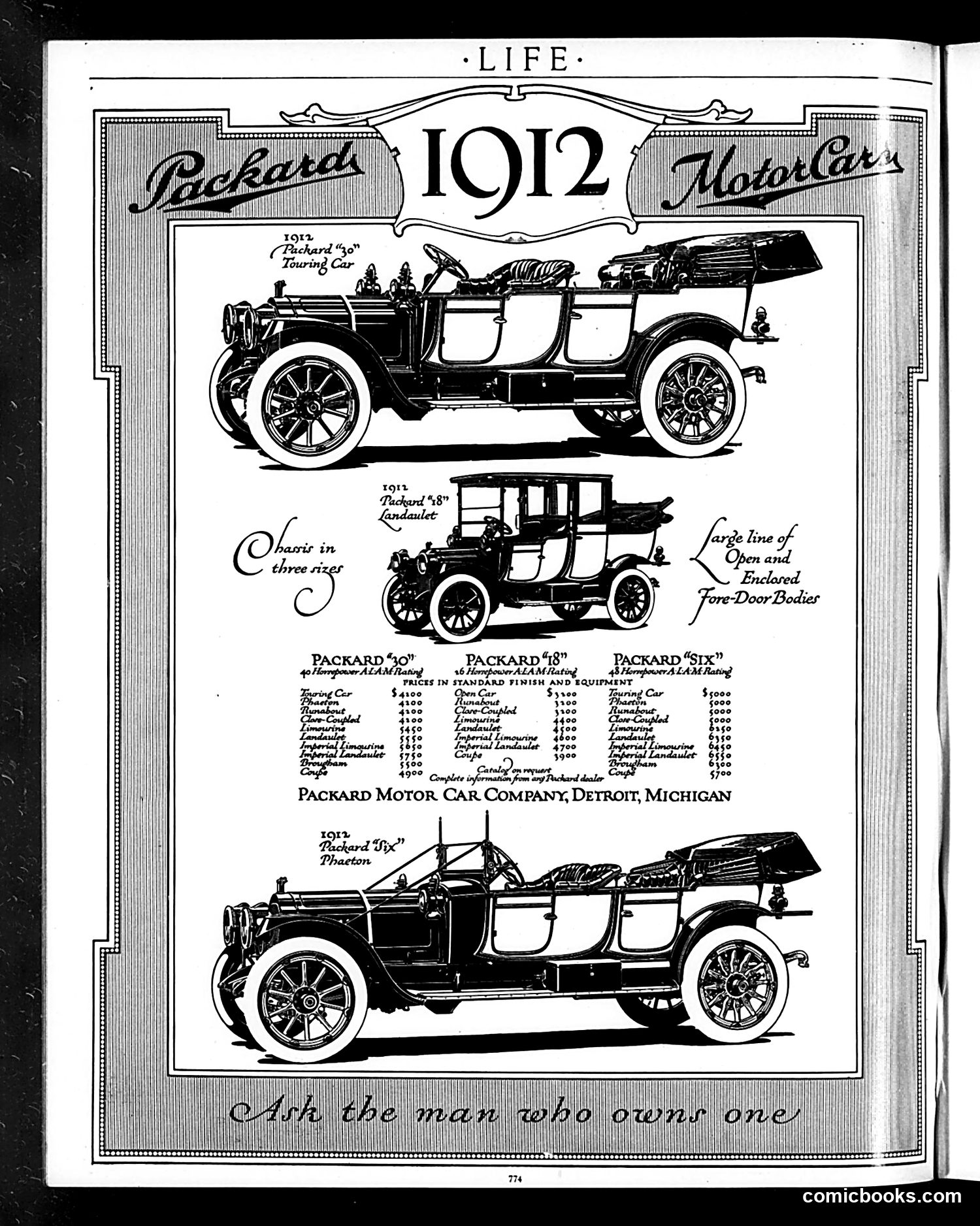
This is primarily **an advertisement page**, not political satire. It showcases three 1912 Packard automobile models from the Packard Motor Car Company in Detroit, Michigan. The page displays: - A "48" model (top) labeled "Phaeton" - A "30" model (middle) described as a "Landaulet" with "Chassis in three rizer" - A "Six" Phaeton (bottom) Each vehicle includes detailed pricing and equipment specifications. The tagline at bottom—"Ask the man who owns one"—was Packard's actual advertising slogan, appealing to luxury car buyers by suggesting owner satisfaction. There is no political or satirical content here; this is straightforward period automotive advertising from Life magazine's commercial pages.
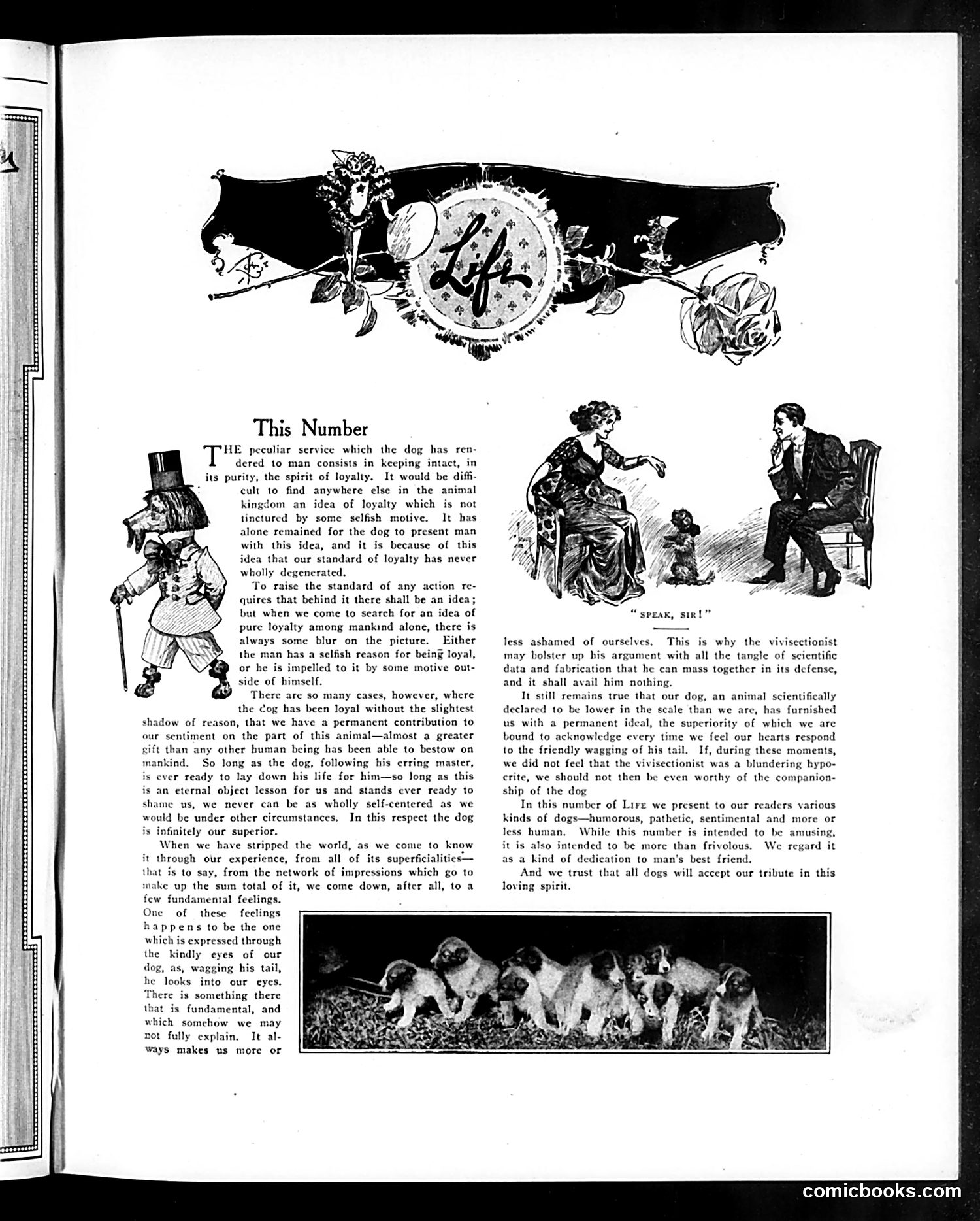
This page celebrates dogs' loyalty to humans. The article argues that dogs possess an almost unique capacity for unconditional loyalty—a quality the author suggests is increasingly rare among people. The text contrasts the dog's faithful companionship with human selfishness and hypocrisy. It notes that even cynical "vivisectionists" (animal experimenters) must acknowledge dogs' genuine devotion. The illustrations show dogs in various domestic scenes and a photograph of dogs resting. The accompanying vignettes—including one labeled "Speak, Sir!"—humorously depict human-canine interactions. The overall message appears to be *sentimental social criticism*: by elevating dogs' moral virtue, the author implicitly critiques human failings in loyalty and integrity. This reflects Progressive Era sentimentality about animals as moral exemplars for corrupted society.
This page from *Life* magazine (April 20, 1912) contains an editorial titled "Preserving Yale's Democracy" alongside three small cartoon vignettes illustrating the text. The editorial discusses wealth inequality and social mobility, arguing that colleges should help poor students rise in status alongside rich ones. The cartoons appear to show working-class figures—laborers with tools—contrasted with wealthier individuals, visually reinforcing the editorial's point about class disparities. The piece references Yale, Harvard, Princeton, and Governor Wilson, discussing how colleges should foster democratic principles by housing students together regardless of wealth and giving poor students equal opportunity to succeed. The satire critiques how even "democratic" institutions can reinforce class divisions if they don't actively work against them.
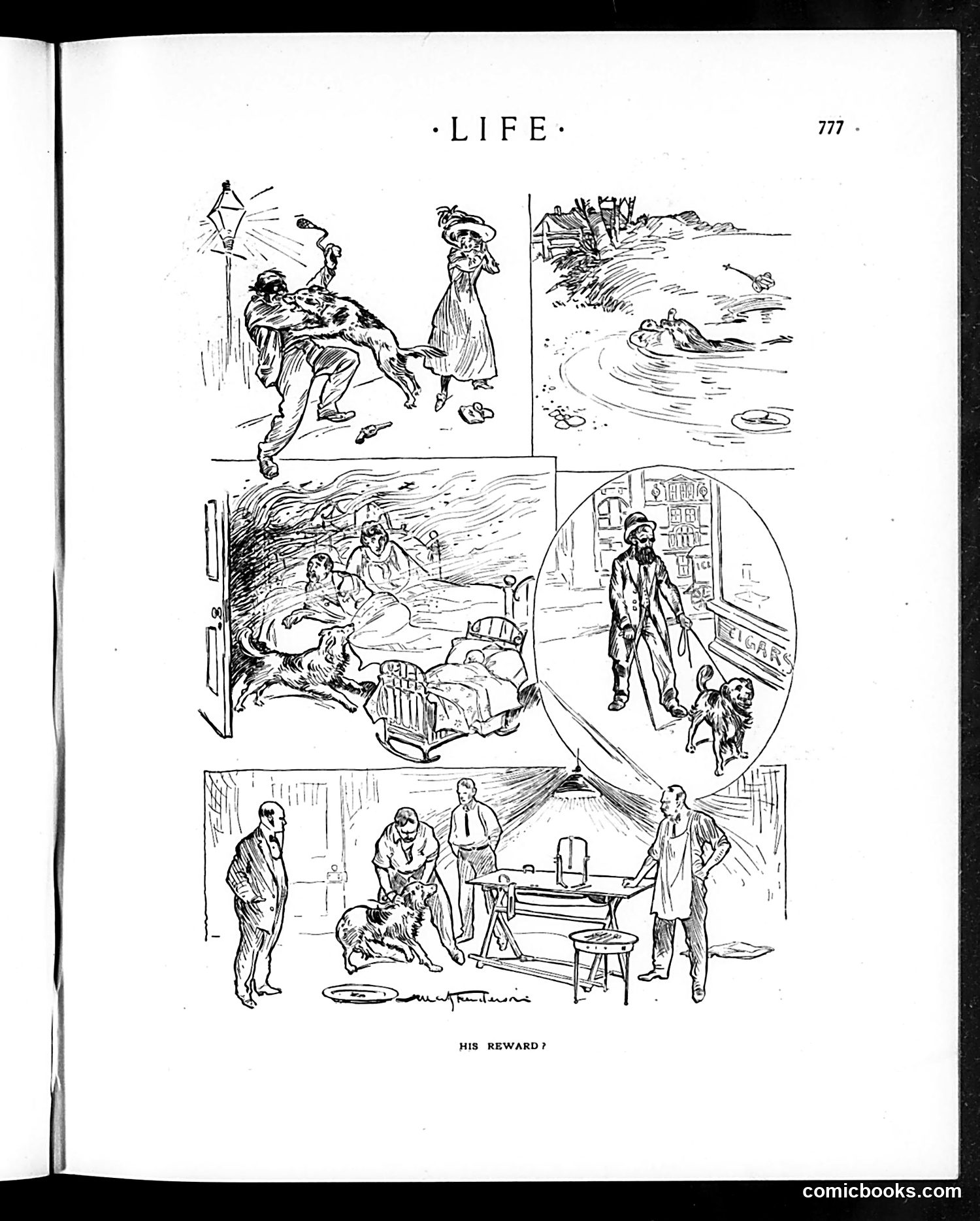
This appears to be a sequential narrative cartoon depicting a dog's journey through various scenarios. The bottom panel shows men in what appears to be a laboratory or medical setting, examining a dog on a table. The title "His Reward?" suggests ironic commentary. The progression moves from outdoor scenes (a man kicking the dog, swimming) through domestic spaces, ultimately ending with the dog being used for scientific experimentation or vivisection. The satire likely critiques animal treatment in early 20th-century medical research or laboratory practices. The punctuation mark "?" emphasizes the dark humor: after enduring mistreatment, the dog's "reward" for survival is to become a research subject—a grim commentary on the ethics (or lack thereof) of contemporary scientific practices involving animals.
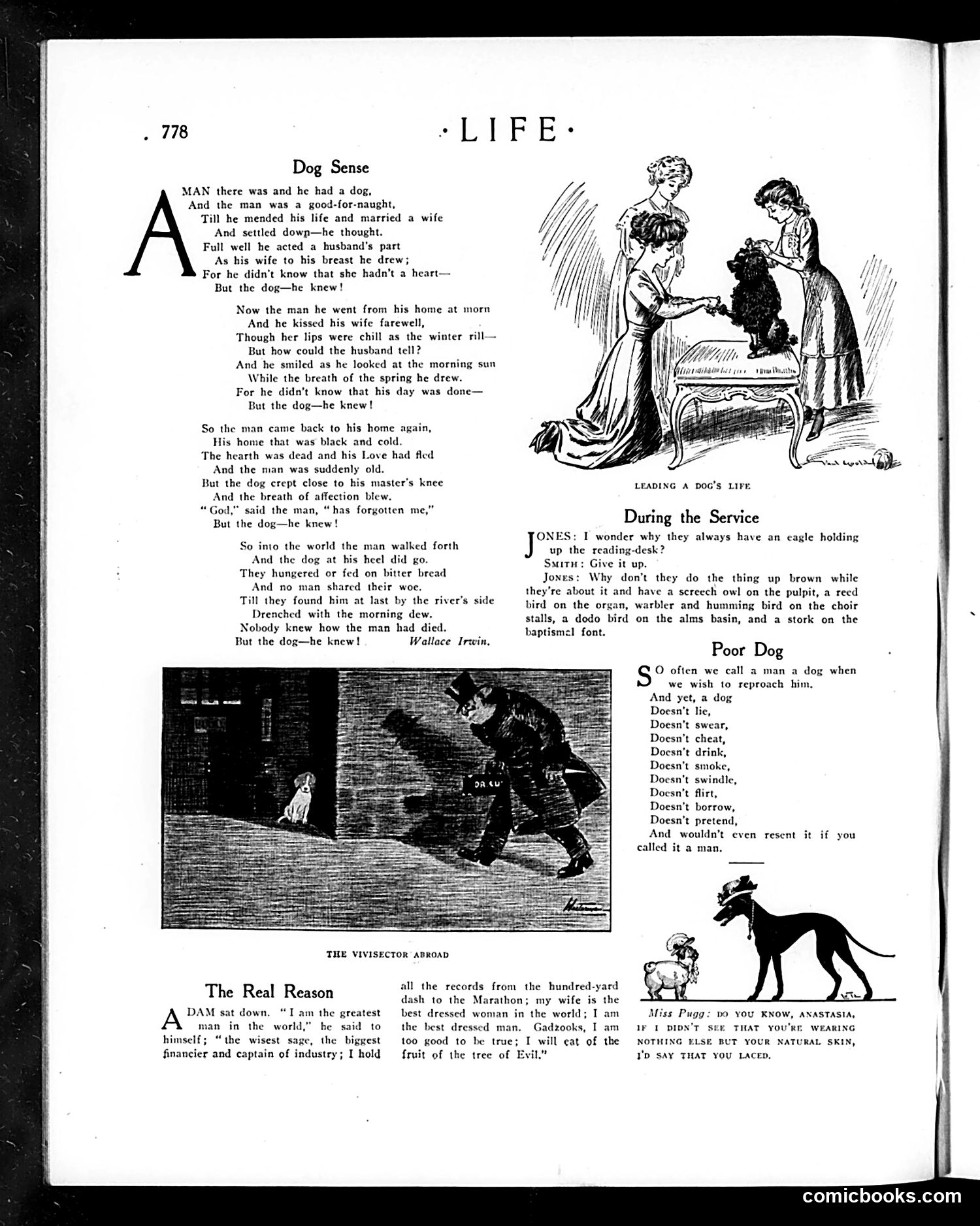
This page contains several dog-themed pieces satirizing human nature. The main poem "Dog Sense" (by Wallace Irwin) tells of a faithless wife whose heartlessness only the family dog perceives—the dog "knew" what the man couldn't see. It's a sentimental commentary on loyalty and intuition, with the tragic implication the man eventually dies by suicide. "Poor Dog" inverts this: it sarcastically catalogs human vices (lying, cheating, drinking, swindling) that dogs lack, ending with the joke that dogs wouldn't even object if called human. "During the Service" is a brief joke about excessive ecclesiastical decoration in churches—using eagles, owls, and various birds to ornament reading desks and pulpits. The scattered illustrations show dogs in everyday situations. The overall theme celebrates canine virtue against human moral failing—a common early-20th-century sentimental trope.
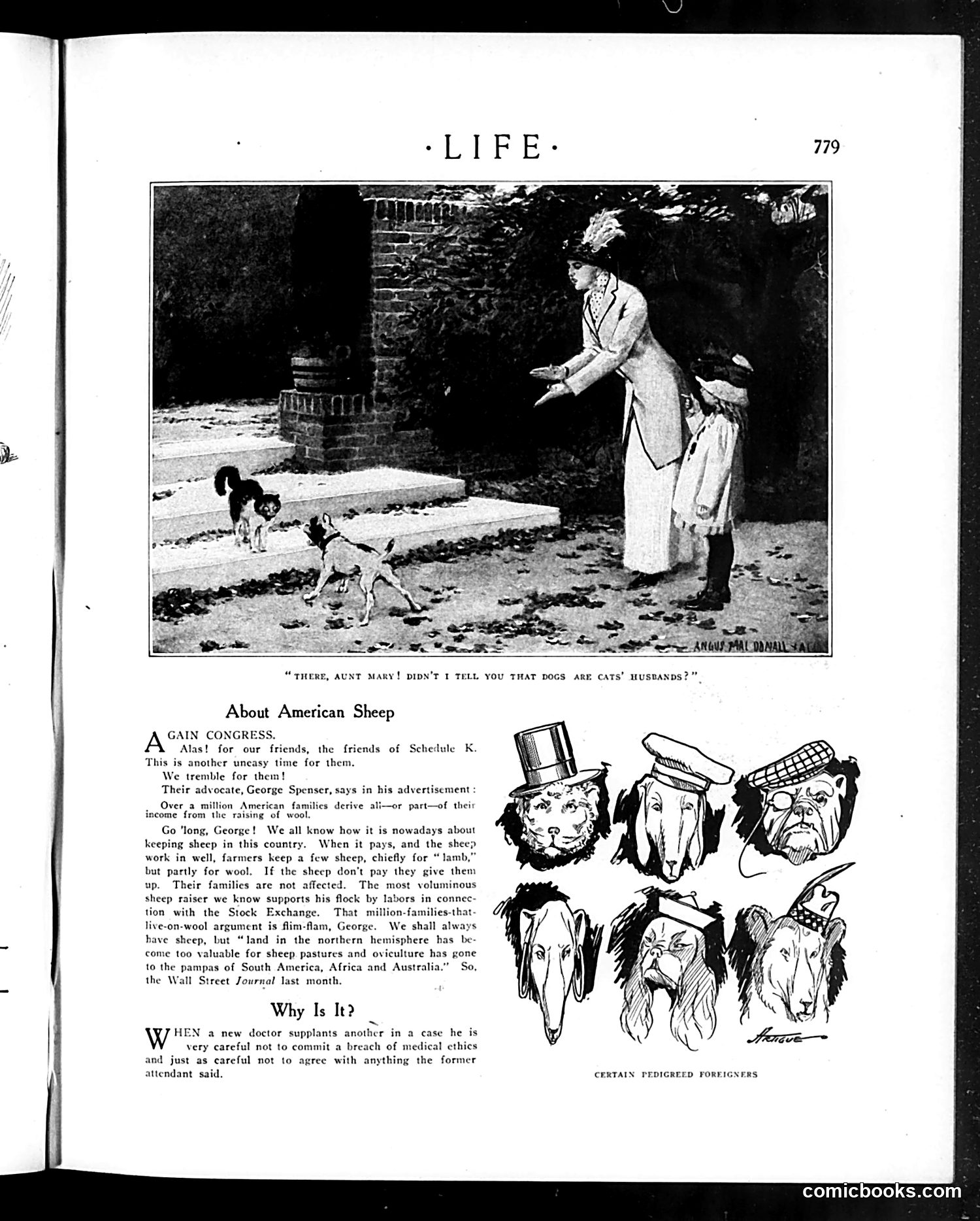
This page satirizes American sheep-raising economics and protectionist trade policy. The top cartoon jokes about dogs being "cats' husbands"—likely a visual pun unrelated to the main article. The main article criticizes advocates for "Schedule K" (a tariff protecting American wool producers). It mocks George Spenser's argument that over a million American families depend on wool income, calling it "flim-flam." The satire's point: American farmers have abandoned sheep-raising because land is too valuable for pastures; the industry has shifted to South America, Africa, and Australia regardless of tariff protection. The accompanying caricatures labeled "CERTAIN PEDIGREED FOREIGNERS" appear to represent foreign competitors or immigrant groups, likely mocking protectionist rhetoric that blamed outsiders for American economic problems. The "Why Is It?" section makes an unrelated joke about professional rivalry between doctors, establishing the magazine's general satirical tone.
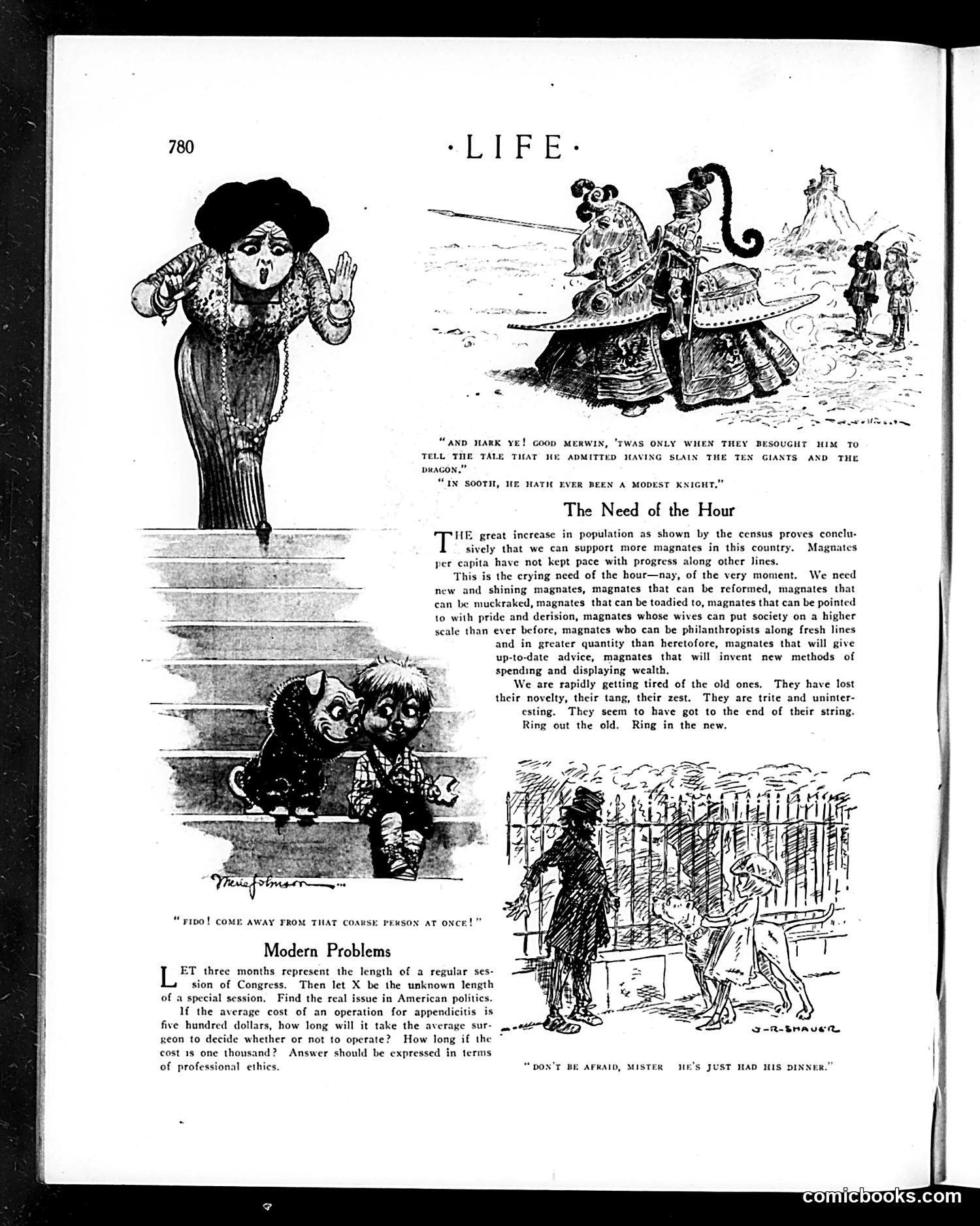
**Top Section ("The Need of the Hour"):** This is satirical commentary on American wealth inequality and the concentration of power among industrialists ("magnates"). The text ironically argues that America needs *more* wealthy tycoons, treating them as a necessity like population growth requires. The satire targets the era's obsession with the ultra-rich while pretending to admire them—phrases like "muckraked" (referring to muckraking journalism that exposed corruption) and "toadied to" reveal the critique beneath the mock-earnest tone. The medieval tale quoted above sets up the irony of false modesty among the powerful. **Bottom Section ("Modern Problems"):** A math-problem format satirizes Congressional dysfunction and professional ethics in medicine. It mocks how Congress's special sessions stretch beyond scheduled three-month sessions with undefined length, suggesting political inefficiency. The appendicitis problem critiques surgeons' conflicts of interest—whether financial incentives (higher fees) rather than genuine medical need drive surgery decisions. Both problems suggest institutional corruption and self-interest masquerading as duty.
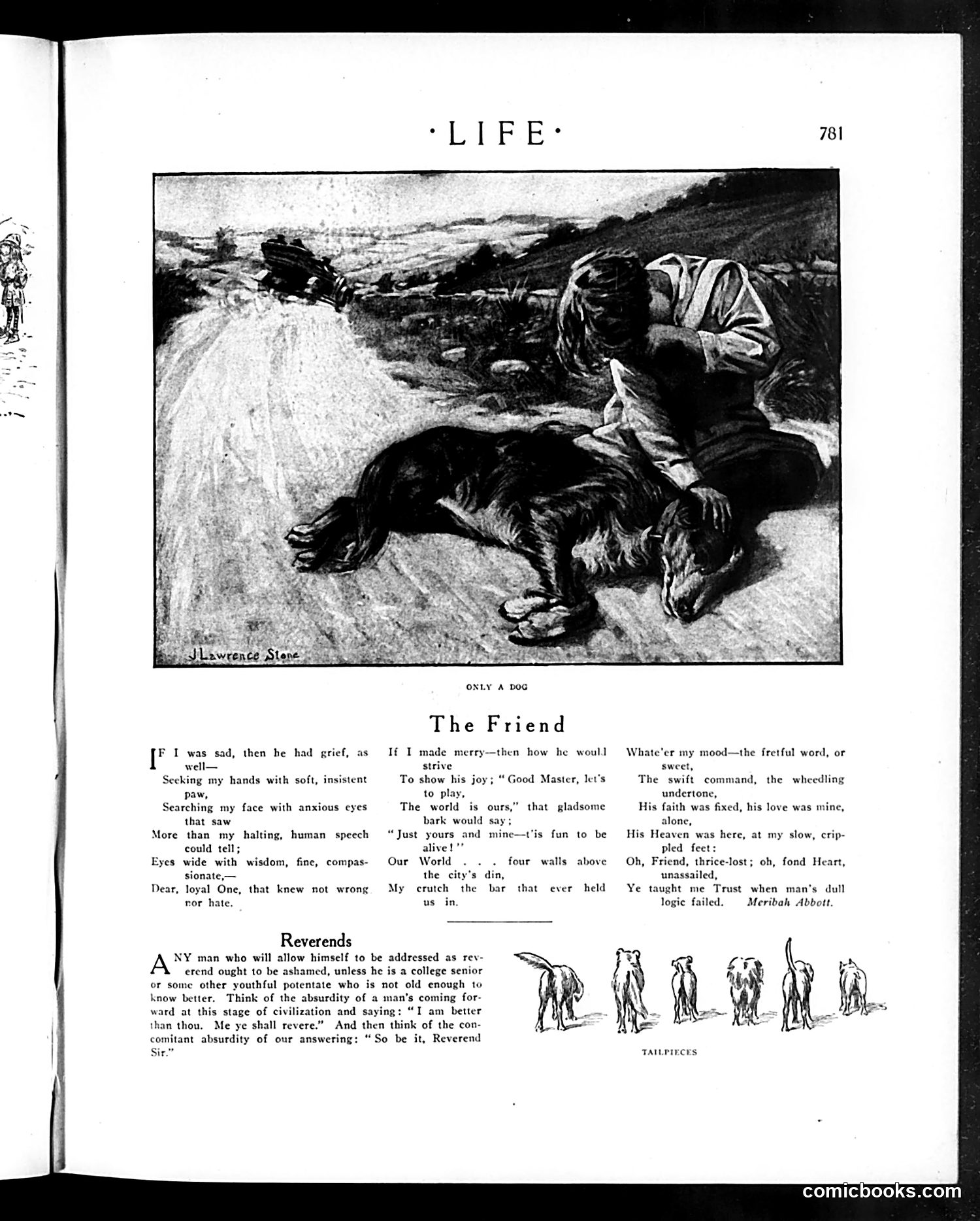
This page contains two distinct pieces of social commentary: **"The Friend"** is a sentimental poem (credited to Meribah Abbott) accompanying an illustration of a dog comforting a disabled man. The poem celebrates a dog's unconditional loyalty and emotional intelligence, contrasting the dog's pure companionship with human failings. The artwork shows the dog as the emotional anchor for its master. **"Reverends"** is a brief satirical essay mocking clergy who accept the title "Reverend." The author argues that in modern civilization, any man claiming to be inherently better than others and demanding reverence is absurd—whether a young college administrator or an elderly clergyman. He ridicules both those arrogant enough to claim superiority and congregations foolish enough to grant it. The piece advocates for dignity without hierarchical honorifics. The page concludes with small tailpiece illustrations of dogs.
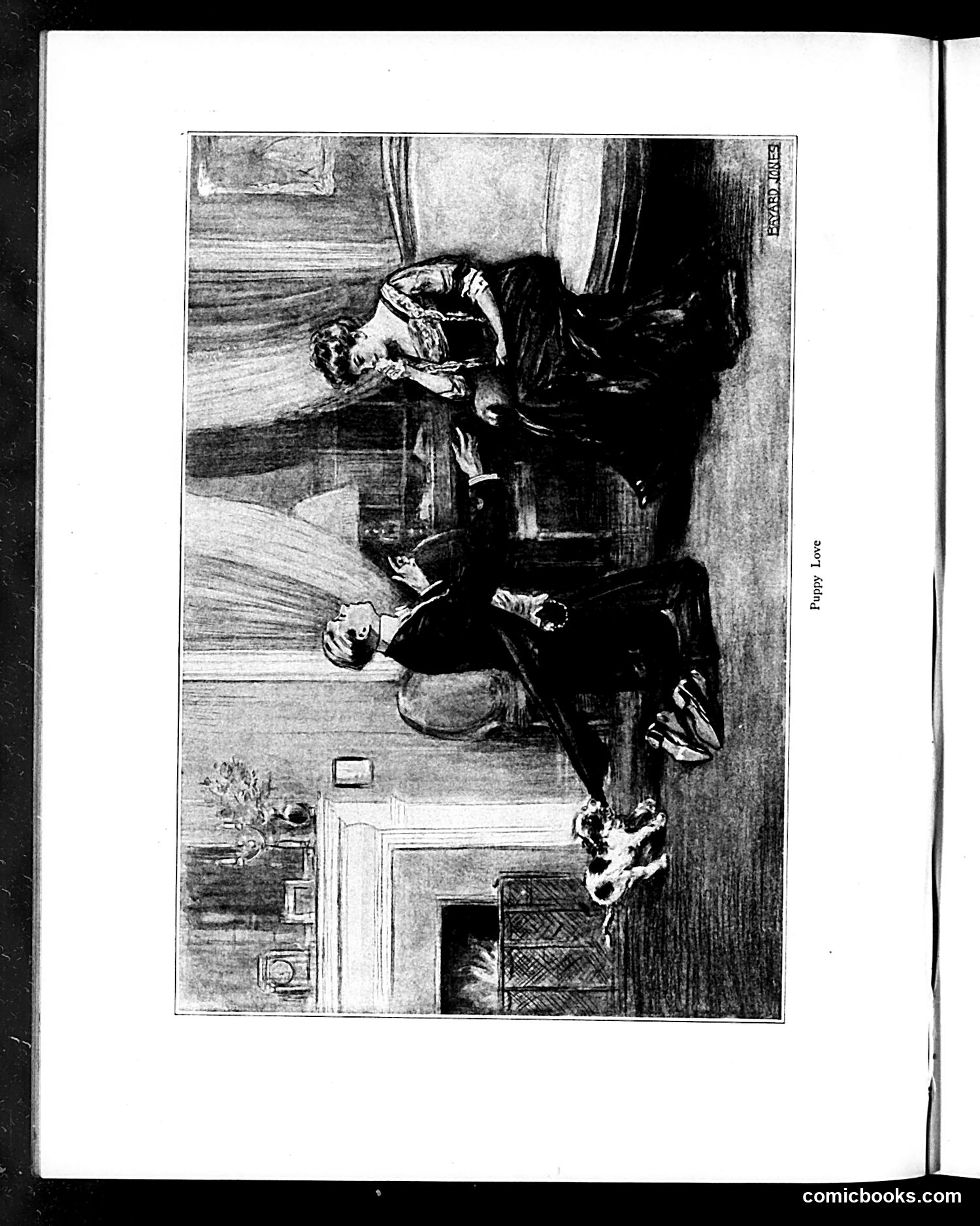
This appears to be a satirical illustration titled "Puppy Love," though the image is rotated and somewhat difficult to parse clearly. The sketch shows what appears to be two figures in an interior domestic setting with period clothing and furnishings. The title suggests social commentary on romantic infatuation, likely poking fun at young or superficial love. The sketch style and presentation are consistent with Life magazine's satirical approach to American social behavior and manners during the early-to-mid 20th century. Without clearer visibility of specific identifying details or accompanying text explaining the particular social or political reference, the exact target of this satire remains unclear, though it appears to critique courtship customs or romantic behavior of its era.
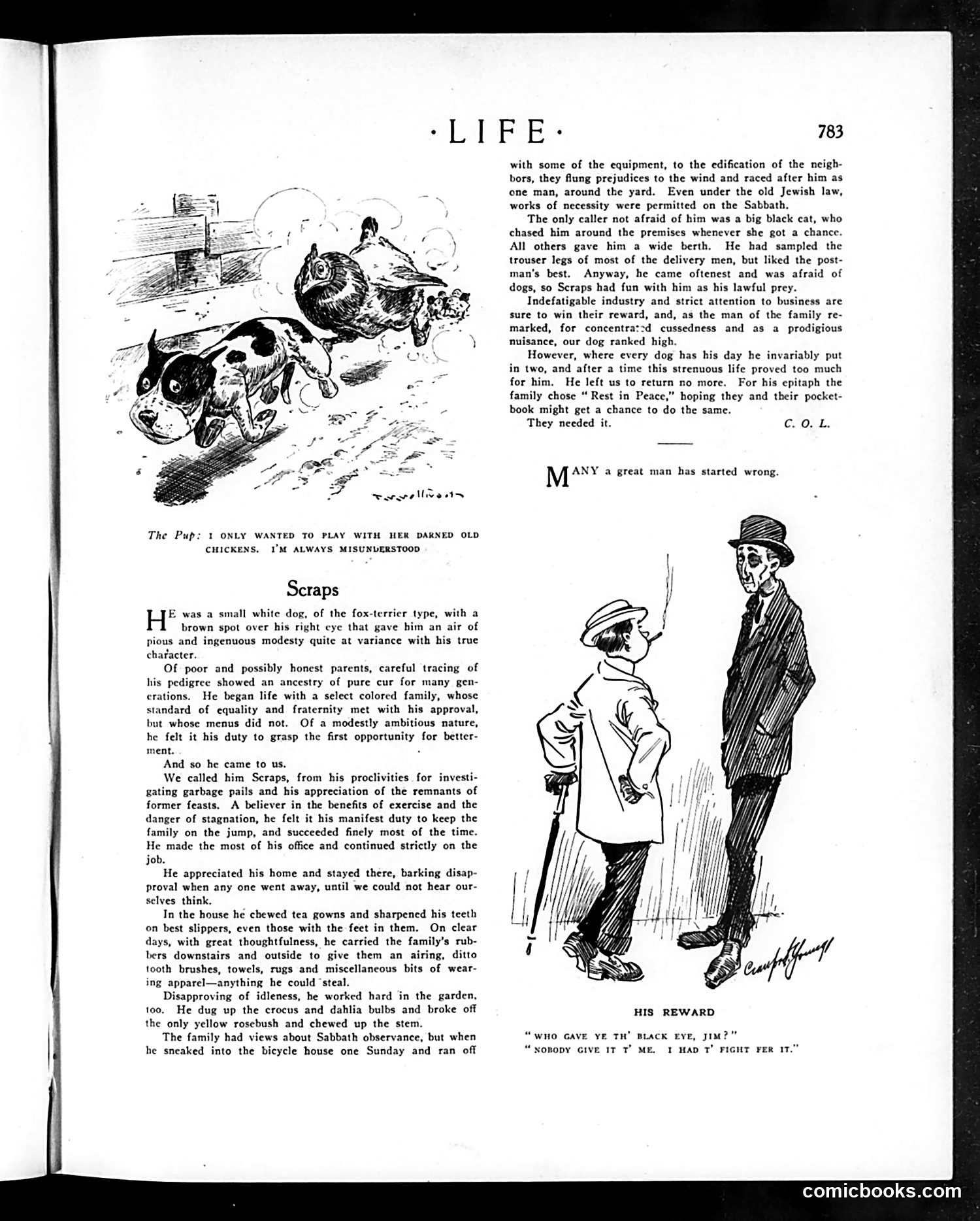
This page from *Life* magazine contains a humorous narrative about a mischievous dog named Scraps, illustrated with sketches. The story is autobiographical in tone, describing the dog's journey from a "select colored family" to the narrator's household. The humor derives from the dog's relentless destructiveness presented as earnest industriousness: he investigates garbage, chews household items (tea gowns, slippers), steals belongings, and destroys the garden—all framed as dutiful behavior. The satire mocks both the dog's "manifest duty" to cause chaos and the family's resigned acceptance. The secondary cartoon shows two boys, one with a black eye, explaining he "had t' fight fer it"—a comment on childhood roughhousing. The text's reference to "old Jewish law" and Sabbath observance suggests the original family's religious practices, adding cultural specificity to the narrative.
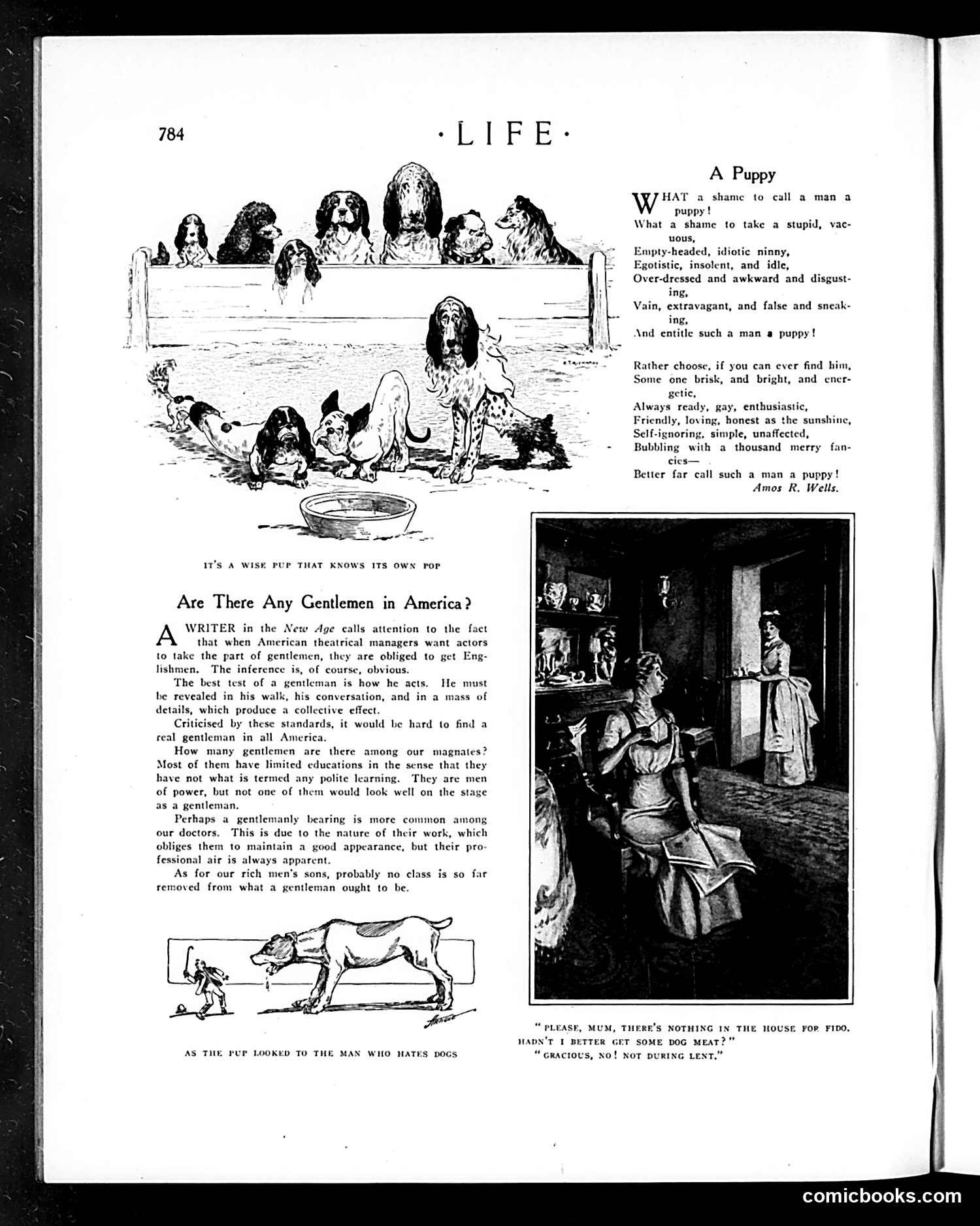
This page satirizes American masculinity and social class through multiple pieces: **"Are There Any Gentlemen in America?"** critiques wealthy American businessmen (magnates) and their sons, arguing they lack the refinement of English gentlemen. The article notes that American theatrical producers must import English actors to play gentleman roles because American men of wealth—despite their power—lack the education, bearing, and polish required. Doctors fare somewhat better due to professional demands. **"A Puppy"** (by Amos R. Wells) contrasts negative traits (vanity, pretension, idleness) with positive ones (honesty, enthusiasm, simplicity), ironically suggesting calling either type "a puppy" is inappropriate. **The dog cartoons** illustrate the theme: one shows a dog judging a man, another depicts a servant asking about dog meat during Lent (a Catholic fasting period)—absurdly applying religious restrictions to pet food. The overall message: American wealth and status don't equal true gentlemanly character; genuine virtue is rarer than assumed.
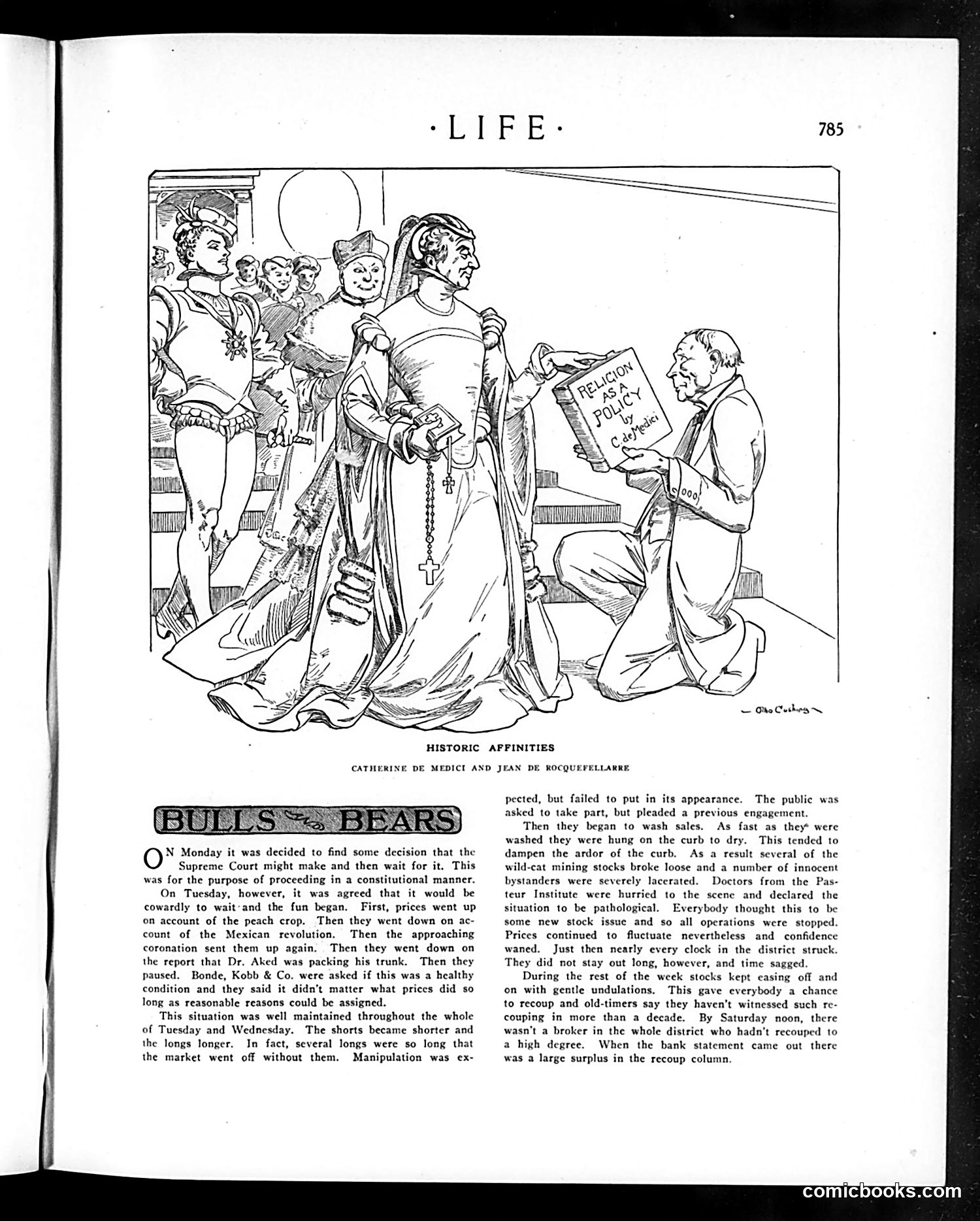
This is a satirical piece about stock market manipulation and volatility during the early 1900s. The cartoon's title references "Catherine de Medici and Jean de Rocquefellarre"—likely equating contemporary financial figures with historical manipulators known for intrigue. The accompanying text mocks the absurdity of market fluctuations driven by trivial reasons: peach crop reports, a Mexican revolution rumor, a coronation, and Dr. Aked "packing his trunk." The satire exposes how speculators ("shorts" and "longs") exploit these manufactured concerns for profit. The piece ridicules "wash sales" (artificial trading to create false activity), manipulation by major brokers, and public gullibility. The darkly comic ending—where everyone mysteriously "recouped" massive profits by Saturday—suggests the entire system is rigged, with ordinary people ("innocent bystanders") harmed while insiders profit from the chaos. The satire attacks financial corruption and the lack of market regulation in the Progressive Era.
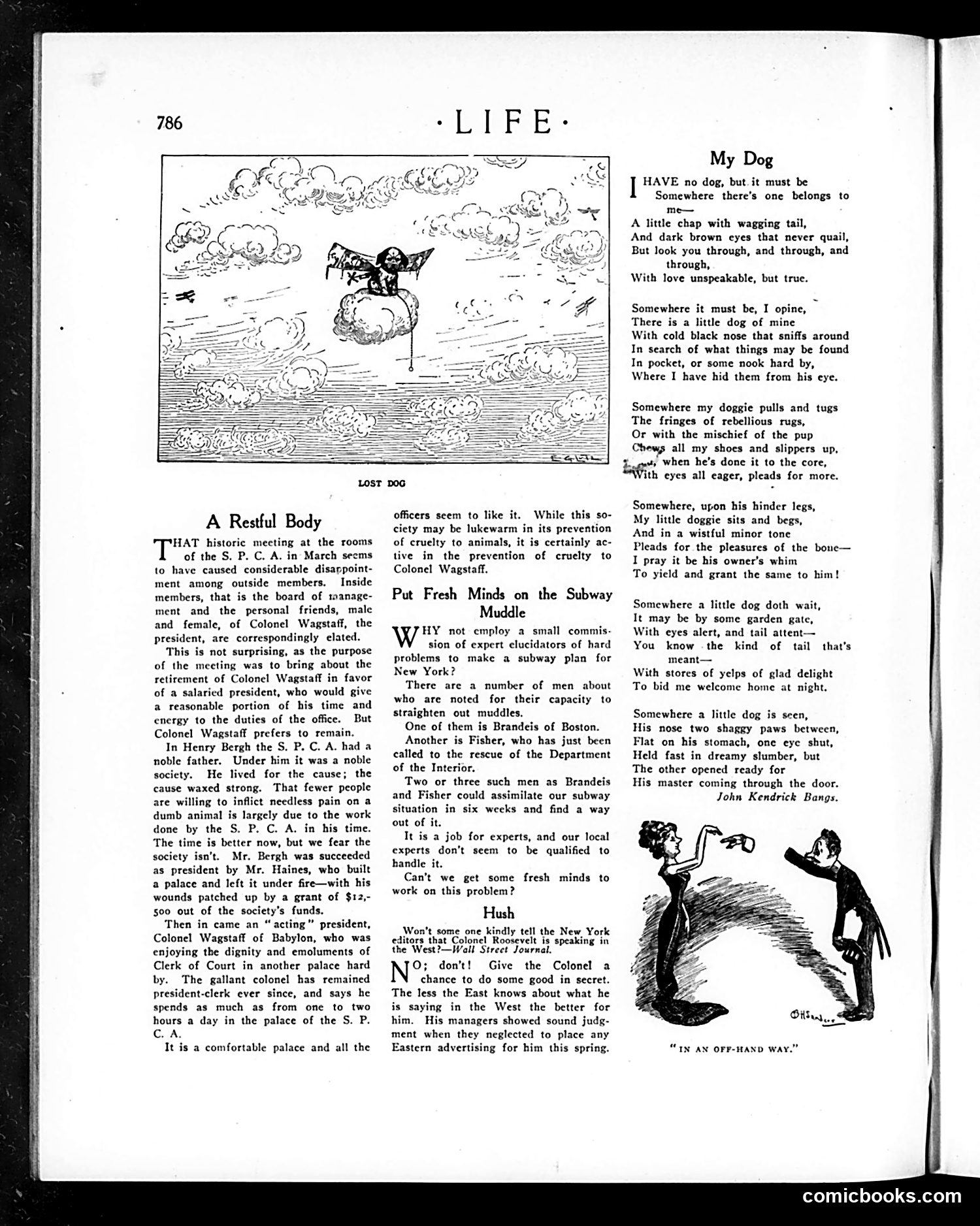
This page contains three distinct pieces satirizing American institutional and political figures circa early 1900s. **"A Restful Body"** mocks Colonel Wagstaff, president of the S.P.C.A. (Society for the Prevention of Cruelty to Animals). The article criticizes him for prioritizing his comfort and maintaining his dual role as Clerk of Court while neglecting the organization's actual mission. The satire is that an animal-welfare society protects its president from accountability while potentially neglecting animal welfare itself. **"Put Fresh Minds on the Subway Muddle"** urges New York to hire expert problem-solvers like Brandeis or Fisher to resolve subway planning chaos, implying current local leadership is incompetent. **"Hush"** is political commentary suggesting Colonel Roosevelt (likely Theodore Roosevelt) should remain silent about his Western speeches, as his managers wisely avoided publicizing them—implying his statements are problematic or embarrassing to Eastern interests. The accompanying illustrations show a lost dog and figures in humorous poses. "My Dog" is a sentimental poem about an imagined pet.
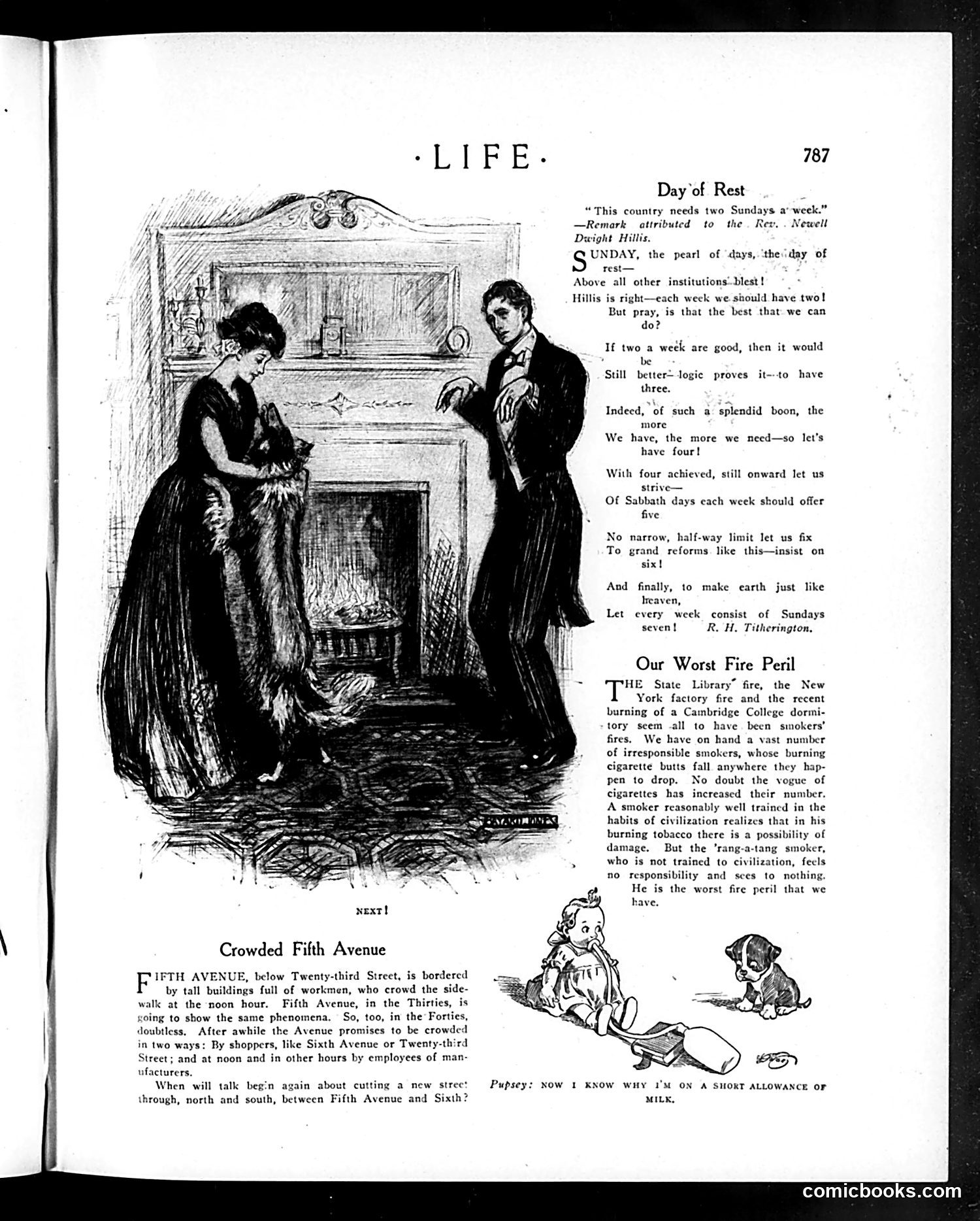
This page contains three separate satirical pieces targeting early 20th-century American social issues. **"Day of Rest"** mocks a remark attributed to Reverend Newell Dwight Hillis proposing two Sundays weekly. The satire uses reductio ad absurdum: if two Sundays are good, why not three, four, five, six, or seven? The joke targets both religious excess and illogical social reform arguments—pushing reasonable ideas to absurd extremes. **"Our Worst Fire Peril"** criticizes irresponsible smokers causing dangerous fires in libraries, factories, and buildings. The piece distinguishes between "civilized" smokers who recognize fire risks and "rang-a-tang smokers"—untrained, careless people indifferent to consequences. This reflects genuine Progressive-era fire safety concerns and class anxiety about urban working populations. **"Crowded Fifth Avenue"** satirizes Manhattan's overcrowding as commercial development spreads northward along Fifth Avenue, with factory workers now crowding the street at noon alongside shoppers, making it resemble less fashionable streets like Sixth Avenue. The accompanying cartoon about a child's milk allowance connects to the last article's crowding theme.
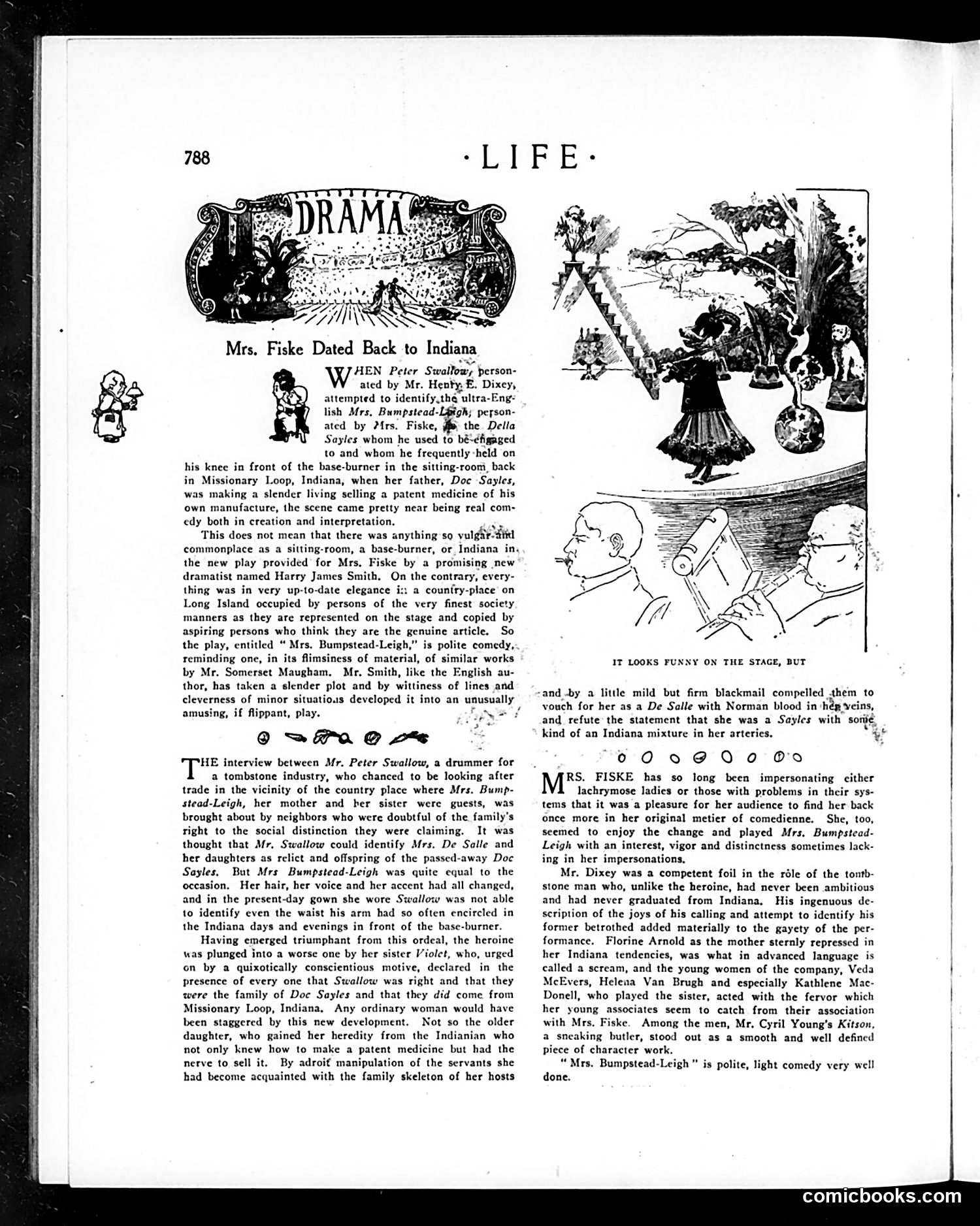
This theater review satirizes the play *Mrs. Bumpstead-Leigh*, starring actress Mrs. Fiske. The satire centers on social pretension: a woman from humble Missionary Loop, Indiana—daughter of a patent-medicine seller—reinvents herself as an ultra-refined English aristocrat ("De Salle with Norman blood"). When an old acquaintance from Indiana threatens to expose her, she uses blackmail to secure false corroboration of her fake identity, thereby maintaining her fraudulent social standing among wealthy Long Island society. The joke is the contrast between the play's "polite comedy" setting of elegant country estates and its plot involving crude deception rooted in vulgar Midwestern origins. The review praises Fiske for returning to her strength in comedic roles, rather than the tearful dramatic parts ("lachrymose ladies") she'd been playing. The humor lies in the gap between appearance and reality—a classic satire of American social climbing.
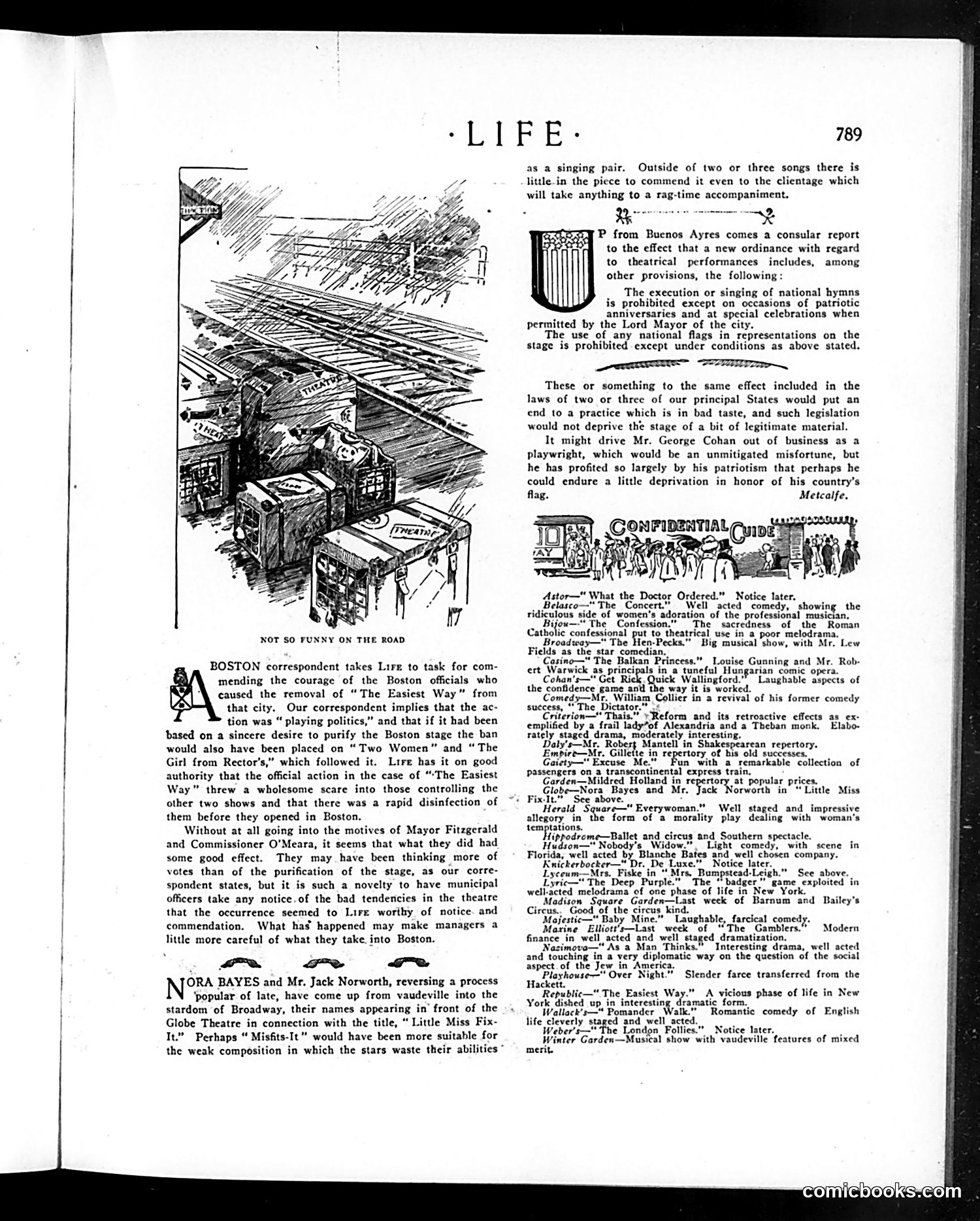
This page contains theater criticism and commentary, not political cartoons. The main illustration shows a cluttered backstage scene labeled "NOT SO FUNNY ON THE ROAD." The primary content criticizes Boston officials (Mayor Fitzgerald and Commissioner O'Meara) for banning the play "The Easiest Way." Life's Boston correspondent challenges whether this action was sincere moral reform or political posturing, noting that similar "immoral" plays like "Two Women" and "The Girl from Rector's" weren't banned. Life defends the officials anyway, arguing that even politically-motivated censorship had the good effect of forcing theaters to clean up content. The page also mocks performers Nora Bayes and Jack Norworth for their weak Broadway show "Little Miss Fix-It," suggesting "Misfits-It" would be more appropriate. Additionally, there's discussion of Buenos Aires theatrical ordinances restricting national hymns and flags on stage—presented as desirably restrictive, particularly toward George Cohan's patriotic plays. The remainder is theater listings and reviews.
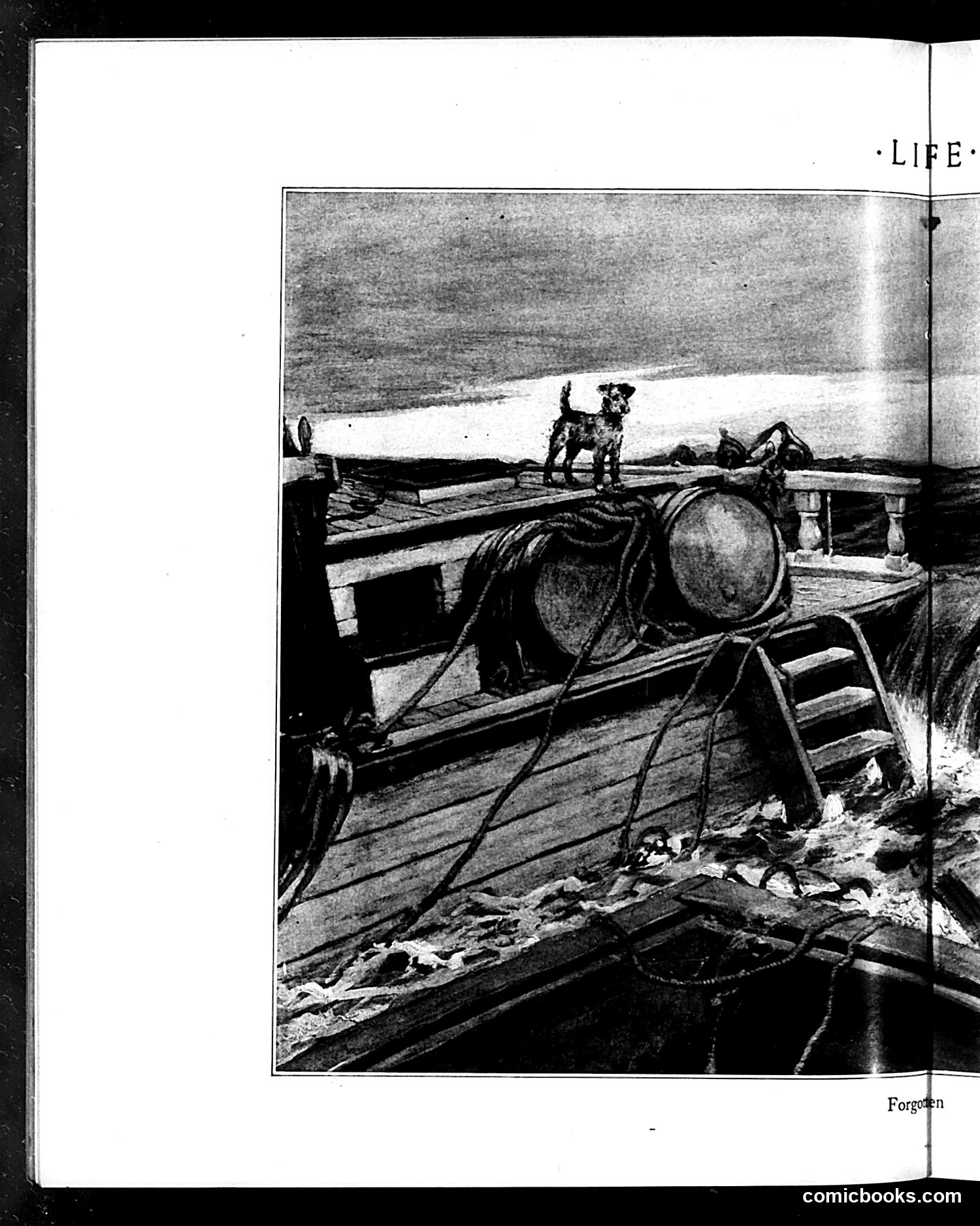
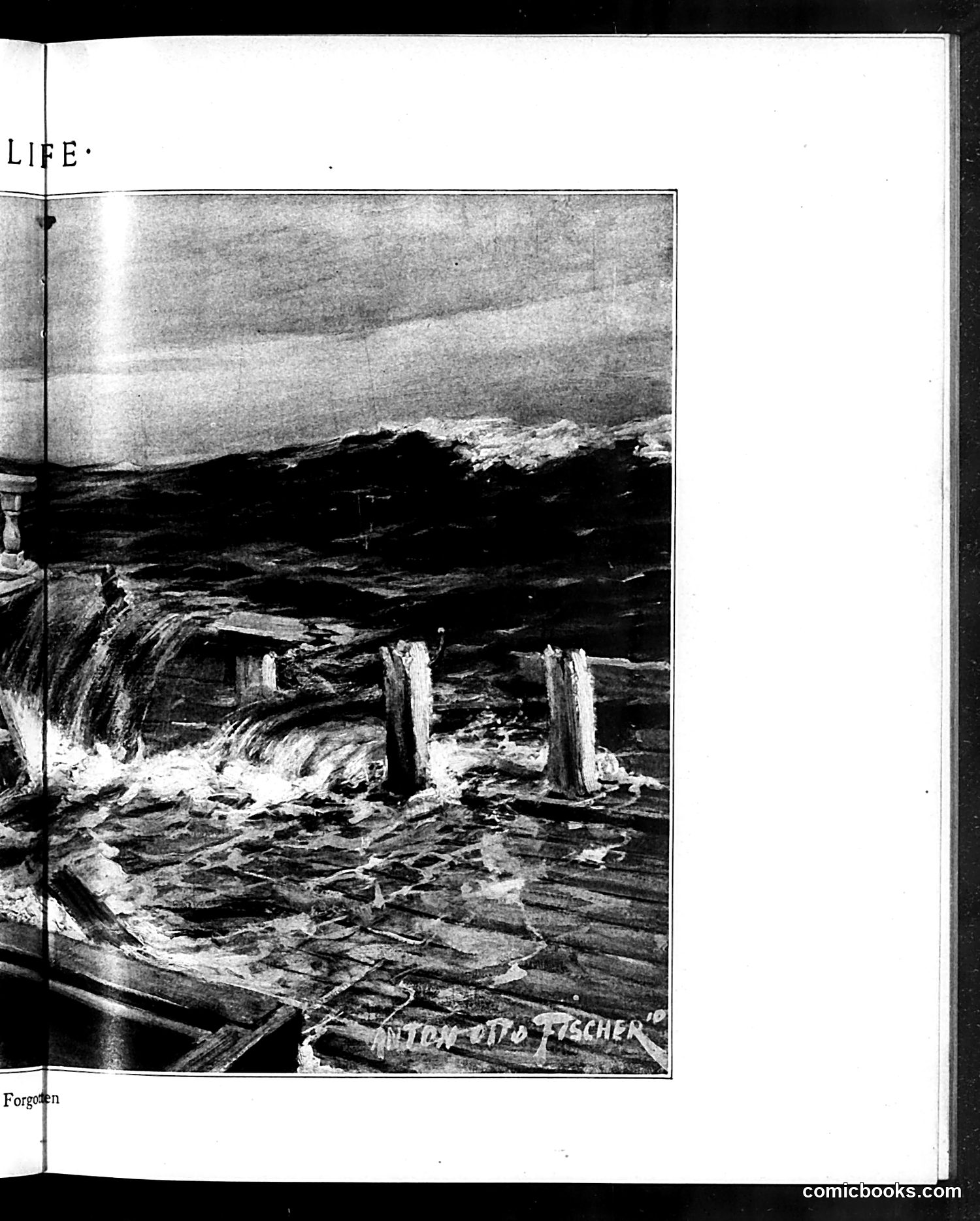
This page from *Life* magazine shows a black-and-white photograph labeled "Forgotten" at the bottom. The image depicts what appears to be abandoned wooden structures or ruins in a desolate landscape, with deteriorating posts and debris scattered across the ground. Dark hills or mountains loom in the background under a hazy sky. The title "LIFE" at the top and the word "Forgotten" suggest this is social commentary—likely critiquing neglected infrastructure, abandoned communities, or economic hardship. However, without additional text or context on the page, the specific historical reference remains unclear. The barren, decaying landscape appears designed to evoke melancholy and abandonment, typical of *Life* magazine's satirical approach to contemporary social issues.
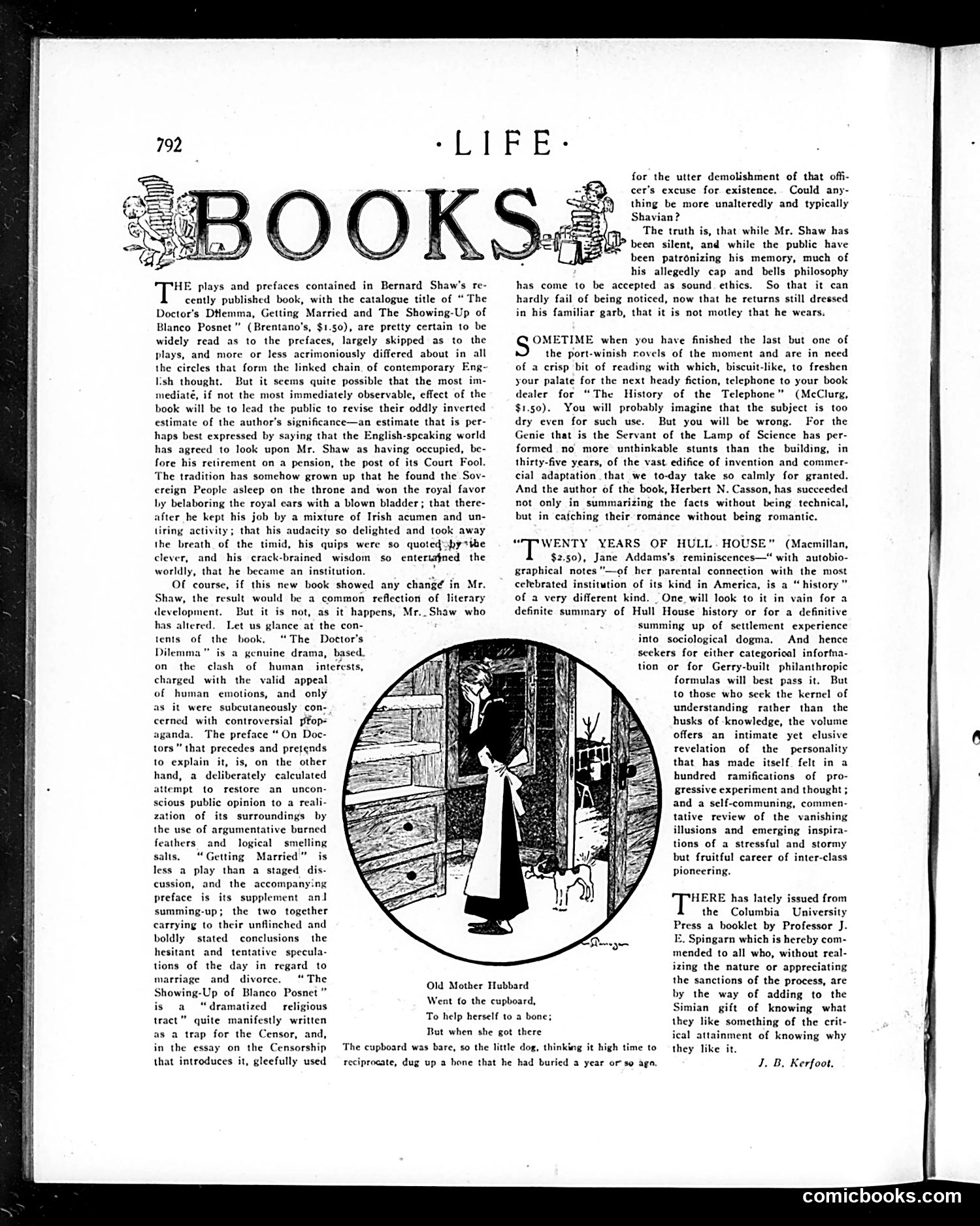
This page discusses Bernard Shaw's recently published book containing plays and prefaces. The key argument is a **reassessment of Shaw's significance**: while the English-speaking world has treated him as a "Court Fool"—a witty entertainer whose clever quips distract rather than instruct—his actual work reveals serious philosophical and ethical content. The article contends that Shaw hasn't changed; rather, public opinion has caught up. Ideas Shaw advocated (on marriage, divorce, censorship) that were once controversial are now becoming accepted as "sound ethics." Therefore, his familiar satirical style now carries genuine intellectual weight rather than mere entertainment. The small illustration of "Old Mother Hubbard" is a visual pun: the dog reciprocates by digging up a bone—suggesting Shaw himself is now reciprocating society's earlier patronizing dismissal by proving his serious merit. The piece essentially argues for Shaw's rehabilitation as a serious thinker, not merely a clever performer.
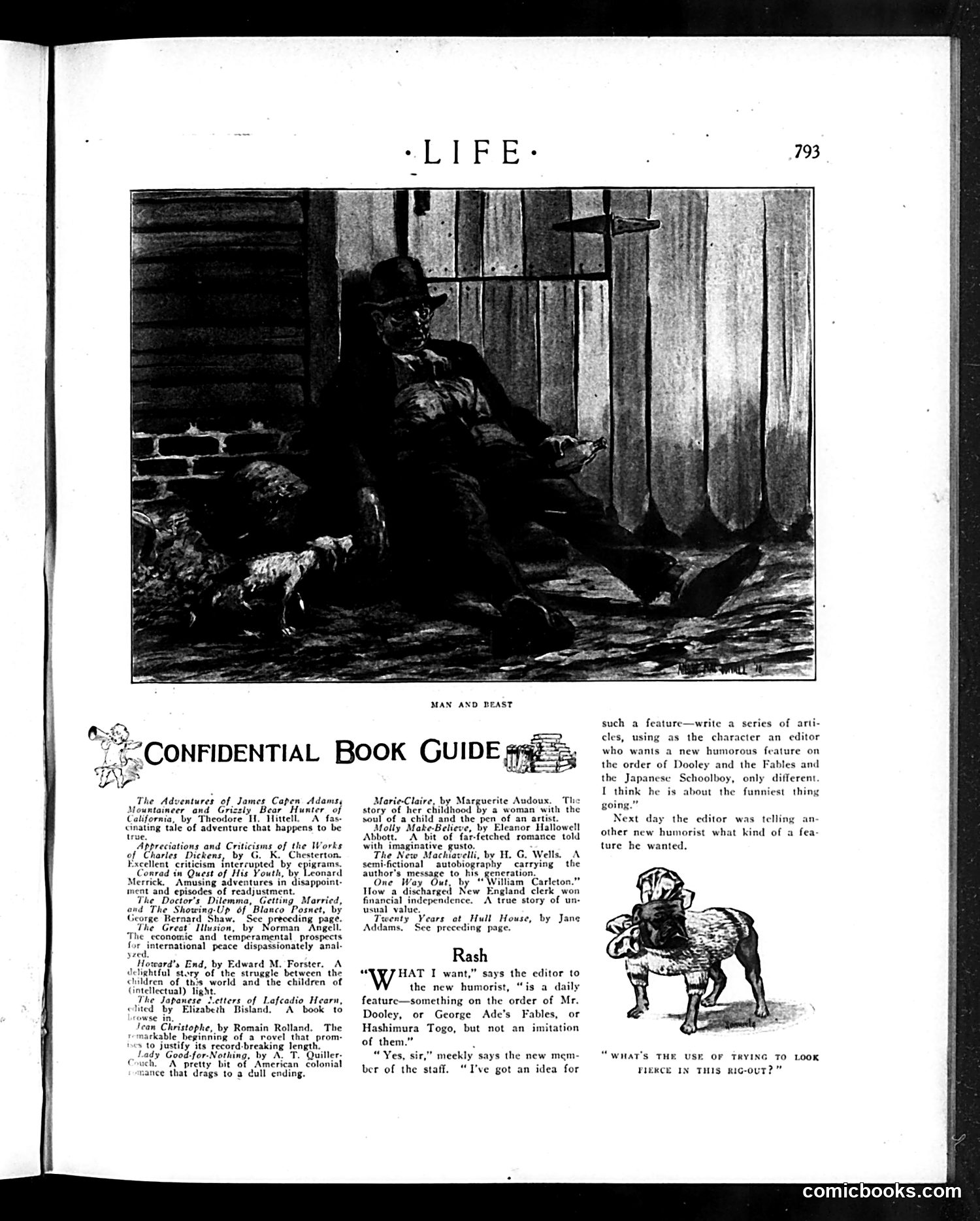
This page from *Life* magazine contains a book review section and a brief satirical dialogue about humor writing. The main cartoon depicts a conversation between an editor and a new staff humorist. The editor requests a daily humorous column modeled after popular contemporary features like Mr. Dooley (a famous satirical character) or George Ade's Fables. The new writer eagerly agrees, then proposes writing about an editor seeking a humorous column—essentially offering to write about the exact conversation happening between them. The satire's point: **circular imitation**. The joke mocks the publishing industry's reliance on derivative content and formulaic humor. Rather than creating something original, the new writer simply proposes recycling the editor's own request as material, mirroring the editor's complaint that he doesn't want "an imitation" of existing popular features—yet that's precisely what gets offered back to him. The accompanying illustration of a disheveled figure humorously captions this irony about the difficulty of appearing authoritative when discussing such absurd creative circumstances.
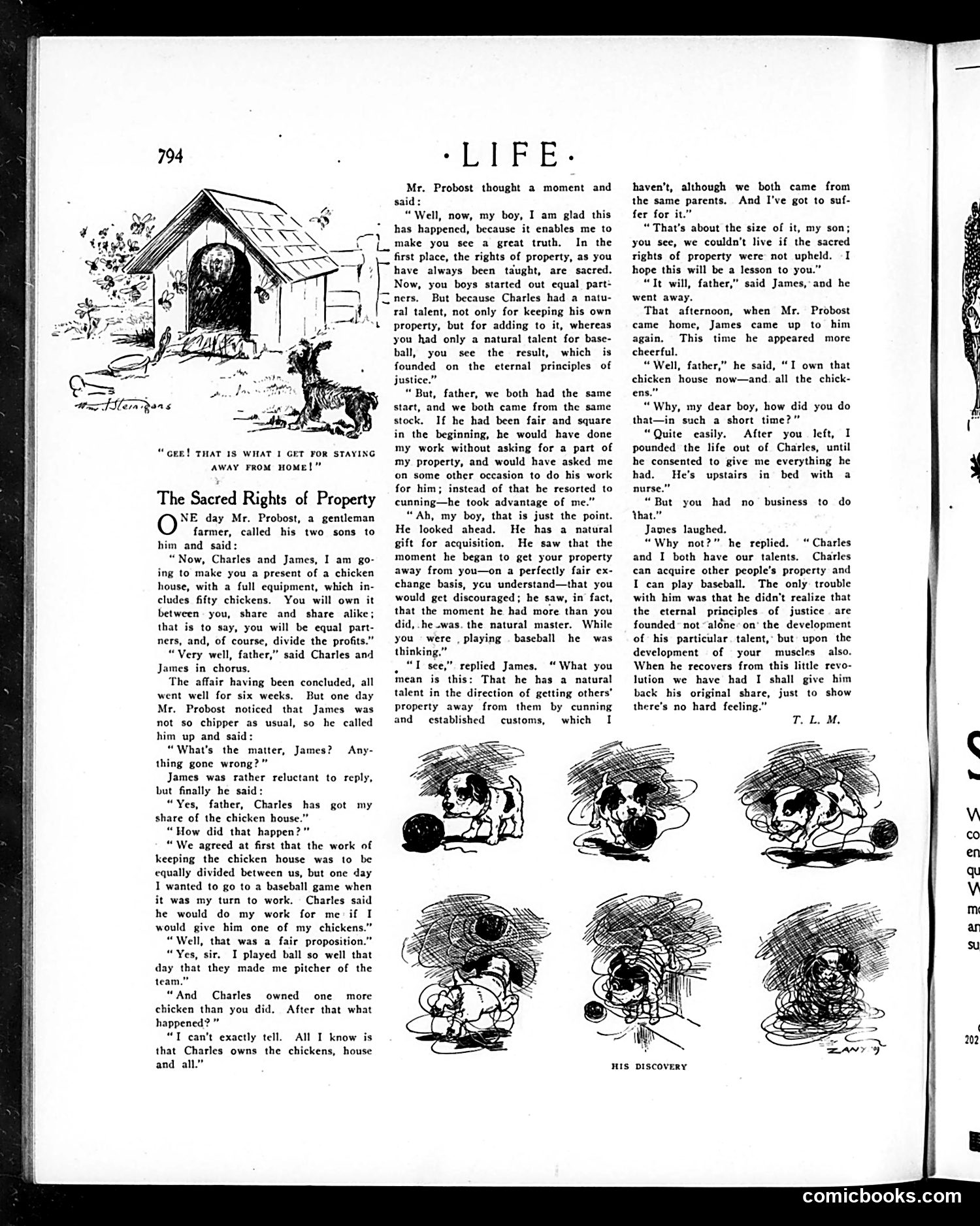
This satirical story critiques laissez-faire capitalism and the doctrine of property rights through a parable about two sons managing a chicken house. **The Setup**: Father Probost gives sons Charles and James equal shares in a chicken farm. Charles, naturally talented at acquiring property, gradually convinces James to trade away his chickens (fairly, by stated rules) to help with baseball. Charles ends up owning everything. **The Satire**: When James protests the unfairness, his father delivers a mock-serious lecture justifying Charles's dominance as natural law—that those with talent for acquisition deserve to accumulate wealth, that cunning is legitimate within "established customs." **The Punchline**: James responds by *beating Charles unconscious* and taking everything back. The father then protests—claiming James "had no business" using force—exposing the hypocrisy: property acquisition through cunning is celebrated as justice, but redistribution through violence is condemned as illegitimate. The cartoon mocks how industrial-era wealthy justified inequality as natural and inevitable, while society's rules protected their advantage.
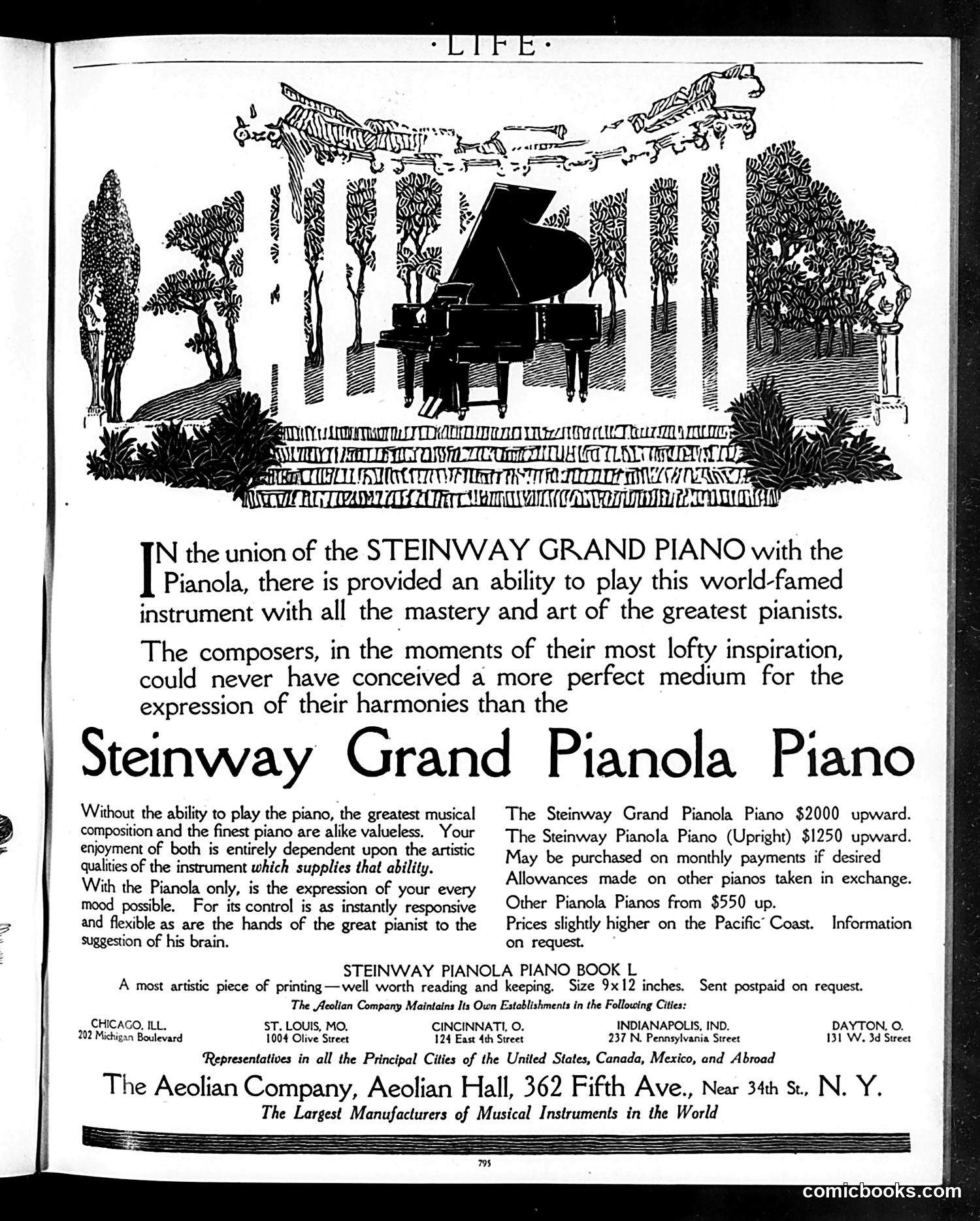
This is a **commercial advertisement**, not political satire. The page promotes the Steinway Grand Pianola Piano—a player piano (mechanical piano) made by combining Steinway's renowned pianos with Pianola technology. The illustration depicts an idealized scene: a grand piano in a garden setting with a figure at the keyboard, surrounded by trees and pastoral imagery. **The sales pitch**: The Pianola mechanism allows anyone to play a Steinway "with all the mastery and art of the greatest pianists," eliminating the need for actual musical training. The ad emphasizes that composition and fine instruments are worthless without performance ability—a problem this product solves. **Pricing**: Grand model ($2000+), upright ($1250+), or cheaper Pianola pianos ($550+). The Aeolian Company lists offices across major U.S. cities. The tone is aspirational: democratizing access to "greatest pianists'" artistry for wealthy consumers who lack musical skill.
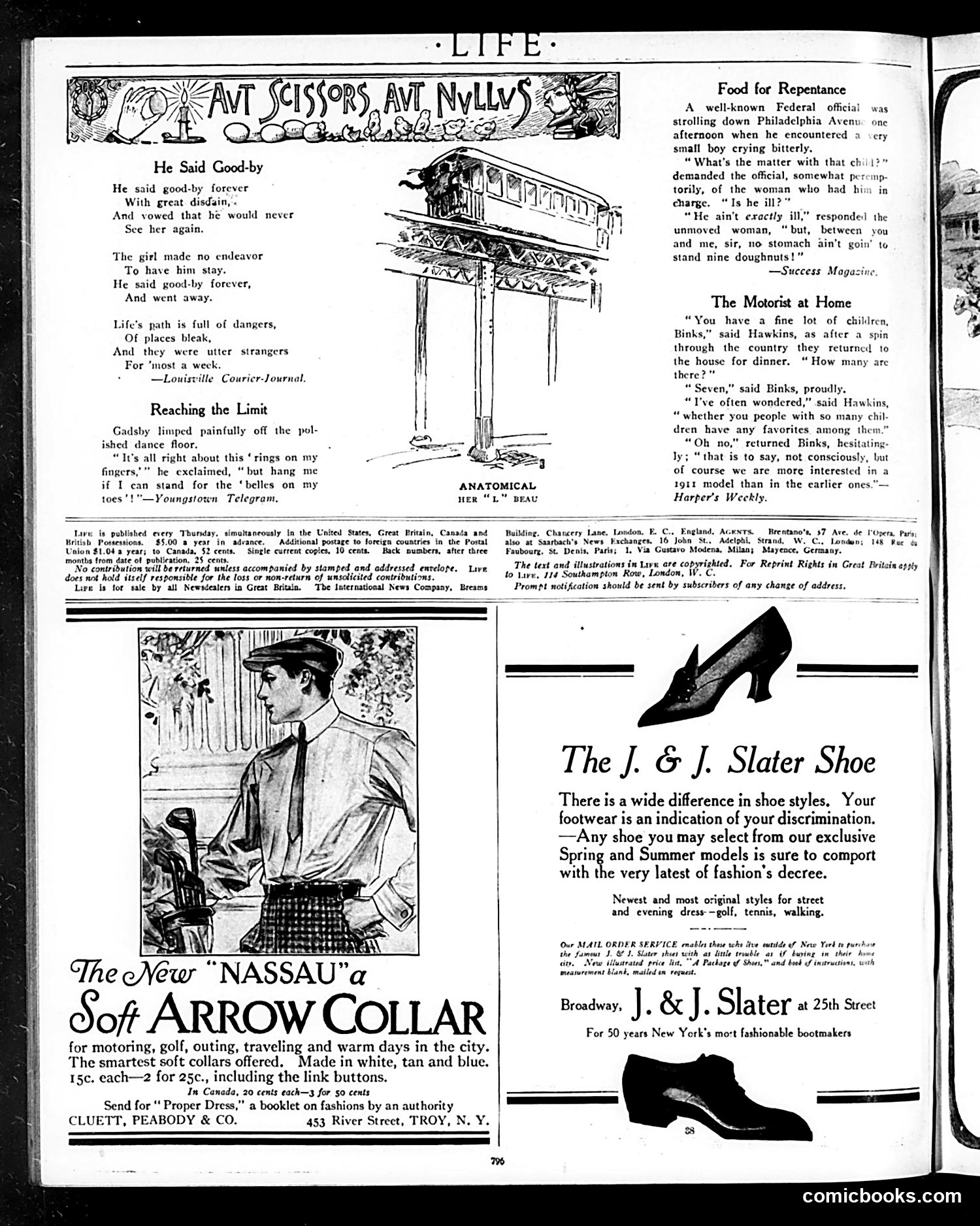
This page from Life magazine contains several brief humorous anecdotes typical of the publication's satirical style, plus period advertisements. **The humor pieces mock social pretension and physical discomfort:** "Food for Repentance" jokes about a child's stomach unable to handle nine doughnuts—likely satirizing excess consumption or the gap between official dignity and bodily reality. "Reaching the Limit" references a man limping after dancing, complaining about "rings on my fingers" and "belles on my toes"—a pun on physical pain from jewelry or tight footwear worn while dancing. "The Motorist at Home" features a motorist noting he's more "interested in a 1911 model" car than earlier ones—a joke equating cars with women or romantic interests, reflecting period automobile enthusiasm. **The advertisements** promote the Arrow Collar and J. & J. Slater Shoes, targeting affluent male consumers concerned with fashionable appearance for motoring, golf, and social occasions. The messaging emphasizes discrimination, taste, and style as status markers. The overall tone reflects early-1910s genteel humor and consumer culture.
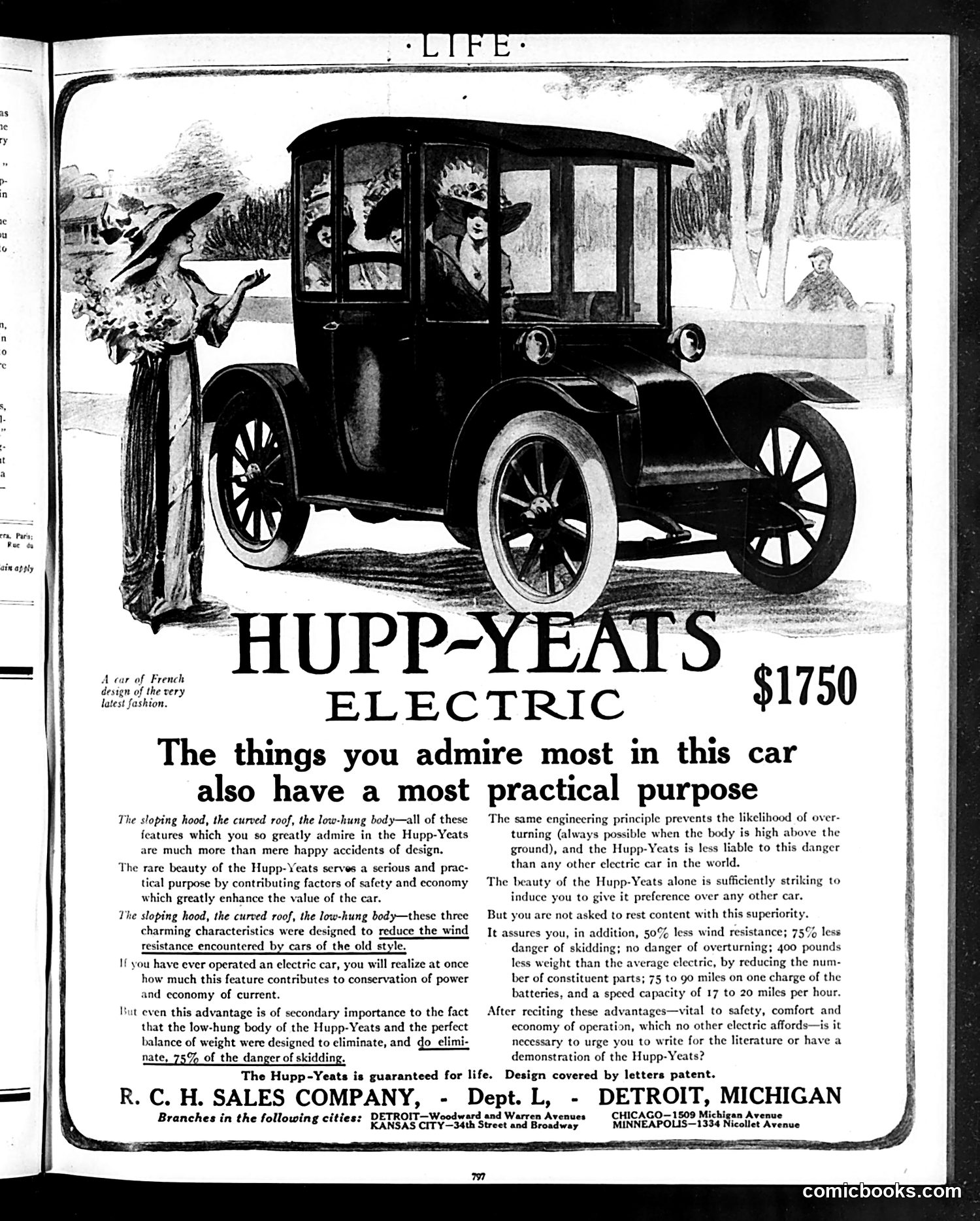
This is primarily a **automobile advertisement**, not political satire. The page promotes the Hupp-Yeats Electric car ($1,750) manufactured by R.C.H. Sales Company in Detroit. The illustration shows a fashionably dressed woman in a large hat admiring the vehicle, with the caption noting it has "French design of the very latest fashion"—appealing to early 20th-century consumers who associated French style with sophistication. The advertisement's humor is subtle: it claims the car's aesthetically pleasing features (sloping hood, curved roof, low body) are actually engineered for practical safety and efficiency—reducing wind resistance by 50%, skidding danger by 75%, and enabling 75-90 miles per battery charge. The joke undercuts itself: consumers attracted by beauty discover they're also getting superior engineering and safety. This was a common advertising strategy for electric vehicles, which faced competition from gasoline cars and needed to justify their higher cost through claimed advantages.
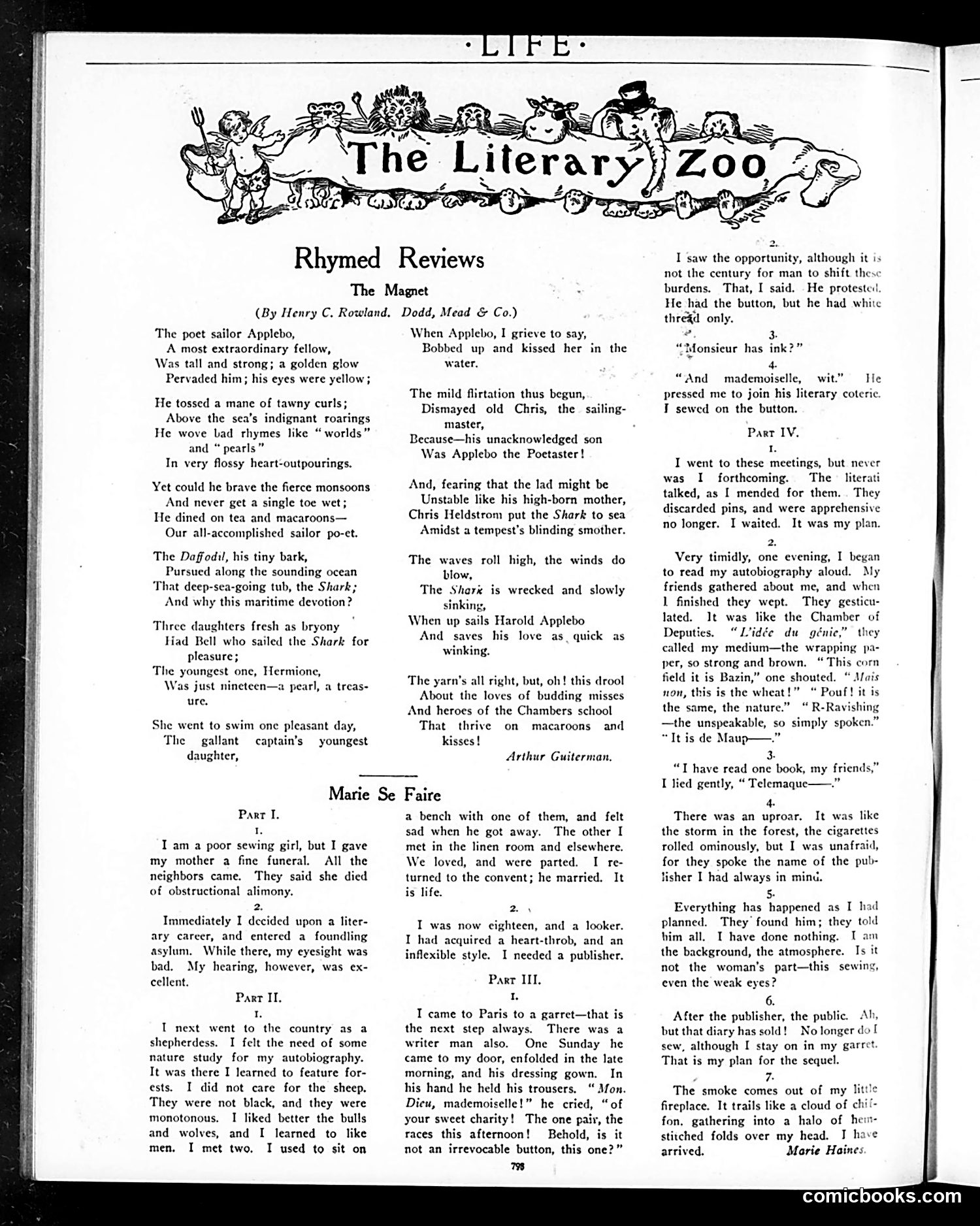
This page from *Life* magazine contains two satirical pieces mocking literary pretension and romantic melodrama popular in early 20th-century fiction. **"The Magnet"** (by Henry C. Rowland) ridicules sentimental sea adventure novels. It parodies the implausible hero "Applebo"—a yellow-eyed, golden sailor-poet who writes overwrought verse ("worlds" / "pearls") yet impossibly rescues his love while remaining dry. Arthur Guiterman's concluding commentary directly mocks the genre's clichés: romantic heroes, "budding misses," and unrealistic adventure tropes that appeal to naive readers. **"Marie Se Faire"** satirizes pretentious women's autobiographical fiction. The narrator is a stereotypical struggling-artist-turned-author who moves through predictable narrative beats: poverty, rural "nature study," romantic disappointment, and finally Parisian garret life. The joke culminates when her emotional autobiography—delivered to a literary coterie—produces theatrical weeping, mocking both the overwrought emotional style and the pretentiousness of Bohemian literary circles who mistake sentiment for genuine genius. Both pieces target the formulaic sentimentality dominating popular literature of the era.
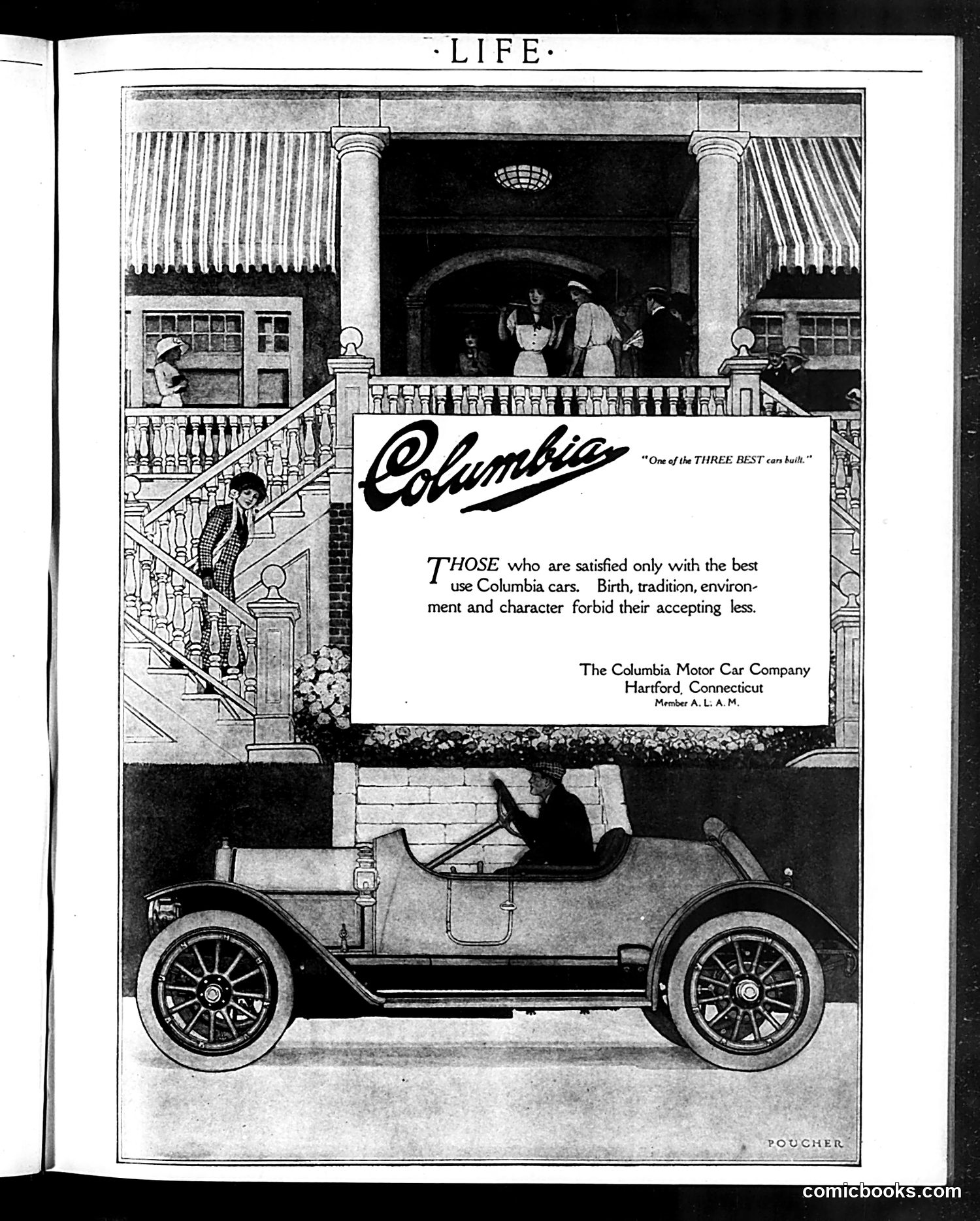
This is primarily a **product advertisement** for Columbia automobiles, not political satire. The page features: **Upper section:** An illustration of an elegant mansion's interior with well-dressed figures, emphasizing luxury and sophistication. **Lower section:** A side-view of a Columbia motor car with a driver. **Message:** The ad's tagline—"One of the THREE BEST cars built"—targets affluent consumers. The accompanying text states that discerning people "satisfied only with the best" choose Columbia cars because of their "birth, tradition, environment and character." This reflects early 1900s automotive marketing that sold cars as **status symbols** associated with wealth and social standing, rather than as practical transportation. The Columbia Motor Car Company was based in Hartford, Connecticut.
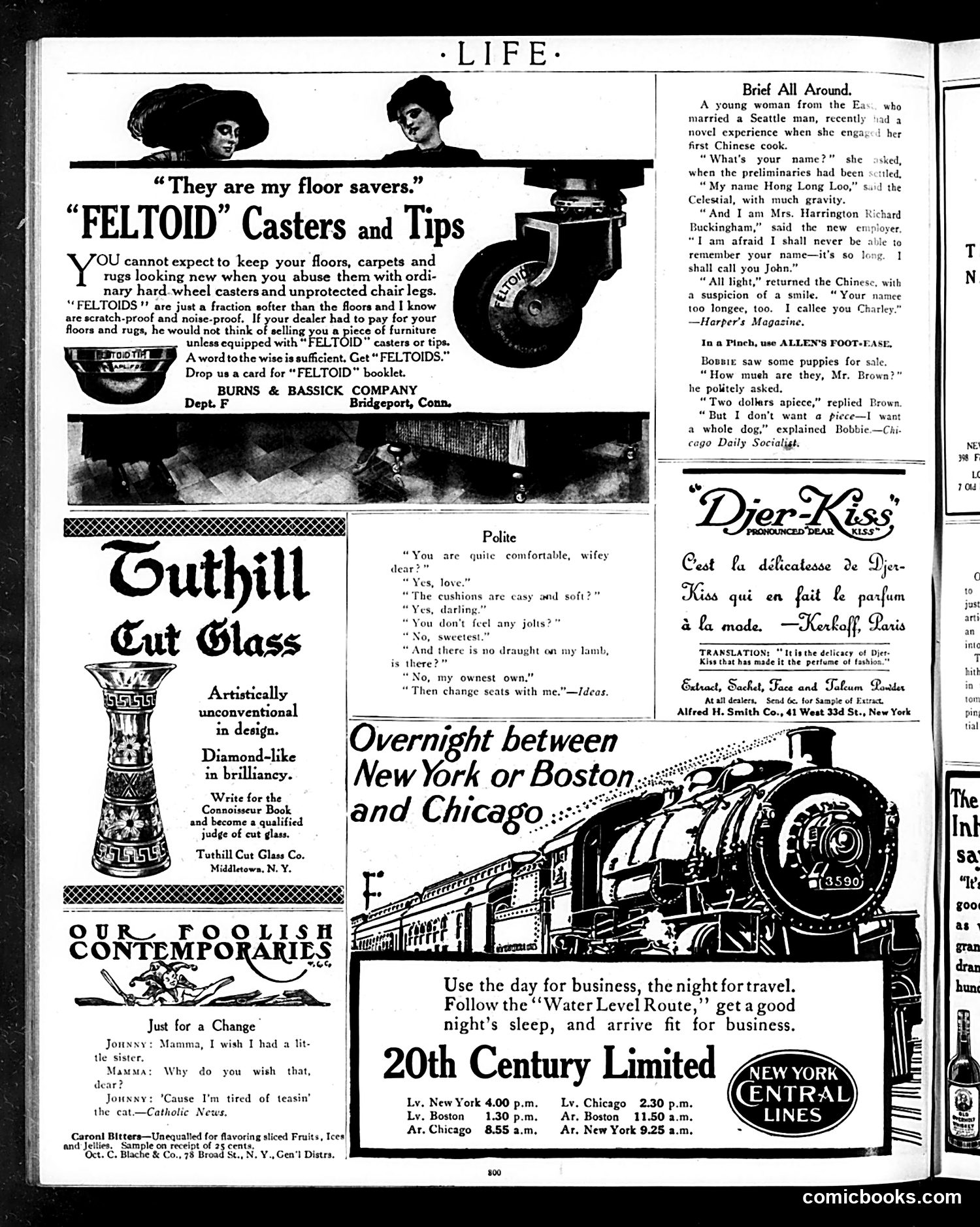
This page is primarily **advertising** with brief humorous filler content typical of early 20th-century Life magazine. The main advertisements include: - **"FELTOID" Casters**: Promotes furniture casters with felt tips to protect floors—the cartoon shows two women, one saying these casters are her "floor savers." - **Cuthill Cut Glass**: Ornamental glassware advertised as "artistically unconventional in design." - **20th Century Limited**: A New York Central railroad service emphasizing overnight travel between major cities. - **Dier-Kiss Perfume**: A French fragrance positioned as fashionable. The humorous filler includes brief jokes about naming a Chinese cook "John" for simplicity, a child wanting a whole dog rather than a "piece," and domestic banter about train comfort. These reflect casual period humor and casual racism typical of the era—treating non-English names and immigrant workers as sources of comedy. This is a standard commercial magazine page blending ads with light entertainment.
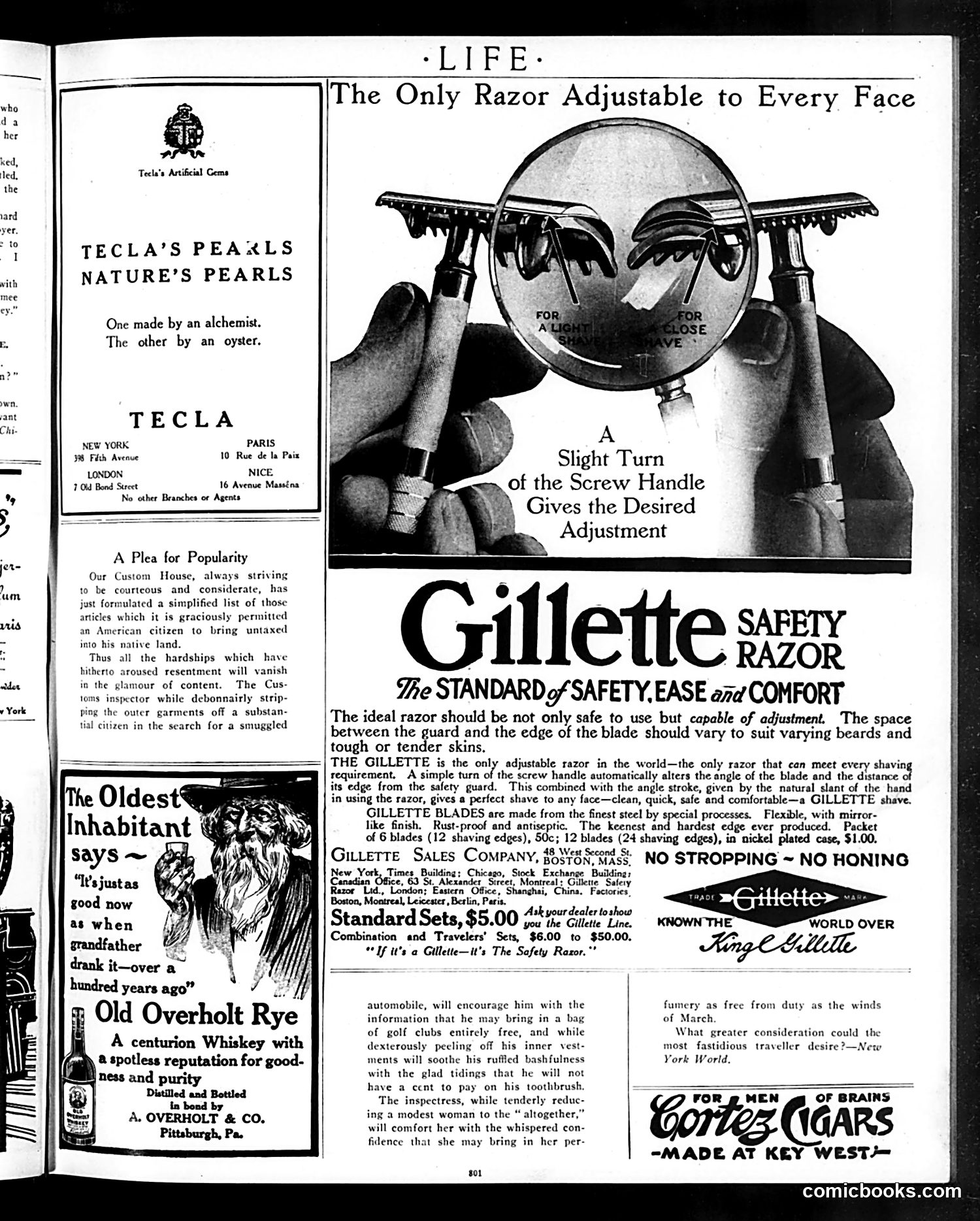
This page is primarily **advertising**, not satire or political commentary. The dominant content is a Gillette Safety Razor advertisement featuring an instructional image of a man using an adjustable razor with a mirror. The smaller ads include: - **Tecla's Pearls**: A luxury jeweler advertisement contrasting artificial and natural pearls - **Old Overholt Rye**: A whiskey advertisement featuring "the oldest inhabitant" (an elderly bearded man), using the humorous hook that the product was "good" a century ago - **Cortez Cigars**: A brief men's cigar advertisement There is a satirical section titled "A Plea for Popularity" mocking U.S. Customs inspectors, suggesting they strip-search travelers while pretending items are duty-free—commentary on customs procedures and corruption. The page reflects early 20th-century advertising conventions and consumer culture, with no apparent political cartoon or specific historical reference beyond general customs bureau critique.
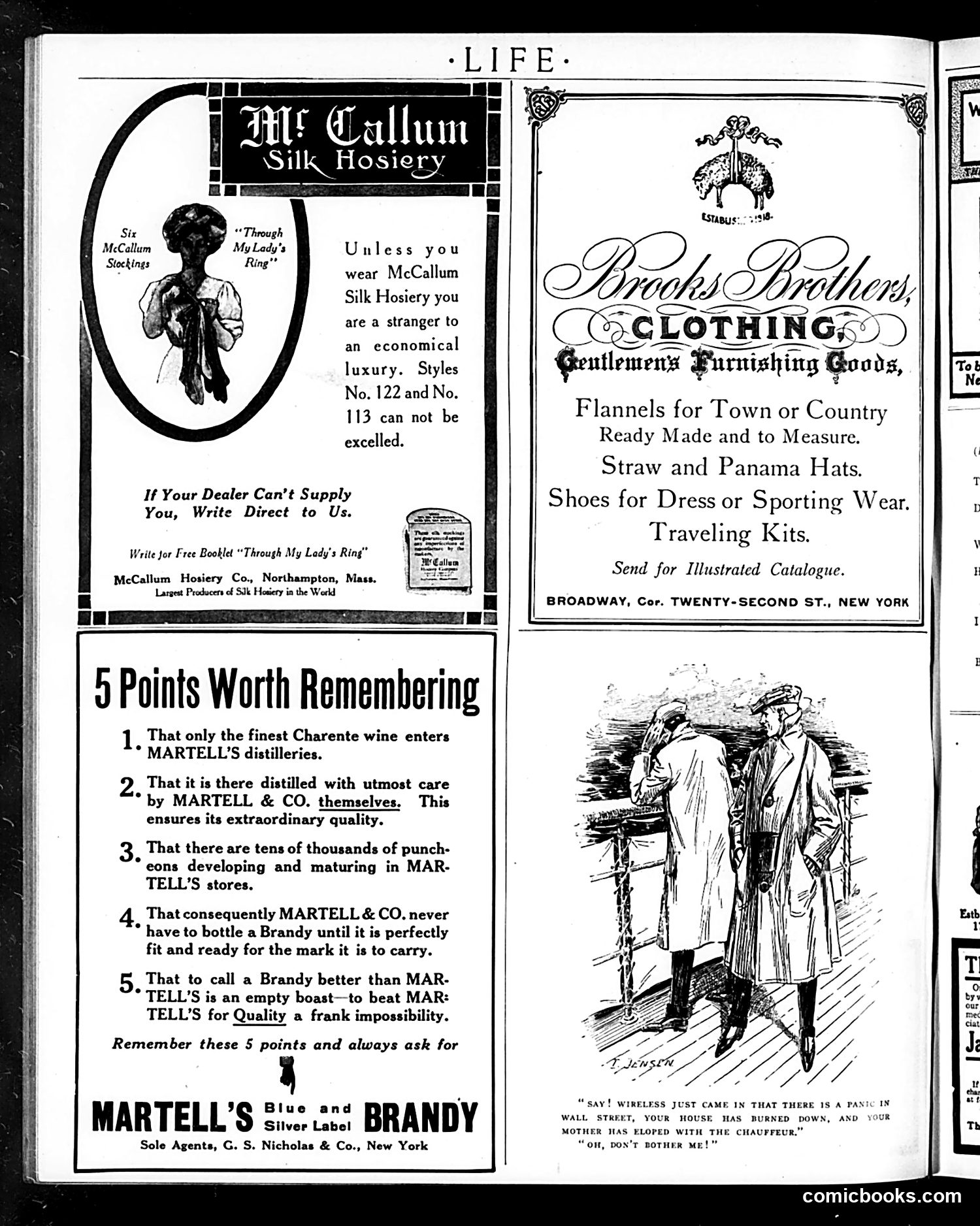
This page is primarily **advertising**, with one small cartoon at the bottom. The cartoon depicts two men receiving catastrophic news via wireless (early radio): a stock market panic, a house fire, and the narrator's mother eloping with the chauffeur. The man's dismissive response—"Oh, don't bother me!"—suggests he's absorbed in something so engaging he ignores disasters. The joke likely satirizes **obsession with wireless technology itself**—the irony being that despite this miraculous communication device delivering urgent information, the recipient finds the technology more captivating than actual emergencies. It pokes fun at the novelty and distraction of new media, a timely subject in the wireless/radio era. The advertisements for McCallum silk hosiery, Brooks Brothers clothing, and Martell's brandy represent typical early-20th-century luxury marketing targeted at affluent readers.
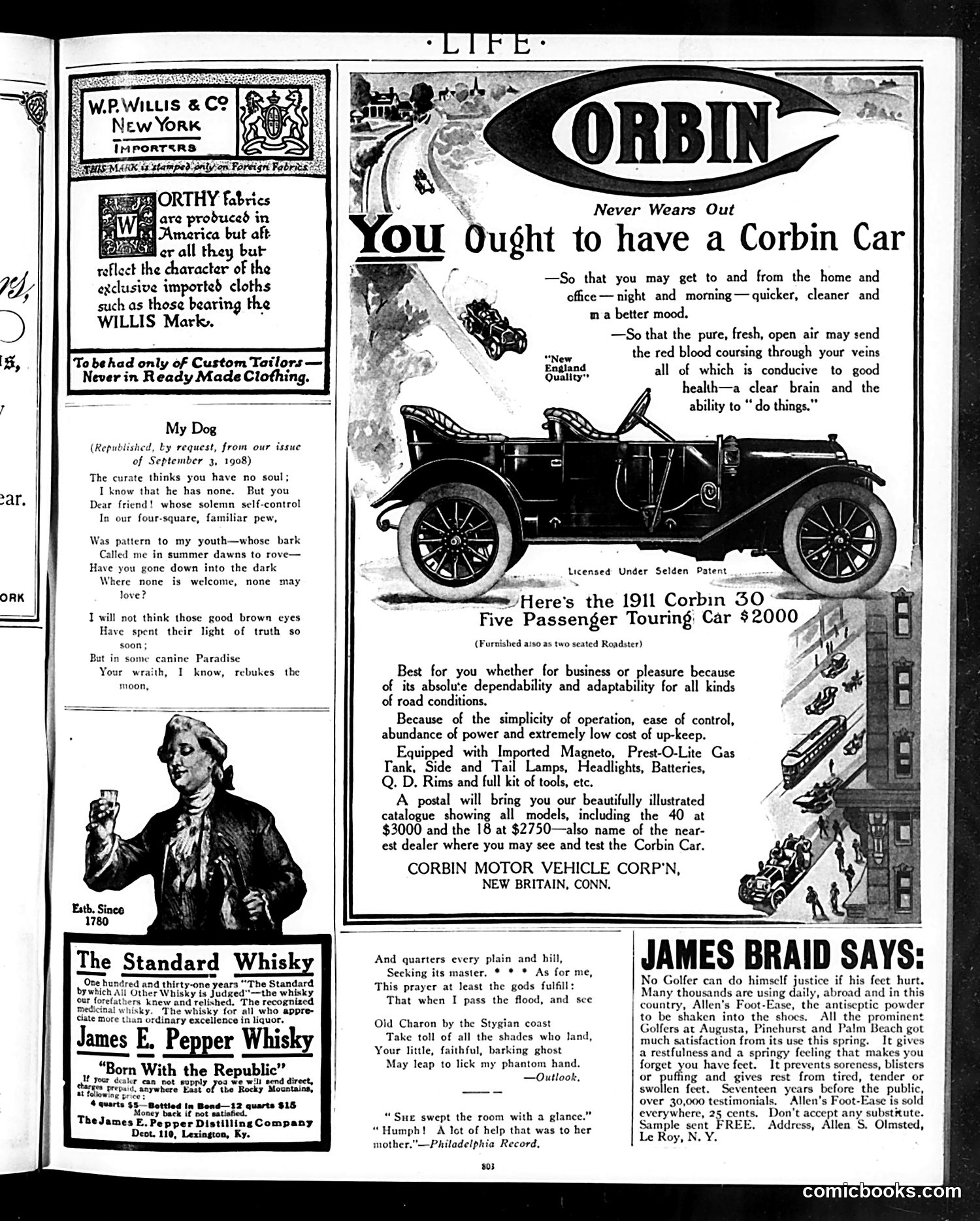
This page is primarily **advertising**, with minimal editorial content. The main advertisements are: **Corbin Motor Car** (center-right): A full-page advertisement for the 1911 Corbin 30 automobile ($2000), emphasizing reliability and health benefits—the "fresh, open air" and red blood coursing through veins reflect early 20th-century wellness marketing that positioned automobiles as health-promoting devices, not merely transportation. **Smaller ads include:** - W.P. Willis & Co. (luxury fabrics) - James E. Pepper Whisky ("Born With the Republic") - Allen's Foot-Ease (antiseptic powder for tired feet, endorsed by golfers) **Editorial content** is minimal: a republished poem "My Dog" (from 1908) about a deceased pet in metaphysical terms, and James Braid's endorsement of foot powder. The page reflects early 1910s advertising culture, where products were marketed with pseudo-scientific health claims and lifestyle aspirations rather than practical specifications. The automobile ad particularly exemplifies how cars were being repositioned from novelty to necessity.
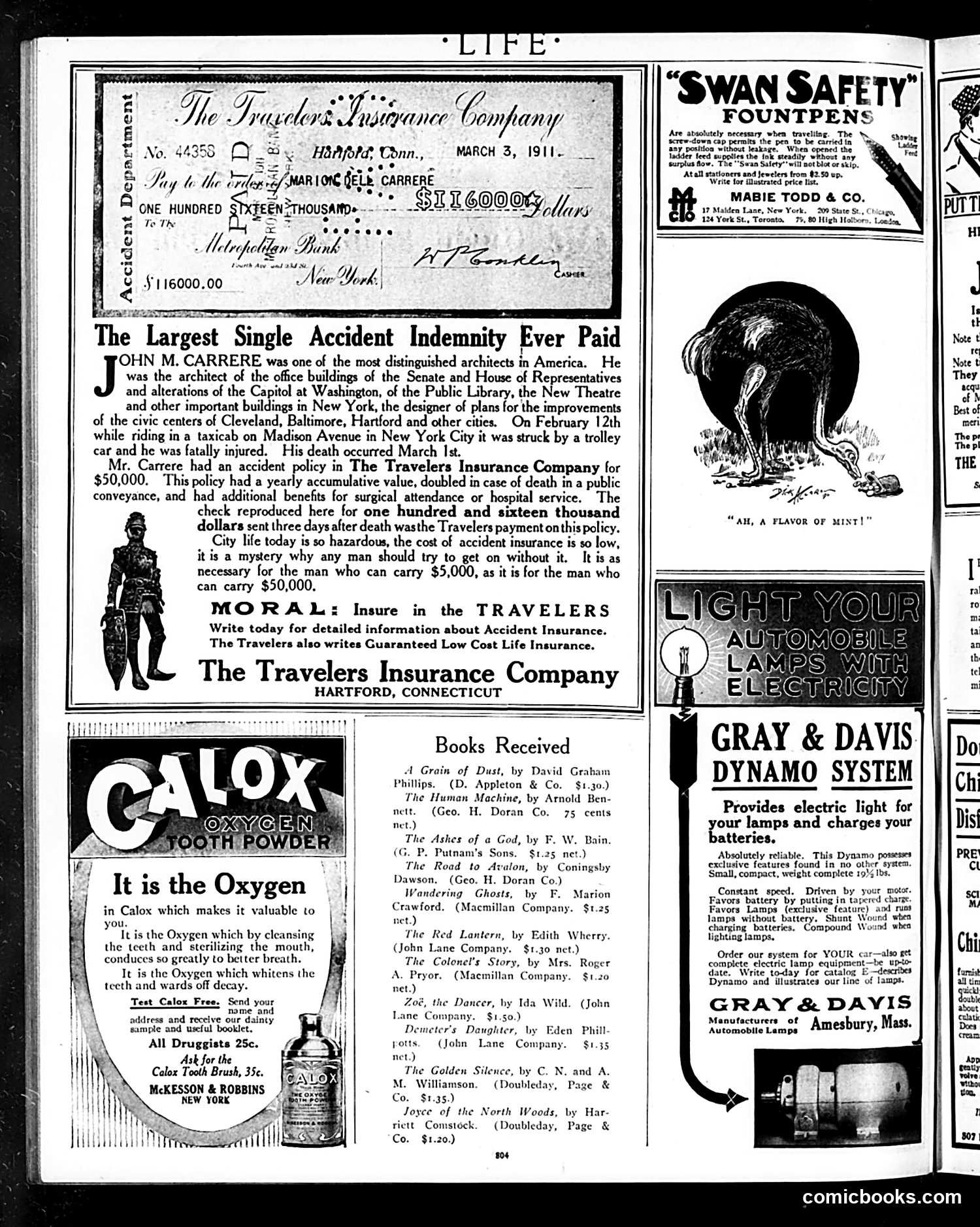
This page primarily features **insurance advertising disguised as news**, not political satire. The dominant article promotes The Travelers Insurance Company by highlighting architect John M. Carrere's fatal 1911 taxicab accident in New York City. The narrative argues that because Carrere—despite his wealth and prominence—died in a public conveyance accident, his $50,000 insurance policy paid out $116,000 due to accumulative benefits and doubling clauses for public accidents. The implicit message: even distinguished, successful men face urban hazards (taxicabs, trolleys), making accident insurance essential. The accompanying advertisements (Calox Oxygen Toothpowder, Swan Safety Fountain Pens, Gray & Davis Dynamo System) reflect early 20th-century consumer goods marketed to middle-class readers. Rather than satire, this represents **Life magazine's commercial function**: selling readers both products and the ideology that modern urban life requires constant protective purchases.
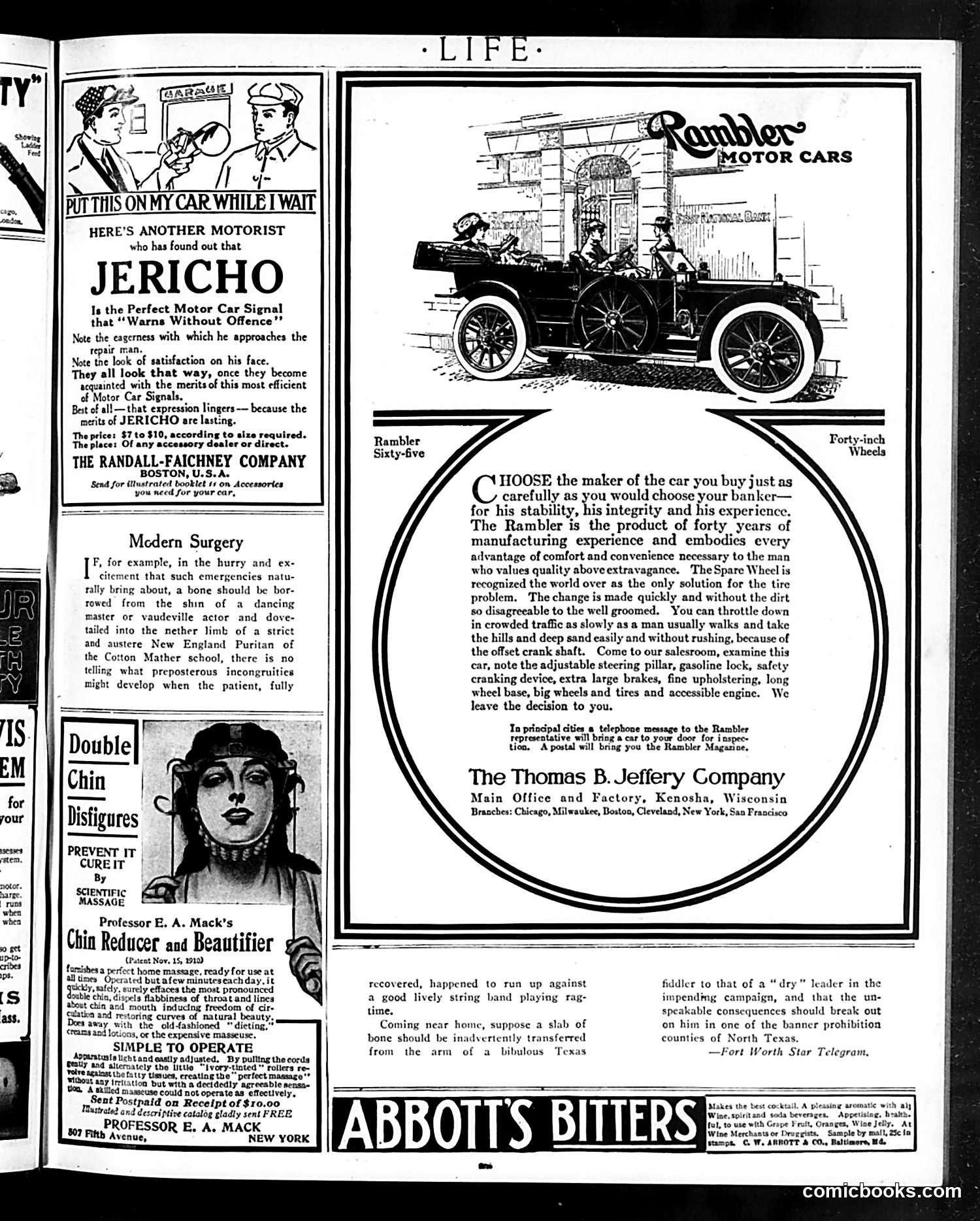
This page contains **advertisements and satirical content** typical of early 1900s Life magazine. The political/social elements: **"Modern Surgery" satire:** A mock-serious piece describing absurd medical transplants (borrowing bones from a dancing master's shin to graft onto a Puritan's leg). This satirizes contemporary surgical enthusiasm and the pretensions of medical "science"—poking fun at doctors experimenting beyond reasonable bounds. **Automobile ads:** The Jericho motor car signal, Rambler, and Thomas B. Jeffery Company ads occupy substantial space, reflecting early automotive culture's status-conscious buyers. **"Chin Reducer" advertisement:** A dubious beauty device marketed via pseudo-scientific claims, typical of era's unregulated health-product marketing targeting insecurity. **Abbott's Bitters ad:** A patent medicine advertisement—products like these often contained alcohol and made exaggerated health claims. The page exemplifies Life's dual purpose: satirizing contemporary American pretensions (medical quackery, consumer culture) while profiting from the very industries being mocked through advertisements.
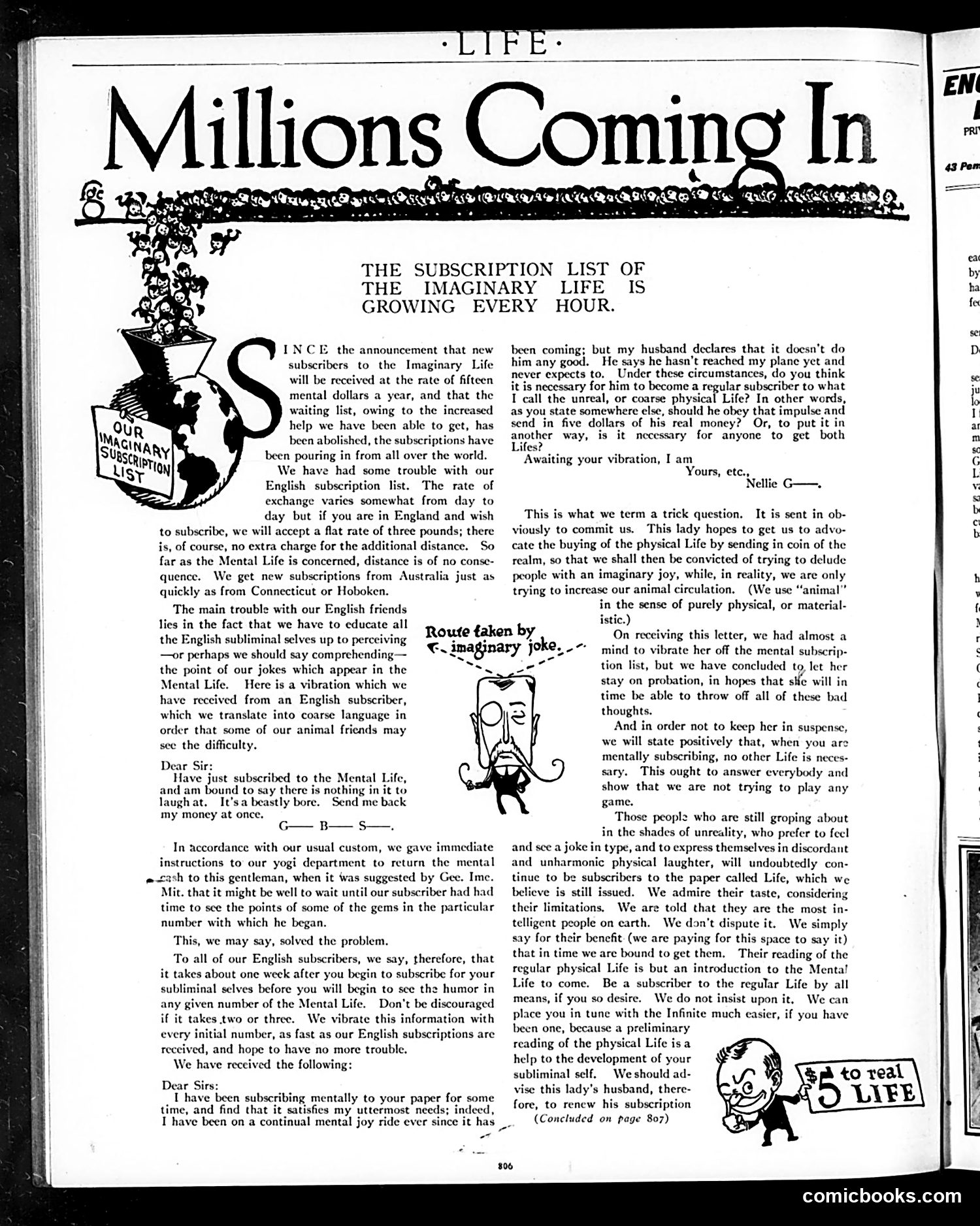
This page satirizes a rival publication called "Mental Life"—apparently a pseudo-spiritual magazine promising subscribers access to higher consciousness or "subliminal" enlightenment through paid mental subscriptions. The satire works through mock letters: an English subscriber complains the publication isn't funny and demands his money back. Life's editors respond that English subscribers need a week to develop the mental capacity to *understand* the jokes. A second letter from a woman describes her husband's resistance to the expensive "mental" subscription, asking if it's necessary. Life's editors mock both the publication and gullible subscribers by suggesting that reading their physical magazine is merely a "preliminary" to the real Mental Life—implying the whole scheme is absurd nonsense designed to separate fools from money. The cartoon mocks the pretentious spiritualism and pseudo-scientific "vibration" language popular in that era. The satire targets credulous readers willing to pay for intangible mental/spiritual benefits.
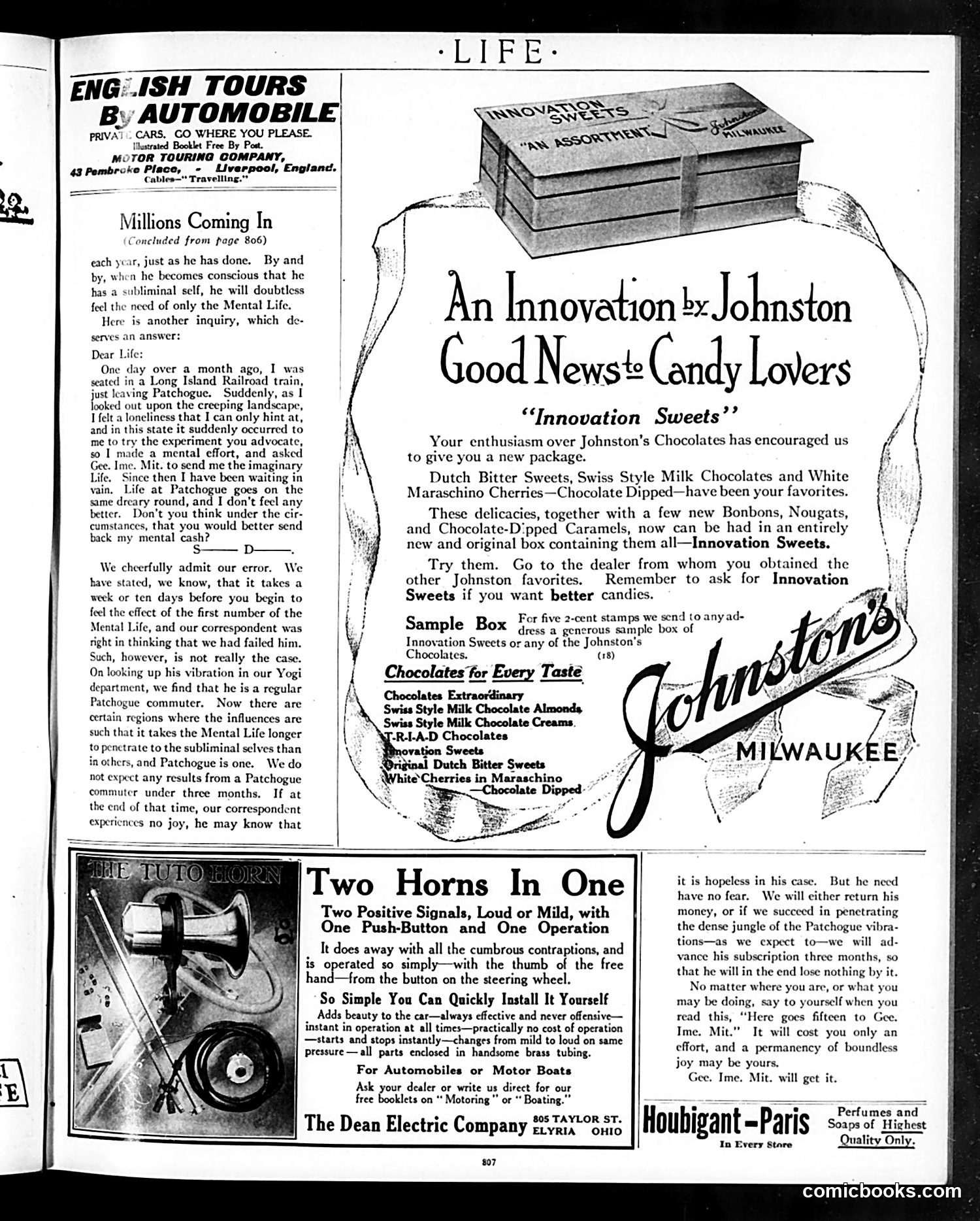
This page mixes satirical content with period advertisements (circa 1910s-1920s). **Main Satire ("Millions Coming In"):** Life magazine responds to a reader's complaint about their "Mental Life" subscription service—an apparent Yogi/spirituality mail product. The reader paid for mental rejuvenation but felt nothing after one month. Life blames the reader's location (Patchogue, Long Island) for having poor "vibrations," claiming he needs three months instead. The satire targets both pseudoscientific self-help schemes and magazine subscription scams of the era, mocking the mystical language used to excuse product failure. **Advertisements:** Include Johnston's candy ("Innovation Sweets"), English automobile tours, a car horn device, and Houbigant-Paris perfumes—typical consumer products of the period. The humor relies on readers recognizing the absurdity of blaming geography for spiritual failure and the proliferation of dubious mail-order wellness products marketed through magazines.
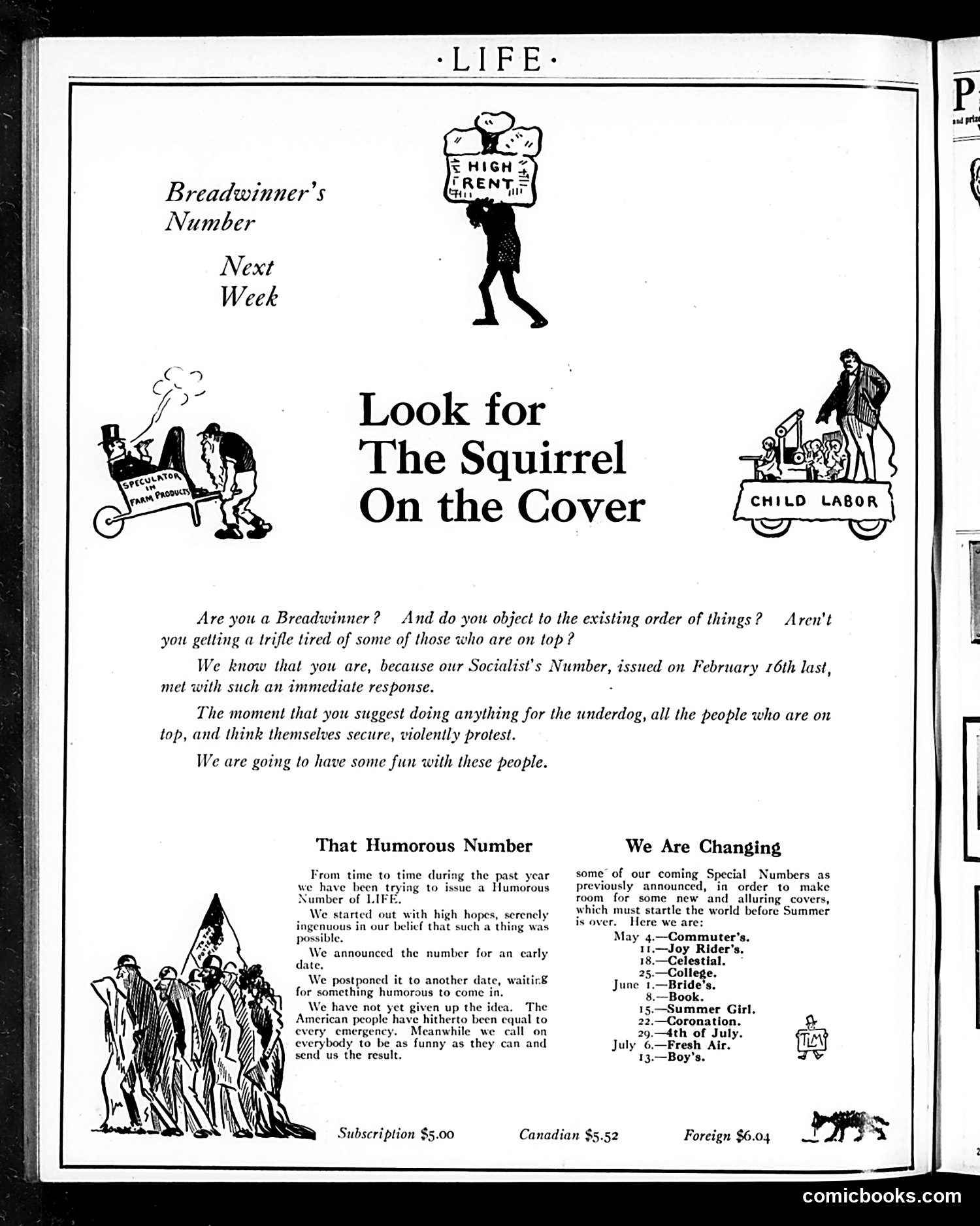
This is a masthead/editorial page announcing upcoming issues. The central message targets "Breadwinners"—working-class readers—asking if they're tired of those "on top" and object to the existing social order. Life references its recent "Socialist's Number" (February 16th), which apparently generated strong backlash from the established classes, who "violently protest" any suggestion of helping "the underdog." The page announces Life's struggle to produce a "Humorous Number," humorously admitting repeated postponements while awaiting funny submissions from readers. It also lists upcoming special-issue covers (Commuter's, Joy Rider's, Bride's, Summer Girl, etc.). The satirical cartoons—including figures labeled "High Rent," "Speculation," and "Child Labor"—mock entrenched social problems. The overall tone is muckraking: Life positions itself as willing to challenge the status quo and invite readers to do the same, while gently ribbing its own editorial challenges.
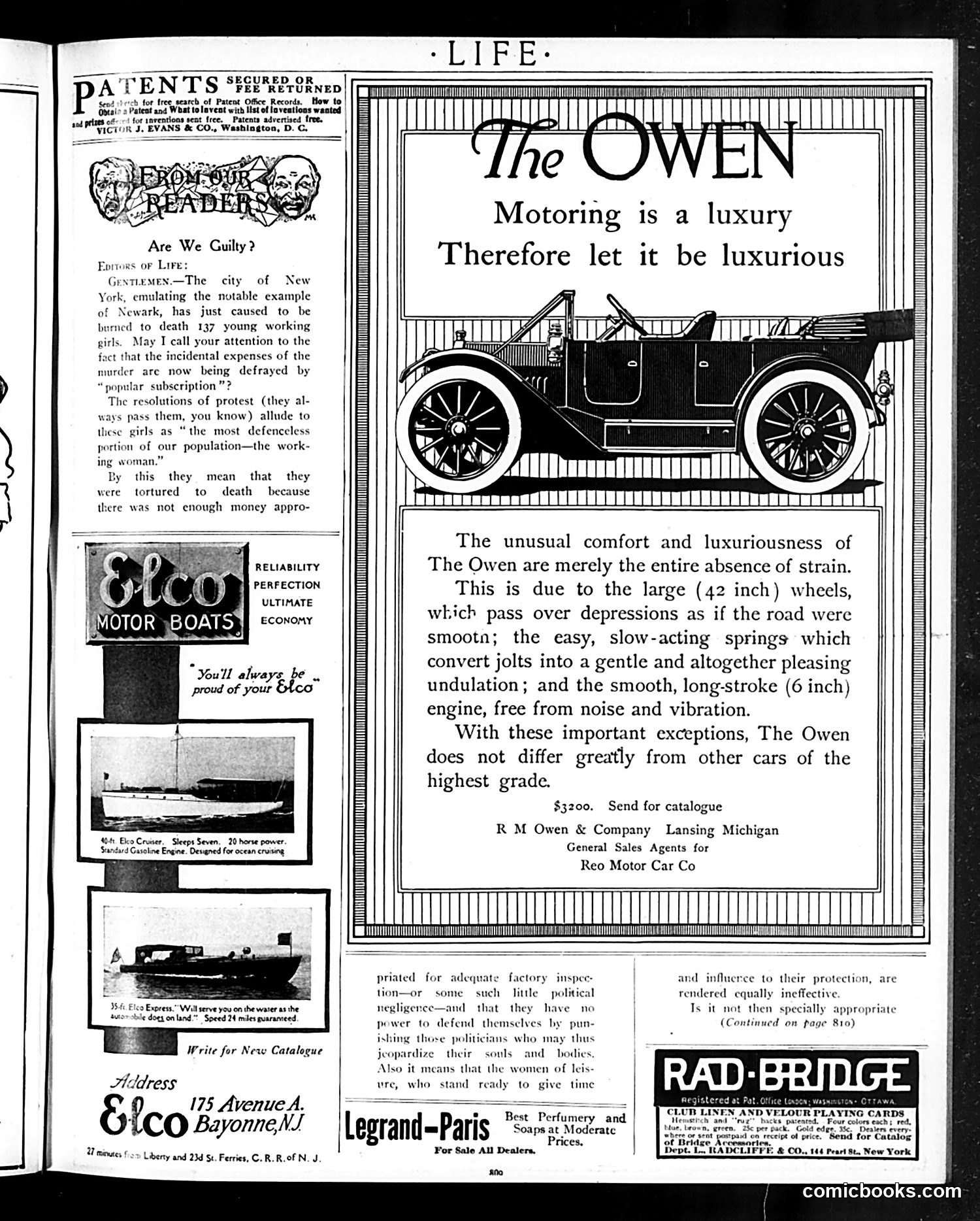
This page is primarily **advertisements** for automobiles and motorboats, with one notable editorial letter. The main content is a satirical letter titled "Are We Guilty?" responding to factory fires in New York and Newark that killed young working women. The author criticizes the hypocrisy of calling these victims "the most defenceless portion of our population" while: 1. Allowing their deaths through inadequate factory inspection 2. Funding the "expenses of murder" through "popular subscription" (implying complicity) 3. Passing meaningless protest resolutions 4. Leaving working women powerless to punish negligent politicians 5. Having wealthy women ("women of leisure") offer only ineffective sympathy The satire's point: society acknowledges workers' vulnerability yet does nothing structural to protect them—offering sentiment instead of reform. The advertisements ironically juxtapose this critique: luxury cars and motorboats emphasize comfort and safety for the wealthy while the letter condemns indifference to working women's preventable deaths.
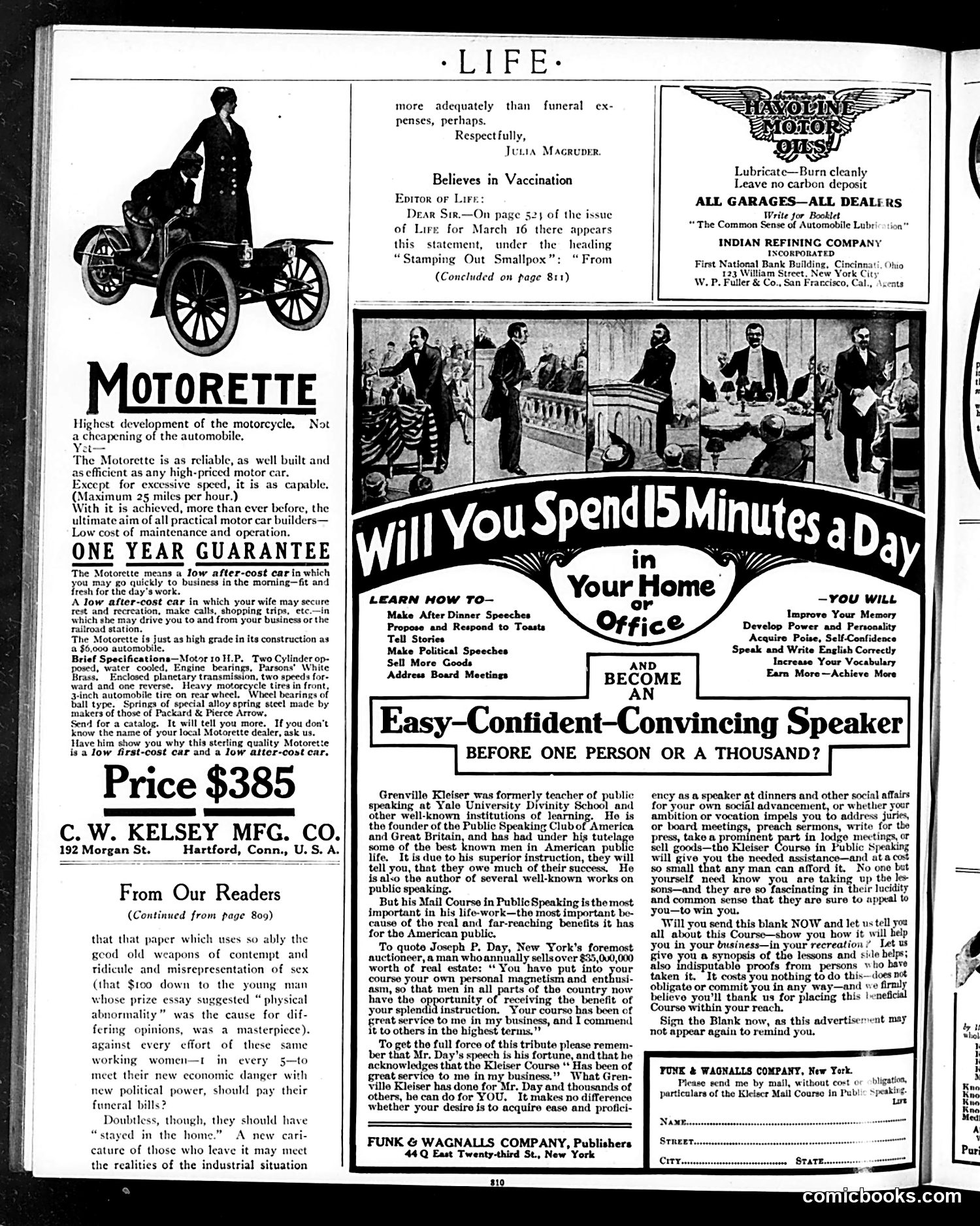
This page mixes advertisements with reader letters addressing social issues. **The Main Advertisement** features the "Motorette," an early motorcycle/motorcar priced at $385—marketed as affordable, reliable transportation for both business commuters and wives making social calls. It represents the early automotive boom and changing gender roles (women driving). **Reader Letters** discuss two topics: 1. **Women's Economic Power**: A letter from "Julia Maguder" critiques Life's previous mockery of working women seeking political power. She argues the magazine unfairly used "contempt and ridicule" against women entering the workforce, sarcastically questioning why such publications should avoid paying "funeral bills" while opposing women's economic independence. This reflects early 20th-century debates over women's suffrage and workplace participation. 2. **Vaccination**: Another reader references a Life article about smallpox prevention (details unclear from visible text). **The large advertisement** promotes Grenville Kleiser's mail course in public speaking, targeting business professionals who need confidence in sales pitches, political speeches, and formal presentations.
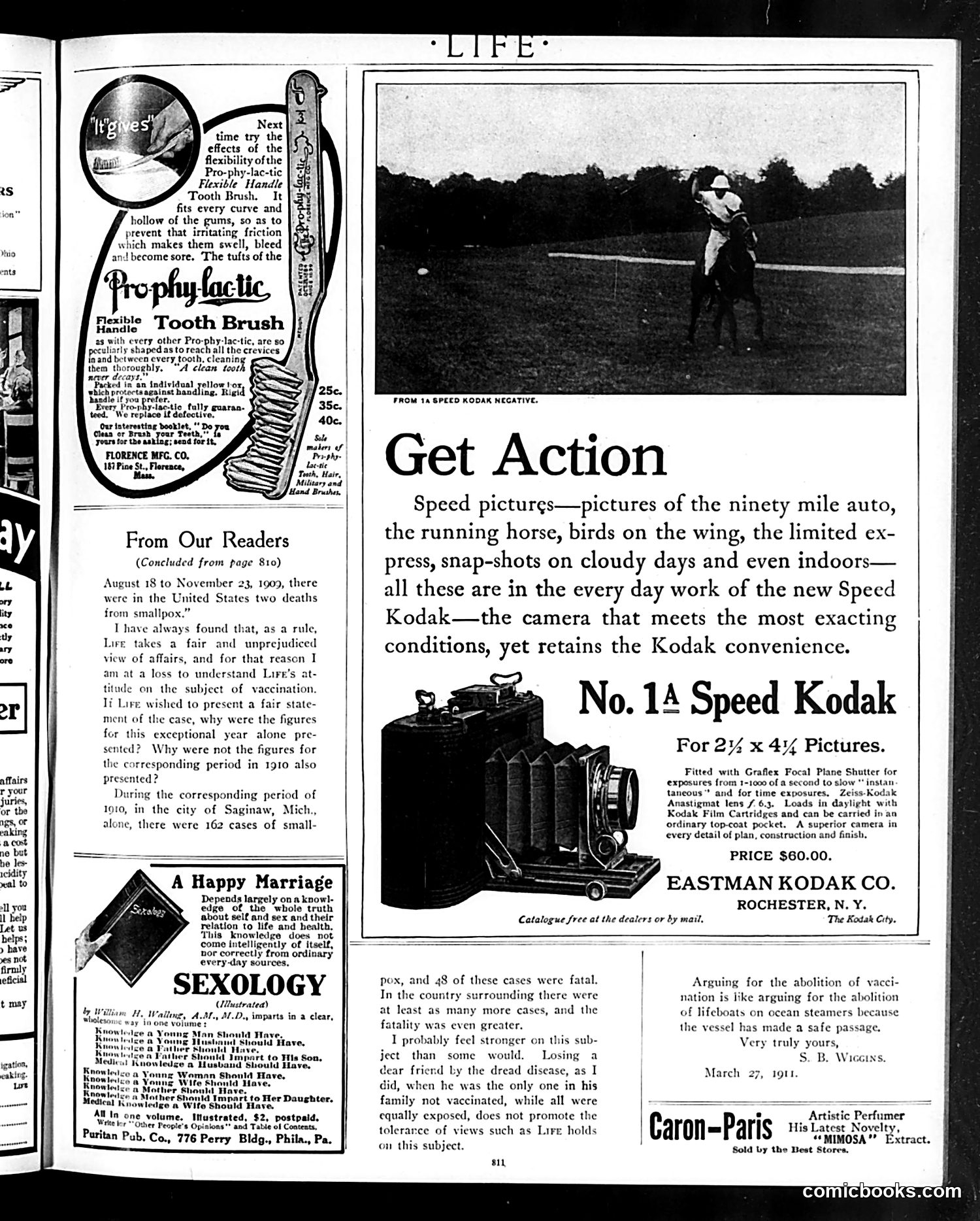
This page is primarily **advertising and reader correspondence**, not political satire. The main content includes: 1. **Pro-phy-lac-tic Toothbrush ad** - A product advertisement emphasizing the brush's flexible handle design to prevent gum irritation and bleeding. 2. **"From Our Readers" section** - A debate about **vaccination policy**. A reader criticizes Life magazine for presenting selective smallpox death statistics (only from 1909, an "exceptional year") without comparing 1910 data. Another reader defends vaccination, describing a personal loss to smallpox in an unvaccinated family member, while acknowledging anti-vaccination sentiment exists. 3. **Speed Kodak camera ad** - Promoting the No. 1A Speed Kodak for action photography. 4. **Sexology book advertisement** - Promoting an illustrated guide on sex education for married couples. The vaccination letter represents genuine early 20th-century public health debate—this was before vaccines' scientific validation was universal, when skeptics questioned their necessity.
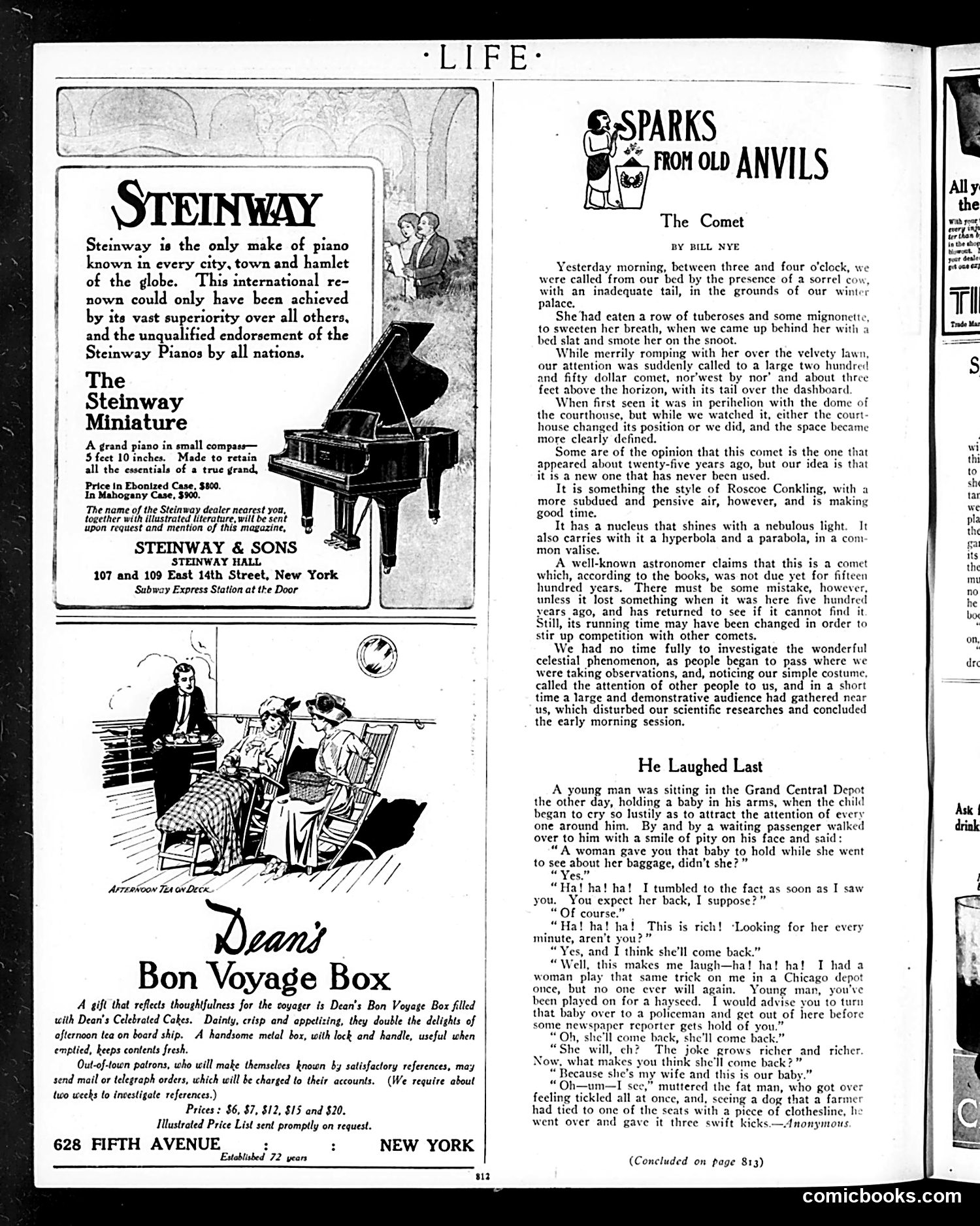
This page is primarily **advertisements** for luxury goods (Steinway pianos, Dean's cakes, bon voyage boxes), typical of Life magazine's era. The editorial content is a humorous essay "The Comet" **by Bill Nye**, a popular 19th-century humorist. Nye describes observing a comet from his property, treating it with mock-scientific language while poking fun at astronomical pretension. He jokes the comet resembles politician **Roscoe Conkling** (a Gilded Age figure known for his appearance and vanity). The piece's humor relies on Nye's characteristic deadpan tone—describing the comet's "hyperbola and parabola" carried "in a common valise" and complaining that onlookers' attention disrupted his "scientific researches." Below begins another humorous anecdote, "He Laughed Last," about a man with a crying baby in Grand Central Depot. The page represents Life's typical blend of genteel advertising and satirical social commentary aimed at educated, affluent readers.
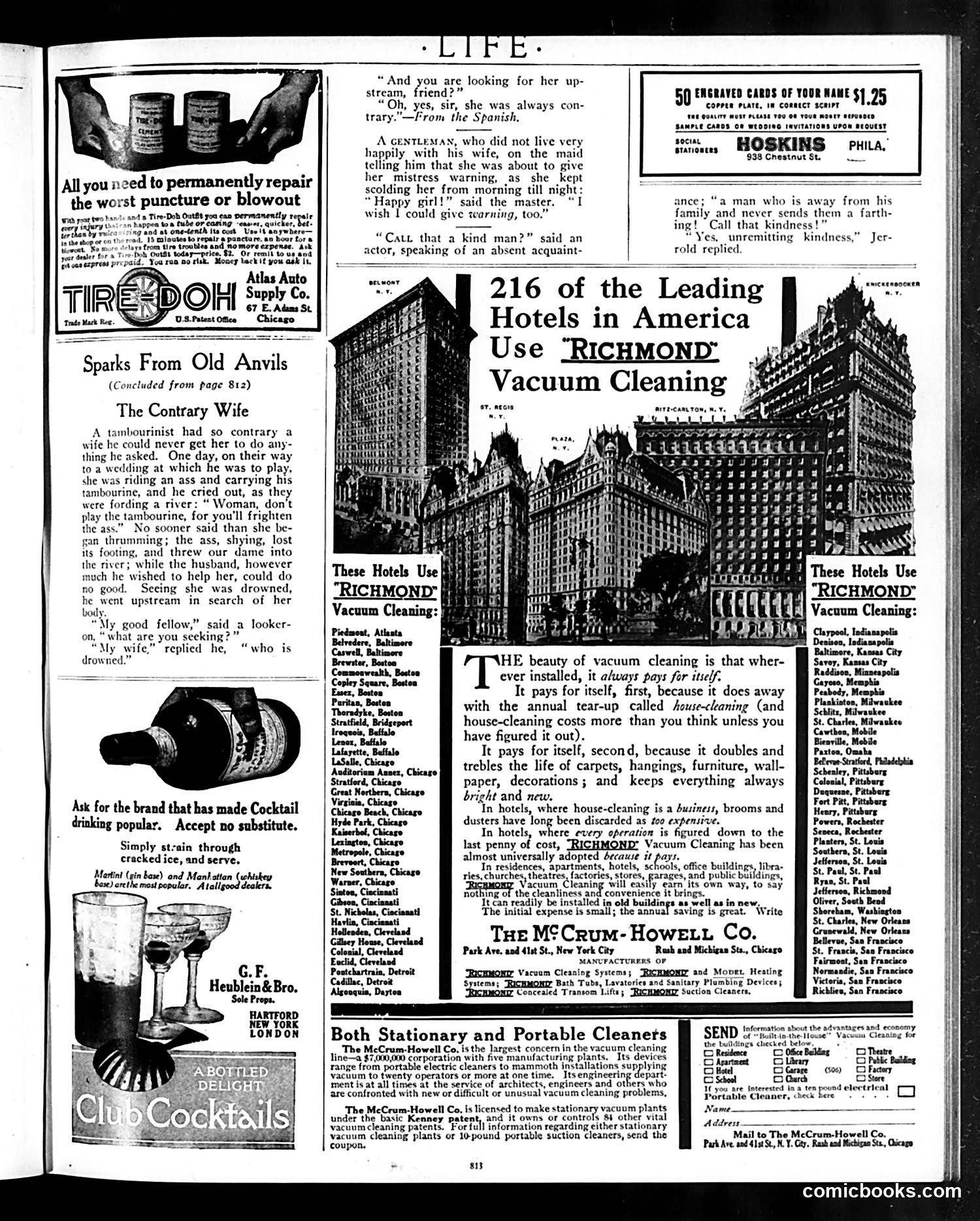
This page is primarily **advertising**, not political satire. The dominant content is a large advertisement for Richmond Vacuum Cleaning Systems, promoting their use in 216 leading American hotels. The smaller humor pieces ("Sparks From Old Anvils") are traditional jokes rather than cartoons—specifically old folk tales about contrary wives, used to fill space between ads. These reflect period attitudes about difficult marriages treated as comedy material. The page also advertises cocktail mixers (G.F. Heublein & Bro.), auto parts, and engraved cards. For modern readers, the most notable element is how casually the Richmond ad promotes labor-saving technology to the wealthy, emphasizing how vacuum cleaners eliminate the need for expensive domestic workers—reflecting early 20th-century class assumptions about mechanization replacing human servants. The jokes are merely filler content typical of magazines from this era.
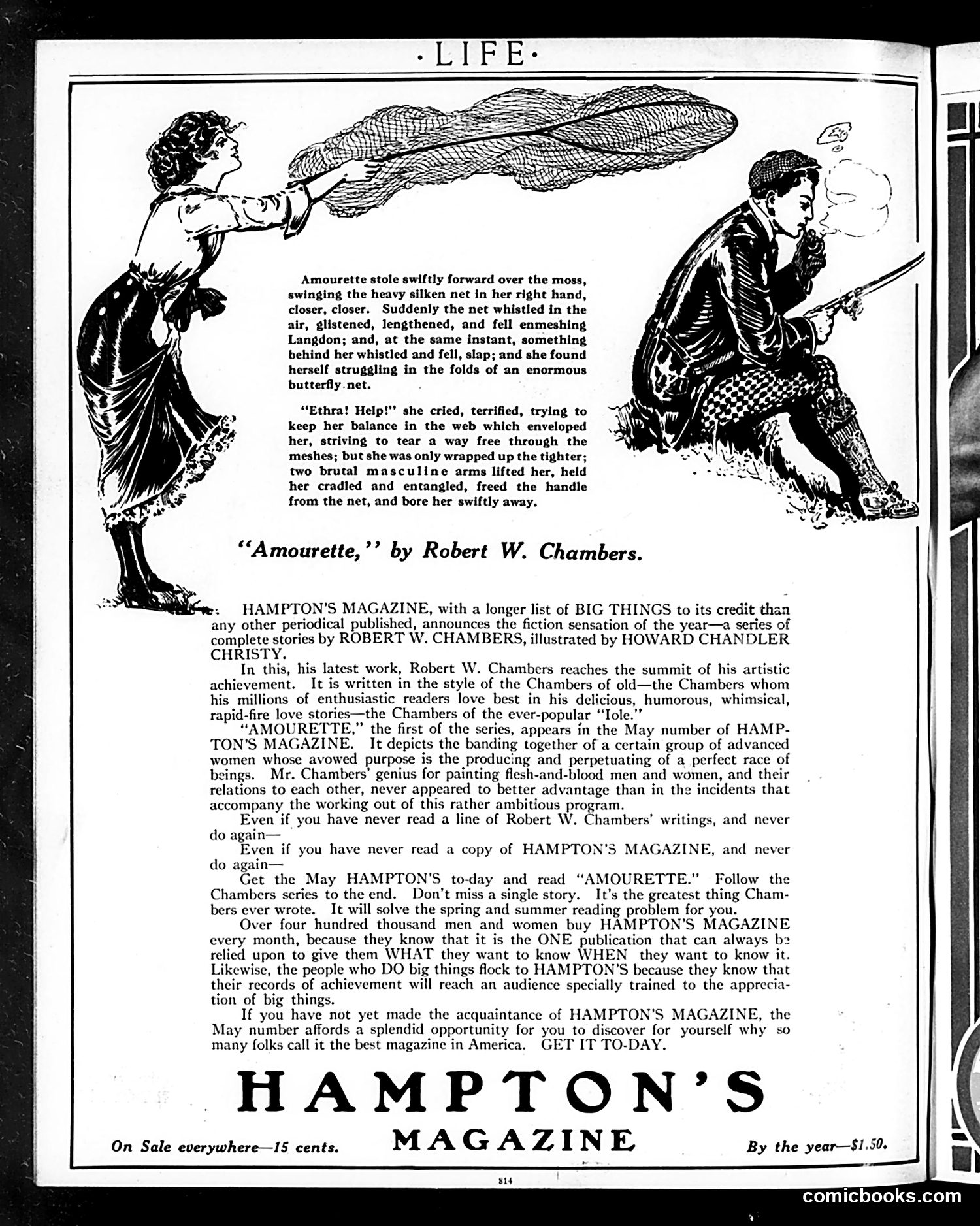
This is primarily a **magazine advertisement**, not political satire. It promotes Hampton's Magazine and a serialized fiction story by Robert W. Chambers titled "Amourette," illustrated by Howard Chandler Christy. The illustration depicts a scene from the story: a woman named Amourette attempts to catch a man (Langdon) with a butterfly net, but is herself caught in a giant butterfly net by another person. The accompanying text describes her struggling to escape. The story's plot involves "advanced women whose avowed purpose is the producing and perpetuating of a perfect race"—likely referencing early 20th-century **eugenics ideology**, which was then considered modern and progressive. This appears to be a romantic/comedic tale playing on gender role reversals and competitive courtship. The ad emphasizes Chambers's reputation for romantic, humorous fiction and Hampton's circulation among successful, educated readers. No specific political figures are caricatured here.
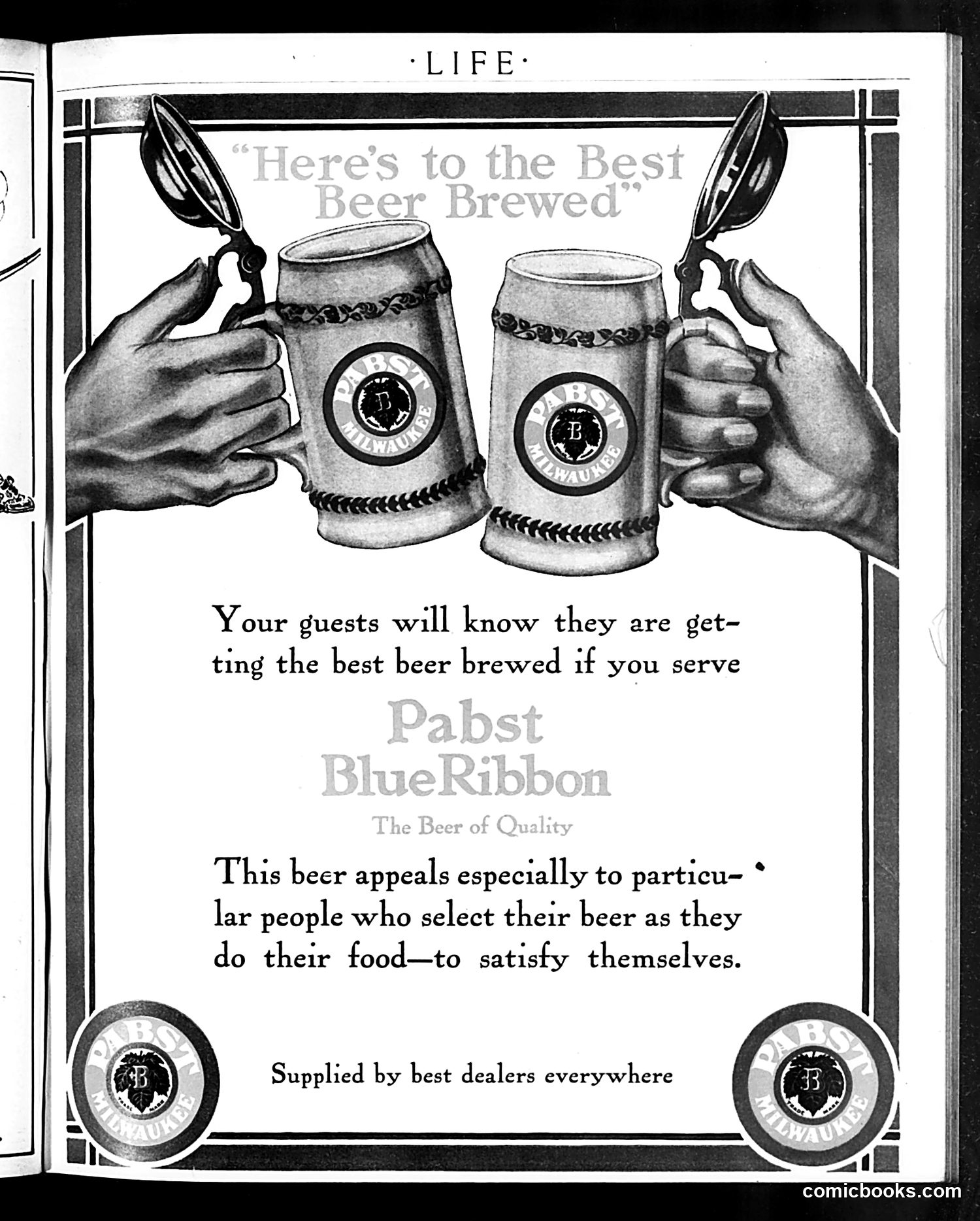
This is a straightforward **beer advertisement**, not political satire or editorial cartoon. It appeared in *Life* magazine during the pre-Prohibition or early Prohibition era (the ornate Art Deco styling suggests 1910s-1920s). The ad shows two hands clinking Pabst Blue Ribbon beer mugs, with the slogan "Here's to the Best Beer Brewed." The message targets discerning consumers who pride themselves on quality selection—comparing beer choice to food preference. The emphasis on "particular people" and "best dealers everywhere" suggests the brand's market positioning among affluent or quality-conscious drinkers. This is purely **commercial advertising content**, using the prestigious *Life* magazine platform to reach its educated, middle-to-upper-class readership.
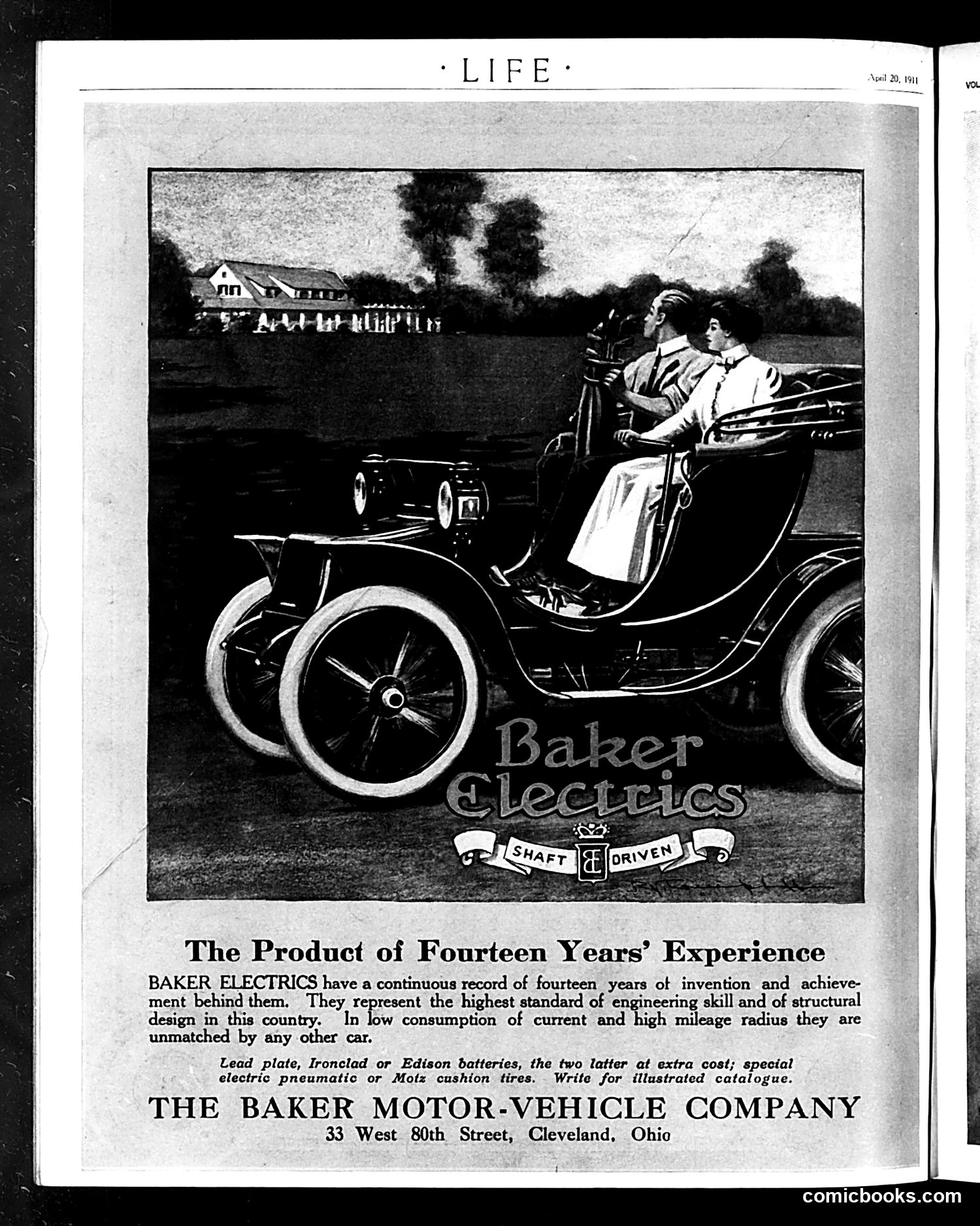
This is primarily an **advertisement**, not satire or political commentary. It appears in *Life* magazine from November 20, 1911, promoting the Baker Motor-Vehicle Company's electric automobiles. The image shows two well-dressed passengers in an early electric car driving past a countryside estate, emphasizing the vehicle's refined appeal to affluent buyers. The "shaft driven" notation references the car's mechanical transmission system. The advertisement's claims reflect the historical moment: electric cars were then serious competitors to gasoline vehicles, touted for low fuel consumption and long range. The specific mention of battery options (lead-plate, Ironclad, or Edison batteries) indicates this was a key selling point—Edison batteries were prestigious, invented by the famous industrialist. For modern readers: this captures when electric vehicles were luxury goods, not niche products, and competed equally with gas-powered cars before the Model T's dominance shifted the market around 1915.