
Life, 1911-04-20 · page 24 of 52
Life — April 20, 1911 — page 24: what you’re looking at
What you’re looking at
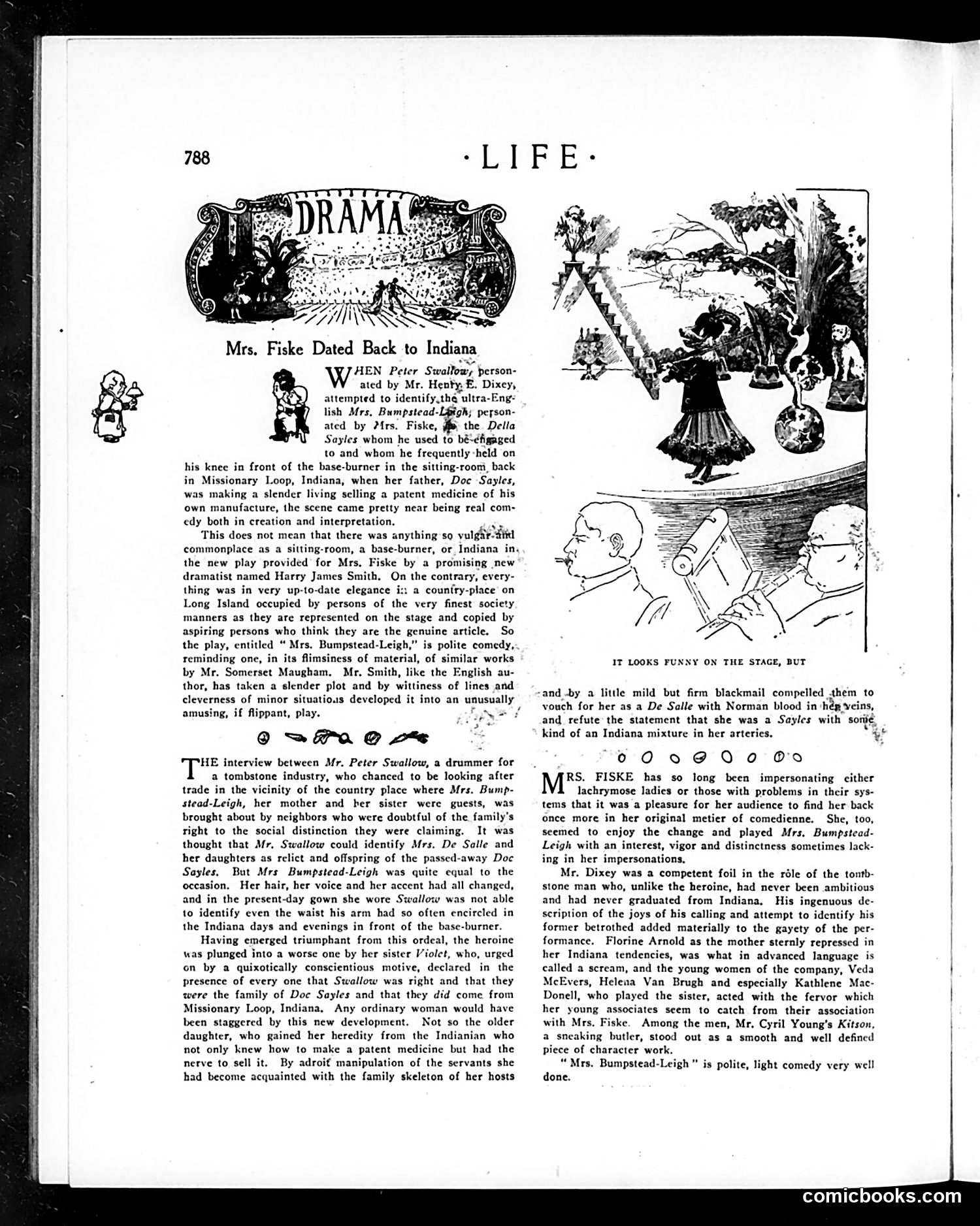
This theater review satirizes the play *Mrs. Bumpstead-Leigh*, starring actress Mrs. Fiske. The satire centers on social pretension: a woman from humble Missionary Loop, Indiana—daughter of a patent-medicine seller—reinvents herself as an ultra-refined English aristocrat ("De Salle with Norman blood"). When an old acquaintance from Indiana threatens to expose her, she uses blackmail to secure false corroboration of her fake identity, thereby maintaining her fraudulent social standing among wealthy Long Island society. The joke is the contrast between the play's "polite comedy" setting of elegant country estates and its plot involving crude deception rooted in vulgar Midwestern origins. The review praises Fiske for returning to her strength in comedic roles, rather than the tearful dramatic parts ("lachrymose ladies") she'd been playing. The humor lies in the gap between appearance and reality—a classic satire of American social climbing.
📄 Transcribed text from this page (OCR, searchable)
Machine-transcribed from the original scan — historical spelling and the odd misread are preserved.
Mrs, Fiske Dated Back to Indiana HEN Peter Swallow, person- ated by Mr. Henty, £. Dixey, attempted to identify,the ultra-Eng: lish Mrs, Bumpstead-L6igh; person- ated by Mrs. Fiske, ffm the Della Sayles whom he used to bé-dfigaged to and whom he frequently -held on his knee in front of the base-burner in the sitting-room, back in Missionary Loop, Indiana, when her father, Doc Sayles, was making a slender living selling a patent medicine of his own manufacture, the scene came pretty near being real com- edy both in creation and interpretation. Se This does not mean that there was anything so yulgar-aiitl commonplace as a sitting-room, a base-burner, or Indiana in, the new play provided for Mrs. Fiske by a promising new dramatist named Harry James Smith, On the contrary, every- thing was in very up-to-date elegance a counfry-place on Long Island occupied by persons of the very finest society manners as they are represented on the stage and copied by aspiring persons who think they are the genuine article. So the play, entitled “ Mrs, Bumpstead-Leigh,” is polite comedy, reminding one, in its flimsiness of material, of similar works by Mr. Somerset Maugham, Mr, Smith, like the English au- thor, has taken a slender plot and by wittiness of lines and cleverness of minor situatious developed it into an unusually amusing, if flippant, play. — 0 =a © oe HE interview between Mr. Peter Swallow, a drummer for a tombstone industry, who chanced to be looking after trade in the vicinity of the country place where Mrs. Bump- stead-Leigh, her mother and her sister were guests, was brought about by neighbors who were doubtful of the family’s right to the social distinction they were claiming. It was thought that Mr, Swallow could identify Mrs. De Salle and her daughters as relict and offspring of the passed-away Doc Sayles, But Mrs Bumpstead-Leigh was quite equal to the occasion. Her hair, her voice and her accent had all changed, and in the present-day gown she wore Swallow was not able to identify even the waist his arm had so often encircled in the Indiana days and evenings in front of the base-burner. Having emerged triumphant from this ordeal, the heroine was plunged into a worse one by her sister Violet, who, urged on by a quixotically conscientious motive, declared in the presence of every one that Swallow was right and that they were the family of Doc Sayles and that they did come from Missionary Loop, Indiana. Any ordinary woman would have been staggered by this new development. Not so the older daughter, who gained her heredity from the Indianian who not only knew how to make a patent medicine but had the nerve to sell it. By adroif manipulation of the servants she had become acquainted with the family skeleton of her hosts IT LOOKS FUNNY ON THE STAGE, BUT and -by a little mild but firm blackmail compelled them to vouch for her as a De Salle with Norman blood in ‘hég veins, and refute the statement that she was a Sayles with sori¢, kind of an Indiana mixture in her arteries. a 0009000 09 RS. FISKE has so long been impersonating cither lachrymose ladies or those with problems in thcir sys- tems that it was a pleasure for her audience to find her back once more in her original metier of comedienne. She, too, seemed to enjoy the change and played Mrs. Bumpstead- Leigh with an interest, vigor and distinctness sometimes lack- ing in her impersonations. Mr. Dixey was a competent foil in the réle of the tontb- stone man who, unlike the heroine, had never been ambitious and had never graduated from Indiana, His ingenuous de- scription of the joys of his calling and attempt to identify his former betrothed added materially to the gayety of the per- formance. Florine Arnold as the mother sternly repressed in her Indiana tendencies, was what in advanced language is called a scream, and the young women of the company, Veda McEvers, Helena Van Brugh and especially Kathlene Mac- Donell, who played the sister, acted with the fervor which her young associates seem to catch from their association with Mrs, Fiske. Among the men, Mr. Cyril Young’s Kitson, a sneaking butler, stood out as a smooth and well defined piece of character work. “ Mrs, Bumpstead-Leigh " done. is polite, light comedy very well e comicbooks.com