
Life, 1911-04-20 · page 22 of 52
Life — April 20, 1911 — page 22: what you’re looking at
What you’re looking at
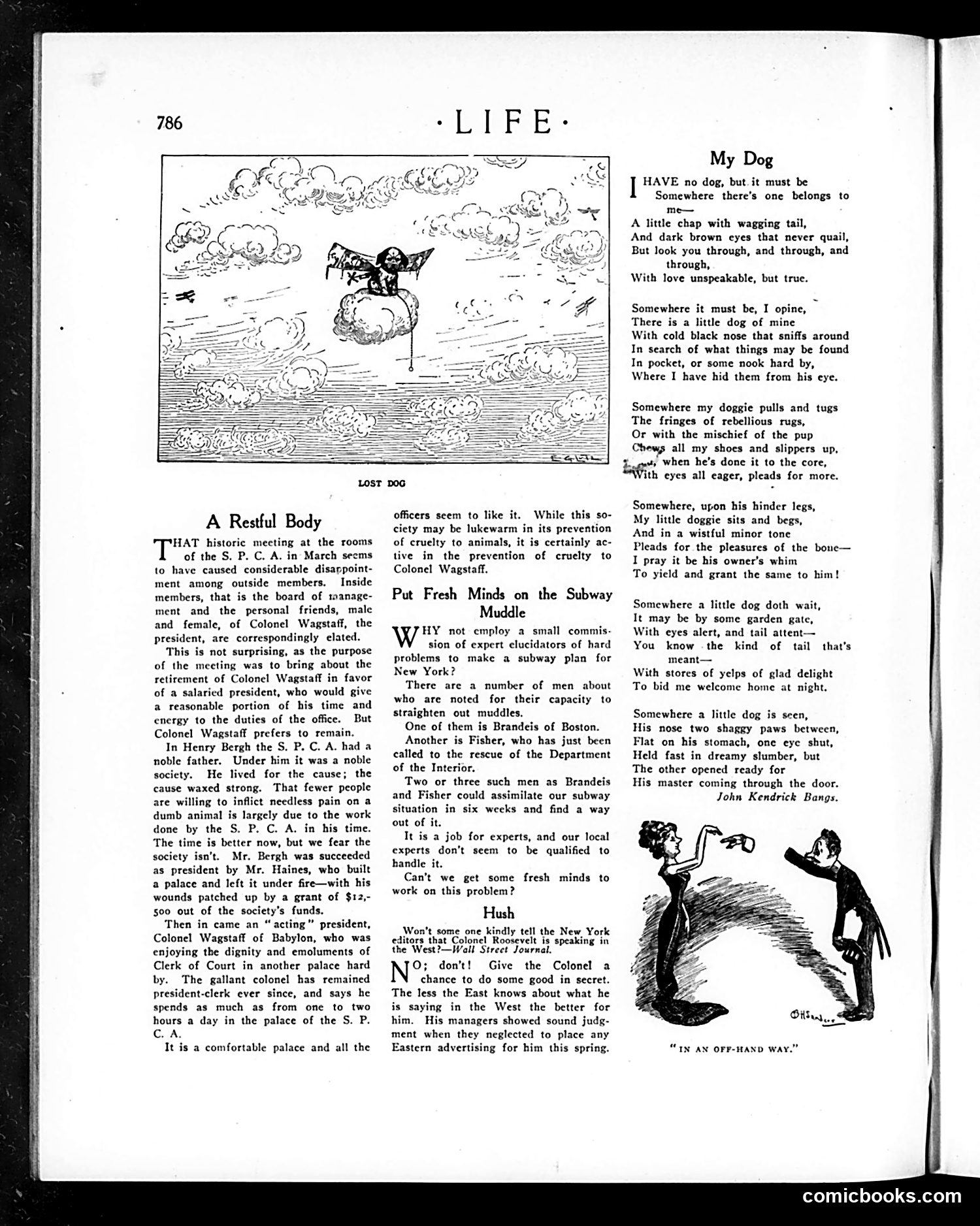
This page contains three distinct pieces satirizing American institutional and political figures circa early 1900s. **"A Restful Body"** mocks Colonel Wagstaff, president of the S.P.C.A. (Society for the Prevention of Cruelty to Animals). The article criticizes him for prioritizing his comfort and maintaining his dual role as Clerk of Court while neglecting the organization's actual mission. The satire is that an animal-welfare society protects its president from accountability while potentially neglecting animal welfare itself. **"Put Fresh Minds on the Subway Muddle"** urges New York to hire expert problem-solvers like Brandeis or Fisher to resolve subway planning chaos, implying current local leadership is incompetent. **"Hush"** is political commentary suggesting Colonel Roosevelt (likely Theodore Roosevelt) should remain silent about his Western speeches, as his managers wisely avoided publicizing them—implying his statements are problematic or embarrassing to Eastern interests. The accompanying illustrations show a lost dog and figures in humorous poses. "My Dog" is a sentimental poem about an imagined pet.
📄 Transcribed text from this page (OCR, searchable)
Machine-transcribed from the original scan — historical spelling and the odd misread are preserved.
— Lost DOG A Restful Body HAT historic mecting at the rooms of the S. P. C. A. in March secms to have caused considerable disappoint- ment among outside members. Inside members, that is the board of toanage- ment and the personal friends, male and female, of Colonel Wagstaff, the president, are correspondingly elated. This is not surprising, as the purpose of the meeting was to bring about the retirement of Colonel Wagstaff in favor of a salaried president, who would give a reasonable portion of his time and energy to the duties of the office. But Colonel Wagstaff prefers to remain. In Henry Bergh the S. P. C. A. had a noble father. Under him it was a noble society. He lived for the cause; the cause waxed strong. That fewer people are willing to inflict needless pain on a dumb animal is largely due to the work done by the S. P. C. A. in his time. The time is better now, but we fear the society isn’t. Mr. Bergh was succeeded as president by Mr. Haines, who built a palace and left it under fire—with his wounds patched up by a grant of $12,- 500 out of the society’s funds. Then in came an “acting” president, Colonel Wagstaff of Babylon, who was enjoying the dignity and emoluments of Clerk of Court in another palace hard by. The gallant colonel has remained president-clerk ever since, and says he spends as much as from one to two hours a day in the palace of the S. P. GA. It is a comfortable palace and all the officers seem to like it. While this so- ciety may be lukewarm in its prevention of cruelty to animals, it is certainly ac- tive in the prevention of cruelty to Colonel Wagstaff. Put Fresh Minds on the Subway Muddle HY not employ a small commis- sion of expert elucidators of hard problems to make a subway plan for New York? There are a number of men about who are noted for their capacity to straighten out muddles. One of them is Brandeis of Boston. Another is Fisher, who has just been called to the rescue of the Department of the Interior. Two or three such men as Brandeis and Fisher could assimilate our subway situation in six weeks and find a way out of Tt is a job for experts, and our local experts don't seem to be qualified to handle it. Can’t we get some fresh minds to work on this problem? Hush Won't some one kindly tell the New York editors that Colonel Roosevelt is speaking in the West?—Wall Street Journal. O; don’t! Give the Colonel a chance to do some good in secret. The less the East knows about what he is saying in the West the better for him. His managers showed sound judg- ment when they neglected to place any Eastern advertising for him this spring. My Dog HAVE no dog, but. it must be Somewhere there's one belongs to me— A little chap with wagging tail, And dark brown eyes that never quail, But look you through, and through, and through, With love unspeakable, but true. Somewhere it must be, I opine, There is a little dog of mine With cold black nose that sniffs around In search of what things may be found In pocket, or some nook hard by, Where I have hid them from his eye. Somewhere my doggie pulls and tugs The fringes of rebellious rugs, Or with the mischief of the pup all my shoes and slippers up, Longe) When he’s done it to the core, ats eyes all eager, pleads for more. Somewhere, upon his hinder legs, My little doggie sits and begs, And in a wistful minor tone Pleads for the pleasures of the boue— I pray it be his owner’s whim To yield and grant the same to him! Somewhere a little dog doth wait, It may be by some garden gate, With eyes alert, and tail attent— You know the kind of tail that's meant— With stores of yelps of glad delight To bid me welcome home at night. Somewhere a little dog is scen, His nose two shaggy paws between, Flat on his stomach, one eye shut, Held fast in dreamy slumber, but The other opened ready for His master coming through the door. John Kendrick Bangs. “IN AN OFF-HAND Way.” comicbooks.com