
Life, 1911-04-20 · page 21 of 52
Life — April 20, 1911 — page 21: what you’re looking at
What you’re looking at
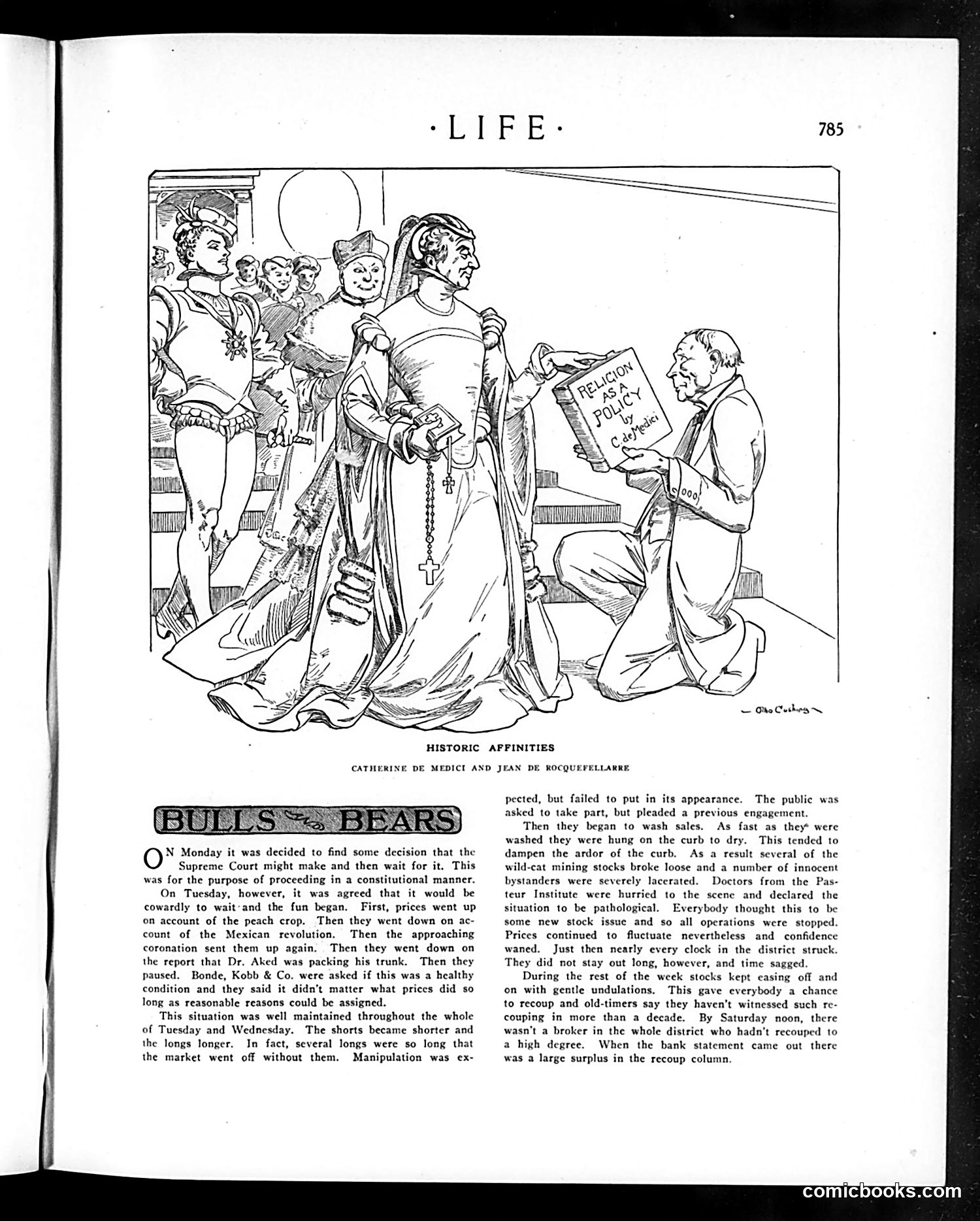
This is a satirical piece about stock market manipulation and volatility during the early 1900s. The cartoon's title references "Catherine de Medici and Jean de Rocquefellarre"—likely equating contemporary financial figures with historical manipulators known for intrigue. The accompanying text mocks the absurdity of market fluctuations driven by trivial reasons: peach crop reports, a Mexican revolution rumor, a coronation, and Dr. Aked "packing his trunk." The satire exposes how speculators ("shorts" and "longs") exploit these manufactured concerns for profit. The piece ridicules "wash sales" (artificial trading to create false activity), manipulation by major brokers, and public gullibility. The darkly comic ending—where everyone mysteriously "recouped" massive profits by Saturday—suggests the entire system is rigged, with ordinary people ("innocent bystanders") harmed while insiders profit from the chaos. The satire attacks financial corruption and the lack of market regulation in the Progressive Era.
📄 Transcribed text from this page (OCR, searchable)
Machine-transcribed from the original scan — historical spelling and the odd misread are preserved.
HISTORIC AFFINITIES CATHERINE DE MEDICE AND JEAN DE ROCQUEFELLARRE. N Monday it was decided to find some decision that the Supreme Court might make and then wait for it. This was for the purpose of proceeding in a constitutional manner. On Tuesday, however, it was agreed that it would be cowardly to wait’and the fun began. First, prices went up on account of the peach crop. Then they went down on ac- count of the Mexican revolution. Then the approaching coronation sent them up again, Then they went down on the report that Dr. Aked was packing his trunk. Then they paused. Bonde, Kobb & Co. were asked if this was a healthy condition and they said it didn’t matter what prices did so long as reasonable reasons could be assigned. This situation was well maintained throughout the whole of Tuesday and Wednesday. The shorts became shorter and the longs longer. In fact, several longs were so long that the market went off without them. Manipulation was ex- pected, but failed to put in its appearance. The public was asked to take part, but pleaded a previous engagement. Then they began to wash sales. As fast as they* were washed they were hung on the curb to dry. This tended to dampen the ardor of the curb. As a result several of the wild-cat mining stocks broke loose and a number of innocent bystanders were severely lacerated. Doctors from the Pas- teur Institute were hurried to the scene and declared the situation to be pathological. Everybody thought this to be some new stock issue and so all operations were stopped. Prices continued to fluctuate nevertheless and confidence waned. Just then nearly every clock in the district struck. They did not stay out long, however, and time sagged. During the rest of the week stocks kept easing off and on with gentle undulations. This gave everybody a chance to recoup and old-timers say they haven’t witnessed such re- couping in more than a decade. By Saturday noon, there wasn't a broker in the whole district who hadn't recouped to a high degree. When the bank statement came out there was a large surplus in the recoup column.