
Life, 1911-04-20 · page 28 of 52
Life — April 20, 1911 — page 28: what you’re looking at
What you’re looking at
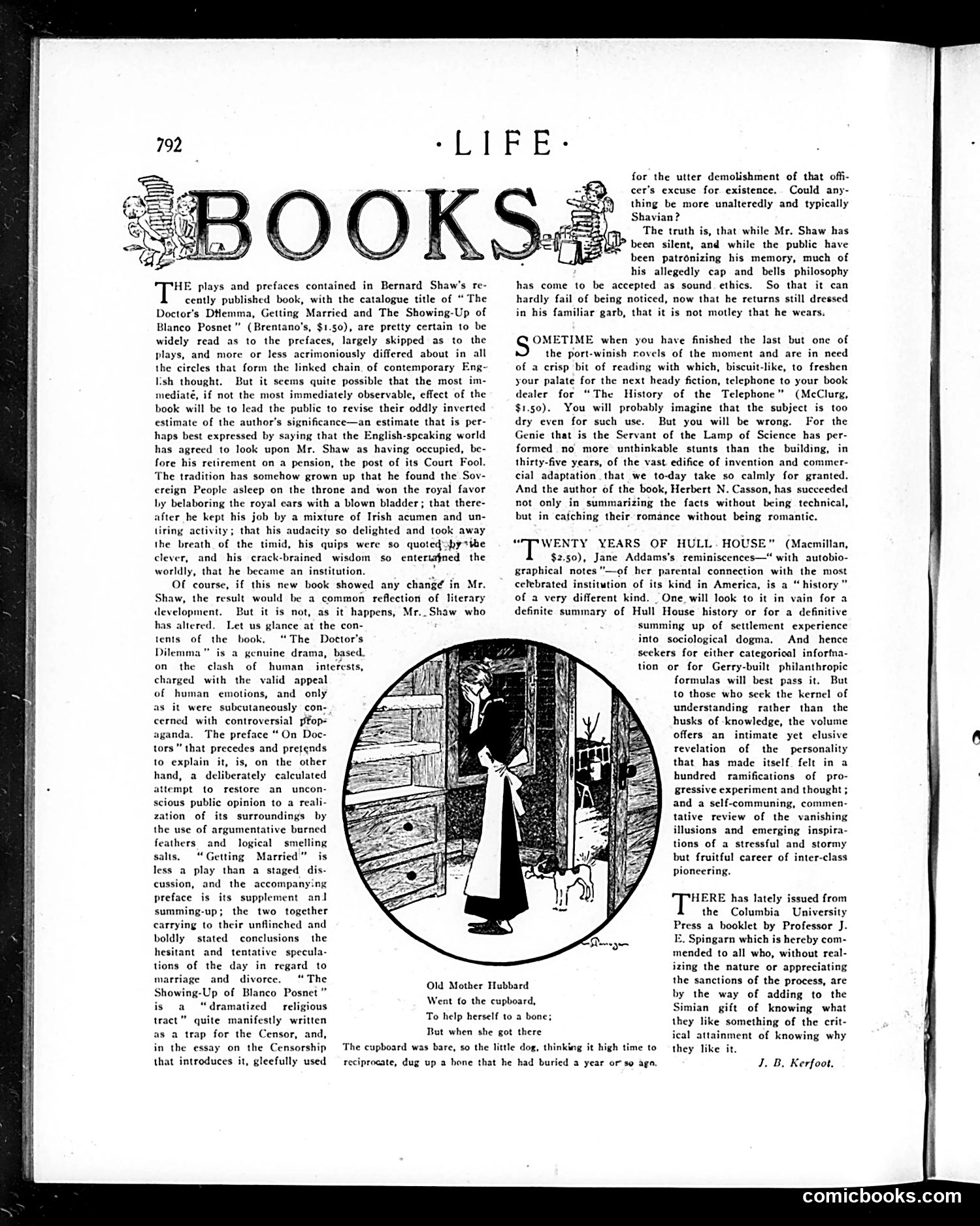
This page discusses Bernard Shaw's recently published book containing plays and prefaces. The key argument is a **reassessment of Shaw's significance**: while the English-speaking world has treated him as a "Court Fool"—a witty entertainer whose clever quips distract rather than instruct—his actual work reveals serious philosophical and ethical content. The article contends that Shaw hasn't changed; rather, public opinion has caught up. Ideas Shaw advocated (on marriage, divorce, censorship) that were once controversial are now becoming accepted as "sound ethics." Therefore, his familiar satirical style now carries genuine intellectual weight rather than mere entertainment. The small illustration of "Old Mother Hubbard" is a visual pun: the dog reciprocates by digging up a bone—suggesting Shaw himself is now reciprocating society's earlier patronizing dismissal by proving his serious merit. The piece essentially argues for Shaw's rehabilitation as a serious thinker, not merely a clever performer.
📄 Transcribed text from this page (OCR, searchable)
Machine-transcribed from the original scan — historical spelling and the odd misread are preserved.
HE plays and prefaces contained in Bernard Shaw’ cently published book, with the catalogue title of “ The Doctor’s DHemma, Getting Married and The Showing-Up of Blanco Posnet” (Brentano's, $1.50), are pretty certain to be widely read as to the prefaces, largely skipped as to the plays, and more or less acrimoniously differed about in all the circles that form the linked ch: of contemporary Eng- Ish thought. But it scems quite possible that the most im- mediaté, if not the most immediately observable, effect of the book will be to lead the public to revise their oddly inverted estimate of the author's significance—an estimate that is per- haps best expressed by saying that the English-speaking world has agreed to look upon Mr. Shaw as having occupied, be- fore his retirement on a pension, the post of its Court Fool. The tradition has somehow grown up that he found the Sov- ereign People asleep on the throne and won the royal favor Ly belaboring the royal cars with a blown bladder; that there- after he kept his job by a mixture of Irish acumen and un- tiring activity; that his audacity so delighted and took away the breath of the timid, his quips were so quotedupysibe clever, and his crack-brained wisdom so entertafned the worldly, that he became an institution. E Of course, if this new book showed any chang¢ in Mr. Shaw, the result would be a common reflection of literary development. But it is not, as it happens, Mr..Shaw who has altered, Let us glance at the con- tents of the book. “The Doctor's Dilemm: a genuine drama, based. on the clash of human intercsts, charged with the valid appeal of human emotions, and only as it were subcutaneously con- cerned with controversial pfop= aganda. The preface “On Doc- tors” that precedes and pretends to explain it, is, on the other hand, a deliberately calculated attempt {o restore an uncon- scious public opinion to a reali- zation of its surroundings by the use of argumentative burned feathers and logical smelling salts. “Getting Married” is less a play than a staged dis- cussion, and the accompanying preface is its supplement and summing-up; the two together carrying to their unflinched and boldly stated conclusions the hesitant and tentative specula- tions of the day in regard to marriage and divorce. “ The Showing-Up of Blanco Posnet” is a “dramatized religious tract” quite manifestly written as a trap for the Censor, and, in the essay on the Censorship that introduces it, gleefully used ELSE SP Old Mother Hubbard Went fo the cupboard, To help herself to a bone; But when she got there The cupboard was bare, so the little dog, thinking it high time to reciprocate, dug up a hone that he had buried a year or so aga. for the utter demolishment of that offi- cer’s excuse for existence. Could any- thing be more unalteredly and typically Shavian? The truth is, that while Mr. Shaw has been silent, and while the public have been patronizing his memory, much of his allegedly cap and bells philosophy has come to be accepted as sound ethics. So that it can hardly fail of being noticed, now that he returns still dressed in his familiar garb, that it is not motley that he wears. OMETIME when you have finished the last but one of the port-winish rovels of the moment and are in need of a crisp bit of reading with which, biscuit-like, to freshen your palate for the next heady fiction, telephone to your book dealer for “The History of the Telephone” (McClurg, $1.50). You will probably imagine that the subject is too dry even for such use. But you will be wrong. For the Genie that is the Servant of the Lamp of Science has per- formed no more unthinkable stunts than the building, in thirty-five years, of the vast edifice of invention and commer- cial adaptation that we to-day take so calmly for granted. And the author of the book, Herbert N. Casson, has succeeded not only in summarizing the facts without being technical, but in catching their romance without being romantic. WENTY YEARS OF HULL. HOUSE” (Macmillan, $2.50), Jane Addams’s reminiscences—* with autobio- graphical notes ”—of her parental connection with the most celebrated institution of its kind in America, is a “history” of a very different kind. One will look to it in vain for a definite summary of Hull House history or for a definitive summing up of settlement experience into sociological dogma. And hence seckers for either categorical inforfna- tion or for Gerry-built philanthropic formulas will best pass it. But to those who seek the kernel of understanding rather than the husks of knowledge, the volume offers an intimate yet elusive revelation of the personality that has made itself felt in a hundred ramifications of pro- gressive experiment and thought ; and a self-communing, commen- tative review of the vanishing illusions and emerging inspira- tions of a stressful and stormy but fruitful career of inter-class pioneering. HERE has lately issued from the Columbia University Press a booklet by Professor J. E. Spingarn which is hereby com- mended to all who, without real- izing the nature or appreciating the sanctions of the process, are by the way of adding to the Simian gift of knowing what they like something of the crit- ical attainment of knowing why they like it. J. B, Kerfoot. comicbooks.com