
Life, 1911-04-20 · page 30 of 52
Life — April 20, 1911 — page 30: what you’re looking at
What you’re looking at
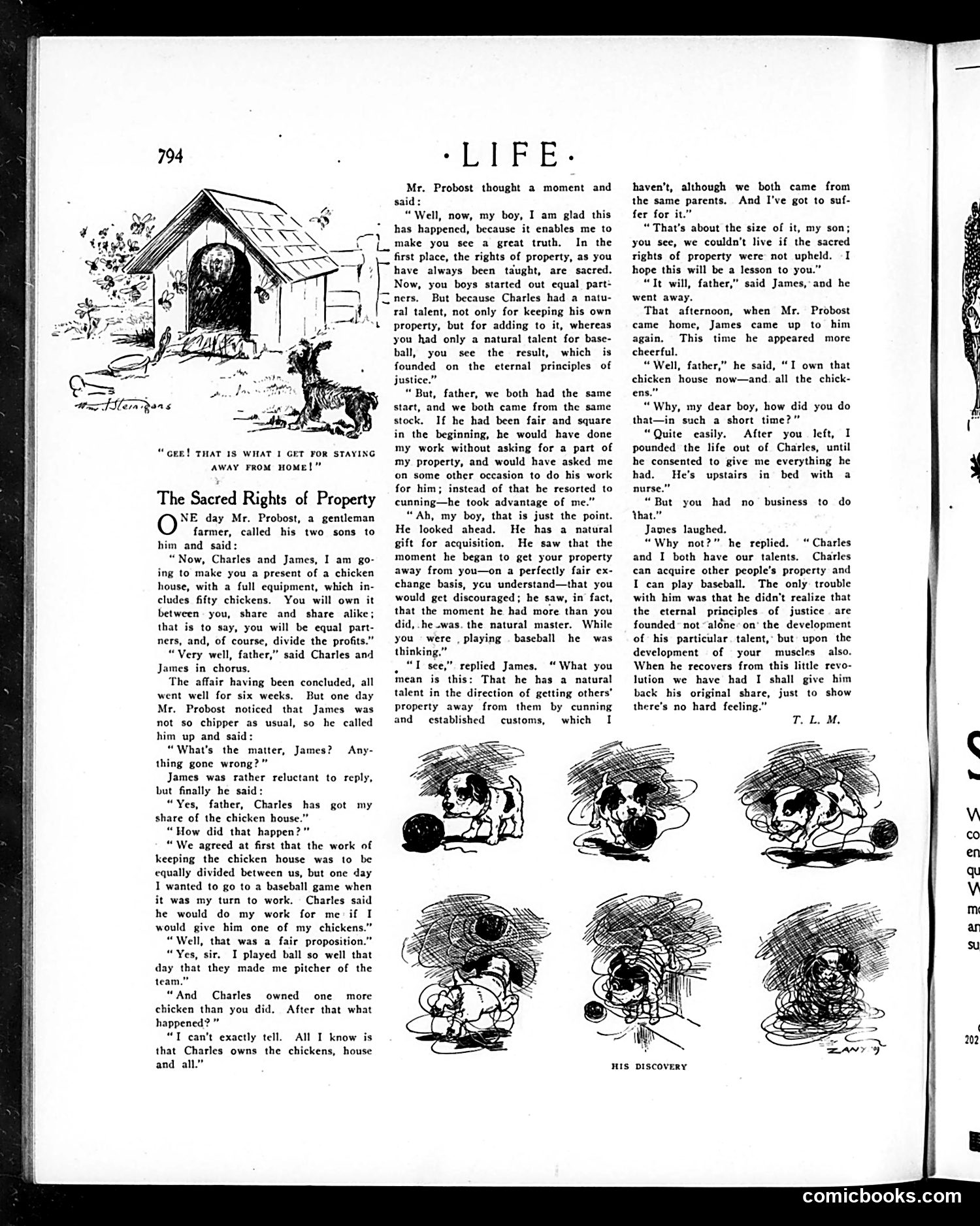
This satirical story critiques laissez-faire capitalism and the doctrine of property rights through a parable about two sons managing a chicken house. **The Setup**: Father Probost gives sons Charles and James equal shares in a chicken farm. Charles, naturally talented at acquiring property, gradually convinces James to trade away his chickens (fairly, by stated rules) to help with baseball. Charles ends up owning everything. **The Satire**: When James protests the unfairness, his father delivers a mock-serious lecture justifying Charles's dominance as natural law—that those with talent for acquisition deserve to accumulate wealth, that cunning is legitimate within "established customs." **The Punchline**: James responds by *beating Charles unconscious* and taking everything back. The father then protests—claiming James "had no business" using force—exposing the hypocrisy: property acquisition through cunning is celebrated as justice, but redistribution through violence is condemned as illegitimate. The cartoon mocks how industrial-era wealthy justified inequality as natural and inevitable, while society's rules protected their advantage.
📄 Transcribed text from this page (OCR, searchable)
Machine-transcribed from the original scan — historical spelling and the odd misread are preserved.
“cee! THAT 18 WHAT I GET FOR STAYING AWAY FROM HOME!” The Sacred Rights of Property NE day Mr. Probost, a gentleman farmer, called his two sons to him and said: “Now, Charles and James, I am go- ing to make you a present of a chicken house, with a full equipment, which in- cludes fifty chickens. You will own it between. you, share and share alike; that is to say, you will be equal part- ners, and, of course, divide the profits.” “Very well, father,” said Charles and James in chorus. The affair having been concluded, all went well for six weeks. But one day Mr. Probost noticed that James was not so chipper as usual, so he called him up and said: “What's the matter, James? Any- thing gone wrong?” James was rather reluctant to reply, but finally he said: “Yes, father, Charles has got my share of the chicken house.” “How did that happen?” “We agreed at first that the work of keeping the chicken house was to be equally divided between us, but one day I wanted to go to a baseball game when it was my turn to work. Charles said he would do my work for me if I would give him one of my chickens. “Well, that was a fair proposition. “Yes, sir. I played ball so well that day that they made me pitcher of the team.” “And Charles owned one more chicken than you did. After that what happened?” “T can't exactly tell. All I know is that Charles owns the chickens, house and all.” ‘EDFE- Mr. Probost thought a moment and said “Well, now, my boy, I am glad this has happened, because it enables me to make you sce a great truth, In the first place, the rights of property, as you have always been taught, are sacred. Now, you boys started out equal part: ‘ners. But because Charles had a natu- ral talent, not only for keeping his own property, but for adding to it, whereas you had only a natural talent for base- ball, you see the result, which is founded on the eternal principles of justice.” “ But, father, we both had the same start, and we both came from the same stock. If he had been fair and square in the beginning, he would have done my work without asking for a part of my property, and would have asked me on some other occasion to do his work for him; instead of that he resorted to cunning—he took advantage of me.” “Ah, my boy, that is just the point. He looked ahead. He has a natural gift for acquisition, He saw that the moment he began to get your property away from you—on a perfectly fair ex- change basis, ycu understand—that you would get discouraged; he saw, in fact, that the moment he had more than you did, .he .was. the natural master. While you were , playing . baseball he was thinking.” . “IT see,” replied James. “ What you mean is this: That he has a natural talent in the direction of getting others’ Property away from them by cunning and established customs, which I haven't, although we both came from the same parents. And I've got to suf- fer for it.” “That's about the size of it, my son; you see, we couldn't live if the sacred rights of property were not upheld. I hope this will be a lesson to you.” “Tt will, father,” said James,and he went away. That afternoon, when Mr. Probost came home, James came up to him again. This time he appeared more cheerful. “Well, father,” he said, “I own that “Why, my dear boy, how did you do that—in such a short time?” “Quite easily. After you left, I pounded the life out of Charles, until he consented to give me everything he had. He's upstairs in bed with a nurse.” “But you had no business to do ‘Yhat.” James laughed. “Why not?” he replied. “ Charles and I both have our talents. Charles can acquire other people’s property and I can play baseball, The only trouble with him was that he didn’t realize that the eternal principles of justice are founded not “aléne: on’ the development of his particular talent,; but upon the development of your muscles also. When he recovers from this little revo- lution we have had I shall give him back his original share, just to show there's no hard feeling.” HIS DISCOVERY comicbooks.com eesa<s2e2ssosts fr fFo 202