
Life, 1911-04-20 · page 33 of 52
Life — April 20, 1911 — page 33: what you’re looking at
What you’re looking at
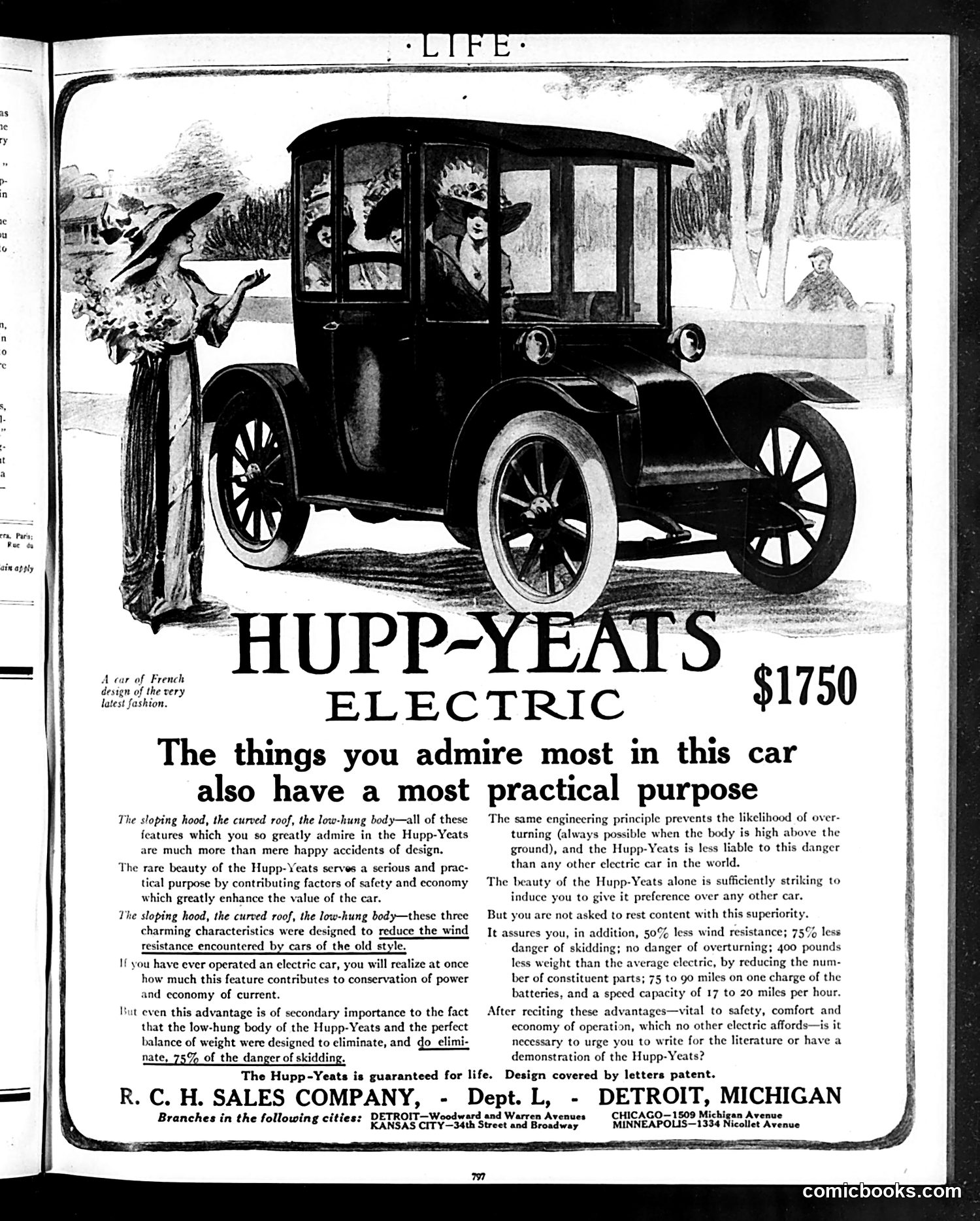
This is primarily a **automobile advertisement**, not political satire. The page promotes the Hupp-Yeats Electric car ($1,750) manufactured by R.C.H. Sales Company in Detroit. The illustration shows a fashionably dressed woman in a large hat admiring the vehicle, with the caption noting it has "French design of the very latest fashion"—appealing to early 20th-century consumers who associated French style with sophistication. The advertisement's humor is subtle: it claims the car's aesthetically pleasing features (sloping hood, curved roof, low body) are actually engineered for practical safety and efficiency—reducing wind resistance by 50%, skidding danger by 75%, and enabling 75-90 miles per battery charge. The joke undercuts itself: consumers attracted by beauty discover they're also getting superior engineering and safety. This was a common advertising strategy for electric vehicles, which faced competition from gasoline cars and needed to justify their higher cost through claimed advantages.
📄 Transcribed text from this page (OCR, searchable)
Machine-transcribed from the original scan — historical spelling and the odd misread are preserved.
ra, Par’ Bee te ain apply A car of French design of the very latest fashion. ELECTRIC The things you admire most in this car also have a most The sloping hood, the curved roof, the low-hung body—all of these features which you so greatly admire in the Hupp-Yeats are much more than mere happy accidents of design. The rare beauty of the Hupp-Yeats serves a serious and prac- tical purpose by contributing factors of safety and economy which greatly enhance the value of the car. The sloping hood, the curved roof, the low-hung body—these three charming characteristics were designed to reduce the wind resistance encountered by cars of the old style. If you have ever operated an electric car, you will realize at once how much this feature contributes to conservation of power and economy of current. lhut even this advantage is of secondary importance to the fact that the low-hung body of the Hupp-Yeats and the perfect balance of weight were designed to climinate, and go_elimi- nate, 75% of the danger of skidding. The Hupp-Yeat: practical purpose The same engineering principle prevents the likelihood of over- turning (always possible when the body is high above the ground), and the Hupp-Yeats is less liable to this danger than any other electric car in the world. The beauty of the Hupp-Yeats alone is sufficiently striking to induce you to give it preference over any other car. But you are not asked to rest content with this superiority. It assures you, in addition, 50% less wind resistance; 75% less danger of skidding; no danger of overturning; 400 pounds less weight than the average electric, by reducing the num- ber of constituent parts; 75 to 90 miles on one charge of the batteries, and a speed capacity of 17 to 20 miles per hour. After reciting these advantages—vital to safety, comfort economy of operation, which no other electric affords necessary to urge you to write for the literature or have a demonstration of the Hupp-Yeats? guaranteed for life. Design covered by letters patent. R. C. H. SALES COMPANY, - Dept. L, - DETROIT, MICHIGAN ii is : DETROIT—Woodward and W: A Branches in the following cities: DETROIT Woodward and Warren Avenues CHICAGO—1509 Michigan Avenue MINNEAPOLIS—1334 Nicollet Avenue $1750 aes 8S ES LE NT a oem 2 oS ce AREER PRIETO TE eee ae ~entemaRRD comicbooks.com