
Life, 1911-04-20 · page 34 of 52
Life — April 20, 1911 — page 34: what you’re looking at
What you’re looking at
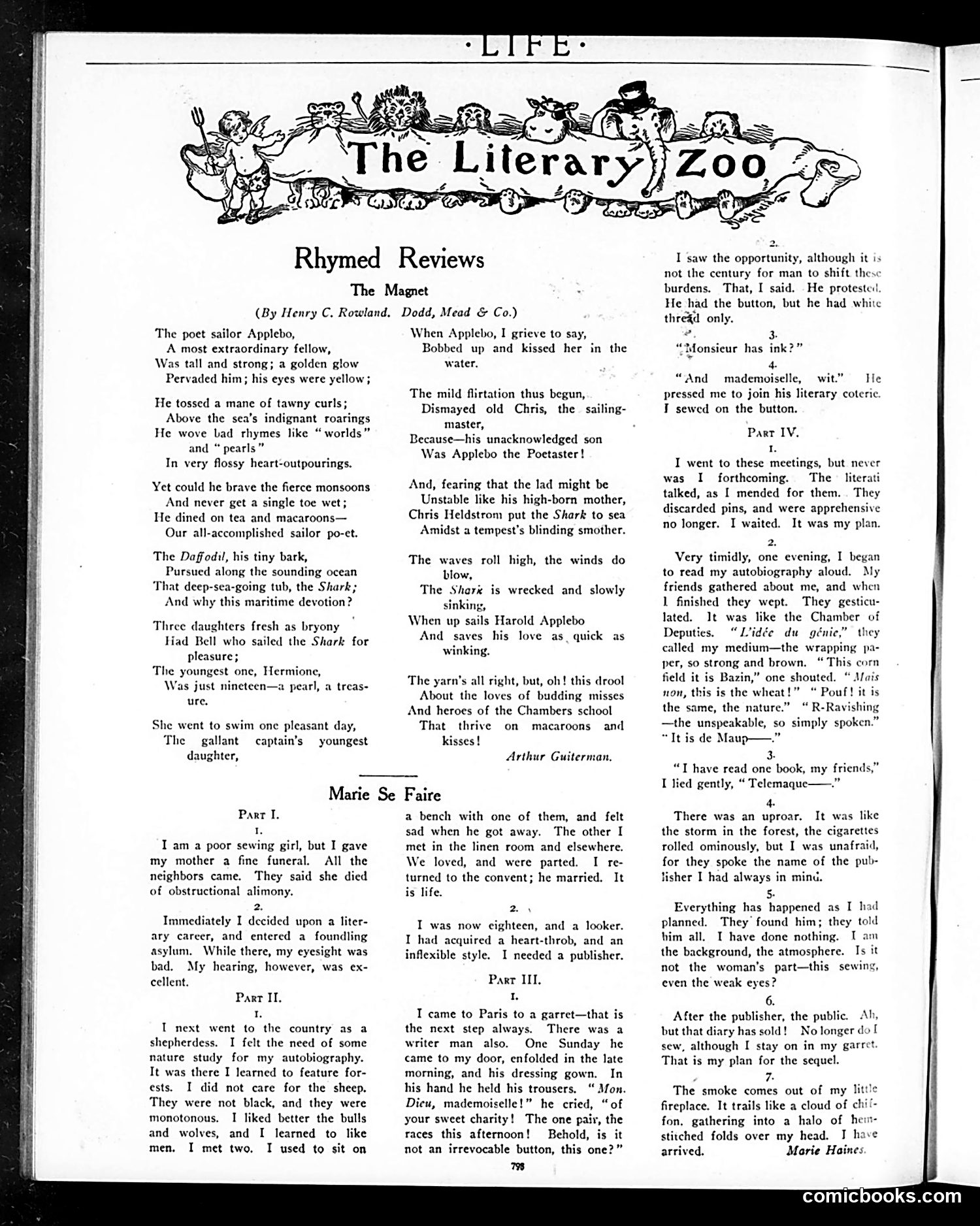
This page from *Life* magazine contains two satirical pieces mocking literary pretension and romantic melodrama popular in early 20th-century fiction. **"The Magnet"** (by Henry C. Rowland) ridicules sentimental sea adventure novels. It parodies the implausible hero "Applebo"—a yellow-eyed, golden sailor-poet who writes overwrought verse ("worlds" / "pearls") yet impossibly rescues his love while remaining dry. Arthur Guiterman's concluding commentary directly mocks the genre's clichés: romantic heroes, "budding misses," and unrealistic adventure tropes that appeal to naive readers. **"Marie Se Faire"** satirizes pretentious women's autobiographical fiction. The narrator is a stereotypical struggling-artist-turned-author who moves through predictable narrative beats: poverty, rural "nature study," romantic disappointment, and finally Parisian garret life. The joke culminates when her emotional autobiography—delivered to a literary coterie—produces theatrical weeping, mocking both the overwrought emotional style and the pretentiousness of Bohemian literary circles who mistake sentiment for genuine genius. Both pieces target the formulaic sentimentality dominating popular literature of the era.
📄 Transcribed text from this page (OCR, searchable)
Machine-transcribed from the original scan — historical spelling and the odd misread are preserved.
Rhymed Reviews The Magnet (By Henry C. Rowland. Dodd, Mead & Co.) The poet sailor Applebo, A most extraordinary fellow, Was tall and strong; a golden glow Pervaded him; his eyes were yellow; He tossed a mane of tawny curls; Above the sea’s indignant roarings He wove bad rhymes like “ worlds” and “ pearls” In very flossy heart-outpourings. Yet could he brave the fierce monsoons And never get a single toe wet; He dined on tea and macaroons— Our all-accomplished sailor po-et. The Daffodil, his tiny bark, Pursued along the sounding ocean That deep-sea-going tub, the Shark ; And why this maritime devotion? Three daughters fresh as bryony liad Bell who sailed the Shark for pleasure; The youngest one, Hermione, Was just nineteen—a pearl, a treas- ure, She went to swim one pleasant day, The gallant captain’s youngest daughter, When Applebo, I grieve to say, Bobbed up and kissed her in the water. The mild flirtation thus begun, Dismayed old Chris, the sailing- master, Because—his unacknowledged son Was Applebo the Poetaster! And, fearing that the lad might be Unstable like his high-born mother, Chris Heldstrom put the Shark to sea Amidst a tempest’s blinding smother. The waves roll high, the winds do blow, The Share is wrecked and slowly sinking, When up sails Harold Applebo And saves his love as_ quick as winking. The yarn’s all right, but, oh! this drool About the loves of budding misses And heroes of the Chambers school That thrive on macaroons and kisses! Arthur Guiterman, Marie Se Faire Part I. 1. I am a poor sewing girl, but I gave my mother a fine funeral. All the neighbors came. They said she died of obstructional alimony, 2 Immediately I decided upon a liter- ary career, and entered a foundling asylum. While there, my eyesight was bad. My hearing, however, was ex- cellent. Part IT. bE I next went to the country as a shepherdess. I felt the need of some nature study for my autobiography. It was there I learned to feature for- ests. I did not care for the sheep. They were not black, and they were monotonous. I liked better the bulls and wolves, and I learned to like men. I met two. I used to sit on a bench with one of them, and felt sad when he got away. The other I met in the linen room and elsewhere. We loved, and were parted. I re- turned to the convent; he married. It is life. 24 I was now cighteen, and a looker. I had acquired a heart-throb, and an inflexible style. I needed a publisher. Parr III. 5a T came to Paris to a garret—that is the next step always. There was a writer man also. One Sunday he came to my door, enfolded in the late morning, and his dressing gown. In his hand he held his trousers. “ Mon. Dieu, mademoiselle!” he cried, “of your sweet charity! The one pair, the races this afternoon! Behold, is it not an irrevocable button, this one?” 78 I saw the opportunity, although it is not the century for man to shift the burdens. That, I said. He proteste:|. He had the button, but he had white thregd only, “Monsieur has ink?” 4 “And mademoiselle, wit.” He pressed me to join his literary coterie. T sewed on the button. Part IV. I. I went to these meetings, but never was I forthcoming. The literati talked, as [ mended for them. . They discarded pins, and were apprehensive no longer. I waited. It was my plan. 2 Very timidly, one evening, I began to read my autobiography aloud. My friends gathered about me, and when Ll finished they wept. They gesticu- lated. It was like the Chamber of Deputies. “L'idée du génie,” they called my medium—the wrapping pa- per, so strong and brown, “ This corn field it is Bazin,” one shouted. “ Mais non, this is the wheat!” “ Pouf! it is the same, the nature.” “ R-Ravishing —the unspeakable, so simply spoken.” “It is de Maup—.” 3. “T have read one book, my friends,” I lied gently, “ Telemaque—.” 4 There was an uproar. It was like the storm in the forest, the cigarettes rolled ominously, but I was unafraid, for they spoke the name of the pub- lisher I had always in mind. 5. Everything has happened as I had planned. They’ found him; they told him all. I have done nothing. I am the background, the atmosphere. it not the woman's part—this sewing, even the weak eyes? 6. After the publisher, the public. Ah, but that diary has sold! No longer do! sew, although I stay on in my garret. That is my plan for the sequel. The smoke comes out of my ! fireplace. It trails like a cloud of cl fon, gathering into a halo of hei- stitched folds over my head. J have arrived. Marie Haines comicbooks.com