
Life, 1911-04-20 · page 12 of 52
Life — April 20, 1911 — page 12: what you’re looking at
What you’re looking at
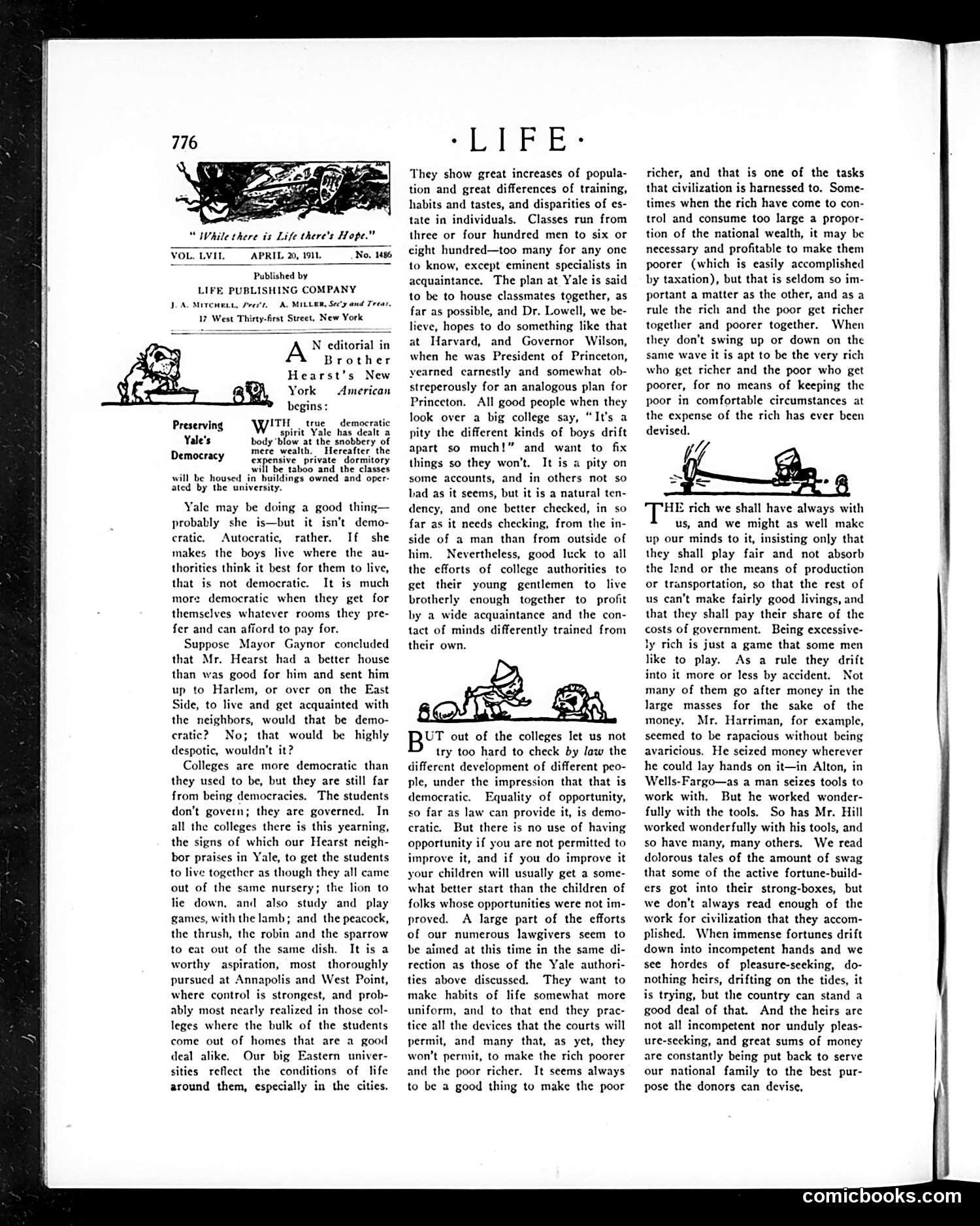
This page from *Life* magazine (April 20, 1912) contains an editorial titled "Preserving Yale's Democracy" alongside three small cartoon vignettes illustrating the text. The editorial discusses wealth inequality and social mobility, arguing that colleges should help poor students rise in status alongside rich ones. The cartoons appear to show working-class figures—laborers with tools—contrasted with wealthier individuals, visually reinforcing the editorial's point about class disparities. The piece references Yale, Harvard, Princeton, and Governor Wilson, discussing how colleges should foster democratic principles by housing students together regardless of wealth and giving poor students equal opportunity to succeed. The satire critiques how even "democratic" institutions can reinforce class divisions if they don't actively work against them.
📄 Transcribed text from this page (OCR, searchable)
Machine-transcribed from the original scan — historical spelling and the odd misread are preserved.
“ While there is Life there's Hope.” VOL. LVI, APRIL 20, 1911. No, 1486 Published by LIFE PUBLISHING COMPANY JOA. Mivewent, Prete AL MILL ty-first Street, New York rey and Treas, editorial in Brother Hearst’s New York = American begins: with true democratic spirit Yale has dealt a body “blow at the snobbery of mere wealth, Hereafter the nsive private dormitory will be taboo and the classes will be housed in buildings owned and oper- ated by the university. Preserving Yale's Democracy Yale may be doing a good thing— probably she is—but it isn’t demo- cratic. Autocratic, rather. If she makes the boys live where the au- ies think it best for them to live, that is not democratic. It is much more democratic when they get for themselves whatever rooms they pre- fer and can afford to pay for. Suppose Mayor Gaynor concluded that Mr. Hearst had a better house than was good for him and sent him up to Harlem, or over on the East Side, to live and get acquainted with the neighbors, would that be demo- cratic? No; that would be highly despotic, wouldn't it? Colleges are more democratic than they used to be, but they are still far from being democracies. The students don’t govern; they are governed. In all the colleges there is this yearning, the signs of which our Hearst neigh- bor praises in Yale, to get the students to live together as though they all came out of the same nursery; the lion to lie down, and also study and play games, with the lamb; and the peacock, the thrush, the robin and the sparrow to eat out of the same dish. It is a worthy aspiration, most thoroughly pursued at Annapolis and West Point, where control is strongest, and prob- ably most nearly realized in those col- leges where the bulk of the students come out of homes that are a good deal alike. Our big Eastern univer- sities reflect the conditions of life around them, especially in the cities. “al RAR They show great increases of popula- tion and great differences of training, habits and tastes, and disparities of ¢s- tate in individuals. Classes run from three or four hundred men to six or cight hundred—too many for any one to know, except eminent specialists in acquaintance. The plan at Yale is said to be to house classmates together, as far as possible, and Dr. Lowell, we be- lieve, hopes to do something like that at Harvard, and Governor Wilson, when he was President of Princeton, yearned carnestly and somewhat ob- streperously for an analogous plan for Princeton. All good people when they look over a big college say, “It’s a pity the different kinds of boys drift apart so much!” and want to fix things so they won't. It is a pity on some accounts, and in others not so bad as it seems, but it is a natural ten- dency, and one better checked, in so far as it needs checking, from the in- side of a man than from outside of him. Nevertheless, good luck to all the efforts of college authorities to get their young gentlemen to live brotherly enough together to profit by a wide acquaintance and the con- tact of minds differently trained from their own. UT out of the colleges Iet us not try too hard to check by law the different development of different peo- ple, under the impression that that is democratic. Equality of opportunity, so far as law can provide it, is demo- cratic. But there is no use of having opportunity if you are not permitted to improve it, and if you do improve it your children will usually get a some- what better start than the children of folks whose opportunities were not im- proved. A large part of the efforts of our numerous lawgivers seem to be aimed at this time in the same di- rection as those of the Yale authori- ties above discussed. They want to make habits of life somewhat more uniform, and to that end they prac- tice all the devices that the courts will permit, and many that, as yet, they won't permit, to make the rich poorer and the poor richer. It seems always to be a good thing to make the poor richer, and that is one of the tasks that civilization is harnessed to. Some- times when the rich have come to con- trol and consume too large a propor- tion of the national wealth, it may be necessary and profitable to make them poorer (which is easily accomplished by taxation), but that is seldom so im- portant a matter as the other, and as a tule the rich and the poor get richer together and poorer together. When they don’t swing up or down on the same wave it is apt to be the very rich who get richer and the poor who get poorer, for no means of keeping the poor in comfortable circumstances at the expense of the rich has ever been devised. TH Tich we shall have always with us, and we might as well make up our minds to it, insisting only that they shall play fair and not absorb the lend or the means of production or transportation, so that the rest of us can’t make fairly good livings, and that they shall pay their share of the costs of government. Being excessive- ly rich is just a game that some men like to play. As a rule they drift into it more or less by accident. Not many of them go after money in the large masses for the sake of the money. Mr. Harriman, for example, seemed to be rapacious without being avaricious. He seized money wherever he could lay hands on it—in Alton, in Wells-Fargo—as a man seizes tools to work with. But he worked wonder- fully with the tools. So has Mr. Hill worked wonderfully with his tools, and so have many, many others. We read dolorous tales of the amount of swag that some of the active fortune-build- ers got into their strong-boxes, but we don’t always read enough of the work for civilization that they accom- plished. When immense fortunes drift down into incompetent hands and we see hordes of pleasure-secking, do- nothing heirs, drifting on the tides, it is trying, but the country can stand a good deal of that. And the heirs are not all incompetent nor unduly pleas- ure-secking, and great sums of money are constantly being put back to serve our national family to the best pur- pose the donors can devise, comicbooks.com