
Life, 1911-04-20 · page 29 of 52
Life — April 20, 1911 — page 29: what you’re looking at
What you’re looking at
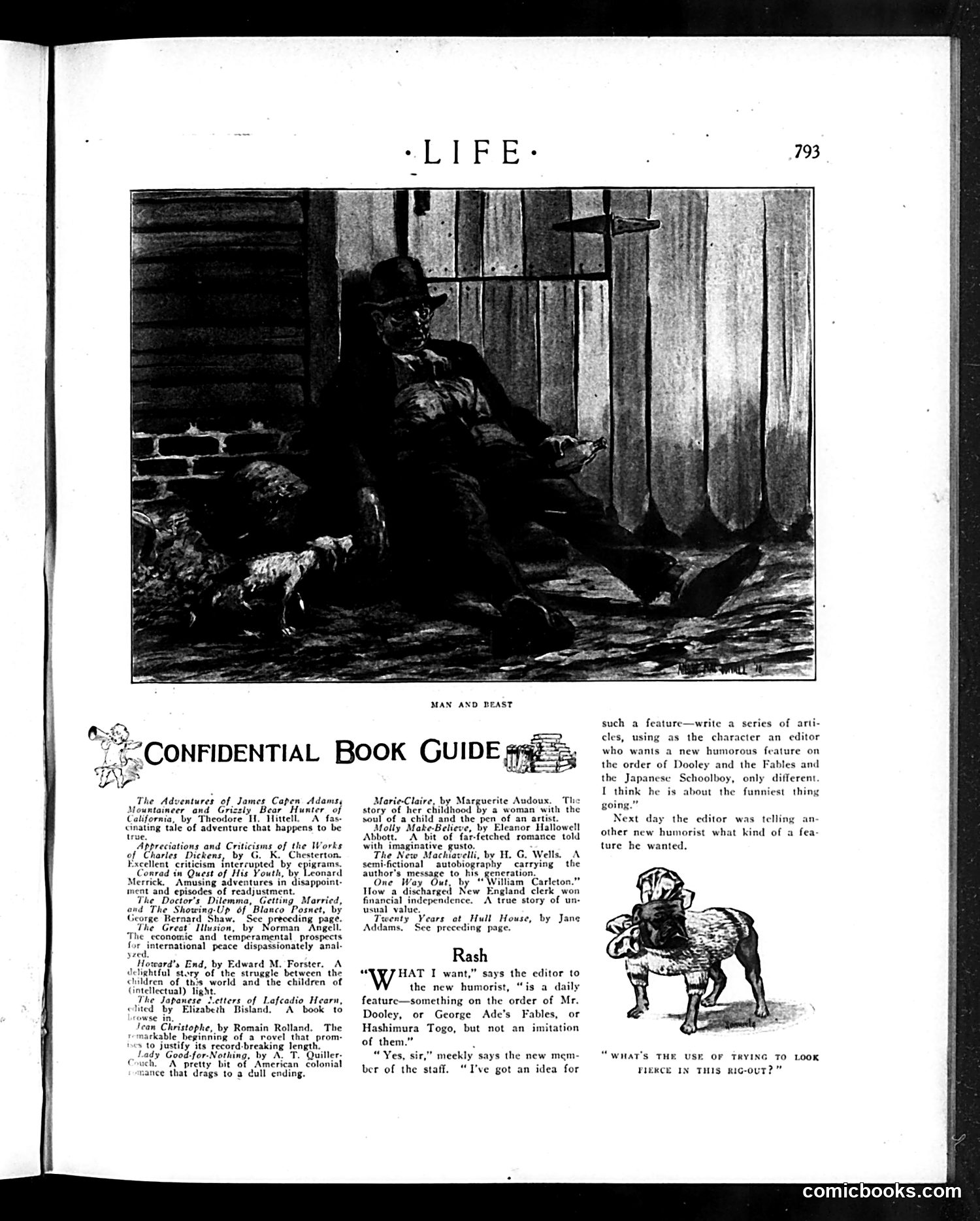
This page from *Life* magazine contains a book review section and a brief satirical dialogue about humor writing. The main cartoon depicts a conversation between an editor and a new staff humorist. The editor requests a daily humorous column modeled after popular contemporary features like Mr. Dooley (a famous satirical character) or George Ade's Fables. The new writer eagerly agrees, then proposes writing about an editor seeking a humorous column—essentially offering to write about the exact conversation happening between them. The satire's point: **circular imitation**. The joke mocks the publishing industry's reliance on derivative content and formulaic humor. Rather than creating something original, the new writer simply proposes recycling the editor's own request as material, mirroring the editor's complaint that he doesn't want "an imitation" of existing popular features—yet that's precisely what gets offered back to him. The accompanying illustration of a disheveled figure humorously captions this irony about the difficulty of appearing authoritative when discussing such absurd creative circumstances.
📄 Transcribed text from this page (OCR, searchable)
Machine-transcribed from the original scan — historical spelling and the odd misread are preserved.
ntures of James Capen Adams, Mountaineer and Grizely Bear Hunter of California, by Theodore H. Hittell. A fas- cinating tale of adventure that happens to be true. Appreciations and Criticisms of the Works of Charles Dickens, by G. K. Chesterton. Excellent criticism Interrupted ‘by epigrams. Conrad in Quest of His Youth, by Leonard Merrick. Amusing adventures in disappoint- ‘at and episodes of readjustment. he Doctor's. Dilemma, Getting Married, ond The Showing-Up 6f Blanco Posnet, by George Rernard Shaw. See preceding page. The Great Illusion, by Norman Angell. ‘The economic and temperamental prospects for international peace dispassionately anal- Howard's End, by Edward M. Forster. A lightful story of the struggle between the clildren of this world and the children of Gotelleetual) light The Japanese Setters of Lafcadio Hearn, clited ‘by Elizabeth Bisland, A rowse Christophe, by Romain Rolland. The arkable beginning of a novel that’ prom- to justify its record-breaking length. lady Good-for-Nothing, by A. T. Quiller- ch. A pretty bit of American colonial ce that drags to a dull ending. MarieClaire, by Marguerite Audoux. The story of her childhood by a woman with the soul of a child and the pen of an artist. Molly Make-Believe, by Eleanor Hallowell Abbott. A bit of far-fetched romance told with imaginative gust The New Machiavelli, by H. G, Wells. A semi-fictional autobiography "carrying | the author's message to his generation. One Way Out, by “William Carleton.” How a discharged New England clerk won financial independence. usual value, Twenty Years ot Hull House, by Jane Addams. See preceding page. Rash HAT I want,” says the editor to the new humorist, “is a daily feature—something on the order of Mr. Dooley, or George Ade’s Fables, or Hashimura Togo, but not an imitation of them i “Yes, sir,” meekly says the new mem- ber of the staff. “I've got an idea for A true story of un- such a feature—write a series of a cles, using as the character an editor who wan ture on the order of Dooley and the Fables and the Japanese Schoolboy, only different. I think he is about the funniest thing going.” Next day the editor was telling a other new humorist what kind of a fea- ture he wanted. a new humorous fe “WHAT'S THE USE OF TRYING TO LOOK FIERCE IN THIS RiG-0oUT?” comicbooks.com