
A complete issue · 76 pages · 1911
Life — April 6, 1911
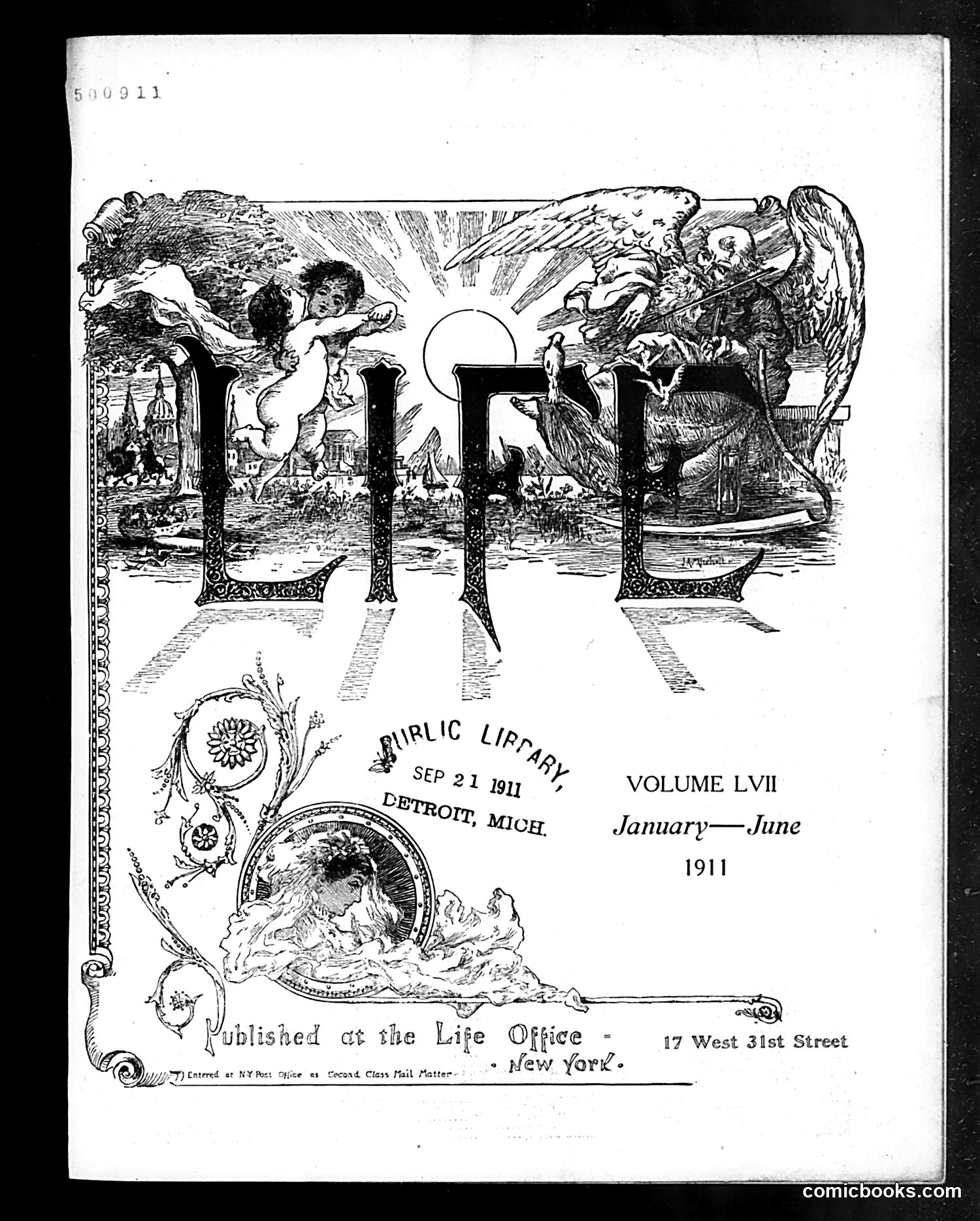
This is the cover of *Life* magazine's January–June 1911 issue. The elaborate decorative illustration depicts a classical or allegorical scene with cherubs, an angel, and ethereal figures surrounding a rising or setting sun. The ornamental design includes floral motifs and an architectural frame with columns. The imagery appears symbolic rather than depicting specific current events or political figures. The celestial and classical elements—common in *Life*'s decorative aesthetic of this era—likely represent themes of renewal, enlightenment, or artistic idealization rather than satirizing particular people or events. Without additional text identifying specific references, the exact satirical meaning or topical commentary remains unclear from the visual alone.
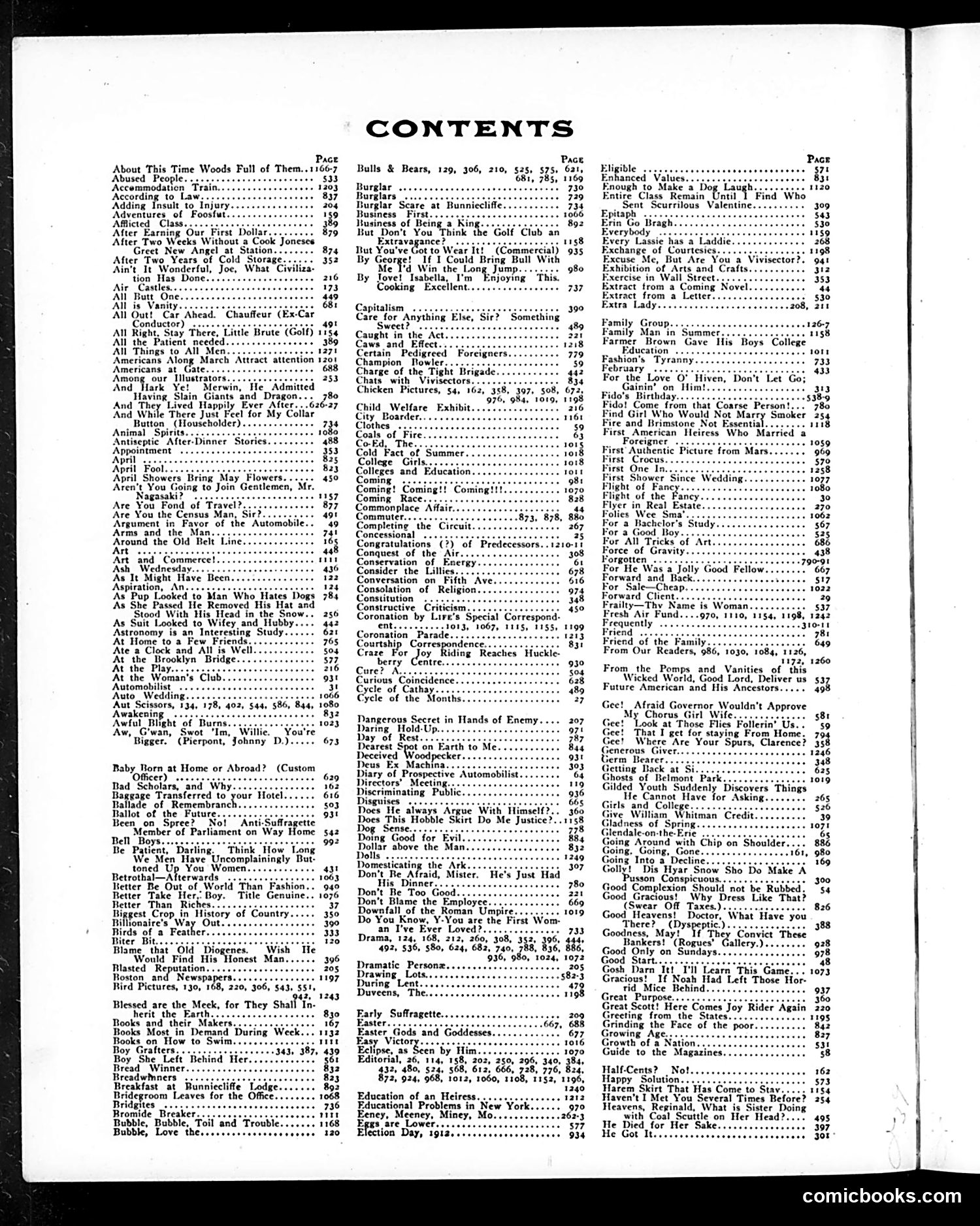
I can see this is a contents page from Life magazine listing article and cartoon titles with their page numbers. However, I cannot see the actual cartoons or illustrations on this page—only the text index. From the OCR'd titles visible, I can identify references to contemporary issues like "Burglar Scare at Bunniecliffe," "Child Welfare Exhibit," and "Early Suffragette," suggesting this is from the early 1900s when women's suffrage was a major topic. To explain the specific cartoons' meaning, satire, and political references, I would need to see the actual images themselves. The contents listing alone doesn't reveal the visual humor or commentary that made Life magazine famous for its satirical illustrations.
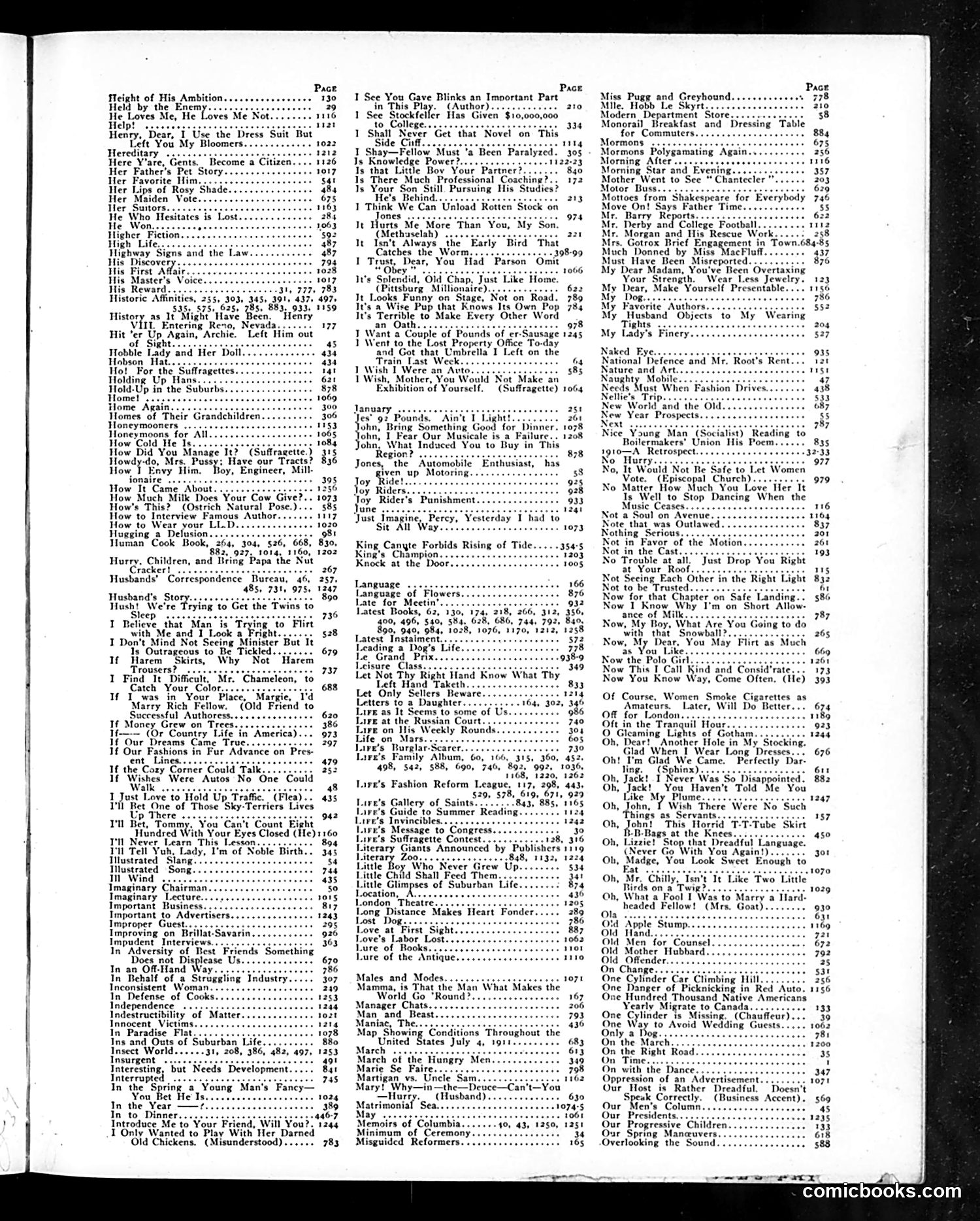
This appears to be a table of contents page from Life magazine rather than a cartoon page. The image shows a dense index listing article titles and corresponding page numbers, organized alphabetically from "H" through "O". The content reflects early 20th-century American concerns: references to topics like "Suffragettes," "Automobiles," "Country Life," and various social commentaries suggest this is from Life's period as a general satirical and humor magazine covering politics, society, and culture. Without seeing the actual illustrated content, I cannot identify specific cartoons or caricatures. This is primarily a reference/navigation page for the magazine's contents rather than substantive editorial material itself.
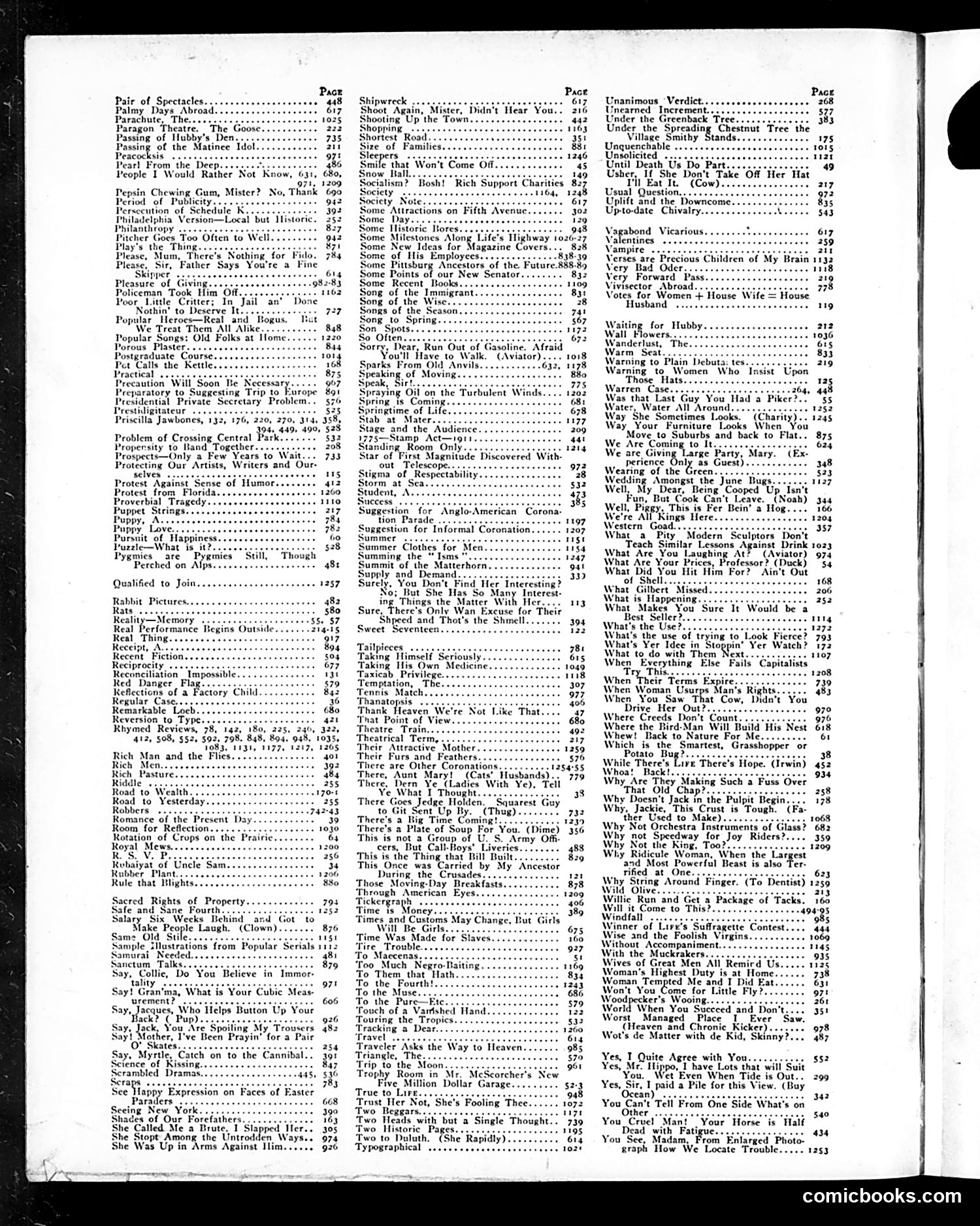
I'm unable to view the specific cartoons or illustrations on this page clearly enough to provide reliable identifications of figures, caricatures, or satirical content. What I can see is a dense index or table of contents listing numerous article and cartoon titles from Life magazine, with page numbers. To accurately explain the political and social satire for a modern reader—identifying specific figures, historical references, and the intended jokes—I would need a clearer image of the actual cartoons themselves, not just the text index. If you could share the image more clearly or specify which cartoon title interests you, I could better help explain its historical context and satirical meaning.
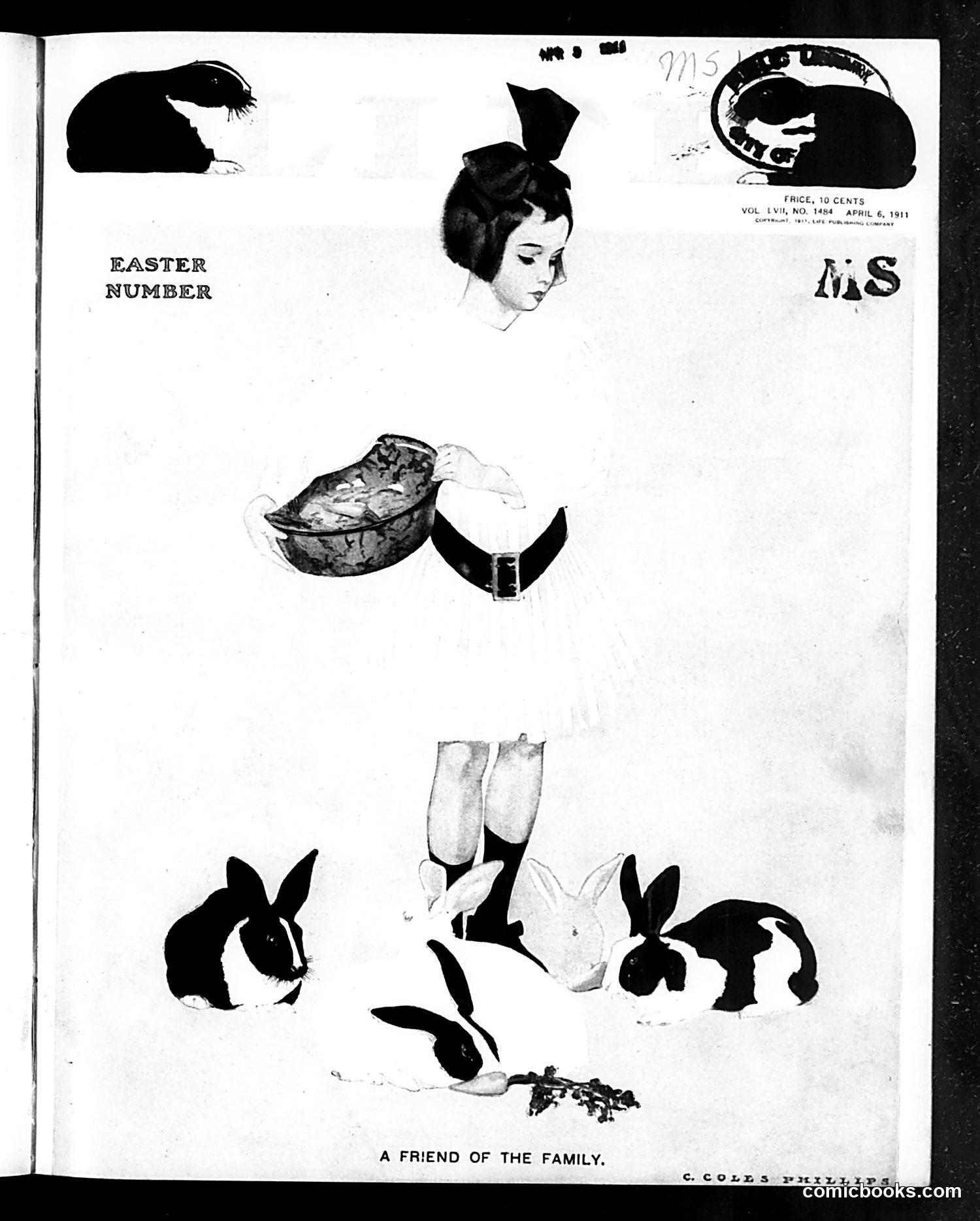
This Easter-themed cover satirizes the holiday's commercialization through fashion and consumption. The central illustration shows a fashionable woman with an elaborate Easter bonnet (the large decorated hat was a major fashion statement for Easter), holding a basket—likely representing the commercial excess associated with Easter celebrations. The silhouetted rabbits at the bottom, labeled "A Friend of the Family," humorously reference Easter's bunny tradition while suggesting irony about the holiday's association with consumption and material goods rather than religious meaning. The magazine's title "MS" and price of "10 cents" appears at top. This satirizes how Easter had become primarily a commercial holiday focused on fashion, gifts, and consumerism rather than its religious significance.
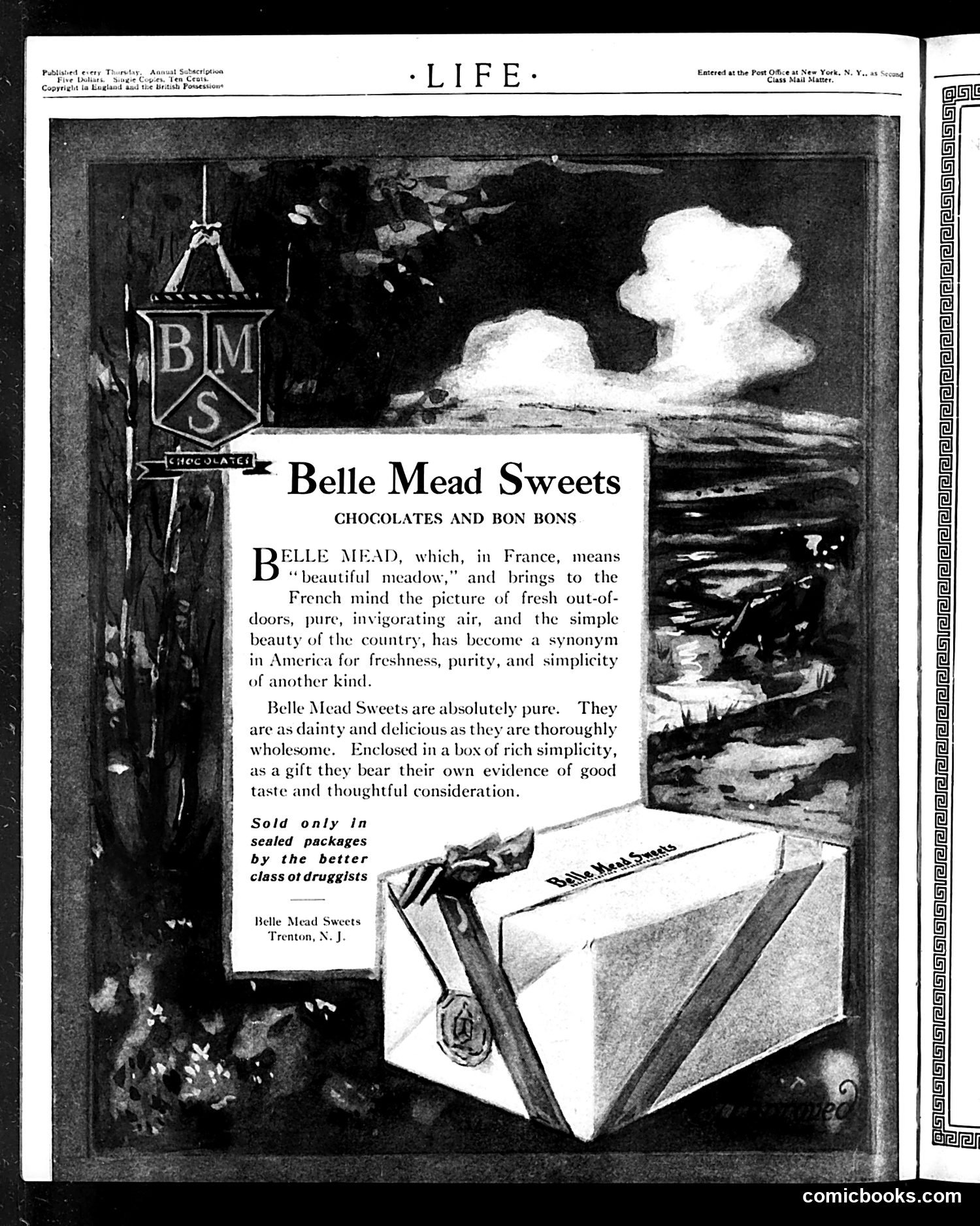
This is primarily a commercial advertisement, not political satire. The page promotes Belle Mead Sweets chocolates and bon bons from Trenton, New Jersey. The ad uses the French name "Belle Mead" (meaning "beautiful meadow") to evoke European sophistication and natural purity—marketing appeals common in early 20th-century advertising. The pastoral imagery (clouds, landscape) reinforces associations with freshness and simplicity. The product was apparently sold exclusively through drugstores in sealed packages, positioning it as a premium gift item for the discerning consumer. The marketing strategy emphasizes wholesomeness and "thoughtful consideration," suggesting Belle Mead Sweets as an appropriate gift demonstrating good taste. This reflects no identifiable political content or satire—it's straightforward product marketing typical of *Life* magazine's advertising pages.
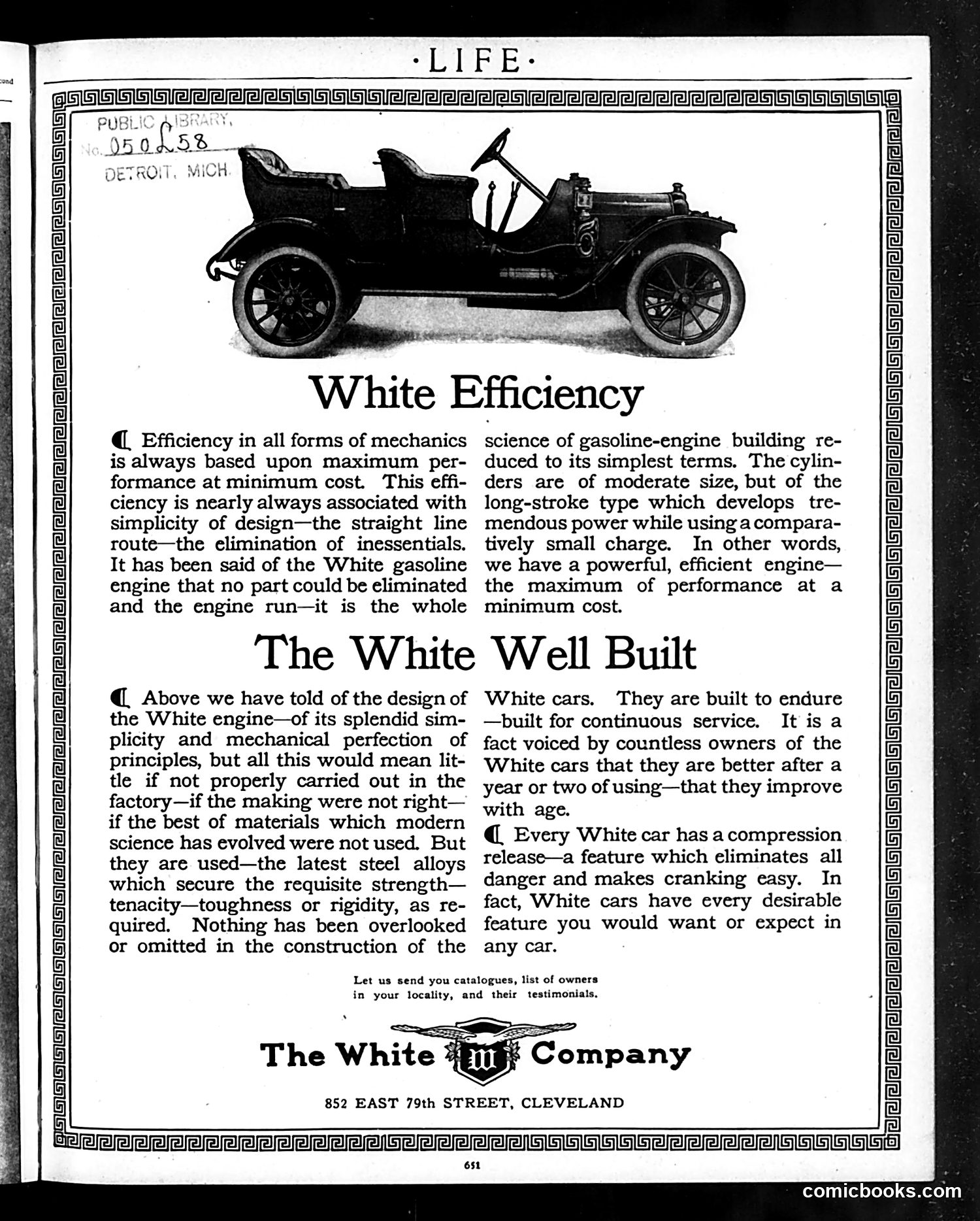
This is a **straightforward automobile advertisement**, not satirical content. The White Company, based in Cleveland, marketed their gasoline-powered cars by emphasizing engineering excellence and durability. The ad argues that White cars embody "efficiency"—maximum performance at minimum cost—through careful mechanical design. The illustration shows a early 1900s open-air touring automobile. Key selling points highlighted: the engine's long-stroke design, use of modern steel alloys, compression-release feature for easy starting, and the claim that White cars "improve with age." The company invites readers to request catalogues and owner testimonials. This represents typical early automotive advertising emphasizing technical specifications and reliability to convince consumers in an era when cars were still luxury items requiring detailed justification.
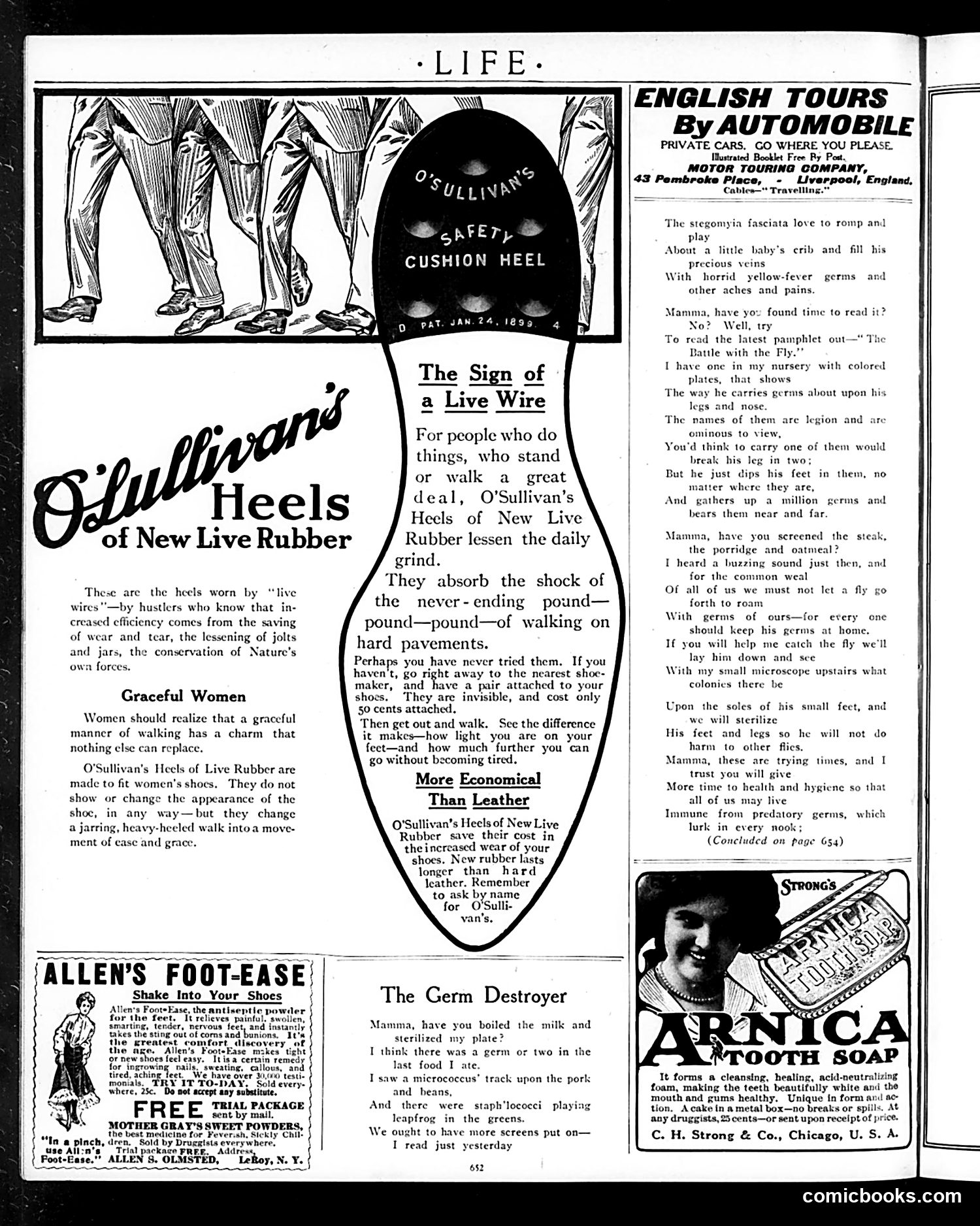
This page is primarily **advertising content** rather than satirical cartoons. It features multiple product advertisements typical of early 20th-century magazines: 1. **O'Sullivan's Heels** - A major advertisement promoting rubber heels that reduce walking fatigue on hard pavements, marketed toward women as providing "grace" and comfort. 2. **Allen's Foot-Ease** - An antifungal powder for foot ailments, with testimonial-style copy. 3. **Arnica Tooth Soap** - A dental hygiene product. 4. **English Tours by Automobile** - A travel service advertisement. 5. **Strongs Arnica Tooth Soap** - Another dental product. The page also contains what appears to be advice column text titled "The Germ Destroyer," discussing household hygiene (boiling milk, sterilizing plates). There is **no political satire** visible on this page—it's purely commercial content and lifestyle advice typical of Life's era.
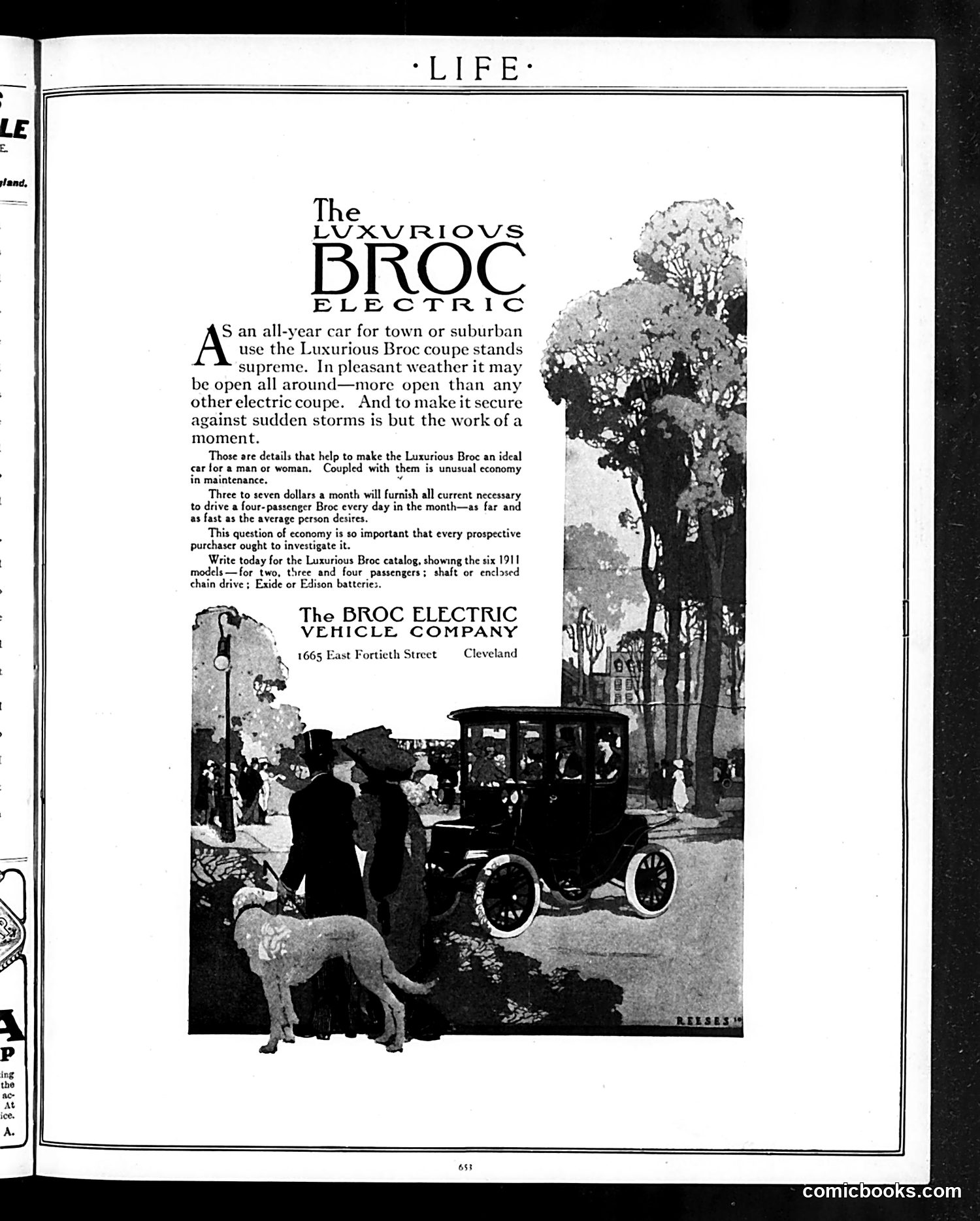
This is a **full-page advertisement** for the Luxurious Broc Electric automobile, manufactured by The Broc Electric Vehicle Company in Cleveland. The ad emphasizes the car's appeal as "an all-year car for town or suburban use," highlighting its convertible coupe design and low operating costs (claiming "$3 to $7 per month" in electricity). The accompanying illustration shows a genteel street scene with well-dressed pedestrians and a dog, positioning the vehicle as suitable for pleasant urban driving. This reflects the **early 1900s electric car market**, when electric vehicles competed seriously with gasoline cars before internal combustion engines eventually dominated. The advertisement targets wealthy urban consumers by emphasizing convenience, economy, and social respectability rather than performance.
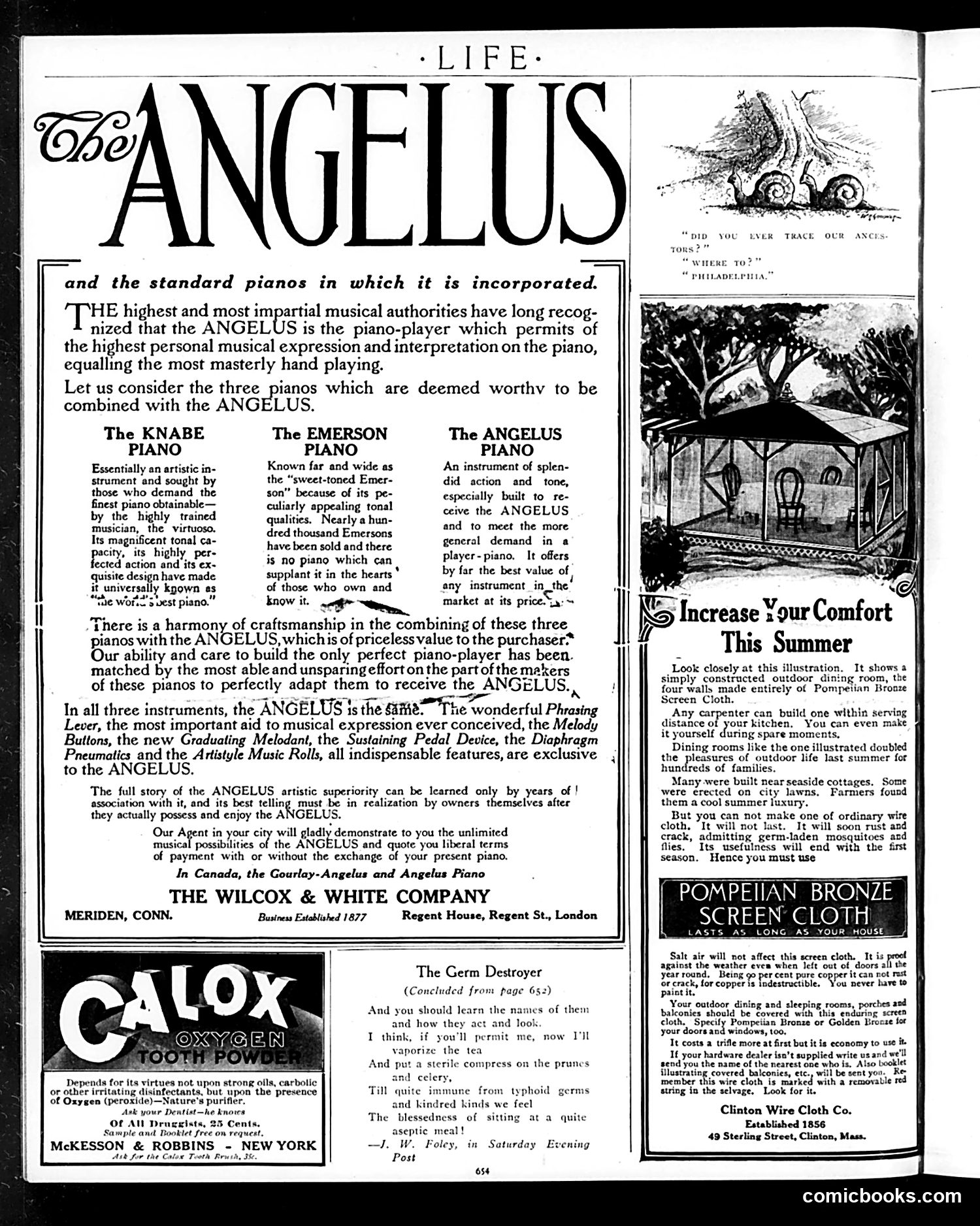
This page is primarily **advertising**, not satire or political commentary. The main feature is a large advertisement for the **Angelus piano** by the Wilcox & White Company, which emphasizes the instrument's superior craftsmanship and musical capabilities. The ad compares three piano models (Knabe, Emerson, and Angelus) and claims the Angelus offers the best value. The page also contains smaller advertisements for: - **Pompeian Bronze Screen Cloth** (a durable outdoor fabric) - **Calox Oxygen** (a dental product) - **Chicago Wire Cloth Co.** (industrial screening) These are standard commercial advertisements typical of *Life* magazine's revenue model. There is no political satire or cartoon commentary visible on this particular page—it functions as a commercial vehicle rather than editorial content.
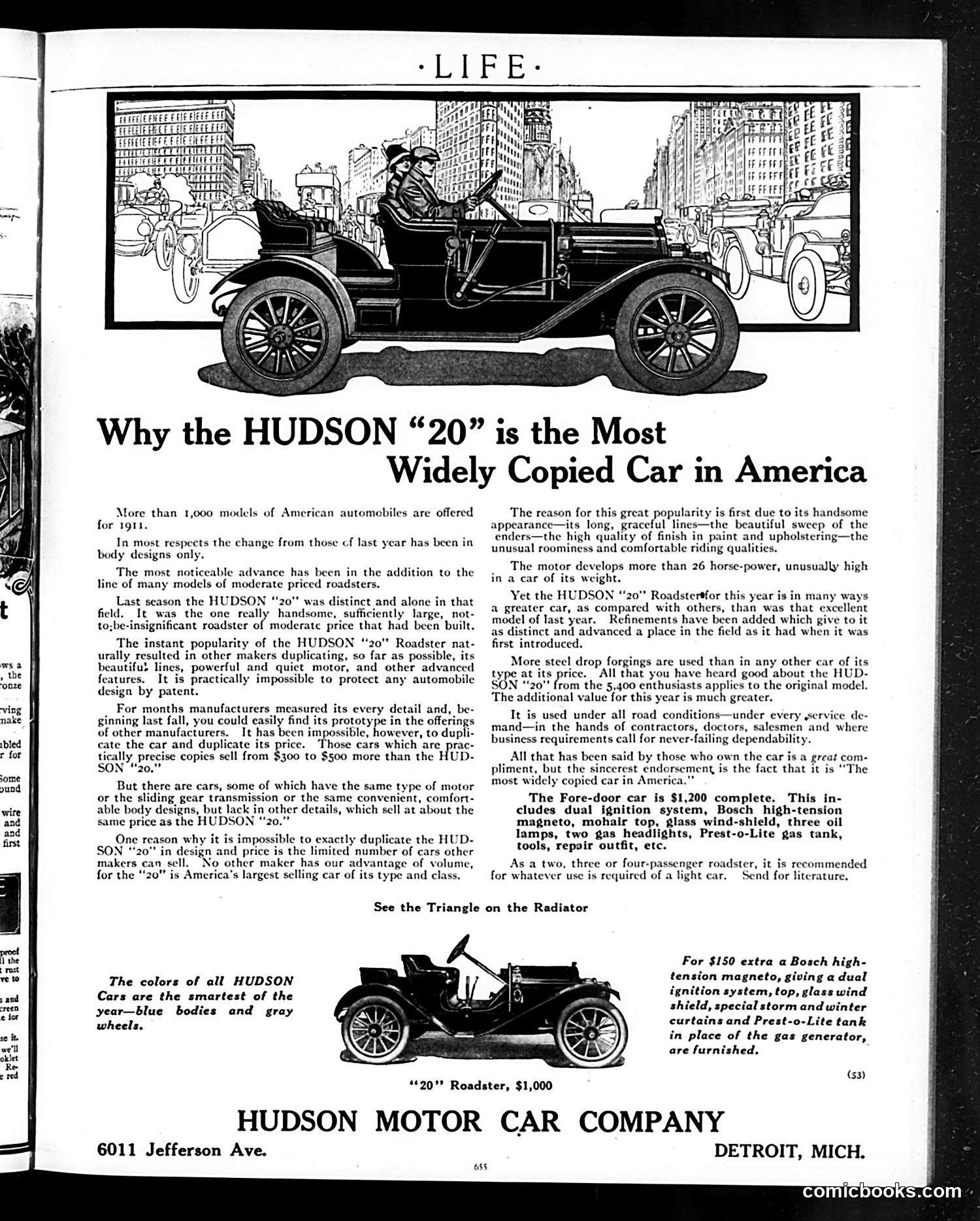
This is primarily a **Hudson Motor Car Company advertisement** from *Life* magazine, not a political cartoon. The page promotes the Hudson "20" automobile as "the Most Widely Copied Car in America." The advertisement includes: - An illustration of the Hudson "20" roadster in an urban street scene - Claims about the car's superior design, handsome appearance, and 26 horsepower motor - The car's $1,000 price point and various features (magnetic top, glass windshield, etc.) The "satire" here is subtle: Hudson boasts that competitors copy its design, framing imitation as proof of excellence rather than admitting it faces genuine competition. This was a common early-1910s marketing strategy—turning market pressure into a selling point. The page includes technical specifications and company contact information in Detroit, Michigan.
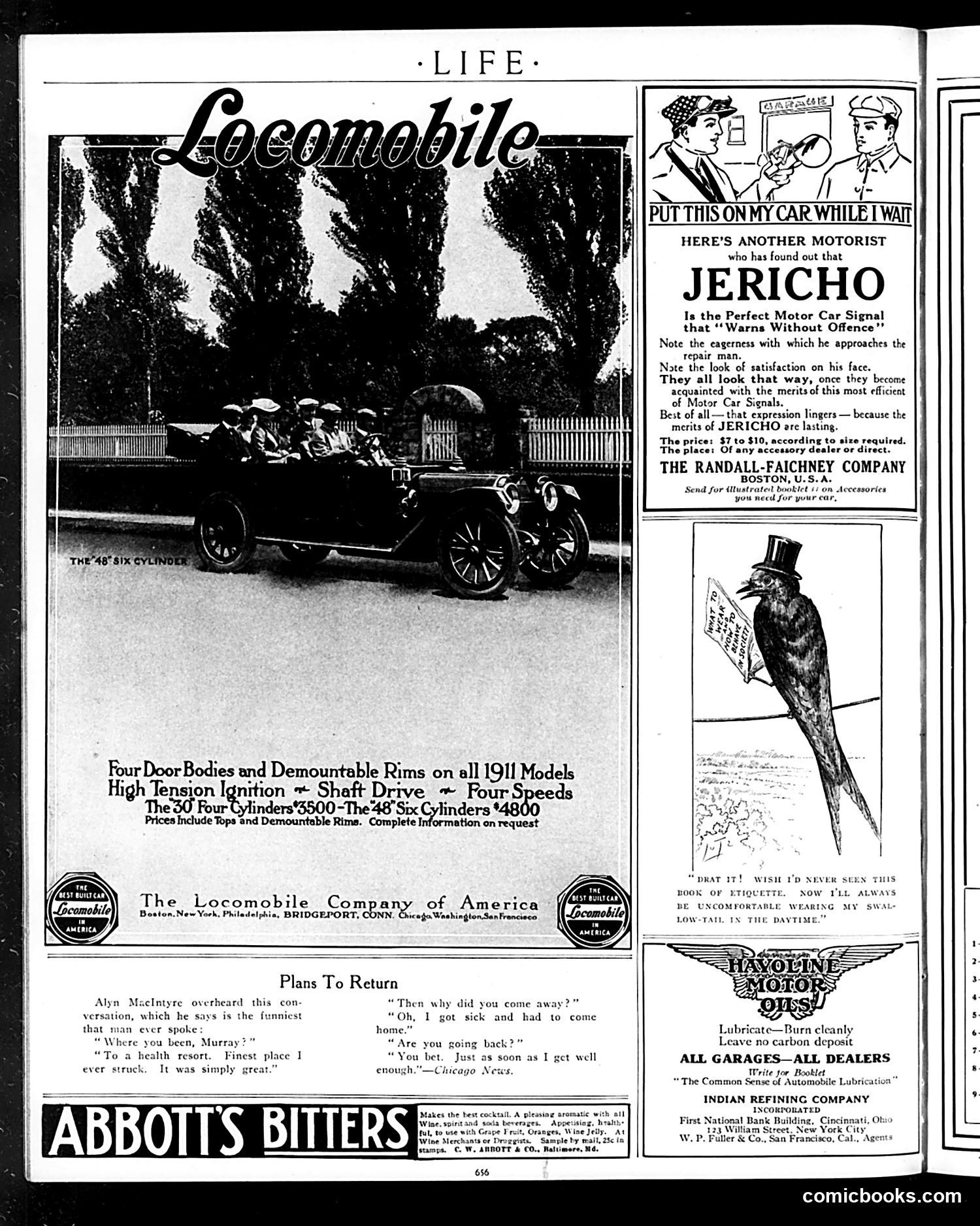
This page is primarily **advertising rather than political satire**. The main content features a Locomobile automobile advertisement (left side) showcasing the "48" Six Cylinder model with four-door bodies. The right side contains additional car-related ads, including a Jericho motor car signal advertisement and a Hasoline motor oil ad. There's also an unrelated Abbott's Bitters liquor advertisement at the bottom. A small humor section titled "Plans To Return" presents a brief conversational joke about someone's vacation absence—he went to a resort, became ill, and returned home early. The cartoonish bird illustration appears to be part of a Hasoline advertisement, making a joke about motor oil ("Beat it! Wish I'd never seen this hood of etiquette..."). Overall, this is a Life magazine advertising page circa 1911, with minimal satirical content.
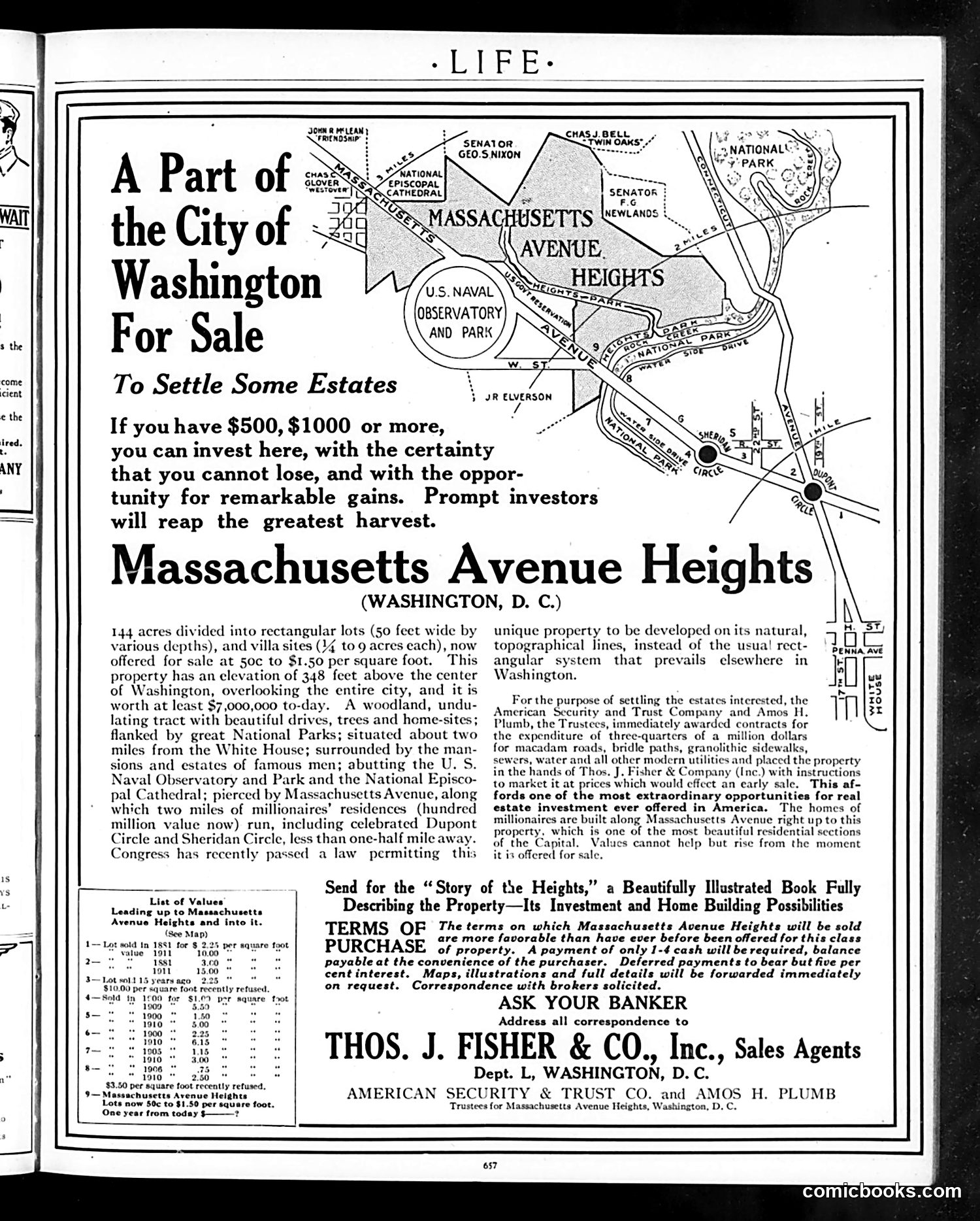
This is **primarily an advertisement**, not a cartoon or satirical content. It promotes "Massachusetts Avenue Heights," a real estate development in Washington, D.C. The ad targets investors with modest capital ($500+), promising safe investment with "remarkable gains" and appealing to the aspirational wealthy. It emphasizes proximity to prestigious landmarks (U.S. Naval Observatory, National Parks, mansions of "millionaires"). The accompanying map shows the property's location in Washington's desirable neighborhoods. A "List of Values" table demonstrates historical property appreciation. The sales pitch exploits early-20th-century optimism about Washington real estate while suggesting this development offers unique advantages over typical rectangular-lot subdivisions—"developed on its natural, topographical lines." **No satirical content or political cartoon is present on this page.**
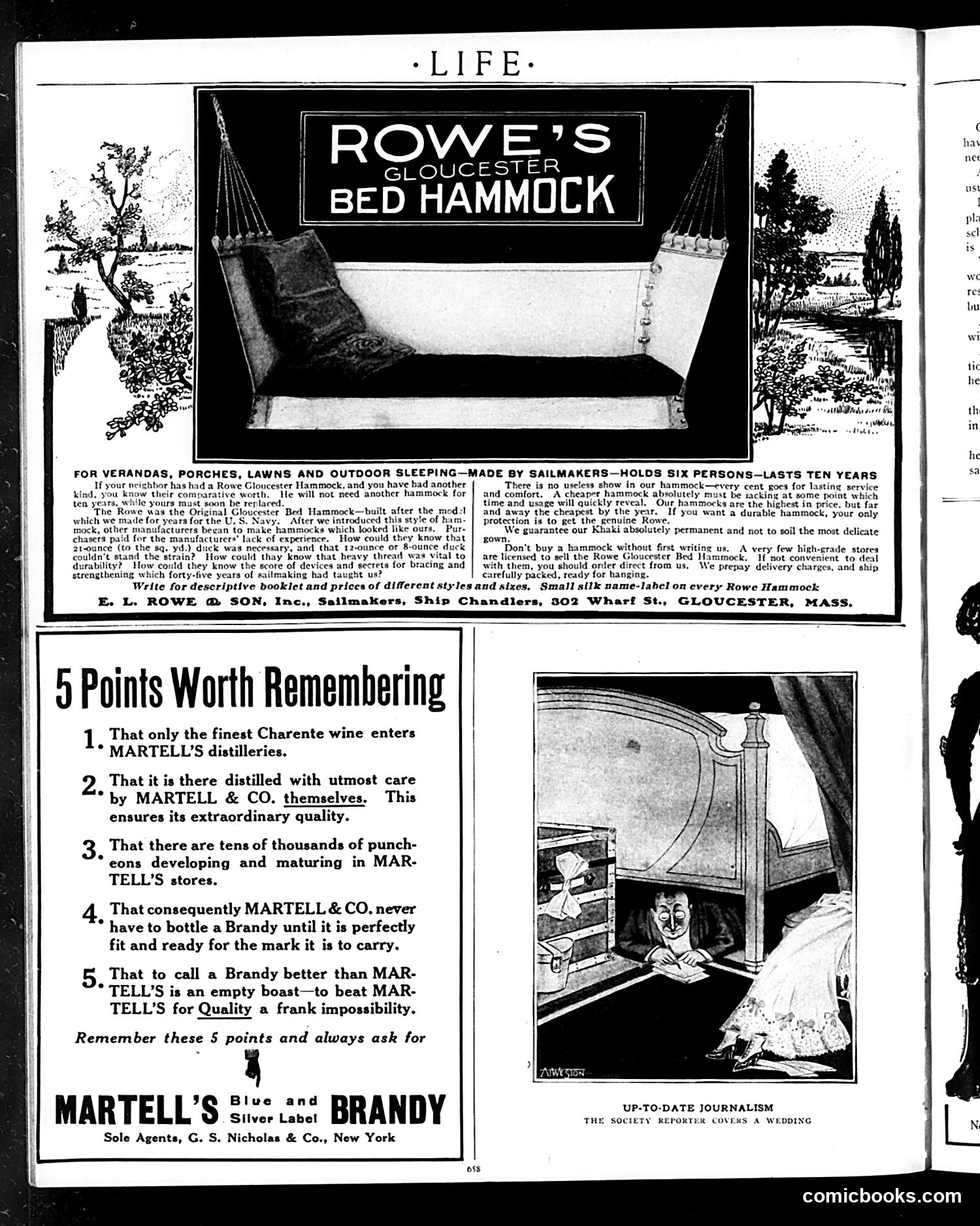
This page contains **two product advertisements** from the early 20th century—not political satire or comics requiring historical context. **Top advertisement:** Rowe's Gloucester Bed Hammock, marketed as a durable outdoor product made by sailmakers for the U.S. Navy. It emphasizes superior construction (heavy-duty duck fabric, strong thread) and longevity (lasts ten years), contrasting itself against cheaper knockoffs that failed quickly. The appeal is to quality and value-per-year rather than initial price. **Bottom advertisement:** Martell's Brandy lists five quality-assurance points about its production—only finest grapes used, careful distillation, long aging in storage—to justify premium pricing and position it as unbeatable in quality. **Small illustration:** Titled "Up-to-Date Journalism—The Society Reporter Covers a Wedding," shows a reporter peering under a bed, likely satirizing sensationalist journalism of the era. These are straightforward commercial ads typical of *Life* magazine's revenue model, not satirical commentary.
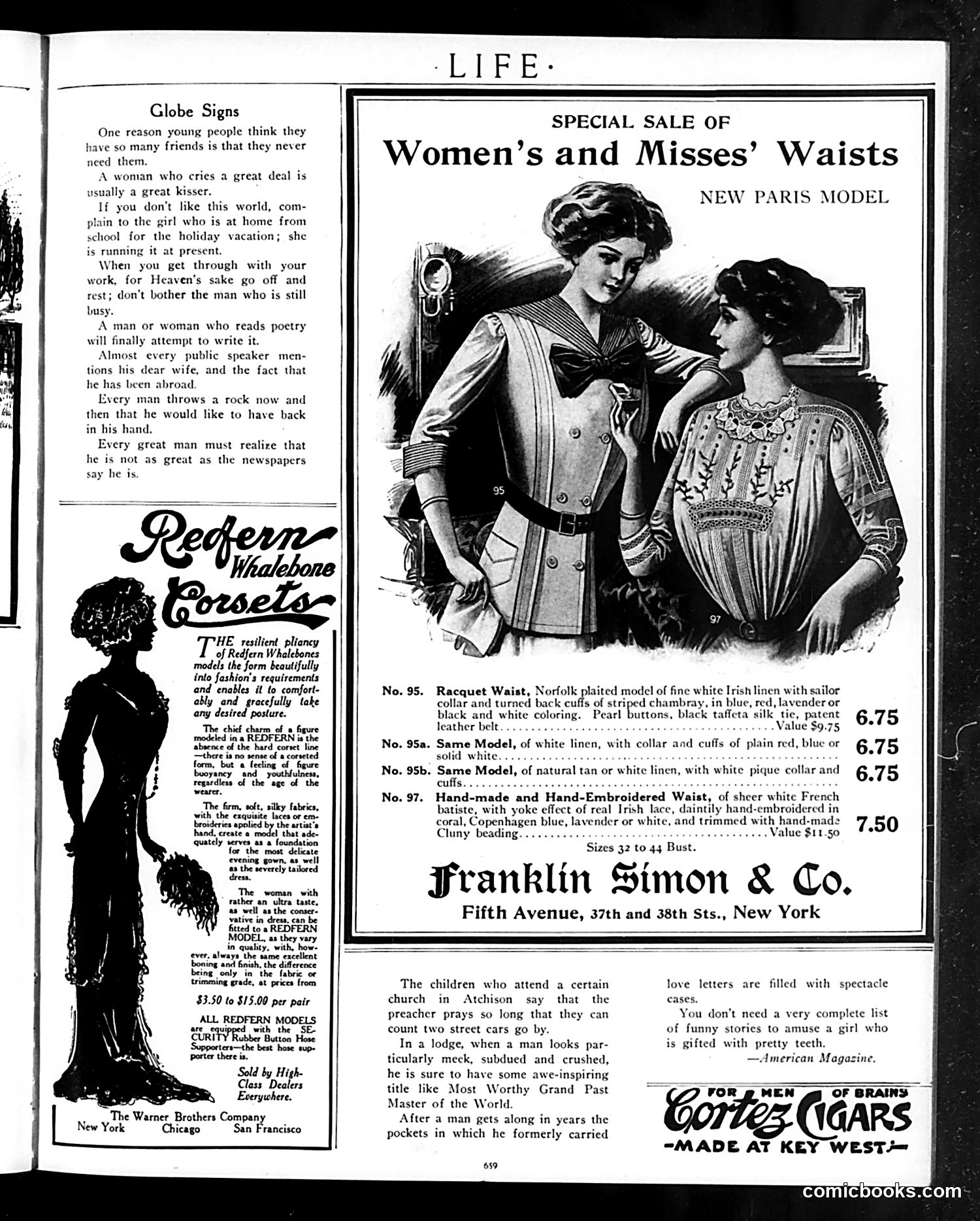
This page contains two distinct elements: **satirical observations** (left) and **commercial advertising** (center-right). The left column presents brief, cynical aphorisms mocking American social conventions—young people's friendships, women's emotional displays, returning school-age daughters running households, and the gap between newspaper portrayals and reality. These are typical of *Life's* satirical "Globe Signs" feature, offering sardonic commentary on everyday pretensions. The bulk of the page advertises women's corsets and waists from two retailers: Redfern corsets (emphasizing the elimination of visible "corset lines") and Franklin Simon & Co. waists. The advertisements feature elegant illustrations of fashionably dressed women and emphasize refined construction—hand-embroidery, fine linens, imported details. The placement of fashion advertising was typical for *Life*, which, despite its satirical editorial content, relied heavily on high-end retail advertisements targeting wealthy readers.
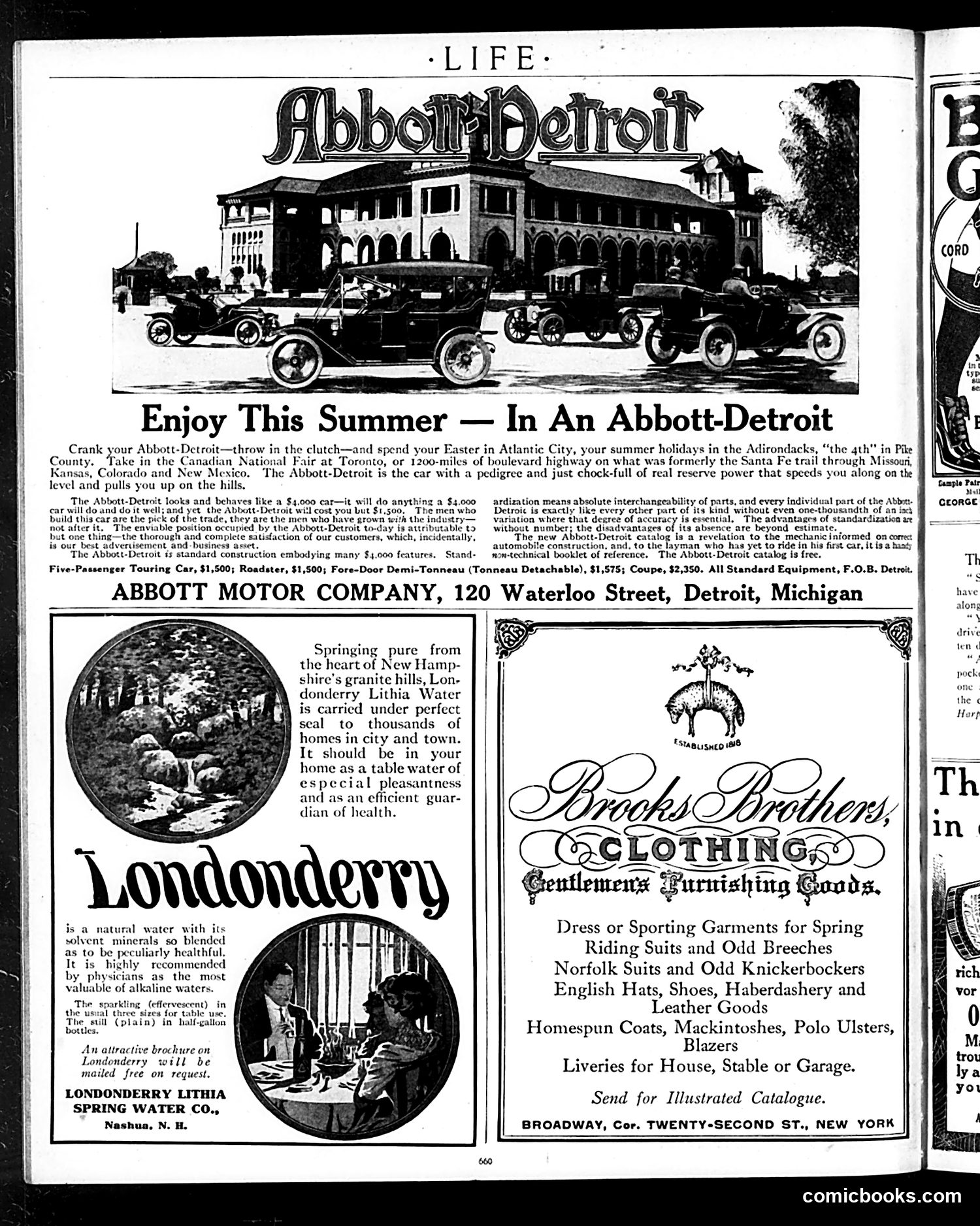
This is not a political cartoon or satirical content page. Rather, it's a full advertisement section from *Life* magazine featuring three main commercial ads: 1. **Abbott Motor Company** (top): Promotes their affordable automobile ($1,500), claiming it performs like expensive $4,000 cars through standardized manufacturing. The image shows early motorcar models outside the Abbott factory building. 2. **Londonderry Lithia Spring Water** (bottom left): Markets mineral water as a healthful beverage for home use, emphasizing its natural alkaline properties. 3. **Brooks Brothers** (bottom right): Advertises gentlemen's clothing, including suits, sporting wear, and accessories. The page represents early 20th-century consumer marketing targeting middle and upper-class readers. No satire or political commentary is present—this is straightforward product promotion typical of *Life*'s revenue model.
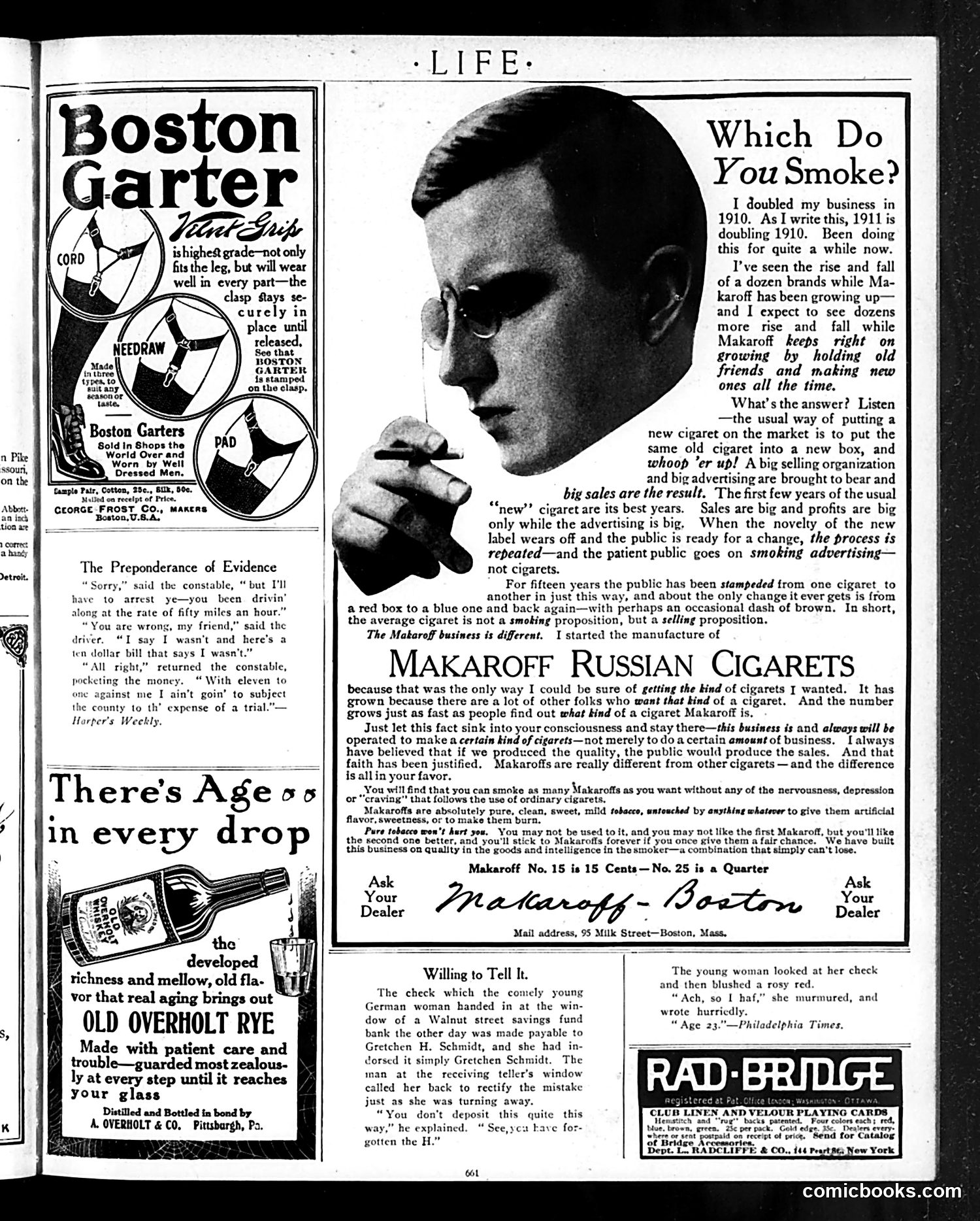
This page contains vintage advertisements and a humorous anecdote rather than political satire. **Left side ads:** Boston Garter (men's leg garters) and Old Overholt Rye whiskey—standard early 1910s product advertising. **Center anecdote ("The Preponderance of Evidence"):** A driver bribes a constable with $10 to avoid an arrest for speeding. The constable accepts, reasoning that with "eleven to one" odds against him (apparently meaning the driver's word versus his own), the county can't afford a trial. The joke satirizes police corruption and the casual nature of bribery in the era—presenting it as a humorous fait accompli rather than scandal. **Right side:** Large Makaroff Russian Cigarets advertisement featuring a man smoking, emphasizing the brand's purity and consistency versus competitors who merely repackage old products in new boxes. This reflects early 1900s marketing competition when cigarette brands rapidly rose and fell. The page is primarily **advertising-focused**, typical of Life magazine's revenue model.
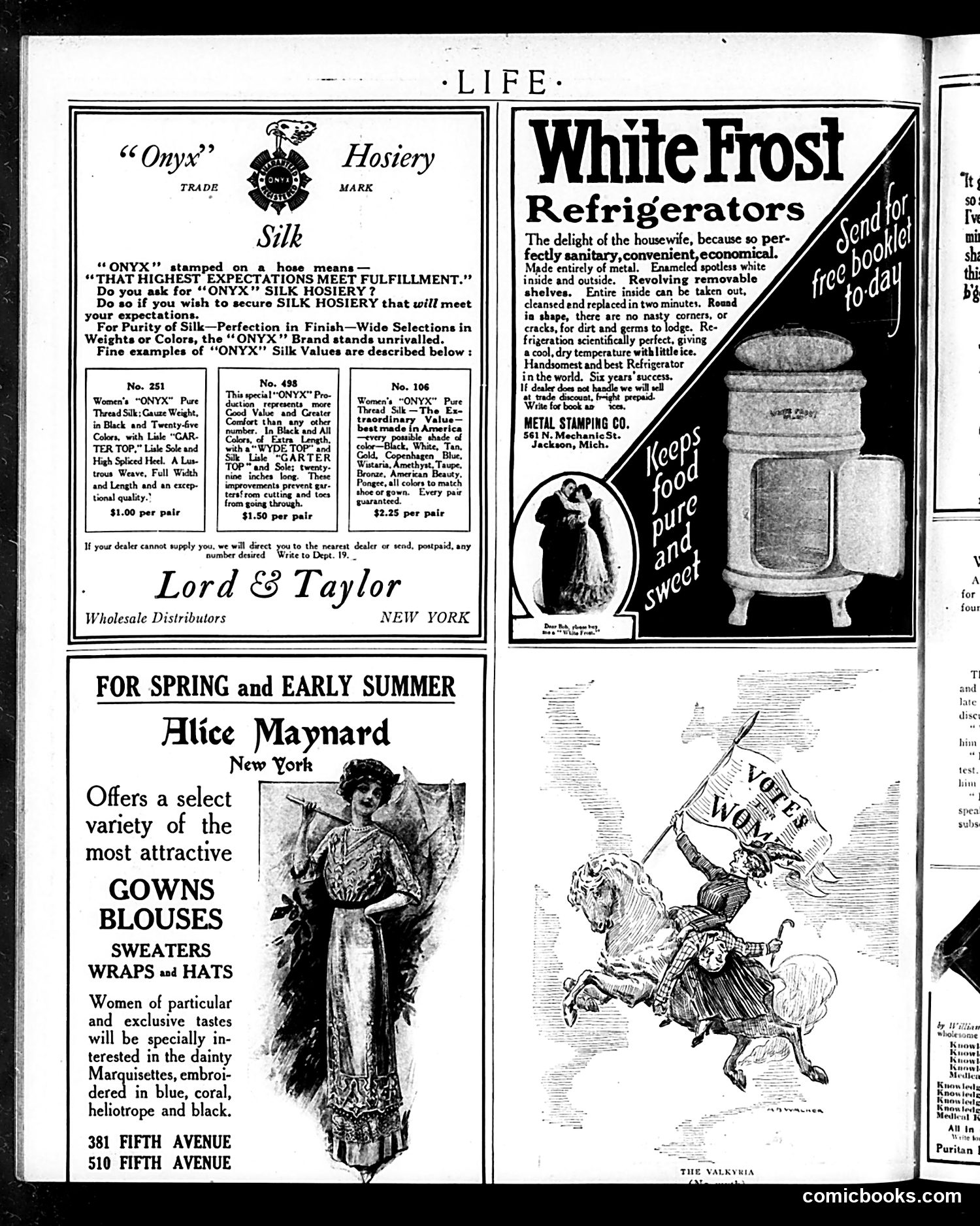
This is primarily a **commercial advertising page** rather than editorial content. The page contains four advertisements: 1. **"Onyx" Silk Hosiery** (top left): Marketed to women as premium silk stockings with various weights and colors, priced $1.00-$2.25 per pair, distributed by Lord & Taylor in New York. 2. **White Frost Refrigerators** (top right): Pitched as "the delight of the housewife" for its sanitary, convenient design with removable shelves and scientific cooling—a modern appliance for early 20th-century home management. 3. **Alice Maynard Fashion** (bottom left): Advertises women's spring/summer clothing including gowns, blouses, and hats for "women of particular and exclusive tastes." 4. **"The Valkyria"** (bottom right): An engraved illustration, likely advertising another product (text unclear in OCR). The page reflects **early 20th-century consumer culture**, emphasizing domesticity, modernity, and luxury goods marketed specifically to affluent women. No political satire is evident.
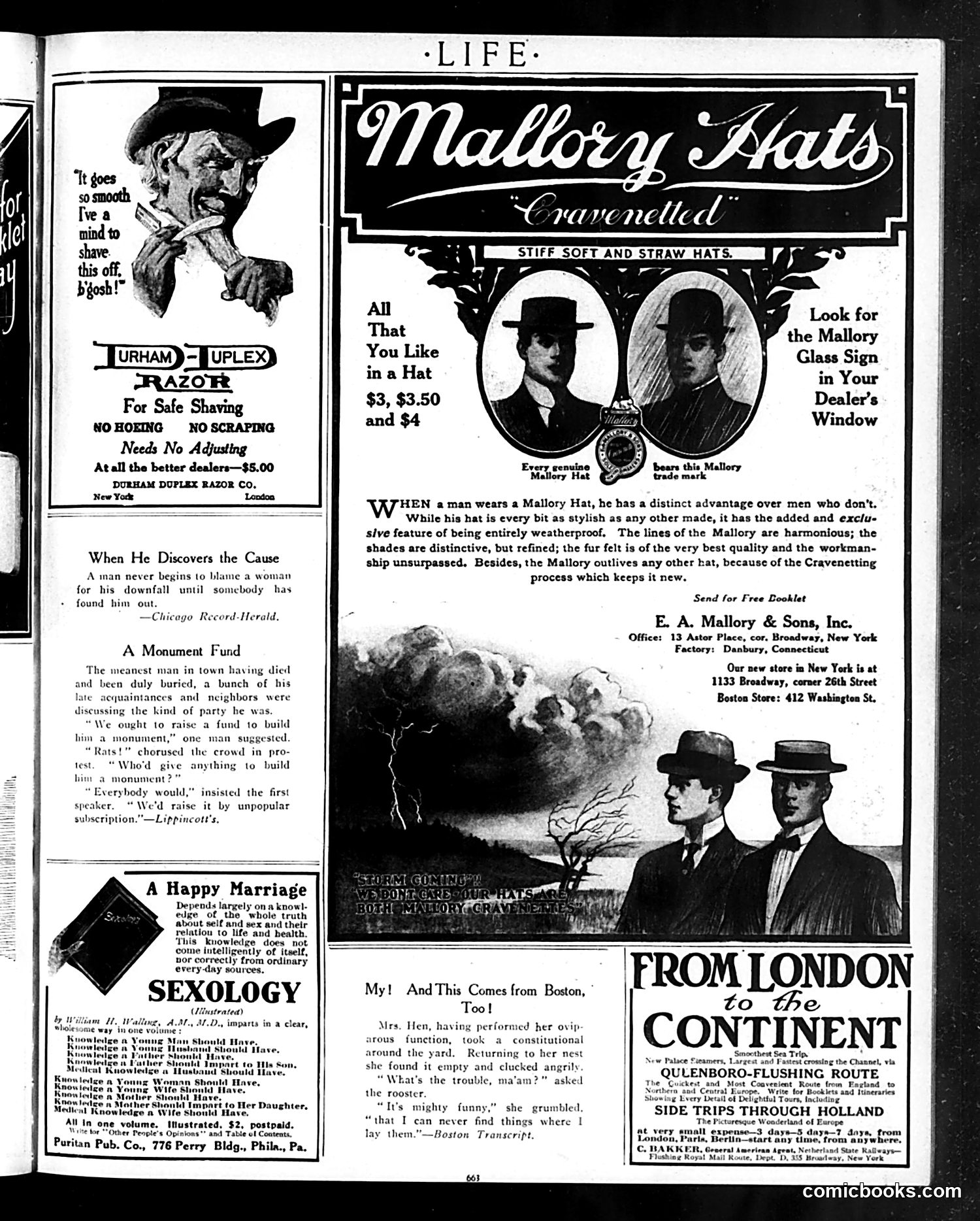
This is primarily an **advertising page** from Life magazine's early era, with minor satirical content interspersed. **The satire:** - "When He Discovers the Cause": A brief quip about male hypocrisy—men blame women for their downfall only after being caught, suggesting men avoid responsibility until exposed. - "A Monument Fund": Dark humor about an unpopular townsperson; the joke is that raising money for his monument would be easy through "unpopular subscription" (people willingly paying to memorialize someone disliked). - "My! And This Comes from Boston, Too!": A domestic joke where a hen loses her eggs and complains about misplacing things—a gentle dig at Boston housekeeping, playing on regional stereotypes. **The advertisements** feature a Duplex Razor (safety razors were revolutionary), Mallory Hats (weatherproof), Sexology textbooks (reflecting early 20th-century sex education publishing), and European steamship travel. The cartoon of a man's face (upper left) promotes Durham-Duplex razors, emphasizing smooth shaving without adjustment or scraping—innovations for the era.
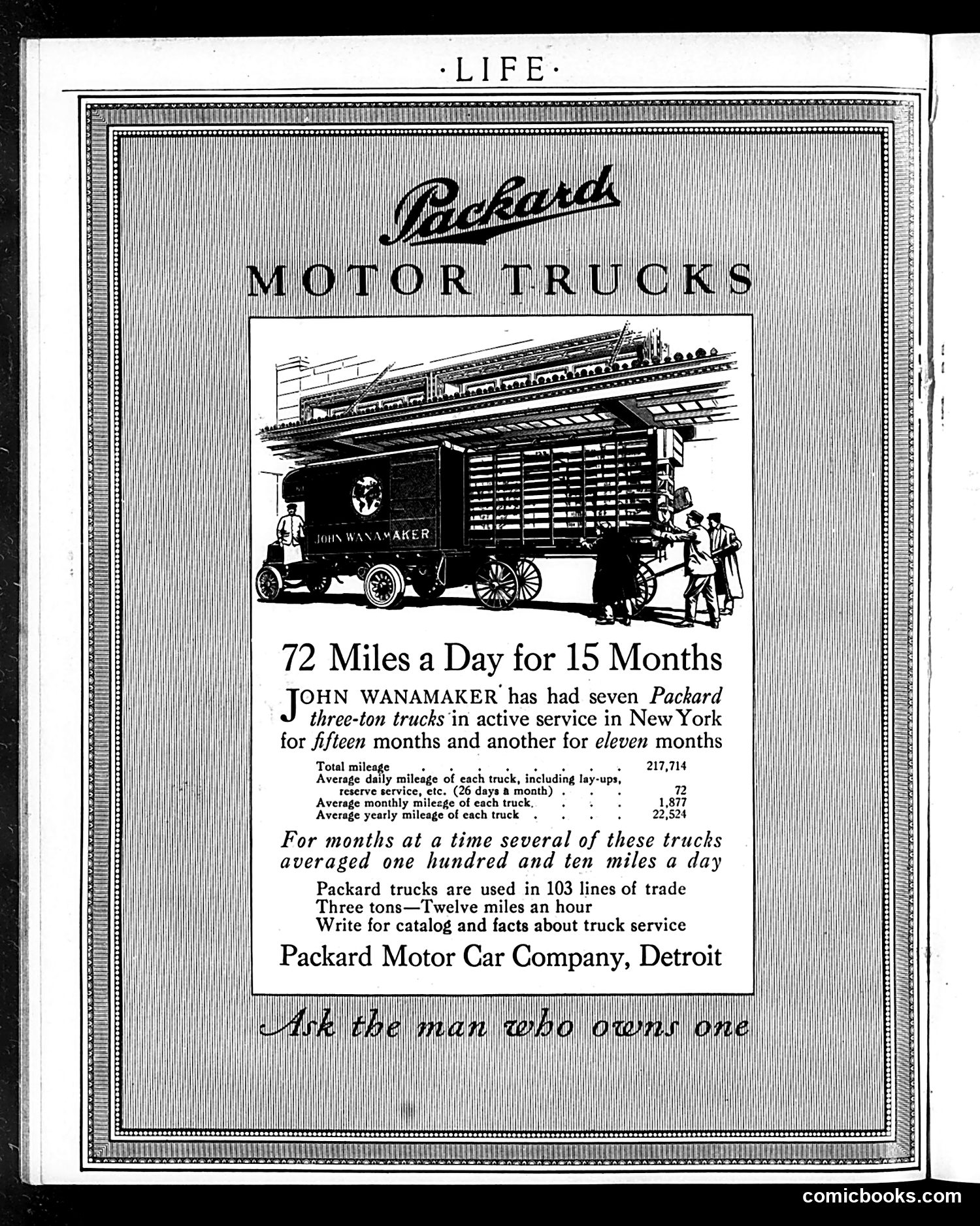
This is primarily a **product advertisement**, not political satire. It appears in *Life* magazine promoting Packard Motor Trucks. The ad features a testimonial from **John Wanamaker**, a real Philadelphia department store magnate, touting the reliability of Packard trucks. The accompanying illustration shows a Packard delivery truck (labeled "John Wanamaker") alongside a train, suggesting the truck as a modern alternative to rail transport. The "point" is commercial: the ad demonstrates Packard's durability through concrete performance data—217,714 total miles across multiple vehicles over 15-26 months of continuous use in New York. The specific mileage figures (72 miles daily average, trucks hitting 110 miles/day) and their use across "103 lines of trade" serve as proof of reliability. The satirical tagline at bottom—"Ask the man who owns one"—was Packard's actual slogan, emphasizing word-of-mouth endorsement. This is advertising, not editorial commentary.
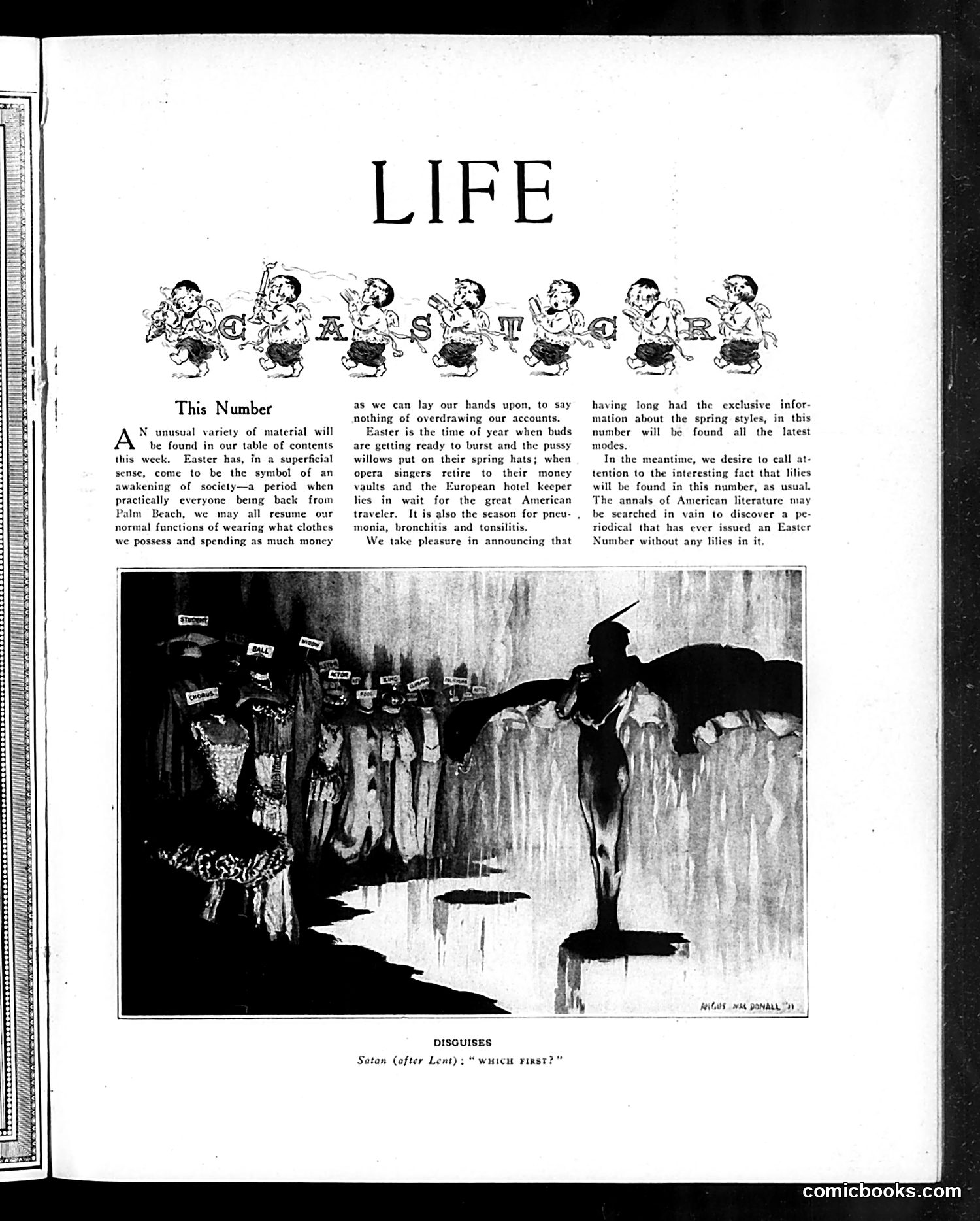
This is the cover/opening page of a *Life* magazine Easter issue, featuring satirical commentary on American Easter traditions and spring fashion. The main cartoon titled "Disguises" depicts Satan (identified in the caption) asking "Where first?" as he surveys various figures in elaborate spring disguises—hats, fashionable clothing, and accessories. The satire suggests that Easter's spiritual renewal is superficial: Americans use the holiday as mere pretense for materialism, displaying wealth through new clothes and European travel while neglecting genuine moral awakening. The editorial text reinforces this mockery, ironically noting that Easter represents "society's awakening" while people return from Palm Beach to "overdraw our accounts" and spend money "as we can lay our hands upon." There's also humorous criticism of the magazine's own cliché—that Easter issues always feature lilies, a tradition so universal they joke no Easter issue has ever been published without them. The satire targets American materialism, fashion obsession, and hollow religious observance.
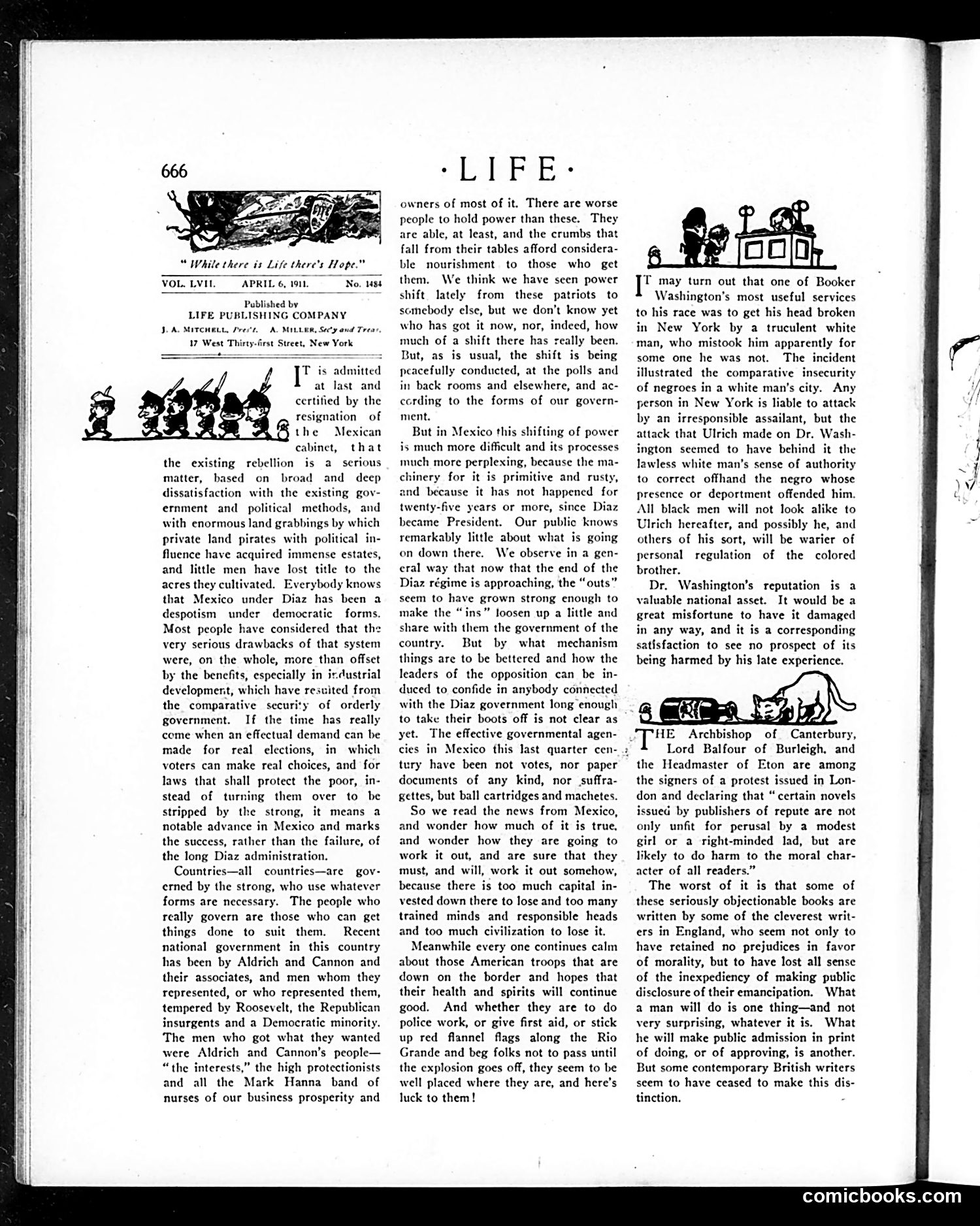
This editorial page discusses the Mexican Revolution and the collapse of Porfirio Díaz's regime. The text acknowledges that Díaz's 30-year dictatorship, despite maintaining "order," was built on land theft and disenfranchisement of ordinary Mexicans. The article compares Mexico's violent power struggle to American politics, arguing that in both countries, true power rests with "the strong"—not voters or laws. It names **Aldrich and Cannon** (Congressional Republican leaders) as those who actually governed America, with Theodore Roosevelt and Democrats playing minor roles. The satirical point: Life suggests American readers shouldn't judge Mexico harshly for its chaos, since America's own democracy is largely theater controlled by wealthy elites. Mexico's rebellion, while messier due to lack of democratic institutions, reflects the same reality—power shifting between competing interests. The reference to "ball cartridges and machetes" as Mexico's actual governing tools underscores the irony: formal government machinery matters little without underlying structural change.
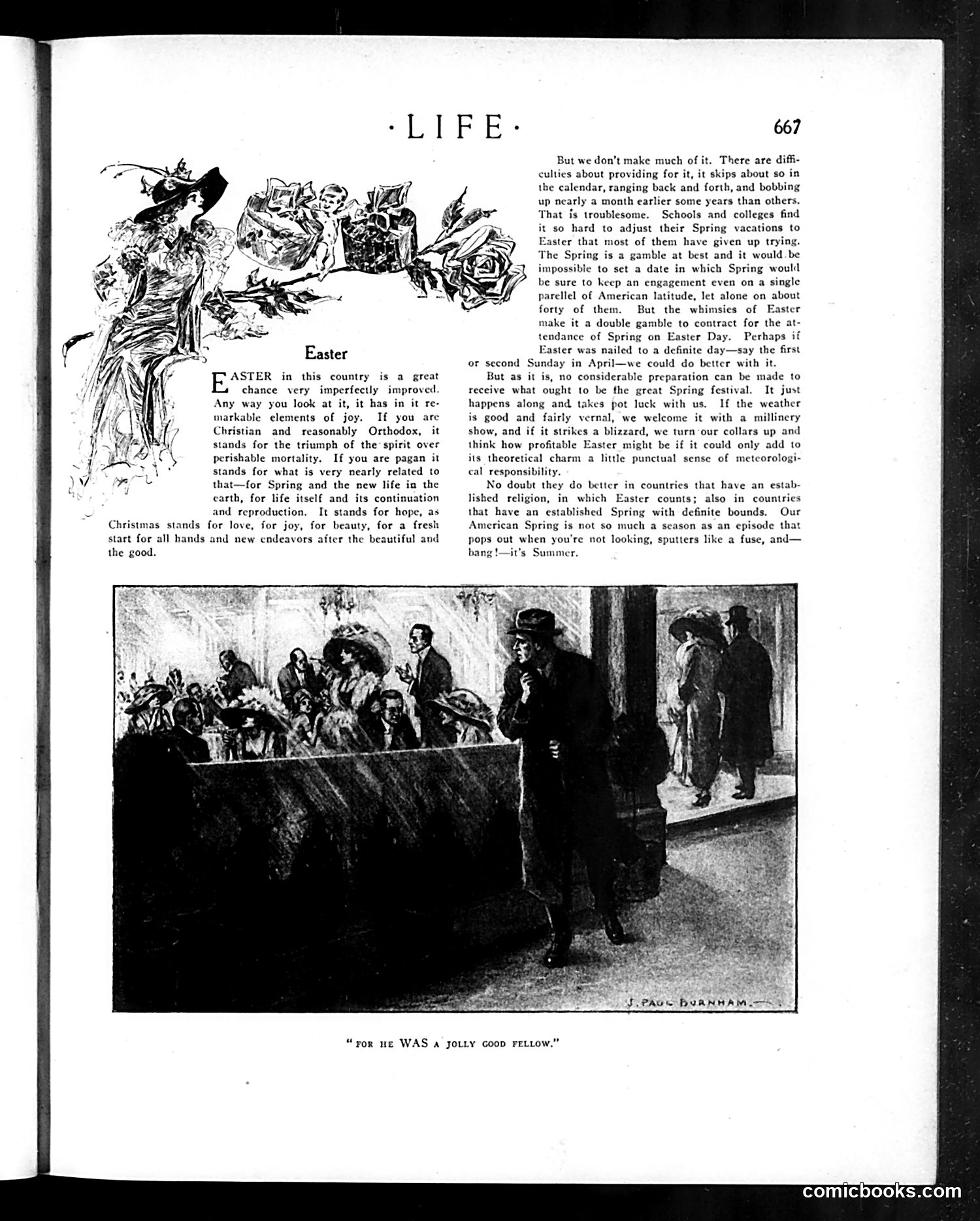
This page from *Life* magazine presents a humorous essay criticizing how Americans inadequately observe Easter. The text argues that Easter, whether viewed religiously (as Christ's triumph over death) or secularly (as spring renewal), deserves proper celebration—yet Americans bungle it. The core complaint: Easter's floating calendar date makes planning impossible. Schools can't schedule spring breaks consistently; the weather is unpredictable; and Americans treat Easter casually, as a "double gamble" dependent on both the holiday's arbitrary timing and unpredictable spring weather. The illustration by J. Paul Burnham (credited at bottom) depicts a funeral scene captioned "For he was a jolly good fellow"—likely satirizing how Americans treat Easter superficially, focusing on hats and weather rather than genuine significance. The essay laments that America lacks the established religious traditions or predictable seasons that other countries enjoy, leaving Easter to be swallowed randomly by an erratic American spring that "pops out" then vanishes into summer.
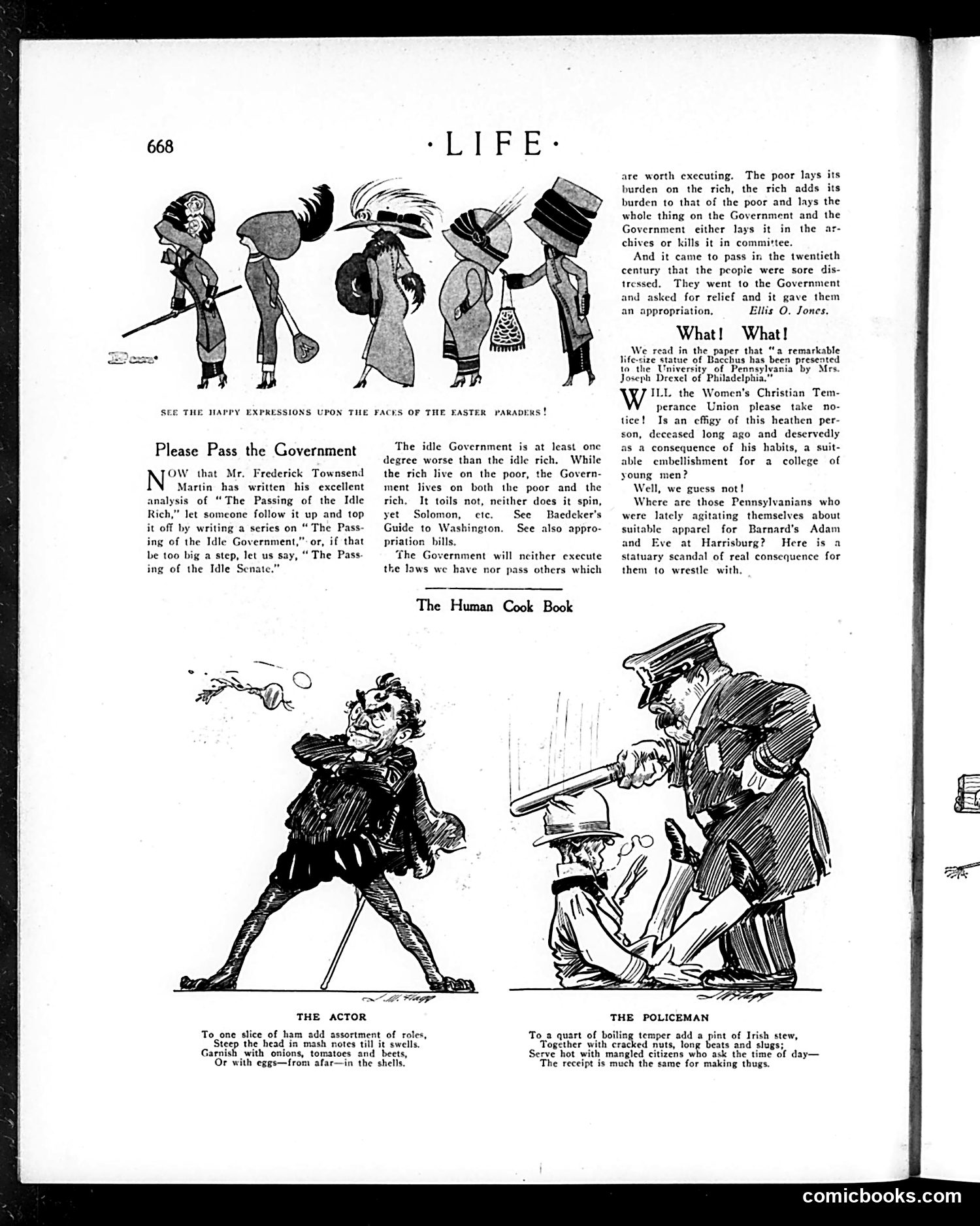
This page satirizes government inefficiency and incompetence through two separate pieces. **"Please Pass the Government"** criticizes the federal government as parasitic and idle—worse than the wealthy it taxes. The essay argues government collects from both rich and poor yet accomplishes nothing: it neither enforces existing laws nor passes necessary ones. Instead, it files matters away or kills them in committee. The Easter parade cartoon above shows well-dressed citizens—suggesting society's superficial happiness masks governmental dysfunction. **"The Human Cook Book"** uses grotesque recipe format to mock authority figures. "The Actor" receives theatrical embellishment; "The Policeman" recipe calls for "boiling temper," "cracked nuts," "long beats and slugs" (beatings), and "mangled citizens"—sardonically claiming the process for making police is identical to making "thugs," implying police brutality and corruption are systemic. Both pieces exemplify *Life* magazine's Progressive-era skepticism toward institutions and power structures.
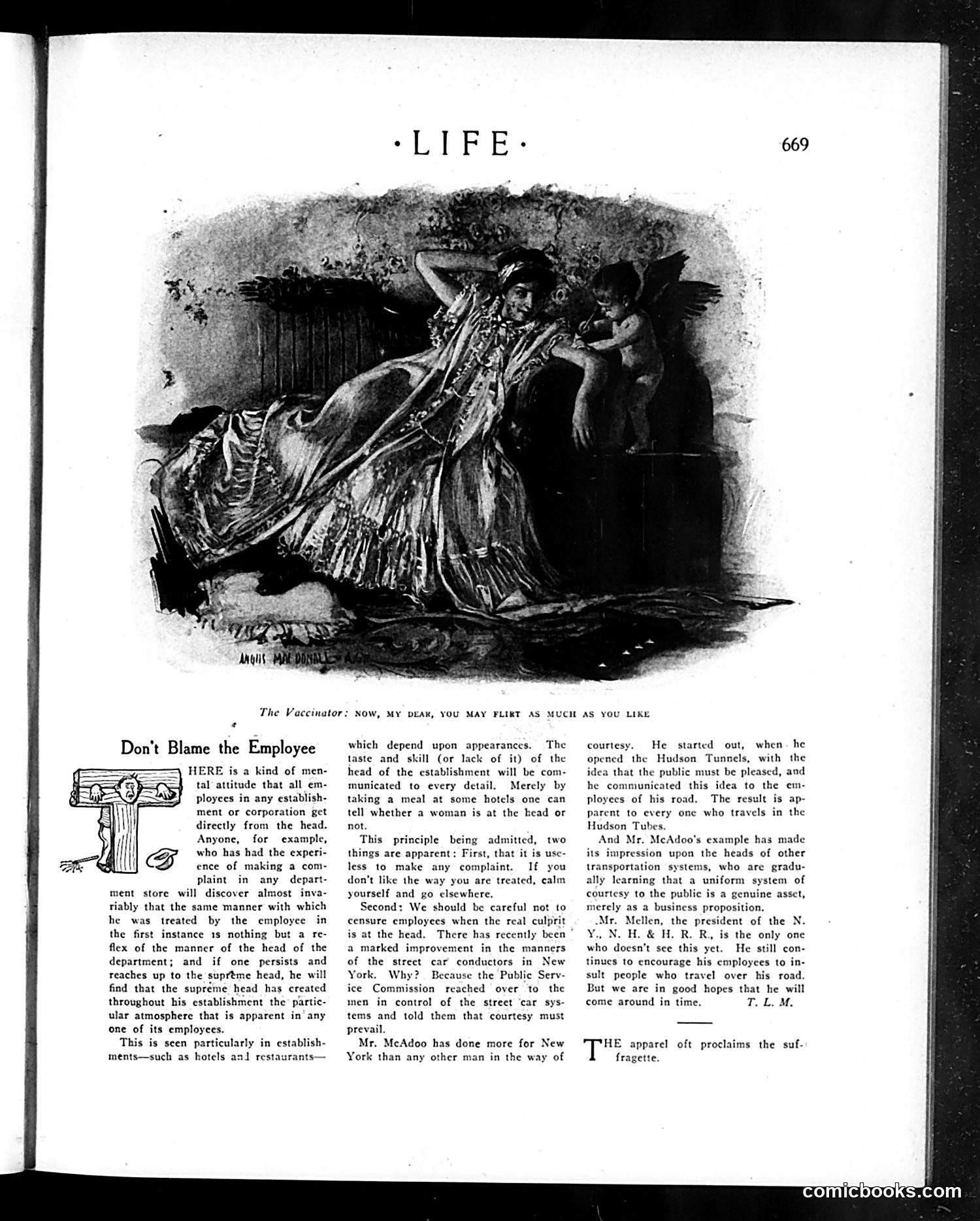
**The Main Cartoon** depicts a vaccination scene with the caption "Now, my dear, you may flirt as much as you like"—likely satirizing either medical hypocrisy or social attitudes toward women's behavior during vaccination procedures. **"Don't Blame the Employee"** is the primary article, arguing that poor customer service reflects management's attitude, not individual workers' failings. It uses examples from hotels, restaurants, and notably New York's street car system and Hudson Tunnels. **Key Figure**: William McAdoo, who managed the Hudson Tunnels/Hudson & Manhattan Railroad, is praised for implementing a courtesy-first policy that supposedly improved service across transportation systems. The article credits him with influencing even competitors. **The Satire**: Management receives both blame and credit for employee behavior. The piece criticizes railroad president Charles Mellen (New York, New Haven & Hartford) for allegedly encouraging employees to be rude—presented as willful mismanagement rather than incompetence. **For Modern Readers**: This reflects early-1900s transit labor debates and the novel idea that corporate culture flows downward from leadership—now standard business thinking but apparently noteworthy then.
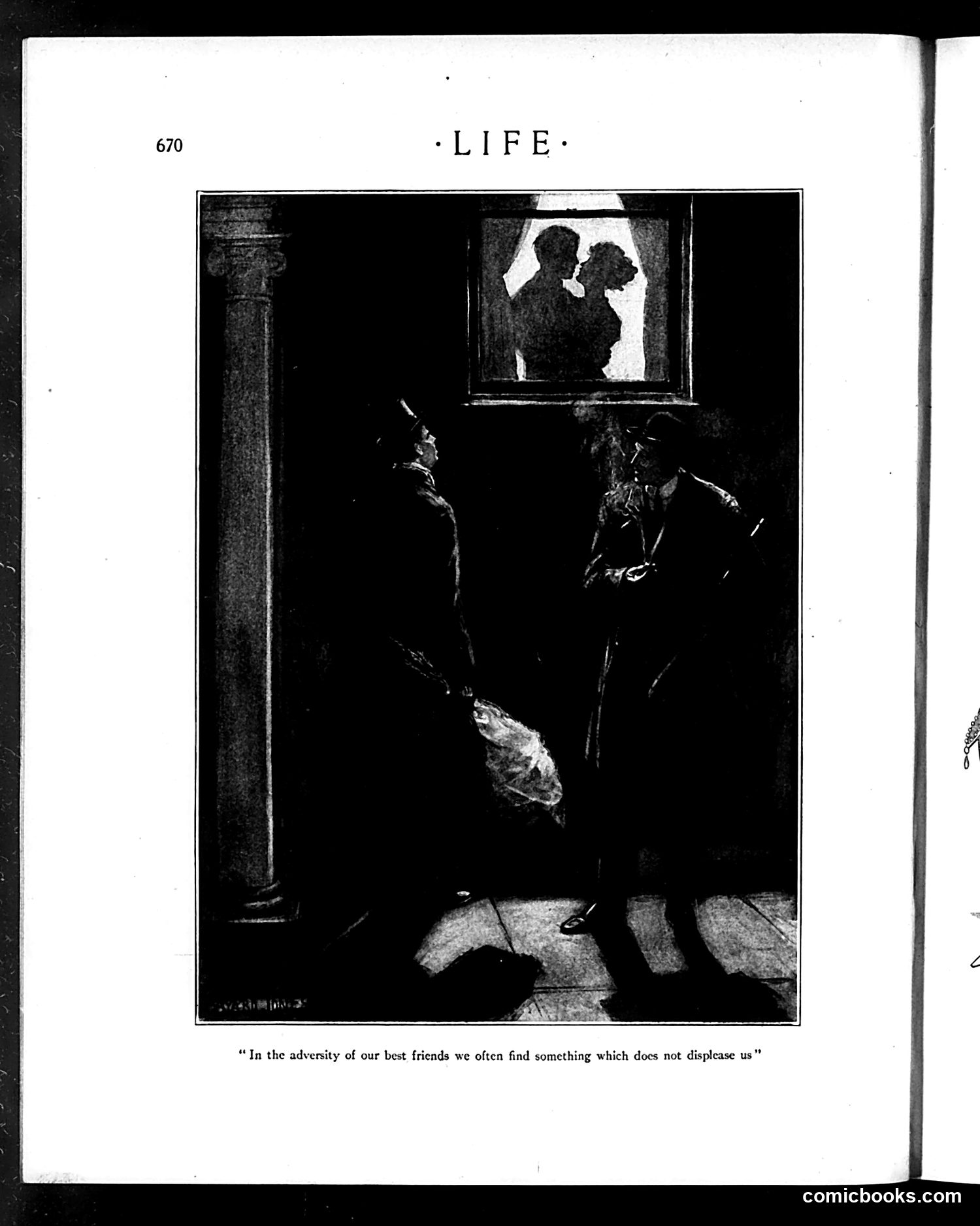
This page from *Life* magazine presents a single illustration with a philosophical caption. The image shows two figures in silhouette viewing a window display where two additional figures are visible. The composition is entirely in shadow and light contrast, emphasizing the voyeuristic quality of observation. The caption—"In the adversity of our best friends we often find something which does not displease us"—is a sardonic observation about human nature, suggesting schadenfreude or secret satisfaction in others' misfortune, even among friends. The illustration appears to be social commentary rather than political satire, exploring a universal human vice: the unspoken pleasure we sometimes take in friends' troubles. The specific context and date remain unclear from the visible text.
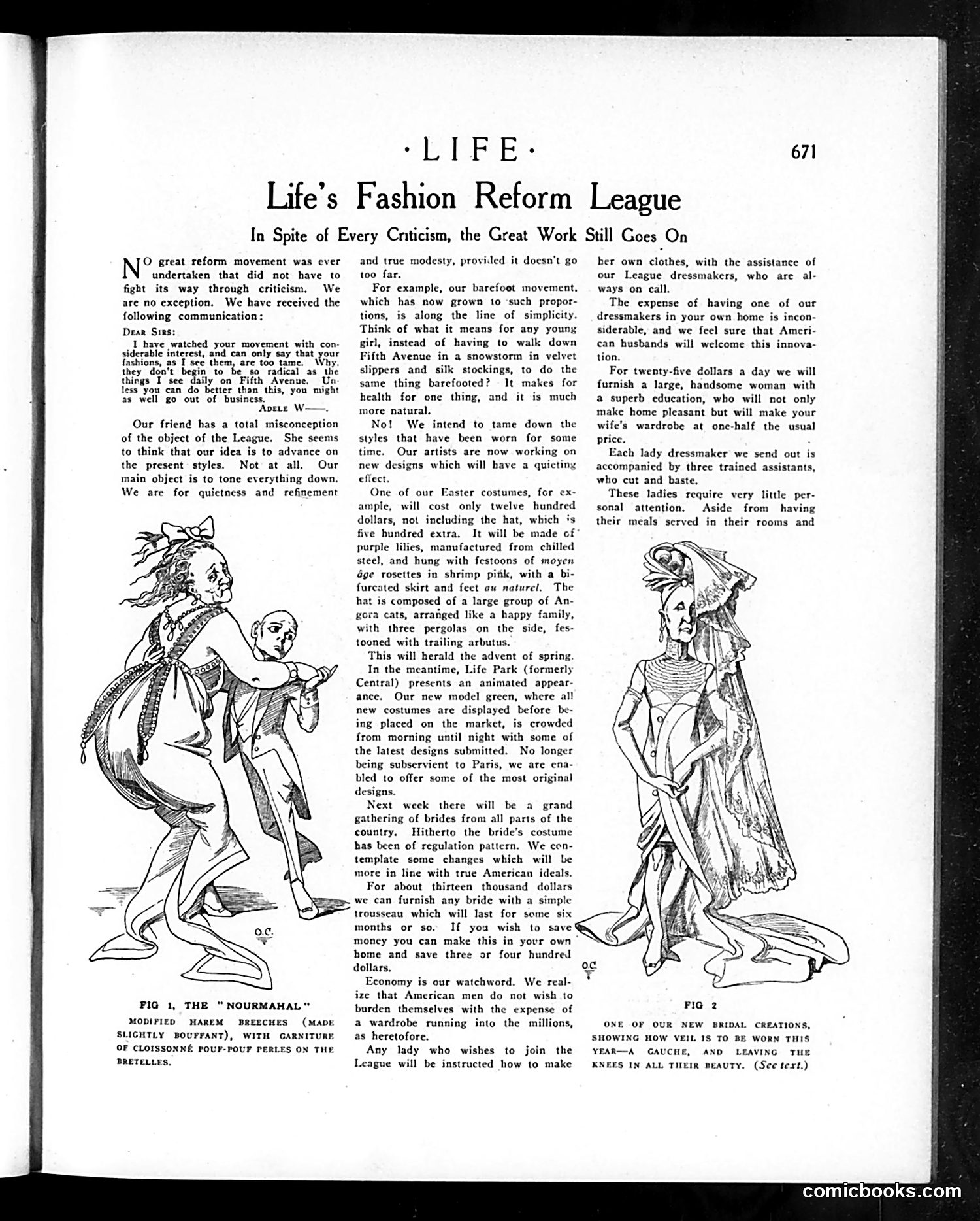
This satirical piece mocks a purported "Fashion Reform League" promoting supposedly economical, simplified clothing—while describing absurdly extravagant designs. The humor lies in the contradiction: the League claims to promote "quietness and refinement" and economy, yet proposes an Easter costume costing $1,700 (including hat) made from "purple lilies manufactured from chilled steel" adorned with Angora cats and arbutus festoons. The two illustrated figures showcase this irony: elaborate, impractical "reformed" fashions presented as radical simplifications. The opening letter from a reader complaining the designs aren't radical enough sets up the satire—Life is mocking both fashion extremism and the earnest reform movements of the era by presenting deliberately nonsensical "improvements" as serious proposals.
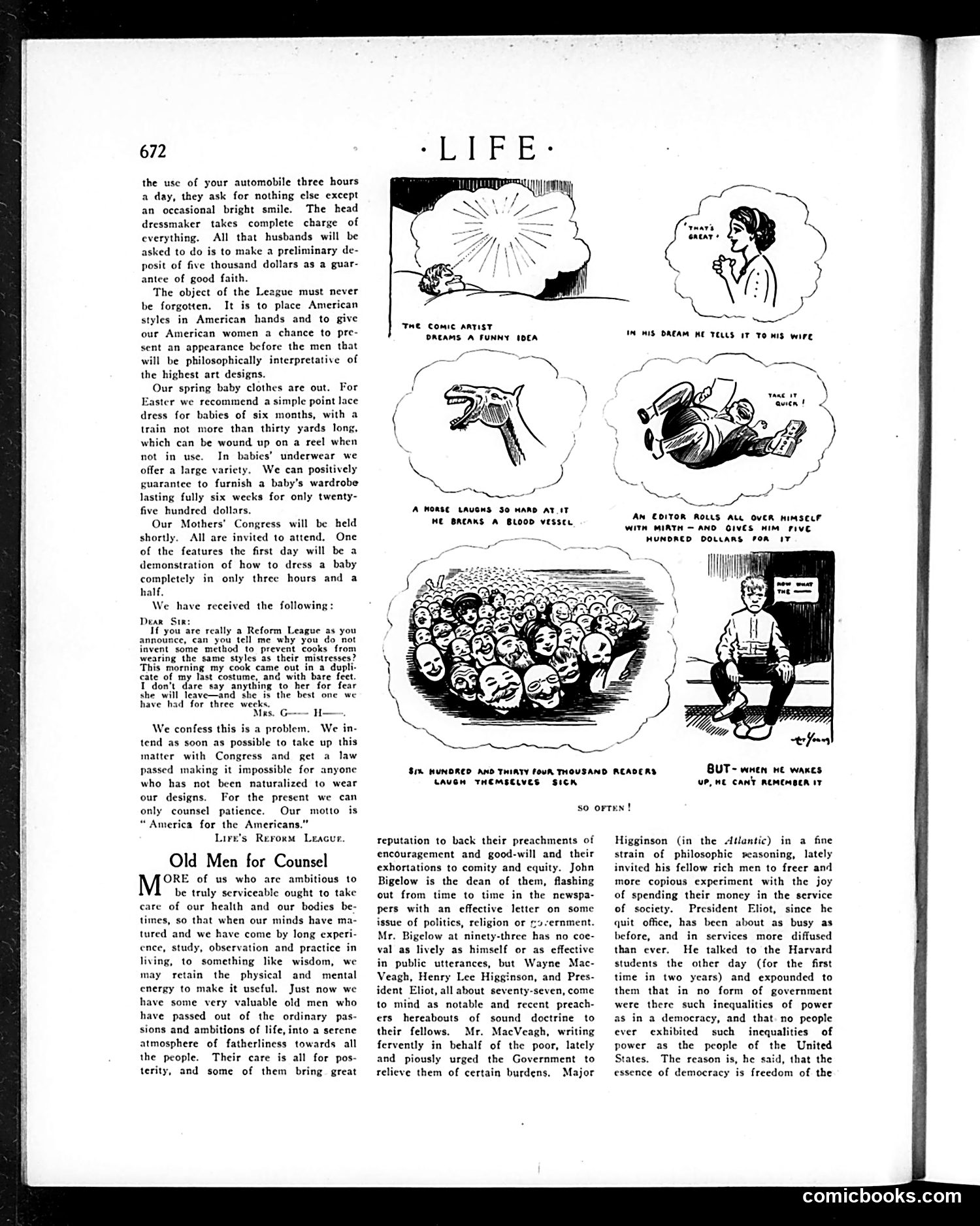
This page contains two satirical pieces mocking American consumer culture and gender dynamics circa early 20th century. **"Life's Reform League"** (left column and cartoons) parodies a fake organization promoting extravagant baby fashion. It ridicules wealthy Americans' obsession with conspicuous consumption—recommending a baby dress with a thirty-yard train and $2,500 wardrobes lasting only six weeks. A letter complains about servants dressing like their mistresses; the "League" facetiously promises to lobby Congress to legally prevent non-citizens from wearing fashionable designs. The satire targets both class anxiety and the absurdity of fashion-obsessed society. **"Old Men for Council"** (right column) praises elderly statesmen like John Bigelow (age 93) and Wayne MacVeagh as voices of wisdom and social conscience. It advocates for retaining experienced elder advisors who promote equity and care for the poor, contrasting their "fatherliness" with younger society's frivolous concerns. The cartoon series illustrates how a comic artist's idea—funny when dreamed—becomes forgotten upon waking, yet earns $500 from an editor, satirizing the creative process and publishing economics.
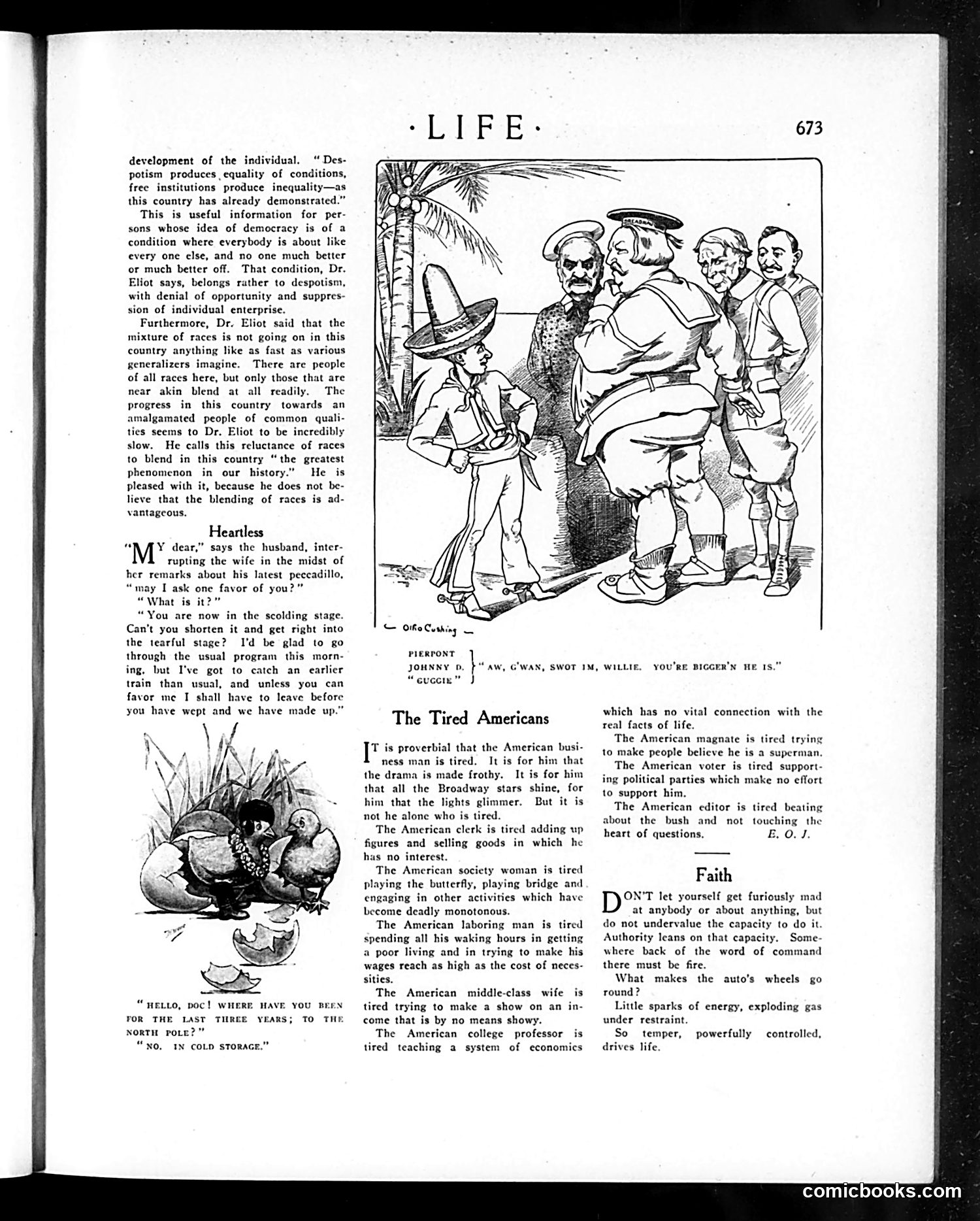
This page contains satirical commentary on American society circa early 20th century. **"The Tired Americans"** is the main feature—a list-format critique cataloging exhaustion across all American social classes: businessmen, clerks, society women, laborers, middle-class wives, professors, magnates, voters, and editors. The satire suggests systemic dissatisfaction pervades every level of society, from the wealthy to the working poor. **The cartoon at top** shows a man in a sombrero addressing others, captioned "Aw, g'wan, swot im, Willie. You're bigger'n he is"—apparently depicting casual violence or bullying, though context is unclear. **"Heartless"** mocks a husband who interrupts his wife's scolding to ask she skip to the "tearful stage" because he needs to catch a train—satirizing male insensitivity and the routinization of domestic conflict. **"Faith"** argues that controlled anger/passion (like engine sparks) drives progress, warning against passive acceptance. The overall message critiques American materialism, monotony, and systemic failure to fulfill democratic promises.
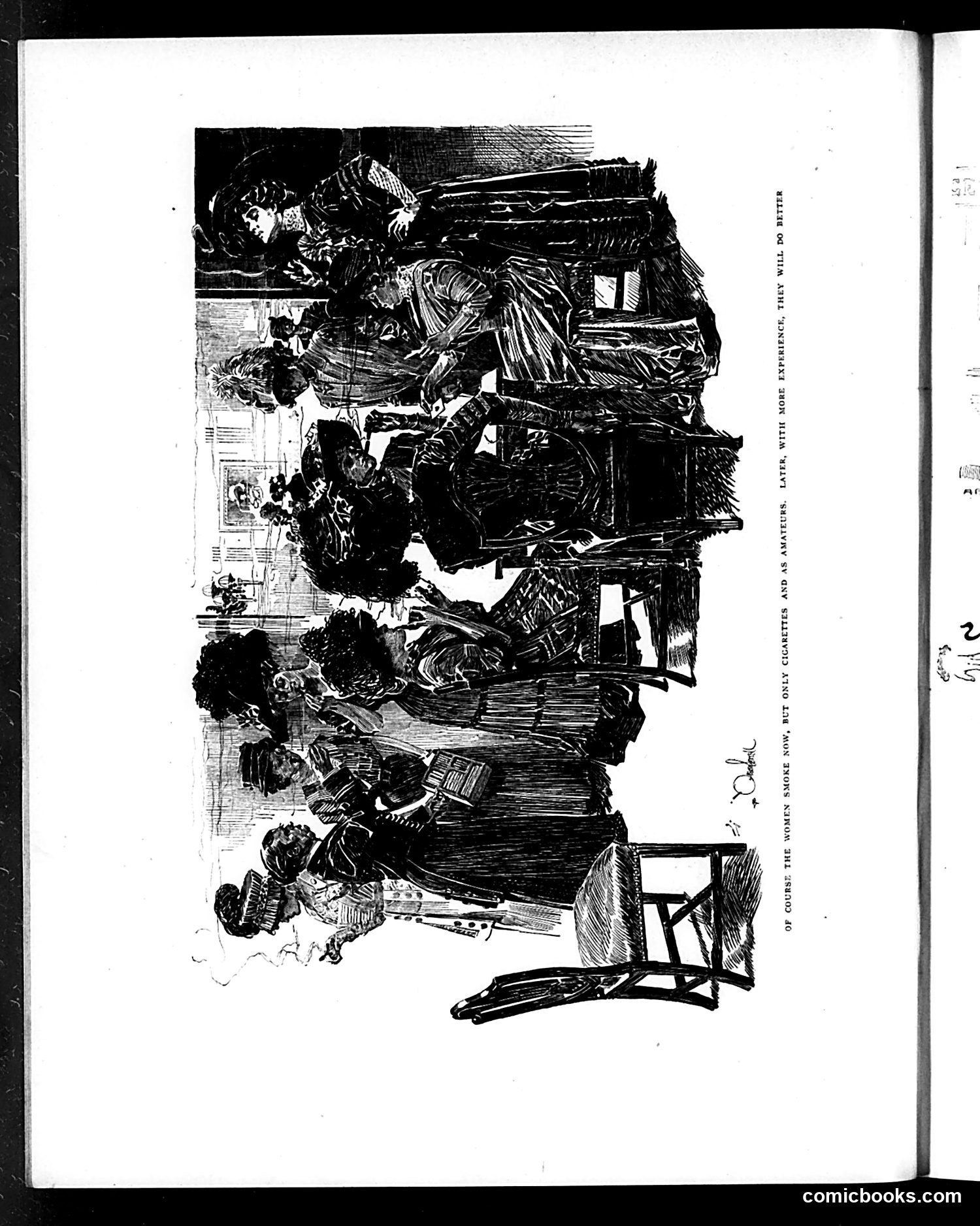
This is a satirical illustration commenting on changing social norms regarding women and smoking in early 20th-century America. The caption reads: "Of course the women smoke now, but only cigarettes and as amateurs." The cartoon appears to depict women in various states of smoking, likely contrasting "respectable" cigarette smoking with other forms (cigars, pipes) traditionally associated with men. The satire targets the hypocrisy of the era: society was beginning to accept women smoking cigarettes as a modern, fashionable behavior, yet still maintained strict moral boundaries—women could only participate "as amateurs" in this previously male-exclusive activity. This reflects genuine social tension of the 1920s-era when cigarette smoking became increasingly feminized and commercialized, yet remained controversial. The "amateur" designation suggests women were merely dabbling in a masculine practice, rather than truly claiming equal social rights.
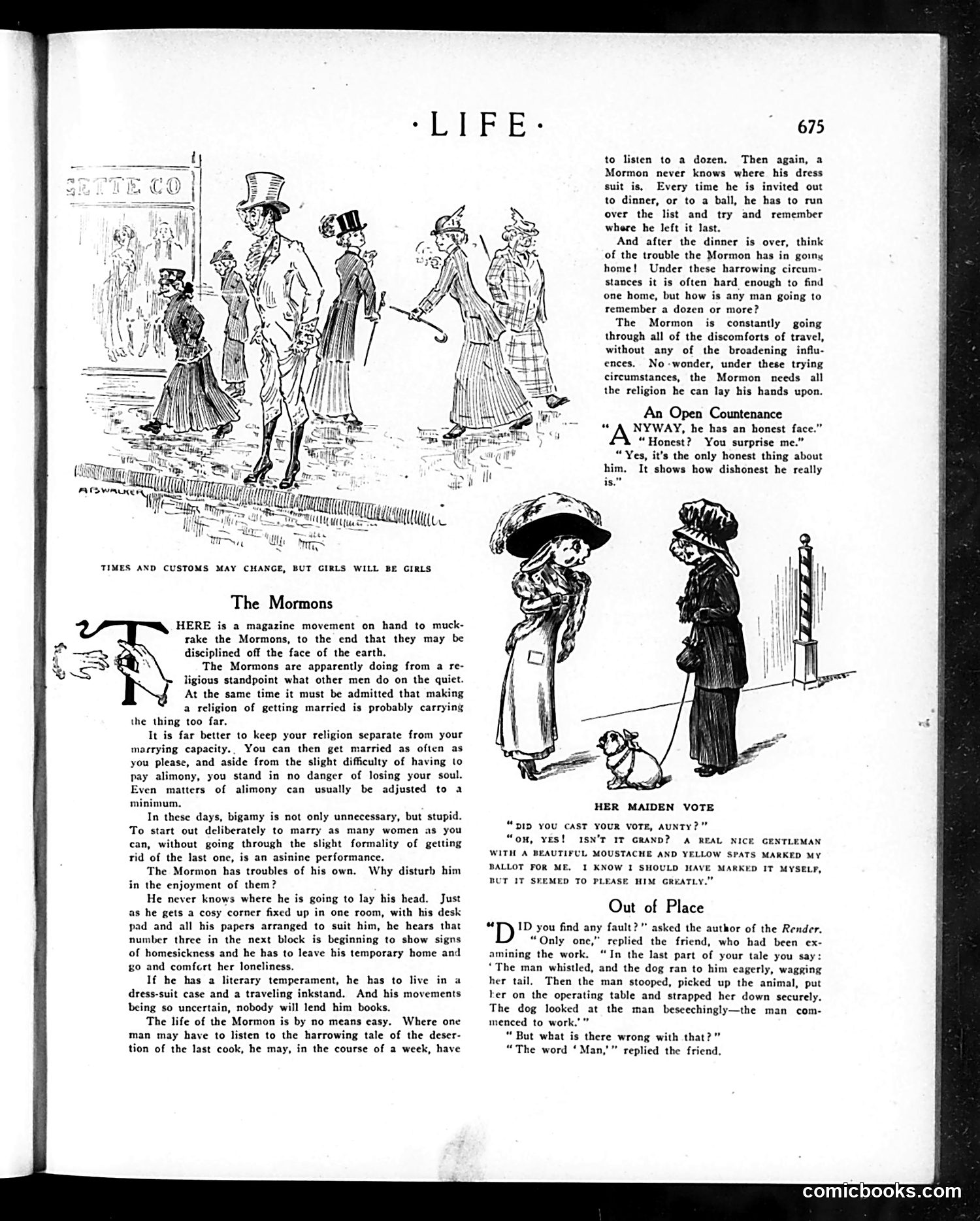
## "The Mormons" This article mocks the Church of Jesus Christ of Latter-day Saints' historical practice of polygamy. The satire presents polygamy as logistically absurd rather than morally outrageous—a man can't remember which home to return to, where his dress suit is, or which cook deserted him. The text sarcastically suggests Mormons "need all the religion" to survive the chaos they've created. The illustration shows elaborately dressed figures, likely depicting multiple wives. The satire is characteristic of early 20th-century anti-Mormon sentiment, framing the practice as ridiculous inconvenience rather than engaging serious theological or ethical arguments. ## "Her Maiden Vote" This cartoon satirizes women's newly won voting rights (appears to reference early suffrage era). A woman admits a gentleman "with a beautiful moustache and yellow spats" marked her ballot for her, suggesting female voters could be easily manipulated by male charm rather than voting independently. The satire implies women aren't yet ready for civic responsibility. ## "Out of Place" A brief joke about jarring word choice in fiction—the friend objects to calling a dog a "man."
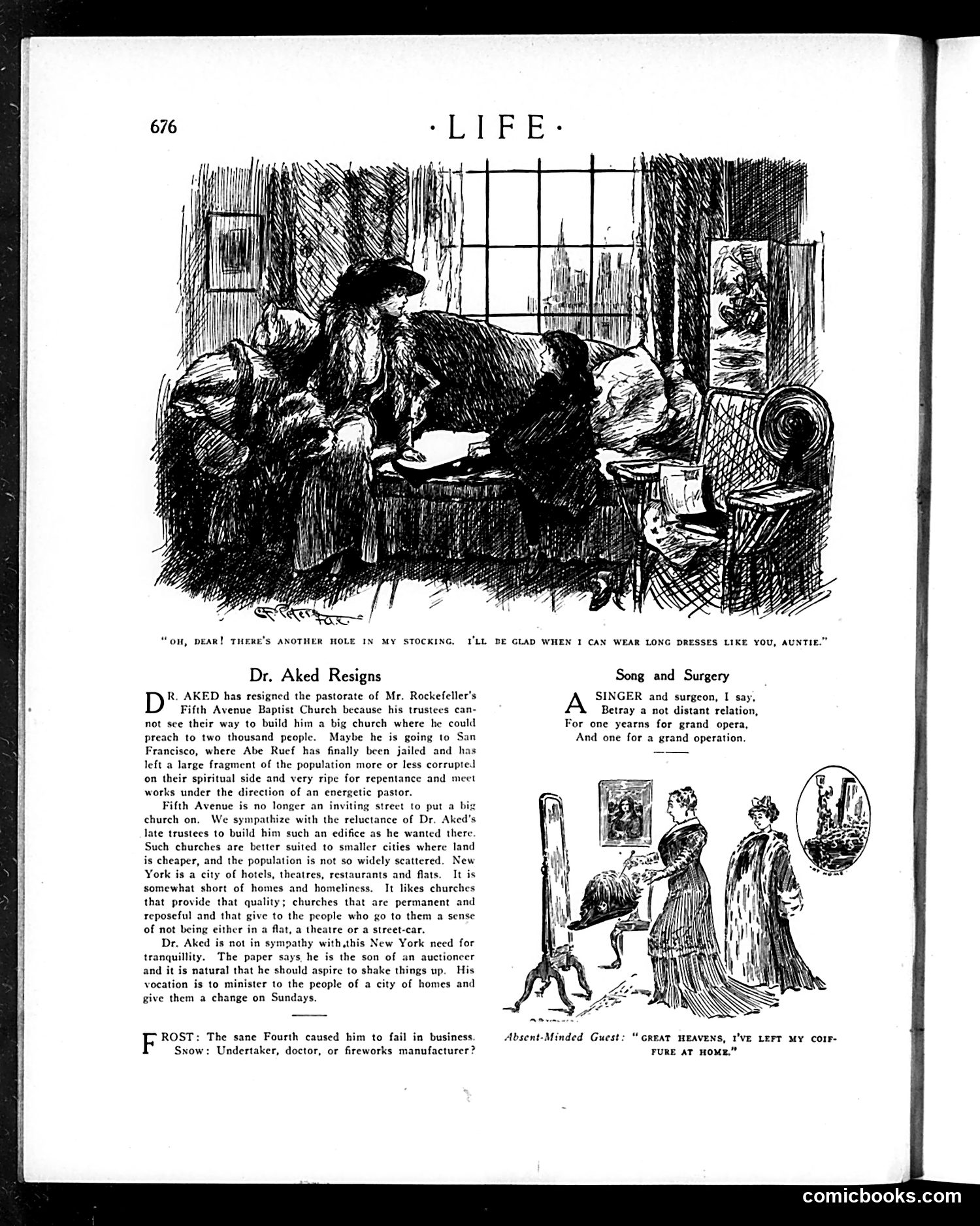
This page contains social satire typical of early 20th-century Life magazine. **Top cartoon**: A child points out a hole in her stocking, expressing eagerness to wear long dresses like her aunt—mocking the impracticality of long Victorian/Edwardian dresses that required constant mending while also satirizing children's desire to adopt adult fashion regardless of practicality. **"Dr. Aked Resigns"**: Reverend Dr. Charles Aked resigned from Rockefeller's Fifth Avenue Baptist Church over disagreements about building a larger structure. Life's commentary satirizes both Aked's ambitions and the unsuitability of grand churches in New York's modern urban landscape of "hotels, theatres, restaurants and flats"—arguing the city needs spiritual comfort, not spectacle. The reference to San Francisco's Abe Ruef scandal implies Aked seeks morally corrupted populations needing redemption. **"Song and Surgery"**: A brief humor piece playing on homophones: a singer wants "grand opera" while a surgeon wants "grand operation"—a simple pun on professional ambitions. **Bottom cartoon**: An absentminded guest realizes they've forgotten their "coiffure" (hairstyle/hairpiece)—likely satirizing elaborate Edwardian hairdressing conventions.
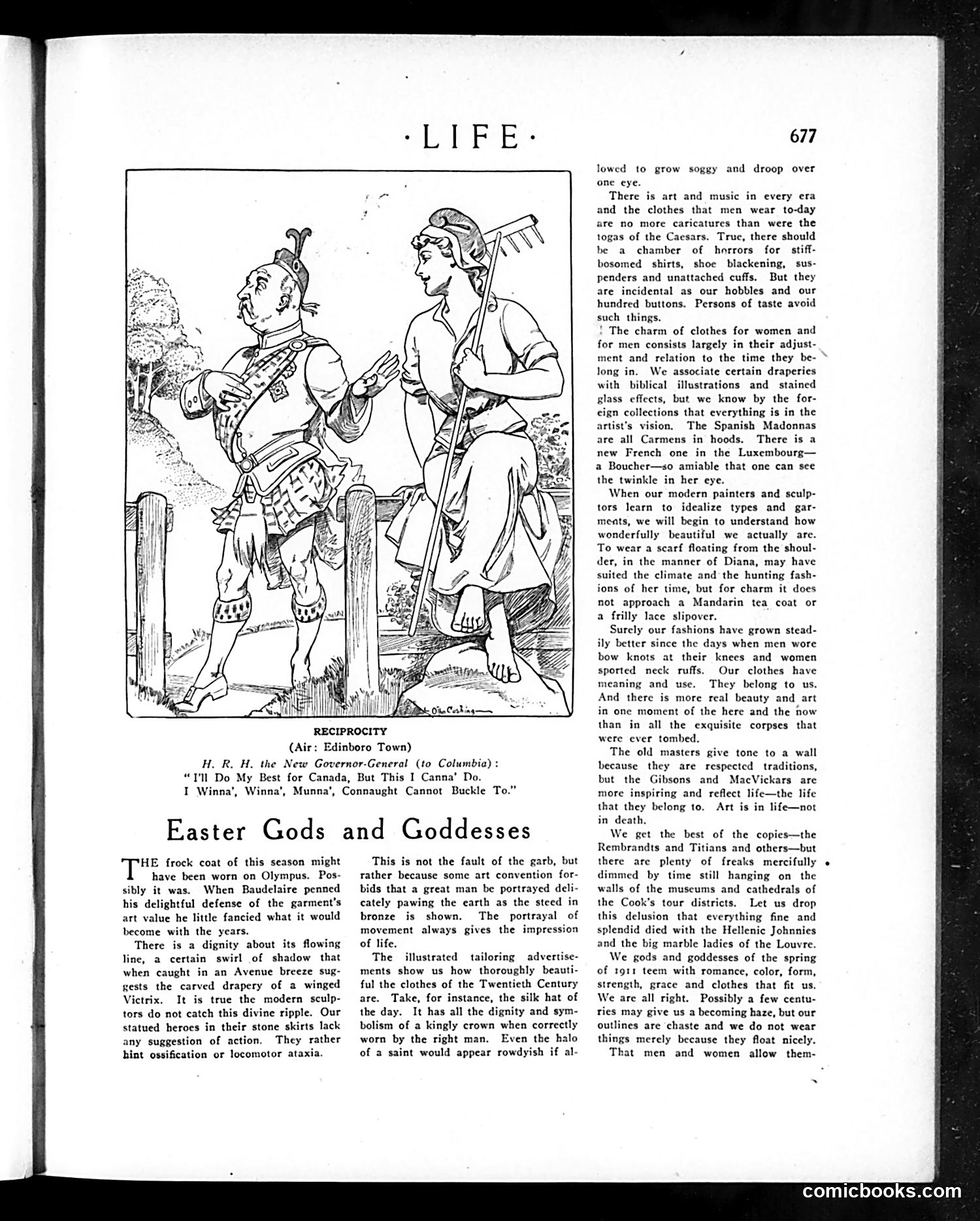
The cartoon depicts two figures in classical dress labeled "RECIPROCITY," referencing a trade dispute between Canada and the United States. The caption identifies one as "H.R.H. the New Governor-General (to Columbia)"—likely the Canadian Governor-General—refusing reciprocal trade agreements with America (personified as "Columbia," the female allegorical figure of the US). The Scottish dialect phrases ("Canna'," "Winna'," "Munna'") mock the Governor-General's resistance, set to the tune of "Edinboro Town." This satirizes Canadian reluctance to accept American trade terms, a contentious 1911 political issue. The accompanying article on fashion is unrelated to the cartoon—a typical Life magazine format mixing editorial commentary with satirical imagery. **Context for modern readers:** This reflects pre-WWI tensions between North American neighbors over economic policy and national sovereignty.
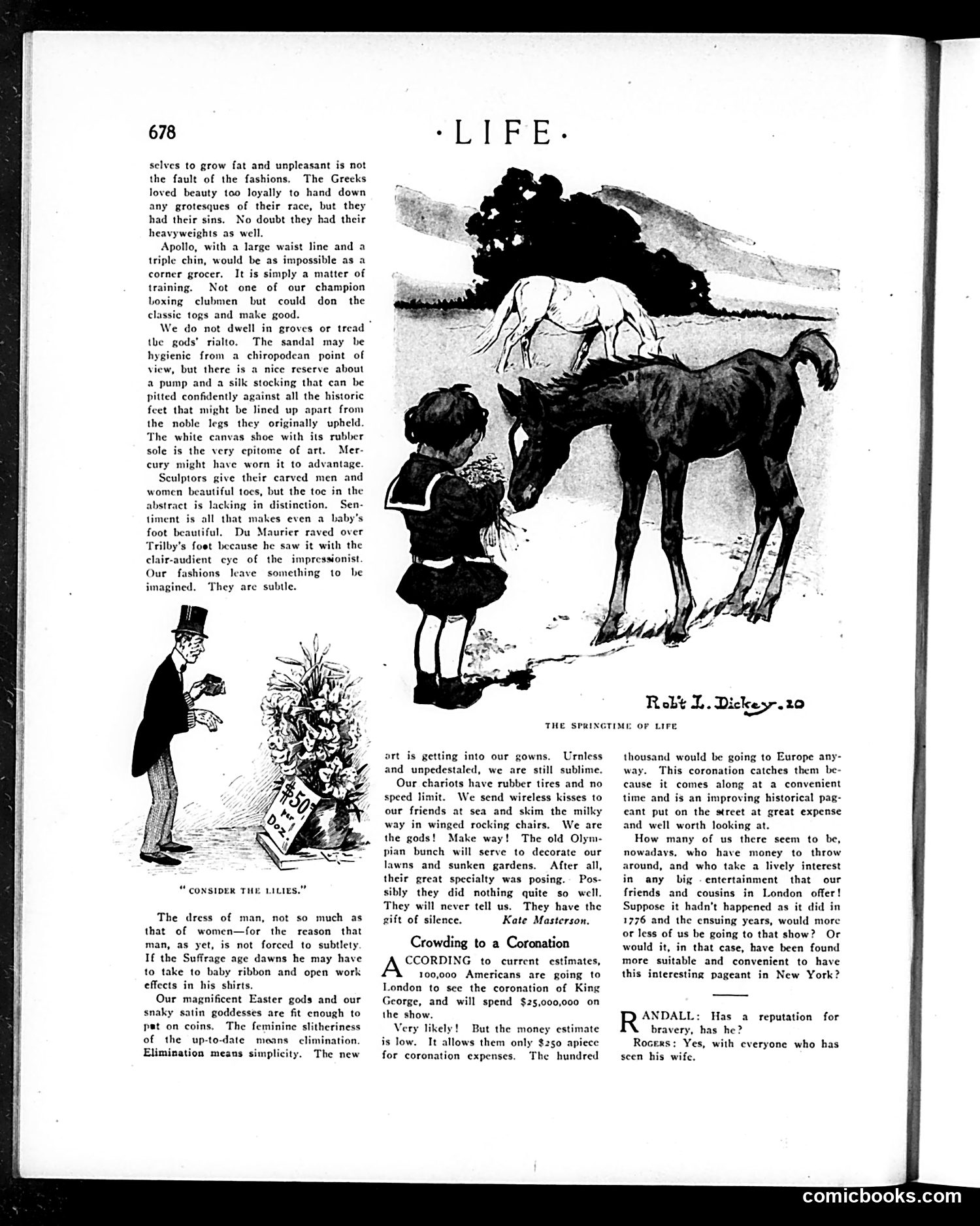
This page contains two distinct pieces of satire: **"The Springtime of Life" (illustrated cartoon):** A commentary on fashion and physical ideals. The text celebrates modern women's fashion for its simplicity and elegance, contrasting it with classical ideals. The cartoon depicts a woman in contemporary dress alongside a camel—likely mocking the exaggerated, ungainly silhouettes that fashion sometimes creates, or suggesting the absurdity of following fashion trends uncritically. **"Crowding to a Coronation":** Satirizes American eagerness to spend lavishly on King George's coronation (1911). The piece mocks the estimated 100,000 Americans planning to travel to London and spend $25 million, sarcastically noting they'd likely go to Europe anyway—the coronation merely provides convenient timing. The underlying jab: Americans who rejected the British monarchy in 1776 now eagerly flock to celebrate it, suggesting shallow materialism and loss of principle among the wealthy. **Brief dialogue at bottom:** A joke about a man's "bravery" being known only to his wife—implying domestic cowardice.
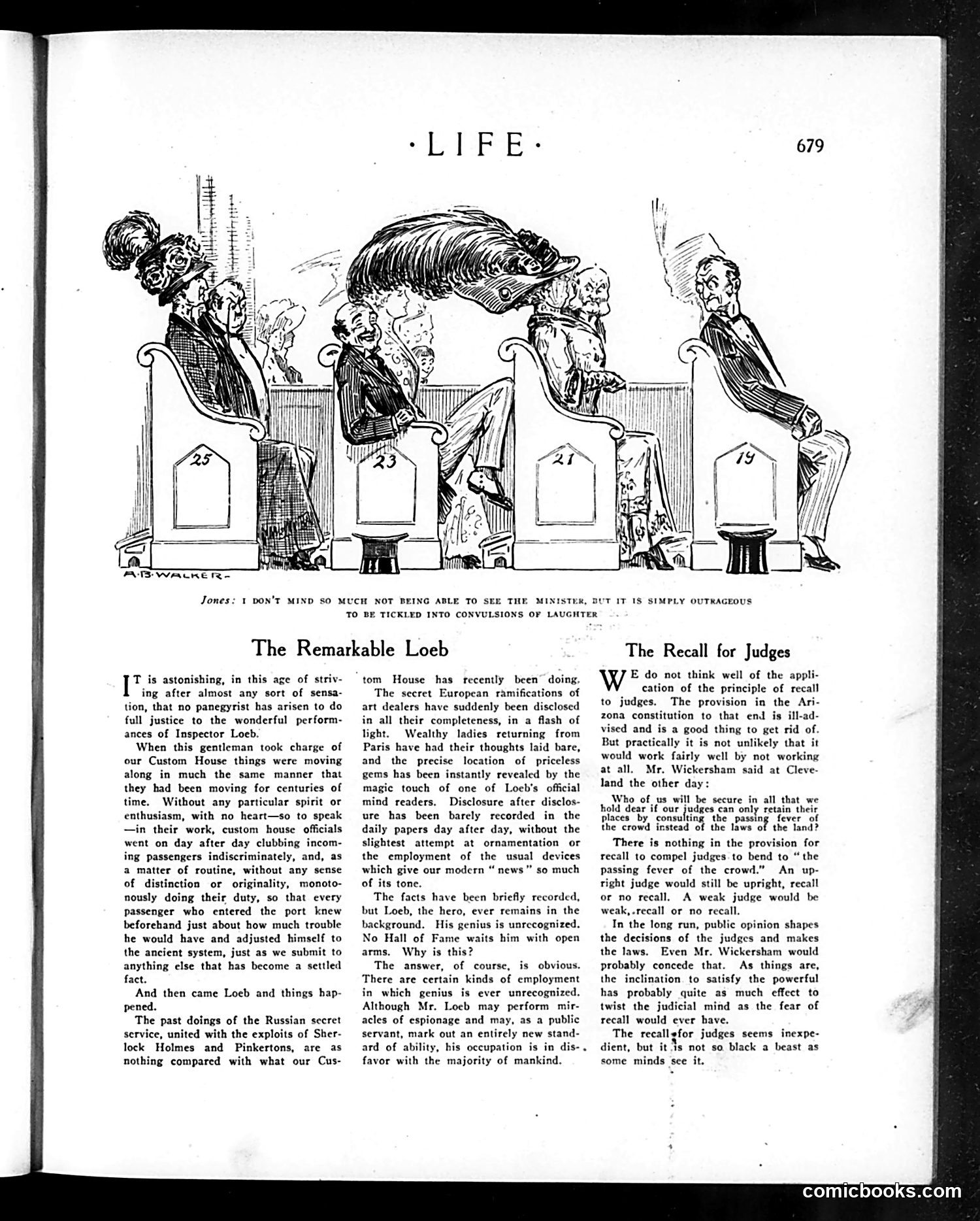
The cartoon depicts a church pew scene where well-dressed men sit in numbered seats (29, 23, 21, 19), their exaggerated features suggesting caricature. The caption, attributed to "Jones," jokes about a minister whose sermons fail to amuse—the speaker claims he "doesn't mind" not seeing the minister because it's "simply outrageous to be tickled into convulsions of laughter." The satire mocks both boring clergy and parishioners who expect entertainment from sermons. The two accompanying articles address contemporary 1910s-era political controversies: **Inspector Loeb** (apparently a U.S. Custom House official) receives satirical praise for his aggressive inspection practices against wealthy travelers and art dealers returning from Europe. The piece criticizes his unrecognized "genius" while acknowledging his unpopular methods. **"The Recall for Judges"** debates Arizona's constitutional provision allowing public recall of judges, defending the concept against conservative fears (citing Attorney General Wickersham) that it would undermine judicial independence.
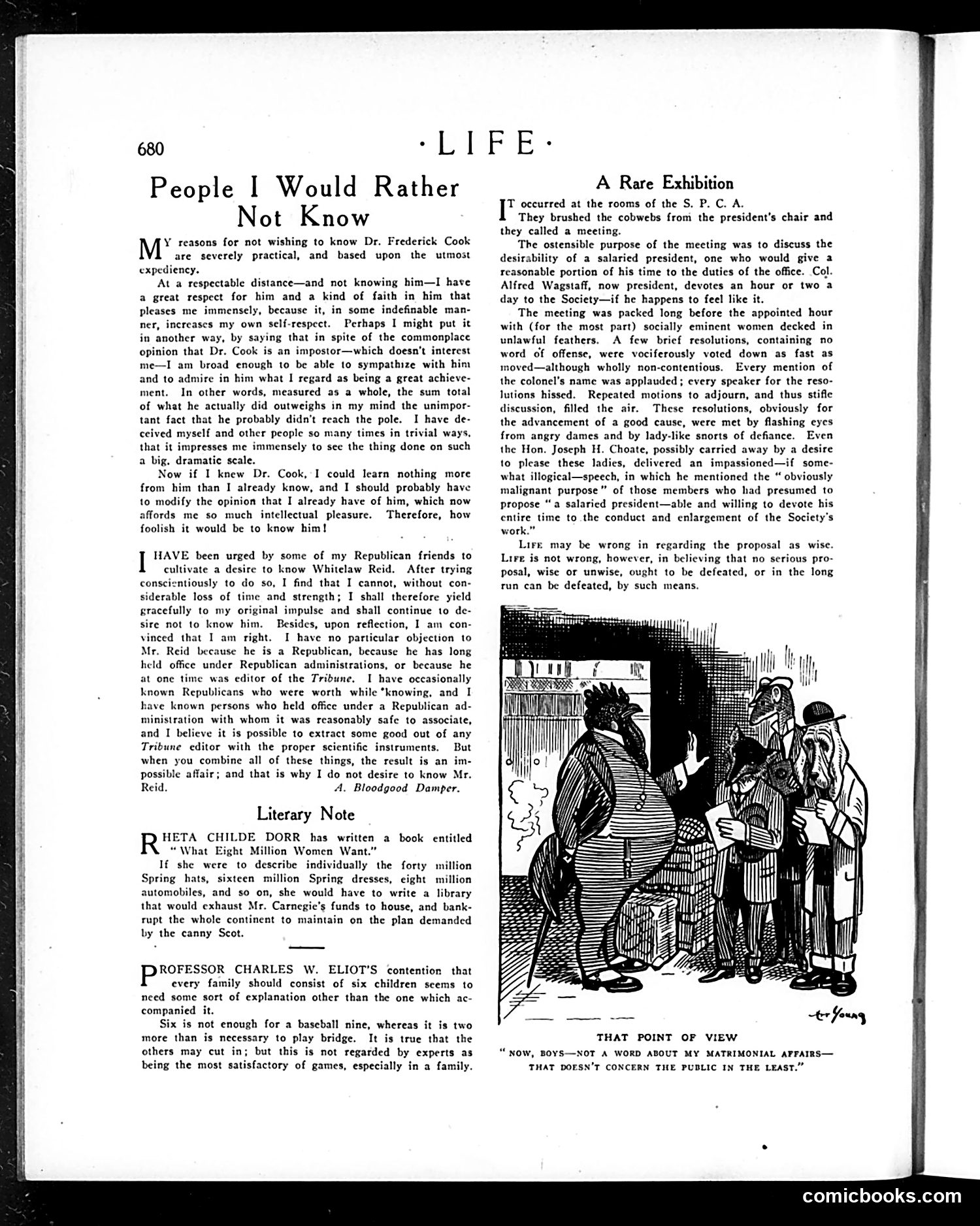
The cartoon depicts a meeting at the S.P.C.A. (Society for the Prevention of Cruelty to Animals). The accompanying text reveals that board members gathered to discuss hiring a salaried president, as the current president, Colonel Alfred Wagstaff, only devotes an hour or two daily to the organization when he feels like it. The cartoon's caption—"Now, boys—not a word about my matrimonial affairs—that doesn't concern the public in the least"—satirizes the hypocrisy of the proceedings. A figure (likely Wagstaff) preemptively silences discussion of his personal matters while the organization supposedly exists to protect those who cannot speak for themselves (animals). The joke is the irony: an organization dedicated to preventing cruelty and advocating for the voiceless is itself silencing legitimate organizational concerns. The cartoon mocks both Wagstaff's self-interested leadership and the board's apparent complicity in avoiding accountability.
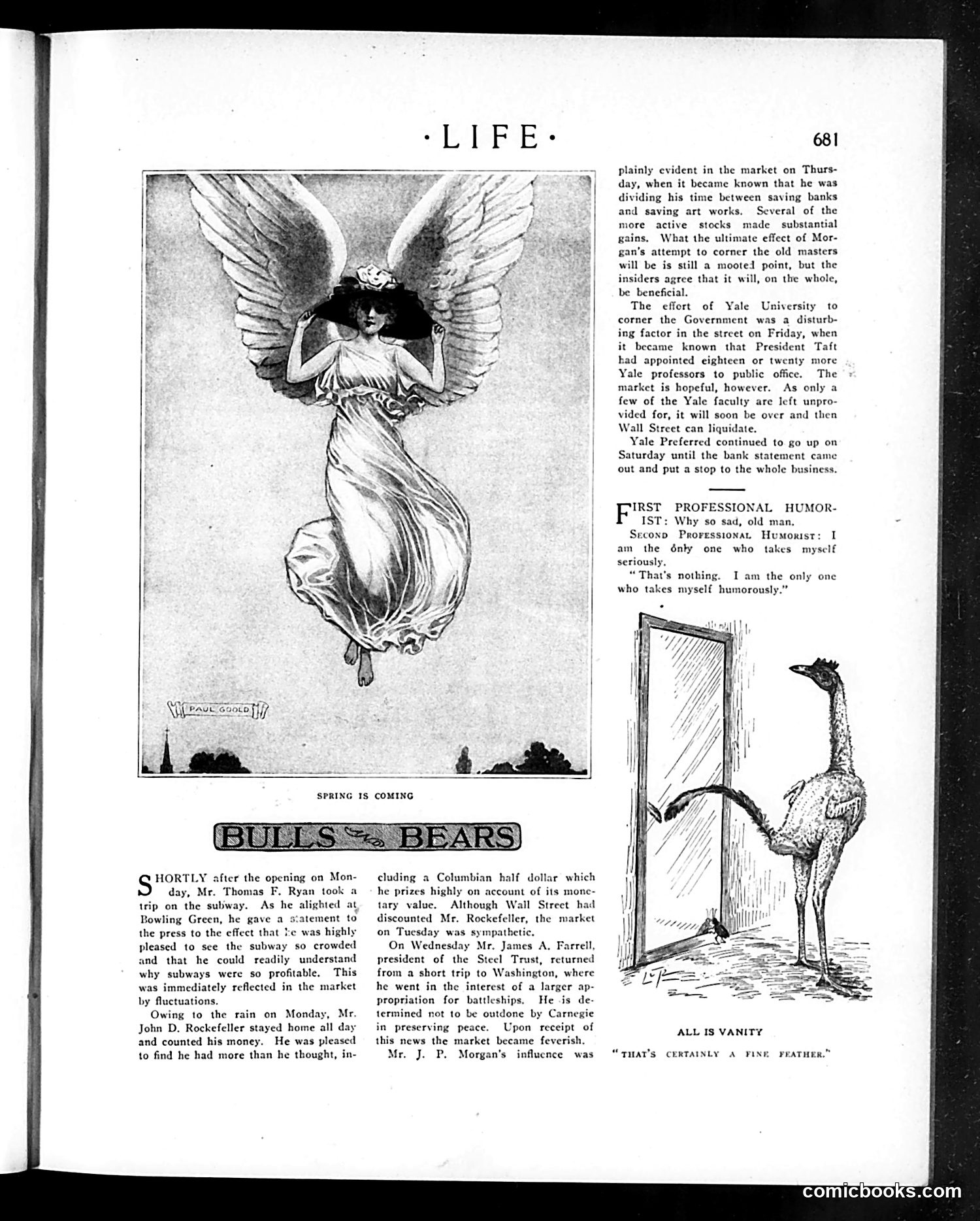
This section satirizes how Wall Street's market reacts to the actions of wealthy industrialists and powerful figures. The piece mocks the market's hypersensitivity: Rockefeller staying home and counting money causes market fluctuations; Steel Trust president Farrell's battleship lobbying makes stocks rise; J.P. Morgan saving art works has beneficial effects; Yale University's influence (via President Taft appointing Yale professors to office) creates market movement. The satire reveals how disconnected market behavior is from actual economic fundamentals—mere rumors of wealthy men's activities trigger buying and selling frenzies. "Yale Preferred" stock satirically responds to the university's political influence-peddling. The page also includes a joke about humorists taking themselves seriously, and a decorative illustration titled "All Is Vanity" featuring an angel and ostrich feather, reinforcing the theme of human vanity and superficiality.
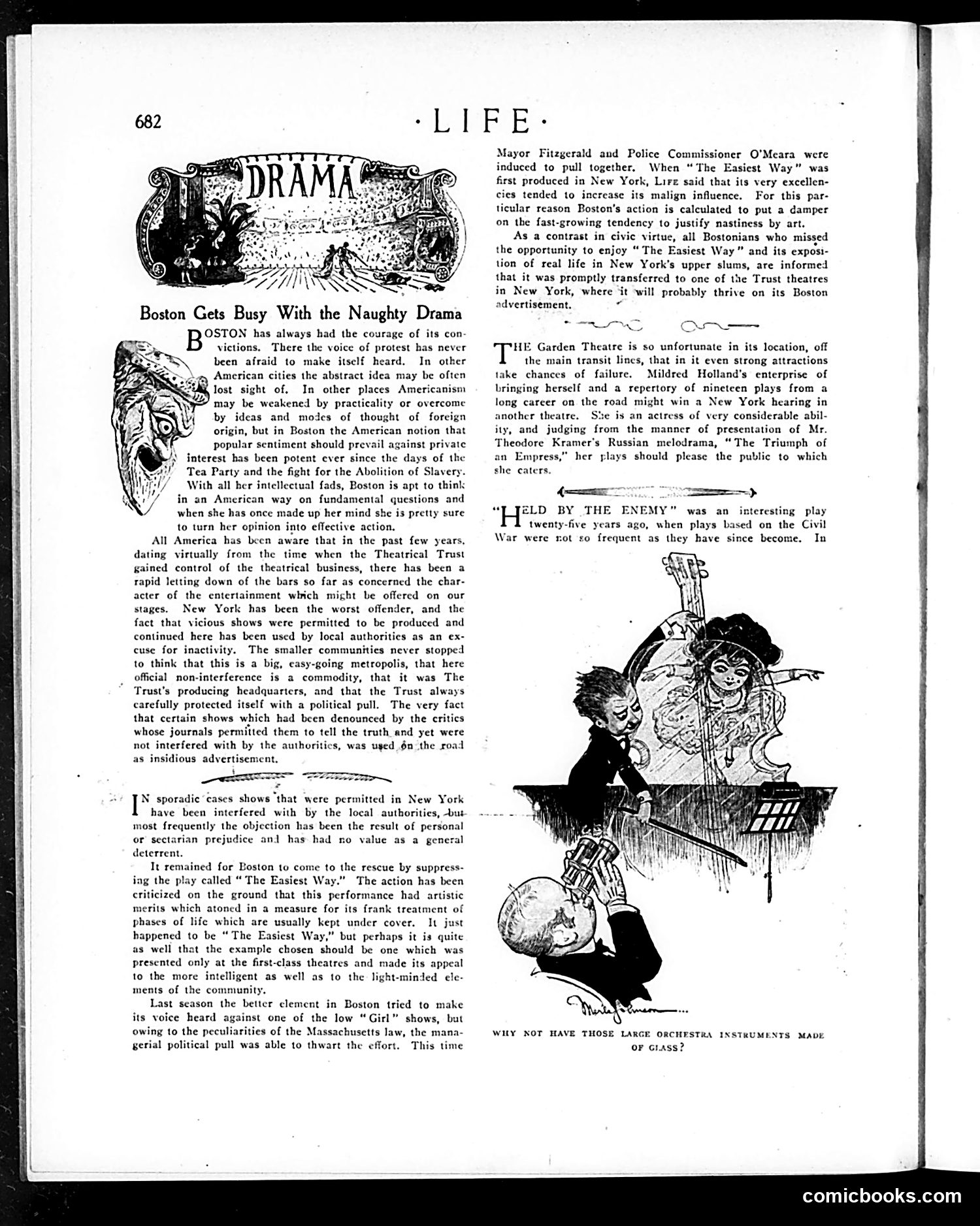
This page critiques Boston's suppression of the play "The Easiest Way," which dealt frankly with urban poverty and morality. The accompanying illustration shows a caricatured soldier or military figure, likely representing Boston's civic "courage" in enforcing moral standards. The article praises Boston's historical tradition of principled stands (Tea Party, Abolition) while discussing theatrical censorship. Life argues that New York's "Theatrical Trust" had degraded stage morality for years, exploiting political connections to avoid interference. Boston's suppression of "The Easiest Way"—despite its artistic merit—is presented as appropriately combating the "fast-growing tendency to justify nastiness by art." The satire's ironic punch: the play, suppressed in Boston, simply moved to New York theaters where Boston's publicity actually *helped* promote it as "insidious advertisement." The article reflects Progressive Era debates over censorship, artistic merit versus moral content, and corporate influence on local governance.
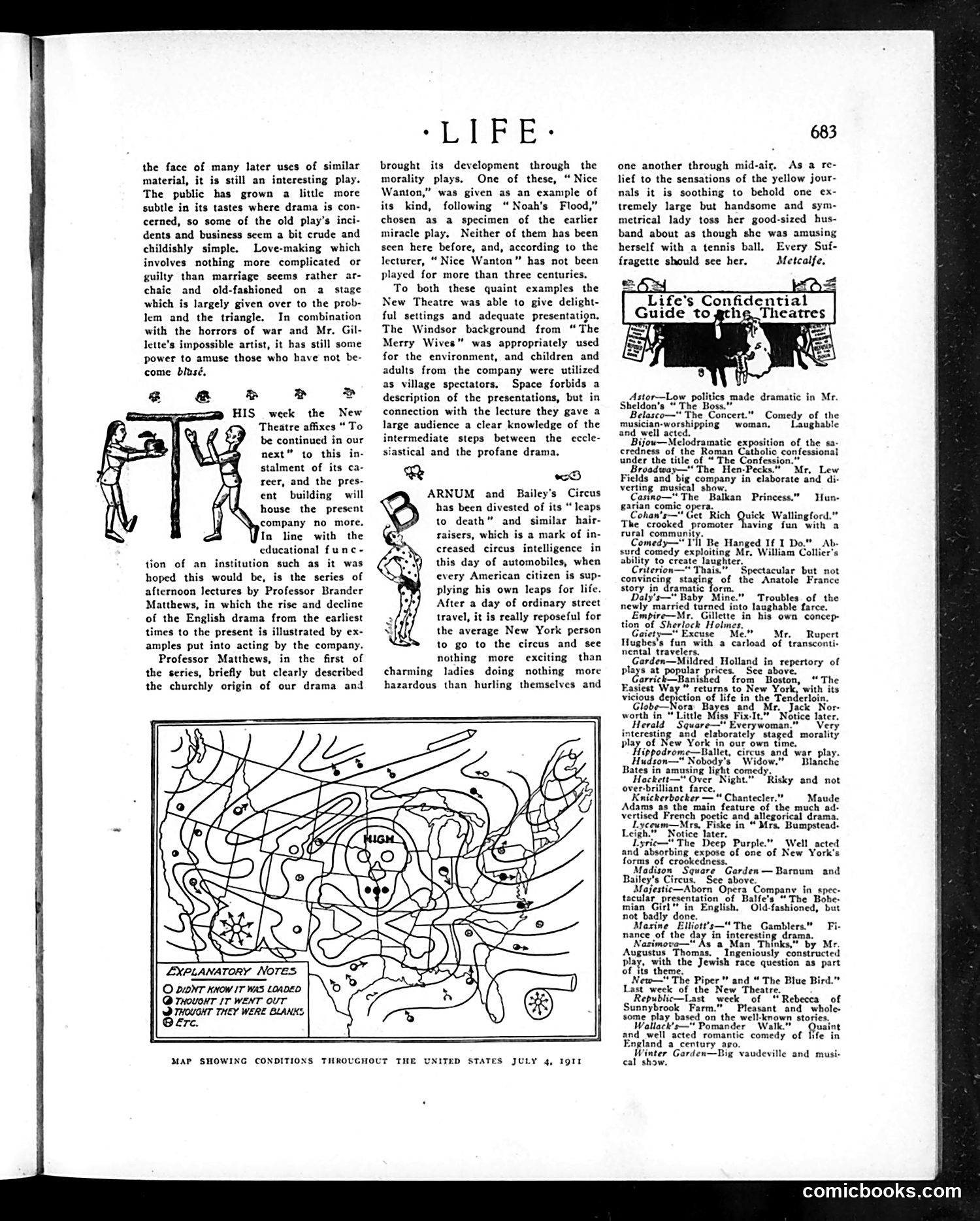
This page contains theater reviews and a curious cartoon map. The main content discusses the New Theatre's educational lectures on drama history, featuring performances of medieval morality plays like "Noah's Flood" and "Nice Wanton" (unseen for three centuries). Professor Brander Matthews traced drama's evolution from religious to secular forms. The page also reviews Barnum & Bailey's Circus, praising its removal of dangerous "leaps to death" acts—a pointed comment on modern urban risks. The author sarcastically notes that New Yorkers get enough life-threatening experiences from street travel and yellow journalism without needing circus danger. He concludes with a jab at suffragettes, suggesting they should appreciate the circus's "extremely large but handsome" woman tossing her husband around like a tennis ball. The cartoon map's caption references unclear incidents involving loaded weapons and blanks, likely referencing contemporary accidents or scandals, though specifics remain obscure without additional context.
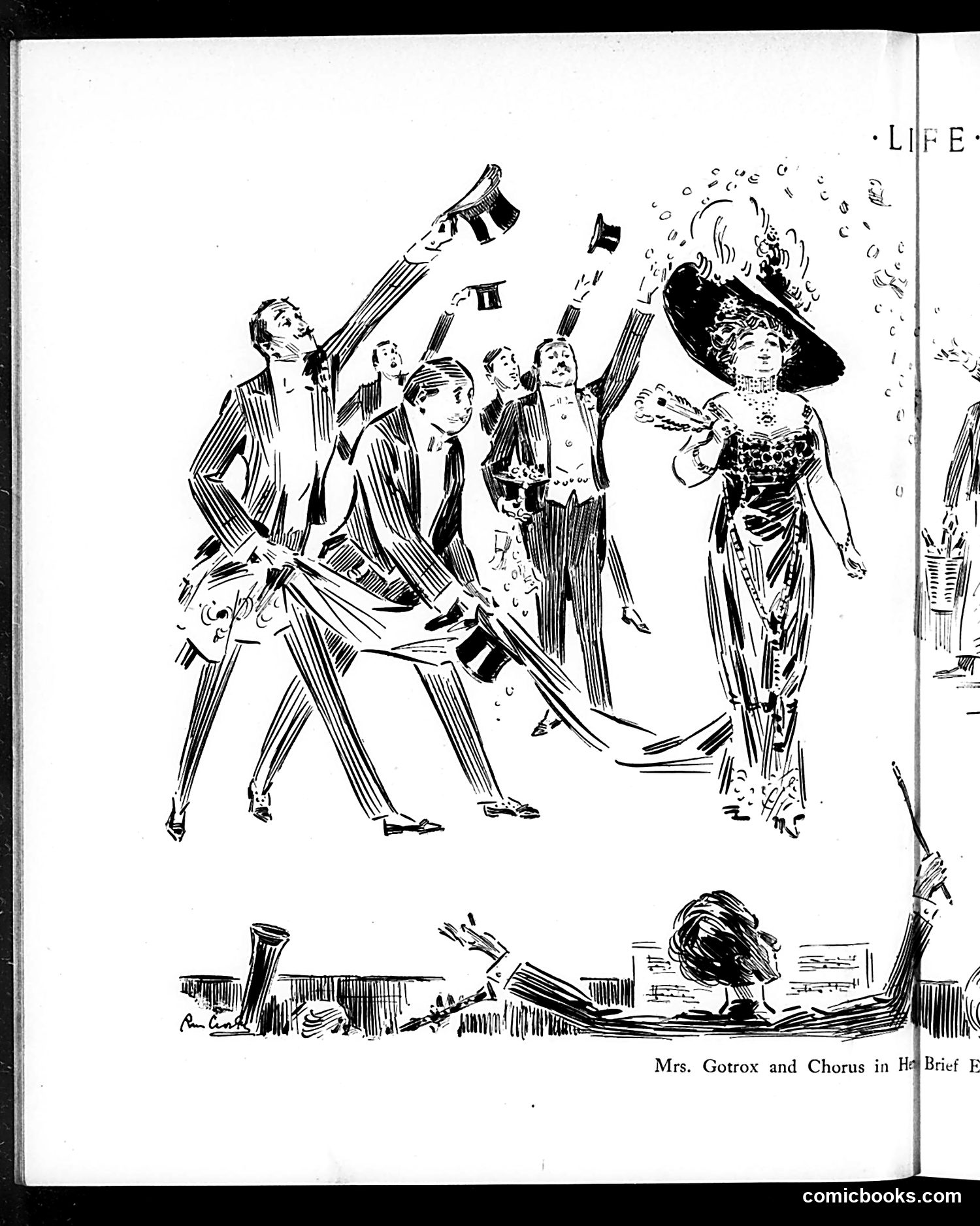
This illustration depicts a theatrical scene titled "Mrs. Gotrox and Chorus in Ha Brief E[ntertainment]" (the full title appears cut off). The image shows a woman in elaborate costume with a large feathered hat commanding attention while several men in business suits around her enthusiastically wave hats and appear to celebrate or cheer. The men's exaggerated poses and expressions suggest comedic adulation or fawning behavior toward the central female figure. The satire likely critiques either a specific theatrical personality of the era or, more broadly, the absurdity of male audiences' obsessive devotion to popular entertainers. The "Mrs. Gotrox" character appears designed as a caricature, possibly of a real performer or theatrical archetype, with the surrounding men portrayed as foolishly eager admirers. Without additional context about Life magazine's publication date or contemporary references, the specific target remains unclear.
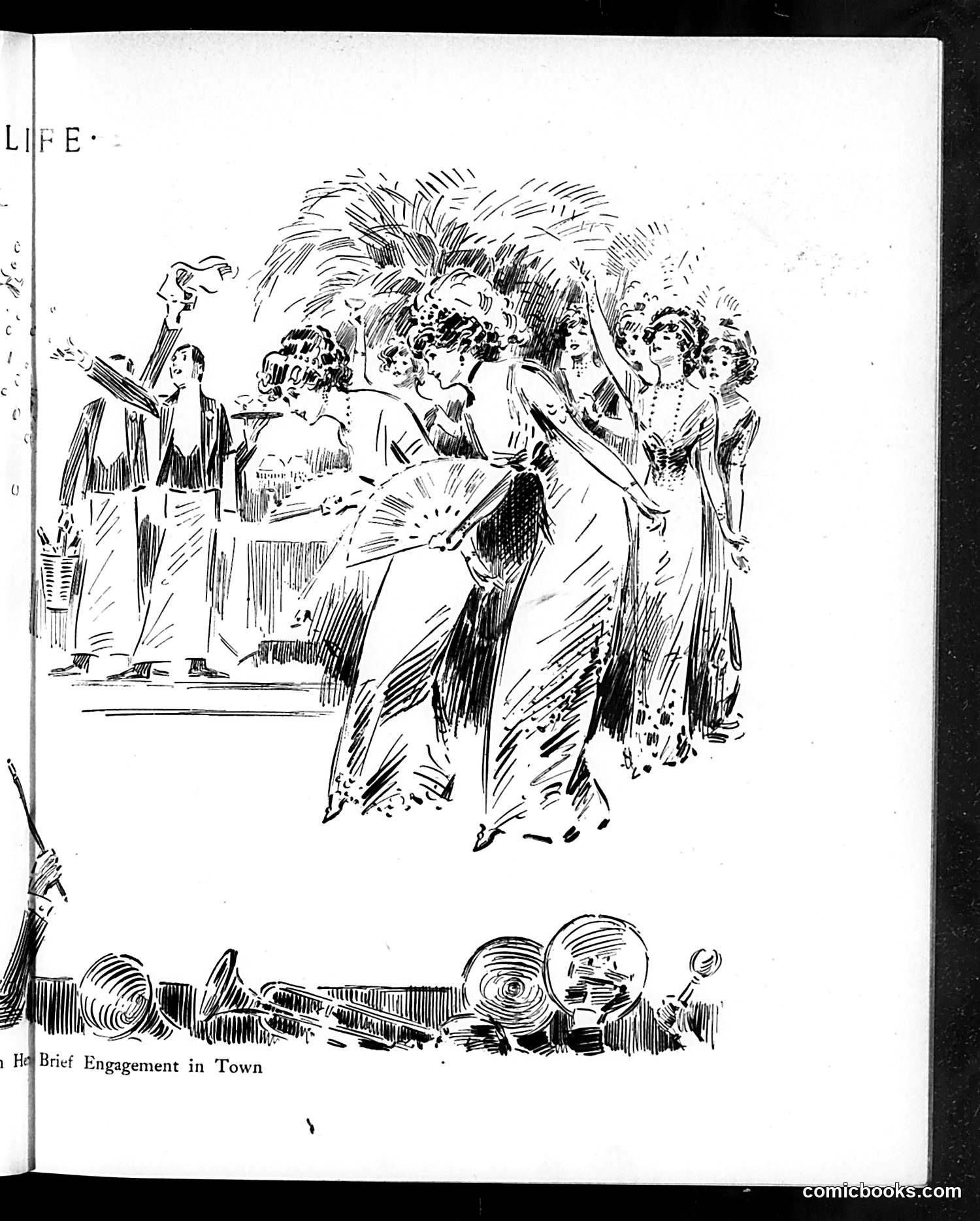
This is a satirical illustration from Life magazine titled "A Brief Engagement in Town." The sketch depicts a social scene with women in fashionable dress gathered around what appears to be a man (left) presenting flowers or gifts. The women are dressed elegantly with elaborate hats and clothing typical of the early 20th century. The satire likely mocks the romantic or social "engagement" - possibly critiquing either male courtship behavior, women's fashion obsession, or the superficiality of high-society social interactions. The scattered theatrical props (masks, objects) at the bottom suggest performative or artificial behavior. Without additional context about the specific publication date or accompanying text, the precise social commentary remains somewhat unclear, but the tone is clearly one of gentle mockery toward urban social customs and romantic conventions of the era.
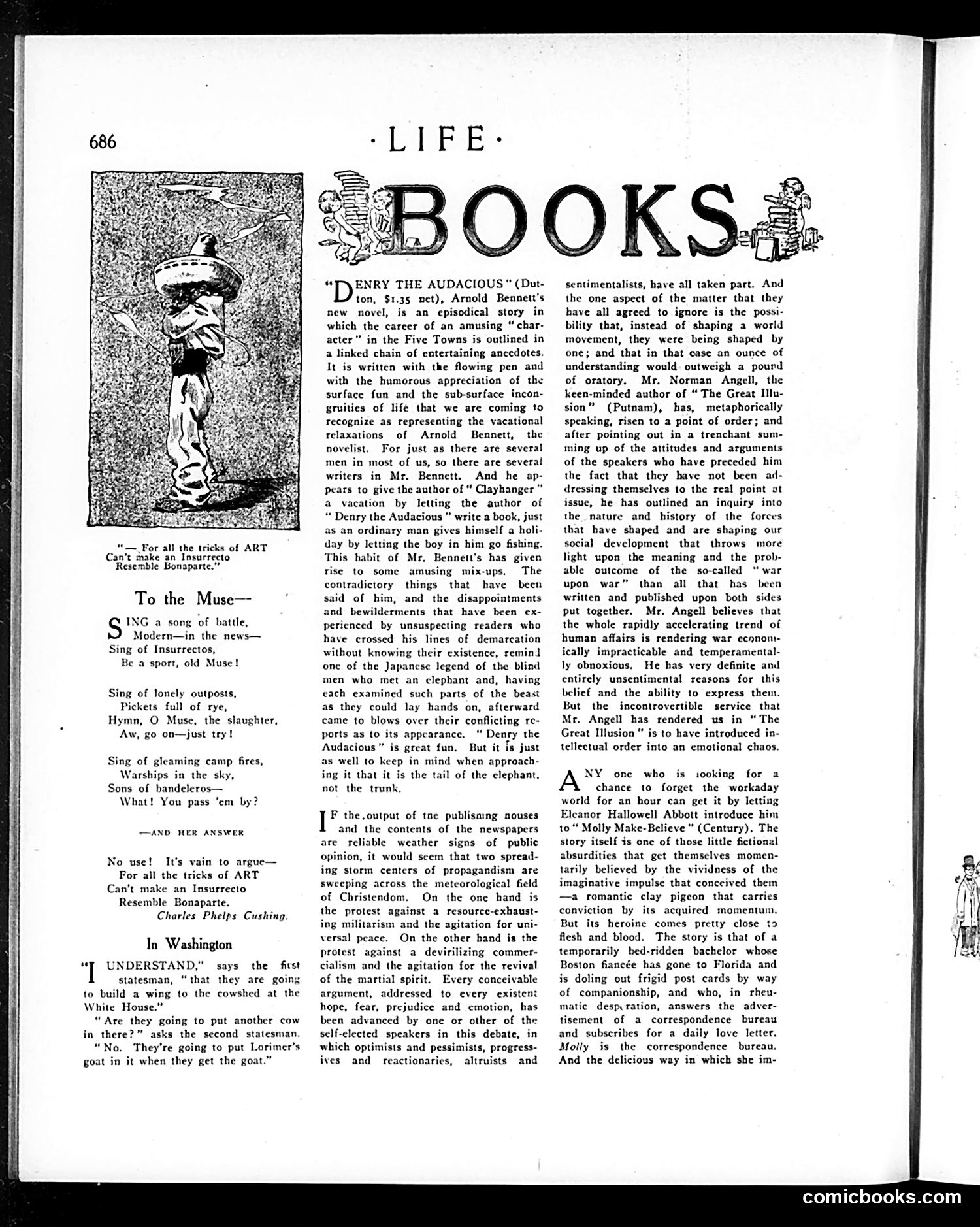
This *Life* magazine page contains political satire from the early 1900s addressing multiple contemporary issues. **The Cartoon "To the Muse"** mocks romantic glorification of the Philippine-American War's insurgents ("Insurrectos"). The poet pleads with the Muse to celebrate their battles, but she refuses—no artistic trick can make Filipino rebels resemble Napoleon Bonaparte. The satire suggests these conflicts lack the grandeur their advocates claim. **The Washington Joke** ridicules a prominent politician named Lorimer (likely William Lorimer, a corrupt U.S. Senator). Calling him a "goat" was period slang for a fool or scapegoat. The "cowshed" reference mocks the White House, implying government incompetence. **The Book Reviews** discuss Arnold Bennett's novel and debates over militarism versus commercialism sweeping Christendom—reflecting early 20th-century anxieties about war, peace, and societal values. The overall tone criticizes both political corruption and naive romanticism about military conflicts.
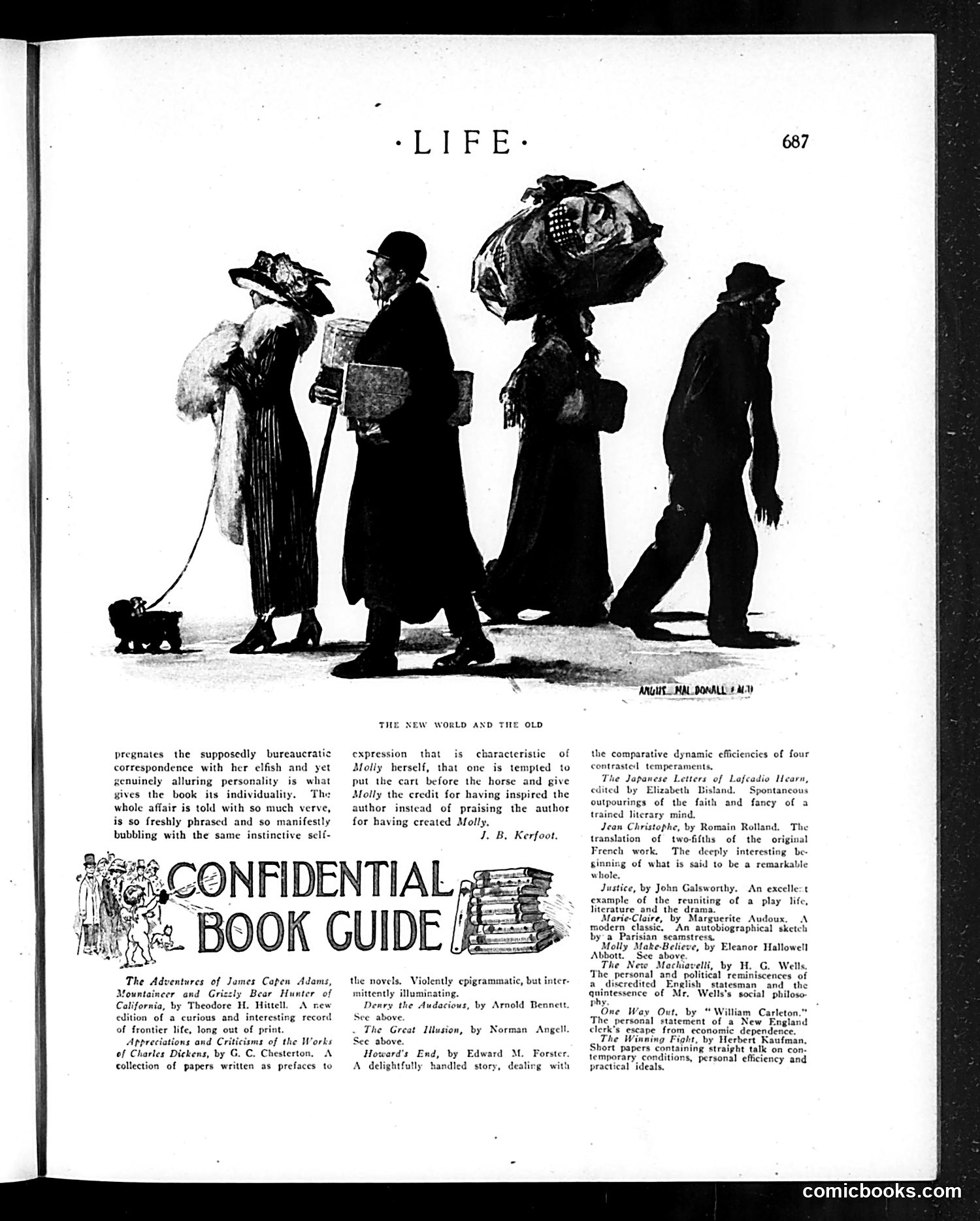
This page from *Life* magazine features a satirical silhouette cartoon by Angus MacDonald titled "The New World and the Old." The image depicts four figures in profile walking together: a fashionably dressed woman with an elaborate hat and small dog, two formally dressed men in bowler hats, and a slouching figure on the right. The cartoon likely contrasts American and European social types or attitudes—"new" versus "old" world sensibilities. The exaggerated fashions and formal postures suggest satire of pretension or social affectation. The disheveled figure at right may represent a counterpoint to the refined Europeans or Americans. The page's main content is a "Confidential Book Guide"—book reviews discussing contemporary novels by Wells, Galsworthy, Bennett, and others, making this primarily a literary criticism section rather than political commentary.
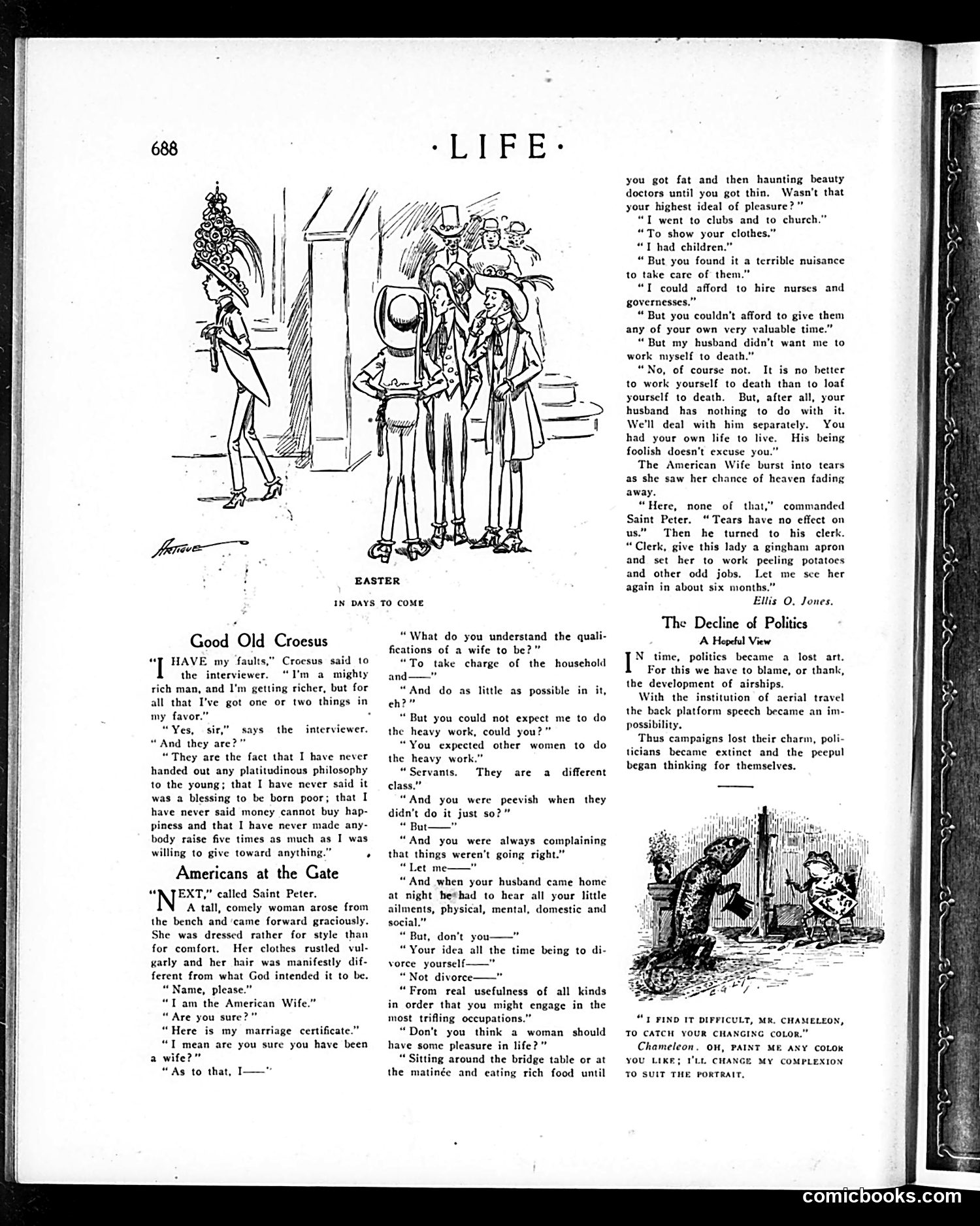
This Life magazine page contains three satirical pieces targeting American society circa early 1900s: **"Good Old Croesus"** mocks wealthy industrialists who hypocritically claim moral virtue while hoarding money. The reference is to the ancient king Croesus, proverbially rich. The joke: at least he's honest about his wealth rather than preaching poverty as noble. **"Americans at the Gate"** is a heavenly judgment scene where Saint Peter interrogates an "American Wife" about her life. The satire attacks upper-class women for idleness, materialism (bridge, theater, beauty treatments), delegating childcare to servants, and contributing nothing meaningful. Her punishment: manual labor. This reflects contemporary anxiety about women's roles and leisure-class excess. **"The Decline of Politics"** suggests airships' invention ended political campaigning (eliminating the campaign train's rear platform speeches), which paradoxically improved democracy by forcing people to think independently rather than follow politicians' rhetoric. The cartoon style and social assumptions are distinctly period—early 20th-century class commentary and gender critique presented as satirical humor.
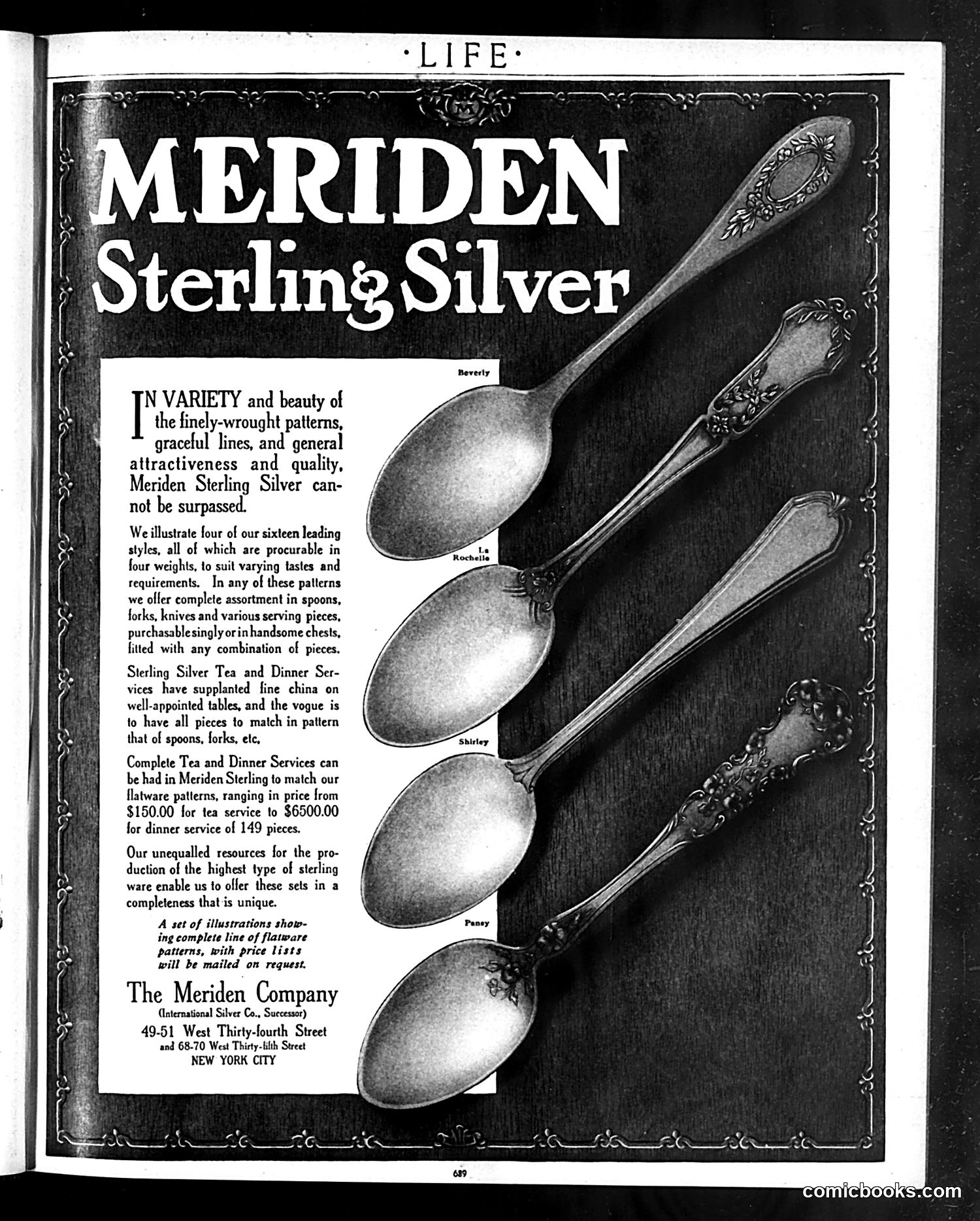
This is not a cartoon or satire—it's a straightforward **advertisement for Meriden Sterling Silver flatware**, published in Life magazine. The page showcases four spoon patterns (labeled Beverly, Rochelle, Shirley, and Pansy) with ornate handles. The ad emphasizes quality craftsmanship, variety of styles and weights, and the prestige of sterling silver tableware. It notes that complete dinner services range from $150 to $6,500, positioning the product as luxury goods for "well-appointed tables." The Meriden Company, based in New York City, was a legitimate silverware manufacturer (International Silver Co.'s successor). This represents typical early-20th-century magazine advertising—using Life's satirical platform to reach affluent readers who could afford fine dining goods. There is no political content or hidden satire to decode; it's a commercial pitch dressed in period typography and photography.
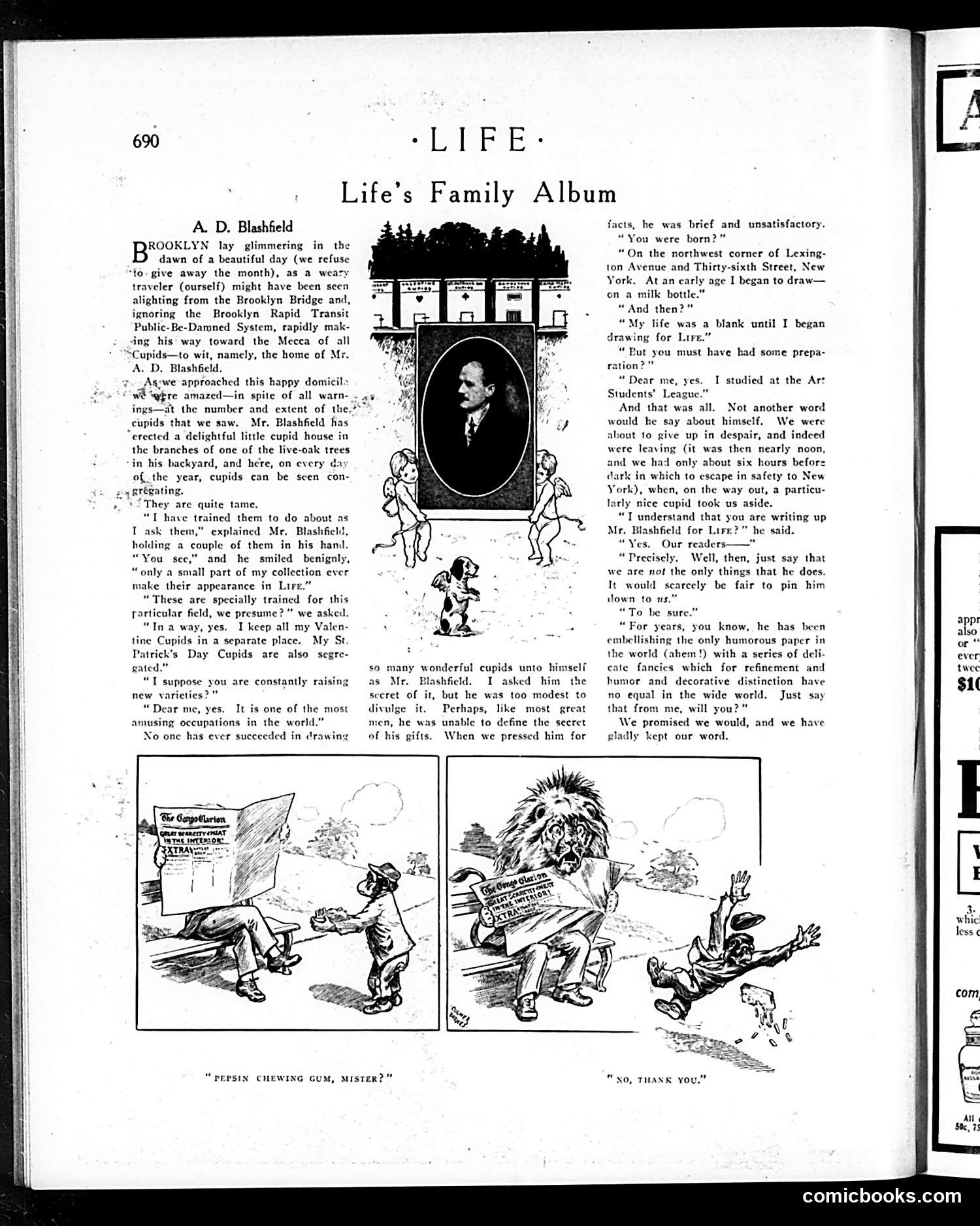
This is a humorous profile piece on artist A. D. Blashfield, presented as a whimsical interview. The satire centers on Blashfield's prolific output of cupid illustrations for *Life* magazine—so many that the piece jokes he's literally bred them like a livestock farmer, keeping separate varieties for Valentine's Day and St. Patrick's Day. The two cartoon panels below show cupids being offered chewing gum and politely refusing, likely satirizing contemporary advertising and consumer culture. The piece affectionately mocks Blashfield's prolific but modest artistic career, his minimal formal training (studied only at the Art Students' League), and his dedication to decorative commercial illustration rather than "serious" fine art. Even a cupid character must remind the interviewer that Blashfield does other work besides creating these charming decorative figures—suggesting his talents were underappreciated or underemployed in wider artistic circles.
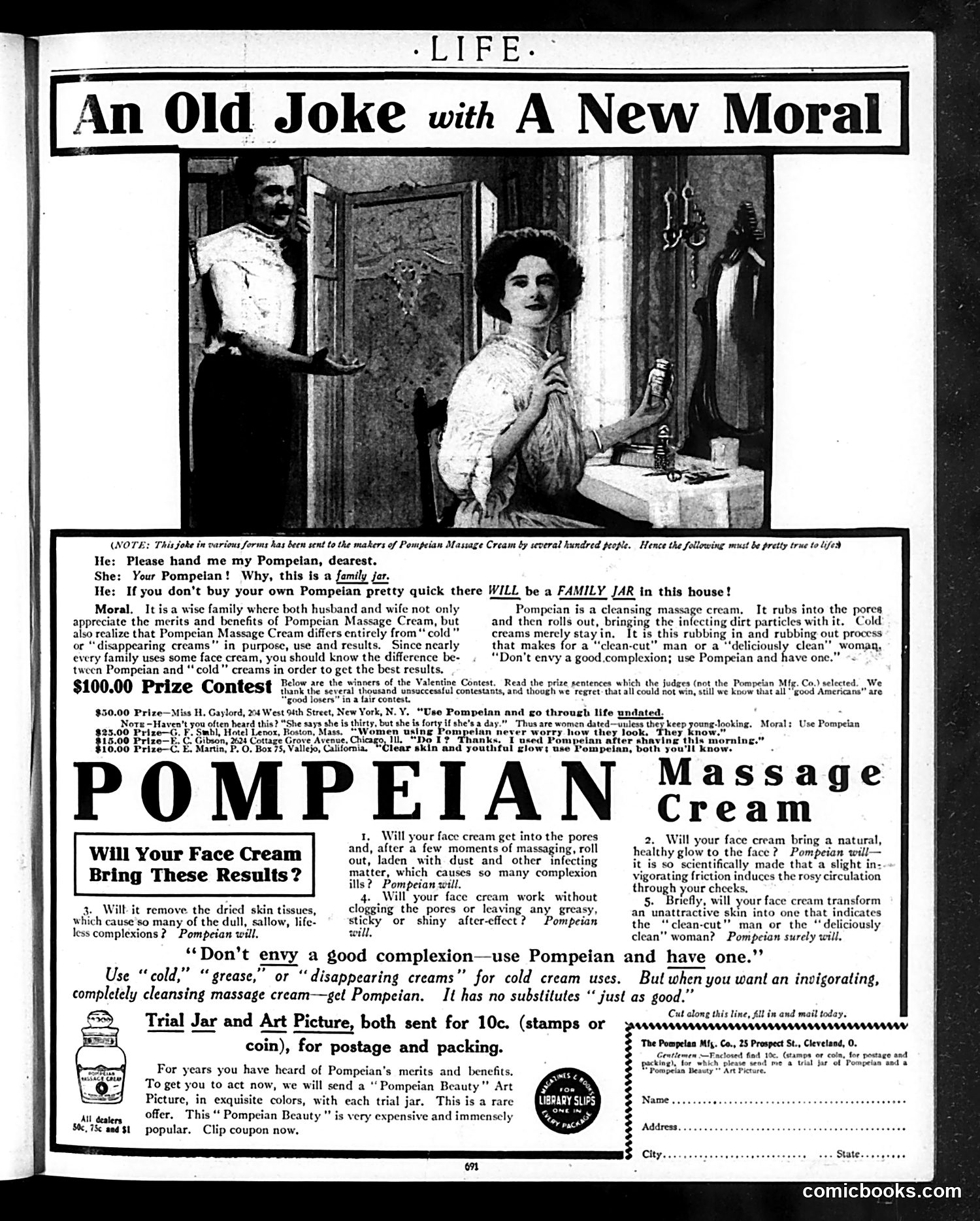
This page is primarily a **Pompeian Massage Cream advertisement** disguised as satirical content. The "joke" depicts a husband and wife quarreling over a shared face cream jar—he threatens a "family jar" (marital conflict) unless she buys her own Pompeian brand. The satire targets **early 20th-century gender roles and consumerism**: the moral suggests that a "wise family" requires *both* husband and wife to use separate Pompeian products, not shared "cold creams." This cleverly positions the product as essential to household harmony while implying that modern couples—particularly women concerned with beauty—should be independent consumers. The advertisement emphasizes Pompeian's superiority through pseudo-scientific claims about pore-cleansing and complexion, contrasting it with inferior competing creams. A "$100 Prize Contest" adds engagement, inviting readers to submit their own versions of this scenario. The page exploits humor to normalize product dependency as a solution to domestic and personal anxieties.
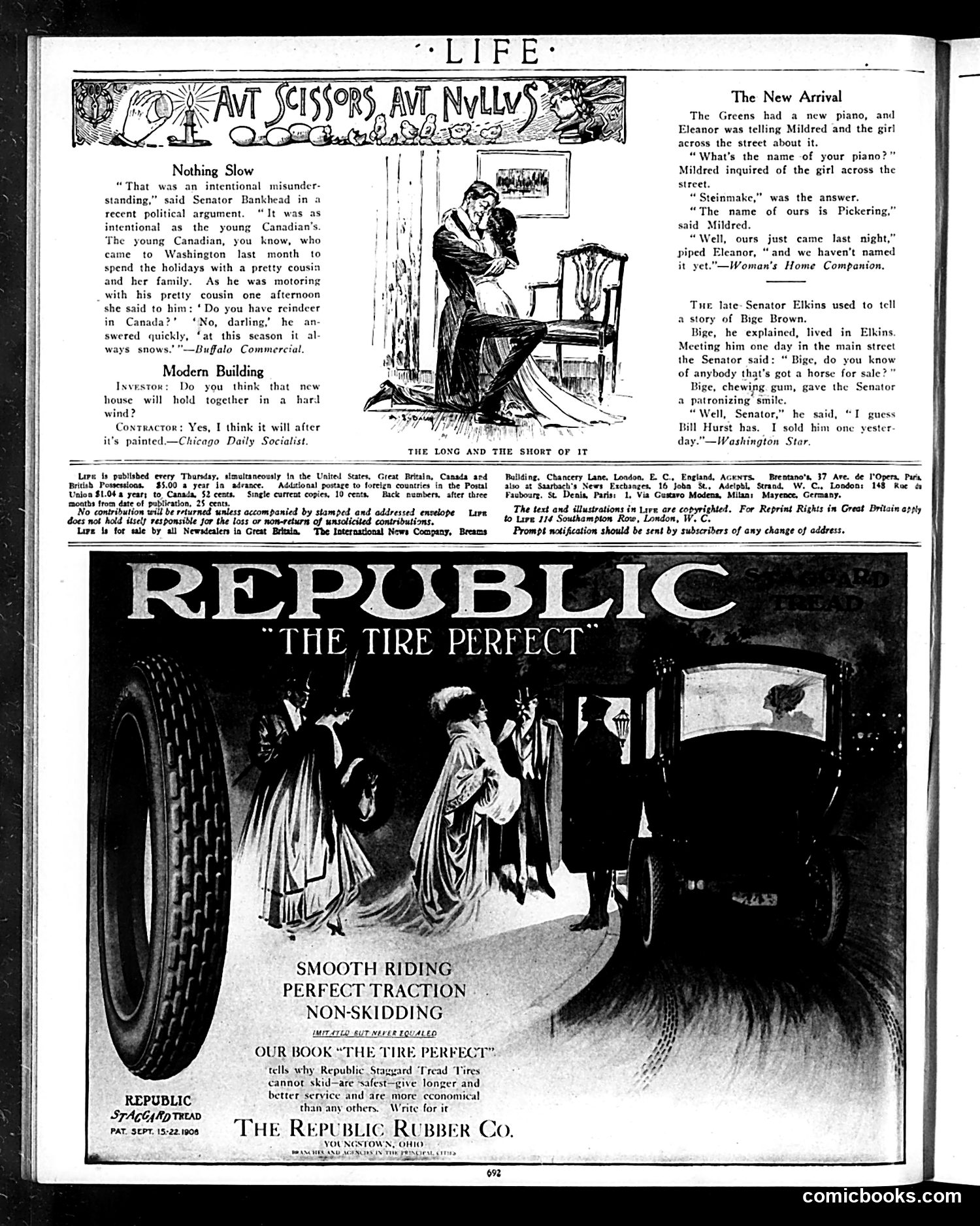
This page contains several short satirical jokes typical of Life magazine's humor section, plus a Republic Tire advertisement. The main cartoon—"The Long and the Short of It"—shows a man at a desk, likely depicting a political or business figure dealing with contrasting situations. The accompanying anecdotes use wordplay and misunderstandings for humor: a Canadian tourist misunderstands a question about reindeer (confusing "season" with snow), and a contractor jokes that a poorly-built house will only hold together after being painted. "The New Arrival" recounts Eleanor bragging about her family's new piano (named "Pickering"), while "Senator Elkins" tells of a transaction involving a horse sale. These pieces exemplify Life's era—early 1900s American humor focused on innocent misunderstandings, provincial stereotypes (the "young Canadian"), and gentle jokes about marriage and domestic life. The satire is mild by modern standards, targeting no specific political figures, though the "Modern Building" joke may subtly mock poor construction standards or worker quality. The Republic Tire ad occupies half the page, typical of period magazine layouts.
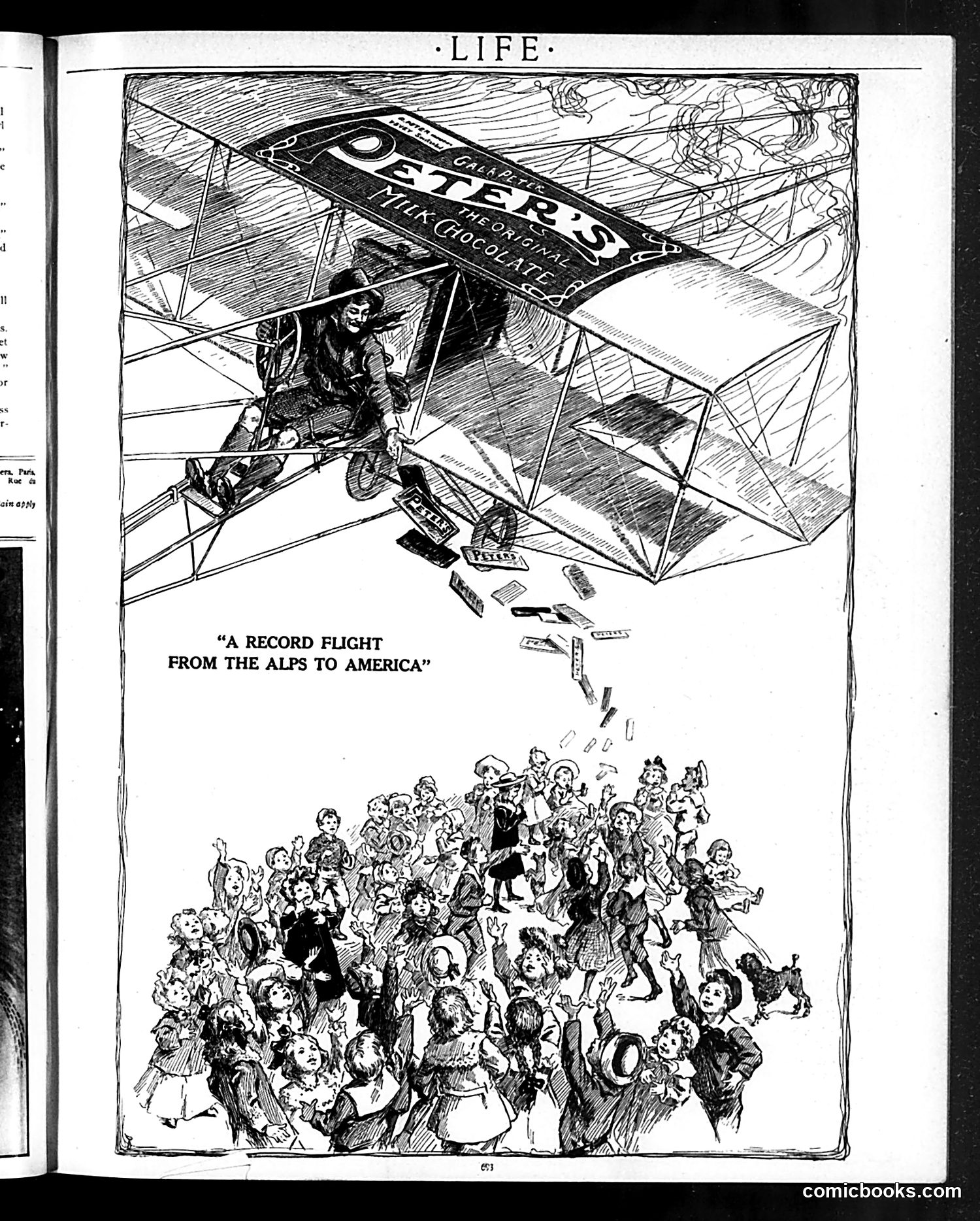
This satirical illustration depicts an airplane dropping chocolate bars (labeled "Hershey's") onto a crowd of people below, titled "A Record Flight From the Alps to America." The cartoon appears to mock either: - American consumerism and materialism (people eagerly receiving commercial products from above) - The novelty of early aviation technology being used for commercial purposes - Possibly post-WWI relations, given the "Alps" reference (European origin) The joke relies on the absurdist image of valuable consumer goods literally raining from the sky, with crowds scrambling to collect them—suggesting Americans' eagerness for branded products or the commercialization of new technology. The precise historical context and intended target remain unclear without additional publication information.
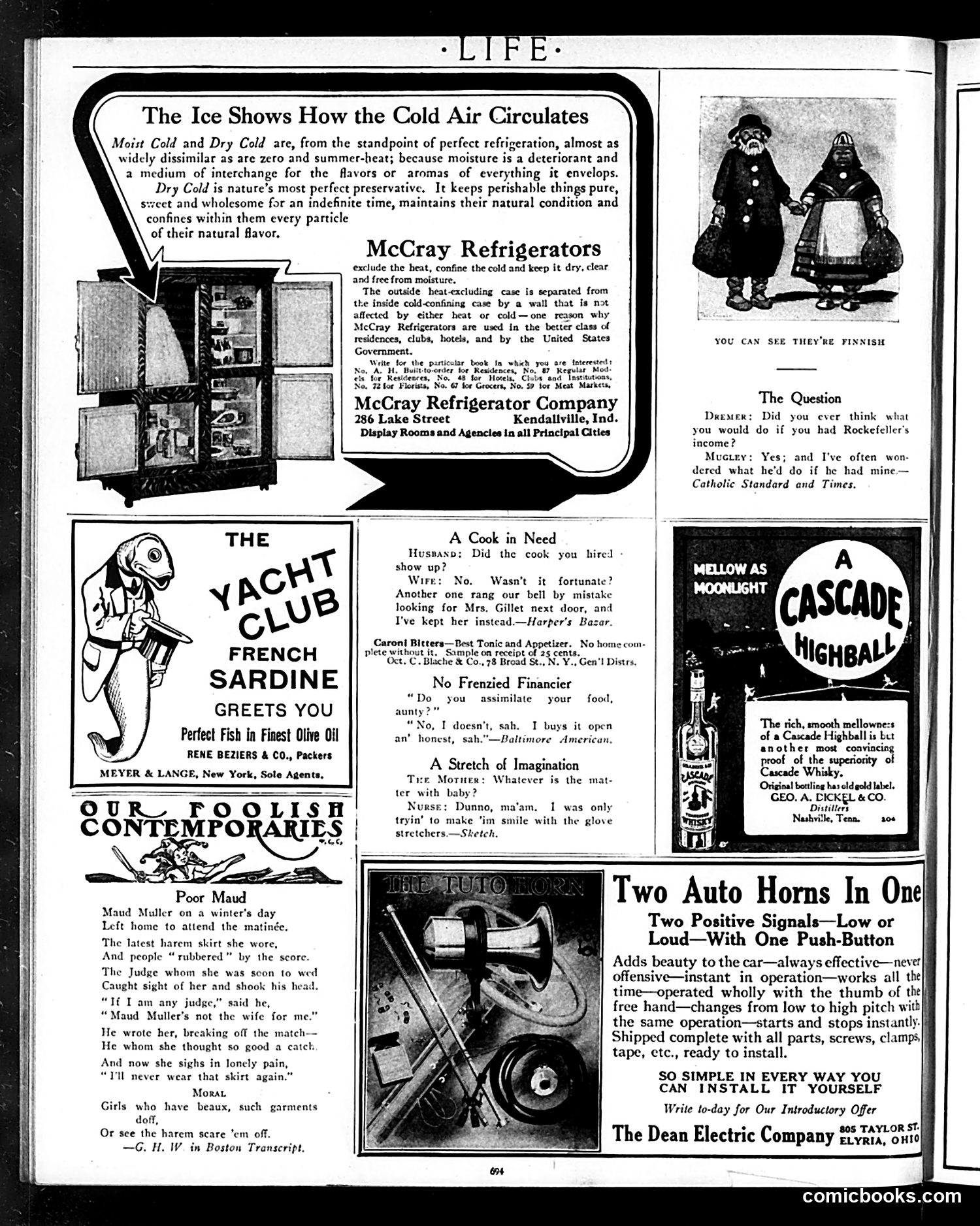
This page contains primarily **advertisements and light humor pieces** rather than political satire. The main content includes: **"Poor Maud" poem**: A morality tale about Maud Muller wearing a scandalous "harem skirt" to a matinee. Her fiancé breaks their engagement upon seeing her in this revealing garment, leading to her regret. The moral warns that girls who wear such daring fashions risk losing respectable suitors. This reflects early 1900s anxieties about women's changing fashion and sexuality. **Humor snippets**: Brief jokes about mistaken identity (a cook), financial naiveté, and baby care—typical period comedy with no deep satire. **Advertisements**: McCray Refrigerators (emphasizing "dry cold"), French sardines, Cascade Whisky, and auto horns dominate the page. The "harem skirt" reference indicates this is from the era when orientalist fashion influenced Western women's clothing, causing moral panic among conservatives. Otherwise, the page is largely commercial, with gentle domestic humor reflecting early-20th-century attitudes toward women and propriety.
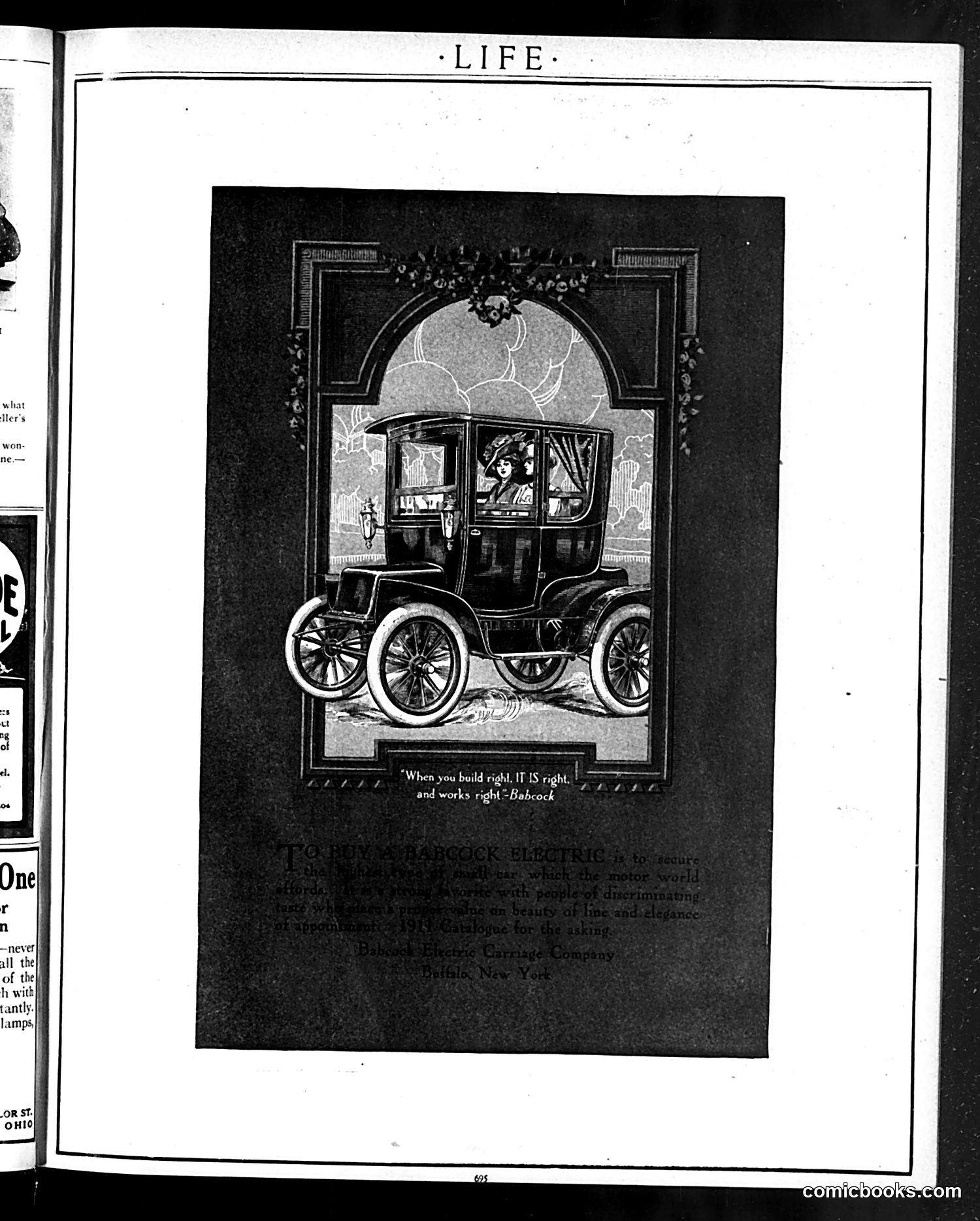
This is an advertisement for the Babcock Electric Carriage Company of Buffalo, New York, appearing in *Life* magazine. The image shows an early electric automobile with passengers, set against an elegant architectural backdrop. The ad uses a quote attributed to "Babcock" ("When you build right, IT IS right, and works right"), emphasizing quality construction. The text below promotes the Babcock Electric as "a secure, safe, and comfortable vehicle" that appeals to "people of discriminating taste" with "beauty of line and elegance of appointment." This reflects the early 1900s when electric vehicles competed with gasoline cars. The emphasis on safety, comfort, and aesthetic refinement suggests electric cars were marketed as upscale, reliable alternatives—particularly appealing to wealthy consumers concerned with quality and status rather than raw power.
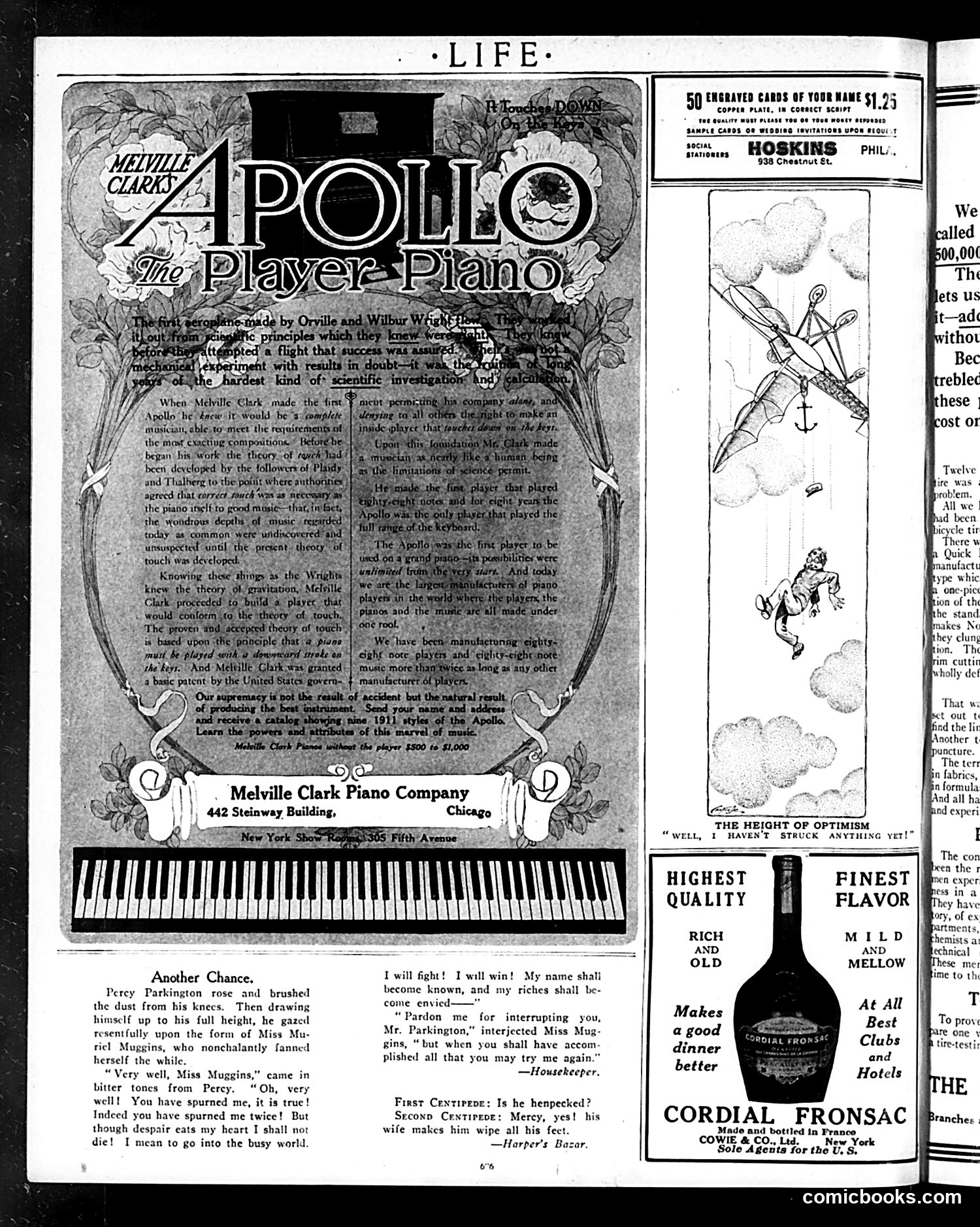
This page contains primarily **advertisements and humor pieces**, not political satire. The main content is a large **Apollo Player Piano advertisement** by the Melville Clark Piano Company, describing the mechanical innovations of their player piano—presenting it as a marvel of engineering that democratizes music by allowing anyone to "play" complex compositions. Below that are two brief **comedic vignettes**: 1. "Another Chance"—a romantic comedy sketch where rejected suitor Percy Parkington declares he'll become rich and famous, prompting Miss Muggins to suggest he try again *after* succeeding. The joke is her utter lack of faith in him. 2. Two brief jokes about henpecked husbands—one questioning whether a man is dominated by his wife (answer: yes, she makes him wipe his feet). The page also includes **period advertisements** for engraved calling cards, Hoskins stationers, and Cordial Fronsac wine. This represents typical early-20th-century Life magazine content: consumer advertising mixed with light domestic humor targeting middle-class readers. There is no significant political commentary visible.
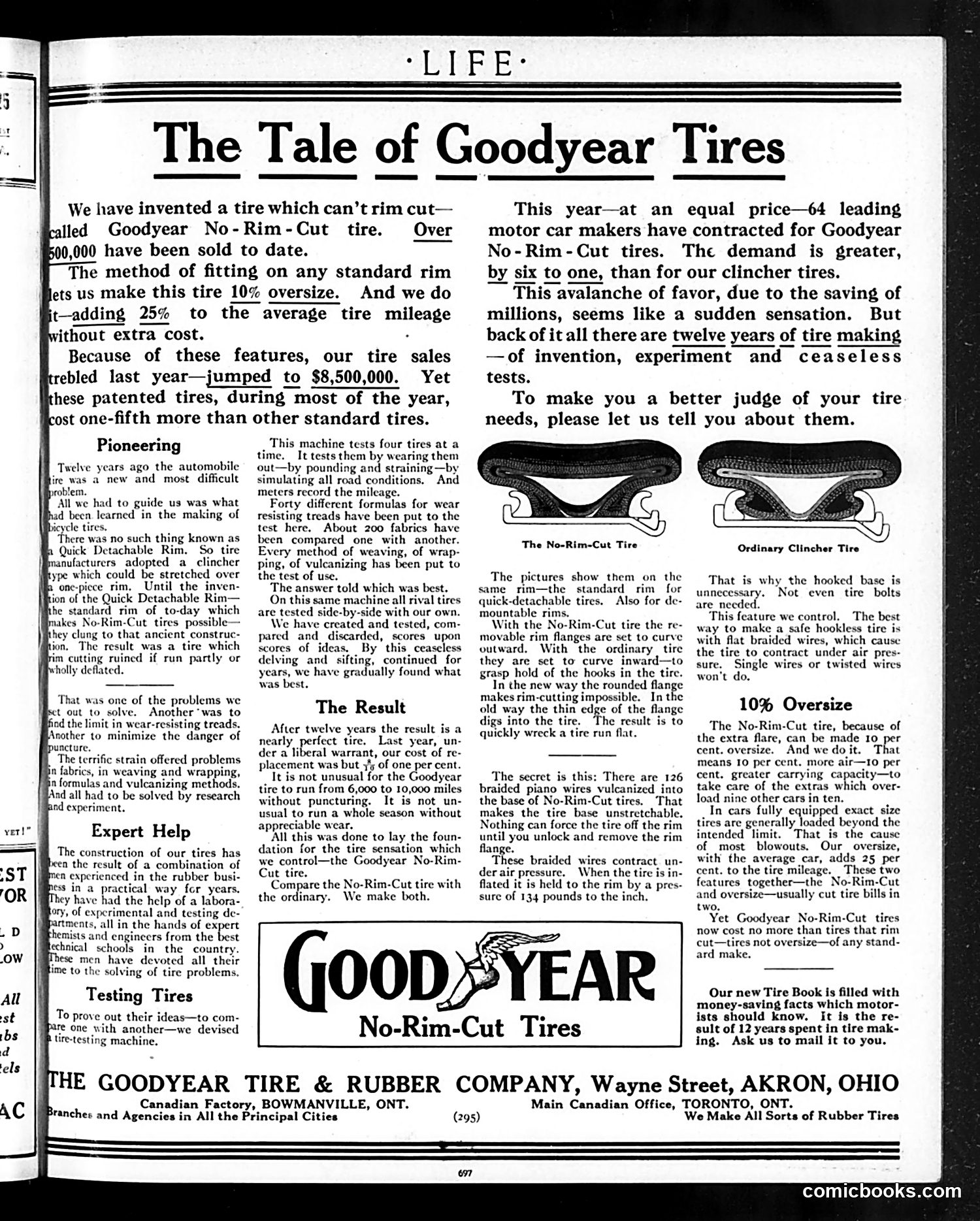
This is **not a political cartoon or satire**—it's a straightforward product advertisement for Goodyear tires, appearing in Life magazine's advertising section. The page promotes Goodyear's newly patented "No-Rim-Cut" tire, which the company claims prevents tire damage from rim cutting (a common failure when tires ran flat). Key selling points include: 10% larger size, 25% longer tire life, over 500,000 units sold, and adoption by 64 major car manufacturers. The article emphasizes the company's research credibility—twelve years of testing, 40 tire formulas tested, 200 fabrics evaluated. Two diagrams contrast the No-Rim-Cut tire's outward-curving rim flange with ordinary tires' inward-curving design that causes damage. This reflects early-1900s automotive advertising strategy: emphasizing engineering innovation and scientific testing to justify premium pricing (initially 20% more expensive than competitors).
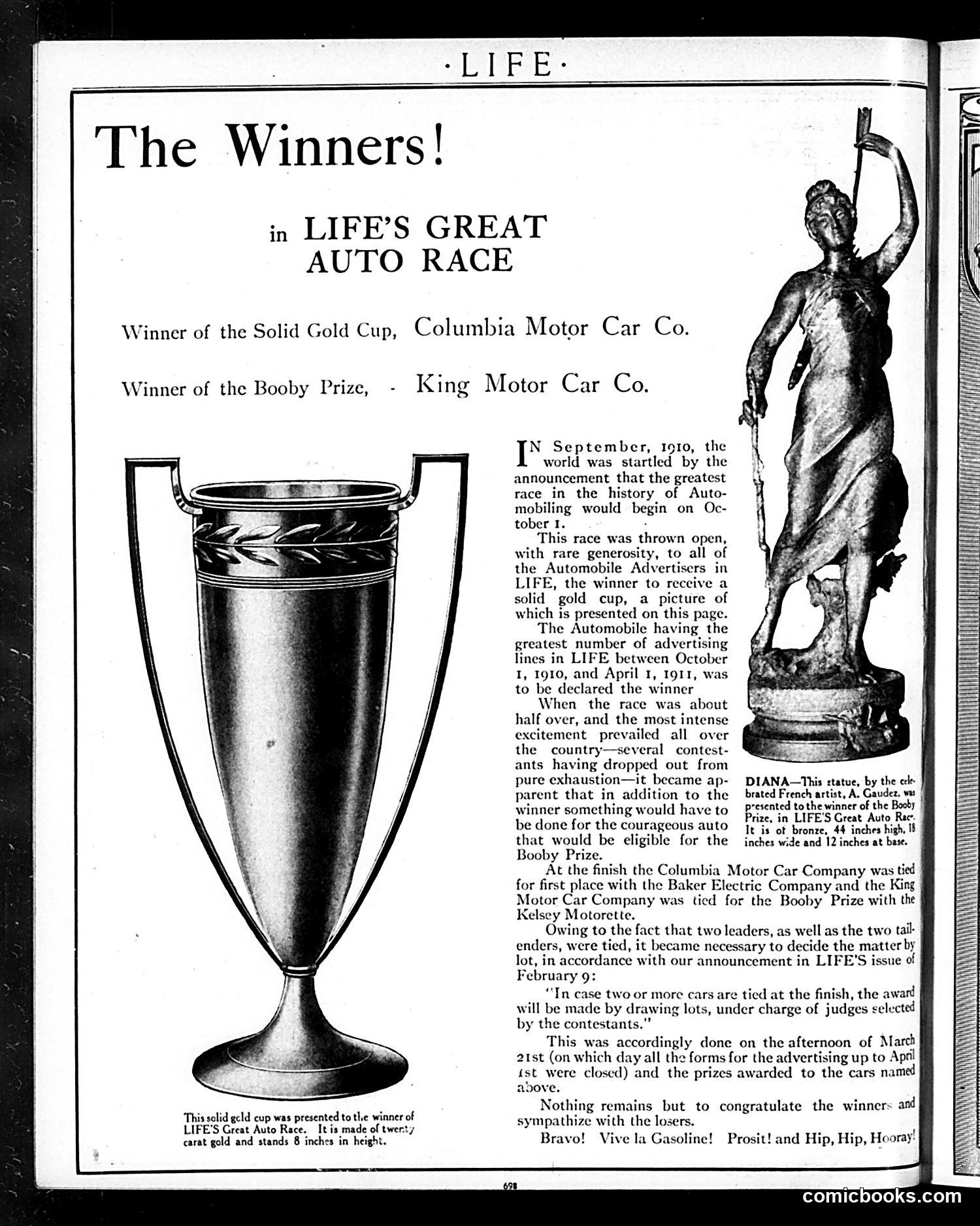
This page announces results of a satirical advertising competition Life magazine ran from October 1910 to April 1911. Auto manufacturers who advertised in Life competed for a solid gold cup—the winner determined by whoever placed the most advertising lines in the magazine. **The Winners:** - Columbia Motor Car Co. won the "Solid Gold Cup" (first place) - King Motor Car Co. won the "Booby Prize" (a bronze Diana statue—humorously, last place) **The Satire:** Life is gently mocking automotive advertisers' desperation to gain visibility through paid advertising. The contest itself became a commentary on commercial excess: manufacturers competed furiously, some "dropped out from pure exhaustion," and ties required random lot-drawing to decide winners. The tone is tongue-in-cheek celebration ("Bravo! Vive la Gasoline!"), but the underlying joke is that this entire competition measured success purely by advertising volume—making visible the sometimes absurd nature of corporate promotion.
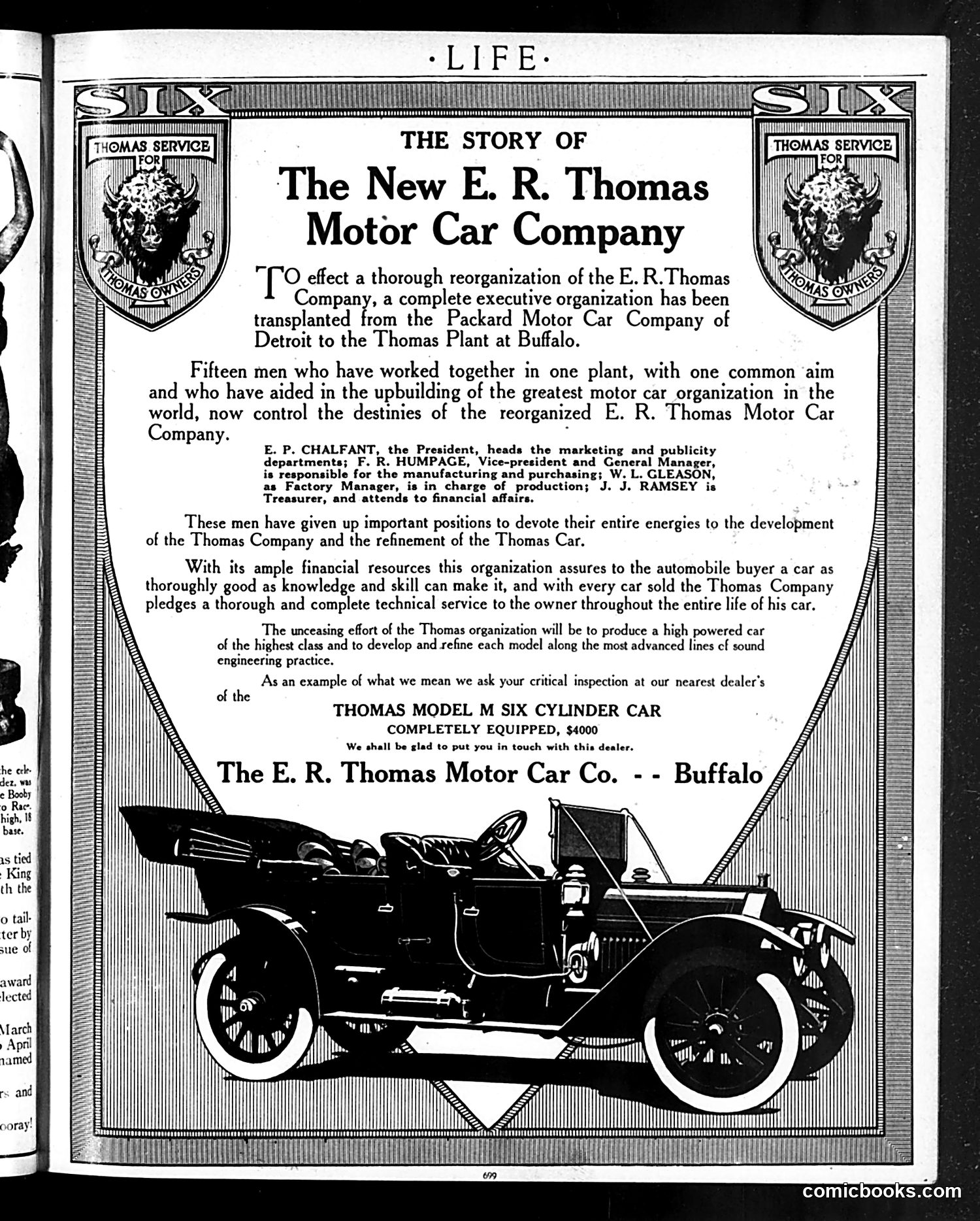
This is **not a cartoon or satire**—it's a straightforward advertisement disguised as editorial content. The page announces the reorganization of the E. R. Thomas Motor Car Company, a Buffalo-based automobile manufacturer, under new leadership drawn from Detroit's Packard Motor Car Company. The text lists five executives (Chalfant, Humpage, Gleason, Ramsey, and others) who've relocated to revitalize the struggling Thomas company. The advertisement emphasizes their credentials, the company's financial stability, and technical service commitments to reassure potential buyers of the Model M Six Cylinder Car, priced at $4,000. The silhouette illustration shows an open-air touring automobile typical of the 1910s era. **For modern readers:** This represents early automotive industry consolidation and executive mobility—experienced managers transplanted to rescue a failing competitor, with marketing language emphasizing reliability and after-sale service as key selling points in a competitive emerging industry.
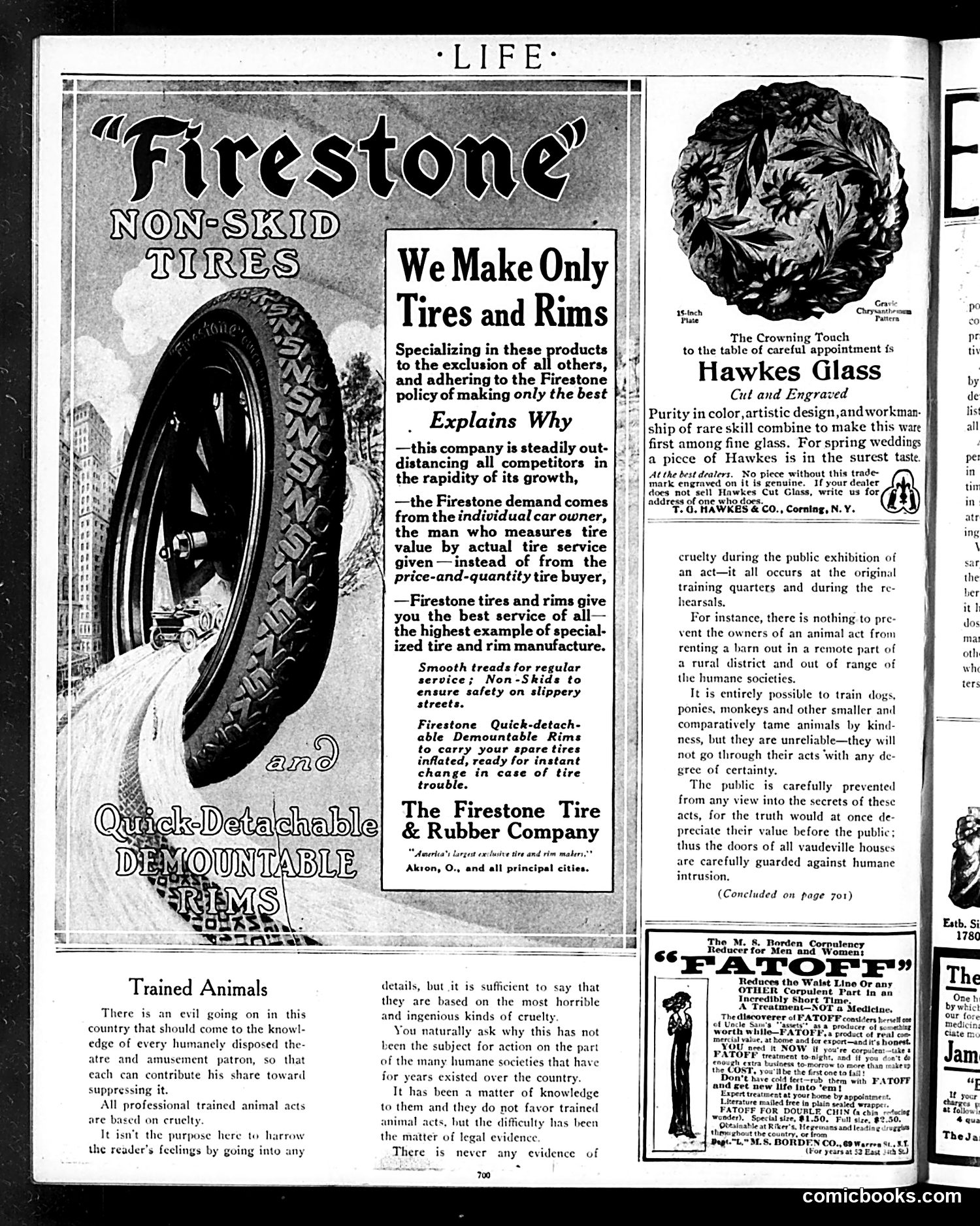
This page is primarily **advertising** with a satirical article on animal cruelty. The **main editorial content** is "Trained Animals," which argues that professional animal acts in vaudeville are inherently cruel. The piece claims that while cruelty occurs during secret training sessions (in remote barns), humane societies cannot prosecute because the public never witnesses abuse. The author suggests vaudeville theaters deliberately prevent inspection to protect their acts' market value. The point is satirical social criticism: the entertainment industry profits from hidden animal suffering while maintaining a respectable public facade. The **advertisements** include Firestone tires, Hawkes Cut Glass (luxury glassware for weddings), and "Fatoff," a dubious weight-reduction treatment marketed to women. The **Crowning Touch** image (right side) appears to be decorative commercial art for the Hawkes Glass ad, not political satire.
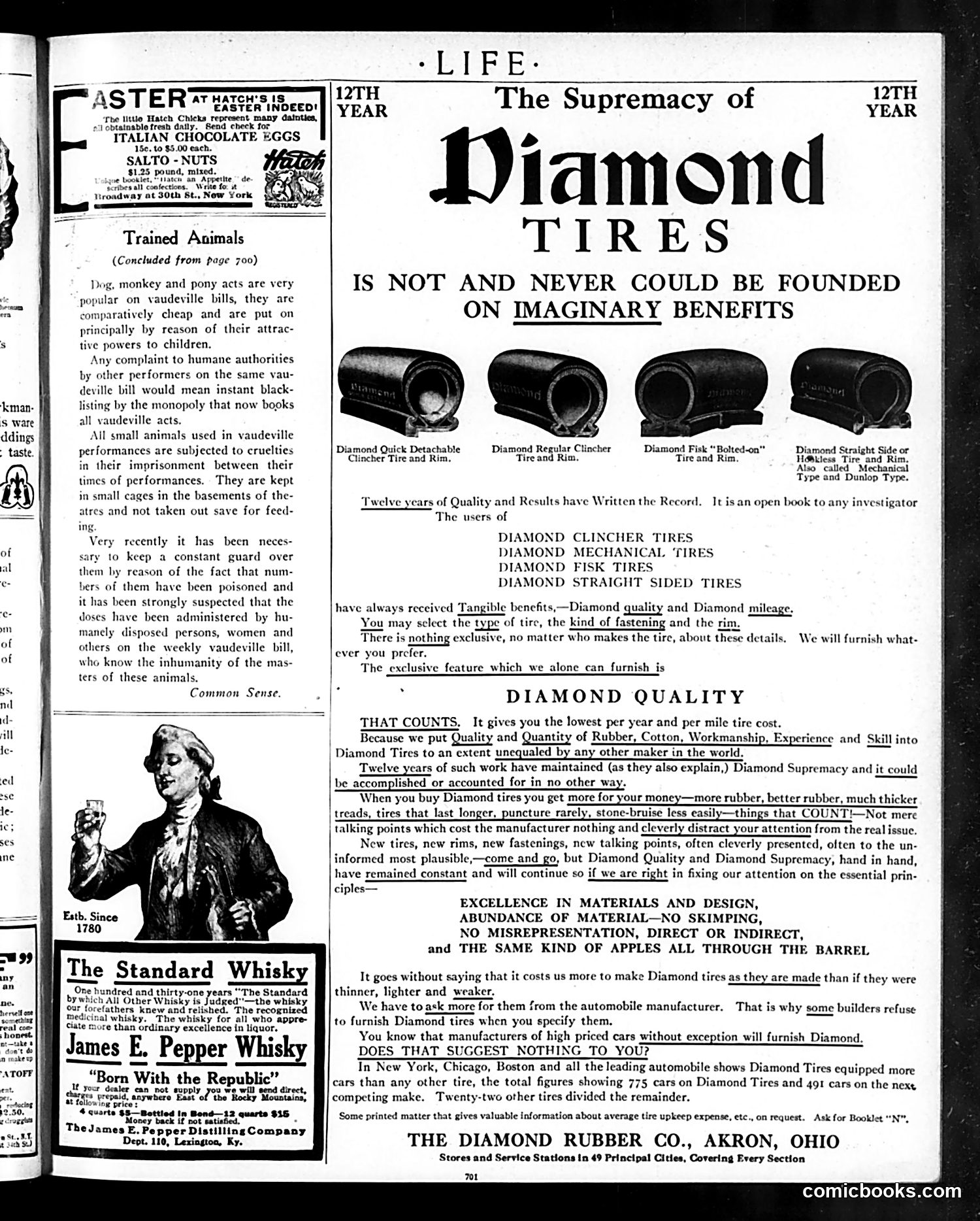
This page is primarily **advertising**, not satire or political commentary. The main content is a large Diamond Tires advertisement emphasizing "quality" and "tangible benefits" over competitor claims. The ad argues Diamond tires deliver measurable value—more rubber, better materials, longer-lasting performance—rather than relying on marketing gimmicks. It references competing tire types (Fisk, Clincher, Straight-sided) to position Diamond as superior through proven results over "twelve years." The left column contains an article on **trained animals in vaudeville**, criticizing their mistreatment—kept in basement cages, subjected to cruelties, and allegedly poisoned by sympathetic performers protesting their use. This advocates animal welfare reform. Minor ads include Easter candy/nuts and James E. Pepper Whisky ("Born with the Republic"). The page represents early 20th-century American consumer advertising and reflects period concerns about animal welfare in entertainment.
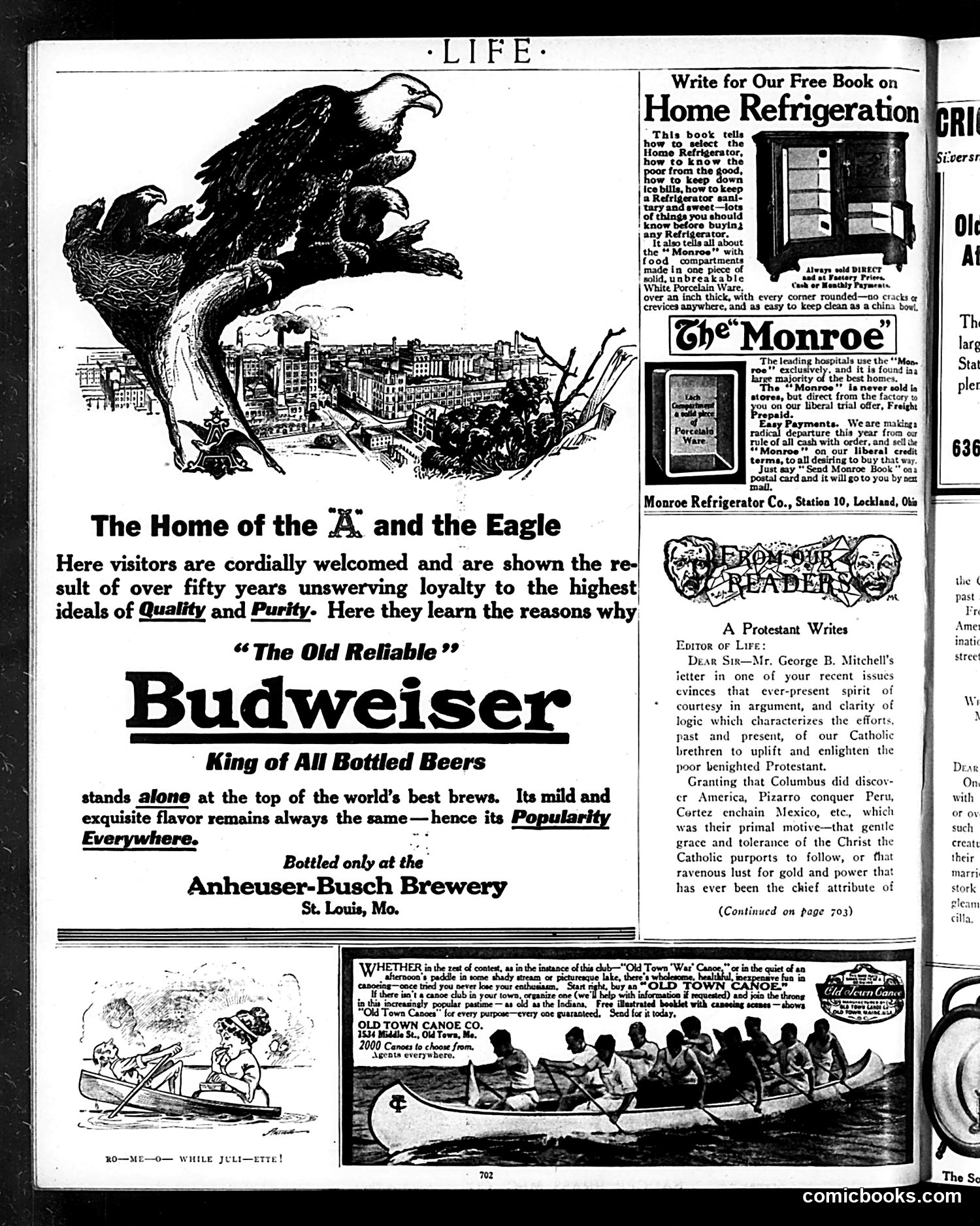
This page is primarily **advertising**, not political satire. The dominant content includes: **Main Advertisement:** Budweiser beer, marketed as "The Old Reliable" and "King of All Bottled Beers" by Anheuser-Busch Brewery in St. Louis. The eagle imagery symbolizes American patriotism and quality. **Secondary Ads:** Monroe Refrigerators (emphasizing modern home convenience and direct factory sales) and Old Town Canoes. **Editorial Content:** A letter titled "A Protestant Writes" responding to a previous article by George B. Mitchell. The writer sarcastically acknowledges Mitchell's "courtesy" while critiquing Catholic claims about historical explorers (Columbus, Cortez, Pizarro) and whether their motives were religious grace or greed for gold and power. This reflects early 20th-century Protestant-Catholic tensions in America. The page reflects period concerns: Prohibition-era beer marketing, emerging consumer appliances, and religious sectarian debate—but contains no political cartoons requiring historical interpretation.
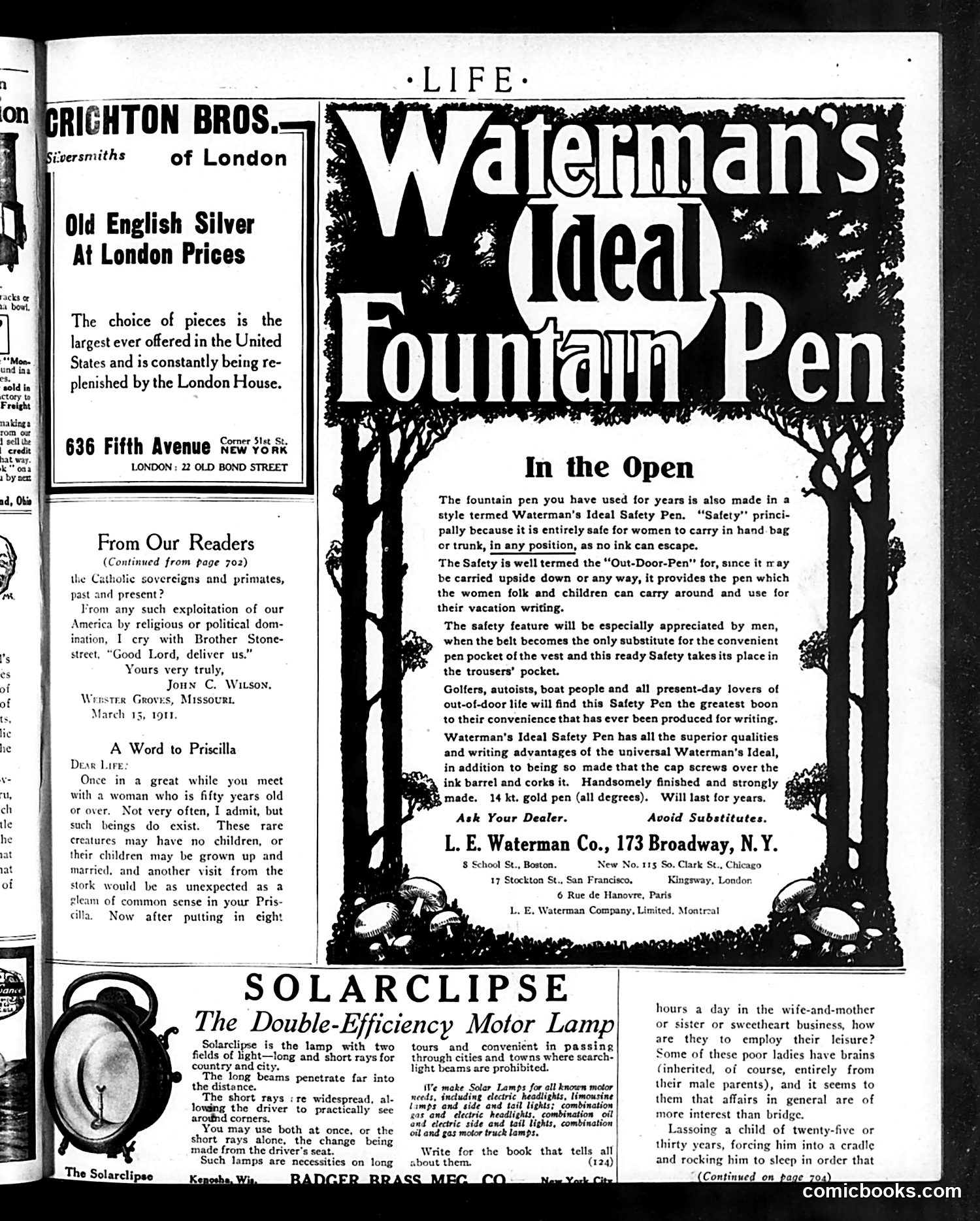
This page is primarily **advertising**, not satire or political commentary. It contains three product advertisements from circa 1911: 1. **Crichton Bros.** - A London silversmith offering Old English silver at London prices 2. **Waterman's Ideal Safety Fountain Pen** - The main advertisement features a decorative tree-framed design promoting a leak-proof pen marketed as safe for women to carry in bags/trunks without ink escape. It emphasizes convenience for outdoor activities (golf, automobiles, boating). 3. **Solarclipse Motor Lamp** - An automobile headlight with dual-beam functionality for country and city driving. The "From Our Readers" section contains reader letters on religious/political topics and a humorous advice column segment about unmarried women over fifty. These are editorial content, not cartoons or satire. The page reflects early 1900s consumer culture and gender assumptions (pens marketed specifically for women's safety needs).
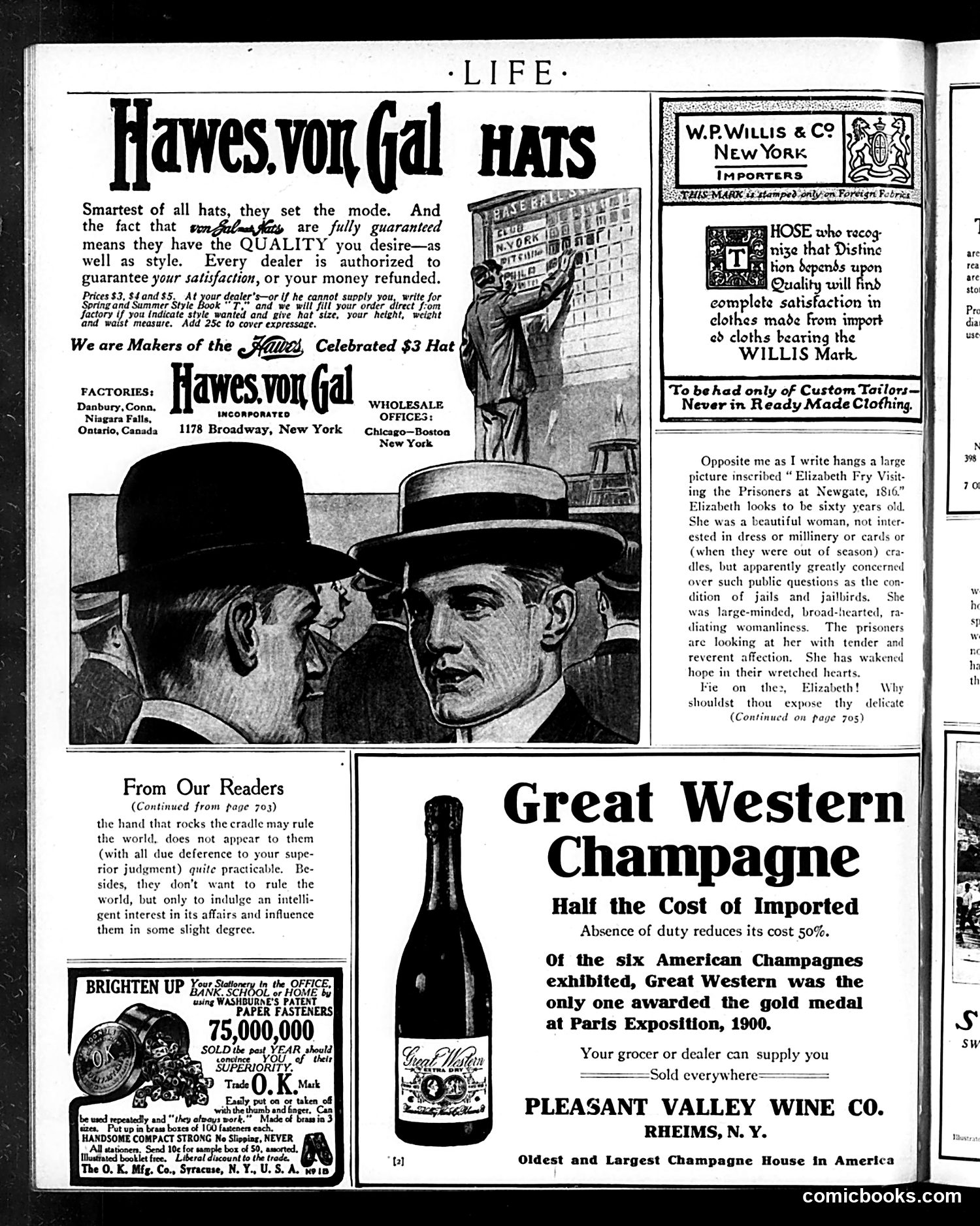
This page is primarily **advertising**, not satire or political commentary. It contains three main advertisements: 1. **Hawes, von Gal Hats**: Promotes men's hats ($3-$5) as "smartest" and guaranteed quality, with factories listed in Danbury, Niagara Falls, and Ontario. 2. **W.P. Willis & Co.**: Advertises imported fine clothing bearing the "Willis Mark," available only through custom tailors. 3. **Great Western Champagne**: Highlights an American champagne from Pleasant Valley Wine Co. (Rheims, N.Y.) that won a gold medal at the 1900 Paris Exposition, costing half as much as imported champagne due to absence of duty. The page also includes a brief editorial note about a historical painting of Elizabeth Fry visiting Newgate prison (1816) and a "From Our Readers" letter debating women's political engagement. **No political cartoons or satire appear on this page.** It reflects early 1900s consumer advertising and social commentary typical of Life magazine's format.
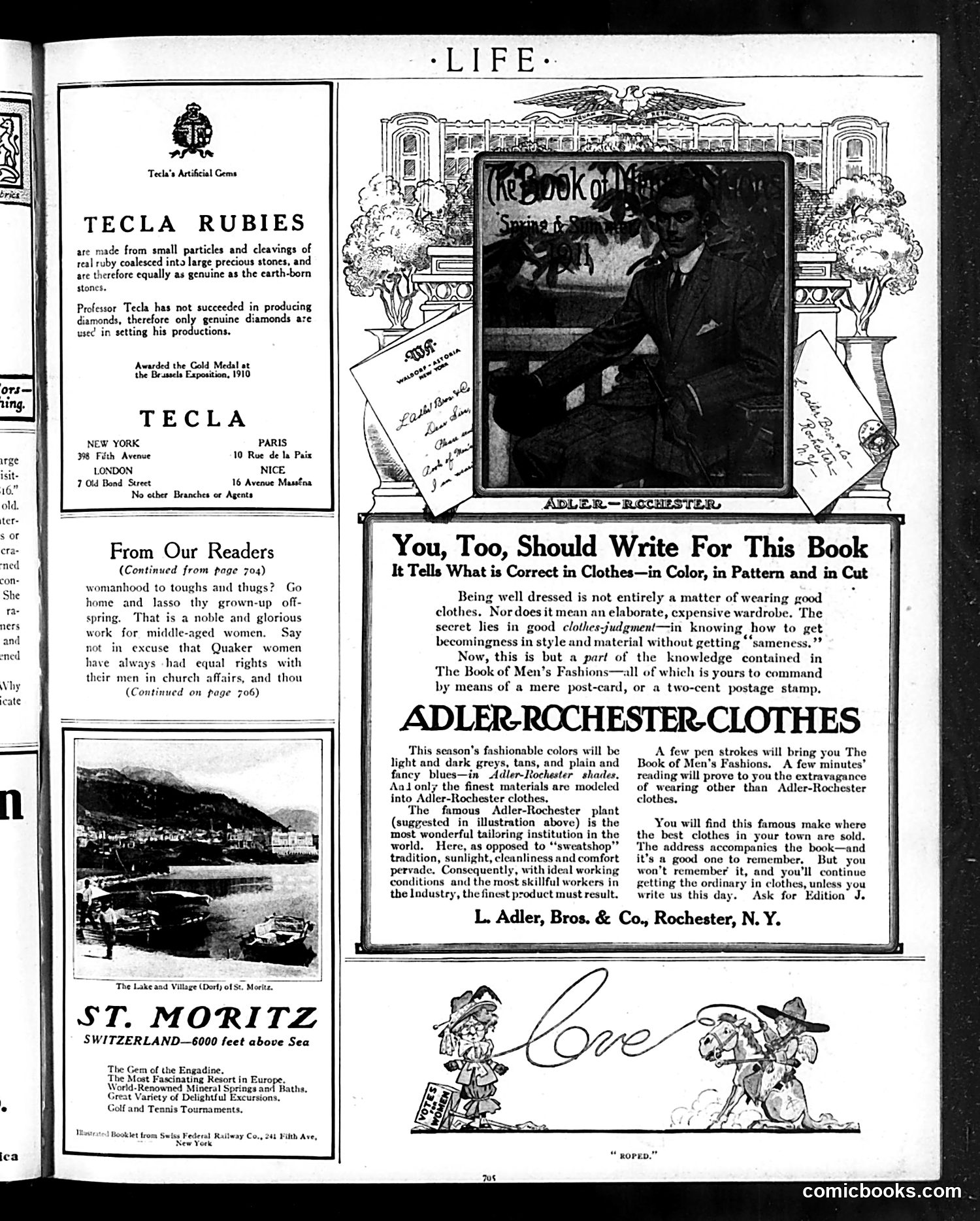
This page is primarily **advertising**, not satire or political commentary. It contains four distinct commercial advertisements: 1. **Tecla Rubies** - promoting synthetic rubies made by coalescing real ruby particles, claiming they're "equally as genuine as earth-born stones" (a dubious marketing claim by modern standards). 2. **St. Moritz, Switzerland** - a travel resort advertisement highlighting mineral springs and recreational activities. 3. **Adler-Rochester Clothes** - the largest ad, promoting men's fashions and tailoring. It emphasizes quality working conditions ("opposed to sweatshop tradition") and proper "clothes-judgment" rather than mere expense. 4. A small section titled **"From Our Readers"** - reader correspondence about social issues (mentions Quaker women's rights). The page reflects early 20th-century consumer culture and advertising conventions. The Adler-Rochester ad's emphasis on ethical manufacturing conditions ("sunlight, cleanliness and comfort") suggests contemporary concerns about exploitative labor practices in the garment industry.
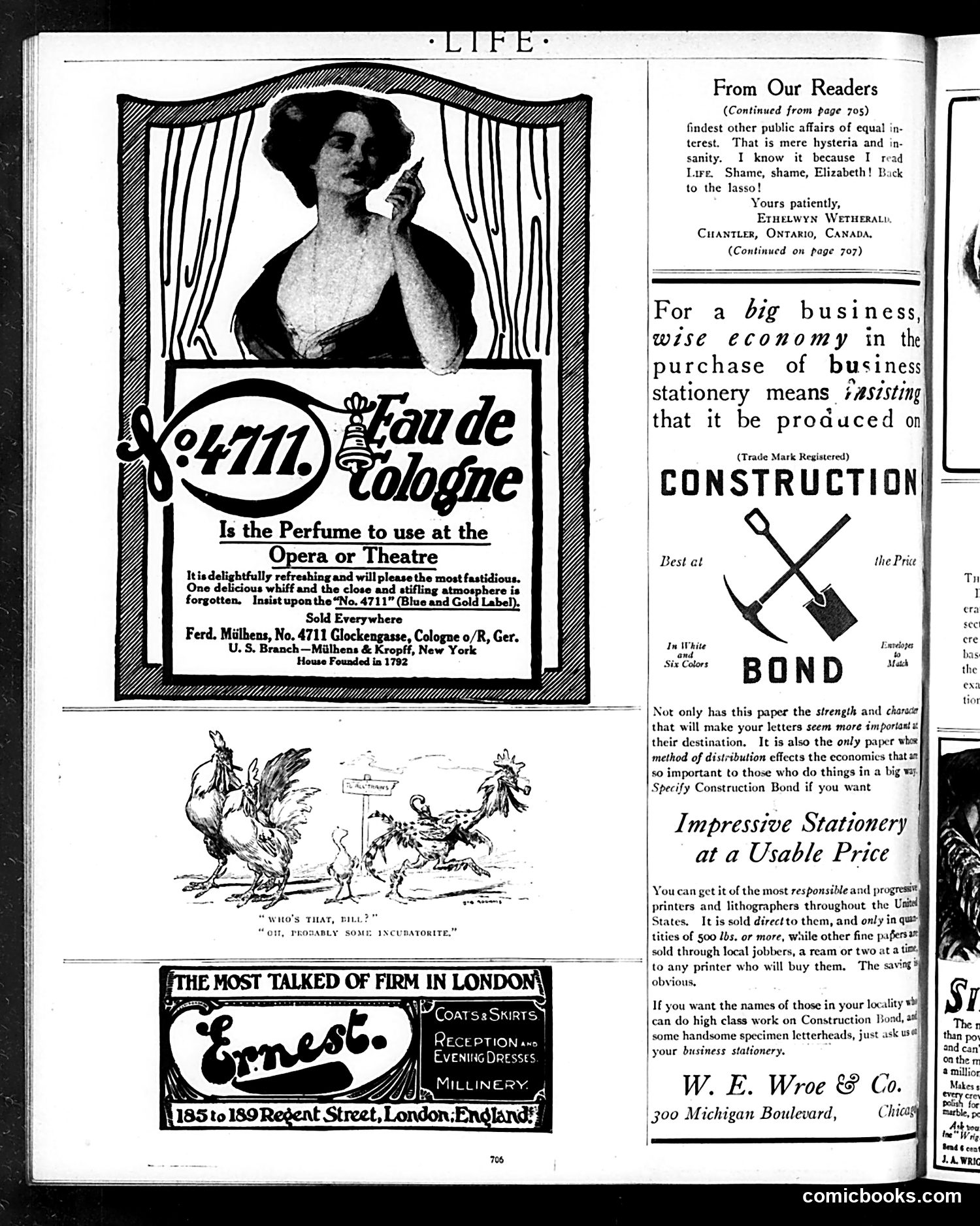
This page is primarily **advertising**, with one cartoon and a reader's letter. The cartoon shows roosters with caption "WHO'S THAT, BILL?" / "OH, PROBABLY SOME INCUBATORITE"—likely satirizing early 20th-century anxieties about artificial incubation technology replacing natural processes. The joke plays on confusion about what's "real" versus mechanically produced. The reader's letter from Ontario condemns "Elizabeth" for public hysteria over unspecified affairs, demanding she return to traditional behavior ("back to the lasso"—suggesting domestic submission). This reflects period attitudes about women's proper roles. The bulk of the page features advertisements: No. 4711 Cologne for theater-goers, Ernest clothing in London, and Construction Bond stationery emphasizing economy for businesses. These ads target middle and upper-class consumers concerned with respectability and efficiency. The page reflects early 1900s commercial culture and social conservatism regarding gender and technology.
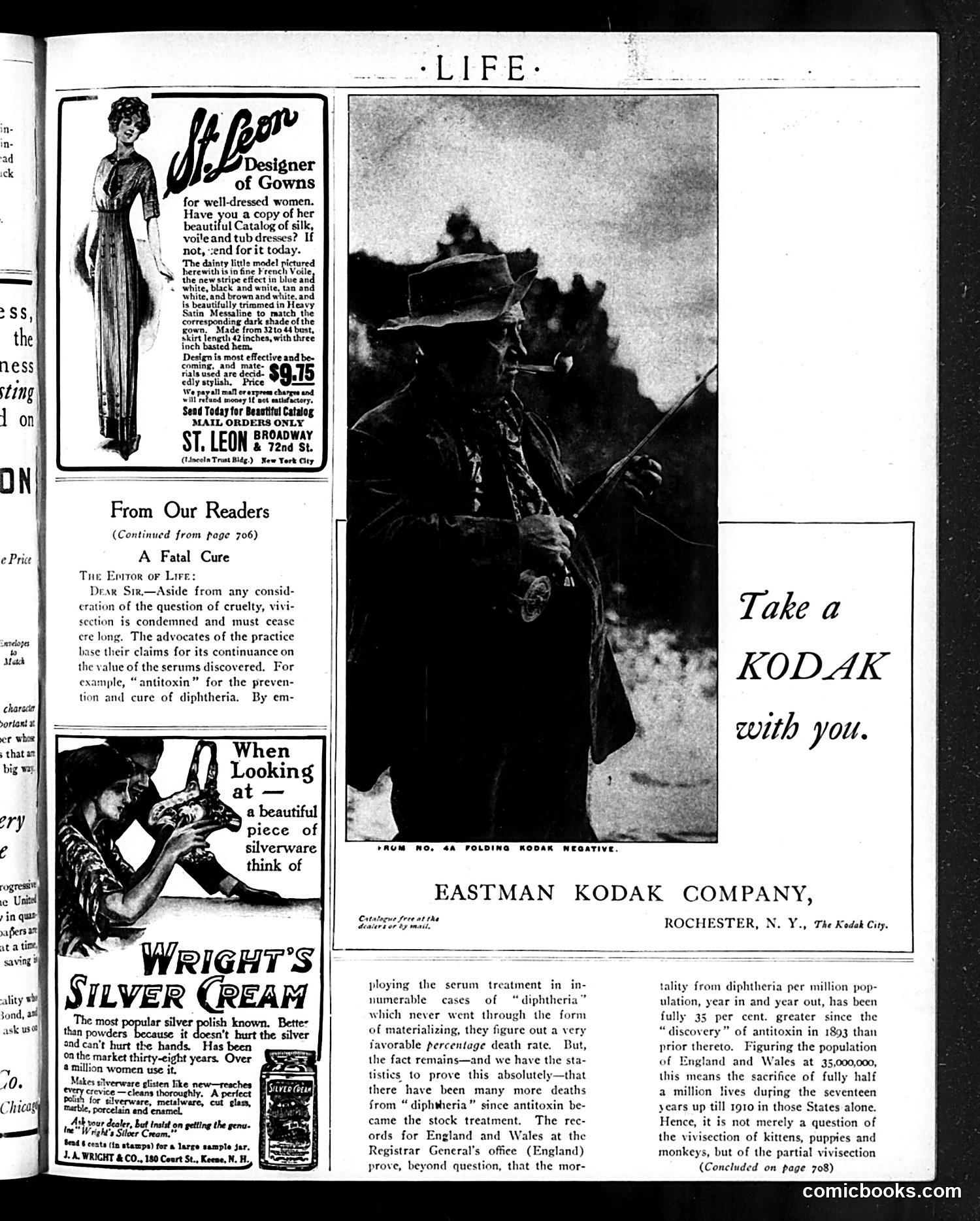
This page contains **advertisements and a reader letter**, not political cartoons requiring satire analysis. The main content is a letter to Life's editor arguing **against vivisection (animal testing)** and specifically attacking the use of antitoxin for diphtheria treatment. The author claims that despite antitoxin's discovery in 1893, diphtheria deaths in England and Wales actually *increased* by 35%, allegedly causing half a million deaths over seventeen years. He argues this proves antitoxin is ineffective and therefore animal testing to develop it cannot be justified. The advertisements include fashion ("St. Leon Designer of Gowns"), silver polish, and Kodak cameras—typical early 20th-century magazine ads. **Modern context**: This represents an anti-vaccination/anti-medicine argument, though the statistical claims appear questionable and likely reflect the writer's selective interpretation rather than scientific reality.
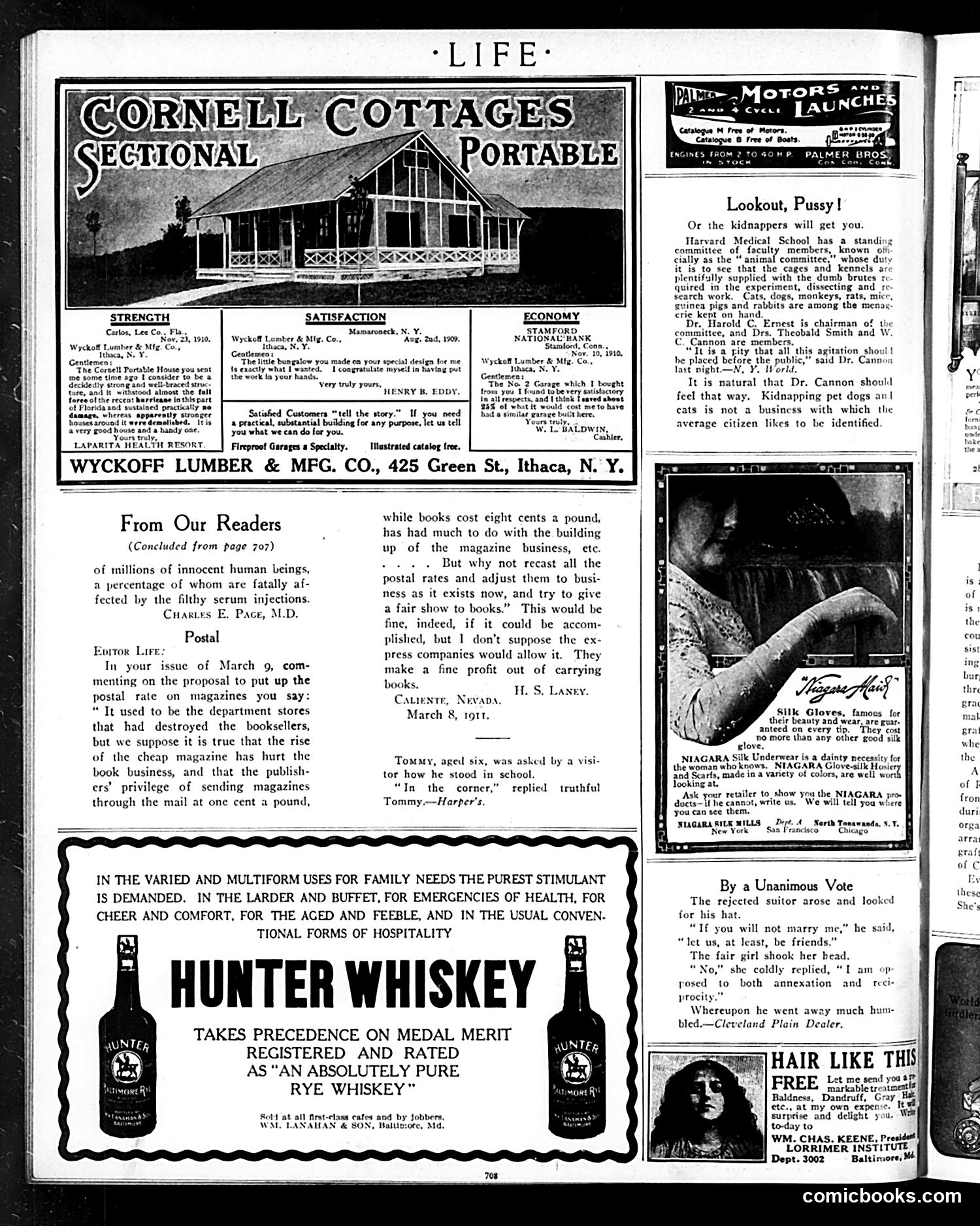
This page is primarily **advertising and reader letters**, with minimal editorial cartooning. The notable content includes: **"Lookout, Pussy!"** — A brief satirical piece criticizing Harvard Medical School's animal experimentation committee. It mocks Dr. Cannon's complaint about public "agitation" over the practice, suggesting his discomfort stems from ethical concerns about kidnapping pets for laboratory use—implying the practice is morally indefensible enough that average citizens wouldn't want to be associated with it. **"By a Unanimous Vote"** — A short humorous anecdote about a rejected suitor attempting to salvage a friendship after romantic rejection, presented without visual illustration. The remainder consists of **advertisements** (Cornell Cottages, Hunter Whiskey, Niagara Gloves, Lorrimer Institute) and **reader correspondence** discussing postal rates, magazine distribution, and serum injections. The page reflects early 20th-century Life magazine's format: mixing light satire with consumer advertising and public discourse on contemporary issues.
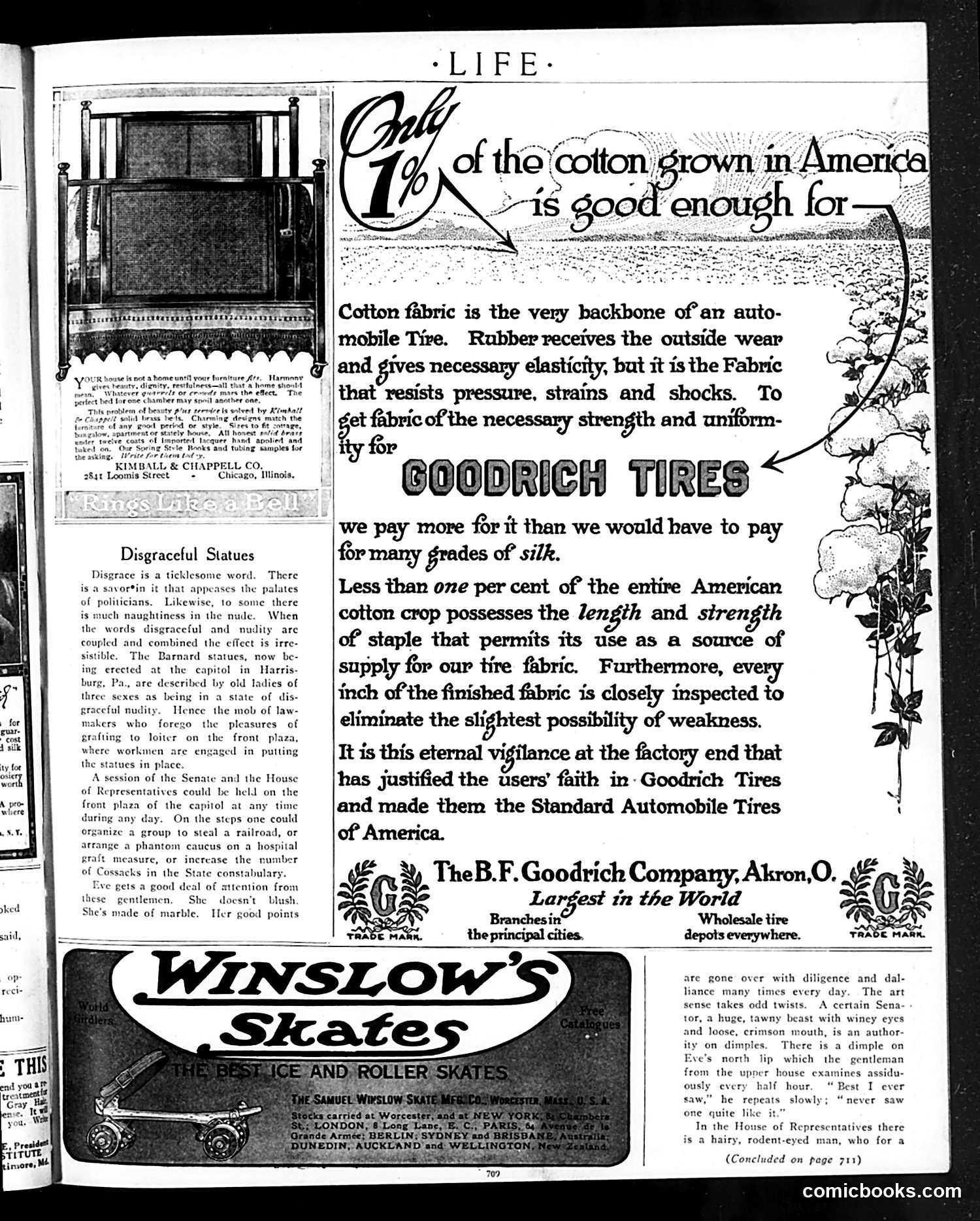
This article satirizes the hypocrisy of politicians who publicly condemn nudity in art while privately ogling a marble statue of Eve being installed at the Pennsylvania State Capitol in Harrisburg. The satire works on multiple levels: lawmakers claim moral outrage about the statue's "disgraceful nudity," yet they abandon their actual legislative duties to loiter and stare at it. The piece mocks their performative morality—they use the controversy for political theater rather than genuine principle. The unnamed "huge, tawny beast" Senator and "hairy, rodent-eyed" Representative are portrayed as hypocritical: they publicly denounce the statue's indecency while obsessively examining anatomical details like a dimple on "Eve's north lip," returning repeatedly to gawk. This reflects early 20th-century tensions between Victorian propriety and modernist art. *Life* magazine, a satirical publication, ridicules the gap between what politicians publicly profess and their actual behavior—a timeless theme of political satire.
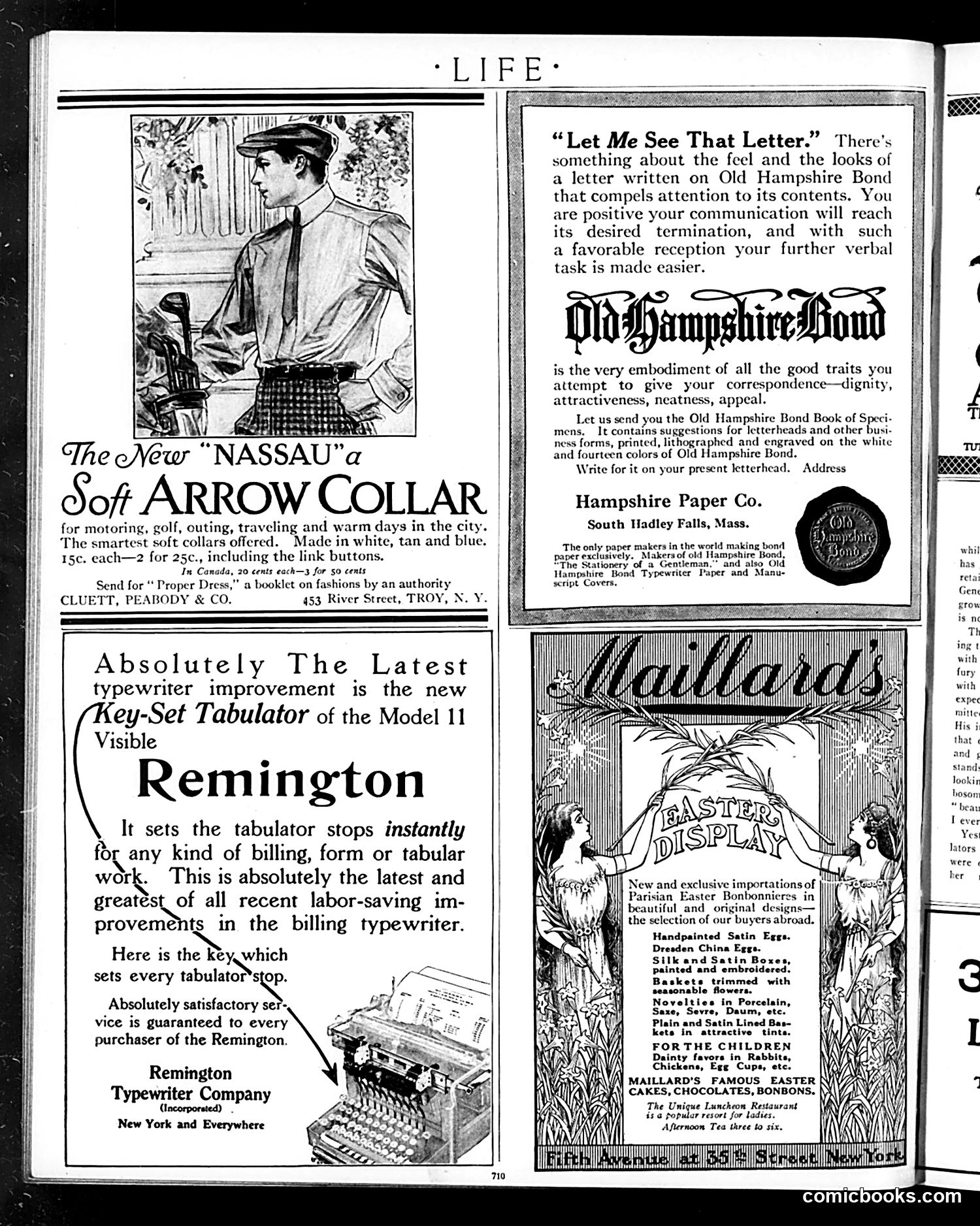
This page is primarily **advertising**, not editorial content or satire. It contains four distinct product advertisements with no political cartoons or satirical commentary: 1. **Arrow Collar** ("Nassau" soft collar) — promotes comfortable neckwear for leisure activities 2. **Hampshire Bond Paper** — emphasizes quality stationery's role in professional correspondence 3. **Remington Typewriter** — highlights a new tabulator feature for billing and business forms 4. **Maillard's Easter Display** — advertises imported Easter bonbons and a ladies' luncheon restaurant The only visual element with human figures shows a man in casual dress examining his correspondence—an illustration supporting the paper company's message about quality materials enhancing business communication. This represents early 20th-century consumer advertising aimed at middle-class professionals and women, emphasizing taste, efficiency, and respectability rather than humor or political critique.
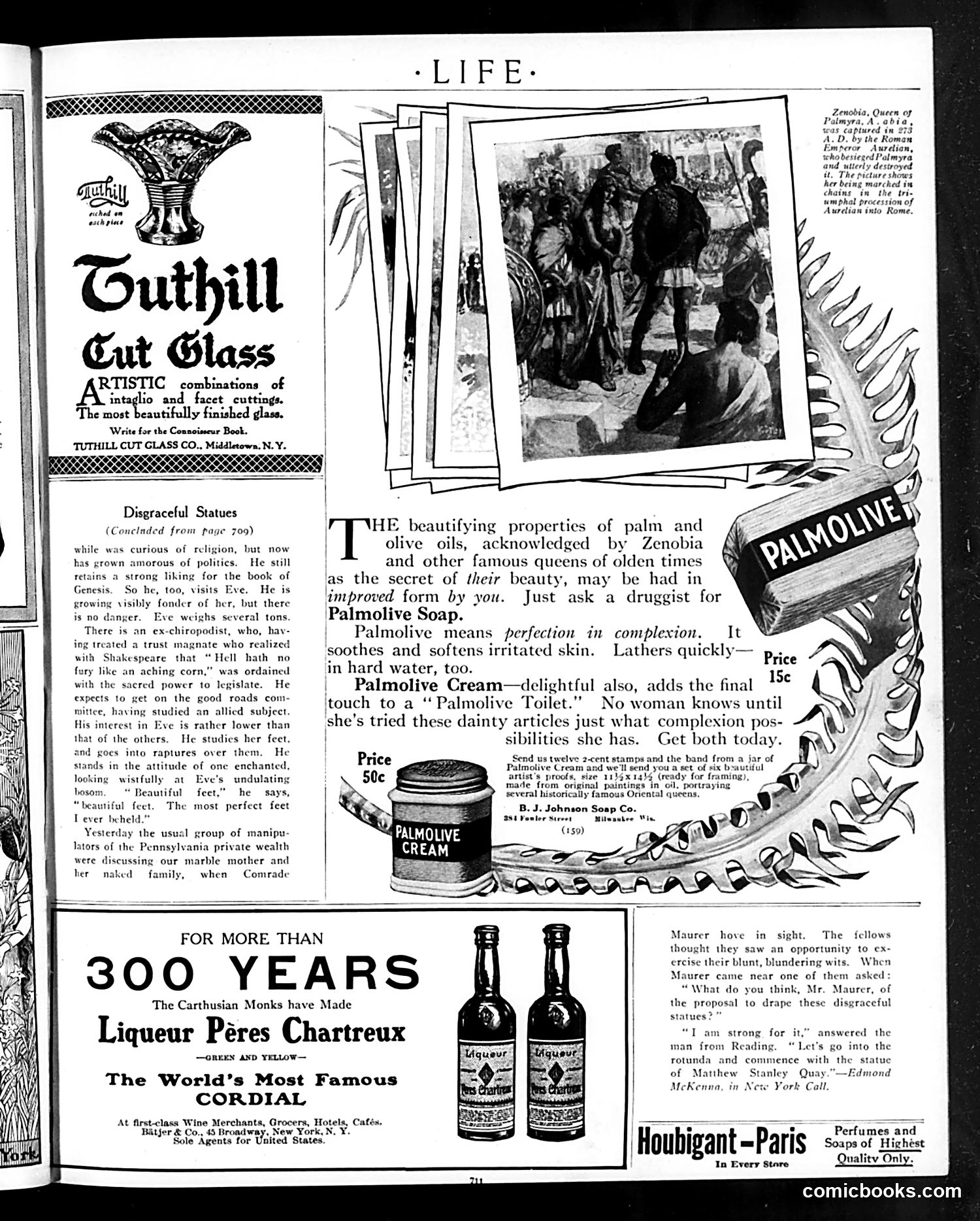
This page is primarily **advertising**, not political satire. The main content includes ads for Tuthill Cut Glass, Palmolive Soap and Cream, Liqueur Péres Chartreux, and Houbigant perfume. However, there is a brief satirical article titled "Disgraceful Statues" (continued from page 709). The text describes various Pennsylvania wealthy men visiting a marble statue of a naked woman ("Eve"), each appreciating it from different angles—one politically motivated, another obsessed with her feet (he's a former chiropodist). The humor lies in satirizing the pretensions and narrow interests of these wealthy manipulators of "Pennsylvania private wealth," suggesting they project their own concerns onto art rather than appreciating it genuinely. The article concludes with a joke about draping "disgraceful statues," referencing a figure named Matthew Stanley Quay (likely a Pennsylvania political figure), though the specific political context is unclear without additional historical information.
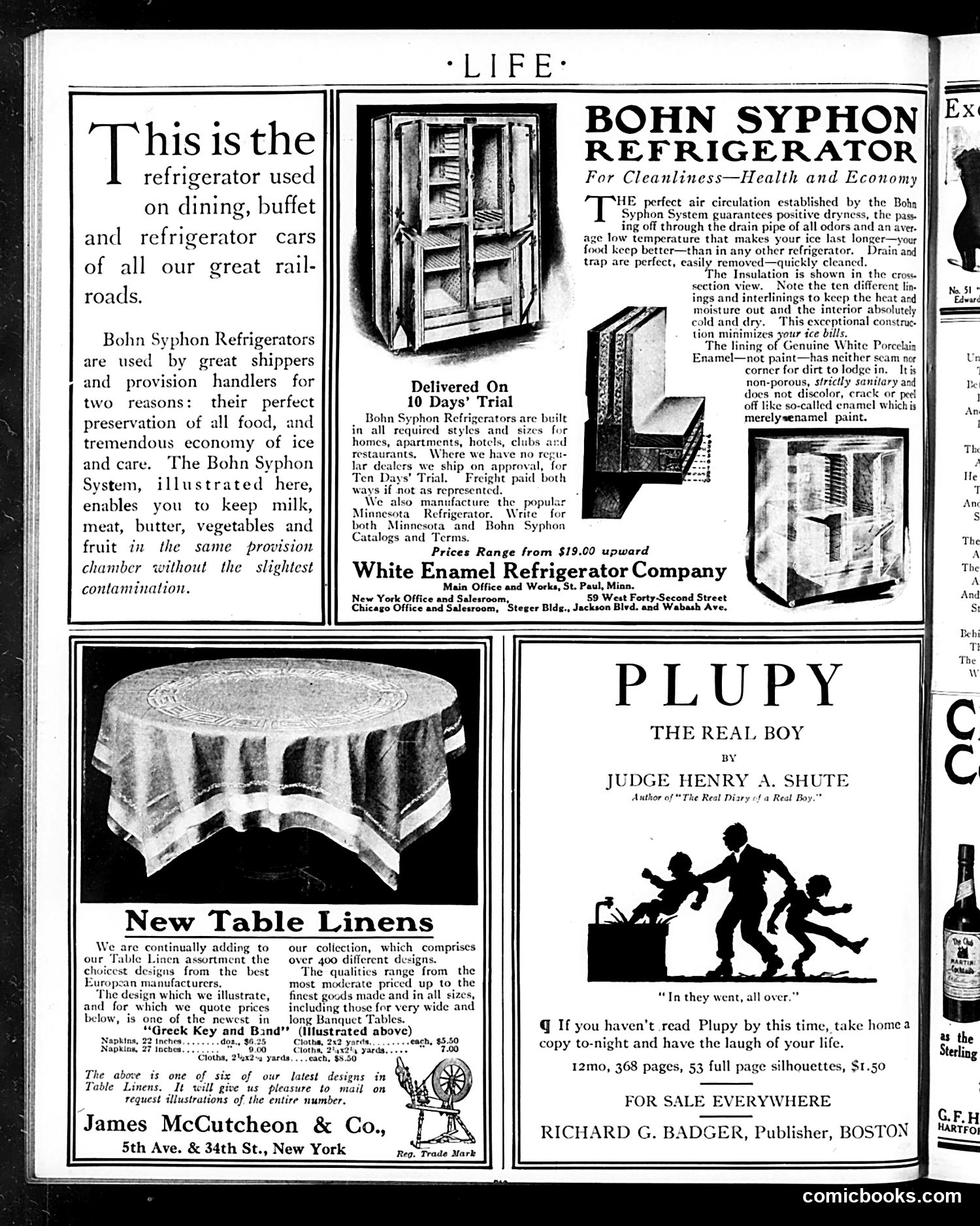
This page contains **no political cartoons or satire**—it is primarily advertising from the early 20th century. The upper half features ads for the **Bohn Syphon Refrigerator** (emphasizing food preservation and ice economy for homes and railroad dining cars) and **table linens** by James McCutcheon & Co. The lower right advertises **"Plupy: The Real Boy"** by Judge Henry A. Shute, a children's book published by Richard G. Badger. The small silhouette illustration shows boys playing roughly ("In they went, all over"). This was a popular juvenile title of the era, following the success of Shute's earlier "The Real Diary of a Real Boy." The ad promotes it as humorous children's literature priced at $1.50. The page reflects typical early-1900s Life magazine content: a mix of consumer product advertising alongside literary promotion, with no satirical or political commentary present.
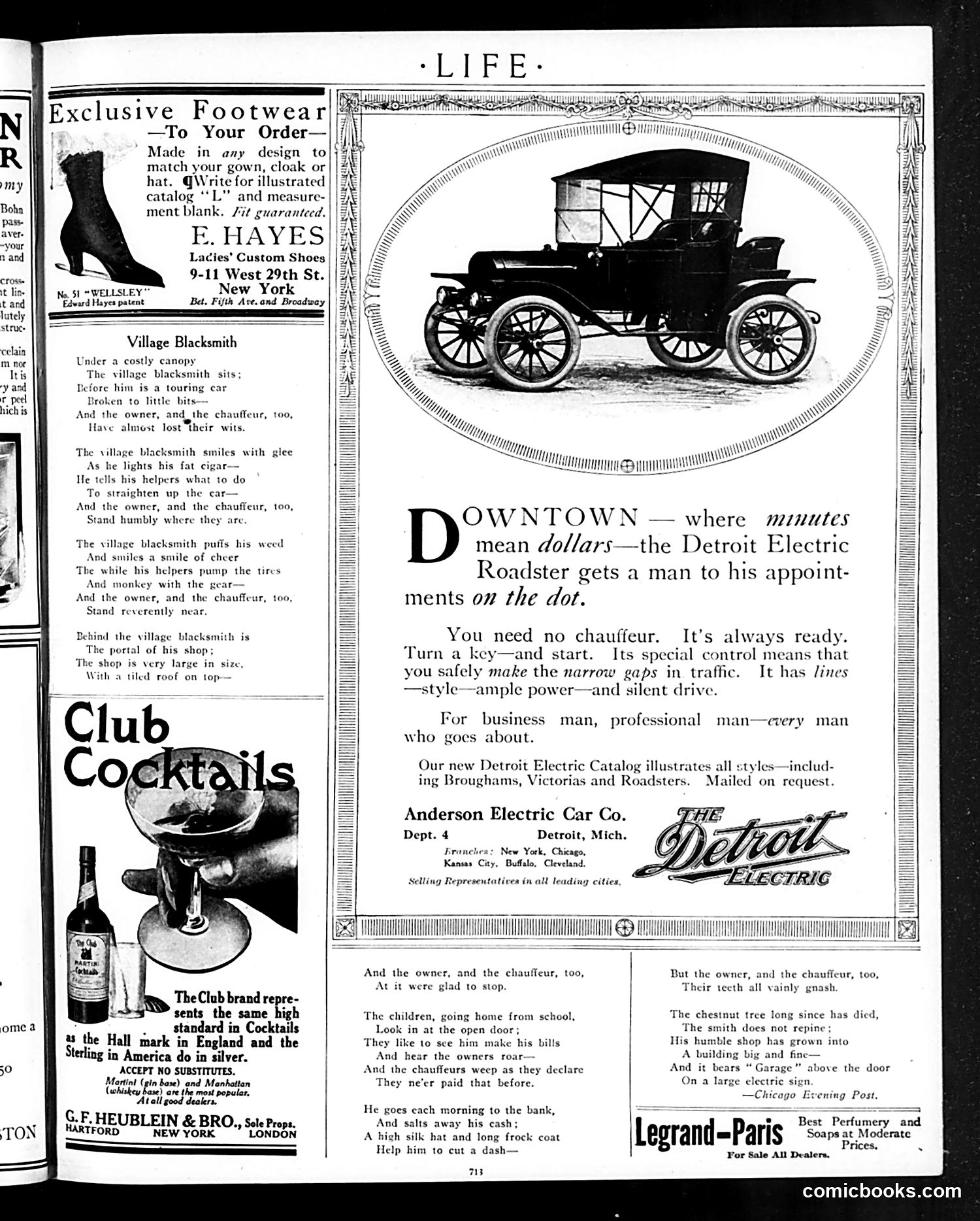
This page contains a humorous poem mocking the social disruption caused by automobiles. The accompanying illustration shows an early motorcar broken down at a blacksmith's shop. The satire reverses traditional hierarchies: the once-humble blacksmith now commands respect and prosperity, while wealthy car owners and their chauffeurs stand "humbly" and "reverently" awaiting repairs. The poem emphasizes the blacksmith's newfound wealth—he visits the bank daily, wears fine clothing, and his modest shop has expanded into a grand building. The joke satirizes how automobiles, despite promising progress and status, frequently broke down and required constant repair. This dependency actually elevated tradesmen like blacksmiths while humbling the affluent owners. The repeated refrain about owners and chauffeurs losing their wits or gnashing their teeth underscores the frustration these unreliable machines caused. The contrasting Detroit Electric Roadster advertisement suggests a solution: a more reliable electric vehicle needing no chauffeur.
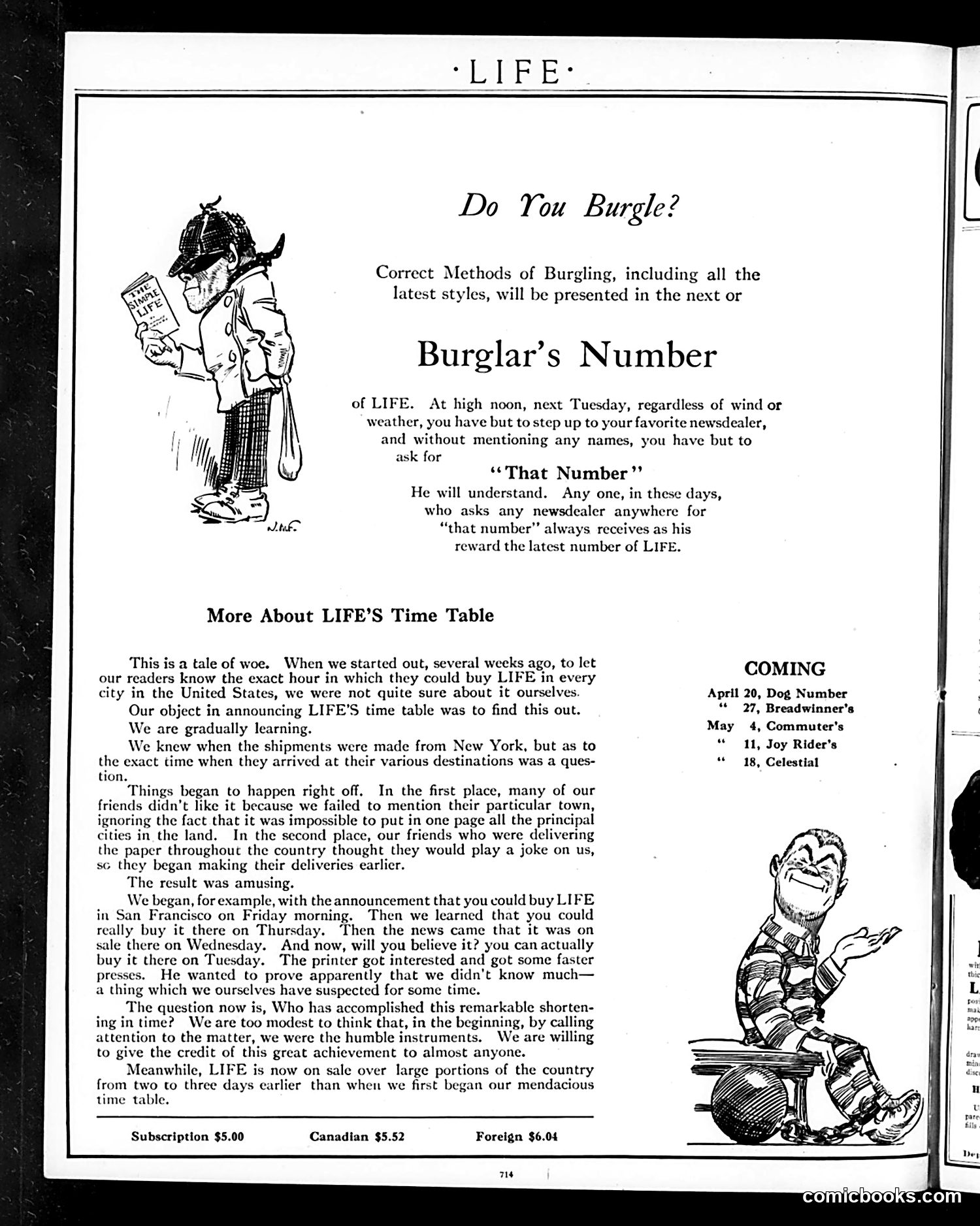
This is a humorous editorial announcement, not political satire. Life magazine is promoting an upcoming "Burglar's Number" (a themed issue) with tongue-in-cheek secrecy—readers should ask newsdealers for "that number" without explanation, as if requesting something illicit. The main text humorously recounts Life's embarrassing failure at publishing a "time table" showing when the magazine would be available in different cities. They intended to locate it precisely but discovered their own incompetence when distributors, amused by the announcement, began delivering copies *earlier* than scheduled—including in San Francisco, where the magazine kept arriving a day sooner each week. The cartoons show a burglar character (left) and a jovial figure (right), fitting the "burglar" theme. The satire targets Life's own editorial pretensions: they thought they could control distribution logistics but got humiliated by their distributors' practical jokes and competitive zeal.
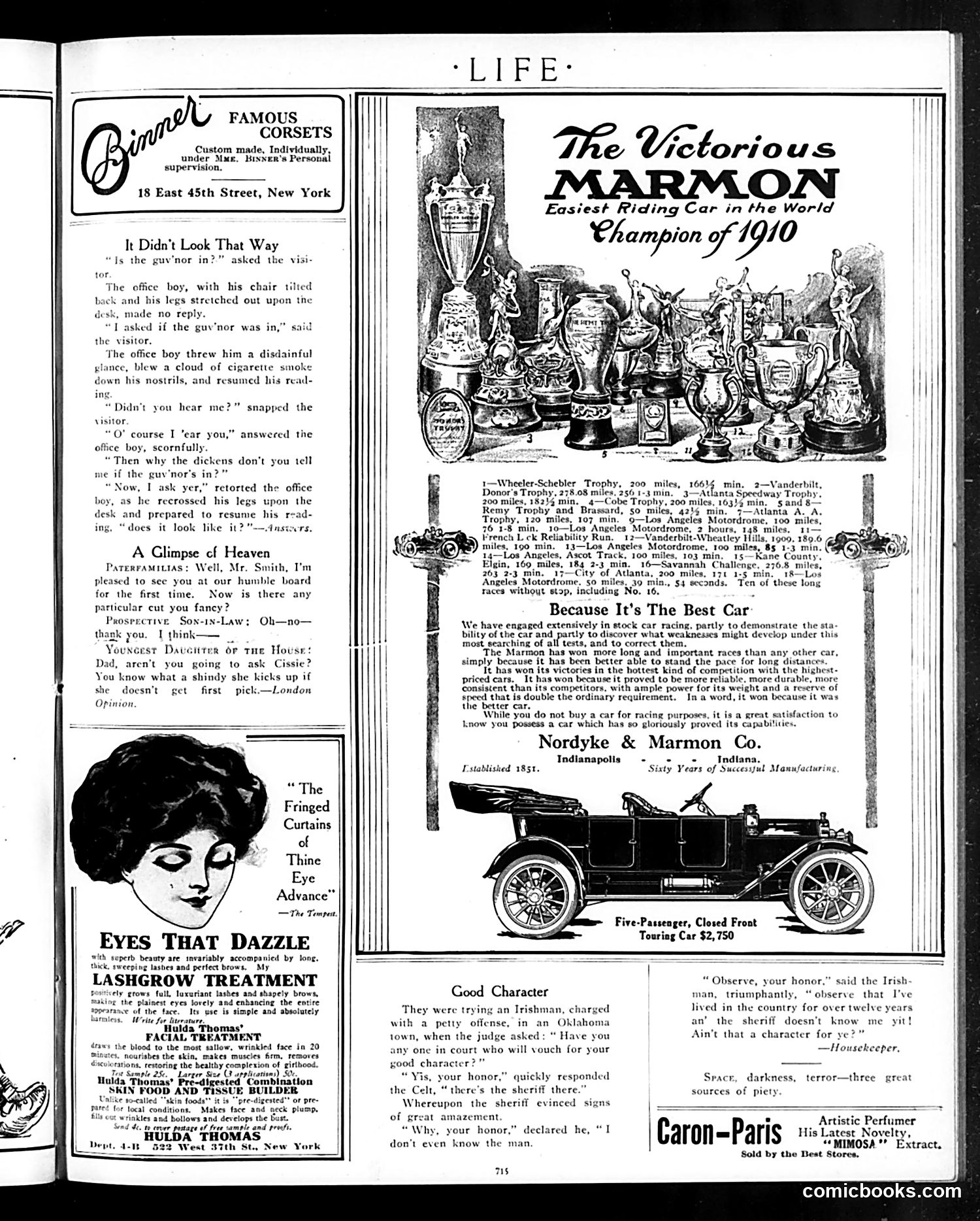
This page consists primarily of **advertisements and humor pieces**, not political cartoons. The content includes: 1. **"It Didn't Look That Way"** — A brief comedic sketch mocking an impertinent office boy who ignores a visitor's inquiries, then smugly asks why the visitor didn't understand his silence. It's a joke about poor service and workplace rudeness, likely relatable to early-1900s office culture. 2. **"A Glimpse of Heaven"** and **"Good Character"** — Short humorous dialogues poking fun at family dynamics and Irish stereotypes (an Irishman being charged with assault, claiming twelve years in the country without incident). 3. **Extensive advertisements** for Birmer corsets, the Marmon automobile (emphasizing racing victories), Lashgrow eyelash treatment, and Caron-Paris perfume. The page reflects early-1900s advertising and light social humor rather than serious political satire. The "jokes" rely on period stereotypes and workplace observations that would amuse contemporary readers.
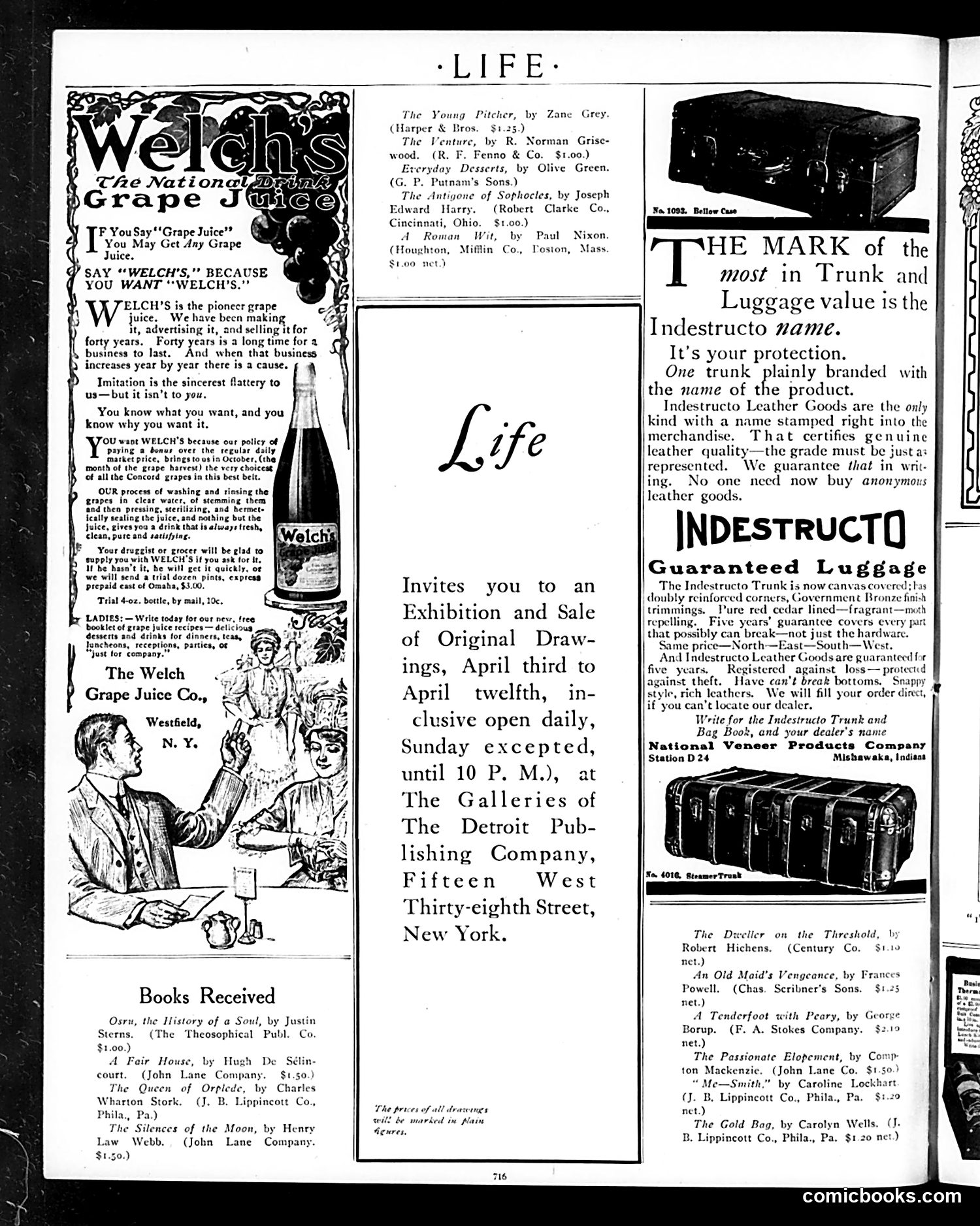
This page is primarily **advertising and book reviews**, not political satire. The main content consists of: **Welch's Grape Juice advertisement** (left): A commercial pitch emphasizing brand loyalty and product quality. The message: don't just ask for "grape juice"—demand "Welch's" specifically, because the company has invested forty years building reputation through superior grapes and processing methods. The illustration shows a man and woman enjoying the product. **Indestructo Luggage advertisement** (right): Emphasizes that their trunks are marked with the brand name directly into leather, guaranteeing authenticity and quality. The pitch targets consumers wary of counterfeit goods. **Center section**: An announcement for an exhibition of original drawings by Life magazine at a Detroit Publishing Company gallery in New York. **Lower sections**: Book reviews and listings of newly received publications. There is **no political cartoon or satire** on this page—it represents typical early 20th-century magazine content mixing advertisements with literary notices.
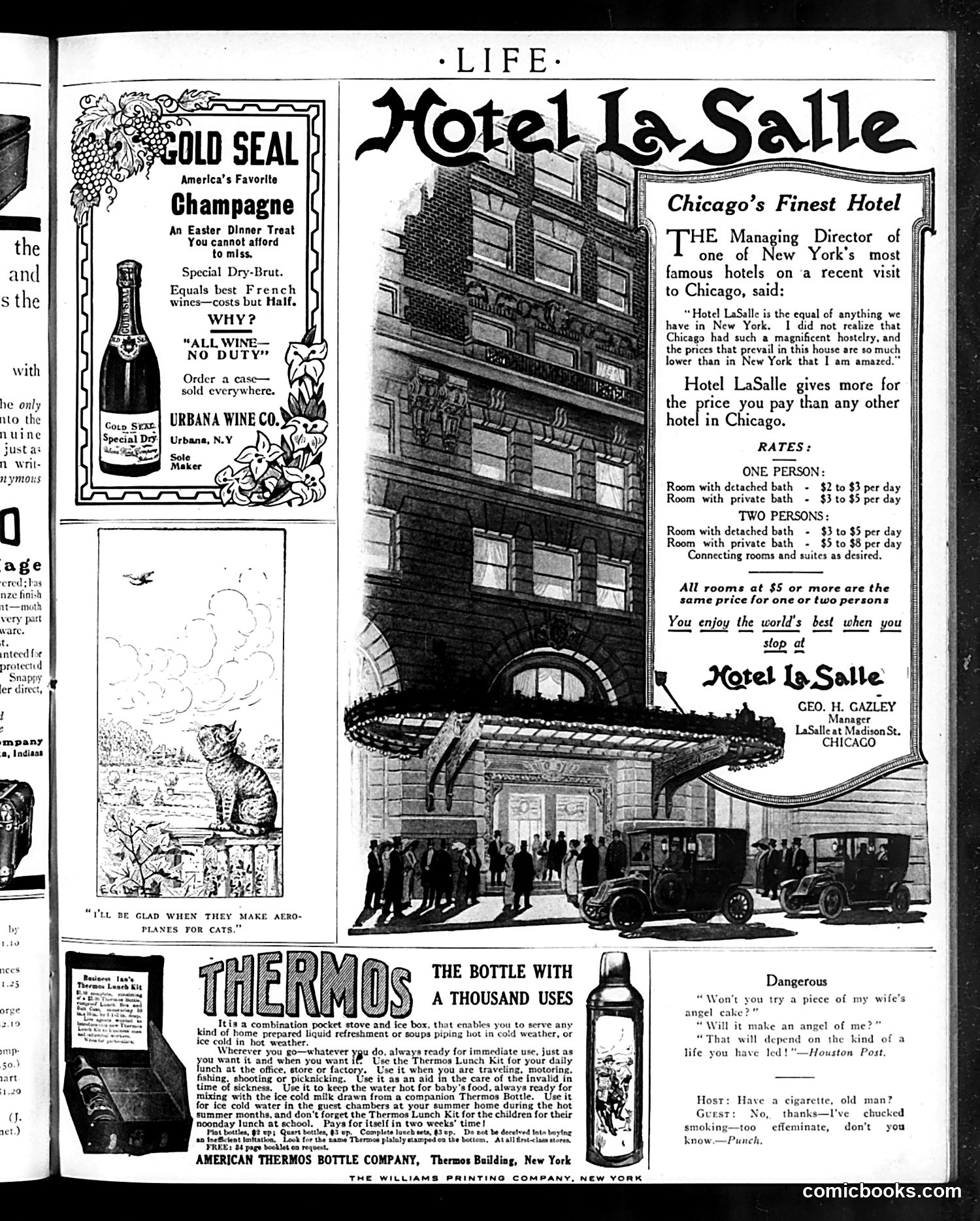
This page is primarily **advertising**, not satire or editorial content. It contains four distinct advertisements: 1. **Gold Seal Champagne** (top left): Markets French-quality wine at half the cost, emphasizing the tariff advantage ("all wine—no duty"). Includes a humorous cartoon of a cat watching an airplane, captioned "I'll be glad when they make aeroplanes for cats"—likely satirizing the era's aviation craze. 2. **Hotel LaSalle** (center-right): Chicago hotel advertisement featuring a testimonial from a New York hotel director praising its quality and low prices compared to New York establishments. Appeals to travelers' value-consciousness. 3. **Thermos Bottle** (bottom): Promotes a multipurpose thermos bottle/lunch kit for professionals, travelers, and families. Lists numerous practical uses. 4. **Humor column** (bottom right): Two brief jokes—one about "angel cake" making angels, another mocking cigarette-smoking as "effeminate"—typical of period humor standards. The page reflects early 20th-century consumer culture and advertising strategies.
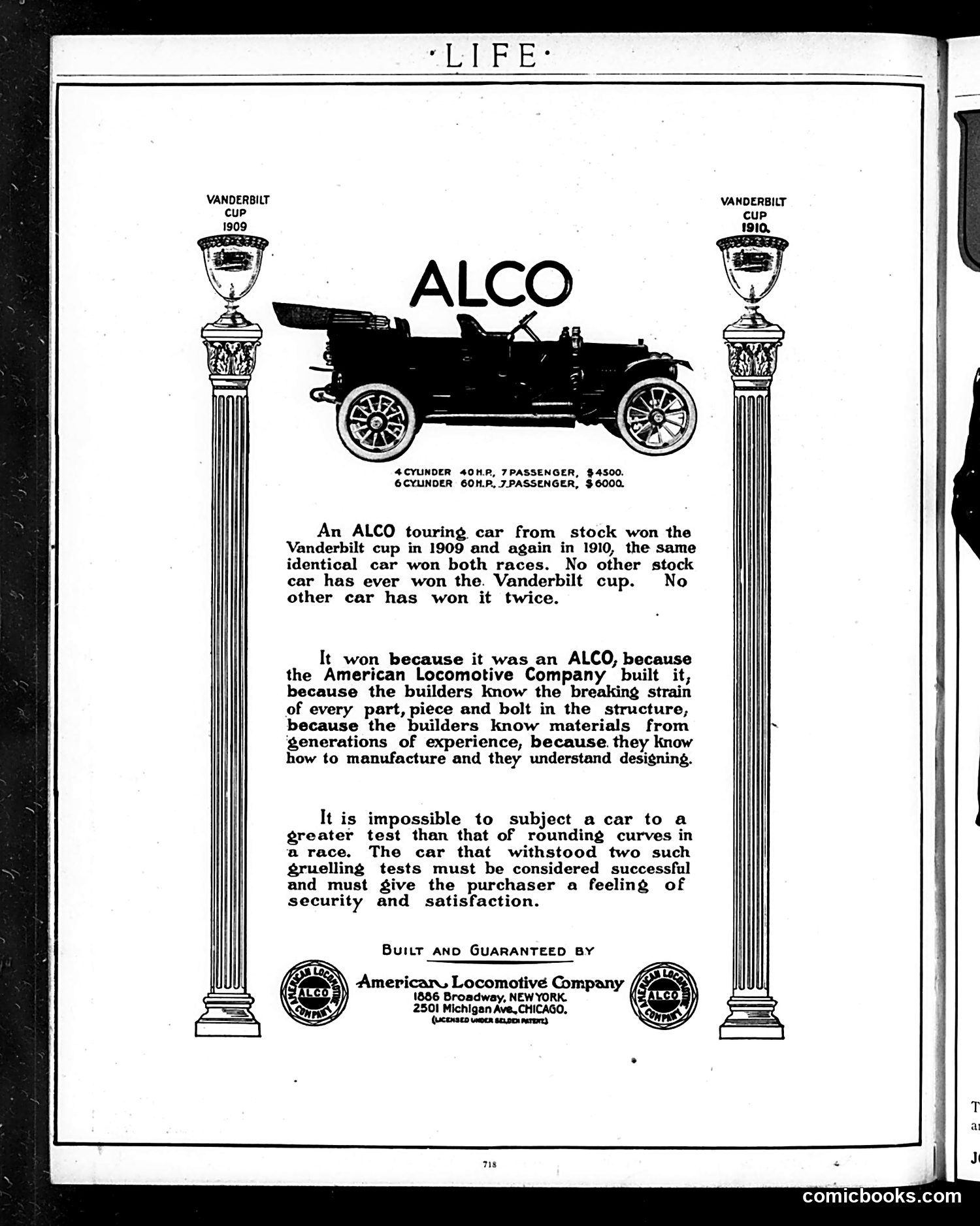
This is a **product advertisement**, not a cartoon or satire. It promotes ALCO (American Locomotive Company) automobiles by touting their 1909 and 1910 Vanderbilt Cup victories—prestigious early automotive racing competitions. The advertisement uses the racing wins as proof of superior engineering and manufacturing quality. The text emphasizes that ALCO's success stemmed from the builders' deep knowledge of materials, design, and manufacturing—traits inherited from their railroad locomotive heritage. The Vanderbilt Cups flanking the vehicle image serve as visual endorsements. The copy argues that surviving grueling race conditions proves reliability, offering purchasers "security and satisfaction." **Context for modern readers**: Early 1900s consumers judged automobiles partly through racing success, as it demonstrated durability. This advertisement conflates sporting victory with everyday automotive reliability—a marketing strategy still used today.
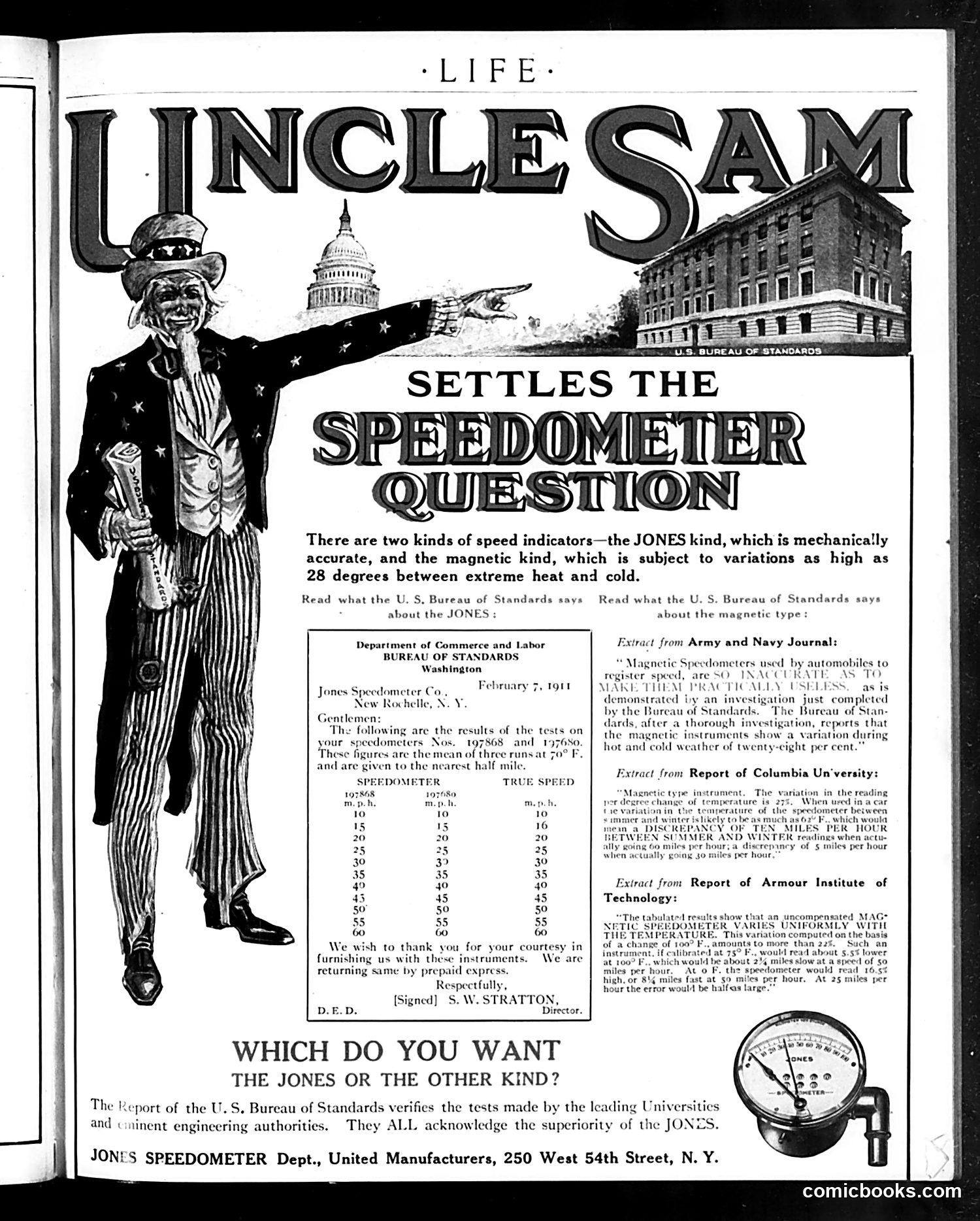
This is a **product advertisement**, not political satire. Uncle Sam endorses the Jones Speedometer brand by presenting scientific evidence of its superiority over competing magnetic speedometers. The page presents official endorsements from the U.S. Bureau of Standards, Army and Navy Journal, Columbia University, and Armour Institute of Technology—all documenting that magnetic speedometers vary by up to 28 degrees in accuracy depending on temperature, while Jones instruments remain mechanically reliable. The imagery of Uncle Sam pointing authoritatively toward government buildings reinforces governmental credibility backing the Jones product. This advertising strategy leverages public trust in federal institutions and academic authorities to promote a commercial good—a common early-20th-century marketing tactic. The "Which do you want?" closing question frames superior accuracy as an obvious consumer choice.
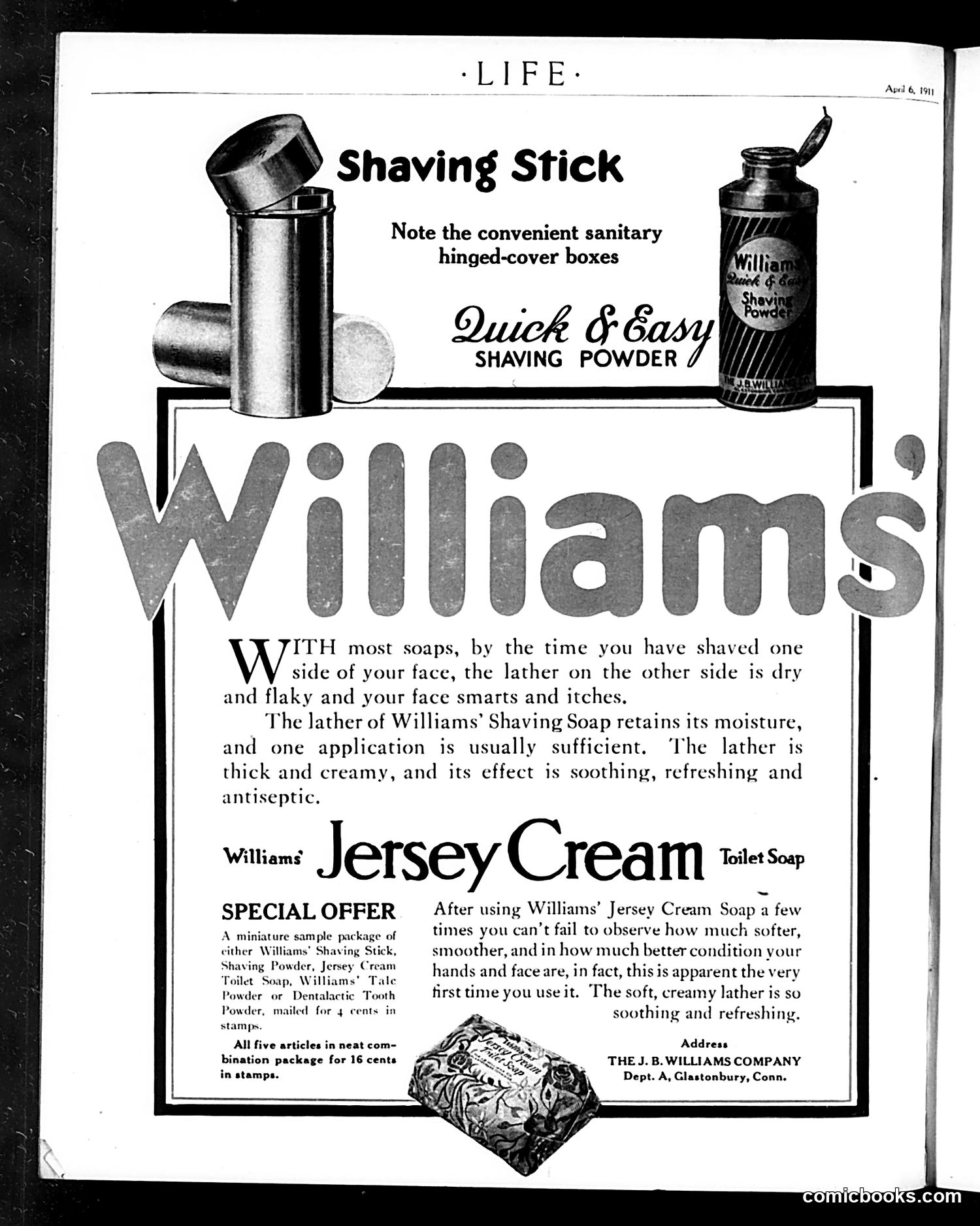
This page is **entirely an advertisement**, not satire or political content. It promotes Williams' Jersey Cream Toilet Soap and related shaving products (shaving stick, powder) from The J.B. Williams Company of Glastonbury, Connecticut. The ad targets male shavers by highlighting a practical problem: conventional soaps' lather dries and flakes on one side of the face while you shave the other side, causing discomfort. Williams claims their soap retains moisture, producing thick, creamy lather that requires only one application and feels "soothing, refreshing and antiseptic." The page includes product images (a shaving stick in hinged-cover boxes, a powder container) and offers a special promotional deal: five sample products mailed for 16 cents in stamps. There is no satire, political commentary, or caricature present—this is straightforward early-20th-century consumer advertising.