
Life, 1911-04-06 · page 33 of 76
Life — April 6, 1911 — page 33: what you’re looking at
What you’re looking at
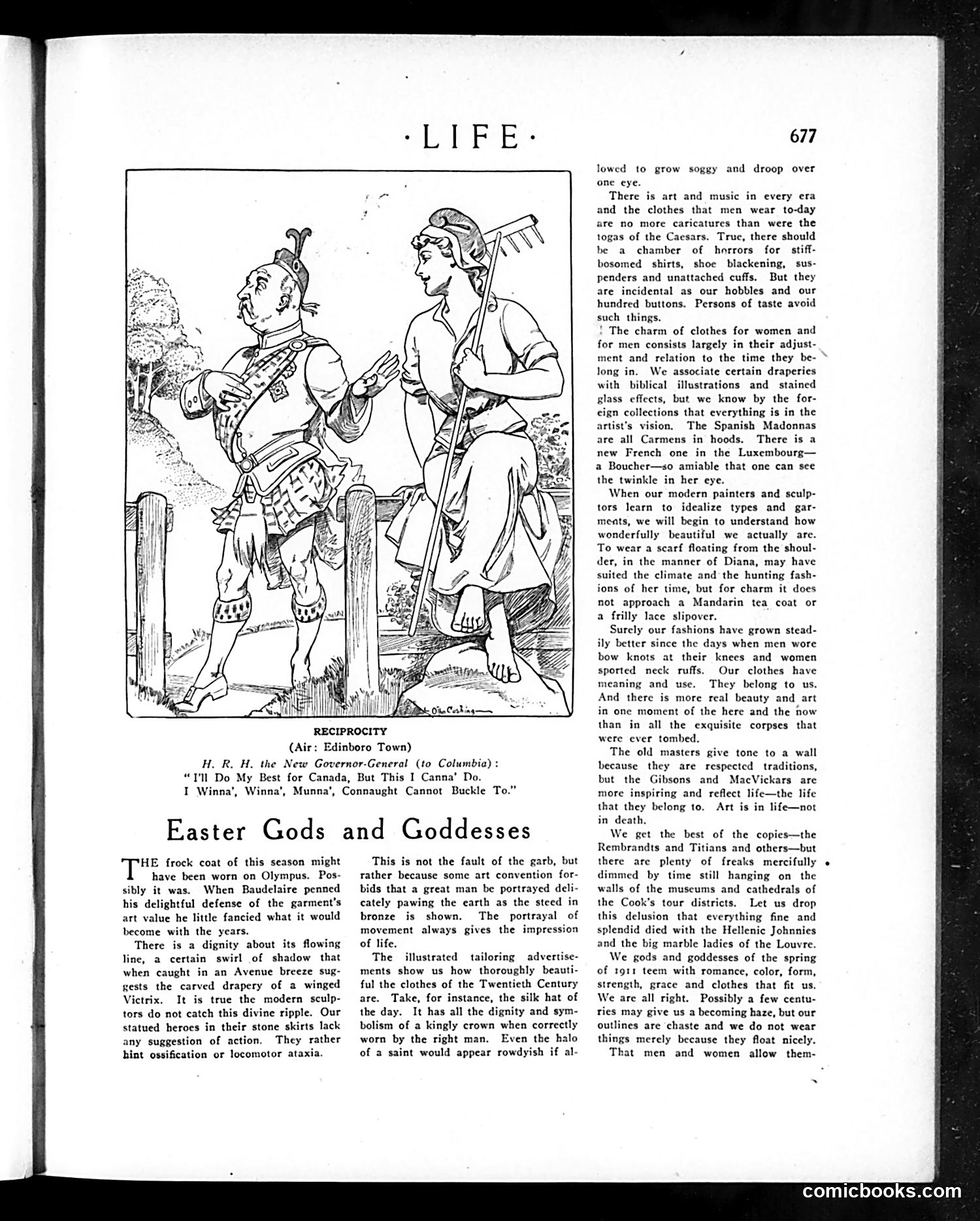
The cartoon depicts two figures in classical dress labeled "RECIPROCITY," referencing a trade dispute between Canada and the United States. The caption identifies one as "H.R.H. the New Governor-General (to Columbia)"—likely the Canadian Governor-General—refusing reciprocal trade agreements with America (personified as "Columbia," the female allegorical figure of the US). The Scottish dialect phrases ("Canna'," "Winna'," "Munna'") mock the Governor-General's resistance, set to the tune of "Edinboro Town." This satirizes Canadian reluctance to accept American trade terms, a contentious 1911 political issue. The accompanying article on fashion is unrelated to the cartoon—a typical Life magazine format mixing editorial commentary with satirical imagery. **Context for modern readers:** This reflects pre-WWI tensions between North American neighbors over economic policy and national sovereignty.
📄 Transcribed text from this page (OCR, searchable)
Machine-transcribed from the original scan — historical spelling and the odd misread are preserved.
RECIPROCITY (Air: Edinboro Town) H.R. H. the New Governor-General (to Columbia) : “T'll Do My Best for Canada, But This I Canna’ Do. I Winna’, Winna’, Munna’, Connaught Cannot Buckle To.” Easter Gods and Goddesses HE frock coat of this season might have been worn on Olympus. Pos- sibly it was. When Baudelaire penned his delightful defense of the garment’s art value he little fancied what it would become with the years. There is a dignity about its flowing line, a certain swirl of shadow that when caught in an Avenue breeze sug- gests the carved drapery of a winged Victrix. It is true the modern sculp- tors do not catch this divine ripple. Our statued heroes in their stone skirts lack any suggestion of action. They rather hint ossification or locomotor ataxia. This is not the fault of the garb, but rather because some art convention for- bids that a great man be portrayed deli- cately pawing the earth as the steed in bronze is shown. The portrayal of movement always gives the impression of life. The illustrated tailoring advertise- ments show us how thoroughly beauti- ful the clothes of the Twentieth Century are. Take, for instance, the silk hat of the day. It has all the dignity and sym- bolism of a kingly crown when correctly worn by the right man. Even the halo of a saint would appear rowdyish if al- 677 lowed 10 grow soggy and droop over one eye. There is art and music in every era and the clothes that men wear to-day are no more caricatures than were the togas of the Caesars. Truc, there should be a chamber of horrors for stiff- bosomed shirts, shoe blackening, sus- penders and unattached cuffs. But they are incidental as our hobbles and our hundred buttons. Persons of taste avoid such things. ! The charm of clothes for women and for men consists largely in their adjust- ment and relation to the time they be- long i We associate certain draperies with biblical illustrations and_ stained glass effects, but we know by the for- cign collections that everything is in the artist's vision. The Spanish Madonnas are all Carmens in hoods. There is a new French one in the Luxembourg— a Boucher—so amiable that one can see the twinkle in her eye. When our modern painters and sculp- tors learn to idealize types and gar- ments, we will begin to understand how wonderfully beautiful we actually are. To wear a scarf floating from the shoul- der, in the manner of Diana, may have suited the climate and the hunting fash- ions of her time, but for charm it does not approach a Mandarin tea coat or a frilly lace slipover. Surely our fashions have grown stead- ily better since the days when men wore bow knots at their knees and women sported neck ruffs. Our clothes have meaning and use. They belong to us. And there is more real beauty and art in one moment of the here and the now than in all the exquisite corpses that were ever tombed. The old masters give tone to a wall because they are respected traditions, but the Gibsons and MacVickars are more inspiring and reflect life—the life that they belong to. Art is in life—not in death, We get the best of the copies—the Rembrandts and Titians and others—but there are plenty of freaks mercifully dimmed by time still hanging on the walls of the museums and cathedrals of the Cook's tour districts. Let us drop this delusion that everything fine and splendid died with the Hellenic Johnnies and the big marble ladies of the Louvre. We gods and goddesses of the spring of 1911 teem with romance, color, form, strength, grace and clothes that fit us. We are all right. Possibly a few centu- ries may give us a becoming haze, but our outlines are chaste and we do not wear things merely because they float nicely. That men and women allow them- comicbooks.com