
Life, 1911-04-06 · page 35 of 76
Life — April 6, 1911 — page 35: what you’re looking at
What you’re looking at
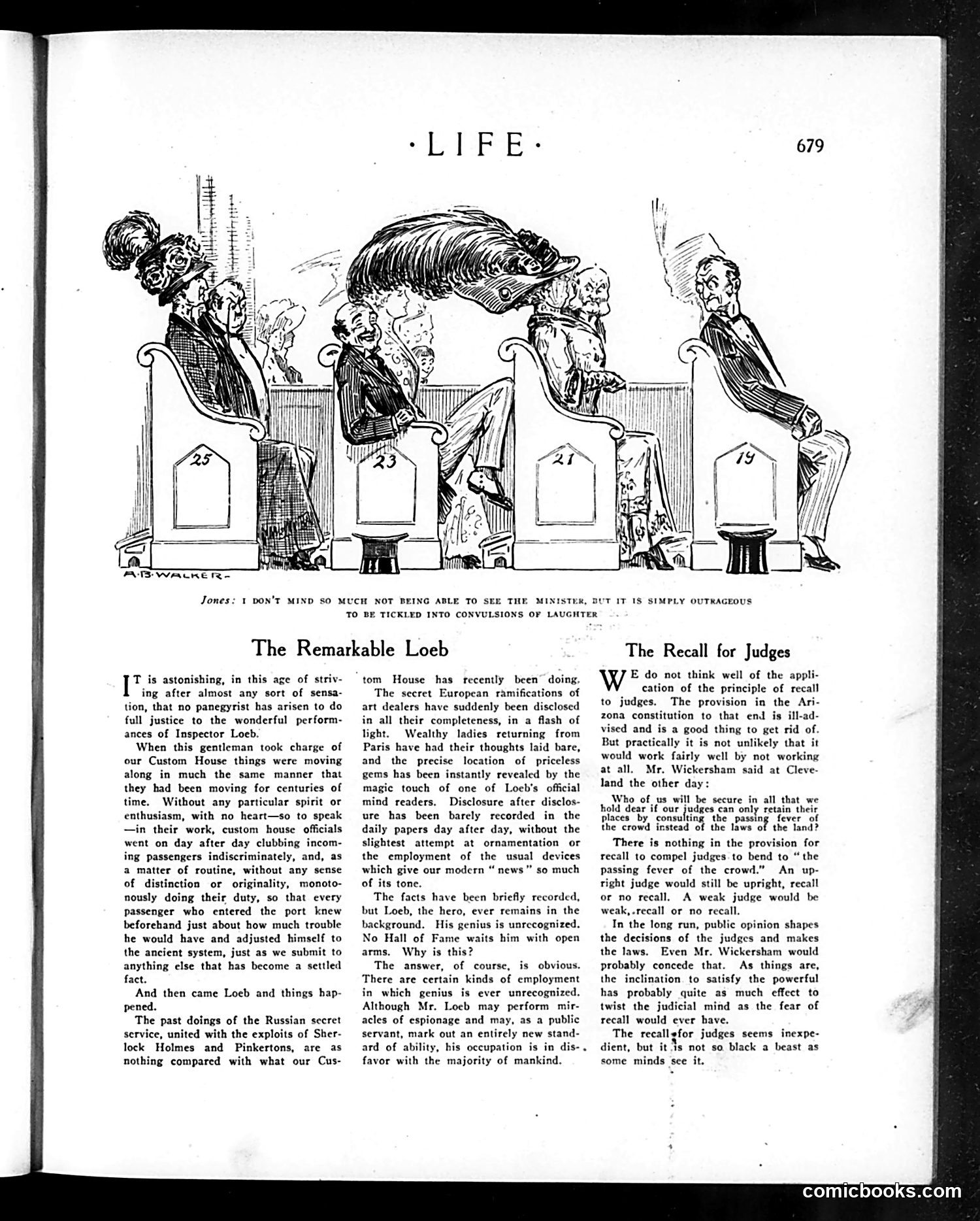
The cartoon depicts a church pew scene where well-dressed men sit in numbered seats (29, 23, 21, 19), their exaggerated features suggesting caricature. The caption, attributed to "Jones," jokes about a minister whose sermons fail to amuse—the speaker claims he "doesn't mind" not seeing the minister because it's "simply outrageous to be tickled into convulsions of laughter." The satire mocks both boring clergy and parishioners who expect entertainment from sermons. The two accompanying articles address contemporary 1910s-era political controversies: **Inspector Loeb** (apparently a U.S. Custom House official) receives satirical praise for his aggressive inspection practices against wealthy travelers and art dealers returning from Europe. The piece criticizes his unrecognized "genius" while acknowledging his unpopular methods. **"The Recall for Judges"** debates Arizona's constitutional provision allowing public recall of judges, defending the concept against conservative fears (citing Attorney General Wickersham) that it would undermine judicial independence.
📄 Transcribed text from this page (OCR, searchable)
Machine-transcribed from the original scan — historical spelling and the odd misread are preserved.
FVTS WACKE IRS Jones; 1 DON'T MIND SO MUCH NOT BEING ABLE TO SEE THE TO BE TICKLED INTO CONVULSIONS OF LAUGHTER The Remarkable Loeb T is astonishing, in this age of striv- ing after almost any sort of sensa- tion, that no panegyrist has arisen to do full justice to the wonderful perform- ances of Inspector Loeb. When this gentleman took charge of our Custom House things were moving along in much the same manner that they had been moving for centuries of time. Without any particular spirit or enthusiasm, with no heart—so to speak —in their work, custom house officials went on day after day clubbing incom- ing passengers indiscriminately, and, as a matter of routine, without any sense of distinction or originality, monoto- nously doing their duty, so that every passenger who entered the port knew beforehand just about how much trouble he would have and adjusted himself to the ancient system, just as we submit to anything else that has become a settled fact. And then came Loeb and things hap- pened. The past doings of the Russian secret service, united with the exploits of Sher- lock Holmes and Pinkertons, are as nothing compared with what our Cus- “tom House has recently been’ doing, The secret European ramifications of art dealers have suddenly been disclosed in all their completeness, in a flash of light. Wealthy ladies returning from Paris have had their thoughts laid bare, and the precise location of priceless gems has been instantly revealed by the magic touch of one of Loeb's official mind readers. Disclosure after disclos- ure has been barely recorded in the daily papers day after day, without the slightest attempt at ornamentation or the employment of the usual devices which give our modern “ news” so much of its tone, The facts have been briefly recorded, but Loeb, the hero, ever remains in the background. His genius is unrecognized. No Hall of Fame waits him with open arms. Why is this? The answer, of course, is obvious. There are certain kinds of employment in which genius is ever unrecognized. Although Mr. Loeb may perform mir- acles of espionage and may, as a public servant, mark out an entirely new stand- ard of ability, his occupation is in dis-. favor with the majority of mankind. MINISTER, BUT IT 1S SIMPLY OUTRAGEOUS The Recall for Judges E do not think well of the appli- cation of the principle of recall to judges. The provision in the Ari- zona constitution to that end is ill-ad- vised and is a good thing to get rid of. But practically it is not unlikely that it would work fairly well by not working at all. Mr. Wickersham said at Cleve- land the other day: Who of us will be secure in all that we hold dear if our judges can only retain their places by consulting the passing fever of the crowd instead of the laws of the land? There is nothing in the provision for recall to compel judges. to bend to “the passing fever of the crowd.” An up- right judge would still be upright, recall or no recall. A weak judge would be weak, recall or no recall. In the long run, public opinion shapes the decisions of the judges and makes the laws. Even Mr. Wickersham would probably concede that. As things are, the inclination to satisfy the powerful has probably quite as much effect to twist the judicial mind as the fear of recall would ever have. The recallefor judges seems inexpe- dient, but it 4s not so. black a beast as some minds sce it. comicbooks.com