
Life, 1911-04-06 · page 44 of 76
Life — April 6, 1911 — page 44: what you’re looking at
What you’re looking at
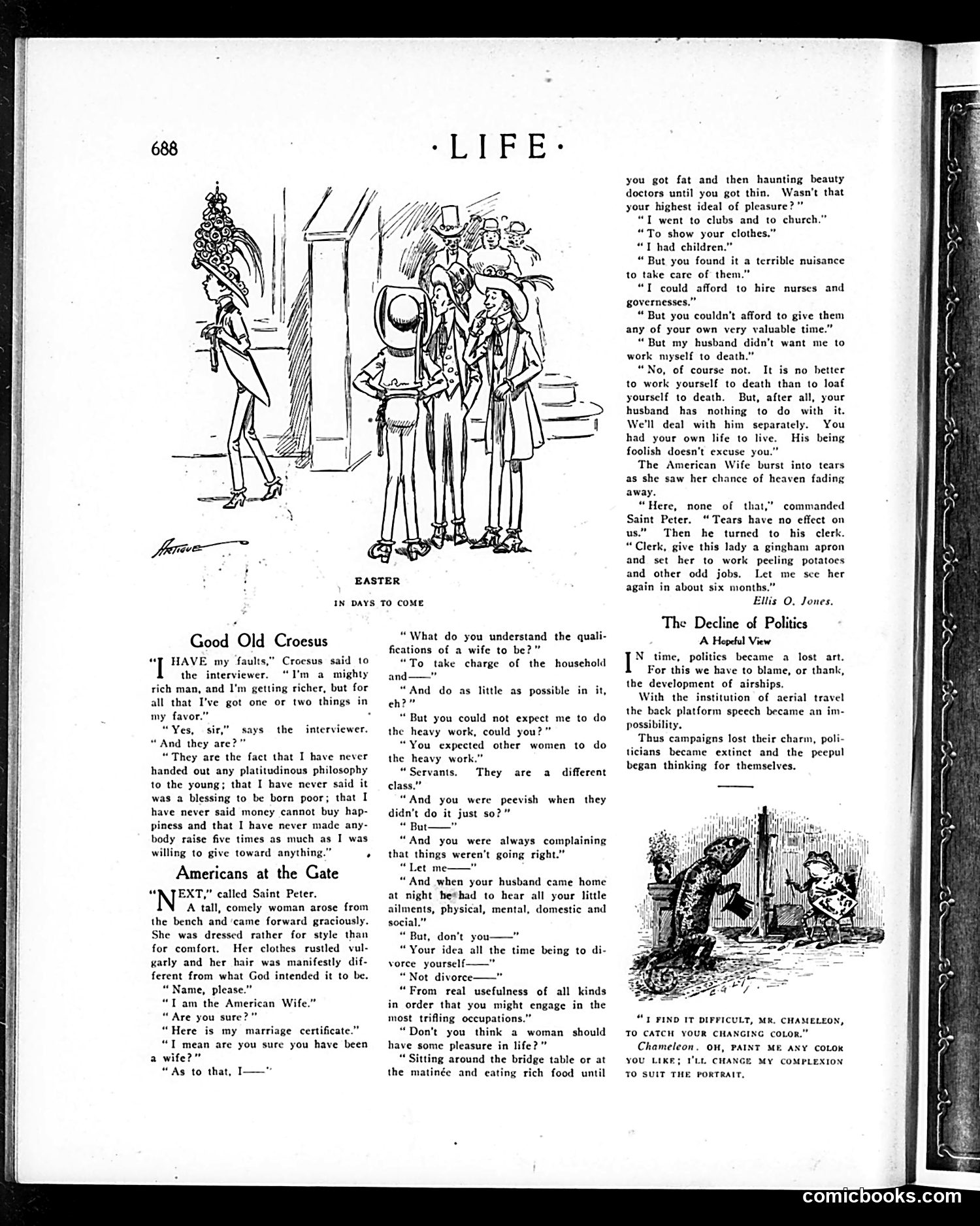
This Life magazine page contains three satirical pieces targeting American society circa early 1900s: **"Good Old Croesus"** mocks wealthy industrialists who hypocritically claim moral virtue while hoarding money. The reference is to the ancient king Croesus, proverbially rich. The joke: at least he's honest about his wealth rather than preaching poverty as noble. **"Americans at the Gate"** is a heavenly judgment scene where Saint Peter interrogates an "American Wife" about her life. The satire attacks upper-class women for idleness, materialism (bridge, theater, beauty treatments), delegating childcare to servants, and contributing nothing meaningful. Her punishment: manual labor. This reflects contemporary anxiety about women's roles and leisure-class excess. **"The Decline of Politics"** suggests airships' invention ended political campaigning (eliminating the campaign train's rear platform speeches), which paradoxically improved democracy by forcing people to think independently rather than follow politicians' rhetoric. The cartoon style and social assumptions are distinctly period—early 20th-century class commentary and gender critique presented as satirical humor.
📄 Transcribed text from this page (OCR, searchable)
Machine-transcribed from the original scan — historical spelling and the odd misread are preserved.
ar Lars pee tier a ; EASTER IN DAYS To COME Good Old Croesus “T HAVE my faults,” Croesus said to the interviewer. “I'm a mighty rich man, and I'm getting richer, but for all that I've got one or two things in my favor.” . “Yes, sii “And they are? “They are the fact that I have never handed out any platitudinous philosophy to the young; that I have never said it was a blessing to be born poor; that I have never said money cannot buy hap- piness and that I have never made any- body raise five times as much as I was willing to give toward anything.” Z Americans at the Gate id EXT,” called Saint Peter. A tall, comely woman arose from the bench and ‘came forward graciously. She was dressed rather for style than for comfort, Her clothes rustled vul- xarly and her hair was manifestly dif- ferent from what God intended it to be. “Name, please.” T am the American Wife.” “Are you sure?” “Here is my marriage certificate.” “T mean are you sure you have been a wife?” “As to that, I— says the interviewer. “What do you understand the quali- fications of a wife to be?” “To take charge of the household and——" “And do as little as possible in it, eh?” “But you could not expect me to do the heavy work, could you?” “You expected other women to do the heavy work.” “Servants, They are a different class.” “And you were peevish when they didn’t do it just so?” “ But—' “And you were always complaining that things weren't going right.” “Let me—”" “And when your husband came home at night hethad to hear all your little ailments, physical, mental, domestic and social.” “ But, don’t. you——” “Your idea all the time being to di- voree yourself —” “Not divorce “From real usefulness of all kinds in order that you might engage in the most trifling occupations.” “Don't you think a woman should have some pleasure in life?” “Sitting around the bridge table or at the matinée and eating rich food until you got fat and then haunting beauty doctors until you got thin, Wasn't that your highest ideal of pleasure?” “T went to clubs and to church.” “To show your clothes.” “T had children.” “ But you found it a terrible nuisance to take care of them.” “T could afford to hire nurses and governesses.” “ But you couldn't afford to give them any of your own very valuable time.” “But my husband didn’t want me to work myself to death.” “No, of course not. It is no better to work yourself to death than to loaf yourself to death. But, after all, your husband has nothing to do with it. We'll deal with him separately. You had your own life to live. His being foolish doesn’t excuse you.” The American Wife burst into tears as she saw her chance of heaven fading away. “Here, none of that,” commanded Saint Peter. “Tears have no effect on us.” Then he turned to his clerk. “Clerk, give this lady a gingham apron and set her to work peeling potatoes and other odd jobs, Let me sce her again in about six months.” Ellis O. Jones. The Decline of Politics A Hopeful View N time, politics became a lost art. For this we have to blame, or thank, the development of airships. With the institution of aerial travel the back platform speech became an im- possibility, Thus campaigns lost their charm, poli- ticians became extinct and the peepul began thinking for themselves. “(1 FIND IT DIFFICULT, MR. CHAMELEON, TO CATCH YOUR CHANGING COLOR.” Chameleon. OW, PAINT ME ANY COLOK YOU LIKE; I'L. CHANGE MY COMPLEXION TO SUIT THE PORTRAIT, ees 5-5 “9 FOG NRE) OC 3 XS ei WF —7> Sheen > comicbooks.com