
Life, 1911-04-06 · page 38 of 76
Life — April 6, 1911 — page 38: what you’re looking at
What you’re looking at
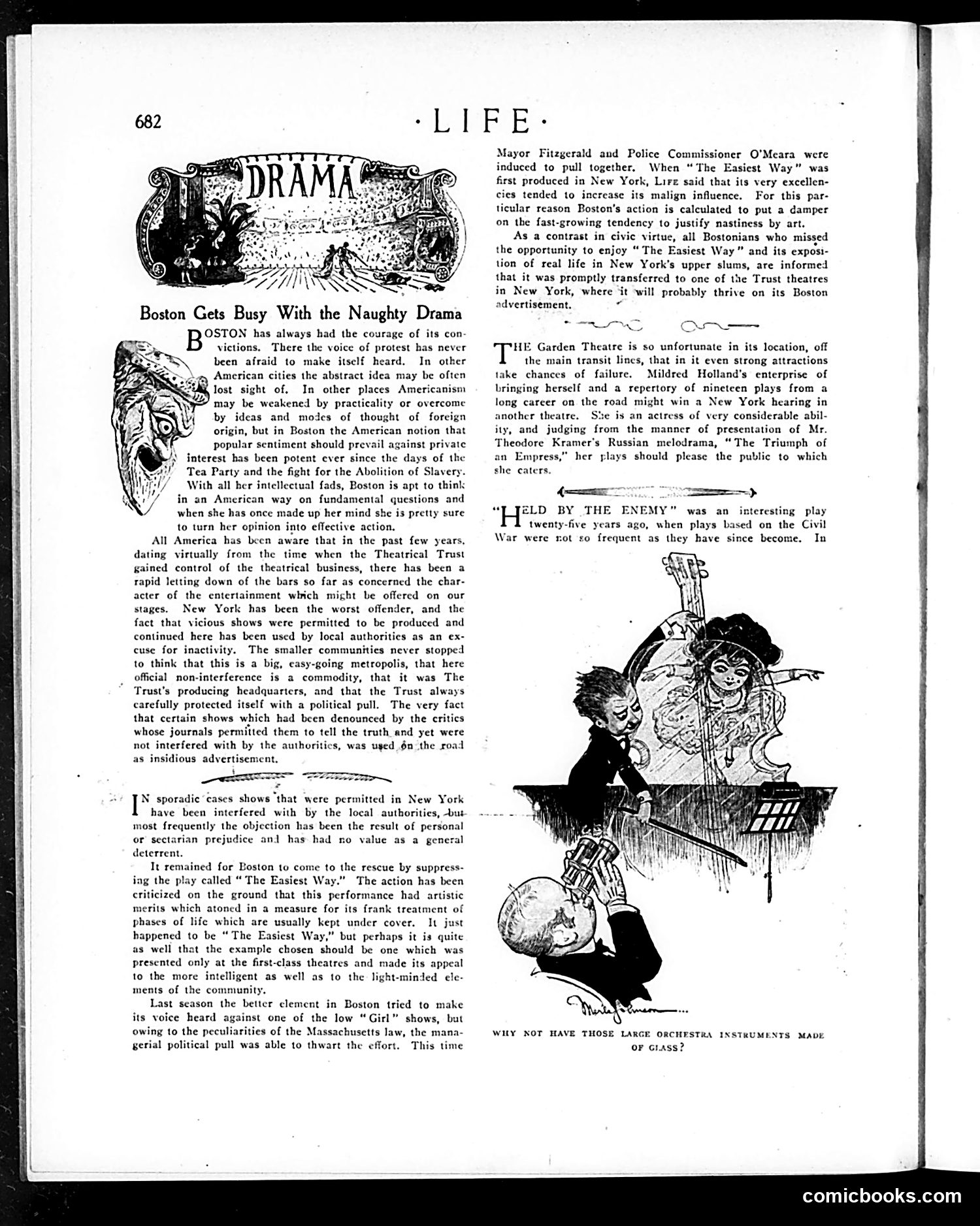
This page critiques Boston's suppression of the play "The Easiest Way," which dealt frankly with urban poverty and morality. The accompanying illustration shows a caricatured soldier or military figure, likely representing Boston's civic "courage" in enforcing moral standards. The article praises Boston's historical tradition of principled stands (Tea Party, Abolition) while discussing theatrical censorship. Life argues that New York's "Theatrical Trust" had degraded stage morality for years, exploiting political connections to avoid interference. Boston's suppression of "The Easiest Way"—despite its artistic merit—is presented as appropriately combating the "fast-growing tendency to justify nastiness by art." The satire's ironic punch: the play, suppressed in Boston, simply moved to New York theaters where Boston's publicity actually *helped* promote it as "insidious advertisement." The article reflects Progressive Era debates over censorship, artistic merit versus moral content, and corporate influence on local governance.
📄 Transcribed text from this page (OCR, searchable)
Machine-transcribed from the original scan — historical spelling and the odd misread are preserved.
"We ES Boston Gets Busy With the Naughty Drama OSTON has always had the courage of its con- victions. There the voice of protest has never been afraid to make itself heard. In other American cities the abstract idea may be often lost sight of. In other places Americanism may be weakened by practicality or overcome by ideas and modes of thought of foreign origin, but in Boston the American notion that popular sentiment should prevail against private interest has been potent ever since the days of the Tea Party and the fight for the Abolition of Slavery. With all her intellectual fads, Boston is apt to think in an American way on fundamental questions and when she has once made up her mind she is pretty sure to turn her opinion into effective action, America has been aware that in the past few years, dating virtually from the time when the Theatrical Trust gained control of the theatrical business, there has been a rapid letting down of the bars so far as concerned the char- acter of the entertainment which might be offered on our stages. New York has been the worst offender, and the fact that vicious shows were permitted to be produced and continued here has been used by local authorities as an ex- cuse for inactivity. The smaller communities never stopped to think that this is a big, easy-going metropolis, that here official non-interference is a commodity, that it was The Trust's producing headquarters, and that the Trust always carefully protected itself with a political pull. The very fact that certain shows which had been denounced by the critics whose journals permitted them to tell the truth and yet were not interfered with by the authoritics, was uged 6n the road as insidious advertisement. sporadic cases shows that were permitted in New York have been interfered with by the local authorities, -but most frequently the objection has been the result of personal or sectarian prejudice and has had no value as a general deterrent. It remained for Boston to come to the rescue by suppress- ing the play called “ The Easiest Way." The action has been criticized on the ground that this performance had artistic merits which atoned in a measure for its frank treatment of phases of life which are usually kept under cover. It t happened to be “The Easiest Way,” but perhaps it is quite as well that the example chosen should be one which was presented only at the first-class theatres and made its appeal to the more intelligent as well as to the light-minded ele- ments of the community, Last season the better clement in Boston tried to make its voice heard against one of the low “Girl” shows, but owing to the peculiarities of the Massachusetts law, the mana- gerial political pull was able to thwart the effort. This time Mayor Fitzgerald and Police Commissioner O'Meara were induced to pull together, When “The Easiest Way” was first produced in New York, Lire said that its very excellen- cies tended to increase its malign influence. For this par- ticular reason Boston's action is calculated to put a damper on the fast-growing tendency to justify nastiness by art. As a contrast in civic virtue, all Bostonians who missed the opportunity to enjoy “The Easiest Way” and its exposi- tion of real life in New York's upper slums, are informed that it was promptly transferred to one of the Trust theatres in New York, where it will probably thrive on its Boston advertisement. % PRO i E Garden Theatre is so unfortunate in its location, off the main transit lines, that in it even strong attractions take chances of failure. Mildred Holland's enterprise of bringing herself and a repertory of nineteen plays from a long career on the road might win a New York hearing in another theatre. She is an actress of very considerable abil- ity, and judging from the manner of presentation of Mr. Theodore Kramer's Russian melodrama, “The Triumph of an Empress,” her plays should please the public to which she caters. =a ==) “I {Pe BY THE ENEMY" was an interesting play twenty-five years ago, when plays based on the Civil War were not so frequent as they have since become. In WHY NOT HAVE THOSE LARGE ORCHESTRA INSTRUMENTS MADE OF Giass? comicbooks.com