
Life, 1911-04-06 · page 25 of 76
Life — April 6, 1911 — page 25: what you’re looking at
What you’re looking at
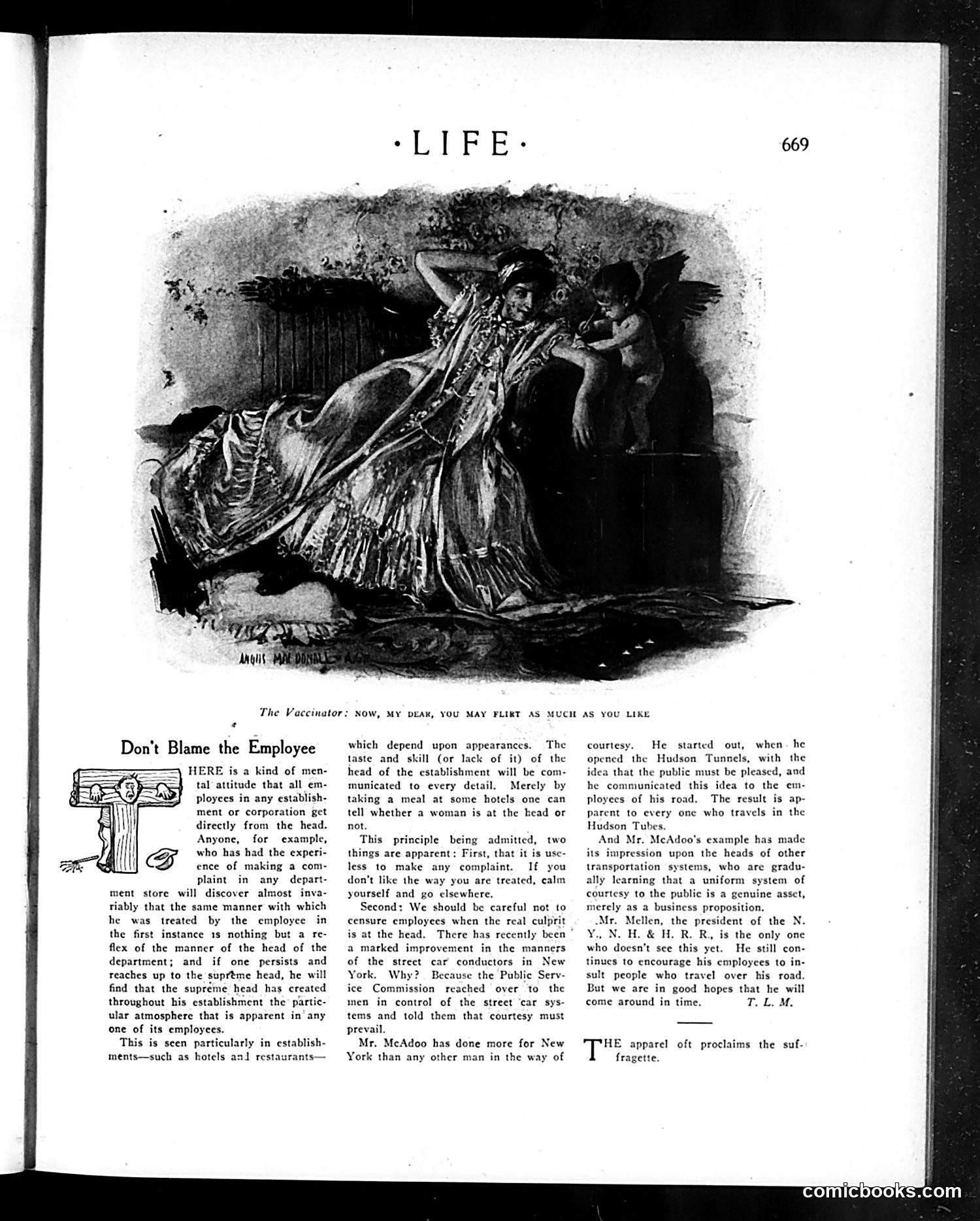
**The Main Cartoon** depicts a vaccination scene with the caption "Now, my dear, you may flirt as much as you like"—likely satirizing either medical hypocrisy or social attitudes toward women's behavior during vaccination procedures. **"Don't Blame the Employee"** is the primary article, arguing that poor customer service reflects management's attitude, not individual workers' failings. It uses examples from hotels, restaurants, and notably New York's street car system and Hudson Tunnels. **Key Figure**: William McAdoo, who managed the Hudson Tunnels/Hudson & Manhattan Railroad, is praised for implementing a courtesy-first policy that supposedly improved service across transportation systems. The article credits him with influencing even competitors. **The Satire**: Management receives both blame and credit for employee behavior. The piece criticizes railroad president Charles Mellen (New York, New Haven & Hartford) for allegedly encouraging employees to be rude—presented as willful mismanagement rather than incompetence. **For Modern Readers**: This reflects early-1900s transit labor debates and the novel idea that corporate culture flows downward from leadership—now standard business thinking but apparently noteworthy then.
📄 Transcribed text from this page (OCR, searchable)
Machine-transcribed from the original scan — historical spelling and the odd misread are preserved.
The Vaccinator: Now, MY DEAK, YOU MAY FLIRT AS MUCH AS YOU LIKE ‘ Don't Blame the Employee HERE is a kind of men- tal attitude that all em- ployees in any establish- ment or corporation get directly from the head. Anyone, for example, who has had the experi- ence of making a com- plaint’ in any depart- ment store will discover almost inva- riably that the same manner with which he was treated by the employee in the first instance 1s nothing but a re- flex of the manner of the head of the department; and if one persists and reaches up to the supreme head, he will find that the supreme head has created throughout his establishment the partic- ular atmosphere that is apparent in’ any one of its employees. This is seen particularly in establish- ments—such as hotels an] restaurants— which depend upon appearances. The taste and skill (or lack of it) of the head of the establishment will be com- municated to every detail. Merely by taking a meal at some hotels one can tell whether a woman is at the head or not. This principle being admitted, two things are apparent: First, that it is use- less to make any complaint. If you don’t like the way you are treated, calm yourself and go elsewhere, Second: We should be careful not to censure employees when the real culprit is at the head. There has recently been a marked improvement in the manners of the strect car conductors in New York. Why? Because the Public Serv- ice Commission reached over to the men in control of the street ‘car sys- tems and told them that courtesy must prevail. Mr. McAdoo has done more for New York than any other man in the way of courtesy. He started out, when he opened the Hudson Tunnels, with the idea that the public must be pleased, and he communicated this idea to the em- ployees of his road. The result is ap- parent to every one who travels in the Hudson Tube: And Mr. McAdoo’s example has made its impression upon the heads of other transportation systems, who are gradu- ally learning that a uniform system of courtesy to the public is a genuine asset, merely as a business proposition. .Mr. Mellen, the president of the N. N. H. & H.R. R, is the only one who doesn’t sce this yet. He still con- tinues to encourage his employees to in- sult people who travel over his road. But we are in good hopes that he will come around in time. T. L. M. HE apparel oft proclaims the suf- fragette.