
Life, 1911-04-06 · page 36 of 76
Life — April 6, 1911 — page 36: what you’re looking at
What you’re looking at
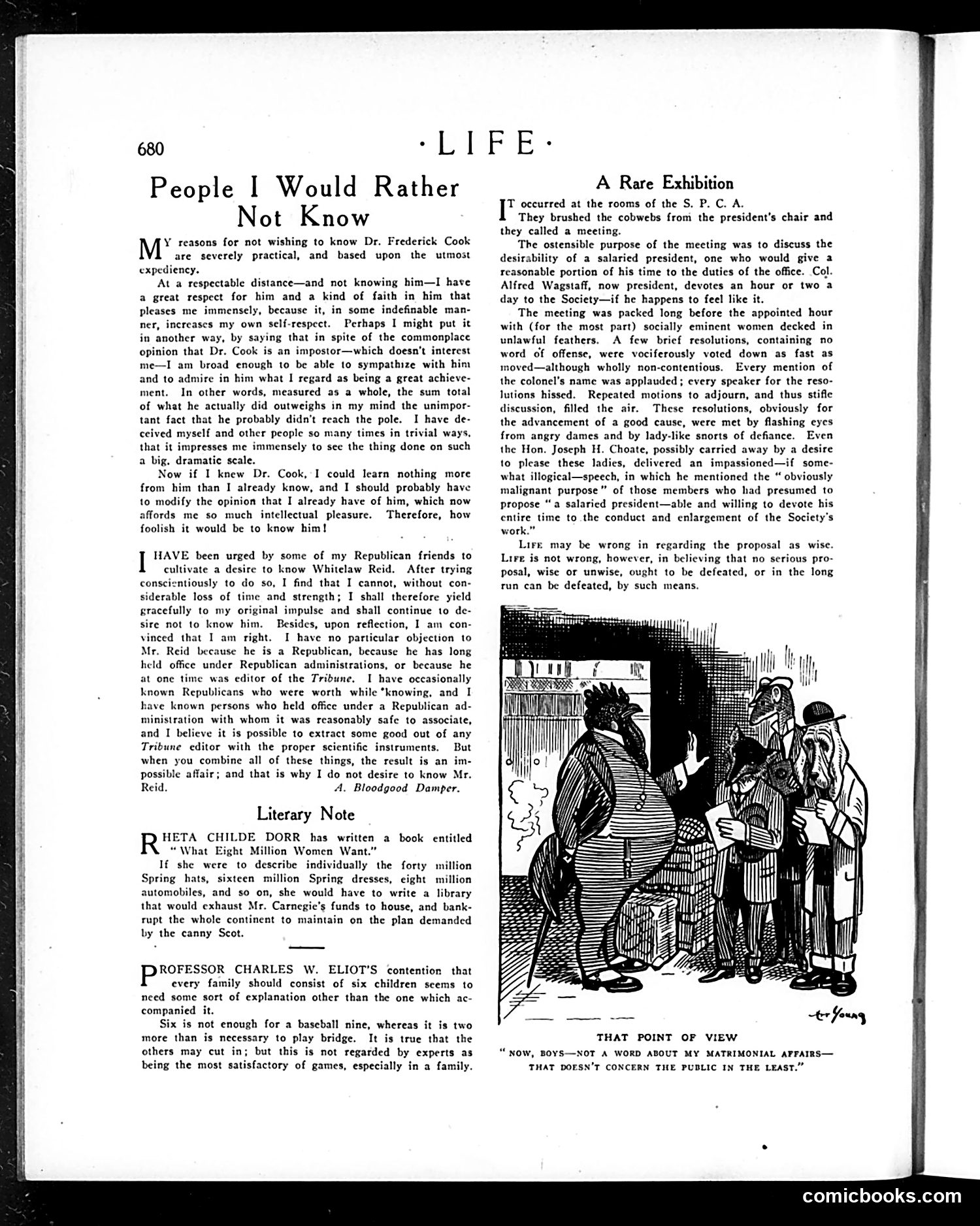
The cartoon depicts a meeting at the S.P.C.A. (Society for the Prevention of Cruelty to Animals). The accompanying text reveals that board members gathered to discuss hiring a salaried president, as the current president, Colonel Alfred Wagstaff, only devotes an hour or two daily to the organization when he feels like it. The cartoon's caption—"Now, boys—not a word about my matrimonial affairs—that doesn't concern the public in the least"—satirizes the hypocrisy of the proceedings. A figure (likely Wagstaff) preemptively silences discussion of his personal matters while the organization supposedly exists to protect those who cannot speak for themselves (animals). The joke is the irony: an organization dedicated to preventing cruelty and advocating for the voiceless is itself silencing legitimate organizational concerns. The cartoon mocks both Wagstaff's self-interested leadership and the board's apparent complicity in avoiding accountability.
📄 Transcribed text from this page (OCR, searchable)
Machine-transcribed from the original scan — historical spelling and the odd misread are preserved.
680 “LTFE- People I Would Rather Not Know Y reasons for not wishing to know Dr. Frederick Cook M are severely practical, and based upon the utmost expediency. At a respectable distance—and not knowing him—I have a great respect for him and a kind of faith in him that pleases me immensely, because it, in some indefinable man- ner, increases my own self-respect. Perhaps I might put it in another way, by saying that in spite of the commonplace opinion that Dr. Cook is an impostor—which doesn’t interest me—I am broad enough to be able to sympathize with him and to admire in him what I regard as being a great achieve- ment. In other words, measured as a whole, the sum total of what he actually did outweighs in my mind the unimpor- tant fact that he probably didn’t reach the pole. I have de- ceived myself and other people so many times in trivial ways, that it impresses me immensely to see the thing done on such a big, dramatic scale. Now if I knew Dr. Cook, I could learn nothing more from him than I already know, and I should probably have to modify the opinion that I already have of him, which now affords me so much intellectual pleasure. Therefore, how foolish it would be to know him! HAVE been urged by some of my Republican friends to cultivate a desire to know Whitelaw Reid. After trying conscientiously to do so, I find that I cannot, without con- siderable loss of time and strength; I shall therefore yield gracefully to my original impulse and shall continue to de- sire not to know him. Besides, upon reflection, I am con- vinced that I am right. I have no particular objection to Mr. Reid because he is a Republican, because he has long held office under Republican administrations, or because he at one time was editor of the Tribune. I have occasionally known Republicans who were worth while *knowing, and I have known persons who held office under a Republican ad- ministration with whom it was reasonably safe to associate, and I believe it is possible to extract some good out of any Tribune editor with the proper scientific instruments. But when you combine all of these things, the result is an im- possible affair; and that is why I do not desire to know Mr. Reid. A. Bloodgood Damper. Literary Note HETA CHILDE DORR has written a book entitled “What Eight Million Women Want.” If she were to describe individually the forty million Spring hats, sixteen million Spring dresses, eight million automobiles, and so on, she would have to write a library that would exhaust Mr. Carnegic’s funds to house, and bank- rupt the whole continent to maintain on the plan demanded by the canny Scot. ROFESSOR CHARLES W. ELIOT'S contention that every family should consist of six children seems to need some sort of explanation other than the one which ac- companied it. Six is not enough for a baseball nine, whereas it is two more than is necessary to play bridge. It is true that the others may cut in; but this is not regarded by experts as being the most satisfactory of games, especially in a family. A Rare Exhibition T occurred at the rooms of the S. P. C. A. They brushed the cobwebs from the president's chair and they called a meeting. The ostensible purpose of the meeting was to discuss the desirability of a salaried president, one who would give a reasonable portion of his time to the duties of the office. Col. Alfred Wagstaff, now president, devotes an hour or two a day to the Society—if he happens to feel like it. The meeting was packed long before the appointed hour with (for the most part) socially eminent women decked in unlawful feathers. A few brief resolutions, containing no word of offense, were vociferously voted down as fast as moved—although wholly non-contentious. Every mention of the colonel’s name was applauded; every speaker for the reso- lutions hissed. Repeated motions to adjourn, and thus stiffe discussion, filled the air. These resolutions, obviously for the advancement of a good cause, were met by flashing eyes from angry dames and by lady-like snorts of defiance. Even the Hon. Joseph H. Choate, possibly carried away by a desire to please these ladies, delivered an impassioned—if some- what illogical—speech, in which he mentioned the “ obviously malignant purpose” of those members who had presumed to propose “a salaried president—able and willing to devote his entire time to the conduct and enlargement of the Society's work.” Lire may be wrong in regarding the proposal as wise. Lire is not wrong, however, in believing that no serious pro- posal, wise or unwise, ought to be defeated, or in the long run can be defeated, by such means. SSS |S Fan SSF in SS =A oo! THAT POINT OF VIEW T A WORD ABOUT MY MATRIMONIAL APFAIRS— THAT DOESN'T CONCERN THE PUBLIC IN THE LEAST.” comicbooks.com