
Life, 1911-04-06 · page 42 of 76
Life — April 6, 1911 — page 42: what you’re looking at
What you’re looking at
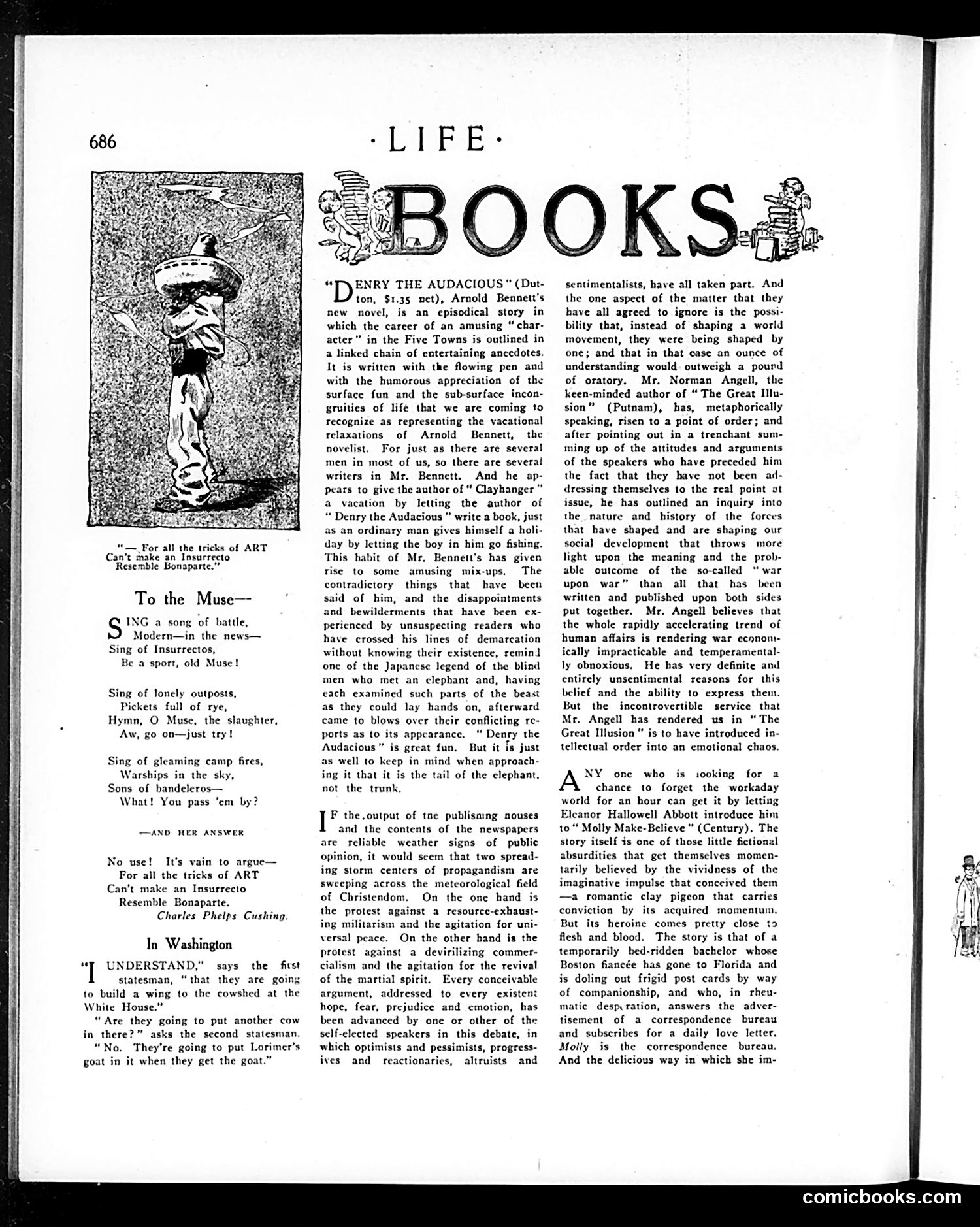
This *Life* magazine page contains political satire from the early 1900s addressing multiple contemporary issues. **The Cartoon "To the Muse"** mocks romantic glorification of the Philippine-American War's insurgents ("Insurrectos"). The poet pleads with the Muse to celebrate their battles, but she refuses—no artistic trick can make Filipino rebels resemble Napoleon Bonaparte. The satire suggests these conflicts lack the grandeur their advocates claim. **The Washington Joke** ridicules a prominent politician named Lorimer (likely William Lorimer, a corrupt U.S. Senator). Calling him a "goat" was period slang for a fool or scapegoat. The "cowshed" reference mocks the White House, implying government incompetence. **The Book Reviews** discuss Arnold Bennett's novel and debates over militarism versus commercialism sweeping Christendom—reflecting early 20th-century anxieties about war, peace, and societal values. The overall tone criticizes both political corruption and naive romanticism about military conflicts.
📄 Transcribed text from this page (OCR, searchable)
Machine-transcribed from the original scan — historical spelling and the odd misread are preserved.
“— For all the tricks of ART Can't make an Insurrecto Resemble Bonaparte.” To the Muse— ING a song of battle, Modern—in the news— Sing of Insurrectos, Be a sport, old Muse! Sing of lonely outposts, Pickets full of rye, Hymn, O Muse, the slaughter, Aw, go on—just try! Sing of gleaming camp fires, Warships in the sky, Sons of bandeleros— What! You pass ‘em by? AND HER ANSWER No use! It’s vain to argue— For all the tricks of ART Can't make an Insurrecto Resemble Bonaparte. Charles Phelps Cushing. In Washington “T UNDERSTAND,” says the first statesman, “that they are going to build a wing to the cowshed at the White House.” “Are they going to put another cow in there?” asks the second statesman. “No. They're going to put Lorimer's goat in it when they get the goat.’ “P)ENRY THE AUDACIOUS” (Dut- ton, $1.35 net), Arnold Bennett's new novel, is an episodical story in which the career of an amusing “ char- acter” in the Five Towns is outlined in a linked chain of entertaining anecdotes. It is written with the flowing pen and with the humorous appreciation of the surface fun and the sub-surface incon- gruities of life that we are coming to recognize as representing the vacational relaxations of Arnold Bennett, the novelist. For just as there are several men in most of us, so there are several writers in Mr. Bennett. And he ap- pears to give the author of “ Clayhanger ” a vacation by letting the author of “ Denry the Audacious ” write a book, just as an ordinary man gives himself a holi- day by letting the boy in him go fishing. This habit of Mr. Bennett's has given rise to some amusing mix-ups. The contradictory things that have been said of him, and the disappointments and bewilderments that have been ex- perienced by unsuspecting readers who have crossed his lines of demarcation without knowing their existence, remind ‘one of the Japancse legend of the blind men who met an clephant and, having each examined such parts of the beast as they could lay hands on, afterward came to blows over their conflicting re- ports as to its appearance. “ Denry the Audacious” is great fun. But it [s just as well to keep in mind when approach- ing it that it is the tail of the elephant, not the trunk. F the.output of tne publisaing nouses and the contents of the newspapers are reliable weather signs of public opinion, it would seem that two spread- ing storm centers of propagandism are sweeping across the meteorological field of Christendom. On the one hand is the protest against a resource-exhaust- ing militarism and the agitation for uni- versal peace. On the other hand is the protest against a devirilizing commer- cialism and the agitation for the revival of the martial spi Every conceivable argument, addressed to every existent hope, fear, prejudice and emotion, has been advanced by one or other of the self-clected speakers in this debate, in which optimists and pessimists, progress- ives and reactionaries, altruists and sentimentalists, have all taken part. And the one aspect of the matter that they have all agreed to ignore is the possi- bility that, instead of shaping a world movement, they were being shaped by one; and that in that case an ounce of understanding would. outweigh a pound of oratory. Mr. Norman Angell, the keen-minded author of “ The Great Illu- sion” (Putnam), has, metaphorically speaking, risen to a point of order; and after pointing out in a trenchant sum- ming up of the attitudes and arguments of the speakers who have preceded him the fact that they have not been ad- dressing themselves to the real p at issue, he has outlined an inquiry into the nature and history of the forces that have shaped and are shaping our social development that throws more light upon the meaning and the prob- able outcome of the so-called “war upon war” than all that has been written and published upon both sides put together. Mr. Angell believes that the whole rapidly accelerating trend of human affairs is rendering war econom- ically impracticable and temperamental- ly obnoxious. He has very definite and entirely unsentimental reasons for this belief and the ability to express them. But the incontrovertible service that Mr. Angell has rendered us in “The Great Illusion” is to have introduced in- tellectual order into an emotional chaos. NY one who is sooking for a chance to forget the workaday world for an hour can get it by letting Elcanor Hallowell Abbott introduce him 10 “ Molly Make-Believe " (Century). The story itself is one of those little fictional absurdities that get themselves momen- tarily believed by the vividness of the imaginative impulse that conceived them —a romantic clay pigeon that carries conviction by its acquired momentum. But its heroine comes pretty close t> flesh and blood. The story is that of a temporarily bed-ridden bachelor whose Boston fiancée has gone to Florida and is doling out frigid post cards by way of companionship, and who, in rheu- matic despration, answers the adver- tisement of a correspondence bureau and subscribes for a daily love letter. Molly is the correspondence bureau. And the delicious way in which she im- comicbooks.com