
Life, 1911-04-06 · page 29 of 76
Life — April 6, 1911 — page 29: what you’re looking at
What you’re looking at
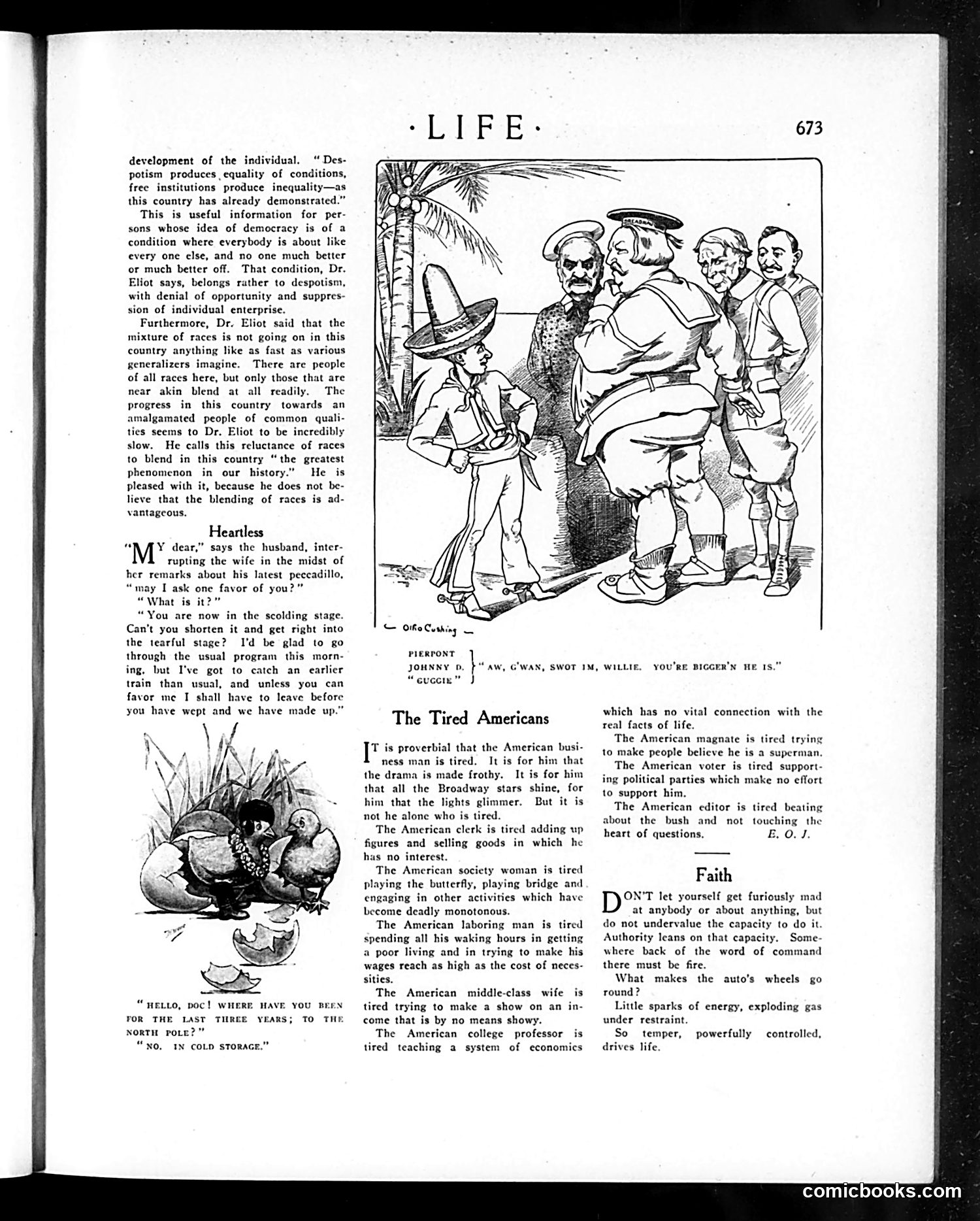
This page contains satirical commentary on American society circa early 20th century. **"The Tired Americans"** is the main feature—a list-format critique cataloging exhaustion across all American social classes: businessmen, clerks, society women, laborers, middle-class wives, professors, magnates, voters, and editors. The satire suggests systemic dissatisfaction pervades every level of society, from the wealthy to the working poor. **The cartoon at top** shows a man in a sombrero addressing others, captioned "Aw, g'wan, swot im, Willie. You're bigger'n he is"—apparently depicting casual violence or bullying, though context is unclear. **"Heartless"** mocks a husband who interrupts his wife's scolding to ask she skip to the "tearful stage" because he needs to catch a train—satirizing male insensitivity and the routinization of domestic conflict. **"Faith"** argues that controlled anger/passion (like engine sparks) drives progress, warning against passive acceptance. The overall message critiques American materialism, monotony, and systemic failure to fulfill democratic promises.
📄 Transcribed text from this page (OCR, searchable)
Machine-transcribed from the original scan — historical spelling and the odd misread are preserved.
development of the individual. “ Des- potism produces equality of conditions, free institutions produce inequality— this country has already demonstrated.” This is useful information for per- sons whose idea of democracy is of a condition where everybody is about like every one clse, and no one much better or much better off. That condition, Dr. Eliot says, belongs rather to despotism, with denial of opportunity and suppres- sion of individual enterprise. Furthermore, Dr. t said that the mixture of races is not going on in this country anything like as fast as various generalizers imagine. There are people of all races here, but only those that are near akin blend at all readily, The progress in this country towards an amalgamated people of common quali- ties seems to Dr. Eliot to be incredibly slow. He calls this reluctance of races to blend in this country “the greatest phenomenon in our history.” He is pleased with it, because he does not be- lieve that the blending of races is ad- vantagcous. Heartless “M’ dear,” says the husband, inter- rupting the wife in the midst of her remarks about his latest peccadillo, “may I ask one favor of you?” “What is it?” “You are now in the scolding stage. Can't you shorten it and get right into the tearful stage? I'd be glad to go through the usual program this morn- ing, but I've got to catch an earlier train than usual, and unless you can favor me I shall have to leave before you have wept and we have made up.” “HELLO, Doc! WHERE HAVE YOU BEEN FOR THE LAST THREE YEARS; TO THE NORTH POLE?” “No. IN COLD STORAGE.” & Othe Cushing PIERPONT JOUNNY D, “euccin” J The Tired Americans T is proverbial that the American busi- ness man is tired. It is for him that the drama is made frothy. It is for him that all the Broadway stars shine, for him that the lights glimmer. But it is not he alone who is tired. The American clerk is tired adding up figures and selling goods in which he has no interest. The American society woman is tired playing the butterfly, playing bridge and engaging in other activities which have become deadly monotonous. The American laboring man is tired spending all his waking hours in getting a poor living and in trying to make his wages reach as high as the cost of neces- sities. The American middle-class wife is tired trying to make a show on an in- come that is by no means showy. The American college professor is tired teaching a system of economics “AW, G'WAN, SWOT IM, WILLIE. You'Re BIGGER'N Me 18.” which has no vital connection with the real facts of life. The American magnate is tired trying to make people believe he is a superman. The American voter is tired support- ing political parties which make no effort to support him. The American editor is tired beating about the bush and not touching the heart of questions, E.0.J. Faith ON’T let yourself get furiously mad at anybody or about anything, but do not undervalue the capacity to do it. Authority leans on that capacity, Some- where back of the word of command there must be fire. What makes the auto’s wheels go round? Little sparks of energy, exploding gas under restraint. So temper, drives life. powerfully controlled, comicbooks.com