
Life, 1911-04-06 · page 22 of 76
Life — April 6, 1911 — page 22: what you’re looking at
What you’re looking at
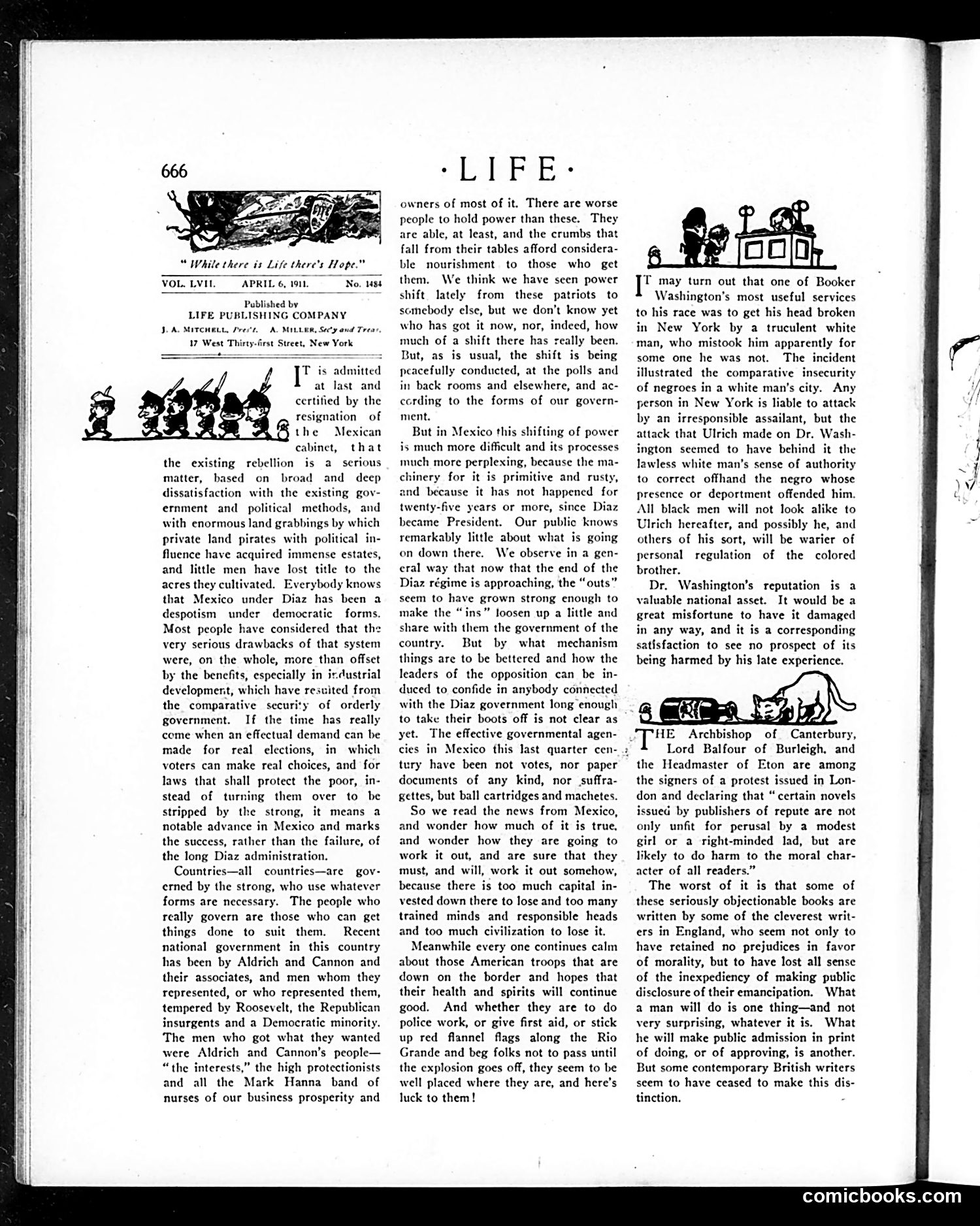
This editorial page discusses the Mexican Revolution and the collapse of Porfirio Díaz's regime. The text acknowledges that Díaz's 30-year dictatorship, despite maintaining "order," was built on land theft and disenfranchisement of ordinary Mexicans. The article compares Mexico's violent power struggle to American politics, arguing that in both countries, true power rests with "the strong"—not voters or laws. It names **Aldrich and Cannon** (Congressional Republican leaders) as those who actually governed America, with Theodore Roosevelt and Democrats playing minor roles. The satirical point: Life suggests American readers shouldn't judge Mexico harshly for its chaos, since America's own democracy is largely theater controlled by wealthy elites. Mexico's rebellion, while messier due to lack of democratic institutions, reflects the same reality—power shifting between competing interests. The reference to "ball cartridges and machetes" as Mexico's actual governing tools underscores the irony: formal government machinery matters little without underlying structural change.
📄 Transcribed text from this page (OCR, searchable)
Machine-transcribed from the original scan — historical spelling and the odd misread are preserved.
Pablished by LIFE PUBLISHING COMPANY JA MITCHELL, Pres, A. MILLER, Sey and Treas, 7 West TI rst Street, New York / I" is admitted by at Jast and certified by the resignation of the Mexican cabinet, that the existing rebellion is a serious matter, based on broad and deep dissatisfaction with the existing gov- ernment and political methods, and with enormous land grabbings by which private land pirates with political in- fluence have acquired immense estates, and little men have lost title to the acres they cultivated. Everybody knows that Mexico under Diaz has been a despotism under democratic forms. Most people have considered that the very serious drawbacks of that system were, on the whole, more than offset by the benefits, especially in irdustrial development, which have resuited from the comparative security of orderly government. If the time has really come when an effectual demand can be made for real elections, in which voters can make real choices, and for laws that shall protect the poor, in- stead of turning them over to be stripped by the strong, it means a notable advance in Mexico and marks the success, rather than the failure, of the long Diaz administration. Countries—all countries—are gov- erned by the strong, who use whatever forms are necessary. The people who really govern are those who can get things done to suit them. Recent national government in this country has been by Aldrich and Cannon and their associates, and men whom they represented, or who represented them, tempered by Roosevelt, the Republican insurgents and a Democratic minority. The men who got what they wanted were Aldrich and Cannon’s people— “the interests,” the high protectionists and all the Mark Hanna band of nurses of our business prosperity and ae a) lado owners of most of it. There are worse people to hold power than these. They are able, at least, and the crumbs that fall from their tables afford considera- ble nourishment to those who get them. We think we have seen power shift lately from these patriots to somebody else, but we don’t know yet who has got it now, nor, indeed, how much of a shift there has really been. But, as is usual, the shift is being peacefully conducted, at the polls and in back rooms and elsewhere, and ac- cording to the forms of our govern- ment. But in Mexico this shifting of power is much more difficult and its processes much more perplexing, because the m chinery for it is primitive and rusty, and because it has not happened for twenty-five years or more, since Diaz became President. Our public knows remarkably little about what is going on down there. We observe in a gen- eral way that now that the end of the Diaz régime is approaching, the “outs” seem to have grown strong enough to make the “ins” loosen up a little and share with them the government of the country. But by what mechanism things are to be bettered and how the leaders of the opposition can be in- duced to confide in anybody connected with the Diaz government long enough to take their boots off is not clear as yet. The effective governmental agen- cies in Mexico this last quarter cen- tury have been not votes, nor paper documents of any kind, nor suffra- gettes, but ball cartridges and machetes. So we read the news from Mexico, and wonder how much of it is true, and wonder how they are going to work it out, and are sure that they must, and will, work it out somehow, because there is too much capital in- vested down there to lose and too many trained minds and responsible heads and too much civilization to lose it. Meanwhile every one continues calm about those American troops that are down on the border and hopes that their health and spirits will continue good. And whether they are to do police work, or give first aid, or stick up red flannel flags along the Rio Grande and beg folks not to pass until the explosion goes off, they seem to be well placed where they are, and here's luck to them! T may turn out that one of Booker Washington's most useful services to his race was to get his head broken in New York by a truculent white man, who mistook him apparently for some one he was not. The incident illustrated the comparative insecurity of negroes in a white man’s city. Any person in New York is liable to attack by an irresponsible assailant, but the attack that Ulrich made on Dr. Wash- ington seemed to have behind it the lawless white man’s sense of authority to correct offhand the negro whose presence or deportment offended him. All black men will not look alike to Ulrich hereafter, and possibly he, and others of his sort, will be warier of personal regulation of the colored brother. Dr. Washington’s reputation is a valuable national asset. It would be a great misfortune to have it damaged in any way, and it is a corresponding satisfaction to see no prospect of its being harmed by his late experience. HE Archbishop of Canterbury, Lord Balfour of Burleigh, and the Headmaster of Eton are among the signers of a protest issued in Lon- don and declaring that “certain novels issued by publishers of repute are not only unfit for perusal by a modest girl or a right-minded lad, but are likely to do harm to the moral char- acter of all readers.” The worst of it is that some of these seriously objectionable books are written by some of the cleverest writ- ers in England, who seem not only to have retained no prejudices in favor of morality, but to have lost all sense of the inexpediency of making public disclosure of their emancipation. What a man will do is one thing—and not very surprising, whatever it is. What he will make public admission in print of doing, or of approving, is another. But some contemporary British writers seem to have ceased to make this dis- tinction. comicbooks.com