
A complete issue · 72 pages · 1910
Life — November 3, 1910
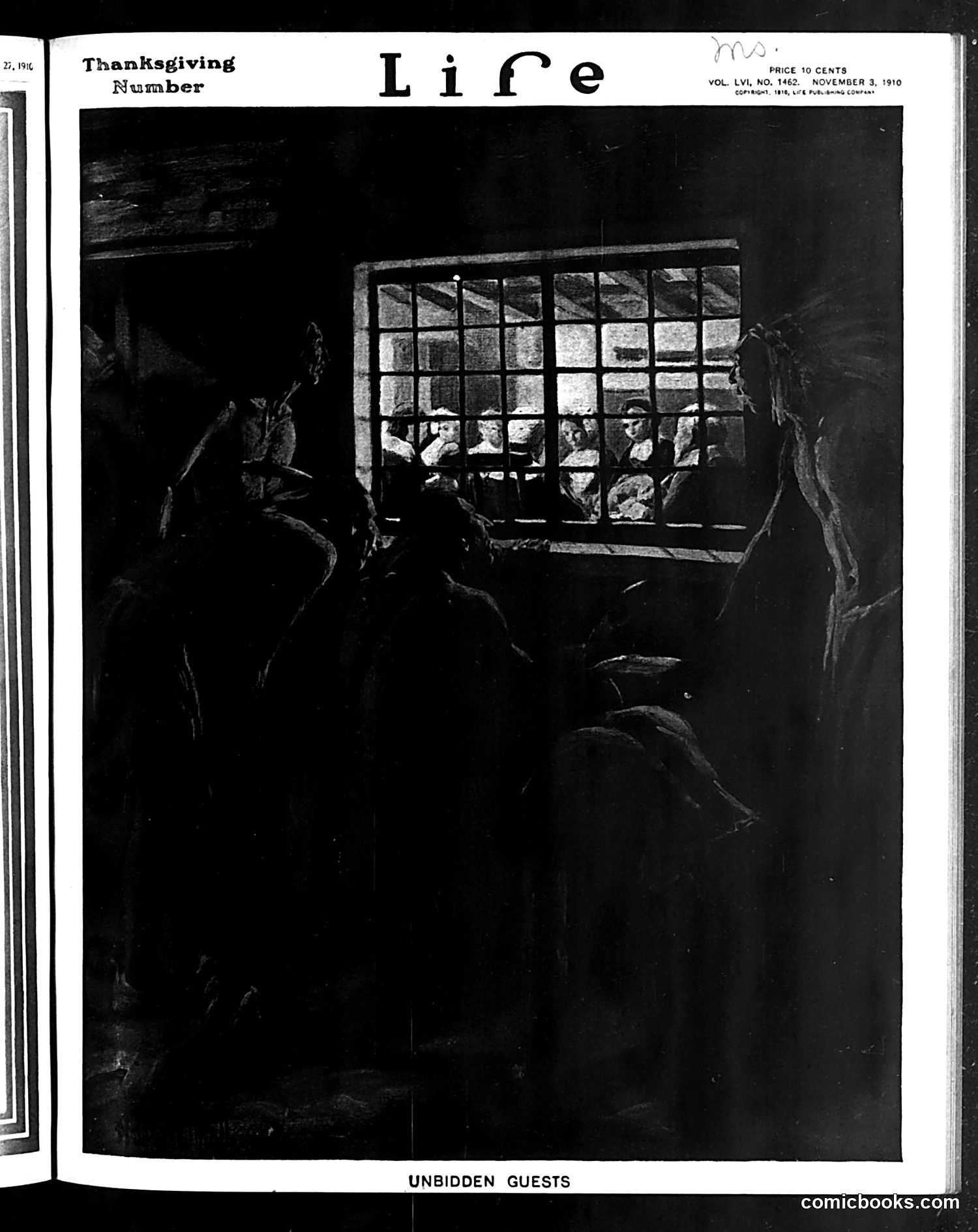
This Thanksgiving-themed illustration depicts figures peering through a window at what appears to be a festive indoor gathering. The title "Unbidden Guests" suggests outsiders looking in on celebration they're not invited to join. The dark silhouettes in the foreground appear to be poor or working-class individuals observing a well-lit, populated scene inside—likely representing wealth or comfortable circumstances. This is social satire contrasting the excluded from the included, playing on Thanksgiving's theme of abundance and gratitude. The specific identities of depicted figures remain unclear from the image alone. The cartoon likely critiques class divisions and economic inequality in early 20th-century America, using the holiday season to highlight the contrast between those with plenty and those without.
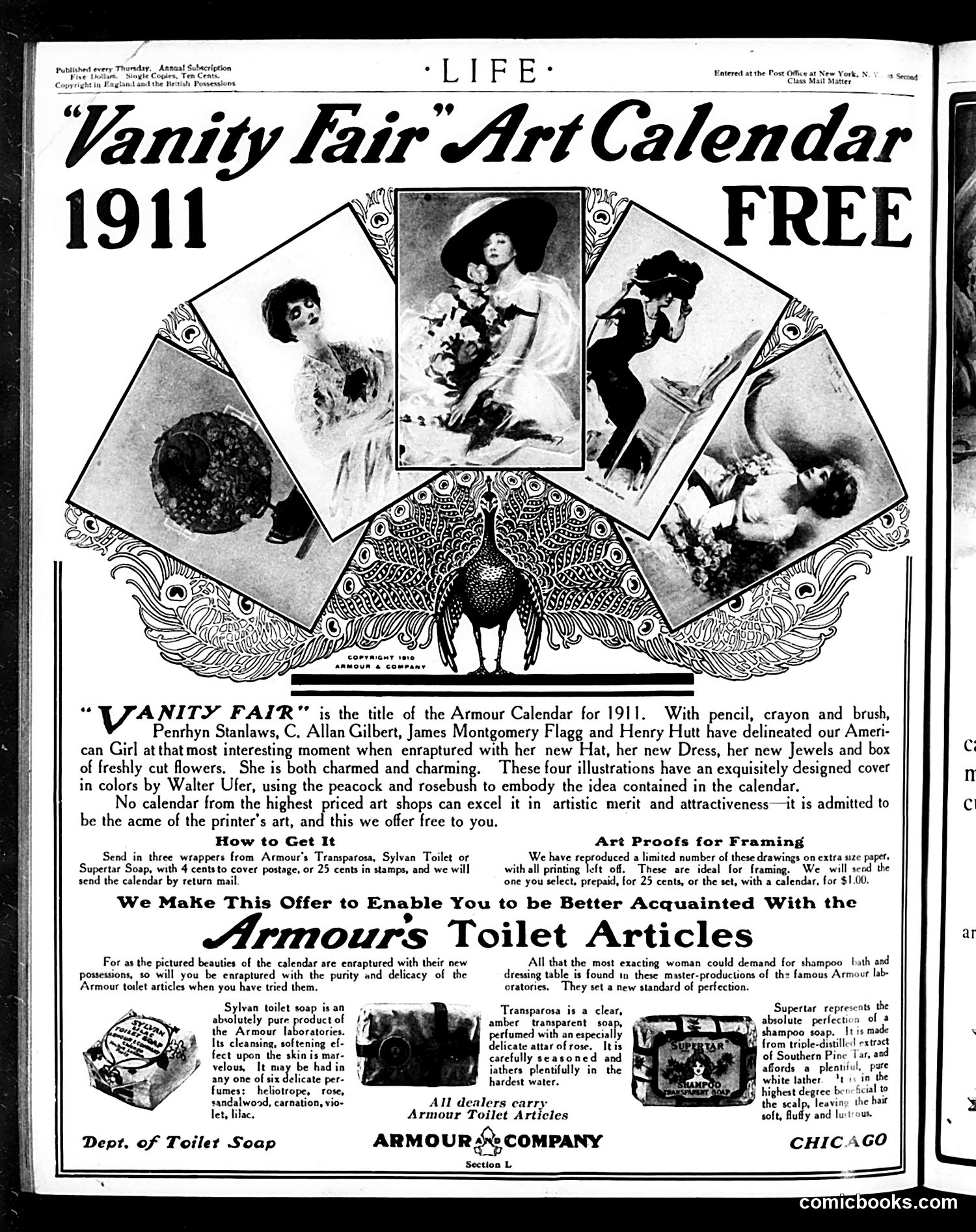
This page is primarily an **advertisement**, not political satire. It promotes a free 1911 "Vanity Fair" Art Calendar from Armour Company, a major meatpacking firm. The calendar features illustrations by prominent artists (Penrhyn Stanlaws, C. Allan Gilbert, James Montgomery Flagg, and Henry Hutt) depicting fashionable women with flowers and new hats—typical early 1900s "Gibson Girl" aesthetic imagery celebrating feminine beauty and fashion. The actual satire is subtle and implicit: **Armour uses high art and glamorous female imagery to market soap and toilet products**—positioning mundane hygiene goods as luxurious lifestyle products. The strategy exploits aspiration; women could obtain "artistic merit" artwork by purchasing soap with wrappers. This represents early 20th-century advertising's manipulation of consumer desire through association with art and beauty.
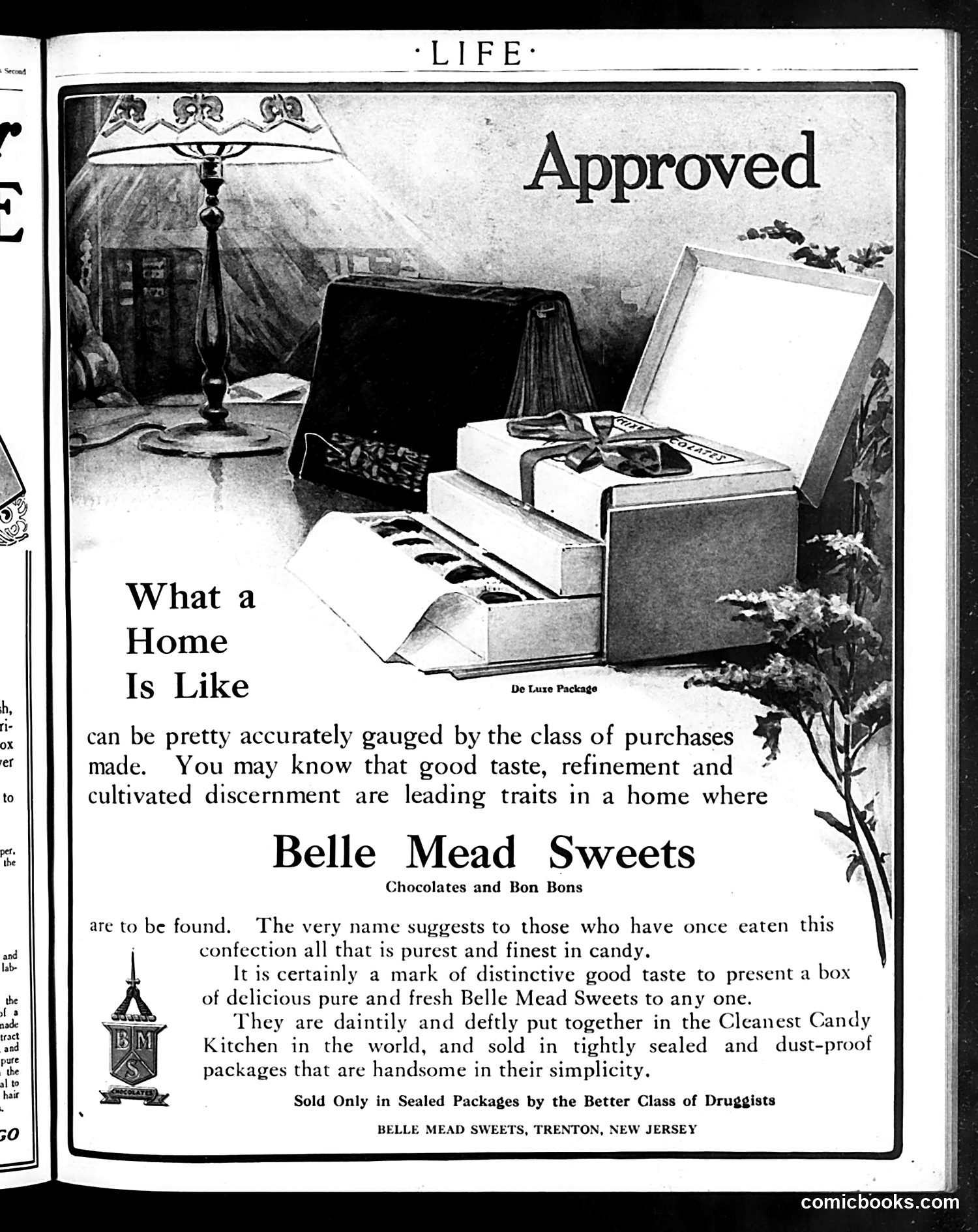
This is **primarily an advertisement**, not editorial content or satire. The page promotes Belle Mead Sweets, a candy company from Trenton, New Jersey. The ad uses the headline "What a Home Is Like" to suggest that one's home quality can be judged by the purchases made there. It positions Belle Mead Sweets chocolates and bon bons as markers of "good taste, refinement and cultivated discernment"—appealing to early 20th-century middle-class aspirations. The "De Luxe Package" shown features elegant boxes displayed with a decorative lamp and potted plant, emphasizing sophistication. The copy emphasizes the sweets are "daintily and deftly put together" in "the Cleanest Candy Kitchen in the world," sold only through "the Better Class of Druggists." No political satire or caricature appears present—this is straightforward period advertising targeting affluent consumers.
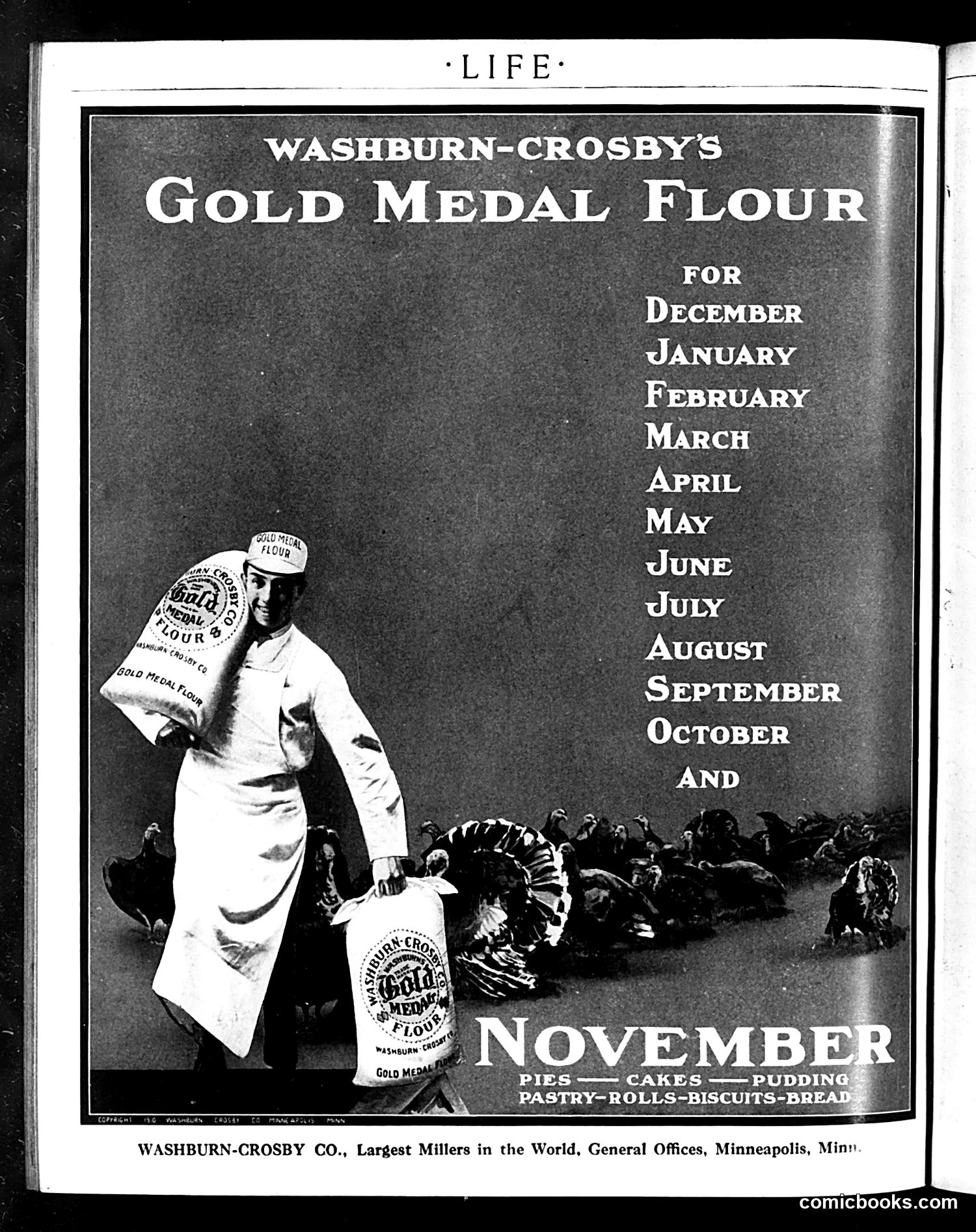
This is primarily a **product advertisement**, not a political cartoon. It's a full-page ad for Washburn-Crosby's Gold Medal Flour, featuring a cook or baker in white uniform and hat holding a large flour sack. The advertisement lists all twelve months, with "November" prominently displayed at the bottom, alongside suggested uses: "PIES—CAKES—PUDDING / PASTRY—ROLLS—BISCUITS—BREAD." The imagery suggests the flour is suitable year-round for holiday and everyday baking. The cook's presentation conveys reliability and professional quality. There is no apparent satire or political commentary—this is straightforward early 20th-century commercial messaging designed to encourage consumers to purchase Gold Medal Flour for their baking needs throughout the calendar year.
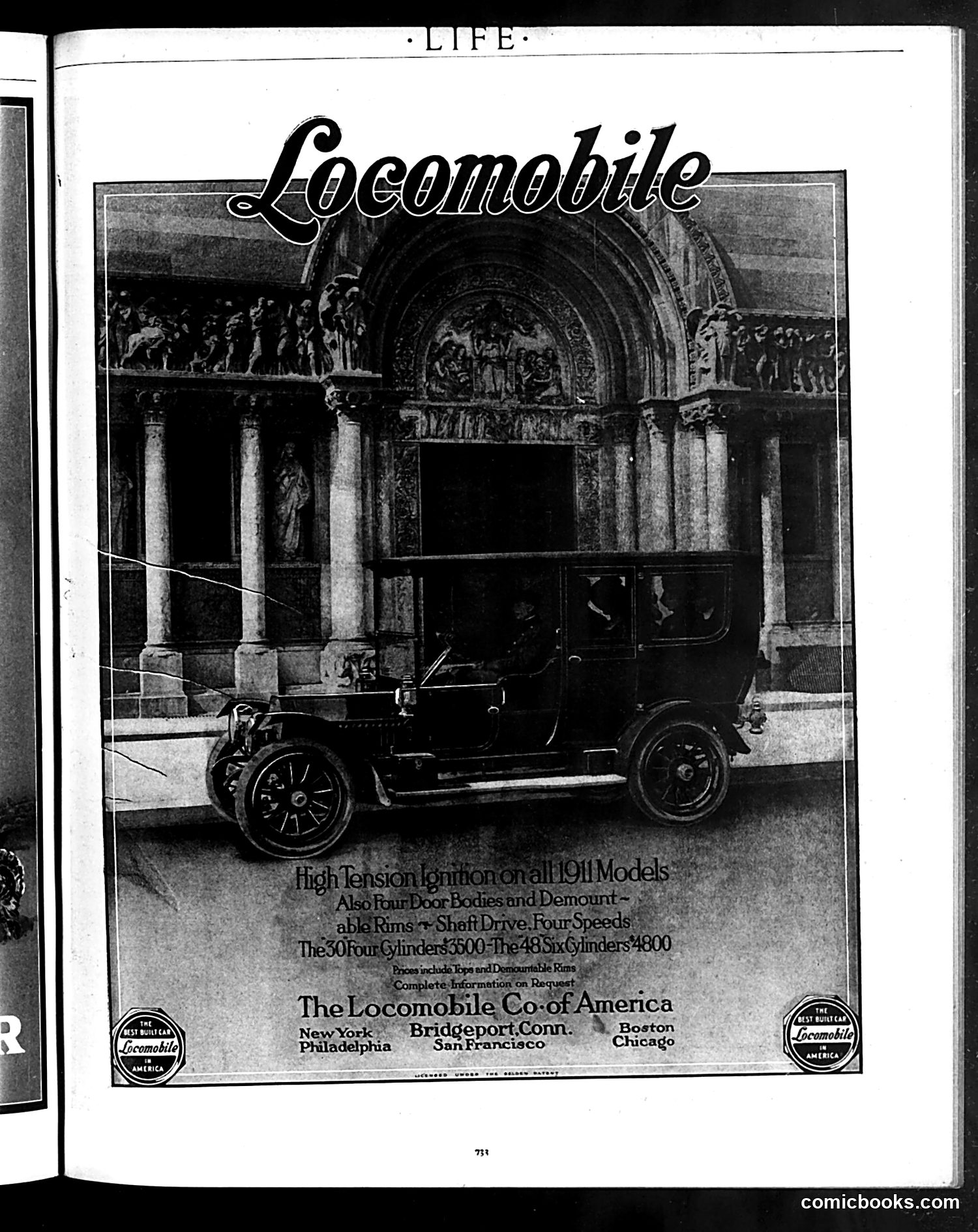
This is **not a cartoon or satire page**—it's a **full-page advertisement** for the Locomobile automobile, appearing in Life magazine. The ad shows a 1911 Locomobile parked in front of an ornate classical building with columns and arched doorways, emphasizing the vehicle's elegance and suitability for upscale clientele. The text highlights technical features: "High Tension Ignition on all 1911 Models," four-door bodies, demountable rims, shaft drive, and four speeds. The 30 four-cylinder engine with 3500-4600 specifications underscores engineering sophistication. The Locomobile Co. of America, headquartered in Bridgeport, Connecticut, lists offices in New York, Philadelphia, Boston, San Francisco, and Chicago, targeting wealthy urban markets during the early automobile era.
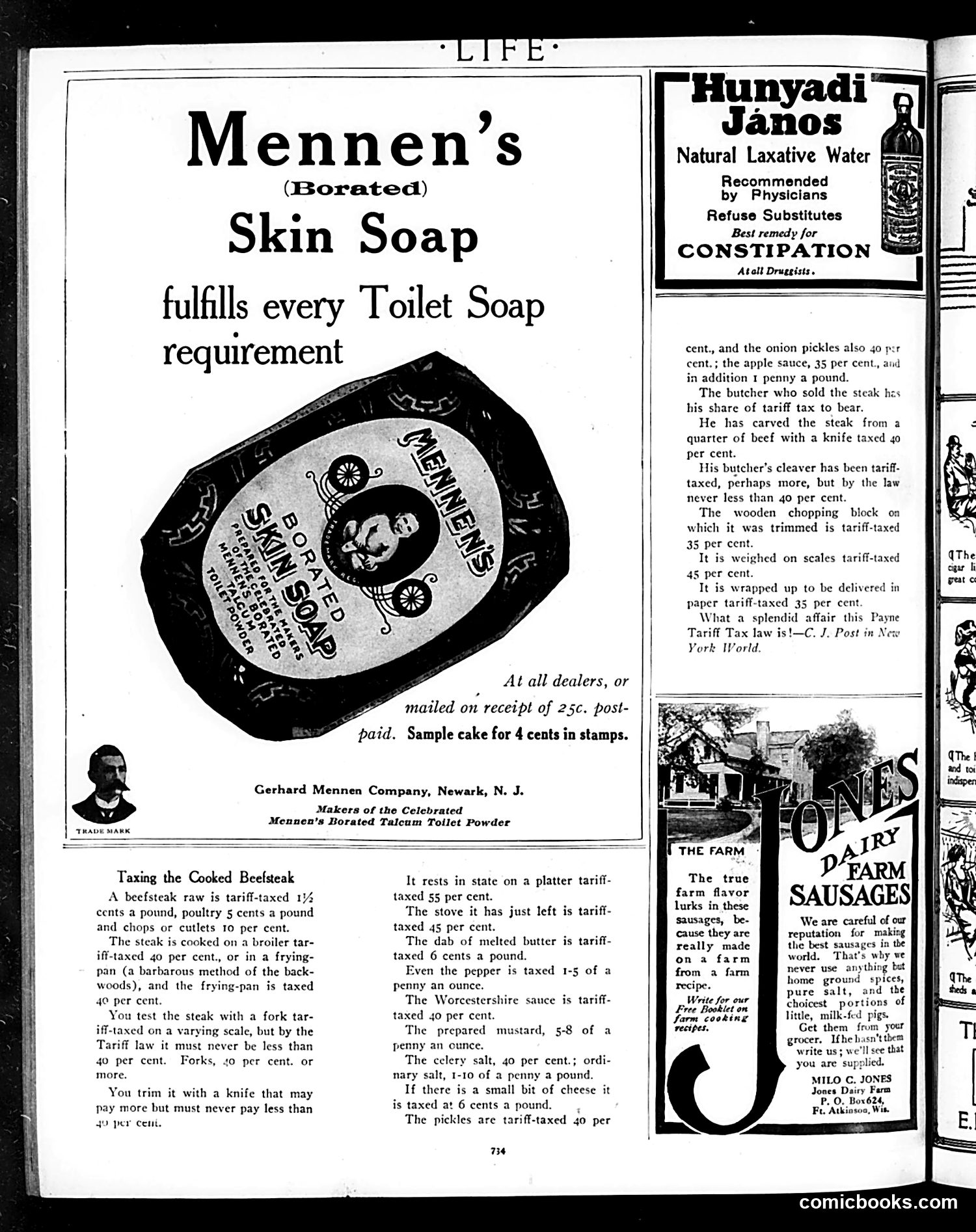
This page is primarily **advertising, not political satire**. The main content features ads for consumer products typical of the early 20th century: - **Mennen's Borated Skin Soap** (left): A toiletry advertisement emphasizing the product fulfills all soap requirements - **Hunyadi Janos Natural Laxative Water** (top right): A patent medicine ad promoting constipation relief - **Jones Dairy Farm Sausages** (bottom right): A food product advertisement The center article, "Taxing the Cooked Beefsteak," *does* contain satire—it humorously details the various tariff taxes applied to different components of a prepared steak under contemporary tariff law, mocking the complexity and apparent absurdity of the tax system. However, this is the page's only satirical content; the remainder is straightforward commercial advertising.
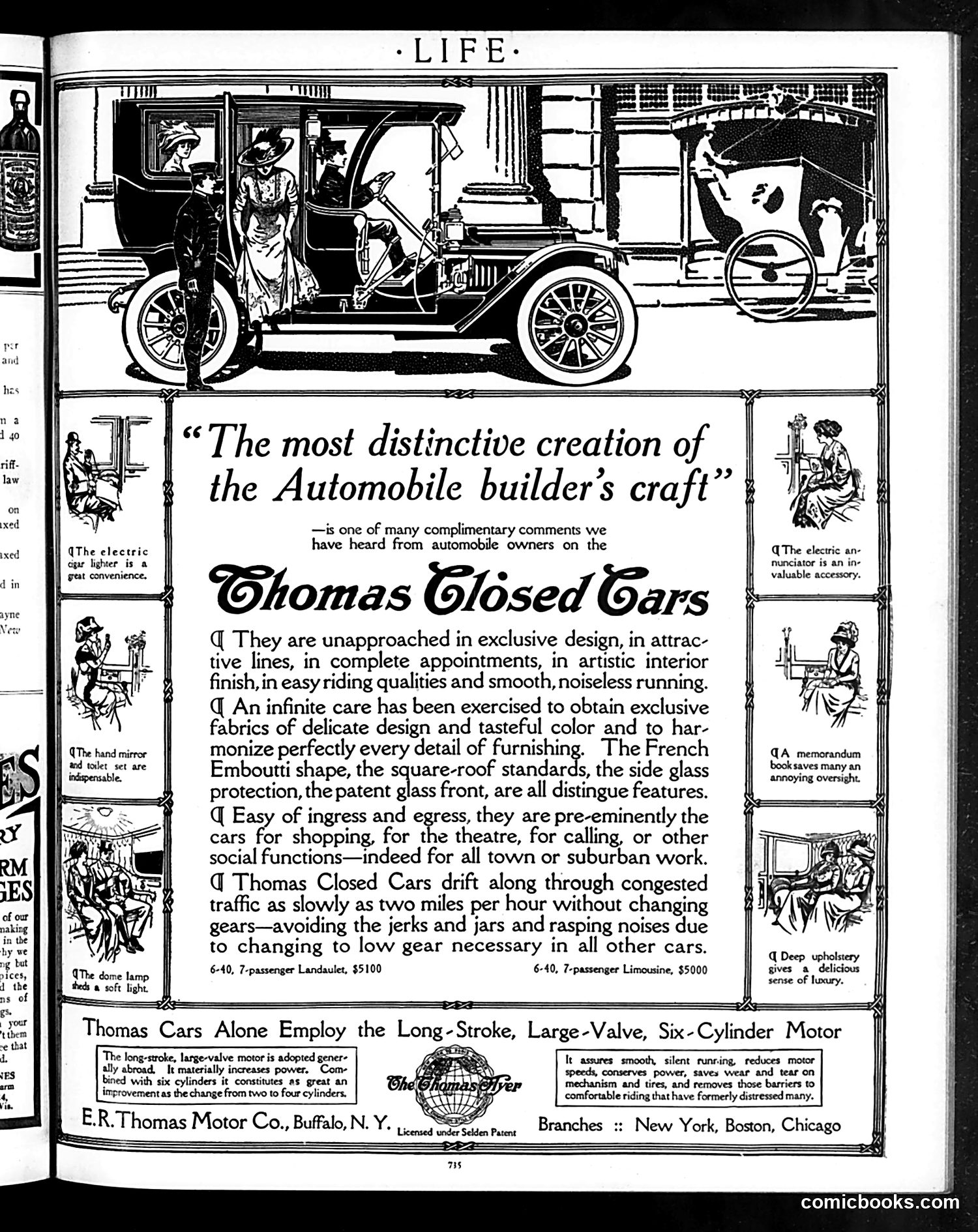
This is a **commercial advertisement**, not political satire. It promotes Thomas Closed Cars, an early automobile manufactured by E.R. Thomas Motor Co. in Buffalo, New York. The page emphasizes luxury features targeting wealthy customers: exclusive design, delicate fabrics, easy entry/exit for social visits, and smooth operation. The decorative illustrations along the margins show women in fashionable dress using the vehicles for shopping and theater—depicting automobiles as status symbols for affluent leisure activities. Key selling points include a six-cylinder engine, glass windows, and quiet operation. The advertisement positions closed cars as superior to open vehicles, particularly appealing to women concerned with maintaining appearance during outings. This reflects early 1910s automobile marketing, when cars were luxury goods for the wealthy.
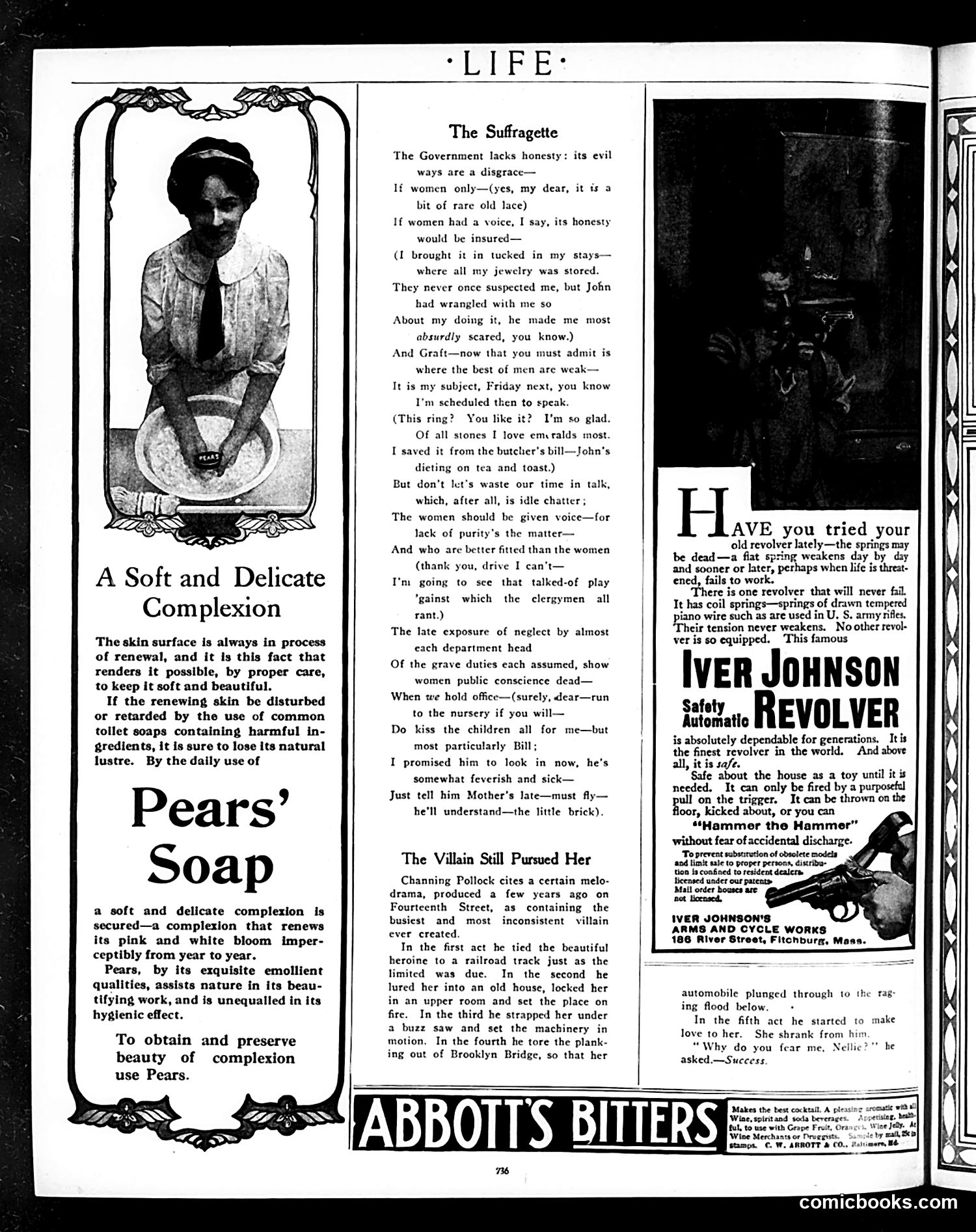
This piece satirizes the women's suffrage movement through a fictional monologue by a woman activist. She describes hiding political materials in her stays (corset), claims the government lacks honesty, and references speaking engagements about women's rights and social reform. The satire mocks suffragettes by portraying the speaker as self-important, scattered, and willing to deceive her husband ("John") about her activities. References to "Graft" and corruption suggest the cartoonist associates the suffrage cause with dubious politics. The accompanying poem "The Villain Still Pursued Her" appears to mock melodramatic narratives, possibly contrasting them with the "real" suffrage debate. This reflects Life's satirical opposition to women's voting rights during the early 20th-century suffrage era.
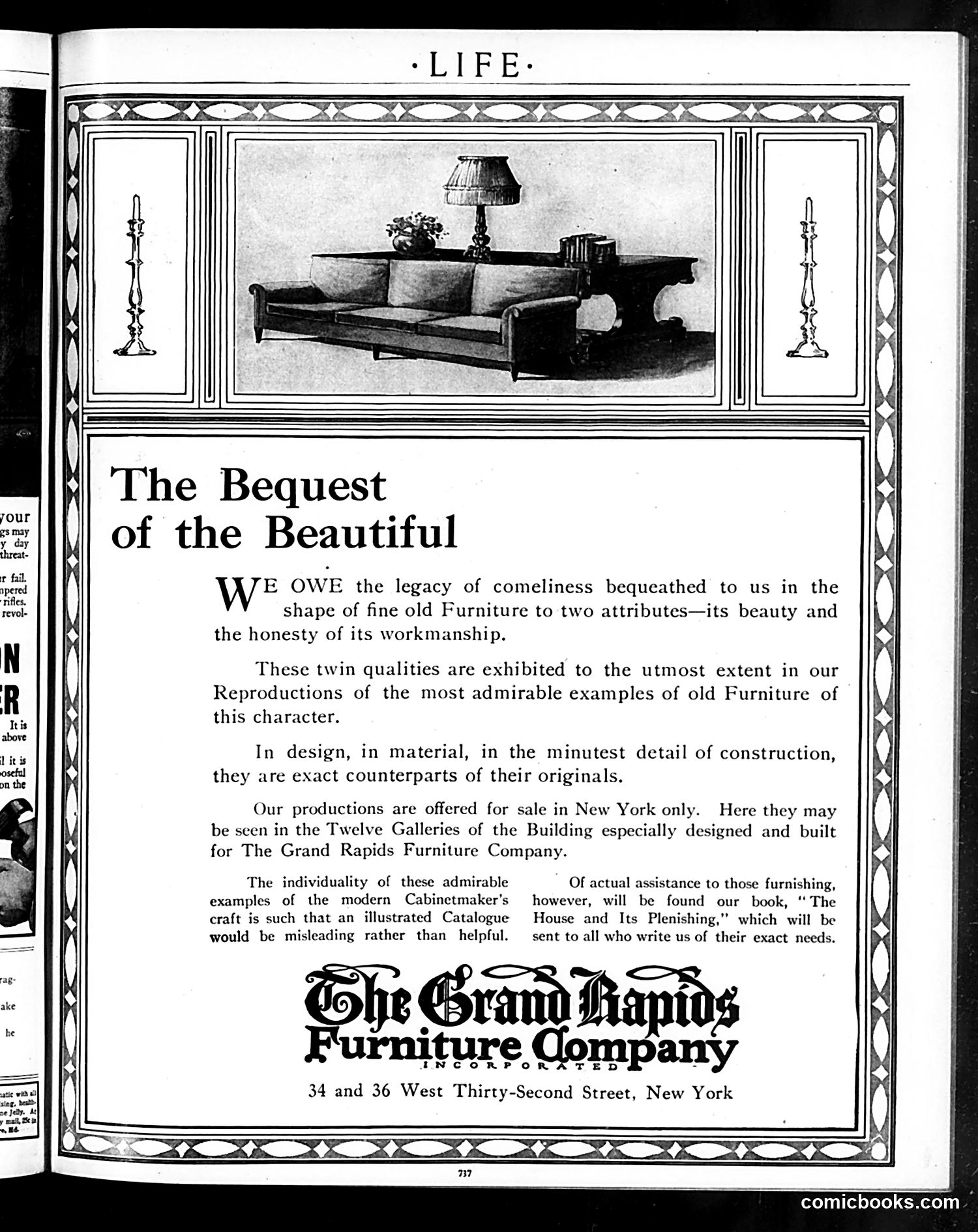
This is **not a cartoon or satire page** — it's a straightforward advertisement for The Grand Rapids Furniture Company, placed in *Life* magazine. The page features a product photograph of an elegant sofa with decorative elements (lamp, side table, plant), flanked by ornamental candlesticks. The text emphasizes that the company produces exact reproductions of fine old furniture, combining historical authenticity with modern craftsmanship. The ad highlights that their pieces are available exclusively at the Twelve Galleries of the Building in New York, and promotes their illustrated catalogue called "The House and Its Furnishings" for those seeking interior design advice. There is **no political or social satire here** — simply period advertising targeting affluent consumers interested in reproduction antique furniture.
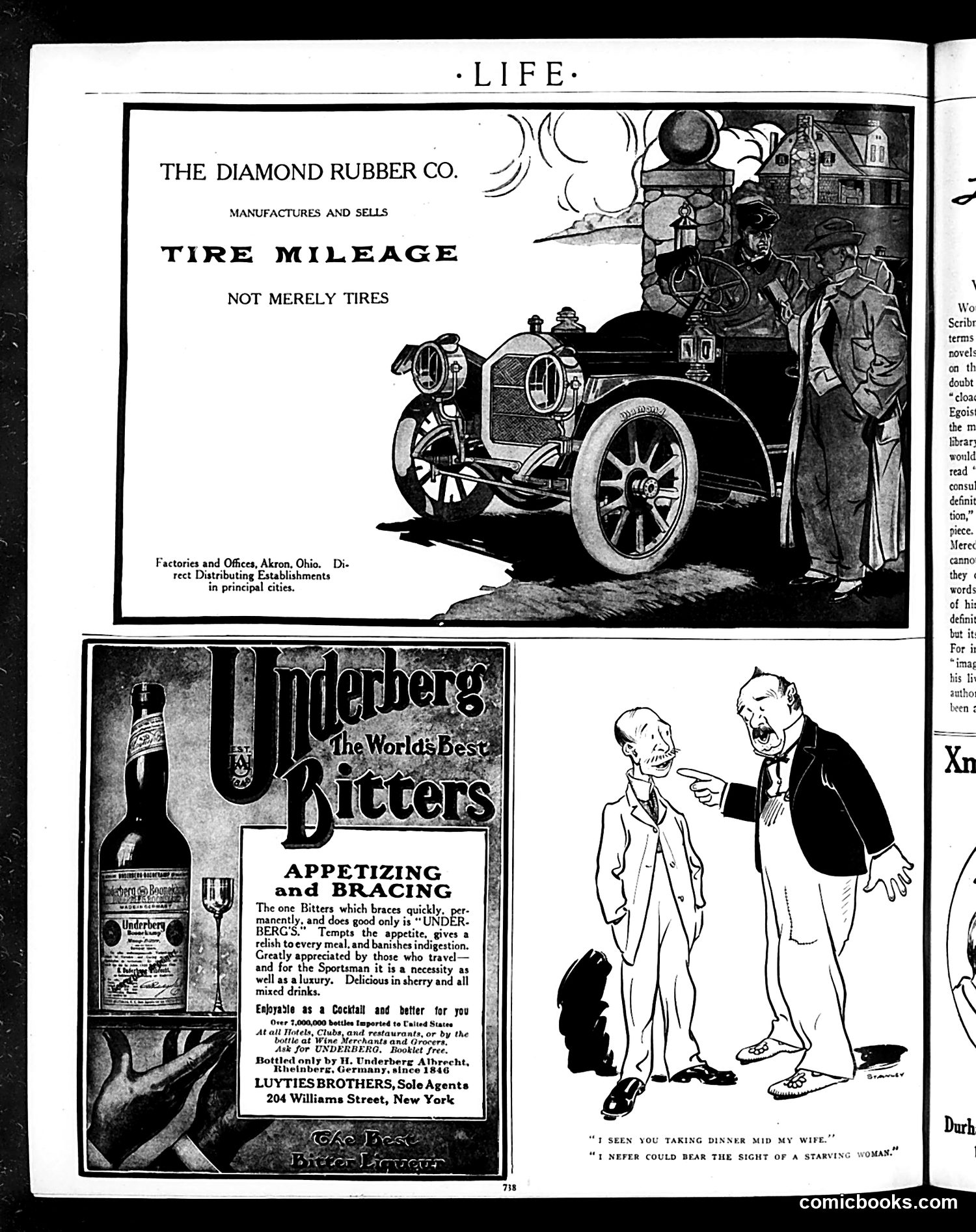
This page contains two advertisements with no political cartoons. The top ad promotes **Diamond Rubber Co.'s tire mileage** products, featuring an early automobile with well-dressed onlookers—a typical early 1900s endorsement image emphasizing modern transportation technology. The bottom ad advertises **Underberg Bitters**, a digestive liqueur marketed as "appetizing and bracing." The ad claims it "tempts the appetite" and is "greatly appreciated by those who travel" and "for the Sportsman." The cartoon accompanying the bitters ad shows two men in conversation with the caption: "I seen you taking dinner mid my wife. I neffer could bear the sight of a starving woman." This is ethnic humor (the broken English suggests a German or Eastern European character) playing on jealousy and appetite—connecting to the bitters product being promoted as an appetite stimulant.
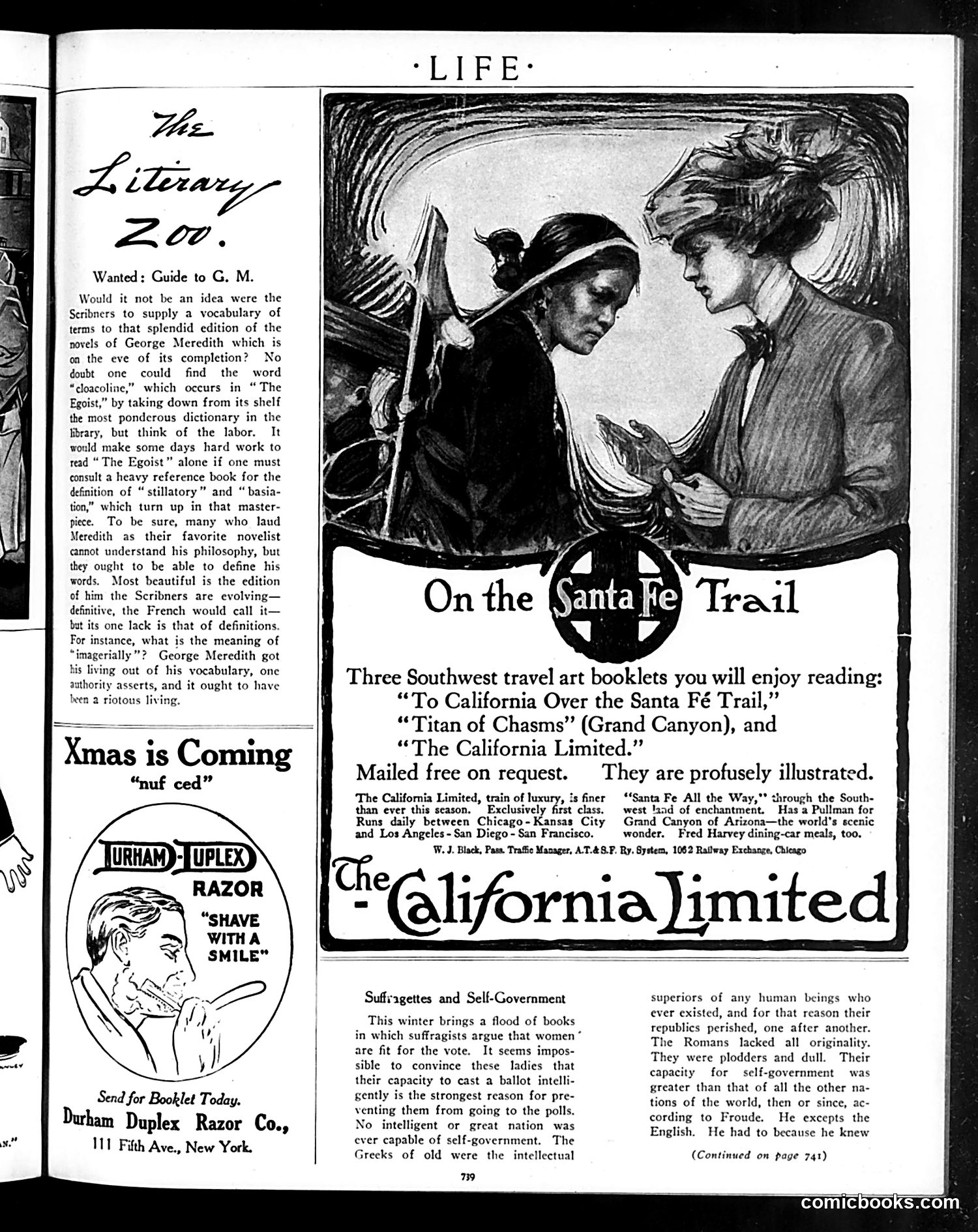
This page is primarily **advertising and literary content**, not political satire. The left column discusses "The Literary Zoo"—a humorous piece about needing a vocabulary guide for George Meredith's novels, which apparently use obscure words like "eolacoline." It's lighthearted literary criticism about a challenging author. Below that is a Durham Duplex Razor advertisement with a cartoon of a man shaving, captioned "Shave with a Smile." The dominant right half is a **Santa Fe Railway advertisement** featuring an illustration of two travelers (one appears to be a Native American guide) on the trail. It promotes travel booklets about Southwest destinations and "The California Limited" luxury train service. The bottom section begins an article on "Suffragettes and Self-Government," discussing women's suffrage arguments—a genuine political topic of the era.
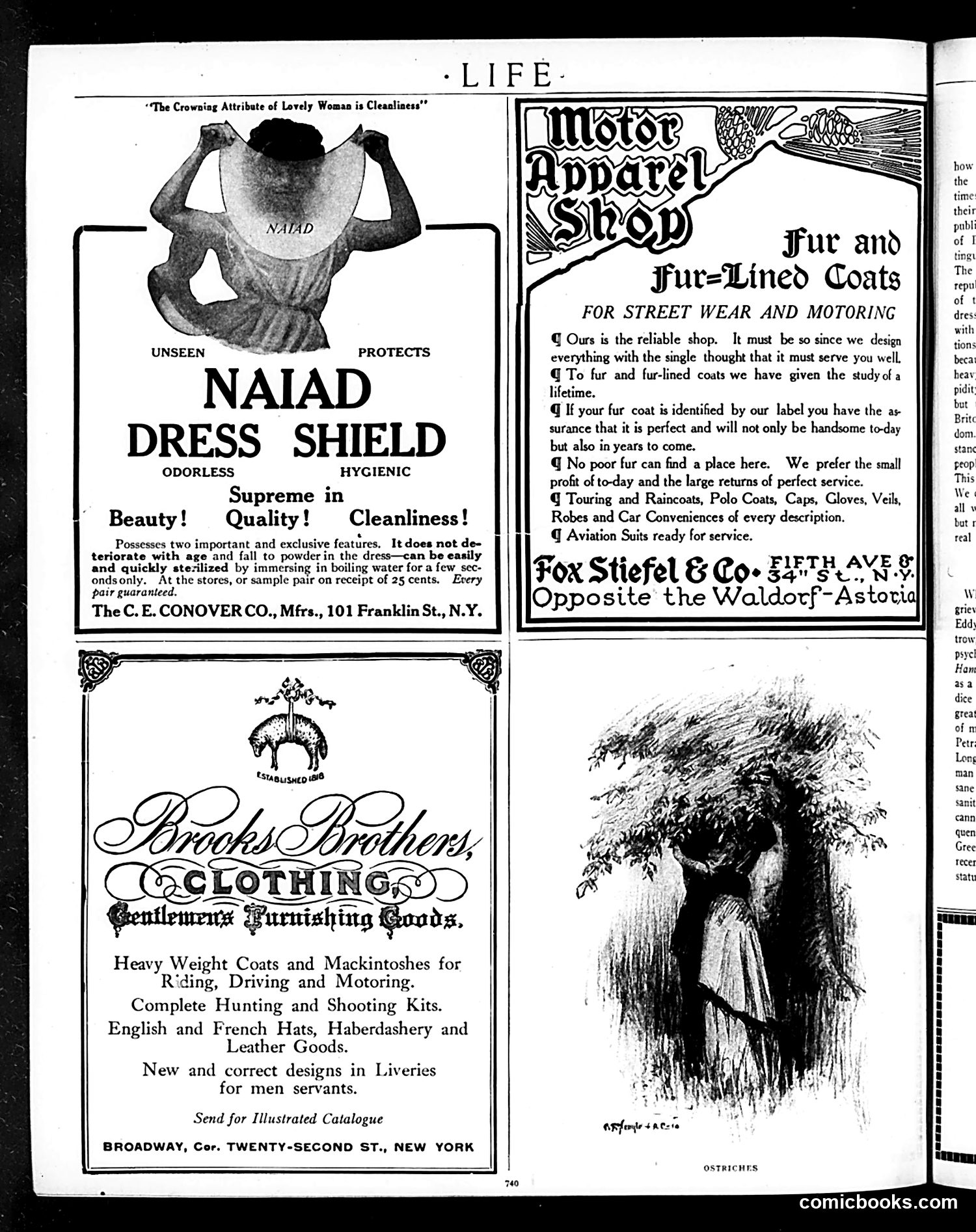
This page is primarily **advertising**, not editorial content or satire. It contains four commercial advertisements from the early 20th century: 1. **NAIAD Dress Shield** - a undergarment accessory claiming to protect clothing from perspiration 2. **Motor Apparel Shop** - fur coats for driving/motoring 3. **Brooks Brothers** - gentlemen's clothing and outdoor gear 4. A small illustration labeled "**Ostriches**" (artist signed, appears decorative rather than satirical) The page header reads "The Crowning Attribute of Lovely Woman is Cleanliness" — a period advertising slogan reflecting contemporary attitudes about hygiene and femininity. **No political satire or caricature is present.** This is a commercial magazine page from approximately the 1910s-1920s showcasing luxury consumer goods for affluent readers.
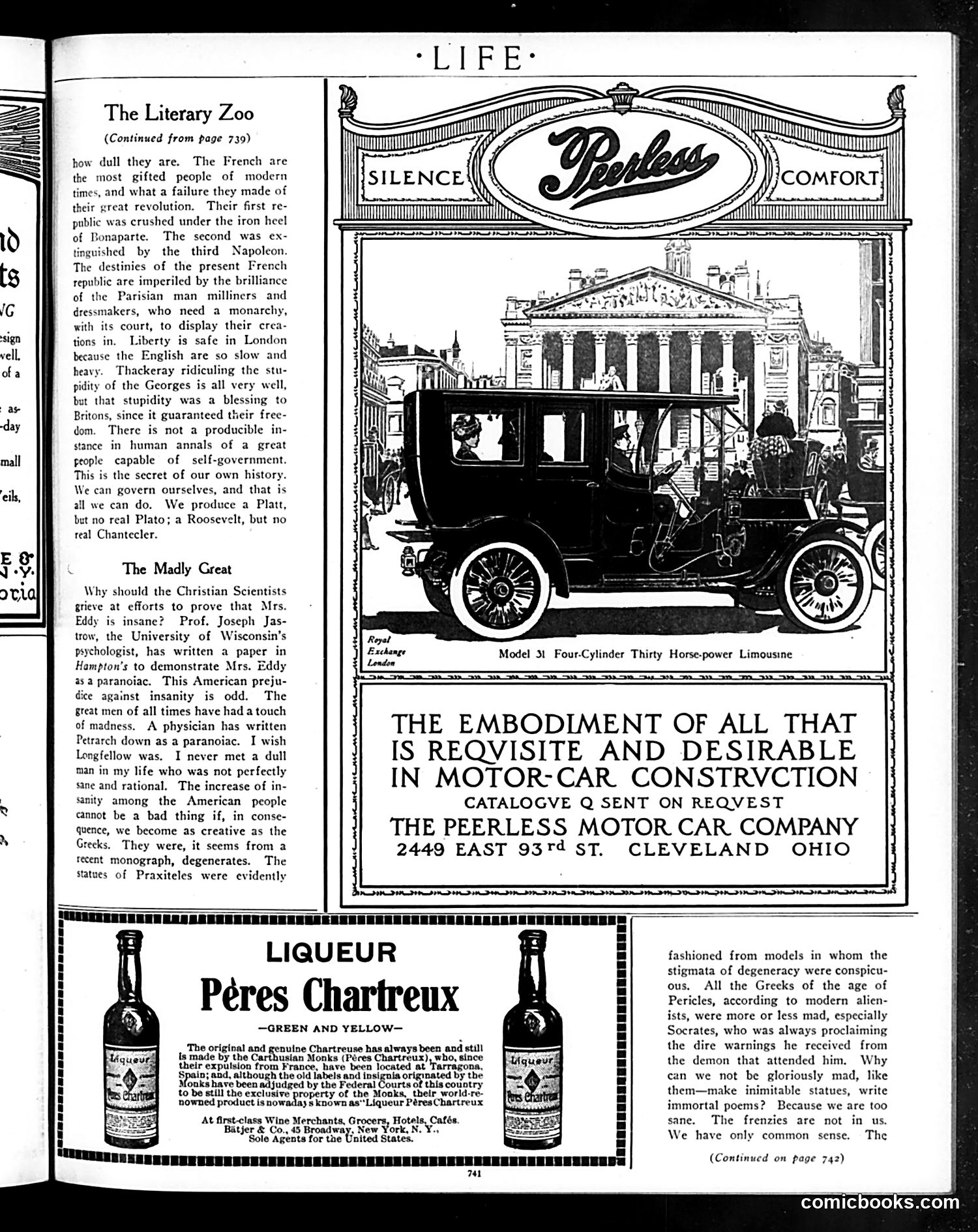
This page mixes editorial content with advertisements. The left column continues "The Literary Zoo," satirizing French intellectuals as self-governing but producing "a Platt, but no real Plato." Below is "The Madly Great," questioning why Christian Scientists defend Mrs. Eddy's sanity, referencing Prof. Joseph Jastrow's psychological assessment calling her a paranoiac. The article argues great historical figures often showed signs of madness. The main visual is a Peerless Motor Car advertisement showing a luxury limousine, emphasizing comfort and quality. Bottom half features a Pères Chartreux liqueur advertisement with two bottle illustrations. The page is primarily **advertising-focused**, with brief satirical commentary on intellectual pretension and mental health discourse typical of early 20th-century Life magazine.
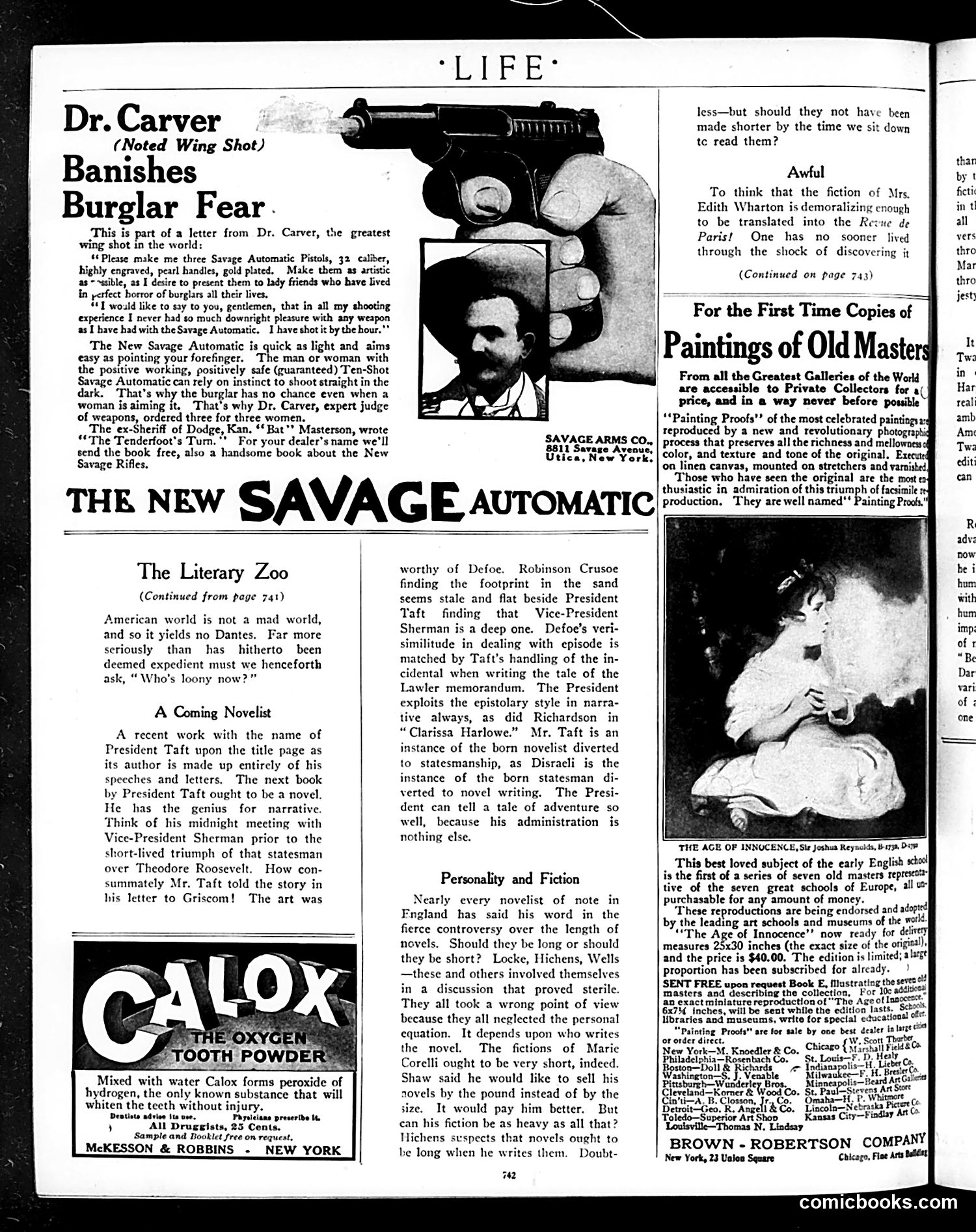
This page contains two main elements: **The Savage Automatic Pistol Advertisement** (top half): Features "Dr. Carver," described as "the greatest wing shot in the world," endorsing luxurious pistols for women concerned about burglars. The ad references "Bat" Masterson, a famous Old West gunslinger turned journalist. The satire appears to be selling firearms to anxious women as status symbols and security—combining frontier mythology with contemporary urban crime fears. The ornate "artistic" guns with pearl and gold suggest impractical luxury. **Literary Commentary** (bottom half): Life's editors mock President Taft as an unwitting novelist, praising his letter-writing abilities while suggesting his presidency is merely "adventure" with no substance. They also satirize the British literary debate about novel length, arguing that quality depends on the author, not length—implying certain popular authors (Marie Corelli, George Bernard Shaw) write excessively padded work. The page reflects early 1900s concerns: urban crime anxiety, nostalgia for frontier legends, and intellectual snobbery about popular literature.
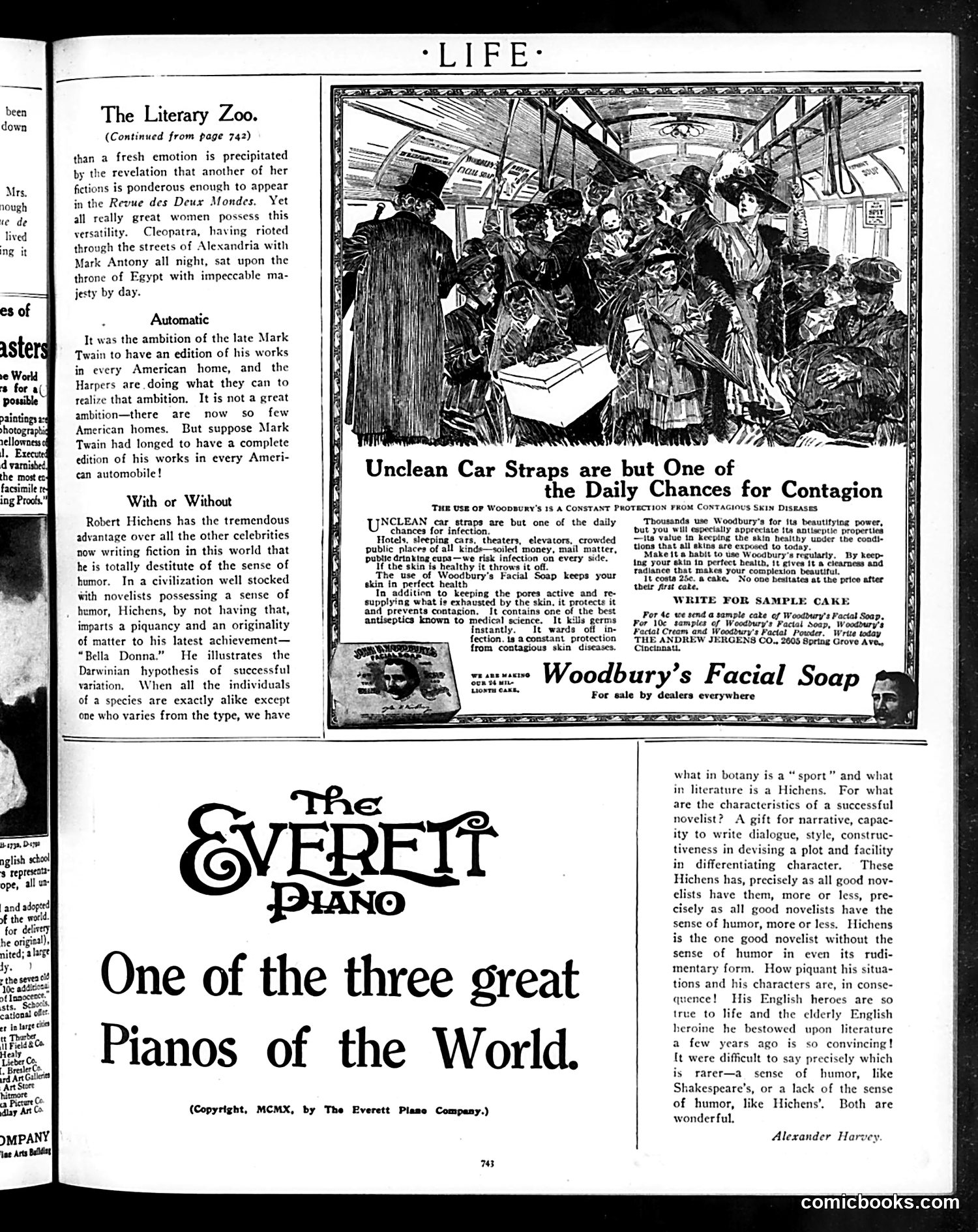
This page mixes literary criticism with advertising. The main content is "The Literary Zoo," a satirical column reviewing contemporary authors. The column's humor targets specific writers: It mocks Mark Twain's ambition to place his works in every American home (noting there are "now so few American homes"), and praises novelist Robert Hichens for his complete *lack* of humor—positioning this absence as his only distinguishing quality among otherwise interchangeable writers. The satire suggests Hichens succeeds precisely because he differs from the type, using Darwinian language about "variation." The page also features a Woodbury's Facial Soap advertisement exploiting health anxieties about contagion from "unclean car straps" and public spaces—reflecting early 20th-century germ-theory concerns. Below is an Everett Piano advertisement. The literary criticism is bylined Alexander Harvey.
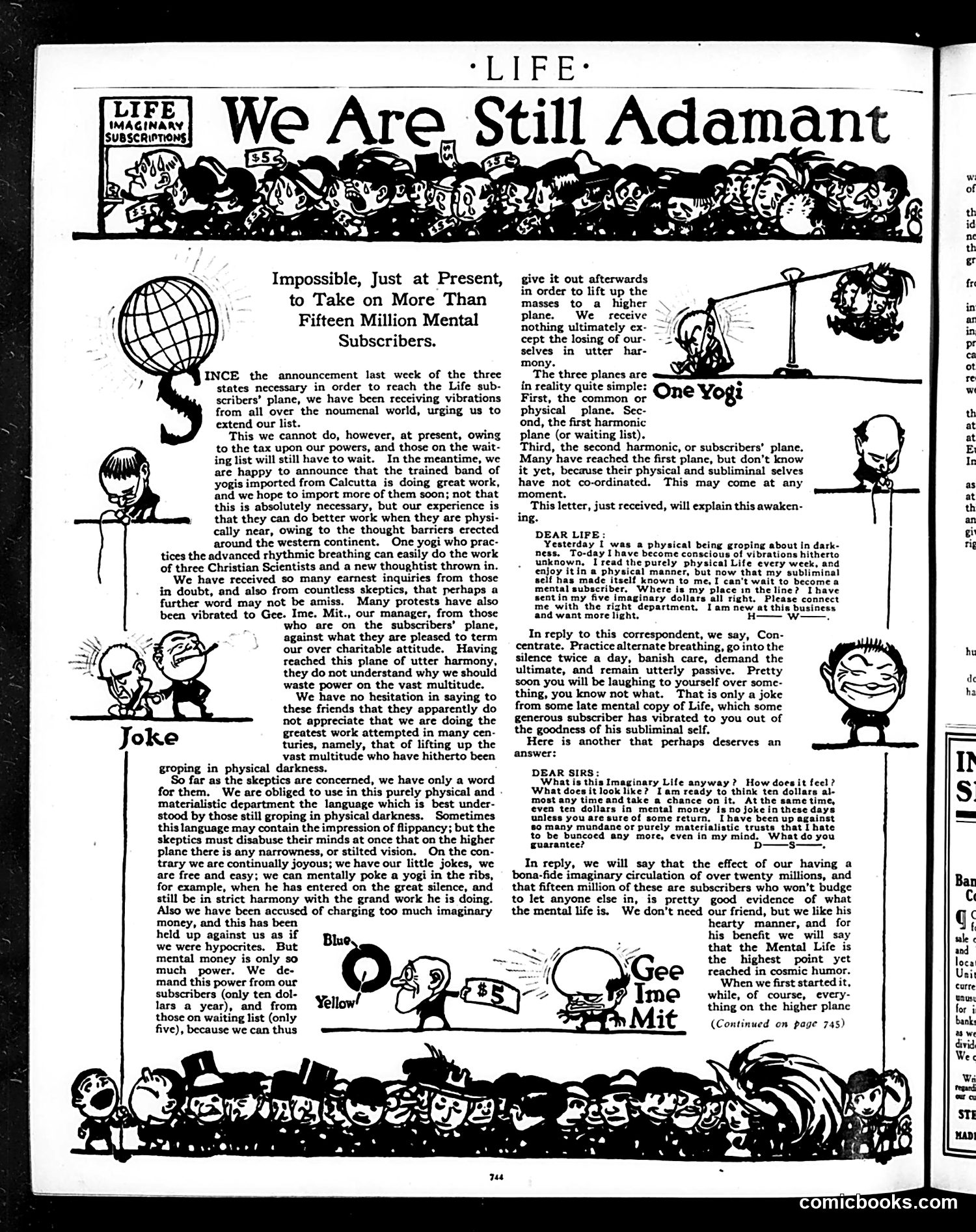
This page satirizes the early 20th-century craze for mysticism, transcendentalism, and New Thought spiritualism. Life magazine (a humor publication) mocks the concept of a magazine with "mental subscribers" on different spiritual "planes of consciousness"—a direct jab at popular occult and pseudo-scientific spiritual movements of the era. The cartoon presents absurdities: imported yogis from Calcutta, charging real money ($10 annually) for imaginary spiritual advancement, and managing an "imaginary circulation of over twenty millions." The humor targets gullible believers who paid actual fees for claimed spiritual enlightenment. References to "Christian Scientists" and "thoughtists" indicate competing metaphysical movements Life lumps together as fraudulent. The cartoon characters (One Yogi, Blue, Yellow, Gee Ime Mit) represent the scheme's operators exploiting the masses' "groping in physical darkness." The satire critiques both the pseudoscience itself and its mercenary exploitation of vulnerable believers seeking spiritual meaning.
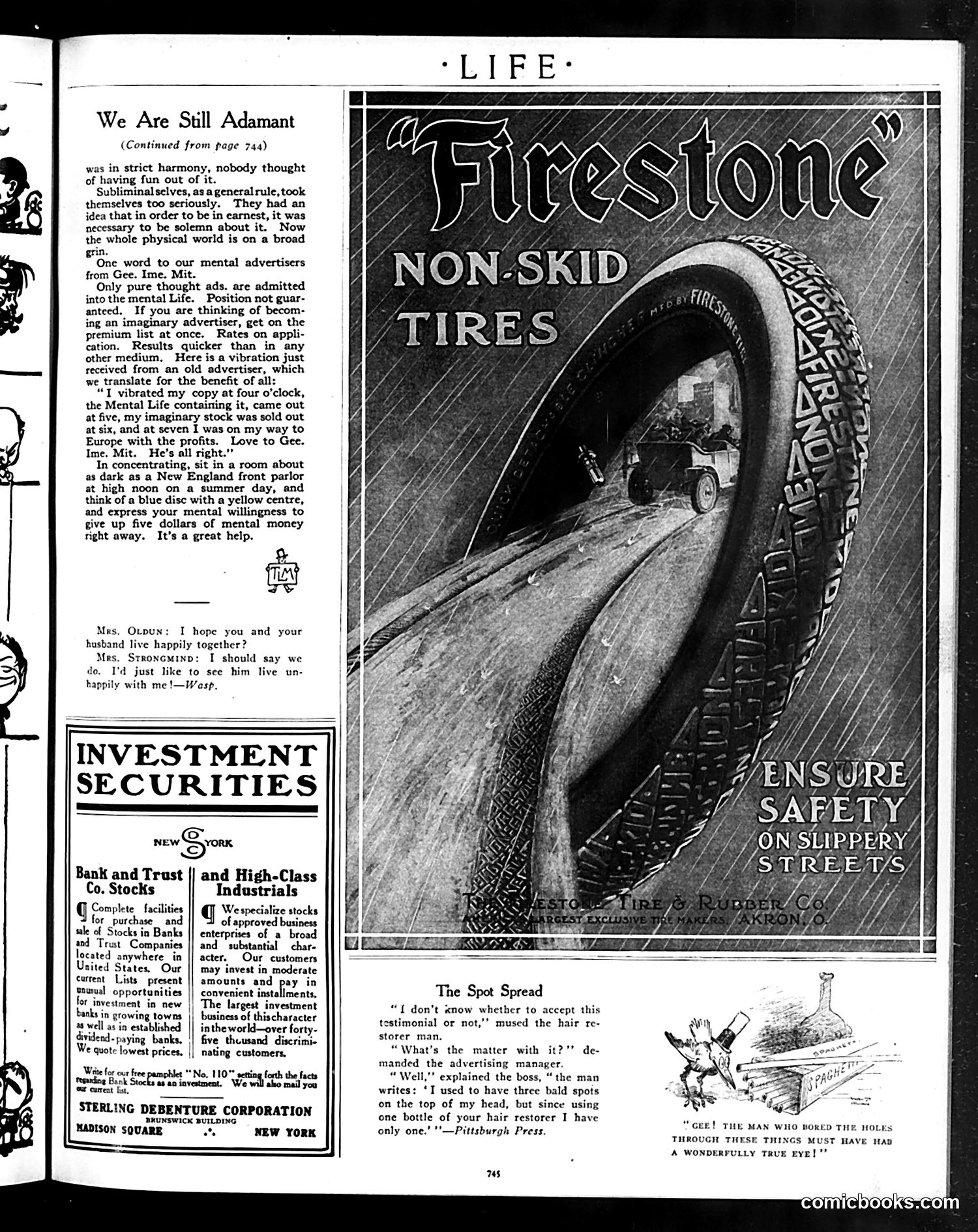
This page mixes satirical commentary with period advertising. The main article "We Are Still Adamant" (continued from earlier) discusses attitudes toward seriousness and earnestness in society, with a humorous digression about "mental advertisers" and "mental money"—a satirical jab at the growing advertising industry's absurd claims about influencing thought. The cartoons are brief, practical jokes: "The Spot Spread" mocks a hair-restorer advertisement's misleading testimonial (a man claims the product reduced his three bald spots to one—clearly nonsensical). The bottom cartoon jokes about precision manufacturing, likely referencing industrial quality control. The advertisements (Investment Securities, Sterling Debenture Corporation) represent the legitimate financial services Life's readers would encounter. These contrast with the satirized "mental advertising" critique, suggesting Life positioned itself as a voice of rational skepticism against commercial hype during the early 20th century.
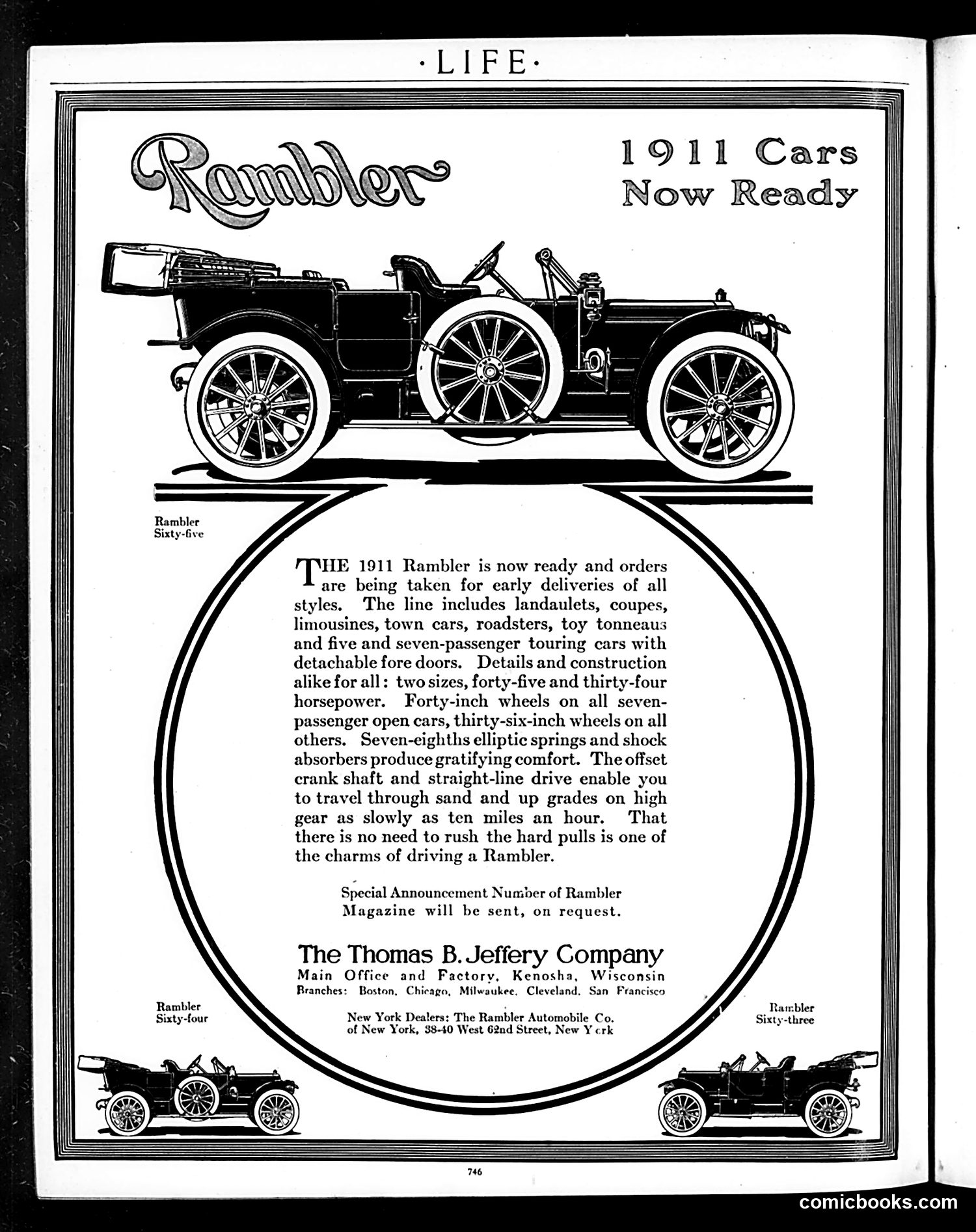
This is a **full-page automobile advertisement**, not political satire. It announces the 1911 Rambler cars manufactured by the Thomas B. Jeffery Company in Kenosha, Wisconsin. The ad promotes various body styles (landaulets, coupes, limousines, roadsters, touring cars) in two horsepower options (45 and 34). Key selling points include comfort features like elliptic springs and shock absorbers, plus the ability to climb grades slowly in high gear—positioning the Rambler as practical and safe rather than requiring reckless speed. The decorative border and side illustrations (labeled "Rambler Sixty-five," "Sixty-four," "Sixty-three") display different car models. This is typical early automotive marketing in *Life* magazine, which accepted substantial advertising revenue. The text emphasizes reliability and ease of operation for early 1900s drivers.
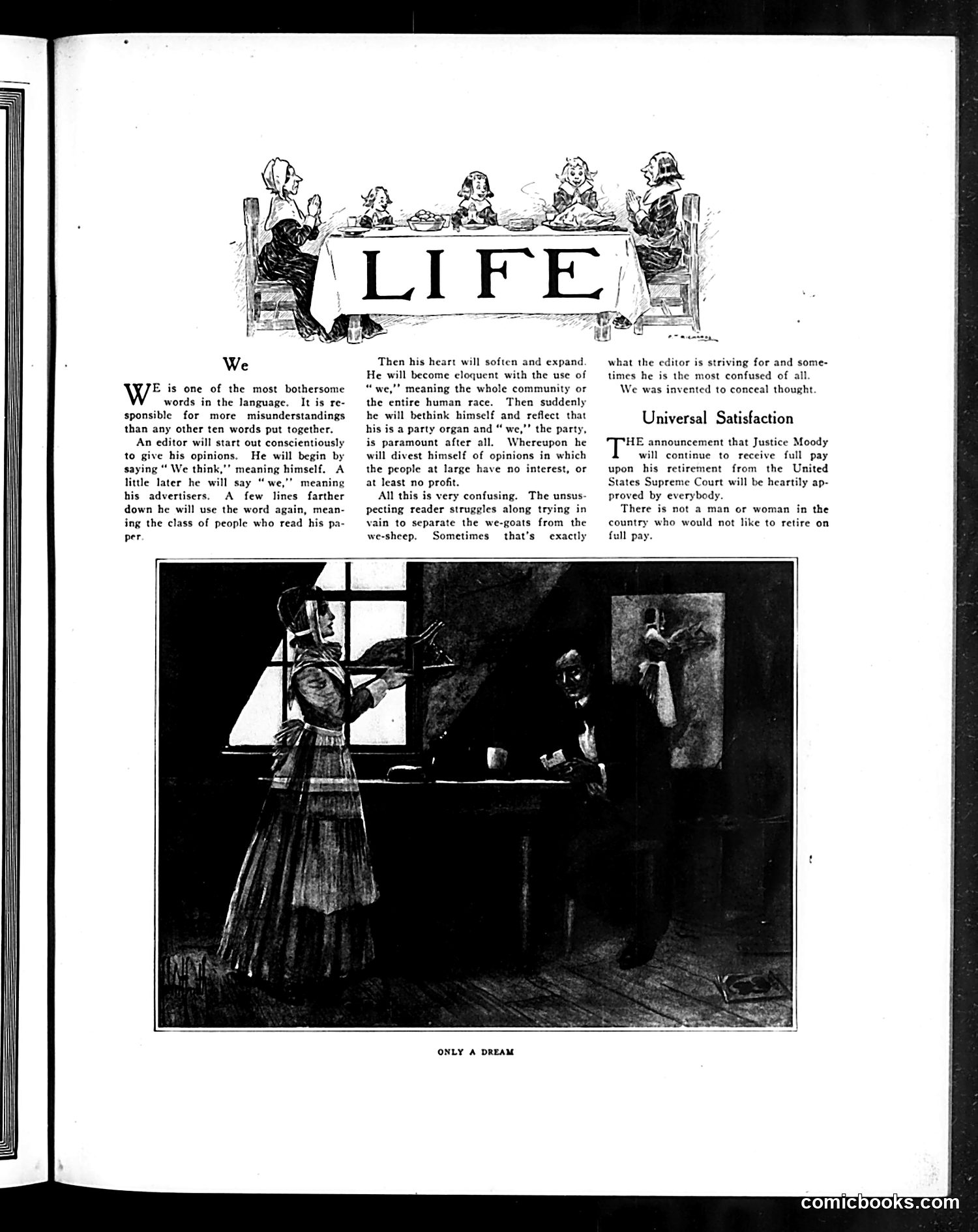
This page contains two satirical pieces critiquing early 20th-century American institutions. **"We"** (top left): An editorial commentary mocking how newspaper editors manipulate the pronoun "we" to obscure their true allegiances. The editor begins claiming to speak for himself ("we think"), shifts to representing advertisers, then the community, then his political party—constantly changing whose interests "we" represents. The satire exposes journalistic dishonesty: editors use "we" to make partisan or commercial positions sound universal. The phrase "we-goats from the we-sheep" suggests readers cannot distinguish genuine public interest from hidden agendas. **"Universal Satisfaction"** (right): A brief, dry satire on Justice Moody's retirement with full pay. The piece sarcastically claims everyone approves—because everyone would love such a cushy arrangement themselves. It's mild criticism of elite privilege: while ordinary citizens must work until death, Supreme Court justices receive lifetime compensation upon retirement. **"Only a Dream"** (illustration): Shows a woman gazing wistfully at the dinner scene at top, suggesting the comfortable life depicted is fantasy for ordinary people.
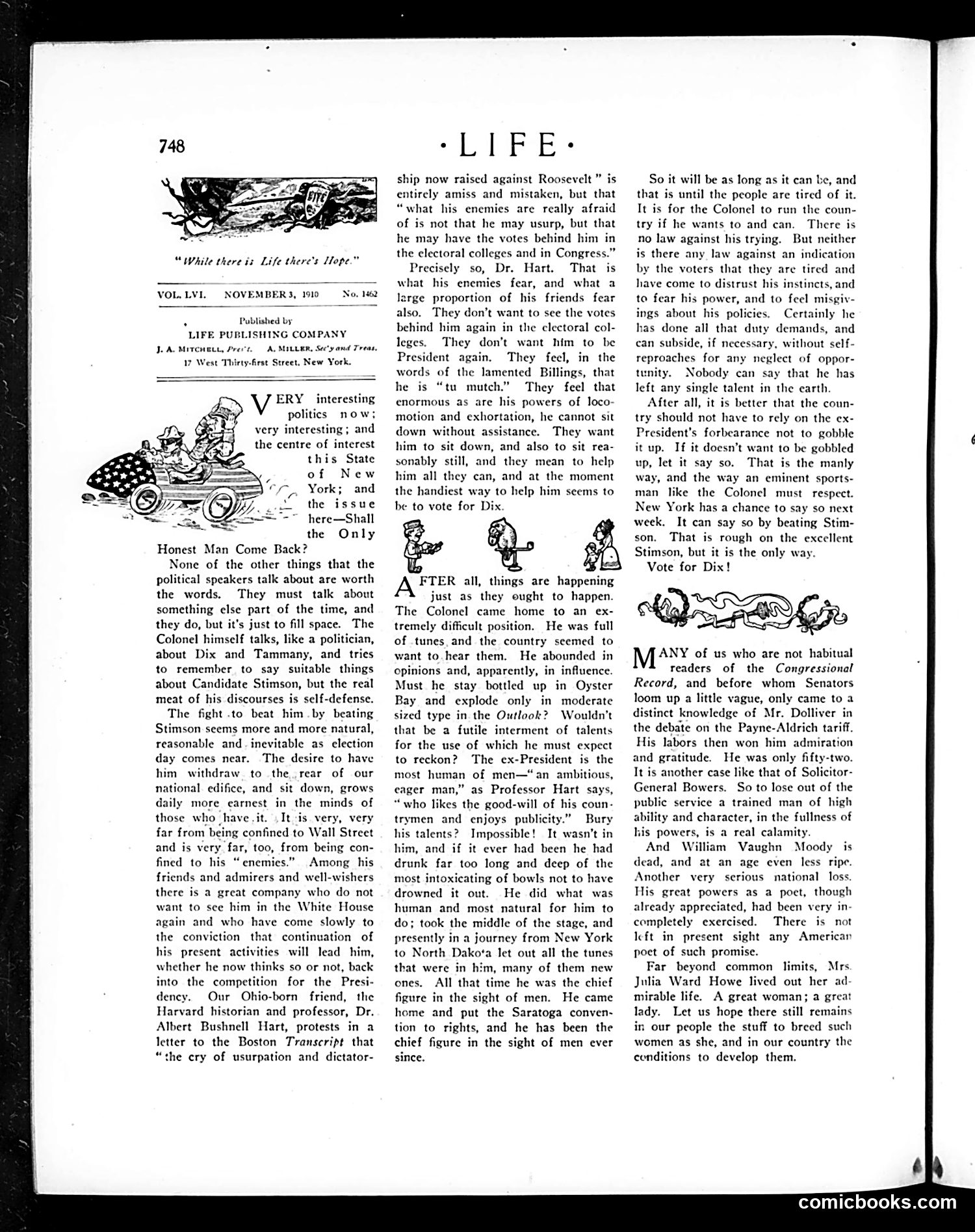
This page discusses Theodore Roosevelt's potential return to politics following his presidency (1901-1909). The central question—"Shall the Only Honest Man Come Back?"—refers to Roosevelt's possible re-entry into electoral politics. The text reveals that Roosevelt's enemies and even some allies fear he'll secure enough electoral votes and congressional support to become President again. The piece acknowledges Roosevelt's natural charisma and ambition: he cannot remain quietly retired but instead has been actively campaigning and giving speeches across the country (notably a journey to North Dakota). The article references New York State politics, particularly the gubernatorial race involving candidate Stimson and Tammany Hall, with voters apparently hoping to support alternative candidate "Dix" to prevent Roosevelt's political resurgence. The commentary suggests Roosevelt's continued public prominence makes another presidential bid increasingly inevitable, despite widespread efforts to discourage it. The tone is sardonic about Roosevelt's inability to remain politically inactive.
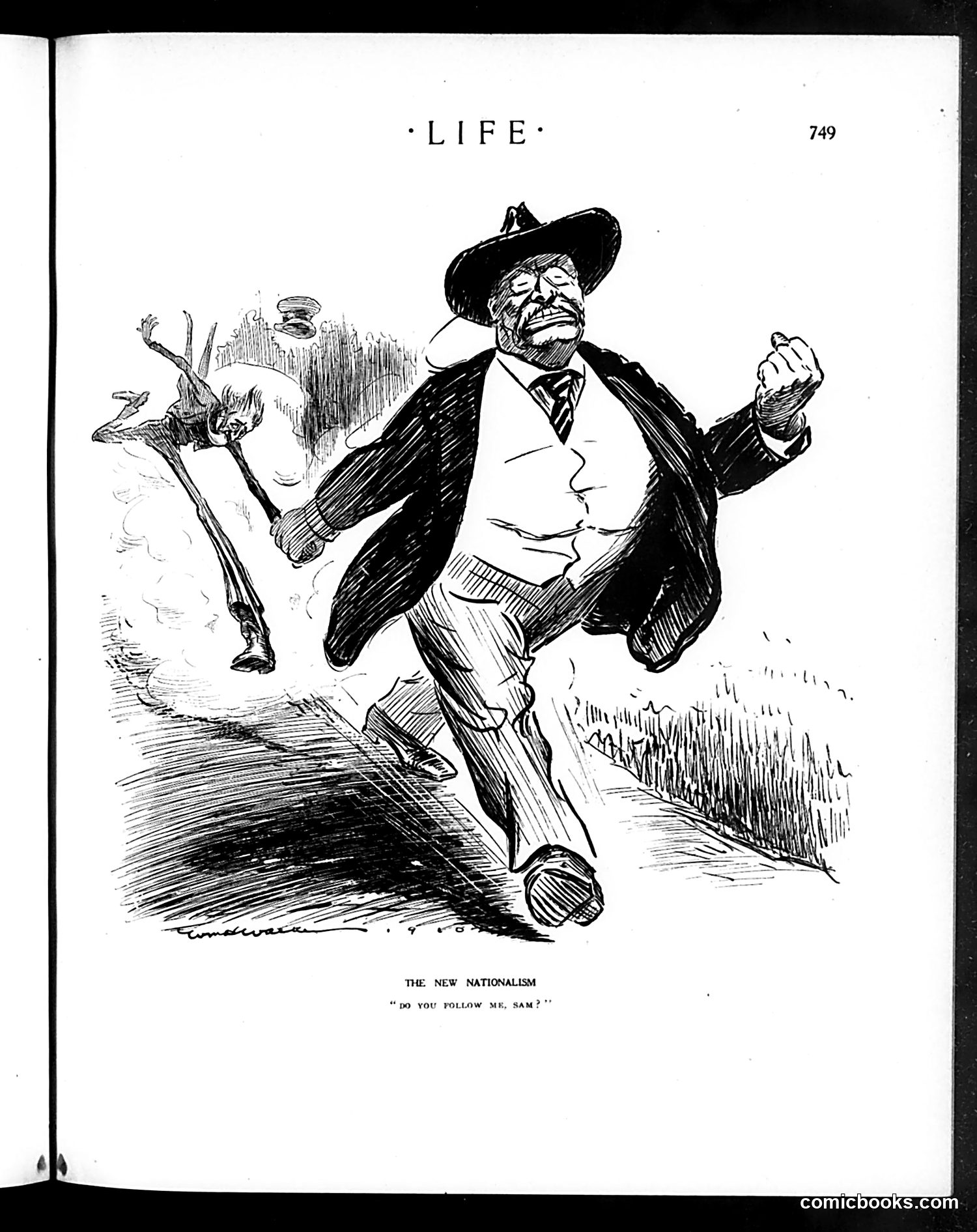
This political cartoon depicts Uncle Sam (the personification of America, identifiable by his characteristic top hat and goatee) being led by a skeletal figure holding a scythe—a symbol of Death. The caption "Do you follow me, Sam?" suggests Death is literally directing American policy. The cartoon critiques "the New Nationalism," likely referring to nationalist or imperialist policies of the early 20th century. The satire warns that blind allegiance to aggressive nationalism leads America toward destruction and death. The skeletal leader's position ahead of Uncle Sam emphasizes that following such policies is self-destructive. The figure being pulled along represents American citizens unknowingly complicit in this dangerous direction.
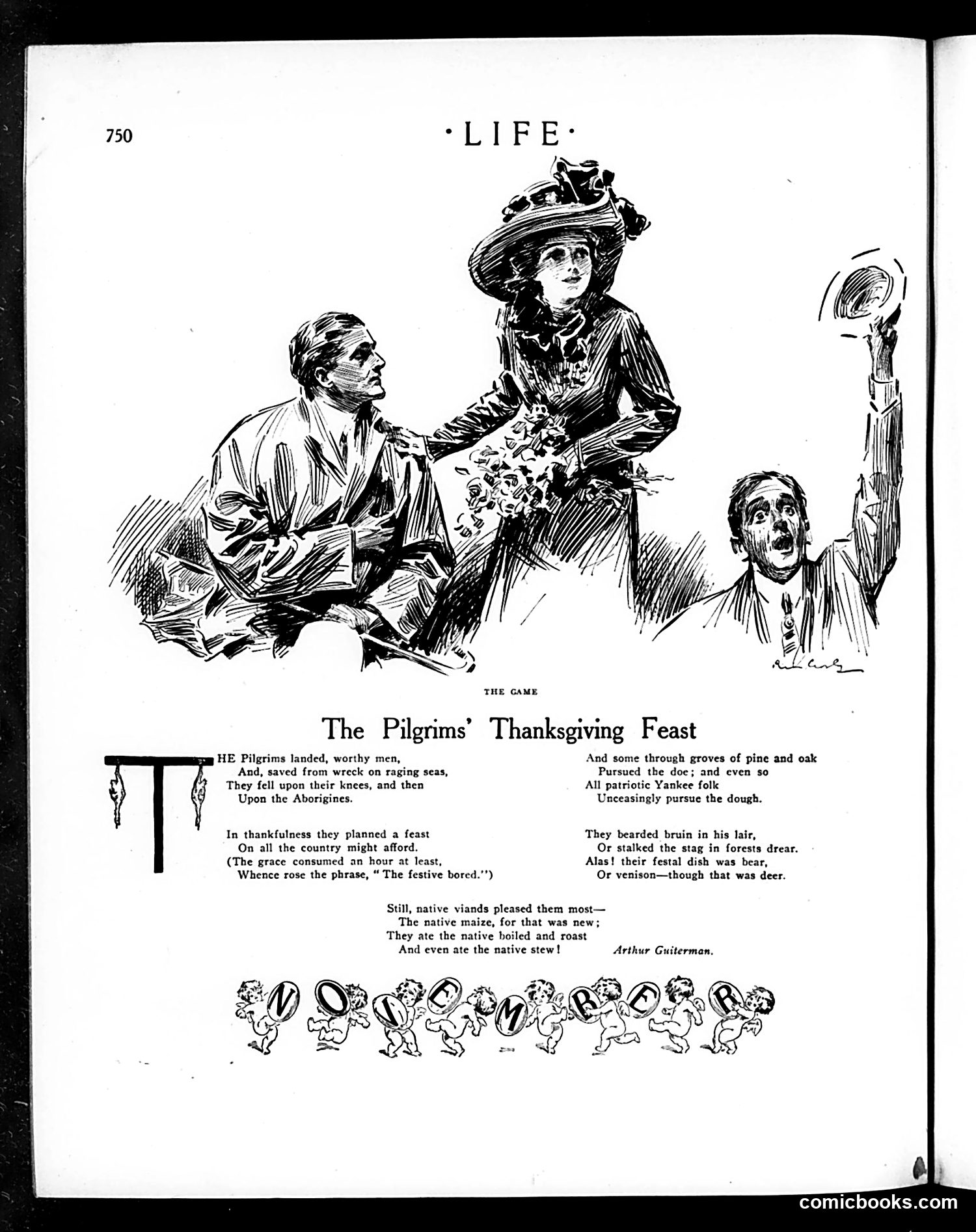
This is a darkly satirical poem by Arthur Guiterman paired with ink illustrations mocking American mythology about the Pilgrims and Thanksgiving. The satire works on multiple levels: **The primary joke**: The poem's opening line—"They fell upon their knees, and then / Upon the Aborigines"—uses a pun to suggest the Pilgrims' true treatment of Native Americans was violent conquest, not peaceful coexistence. The phrase "native viands" (native food) becomes a grim double meaning. **Secondary satire**: The poem mocks modern Americans ("All patriotic Yankee folk") for obsessively "pursuing the dough" (money), equating contemporary greed with the Pilgrims' supposed piety. **The illustrations** show three figures in period dress: one seated man, one standing woman offering food, and one man raising his arms in apparent distress—likely depicting the chaotic reality behind the sanitized Thanksgiving narrative. The cartoon challenges the sanitized historical narrative Americans were taught, suggesting hypocrisy in how the nation portrayed its founding.
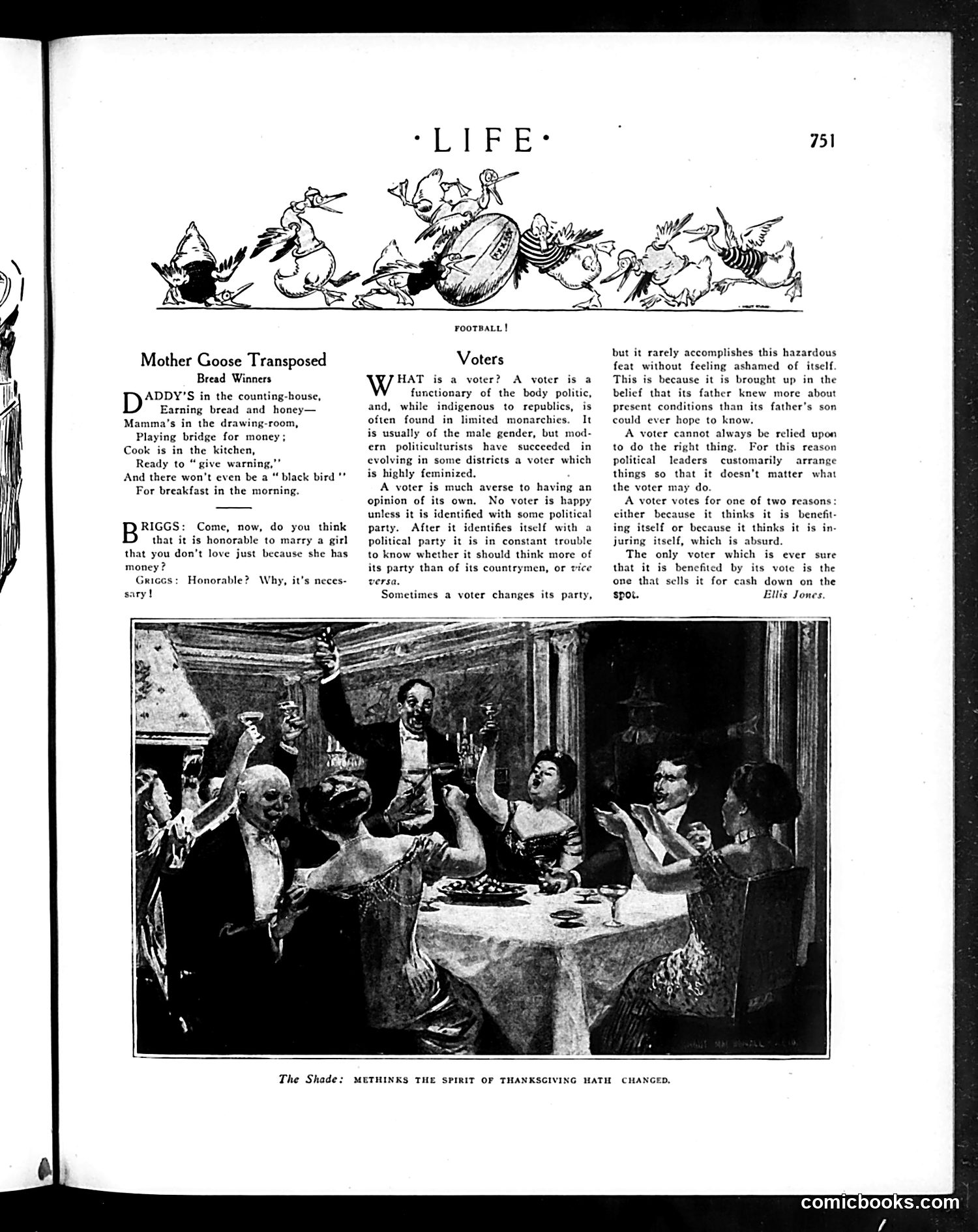
This page contains satirical commentary on early 20th-century American social issues: **"Mother Goose Transposed"** parodies the nursery rhyme, satirizing changing domestic roles. It depicts a wife playing bridge for money (gambling) while the husband earns wages and the cook threatens to quit—mocking the erosion of traditional household order and proper domestic hierarchy. **The Riggs dialogue** is a brief joke about marrying for money despite lack of love, suggesting this was an accepted (if cynical) practice among the wealthy. **"Voters"** is a lengthy satirical essay defining voters as creatures who lack independent thought, blindly follow political parties, and are easily manipulated by leaders. It mocks voter susceptibility to corruption ("sells it for cash") and suggests electoral outcomes don't actually depend on voter choice—a pessimistic commentary on democratic process. **"The Shade"** illustration depicts a holiday gathering, with the caption suggesting Thanksgiving's spiritual meaning has been corrupted, likely by commercialism or materialism. The overall tone is caustic social criticism typical of *Life*'s satirical mission.
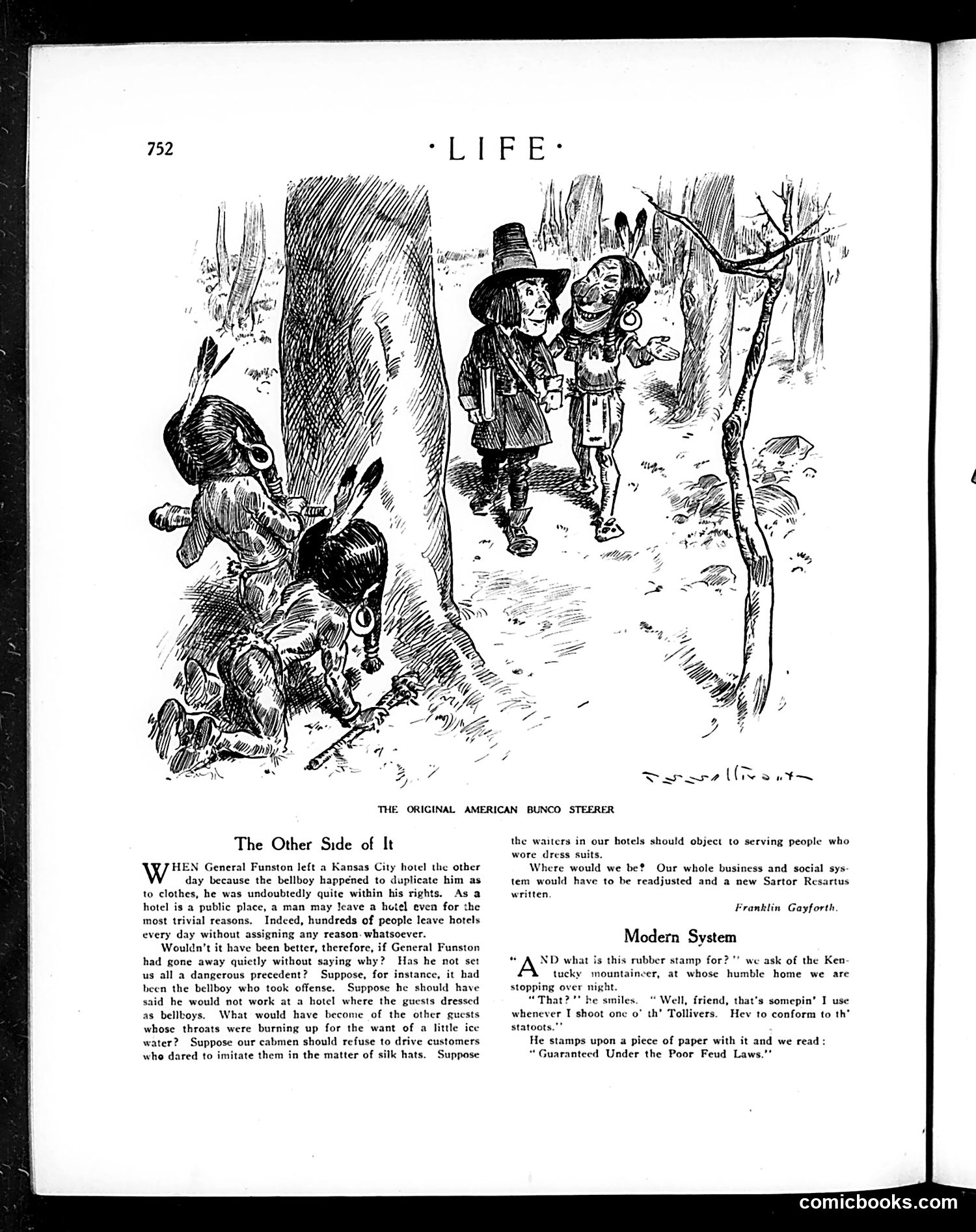
**The Cartoon:** "The Original American Bunco Steerer" depicts anthropomorphized rabbits dressed as humans in a forest setting, satirizing con artists or swindlers ("bunco steerers"). **"The Other Side of It":** This piece sardonically defends General Funston's decision to leave a Kansas City hotel because a bellboy wore identical clothing. The author argues that while Funston had the right to leave, his public complaint set a dangerous precedent. The satire escalates absurdly: if workers could object to customers dressing like them, society would collapse—waiters refusing to serve diners in suits, cab drivers refusing suited passengers, etc. The piece mocks Funston's pettiness by showing how ridiculous such logic becomes when universalized. **"Modern System":** A Kentucky mountaineer explains his rubber stamp, used "whenever I shoot onc o' th' Tollivers," stamping papers reading "Guaranteed Under the Poor Feud Laws." This satirizes rural feuding culture by presenting violence as regulated by official procedure—mocking both mountaineer lawlessness and bureaucratic absurdity. Both pieces employ exaggeration to critique social pretension and illogical behavior.
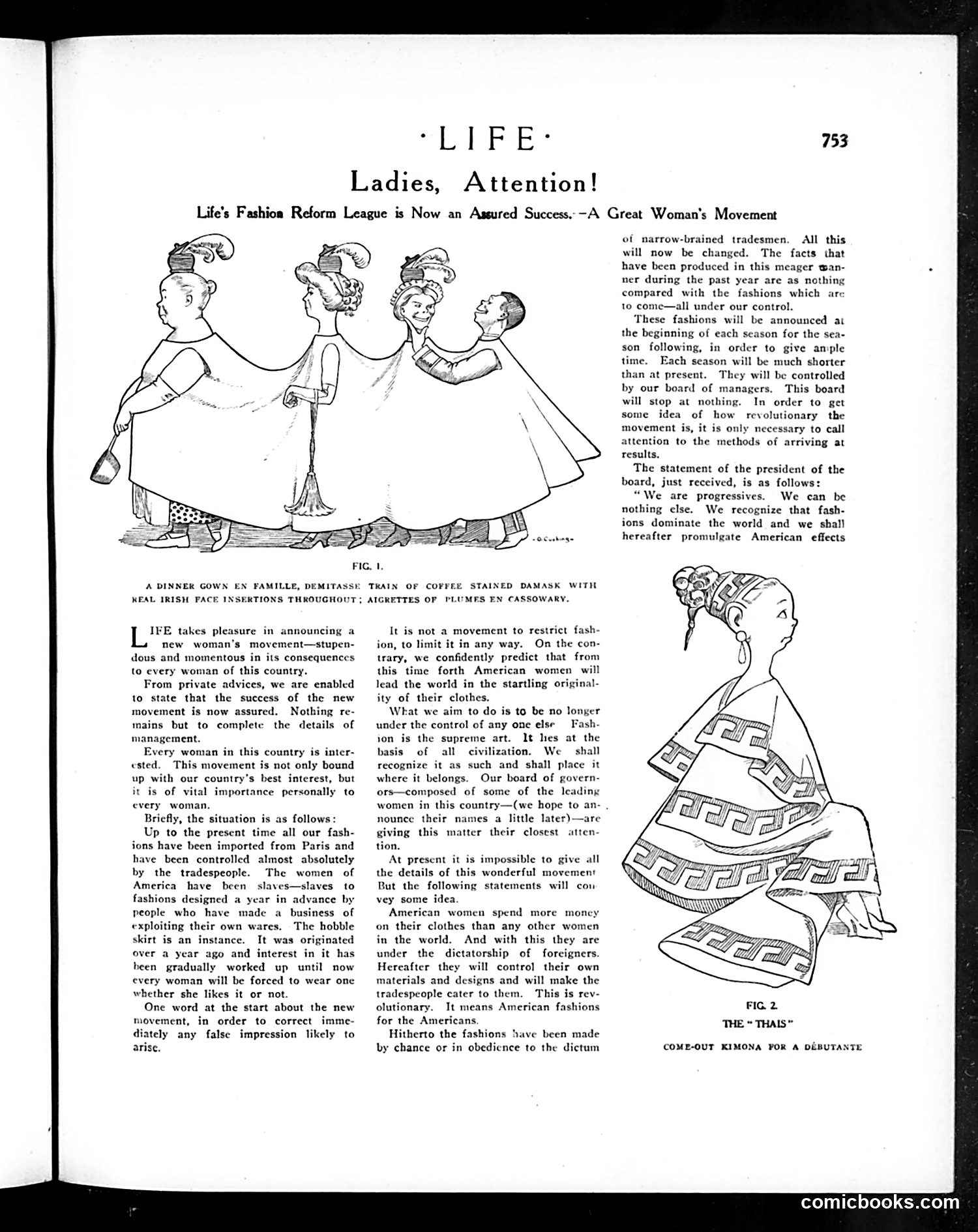
This 1910s *Life* magazine page satirizes the emerging "Fashion Reform League," presented as a women's movement to liberate American women from French fashion dominance. The satire targets both the pretentious movement itself and Paris's control over women's clothing. **The Joke:** The article mockingly celebrates this "revolutionary" effort with grandiose language ("progressive," "momentous"), claiming women will now control their own designs rather than obey "narrow-brained tradesmen." Yet the illustrations undermine this—Figure 1 shows an absurdly impractical dinner gown with exaggerated train and plumage, while Figure 2 depicts a "Come-out Kimona" in equally ridiculous styling. **The Point:** Life is lampooning women who claim independence from fashion while remaining enslaved to equally impractical garments. The reform movement promises liberation but merely substitutes one tyranny (Paris) for another (American designers). The grandiose rhetoric about "the supreme art" of fashion masks the fundamental absurdity that women will always be controlled by frivolous clothing standards, regardless of nationality.
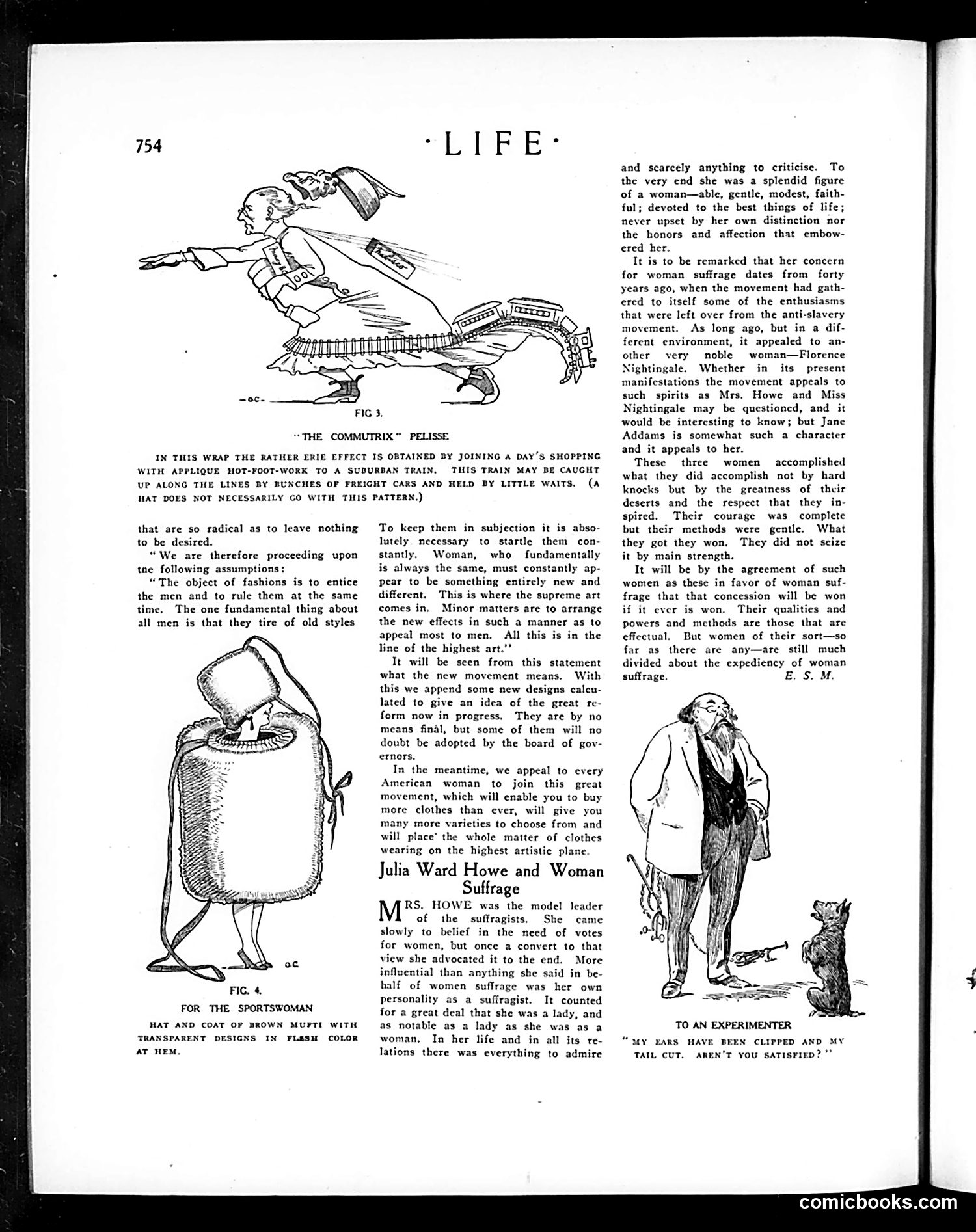
This page satirizes early 20th-century women's fashion and women's suffrage through interconnected commentary. **Fashion Satire (Top):** Absurd illustrated designs ("The Commutrix Pelisse," "For the Sportswoman") mock the constant churn of women's fashion. The text ironically suggests fashion exists to "entice" and "rule" men by perpetually startling them with novelty, while women remain "fundamentally...always the same." The joke: manufacturers convince women to buy endless new clothes through pseudo-artistic justification. **Suffrage Commentary (Bottom):** An essay honors Julia Ward Howe as a dignified suffrage advocate whose "personality" and genteel character lent credibility to women's voting rights. The author (E.S.M.) argues that respectable women like Howe, Florence Nightingale, and Jane Addams achieved change through moral authority, not "hard knocks," suggesting suffrage will succeed only through such graceful persuasion—not aggressive activism. **The Joke:** Both sections critique how women are manipulated—through fashion consumption and through expectations of "ladylike" behavior—while appearing to celebrate women's agency.
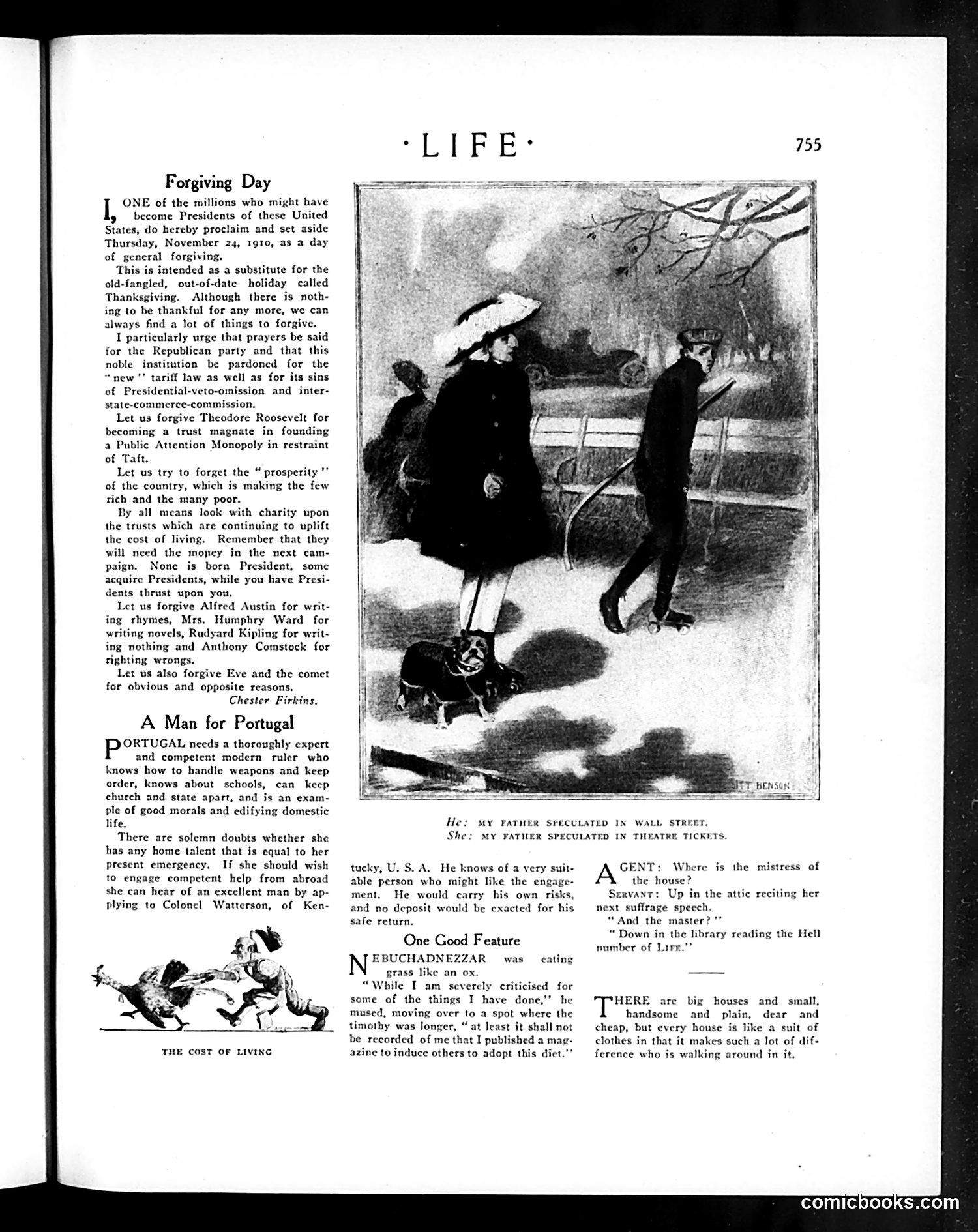
This page satirizes American politics and social issues of 1910. The main article, "Forgiving Day," is a mock proclamation replacing Thanksgiving with a day to forgive society's failures. It mocks President Taft's administration, criticizing the Republican party's tariff law, and references Theodore Roosevelt's recent political activities as creating a "Public Attention Monopoly." The piece sarcastically urges forgiveness for trusts raising the cost of living, and jokes that presidents are "thrust upon you" rather than earned. The cartoon below depicts two figures discussing parental financial speculation: one's father speculated in Wall Street; the other's in theater tickets—a visual joke about different forms of financial risk-taking among the wealthy. "A Man for Portugal" humorously suggests hiring an American expert to rule Portugal, likely referencing contemporary debates about American interventionism abroad. The page reflects 1910 Progressive Era frustrations with corporate monopolies, wealth inequality, and political corruption.
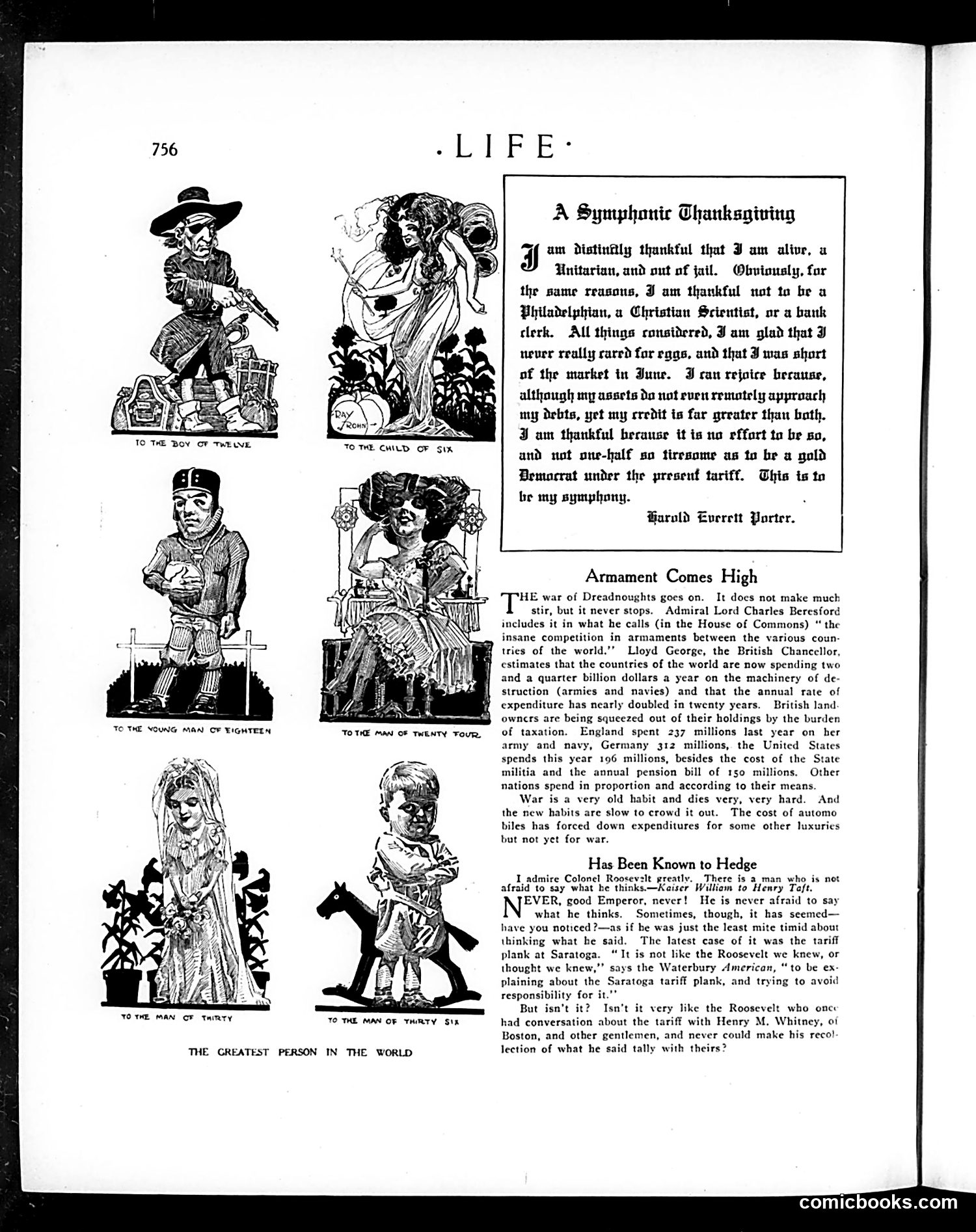
This page satirizes early 1900s American politics and social issues. The left side features six caricatured figures labeled "The Greatest Person in the World"—likely representing different social stereotypes or political figures of the era, though specific identities are unclear from the image alone. The main articles target: 1. **"Armament Comes High"**: Critiques the escalating global arms race, citing specific military spending figures (Britain £237 million, Germany £312 million, U.S. $196 million annually). The satire suggests nations are bankrupting themselves on weapons while ordinary citizens suffer taxation. 2. **"Has Been Known to Hedge"**: Mocks Theodore Roosevelt's inconsistency, particularly regarding his tariff policy at Saratoga. The joke: Roosevelt claims to always speak his mind frankly, yet conveniently "forgets" past statements when convenient—suggesting political dishonesty masked by bluster. The opening piece is a humorous Thanksgiving essay by Harold Everett Porter offering ironic thanks for being outside jail and avoiding certain professions.
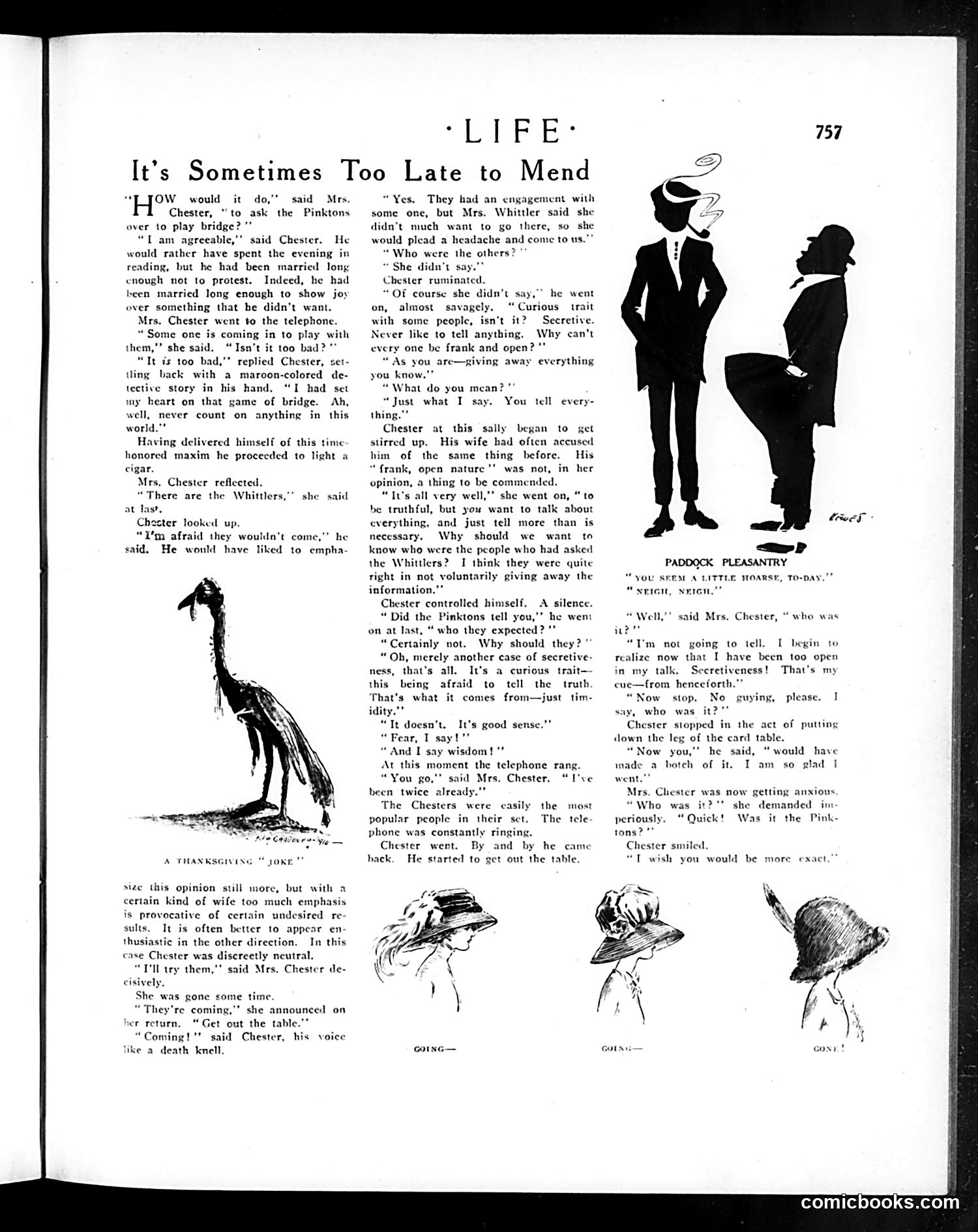
This satirical story concerns the mundane marital dynamics of Mr. and Mrs. Chester. The humor revolves around hypocrisy and role-reversal: Chester has just pontificated about people being secretive and evasive, criticizing those who won't openly share information. When a telephone call comes, he takes it—then deliberately refuses to tell his wife who called, claiming he's adopted a policy of "secretiveness." The joke is that Chester, moments after condemning secrecy as cowardly "timidity," immediately practices it himself. His wife had actually been arguing *for* discretion and privacy (the "wisdom" position), while he championed total frankness. Now, in petty retaliation, he embraces secrecy. The page's illustrations show fashionable women in 1920s-style hats and a Thanksgiving turkey drawing, reflecting the era's aesthetic. The title "It's Sometimes Too Late to Mend" suggests that once you've revealed your true nature through marriage, you can't change—Chester is stuck being the type who talks too much, and his attempt at reform is transparently performative.
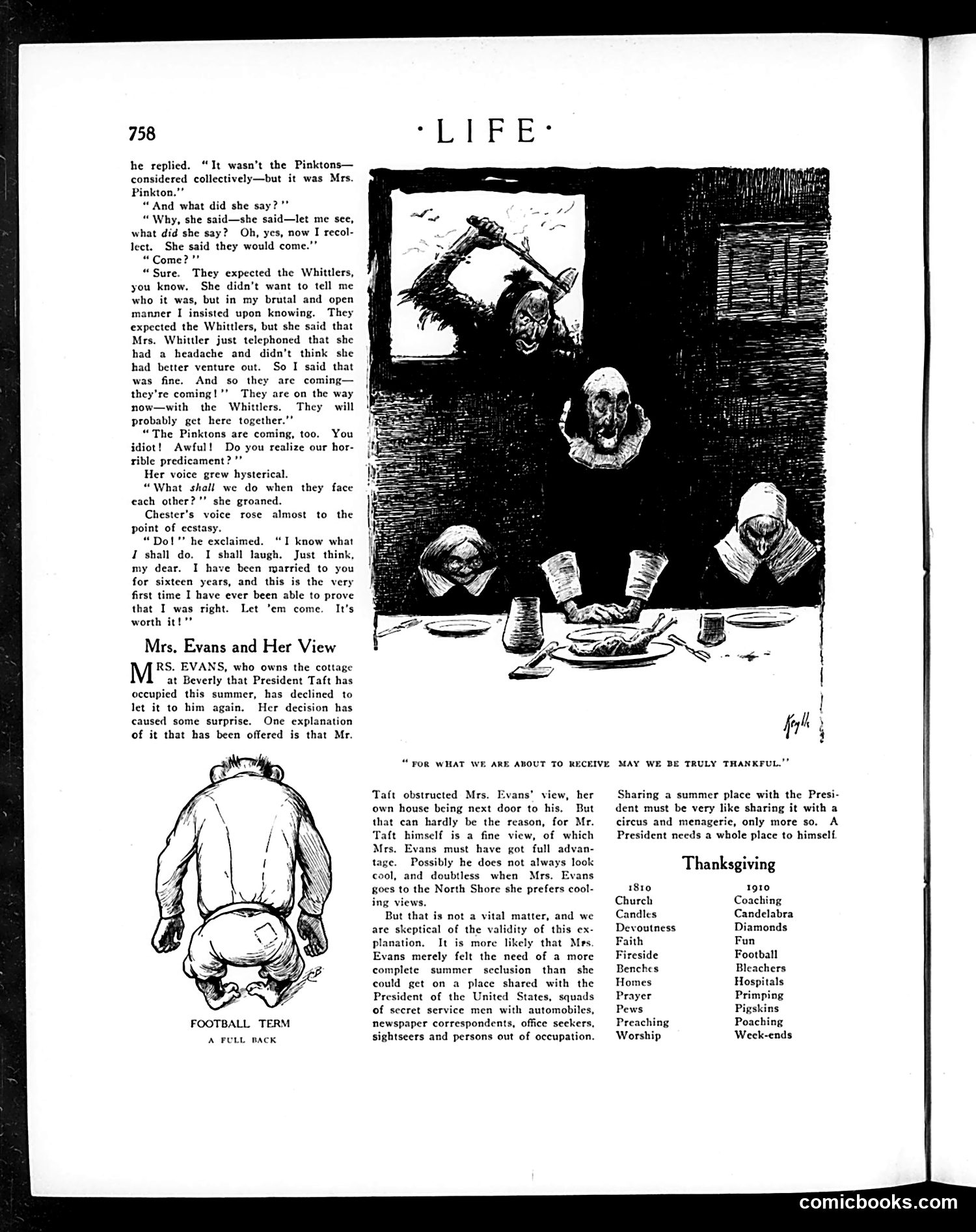
This Life magazine page (circa 1910) contains two satirical pieces: **The Chester/Pinkton Story (top):** A domestic comedy about a husband who invited both the Pinktons AND Whittlers to dinner, not realizing the families apparently have conflict. The husband finds this hilarious because it proves him right about something to his exasperated wife—suggesting marital discord played for laughs. **Mrs. Evans and Her View (bottom):** Political satire about President William Howard Taft. Mrs. Evans declined to rent her Beverly cottage to Taft again. The article humorously suggests this isn't because Taft blocked her view (though he's heavy-set), but rather that hosting a President means enduring "secret service men with automobiles, newspaper correspondents, office seekers, sightseers"—essentially that the presidential circus makes private life impossible. It's gentle mockery of presidential entourage excess. **The "Football Term" cartoon** appears to be unrelated visual humor about a rotund figure labeled "A Full Back." The "Thanksgiving" list contrasts 1810 values with 1910 materialism (churches vs. coaching, prayer vs. primping).
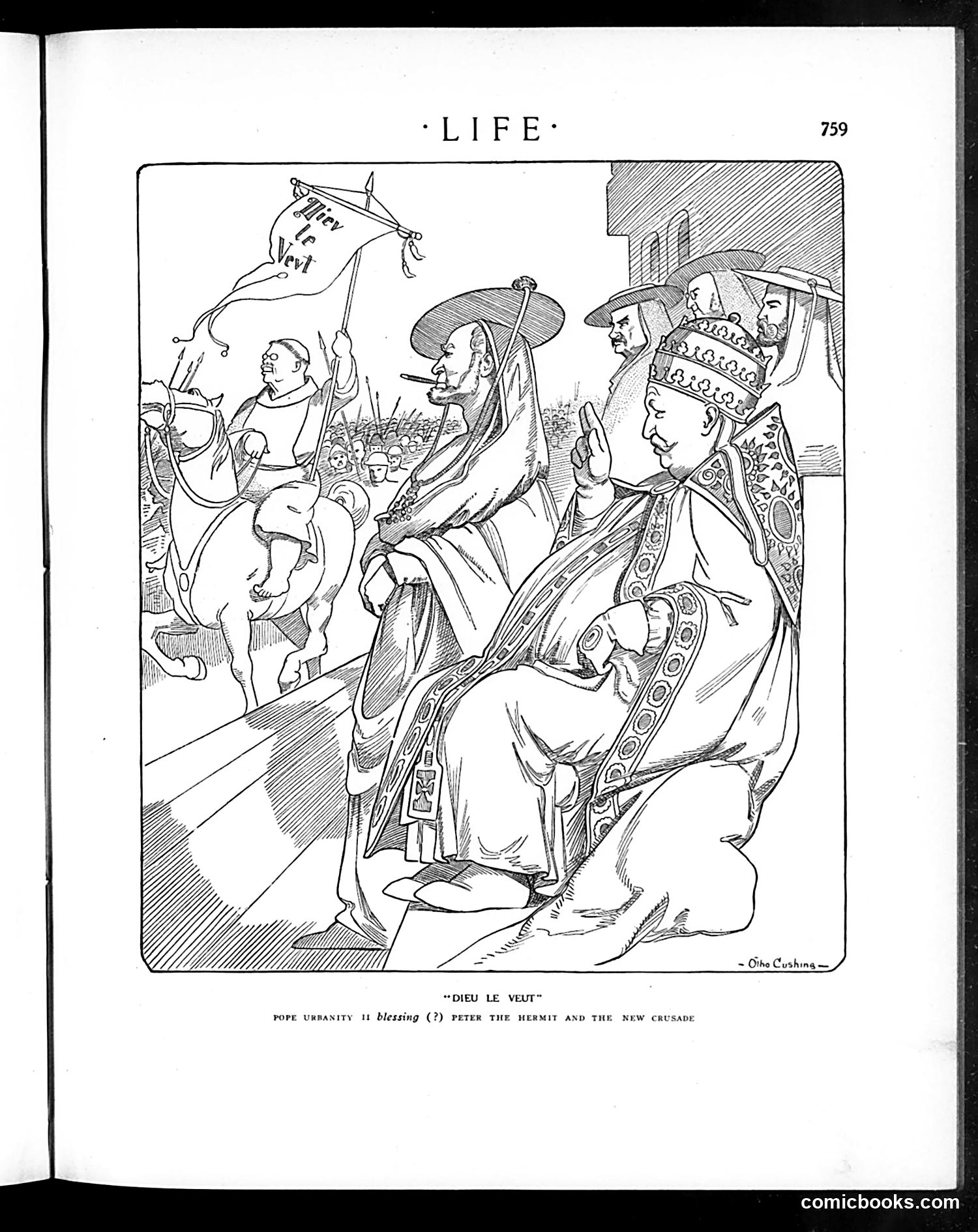
The caption reads "DIEU LE VEUT" ("God Wills It") and references "Pope Urbanity II blessing (?) Peter the Hermit and the New Crusade." This is a satirical comparison between medieval crusades and contemporary events. The cartoon depicts figures in ornate religious and royal dress presenting banners to armed figures, mimicking historical crusade imagery. The satire appears to criticize Pope Urban II's apparent blessing of what the cartoonist calls a "new crusade"—likely referencing early 20th-century military conflicts or religious-political movements being justified with religious rhetoric. The artist (signed "Orth Cushina") uses historical parallel to mock the invocation of religious authority for military adventures. The elaborate costumes and solemn ceremony emphasize the pretension of framing modern conflicts in crusade terminology.
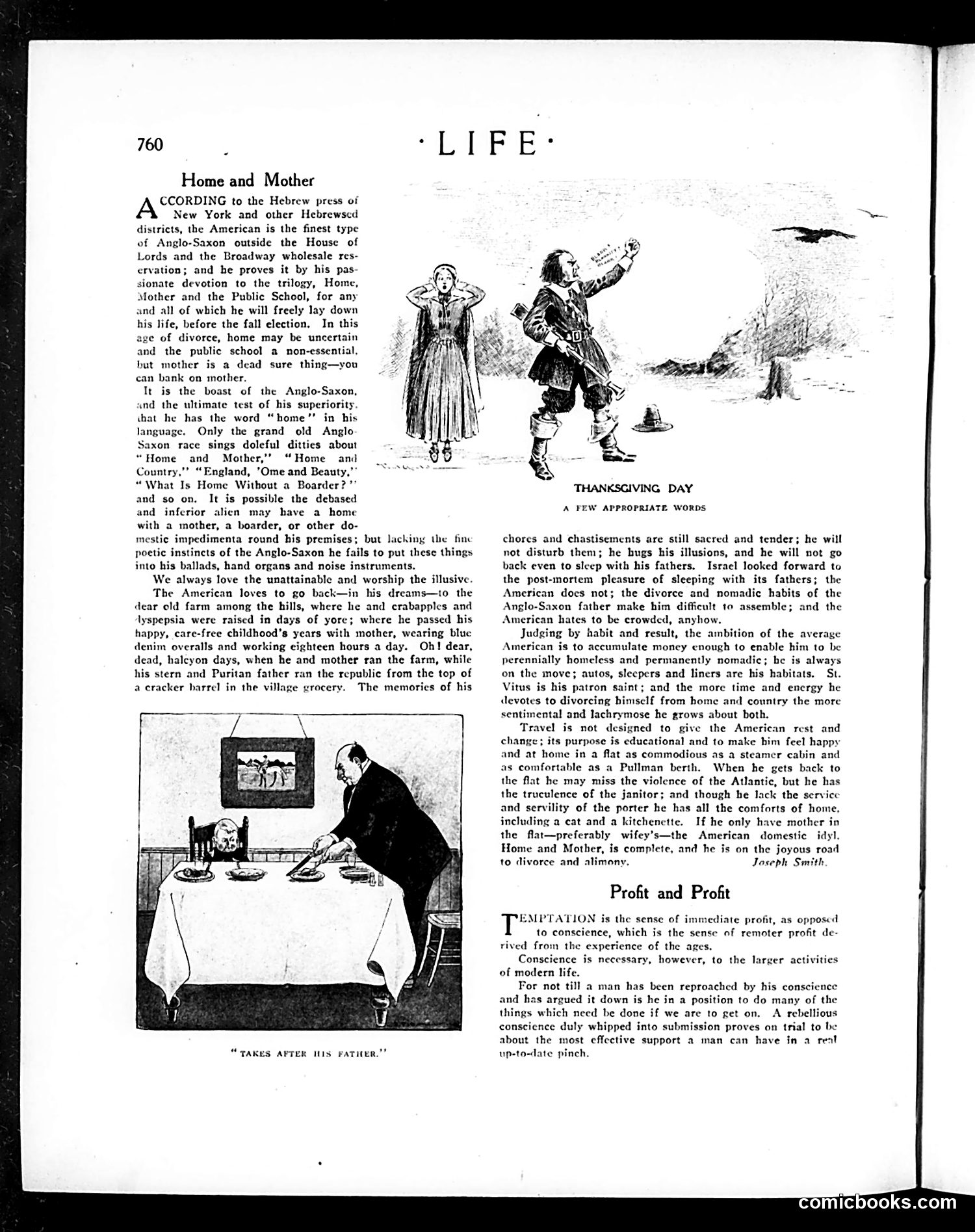
This satirical piece mocks American reverence for "Home and Mother" as hollow sentiment disconnected from actual behavior. The author argues that Anglo-Saxons boast about devotion to home, yet Americans are perpetually nomadic—constantly moving via autos, trains, and ships—while romanticizing an idealized farm childhood that no longer exists. The accompanying illustration "Takes After His Father" depicts a domestic scene where a man dines while a woman serves, likely satirizing the gap between sentimental family ideals and actual domestic arrangements. The satire targets American hypocrisy: citizens claim to cherish home and family stability while pursuing divorce, relocation, and rootlessness. The critique extends to ethnic stereotyping—contrasting Anglo-Saxon "poetic" sensibilities about home with supposedly inferior immigrant cultures, which Life then undercuts by suggesting Americans actually embody restlessness and emotional dishonesty. The tone is biting social commentary on American materialism masquerading as sentimentality.
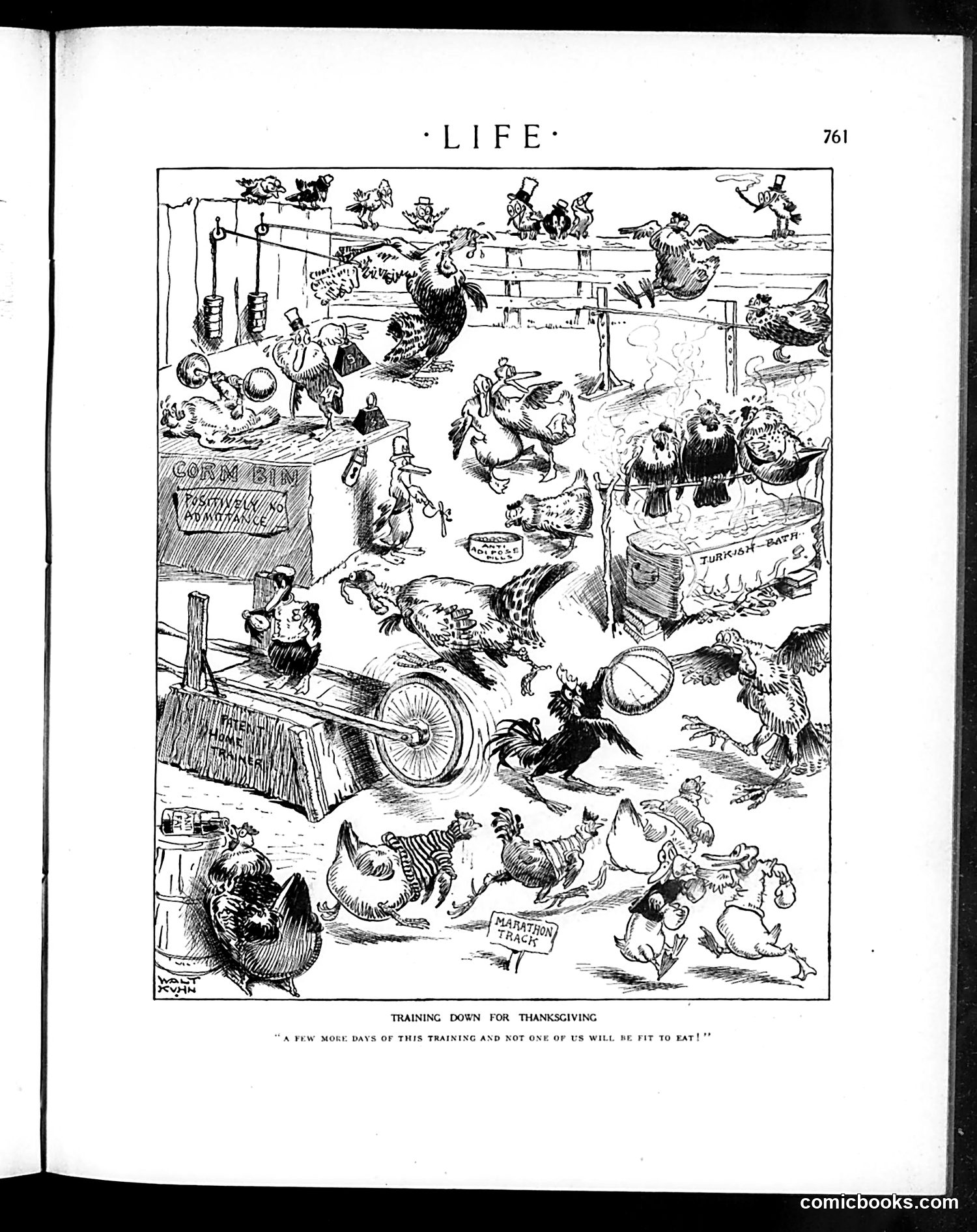
This satirical cartoon depicts a barnyard chaos scene where various farm animals—chickens, turkeys, pigs, and others—are engaged in athletic training activities: exercising with weights, running races ("Marathon Track" visible), using gym equipment, and performing acrobatics. The joke plays on the phrase "training down," which refers to athletes reducing weight before competition. Here, the animals are ironically "training down" (getting fit and lean) in preparation for Thanksgiving—the holiday when they would traditionally be slaughtered and eaten. The quoted caption delivers the dark humor: the animals hope that by becoming too physically fit and muscular rather than plump, they'll become inedible. It's a darkly comedic commentary on the fate awaiting farm animals destined for the holiday table, rendered through their absurd attempt at self-preservation through fitness.
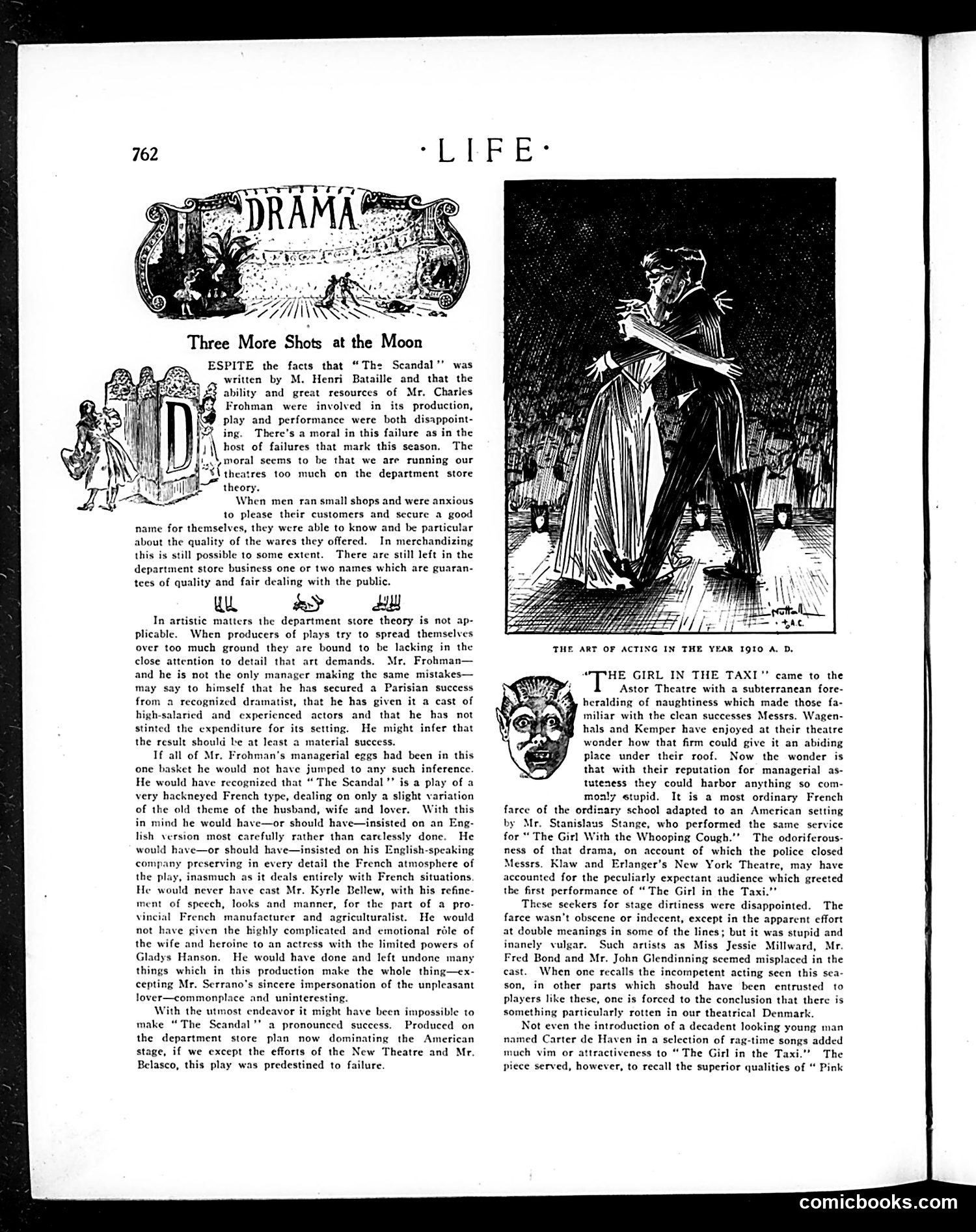
This page critiques two Broadway productions. The main article attacks "The Scandal," a French play produced by Charles Frohman, arguing it failed because Frohman operates theaters like department stores—spreading resources too thin across multiple productions rather than focusing carefully on quality. The critic names specific actors (Kyrle Bellew, Gladys Hanson) as miscast for this French-themed drama. The secondary piece dismisses "The Girl in the Taxi," another French farce adapted by Stanislaus Stange, as stupidly ordinary. The critic suggests producers Wagenhals and Kemper—normally reliable—inexplicably lowered their standards with this import. The satirical point: Broadway's commercial "department store theory" produces mediocrity. Quality requires the focused attention small shopkeepers once gave their merchandise, not the scattered approach of large theatrical operations chasing profits. The illustration (top right) appears to depict a character from one production, though the specific dramatic moment is unclear.
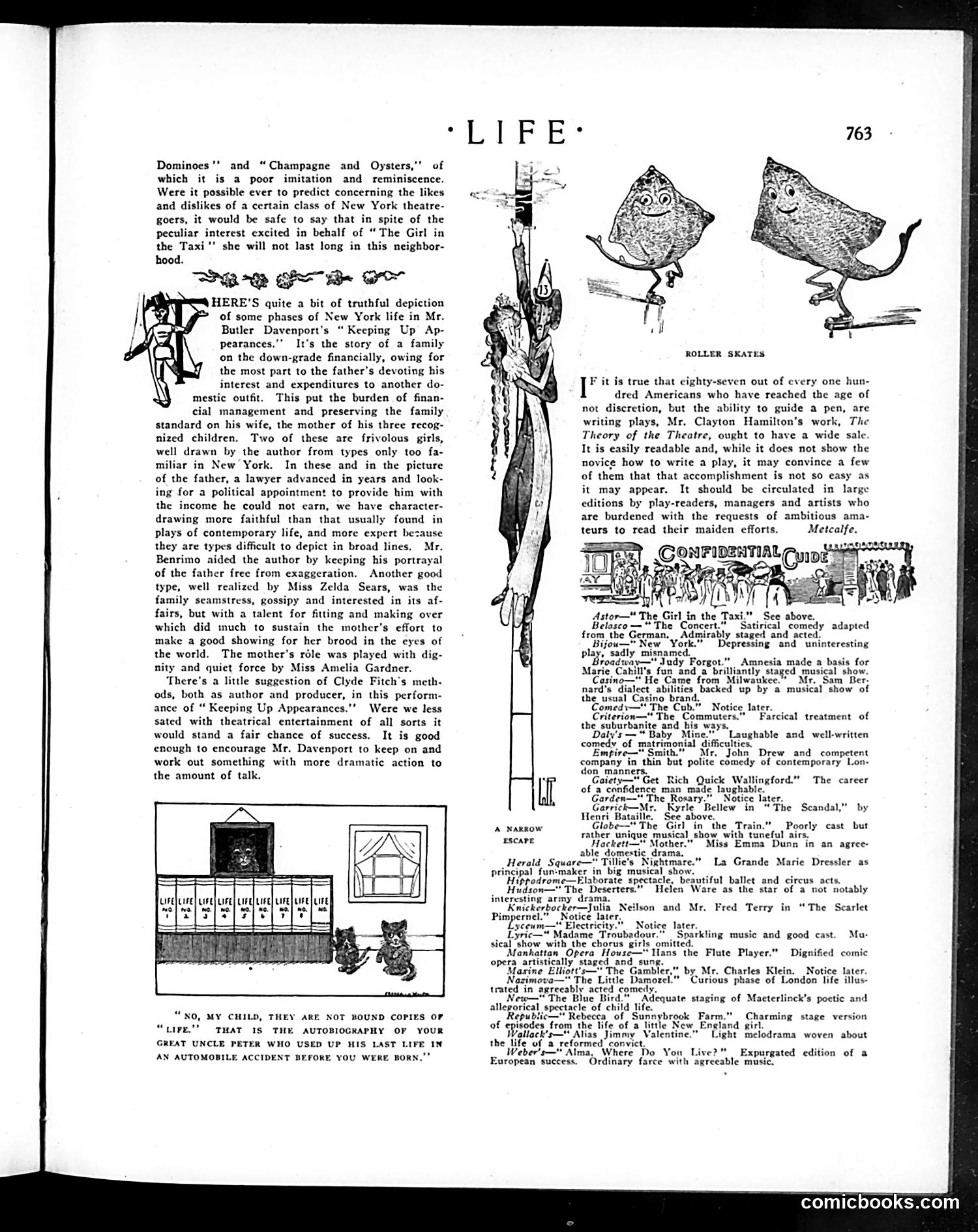
This page from *Life* magazine contains theatre reviews and two cartoons satirizing American culture circa the early 1900s. The **top cartoon** depicts roller skates—likely mocking a fad or frivolous leisure activity among the wealthy or fashionable set. The **bottom cartoon** shows stacks of *Life* magazines labeled as "the autobiography of your Great Uncle Peter," humorously suggesting that this uncle exhausted his nine lives in an automobile accident before the child was born. This is dark humor about early automobile fatalities, which were common and shocking to society at the time. The joke implies *Life* magazine itself documents the reckless modern age. The text reviews theatre productions, critiquing contemporary plays like "The Girl in the Taxi" and "Keeping Up Appearances"—works dealing with New York society, financial decline, and domestic life. The reviewer praises realistic character-drawing while lamenting theatrical oversaturation.
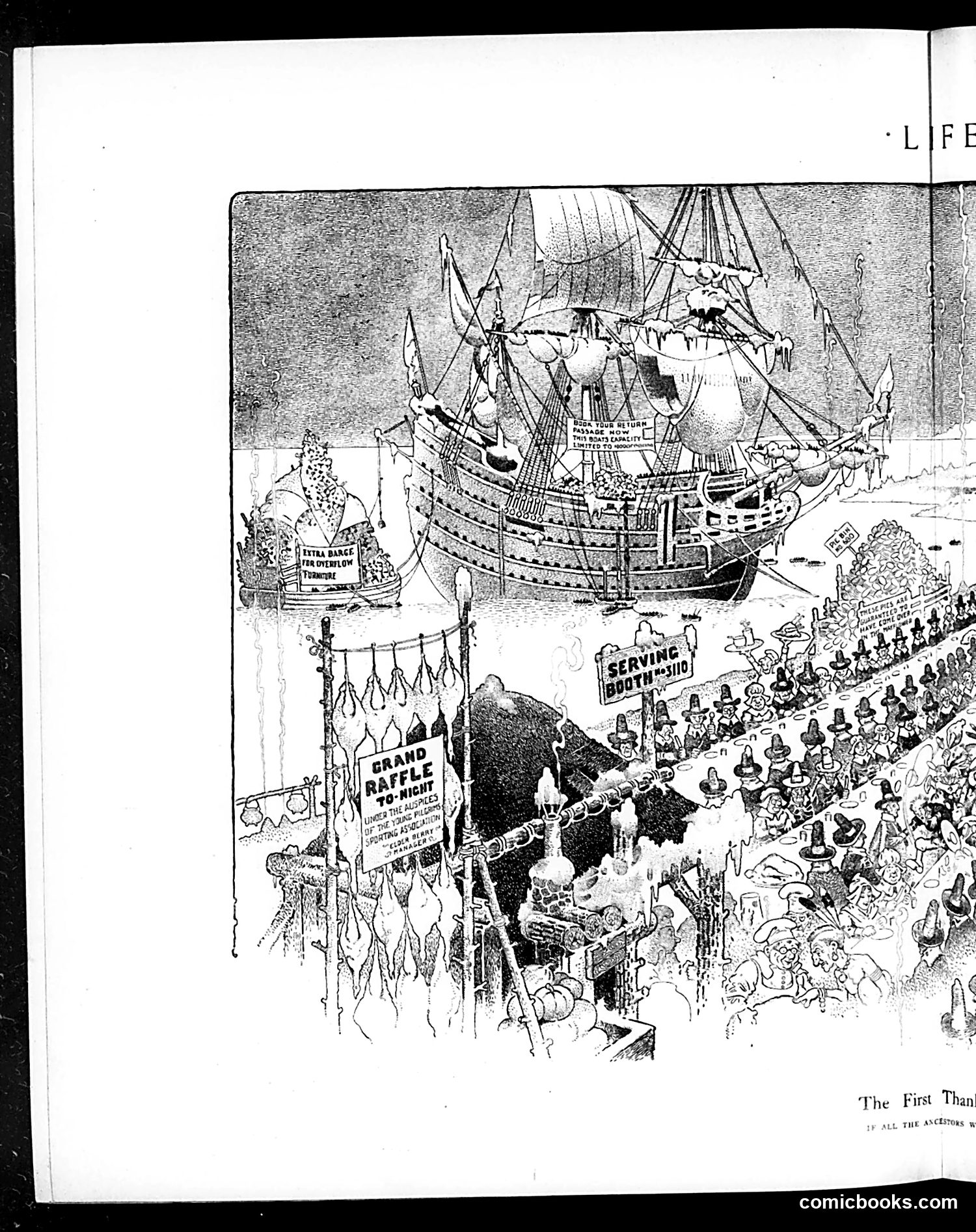
This appears to be a satirical illustration depicting a Thanksgiving scene with historical commentary. The image shows a large colonial-era ship (likely representing the Mayflower) alongside various booth signs including "Grand Raffle To-Night" and "Serving Booth #310," with crowds of people gathered below. The satire seems to mock the commercialization and carnival-like atmosphere surrounding Thanksgiving celebrations. By juxtaposing the symbolic ship of the Pilgrims with modern fairground attractions and booths, the cartoonist critiques how the holiday's historical significance has been reduced to commercial spectacle and entertainment. The partial title "The First Than[ksgiving]" confirms the Thanksgiving theme. The visible phrase "If All The Ancestors W[ere here]" suggests commentary on how modern celebrations might horrify historical figures.
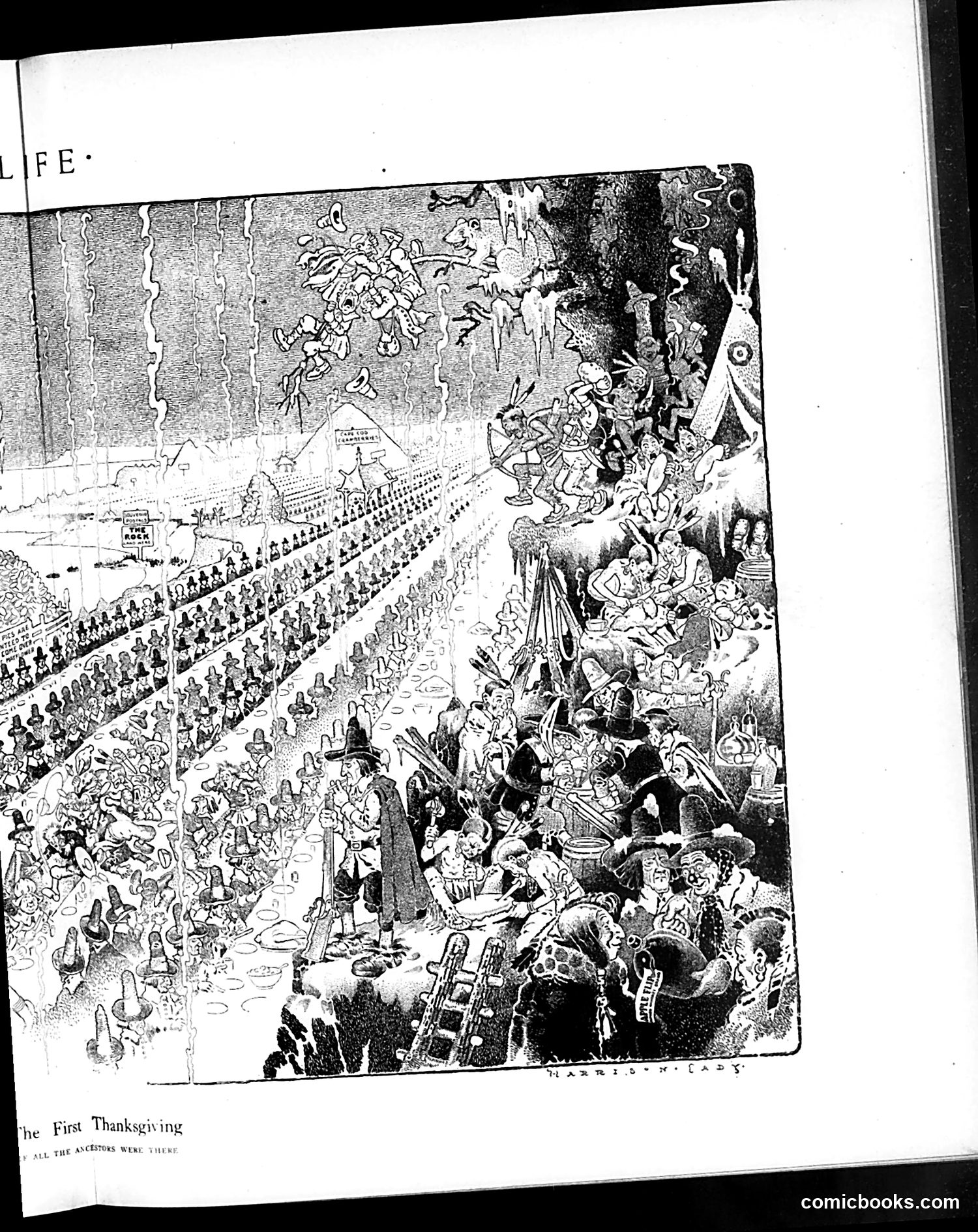
This satirical illustration depicts a chaotic, heavily populated scene labeled as depicting the "First Thanksgiving." The cartoon critiques the romanticized historical narrative of Thanksgiving by showing the scene crowded with numerous figures in period costume, alongside Native Americans, soldiers, and what appears to be satirical or exaggerated characterizations. The title's emphasis that "all the ancestors were here" suggests the cartoon is commentary on American historical mythology—specifically the sanitized Thanksgiving story taught in schools. The densely packed composition and carnivalesque atmosphere implies the actual historical event was messier, more complex, and involved far more competing interests and peoples than the simplified "pilgrims and Native Americans sharing a meal" narrative typically presented. The satire appears to mock oversimplified patriotic histories.
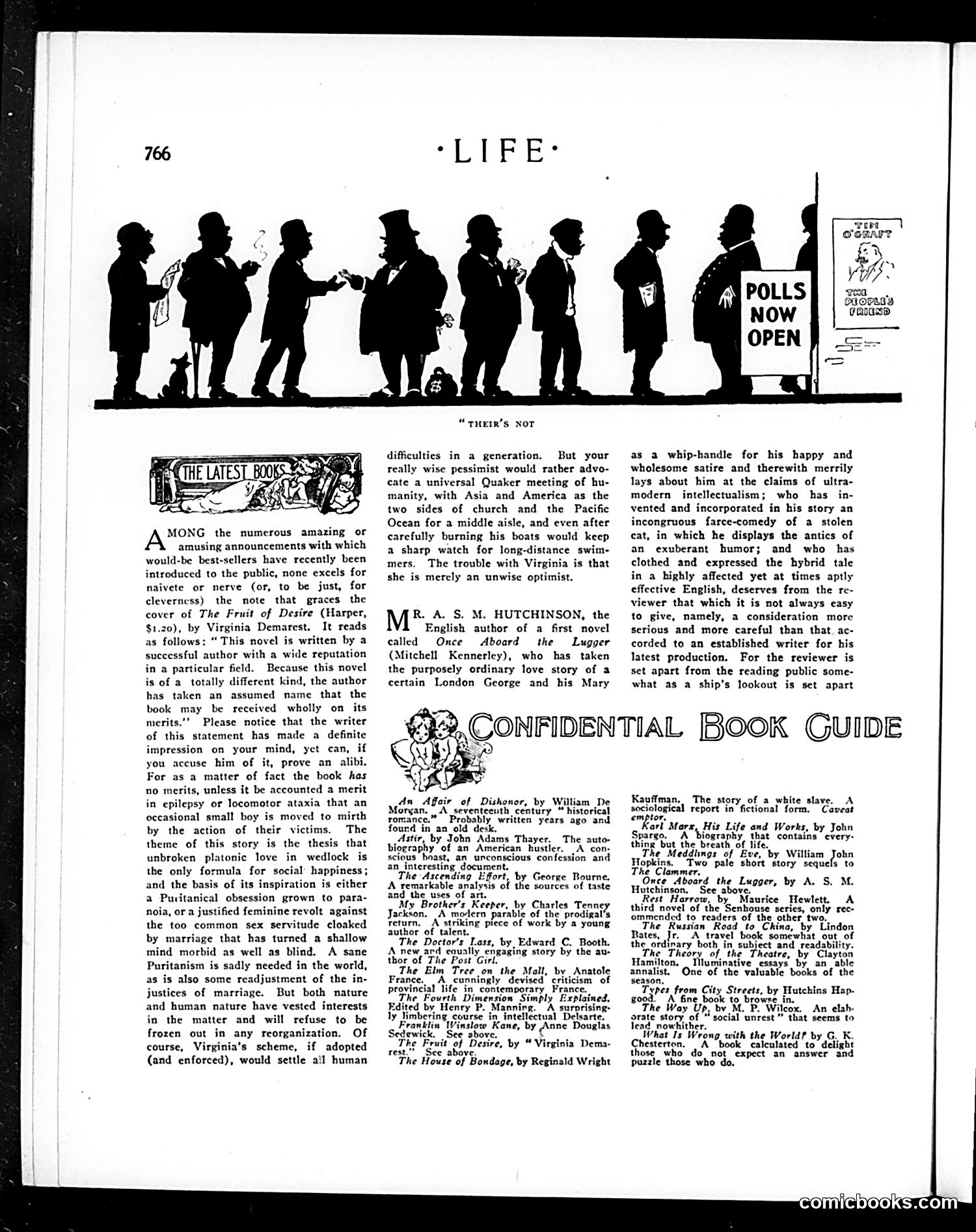
## The Cartoon The silhouette shows a line of well-dressed men in top hats approaching a "Polls Now Open" sign—a commentary on election voting. The caption "There's Not" (presumably continuing as "There's not much difference") suggests the satire targets political uniformity: despite appearing as distinct individuals, voters are essentially interchangeable, all heading toward the same polls. This likely critiques either voter apathy, the similarity between political candidates, or the futility of voting choices. ## The Book Reviews The page reviews contemporary novels, with particular mockery directed at *The Fruit of Desire* by "Virginia Demarest." The reviewer ridicules the publisher's claim that an established author used a pseudonym so readers would judge the book "wholly on its merits"—noting this is transparently self-serving marketing. The reviewer dismisses the novel's premise (platonic marriage as social salvation) as naive utopianism, calling its author an "unwise optimist." Other reviewed works address contemporary concerns: marriage inequality, social climbing, and intellectual trends.
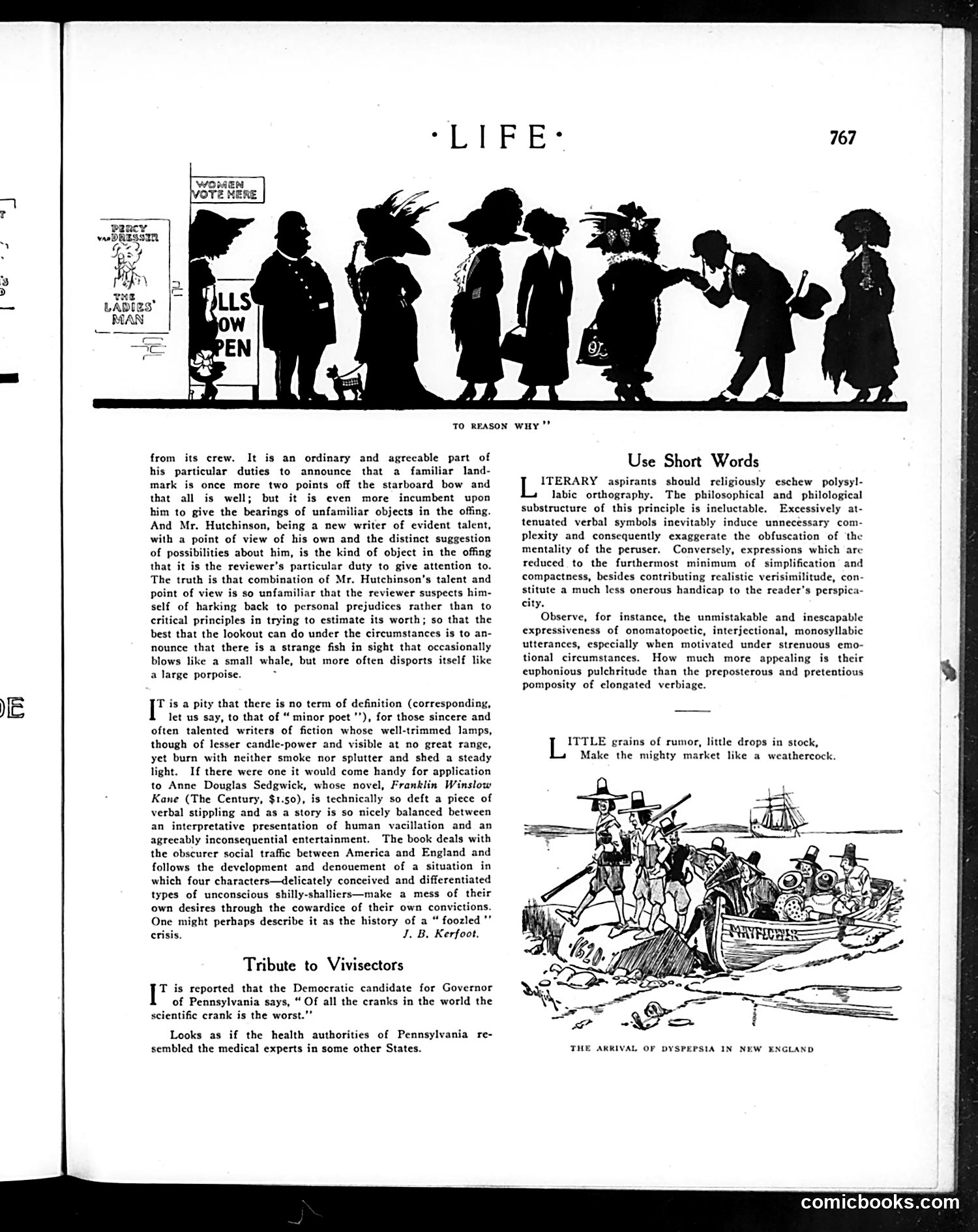
The top silhouette depicts women voting—indicated by "WOMEN VOTE HERE" signs—representing women's suffrage, a contentious political issue of the early 20th century. The main text discusses literary criticism and writing style. A section titled "Use Short Words" ironically demonstrates its own principle by using deliberately complex vocabulary ("polysyllabic orthography," "ineluctable," "obfuscation") to argue that writers should use simple language. This is satirical self-contradiction—the author practices the opposite of what they preach. The "Tribute to Vivisectors" section quotes a Pennsylvania gubernatorial candidate calling scientific researchers "cranks," then sarcastically suggests Pennsylvania's health authorities resemble medical experts elsewhere—implying they too oppose animal testing. The bottom illustration, captioned "THE ARRIVAL OF DYSPEPSIA IN NEW ENGLAND," shows a shipwreck with cargo spilling, humorously personifying indigestion as an unwelcome immigrant arriving by boat, poking fun at nativist anxieties about foreign arrivals.
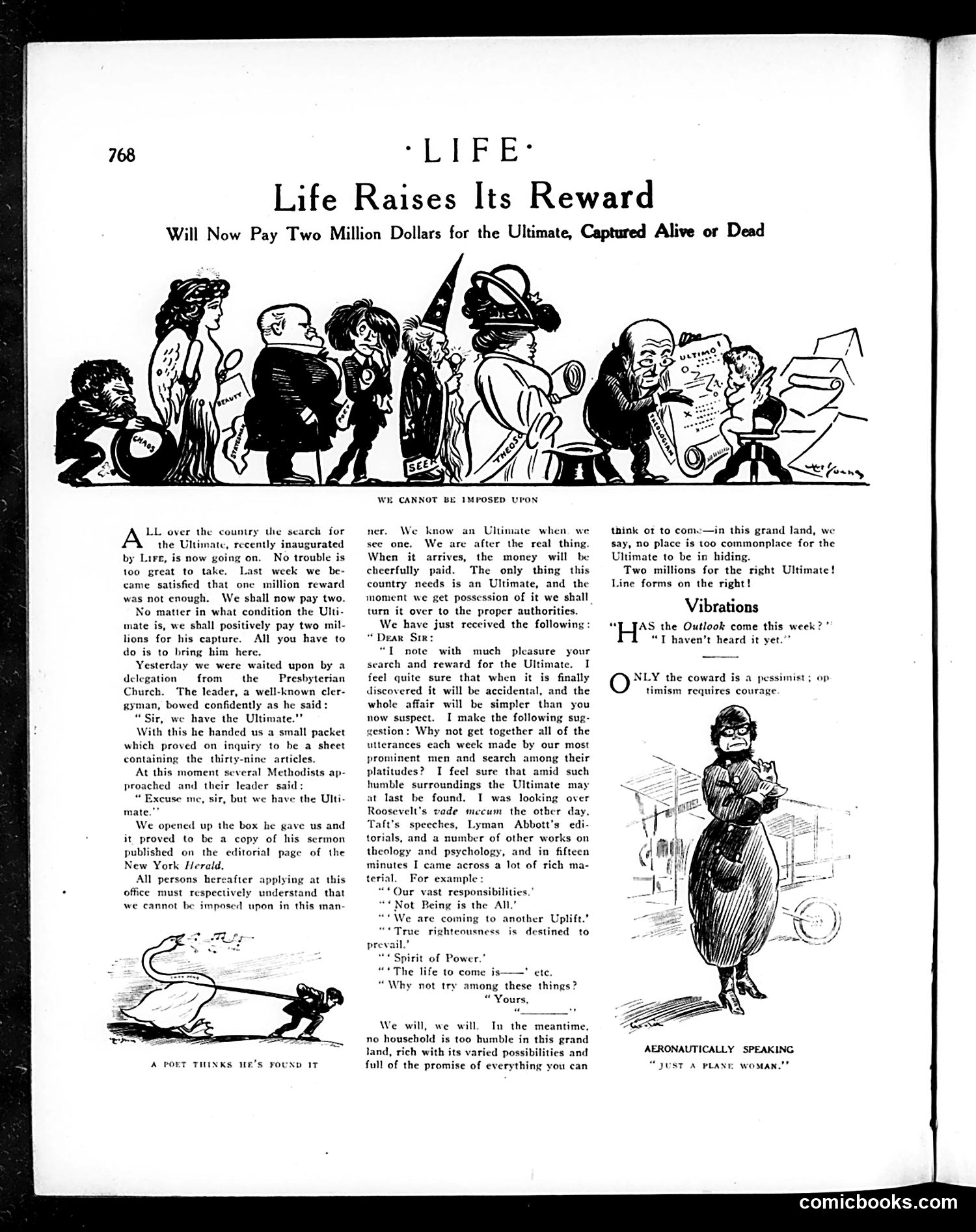
This is a satirical attack on vague political and religious rhetoric. Life magazine announces a two-million-dollar reward for discovering "the Ultimate"—a mockery of the era's tendency toward grandiose, meaningless platitudes. The cartoon depicts various groups (Presbyterian and Methodist churches) submitting their candidates for "the Ultimate," each offering hollow documents: the Thirty-Nine Articles and newspaper sermons. The satire suggests these institutions traffic in empty abstractions. The letter then ridicules prominent figures—likely **Theodore Roosevelt**, **William Howard Taft**, and **Lyman Abbott** (a reformist editor)—whose public statements are presented as interchangeable corporate-speak: "Our vast responsibilities," "True righteousness," "Spirit of Power." The joke is that these dignified-sounding utterances are actually meaningless platitudes masquerading as wisdom. The sidebar cartoon about "a plane woman" appears unrelated wordplay humor.
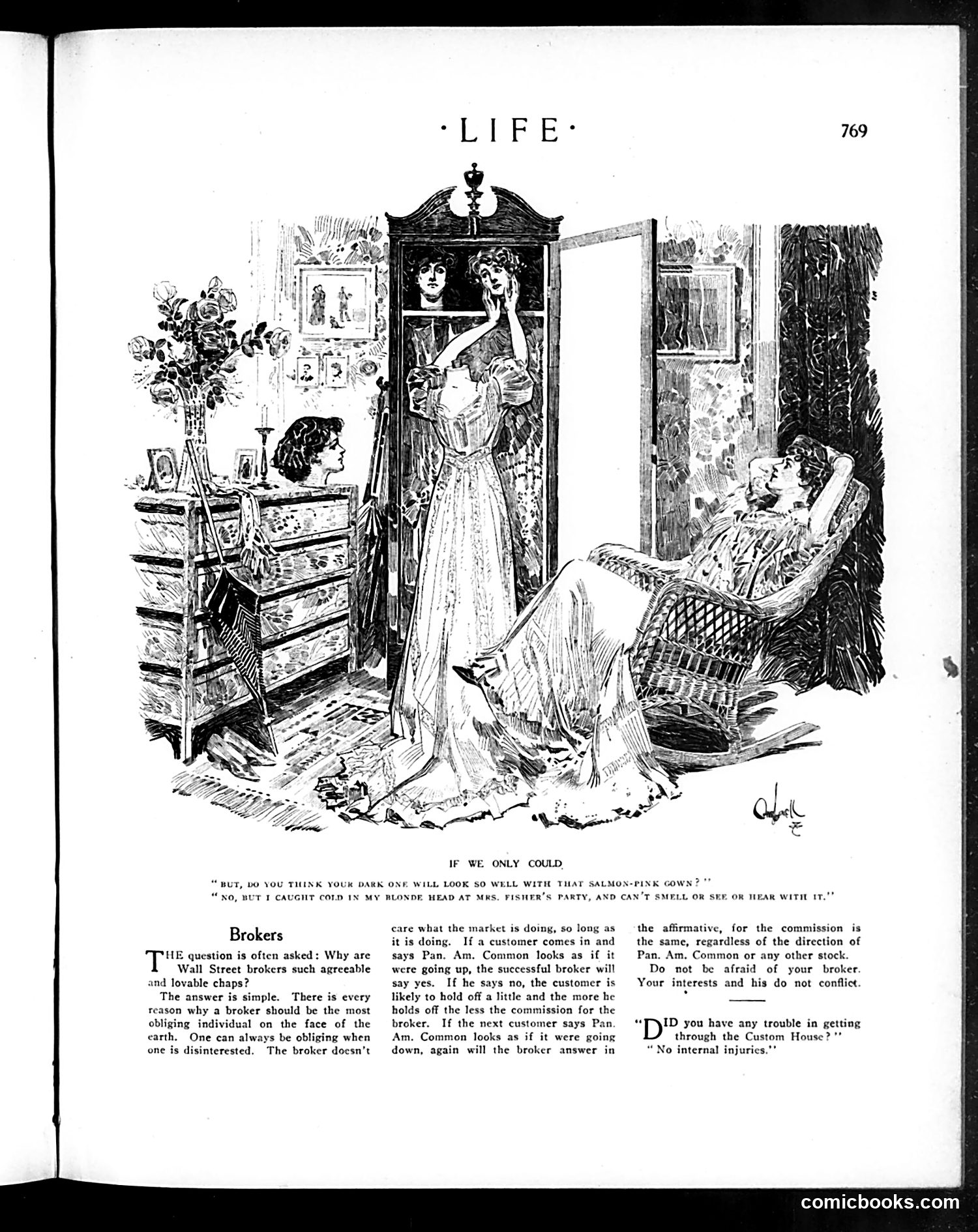
The page contains two satirical pieces about early 20th-century American life. **Top cartoon**: A humorous domestic scene where a woman admires another's dark gown paired with salmon-pink, but reveals she caught a cold at "Mrs. Fisher's party" and cannot smell, see, or hear properly—so the color coordination is irrelevant to her. The joke mocks superficial fashion concerns among wealthy women. **"Brokers" article**: Sharp satire on Wall Street brokers' dishonesty. The piece explains brokers appear "agreeable" because they're completely indifferent to clients' interests. Whether a stock rises or falls, the broker profits equally from commissions. The satire concludes sarcastically that clients should trust brokers because "your interests and his do not conflict"—obviously false. A closing joke about "no internal injuries" from Customs suggests brokers are smugglers. The satire targets broker corruption and the era's casual acceptance of financial bad faith.
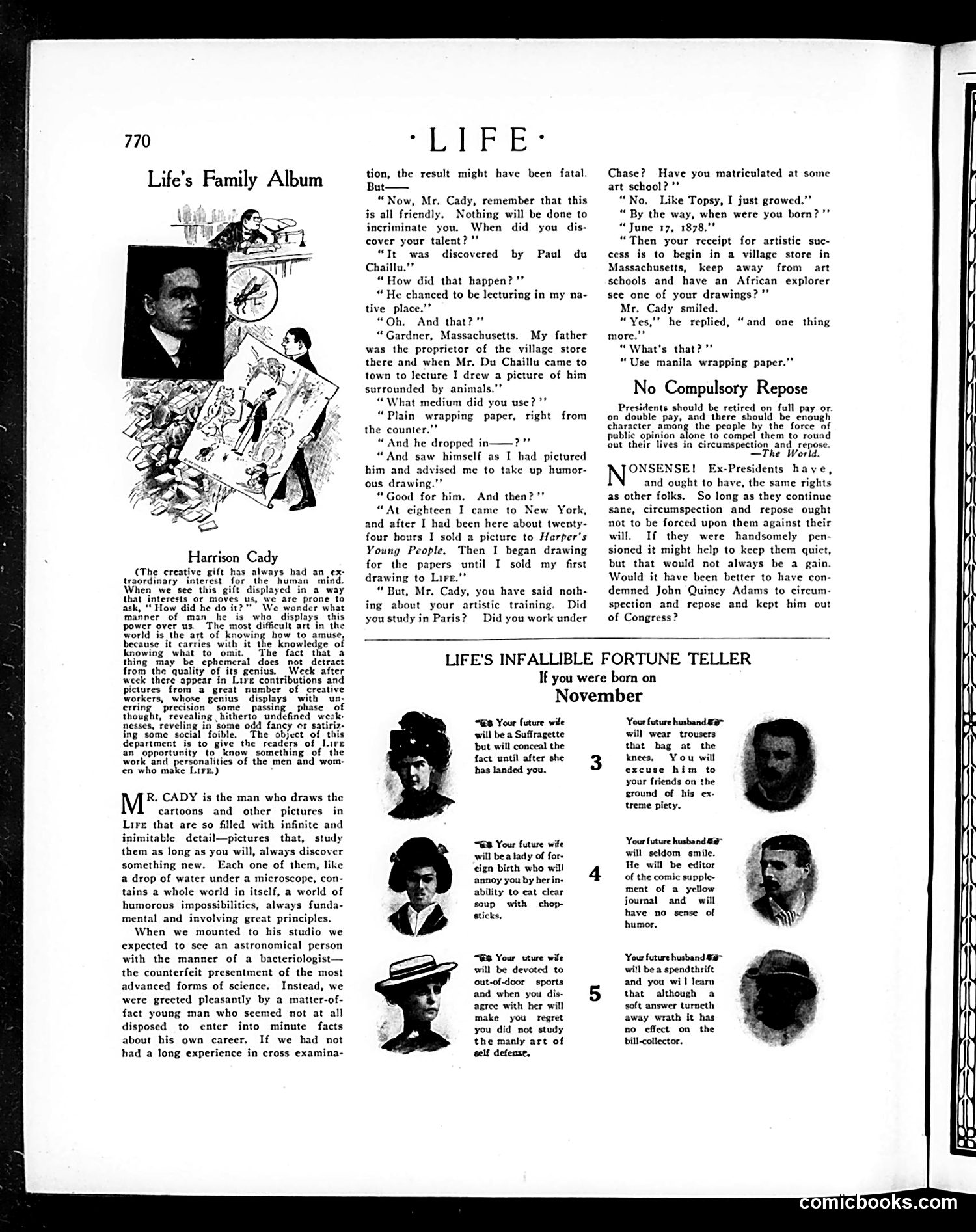
This page profiles **Harrison Cady**, a cartoonist and illustrator for *Life* magazine. The text celebrates his creative talent through an interview format, explaining how Cady discovered his artistic gift when African explorer Paul du Chaillu saw his drawing in a Massachusetts village store at age eighteen—launching a career without formal art school training. The satire is gentle: Cady's success story mocks pretension about artistic credentials. When asked about studying in Paris or attending art school, he replies "like Topsy, I just growed"—a reference to the character from *Uncle Tom's Cabin* who claims she wasn't born but simply "growed up." The joke suggests genuine talent needs no institutional validation. Below this is an unrelated editorial item about ex-presidents, arguing they deserve freedom rather than enforced retirement. The page also includes a fortune-telling feature keyed to November birthdays—typical *Life* magazine filler content mixing humor with social commentary.
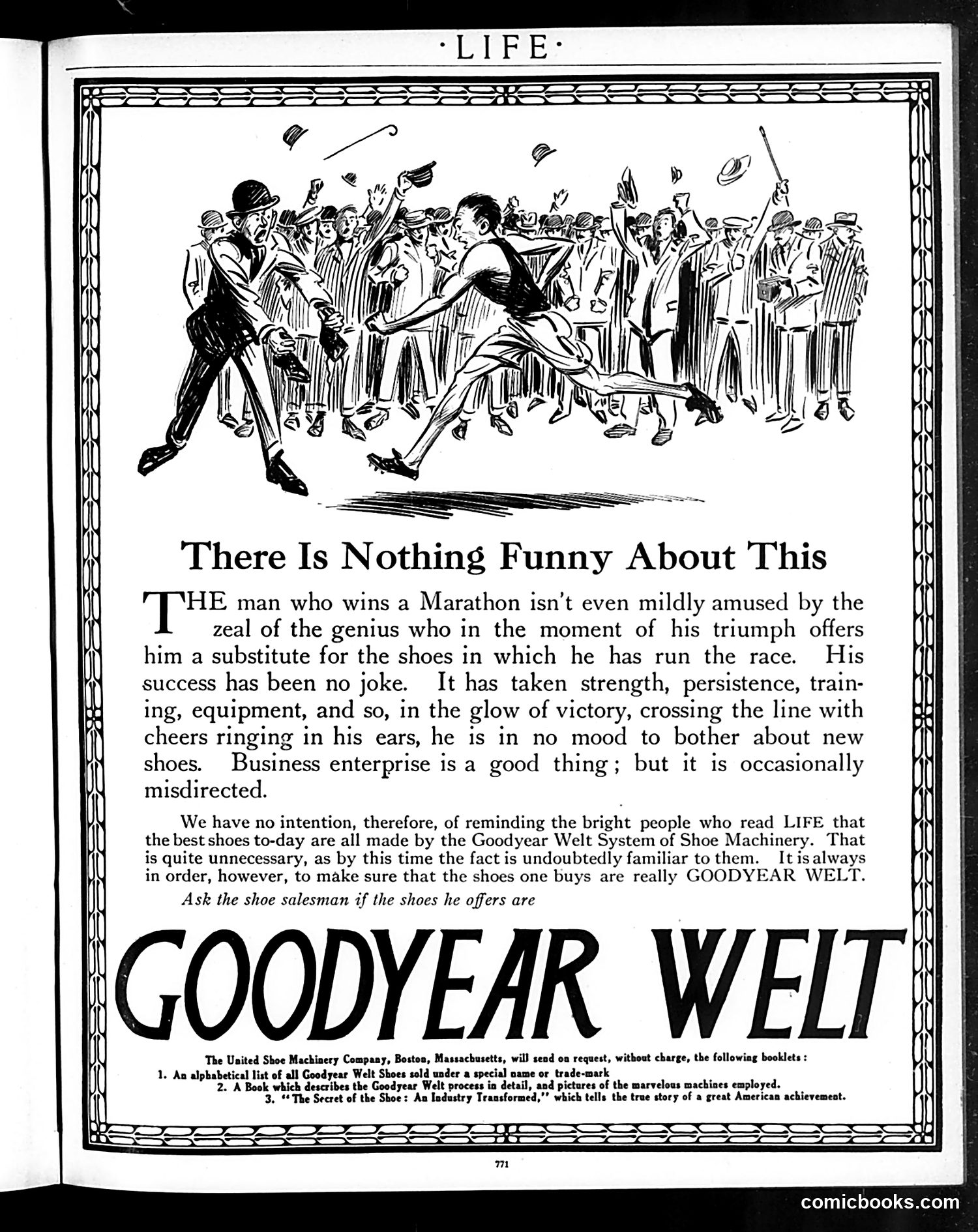
This is primarily a **shoe advertisement**, not satire. The cartoon depicts a Marathon runner being accosted at the finish line by an overzealous shoe salesman offering him new shoes—the joke being terrible timing and aggressive marketing. The ad's humor is self-aware: *Life* magazine acknowledges that promoting shoes to an exhausted athlete is ridiculous, then pivots to the actual pitch. The text argues that while "business enterprise is a good thing," this scenario shows it can be "misdirected." The advertisement then promotes **Goodyear Welt System** shoes, claiming they're made with superior machinery. By admitting the absurdity of hard-sell tactics, the copywriter positions Goodyear as the reasonable choice—customers should simply ask their shoe salesman if shoes are "really GOODYEAR WELT." This represents early 20th-century advertising that used self-deprecating humor and *Life*'s satirical voice to build brand credibility.
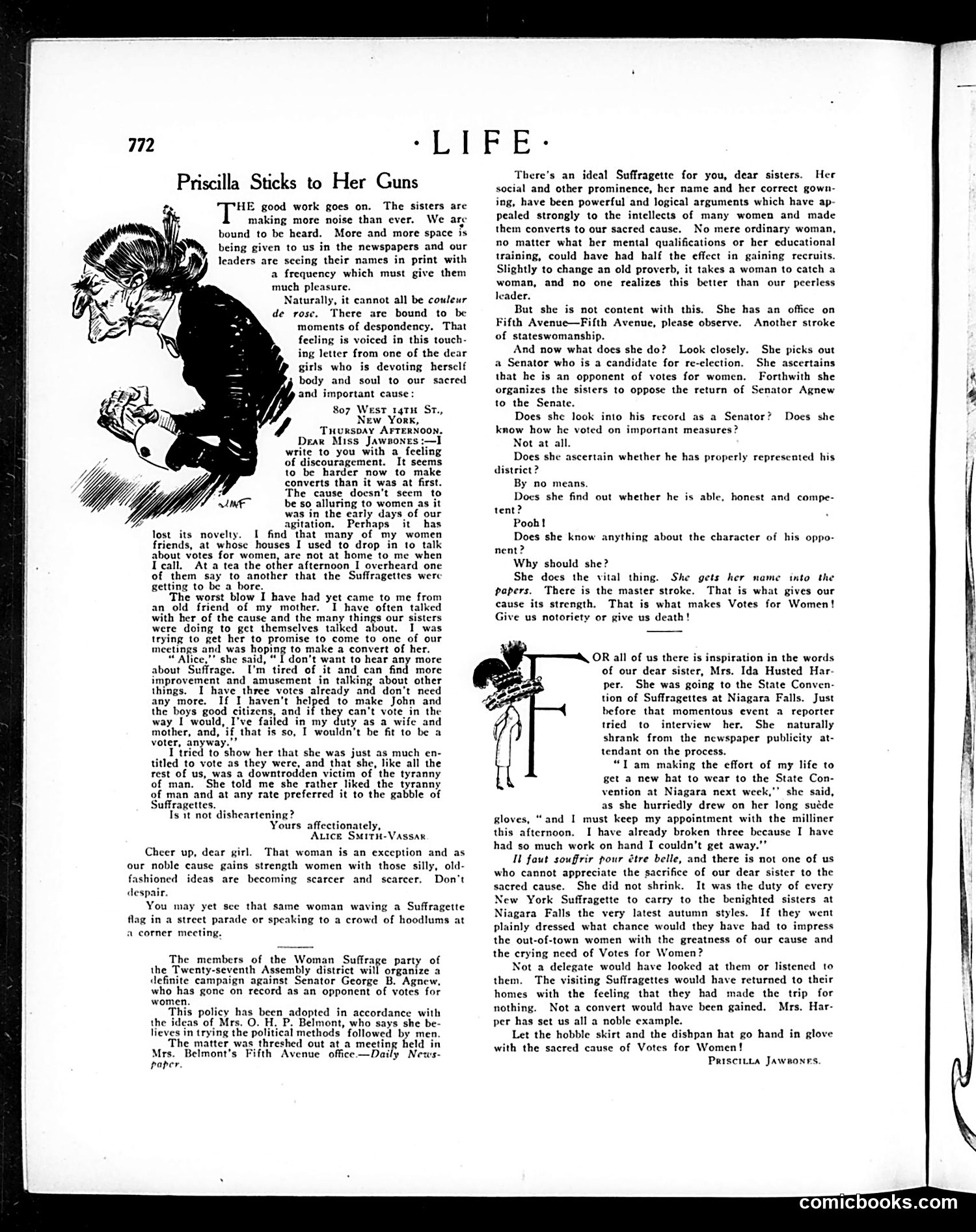
This 1912 *Life* magazine article satirizes the women's suffrage movement through a fictional letter from activist "Alice Smith-Vassar" expressing frustration that converts are harder to gain—even women she knows are avoiding her now, finding suffragettes tedious. The satire operates on two levels: The letter-writer represents overzealous, annoying activists whose evangelism backfires. More cutting, the *Life* editors mock the movement's class-based strategy by praising Mrs. O.H.P. Belmont (the wealthy, fashionable socialite mentioned) as the "ideal Suffragette"—implying that only wealthy, well-dressed women matter to the cause, not "ordinary women." The cartoon (showing a woman in fashionable dress and hat) visualizes this elitism. The editors further ridicule suffragettes' political naivety and their adoption of "political methods followed by men," particularly their campaign targeting Senator Agnew. The overall message: these women are shallow, socially awkward, class-conscious activists whose cause lacks genuine substance.
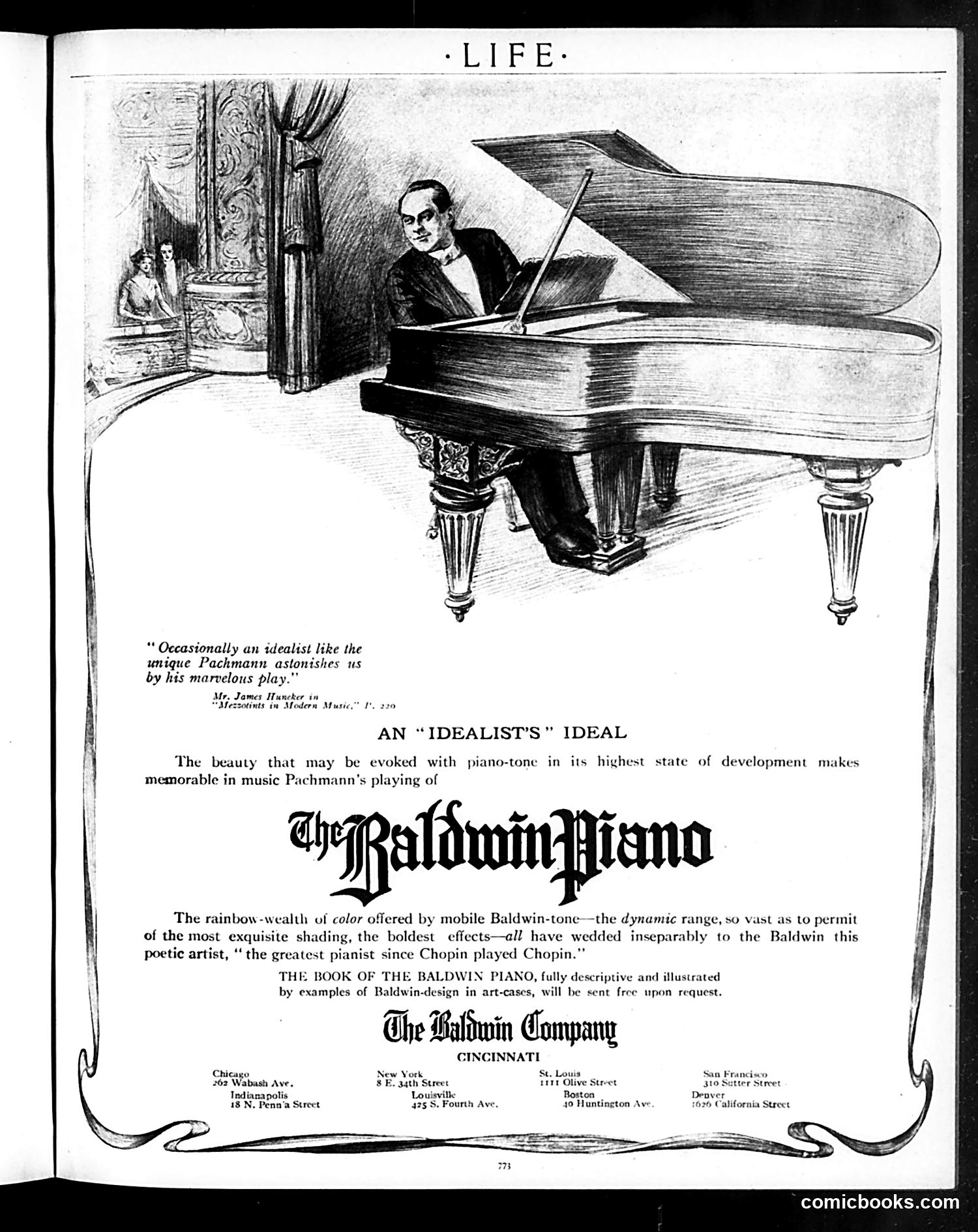
This is a **Baldwin Piano advertisement**, not political satire. The page features a sketch of pianist Vladimir de Pachmann at a grand piano, with text praising his artistry. The "satire" is subtle advertising wordplay: the headline calls Pachmann an "idealist" whose "ideal" instrument is the Baldwin piano. A music critic (James Huneker) is quoted calling Pachmann uniquely talented, and the ad claims the Baldwin piano's tonal qualities made his playing "memorable." The humor lies in the self-congratulatory marketing—presenting a piano endorsement as cultural validation. By associating the Baldwin with Pachmann (described as "the greatest pianist since Chopin"), the company elevates their product to an artistic necessity. For a modern reader: this is essentially a celebrity endorsement ad dressed up as cultural commentary, using flattery of both artist and instrument to persuade wealthy buyers that owning a Baldwin piano connected them to musical greatness.
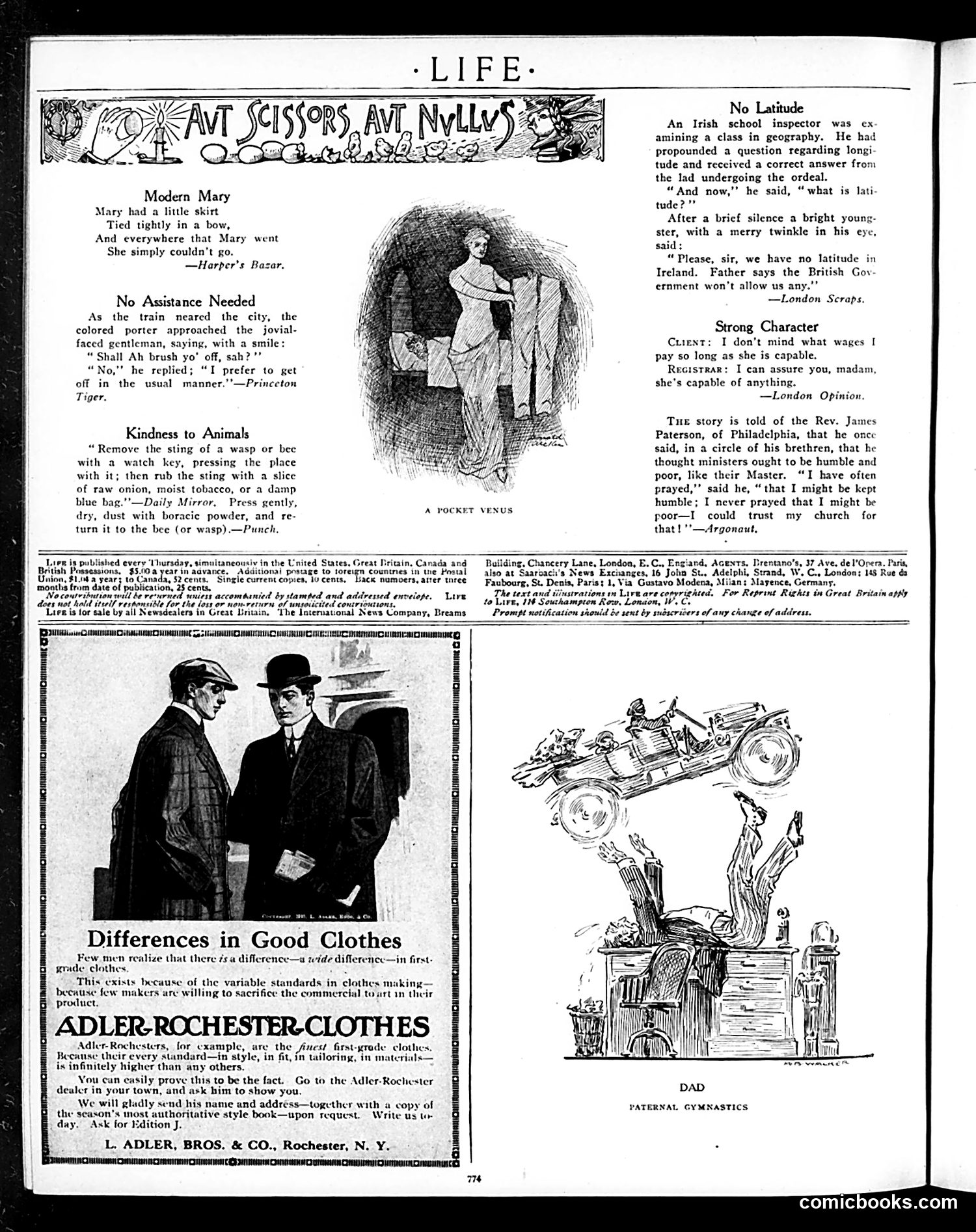
This page contains several brief humorous anecdotes and advertisements typical of early 20th-century American satirical humor. The jokes target contemporary social attitudes: "Modern Mary" mocks the restrictive clothing fashions of the era (tight corsets and skirts); "No Latitude" makes light of Irish grievances against British colonial rule through a schoolboy's clever wordplay; "Strong Character" plays on assumptions about domestic servants' capabilities; and the anecdote about Rev. Paterson satirizes ministerial hypocrisy regarding poverty. The central illustration, "A Pocket Venus," depicts a woman in classical pose—appearing to reference popular aesthetics of beauty and femininity. "Differences in Good Clothes" is a full advertisement for Adler-Rochester clothing, emphasizing quality craftsmanship as superior to competitors. "Dad: Paternal Gymnastics" (bottom right) shows a humorous illustration of a father performing acrobatic stunts with his child, playing on the notion of vigorous paternal engagement. The page is primarily miscellaneous humor and advertising rather than cohesive political or social commentary.
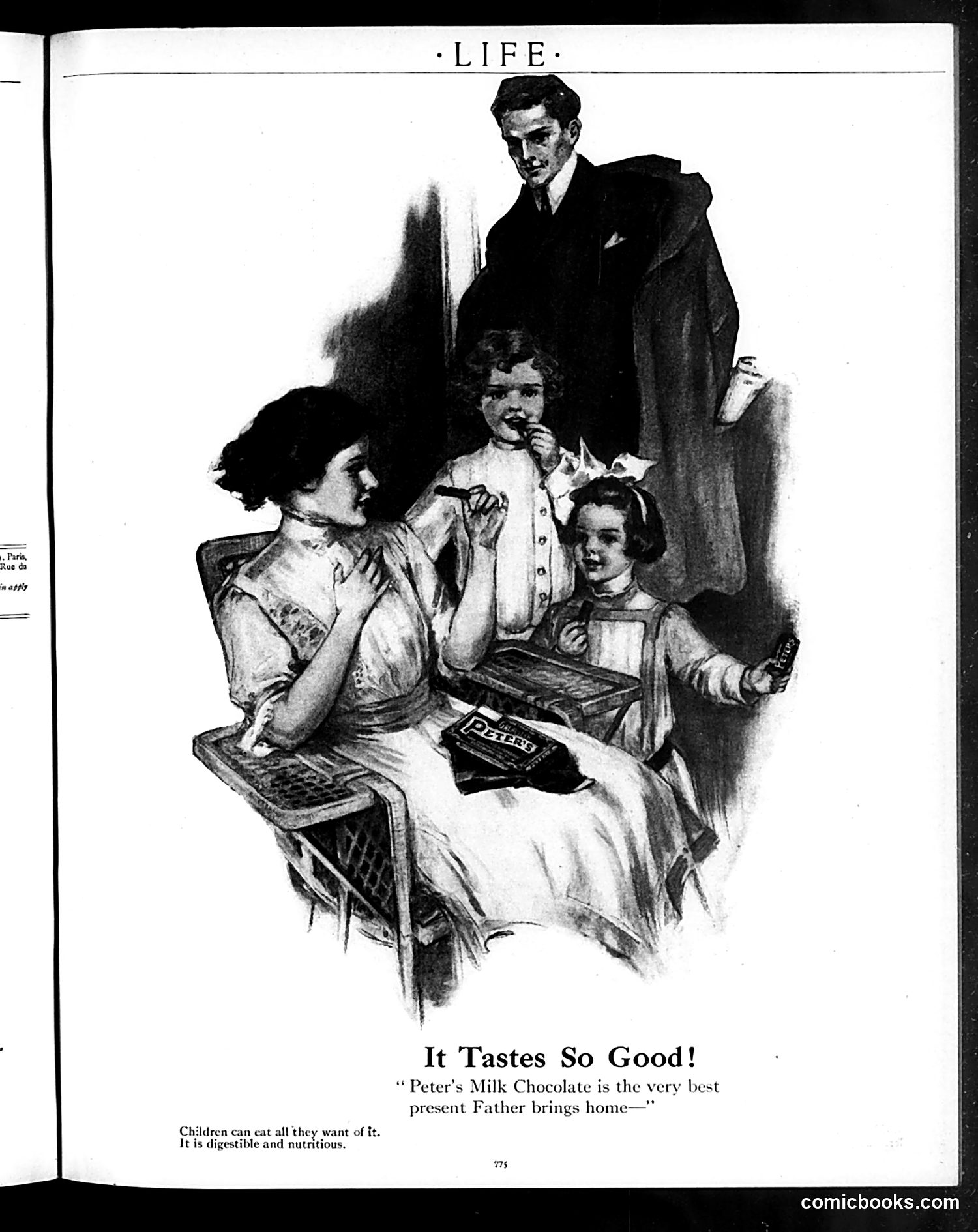
This is a **Peter's Milk Chocolate advertisement**, not satire or political commentary. The page depicts a domestic scene where a father (standing, in dark suit) presents chocolate to his wife and two children. The tagline emphasizes that Peter's chocolate is an ideal gift fathers bring home. The ad's appeal targets early-20th-century middle-class values: paternal generosity, family togetherness, and child welfare. The reassuring claims that chocolate is "digestible and nutritious" and that "children can eat all they want" reflect period advertising strategies addressing parental concerns about candy safety—a significant marketing angle when food regulation was nascent. The illustration's sentimental, idealized family portrayal is typical of vintage advertising aesthetics designed to associate the product with wholesomeness and domestic happiness.
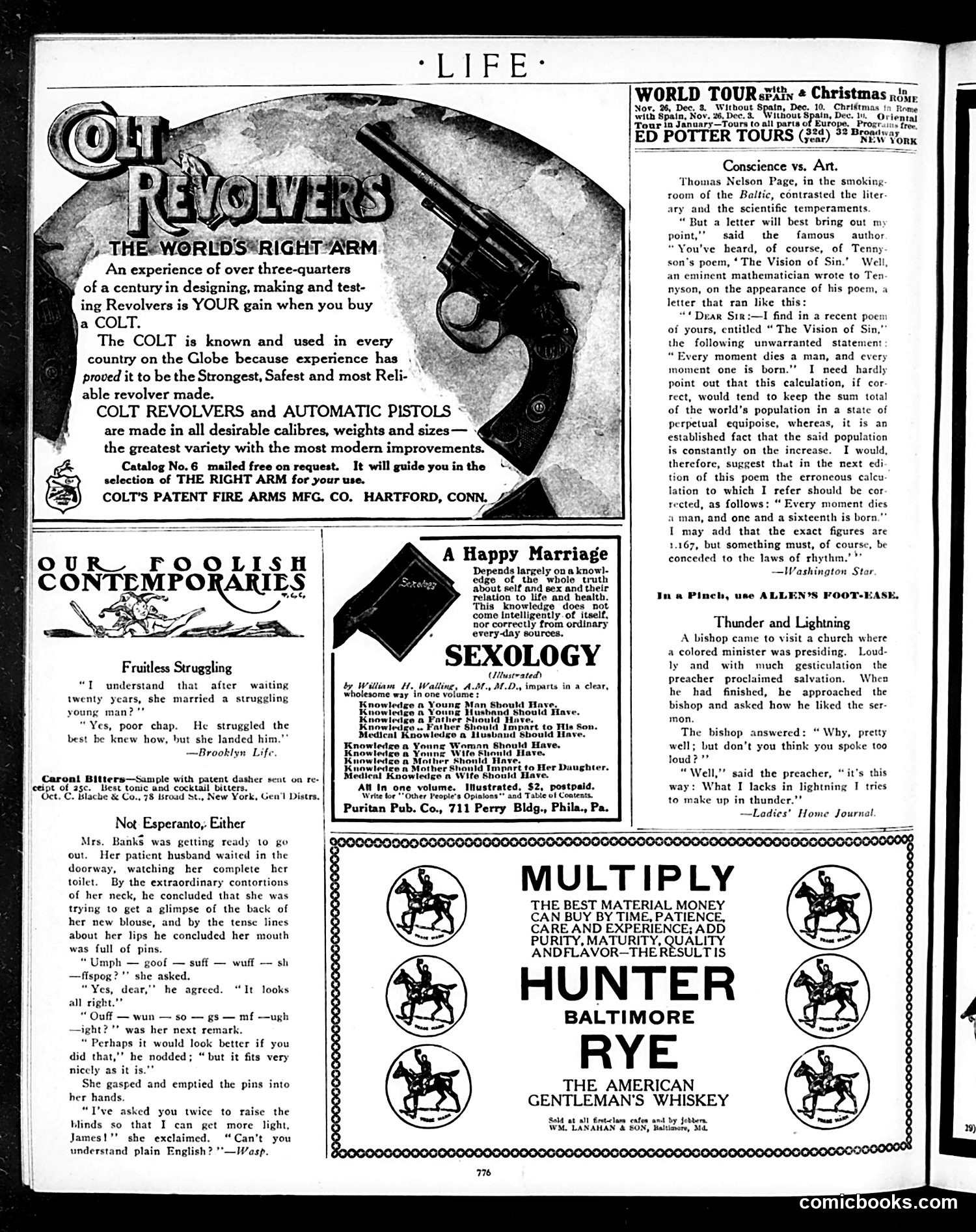
This page is primarily **advertising and humor columns** from an early 20th-century *Life* magazine issue. **Main Content:** The "Conscience vs. Art" piece describes author Thomas Nelson Page contrasting literary and scientific temperaments. A mathematician critiqued Alfred Tennyson's poem "The Vision of Sin" for the line "Every moment dies a man, and every moment one is born"—arguing this would keep population static, when populations actually increase. The satire mocks overly literal-minded scientific pedantry applied to poetry. **Humor Columns:** "Fruitless Struggling" and "Not Esperanto, Either" are typical early-1900s domestic comedy, relying on wordplay and marital miscommunication tropes common to the era. **Large Advertisements:** Colt Revolvers, Hunter Baltimore Rye whiskey, Sexology books, and other products dominate the page—typical of *Life's* business model mixing editorial content with paid advertising. The page reflects early 20th-century magazine publishing, satirical sensibilities, and consumer culture.
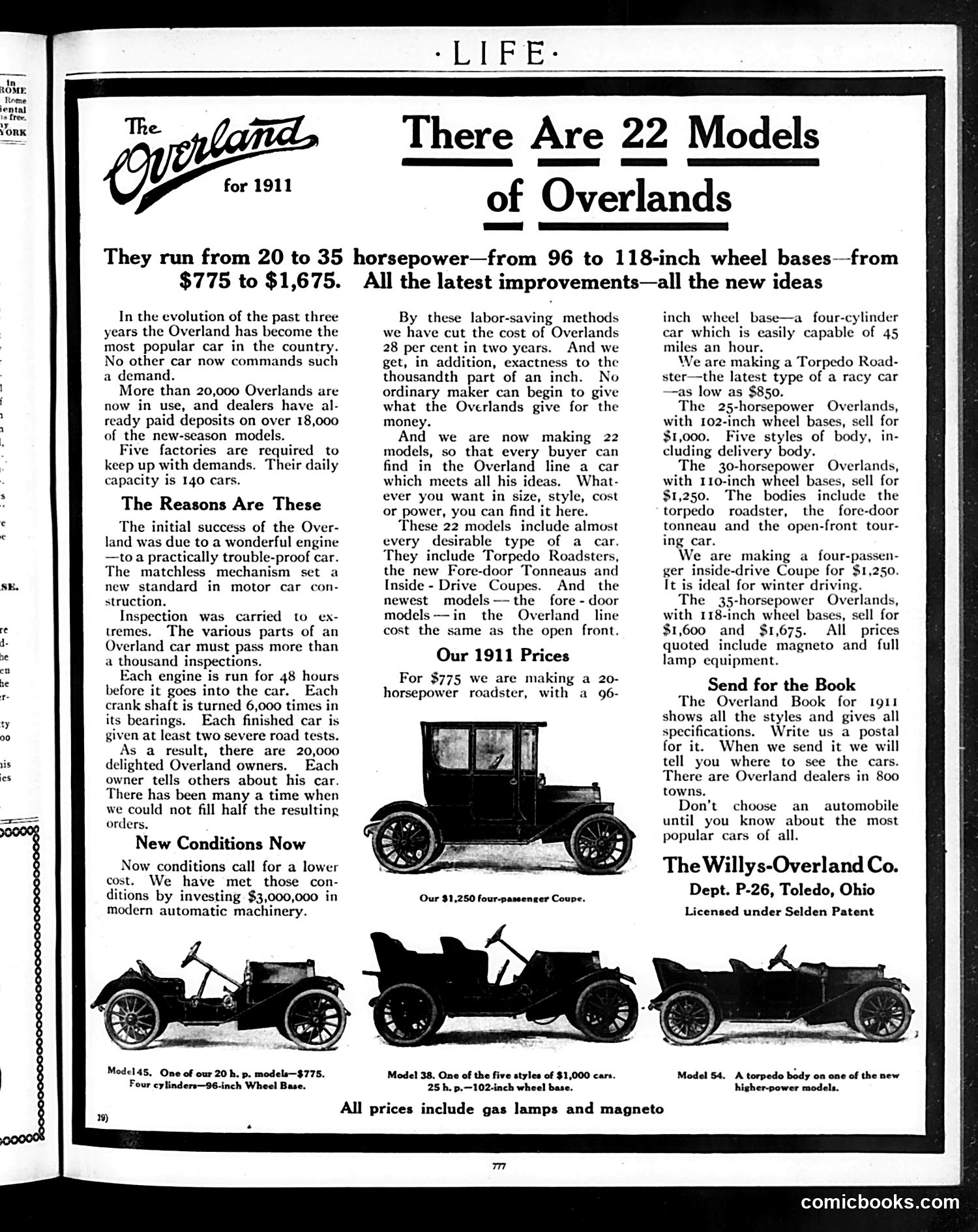
This is a straightforward **automobile advertisement**, not satirical content. It's a full-page ad for the Overland car, published in *Life* magazine in 1911. The page promotes the Willys-Overland Company's 1911 vehicle lineup: 22 models ranging from $775 to $1,675, with 20-35 horsepower. The ad emphasizes manufacturing innovation (the company invested $3 million in automation to cut costs 28%), quality control (engines run 48 hours before installation), and variety—multiple body styles including roadsters, coupes, and tonneaus to suit different buyers. Three photographs show sample models: a basic roadster, a $1,000 touring car, and a torpedo roadster. This represents early automotive marketing when cars were still luxury goods. The ad's appeal to affordability and reliability reflects the competitive auto market of that era, before Ford's Model T dominance.
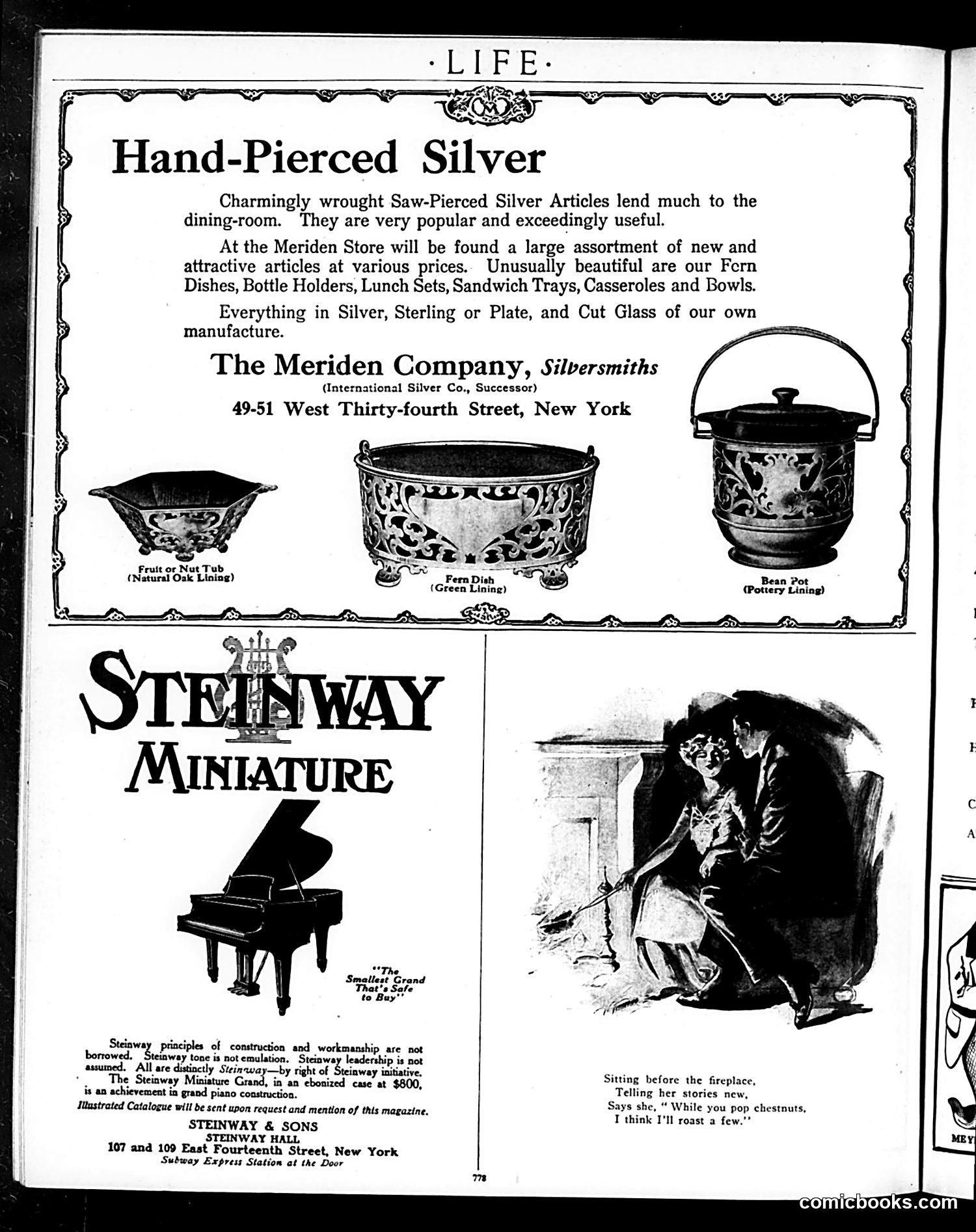
This page is primarily **advertising**, not political satire. It contains three commercial advertisements from the early 20th century: 1. **The Meriden Company** (top): Promotes hand-pierced silver dining articles—fern dishes, bottle holders, casseroles—with product images showing ornate serving vessels with decorative piercings. 2. **Steinway Miniature Grand Piano** (bottom left): Advertises a $600 grand piano, emphasizing Steinway's unique construction principles and craftsmanship. 3. **Fireplace Scene** (bottom right): A lighthearted domestic vignette showing a woman by a fireplace joking about roasting chestnuts while her companion pops them—a play on the phrase "pop chestnuts" that suggests she'll "roast" him instead. There is **no political cartoon or satire** on this page. It reflects period consumer culture and domestic leisure activities among affluent households.
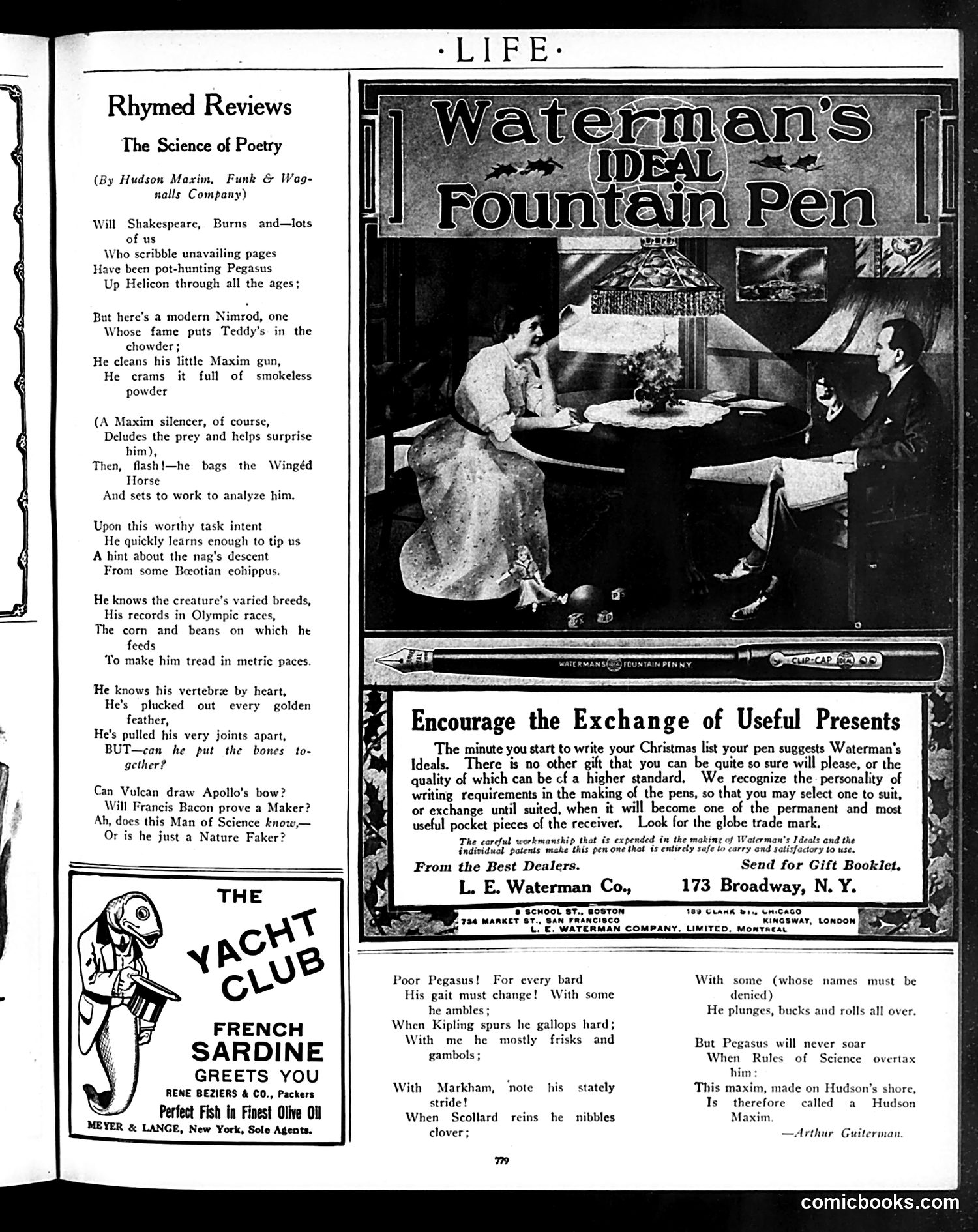
This is a book review by Arthur Guiterman satirizing Hudson Maxim's work *The Science of Poetry*. The joke hinges on a pun: Maxim was an inventor known for the Maxim gun (a smokeless powder weapon), not a poet. Guiterman mocks the premise that poetry can be scientifically dissected like a machine. The metaphor compares Maxim to a hunter who kills Pegasus (the mythical winged horse symbolizing poetic inspiration), then analytically "pulls his very joints apart" — breaking down the creature's anatomy, breeding, diet, and skeletal structure. The satire's point: such mechanical analysis destroys poetry's essence. The final "maxim" pun suggests that applying scientific rules to art produces not inspiration but mere mechanical output — a "Hudson Maxim" (gun) rather than genuine verse. The review mocks pseudo-scientific approaches to inherently non-scientific subjects.
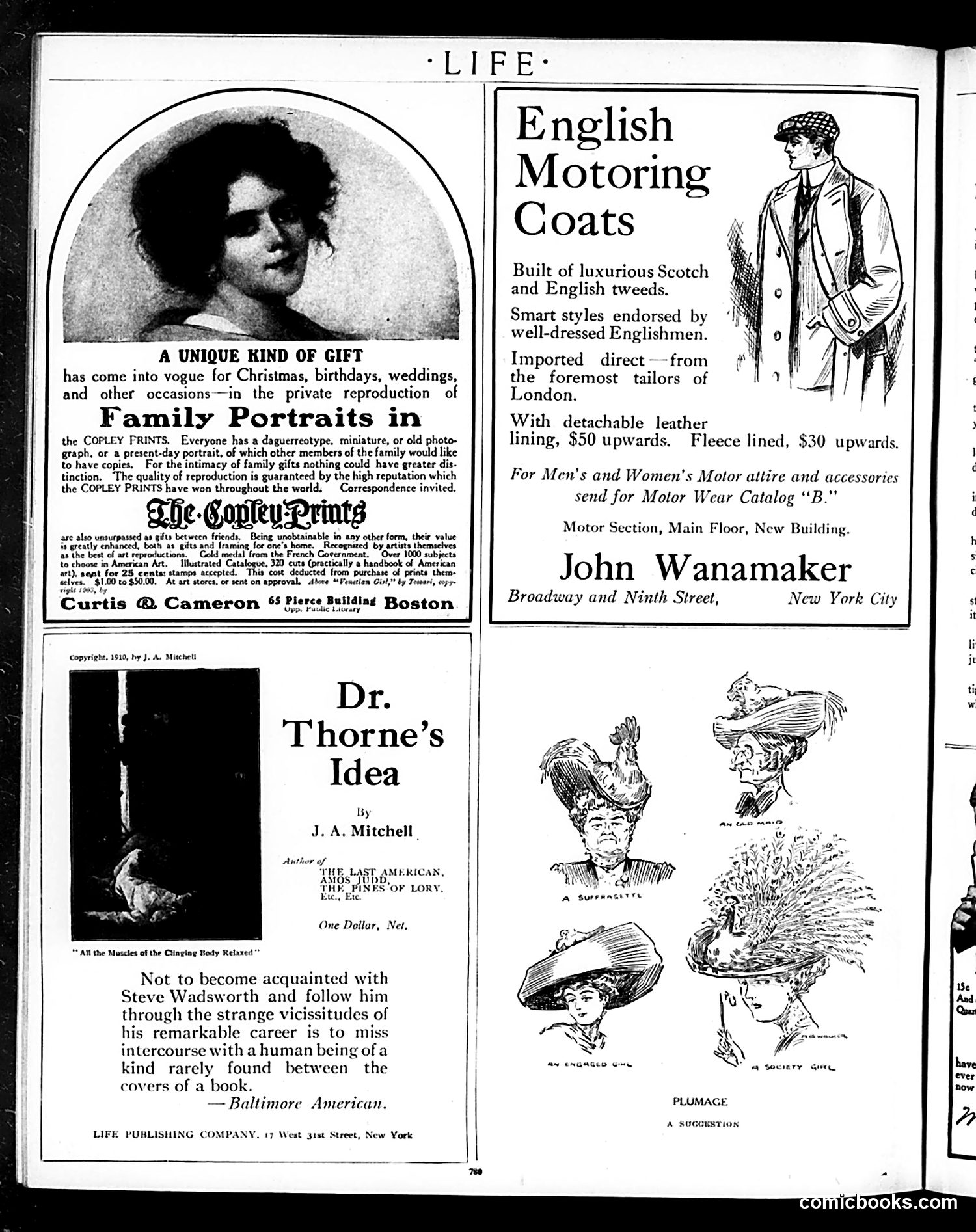
This page is primarily **advertising and book promotion**, not political satire. The content includes: 1. **Copley Prints advertisement** (top left): Promotes family portrait reproductions as gift-giving, targeting middle-class consumers seeking affordable art. 2. **Dr. Thorne's Idea book promotion** (bottom left): A novel by J.A. Mitchell (Life's editor) about a character named Steve Wadsworth, endorsed by the Baltimore American. 3. **English Motoring Coats advertisement** (top right): John Wanamaker department store ad promoting imported British clothing for the emerging automotive market—a luxury/status symbol. 4. **Plumage sketch** (bottom right): Four hat designs labeled "A Suggestion," likely satirizing women's elaborate millinery fashion trends of the era. The page reflects early-1910s consumer culture: family portraiture, leisure reading, motorcar fashion, and women's conspicuous hat consumption. No specific political figures or events are referenced.
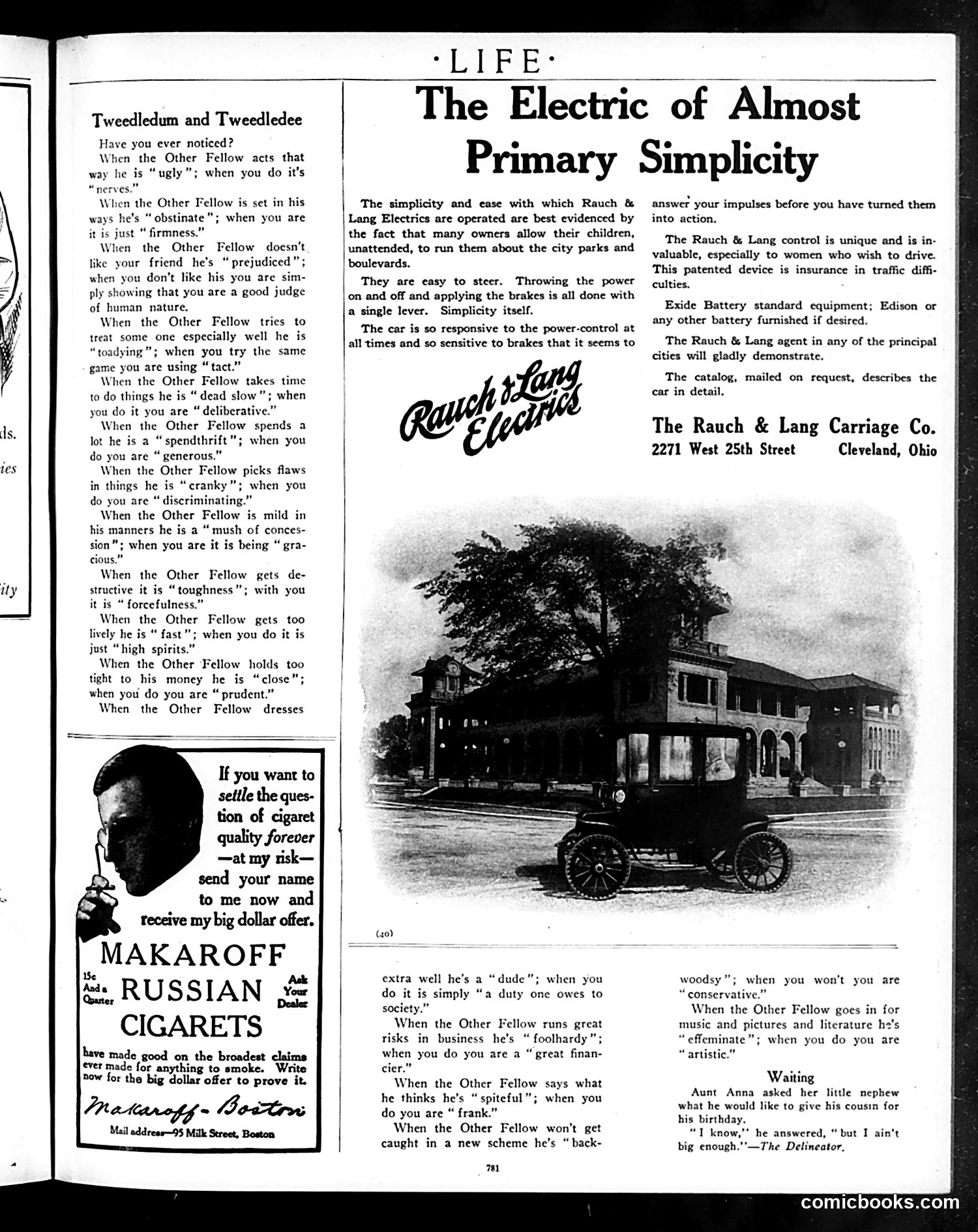
**Main Content: "Tweedledum and Tweedledee"** This is a satirical commentary on human hypocrisy and double standards. The piece lists paired scenarios showing how we judge identical behaviors differently depending on who performs them. When "the Other Fellow" does something, we use negative terms ("ugly," "obstinate," "cranky"); when we do it, we use positive euphemisms ("nerves," "firmness," "discriminating"). The title references Lewis Carroll's characters to suggest this behavior is absurdly predictable and universal. The satire targets our tendency to rationalize our own conduct while condemning others for the same actions—a timeless observation about human nature and moral relativism. **Secondary Content:** Two period advertisements appear: Makaroff Russian Cigarettes and Rauch & Lang electric automobiles (notable for marketing ease of operation to women drivers). A brief joke titled "Waiting" concludes the page.
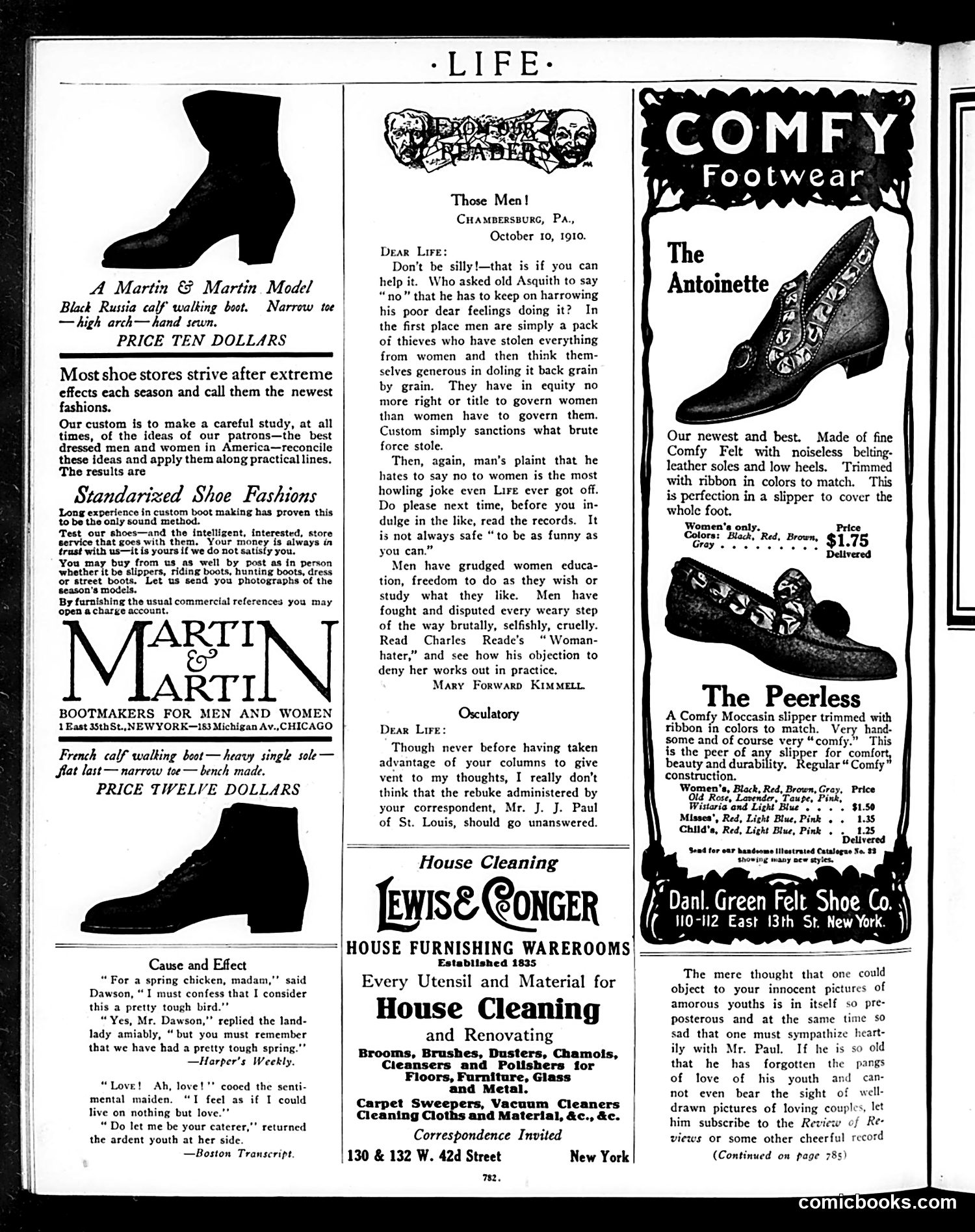
This page primarily contains **advertisements for footwear and household goods**, interspersed with reader letters to the magazine addressing women's rights and gender relations. The substantive content appears in three letters to "Dear Life": 1. **First letter (Chambersburg, PA)**: A woman responds sharply to what appears to be a previous article or letter. She argues men are "thieves" who've "stolen everything from women" and patronizingly return it "grain by grain." She challenges the notion that men "hate to say no to women," calling it "the most howling joke," and demands men read historical records before claiming to be generous toward female autonomy. 2. **Second letter (Osculatory)**: A reader defends a previous rebuttal by "Mr. J. J. Paul of St. Louis," suggesting his criticism of women's rights advocates deserves response. 3. **Third letter (Cause and Effect)**: A brief anecdote about chickens (fragment visible). **Context**: This reflects early 1910s debates over women's suffrage and equality—contentious issues before women gained voting rights in 1920. The letters show active public discourse on gender relations in Life's correspondence section.
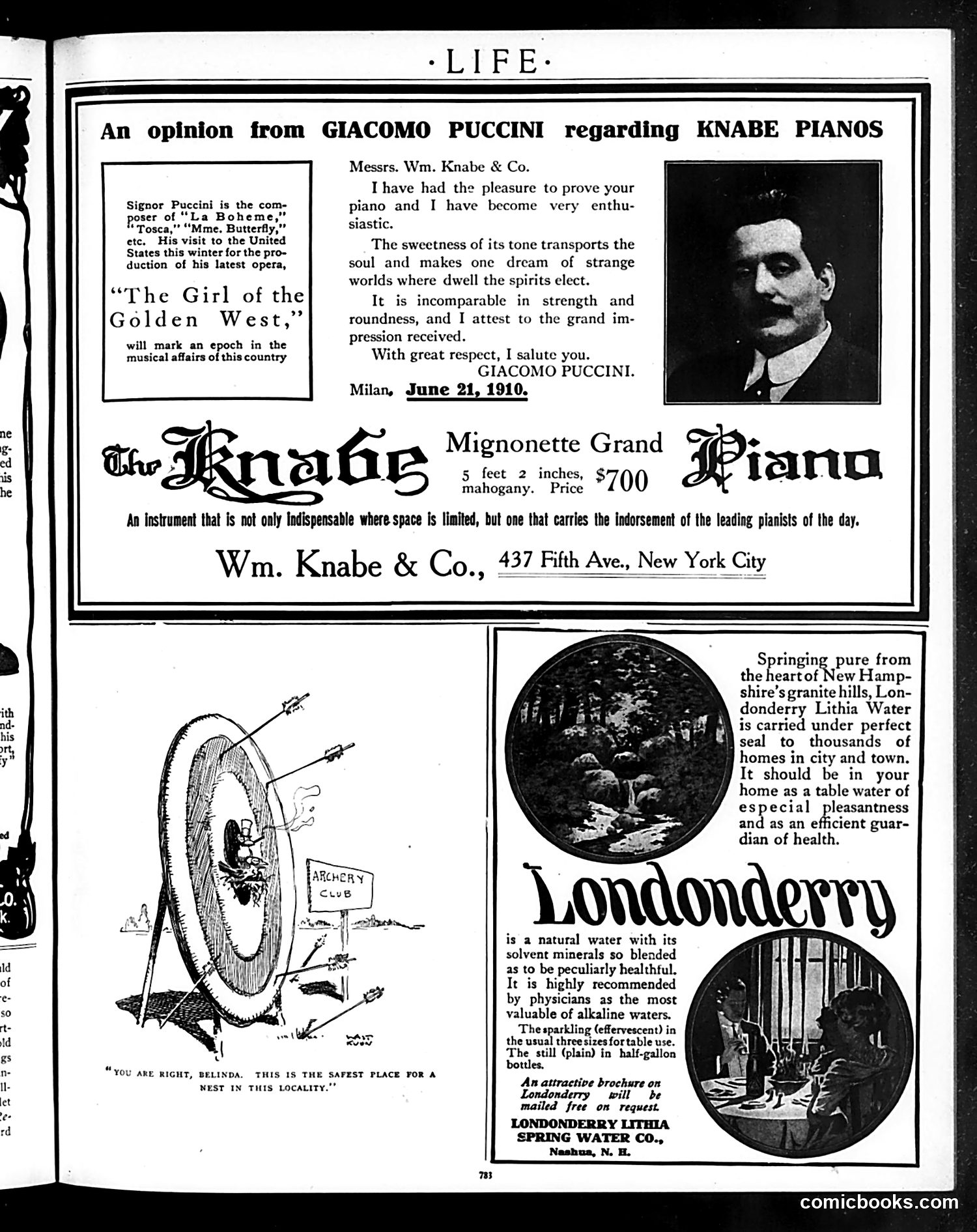
This is primarily an **advertising page** from Life magazine (dated around 1910, based on Puccini reference). The main content features a **celebrity endorsement**: composer Giacomo Puccini testifies to the quality of Knabe pianos, praising their tone and strength. This was a common advertising strategy—leveraging famous artists' names to sell luxury goods. The page also includes: - A small **cartoon** showing an archer at a club with the caption "You are right, Belinda. This is the safest place for a nest in this locality"—a mild joke about archery being unexpectedly safe for birds. - Advertisements for **Londonderry Lithia Water**, a mineral spring water marketed as healthful, recommended by physicians for its alkaline properties. The satire is implicit: Life presents high-class luxury items (pianos, bottled spring water) alongside modest social humor, reflecting the magazine's satirical approach to American consumer culture and upper-class aspirations of the era.
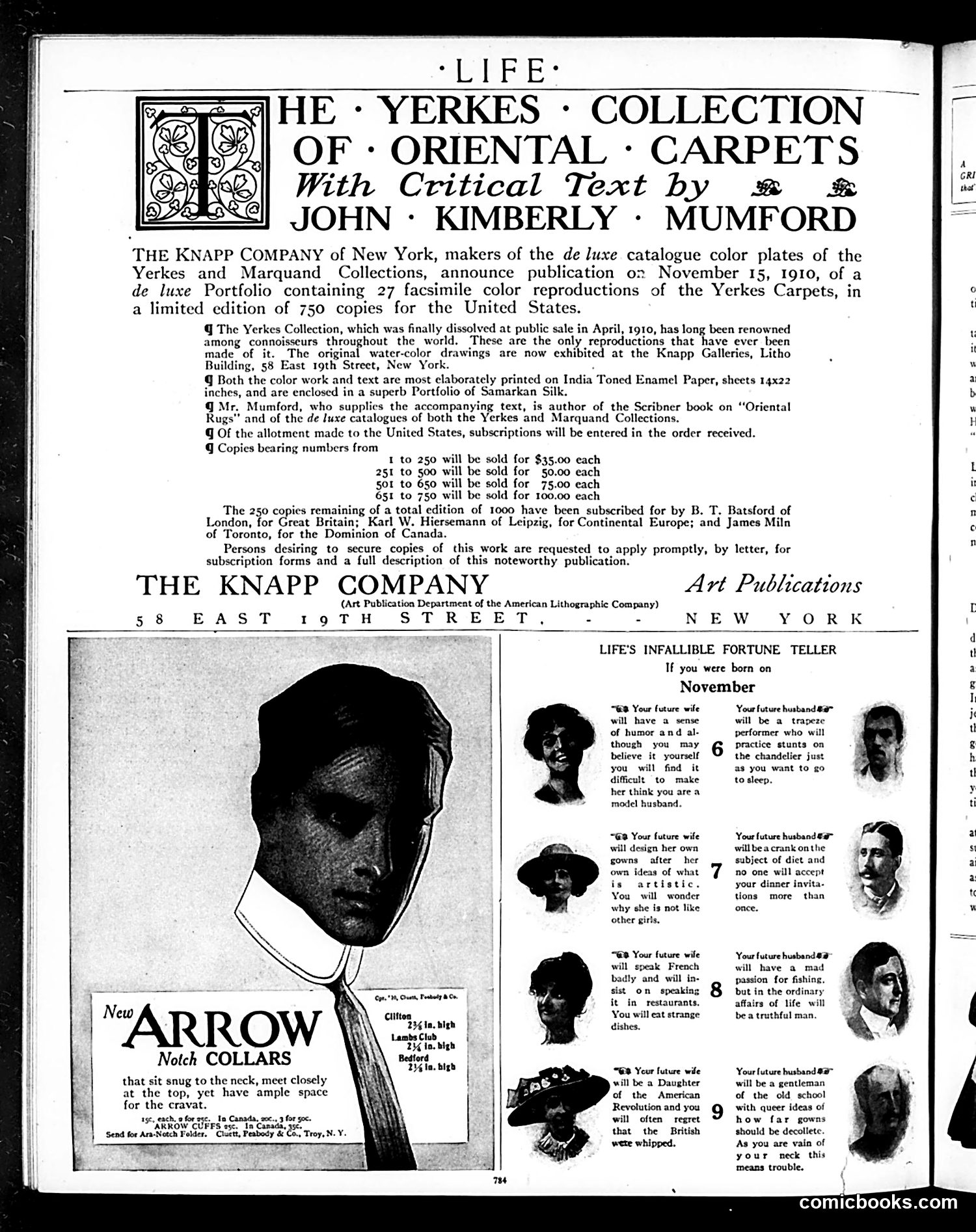
This page is primarily **advertising and announcements**, not political satire. The dominant content announces a luxury portfolio of the Yerkes Oriental Carpet Collection—a prestigious estate collection dissolved in 1910—being published by the Knapp Company in a limited edition of 750 copies at escalating prices ($35–$100 depending on copy number). The right side features "Life's Infallible Fortune Teller," a **humorous fortune-telling game for November births**. This is light social satire: it mockingly predicts domestic futures (wives will be eccentric, husbands will be odd) in playful, exaggerated terms—poking fun at marriage stereotypes and fortune-telling itself. An **Arrow Collar advertisement** appears, showing a man in formal dress, promoting the brand's "Notch" collar design. The page contains no political cartoons or serious satire—it's a commercial publication mixing high-end luxury goods marketing with genteel humor typical of Life magazine's early 20th-century format.
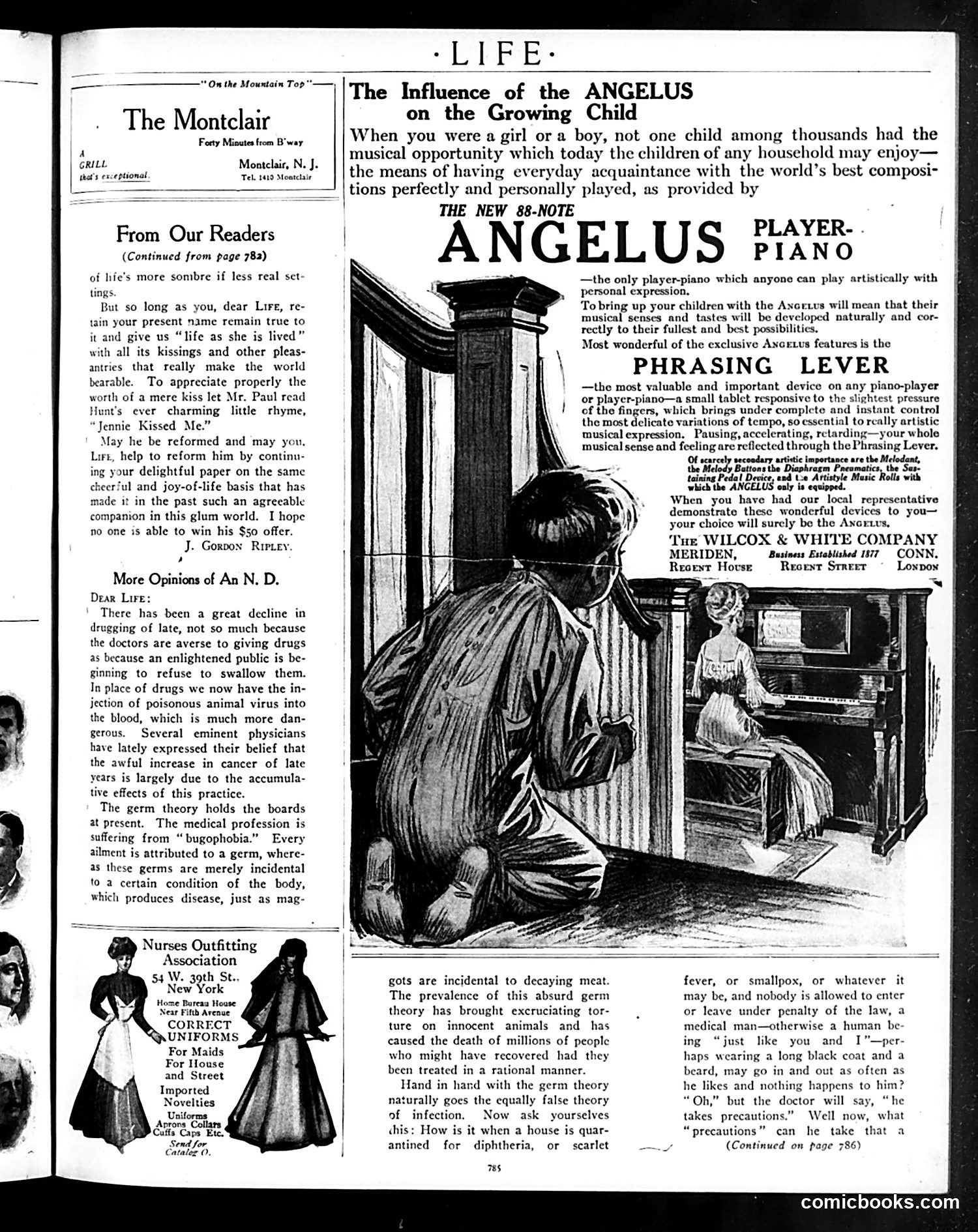
This page primarily consists of **advertisements and readers' letters**, not political satire. The main content is a large **advertisement for the Angelus player-piano**, featuring an illustration of a young girl at the keyboard. The ad emphasizes the piano's "Phrasing Lever"—a device allowing artistic control—and claims the instrument will develop children's musical tastes naturally. It's pitched as a luxury item bringing "the world's best compositions" into any home. The readers' letters section includes medical commentary criticizing the "germ theory" of disease and injections of "poisonous animal virus," likely referencing anti-vaccination sentiment or skepticism toward contemporary medical practices. A letter-writer praises *Life* magazine itself for maintaining its humorous, life-affirming editorial stance. A smaller advertisement promotes correct uniforms for maids and housekeeping staff. **No political cartoon or satire appears on this page.** The content reflects early 20th-century consumer culture and period medical debates.
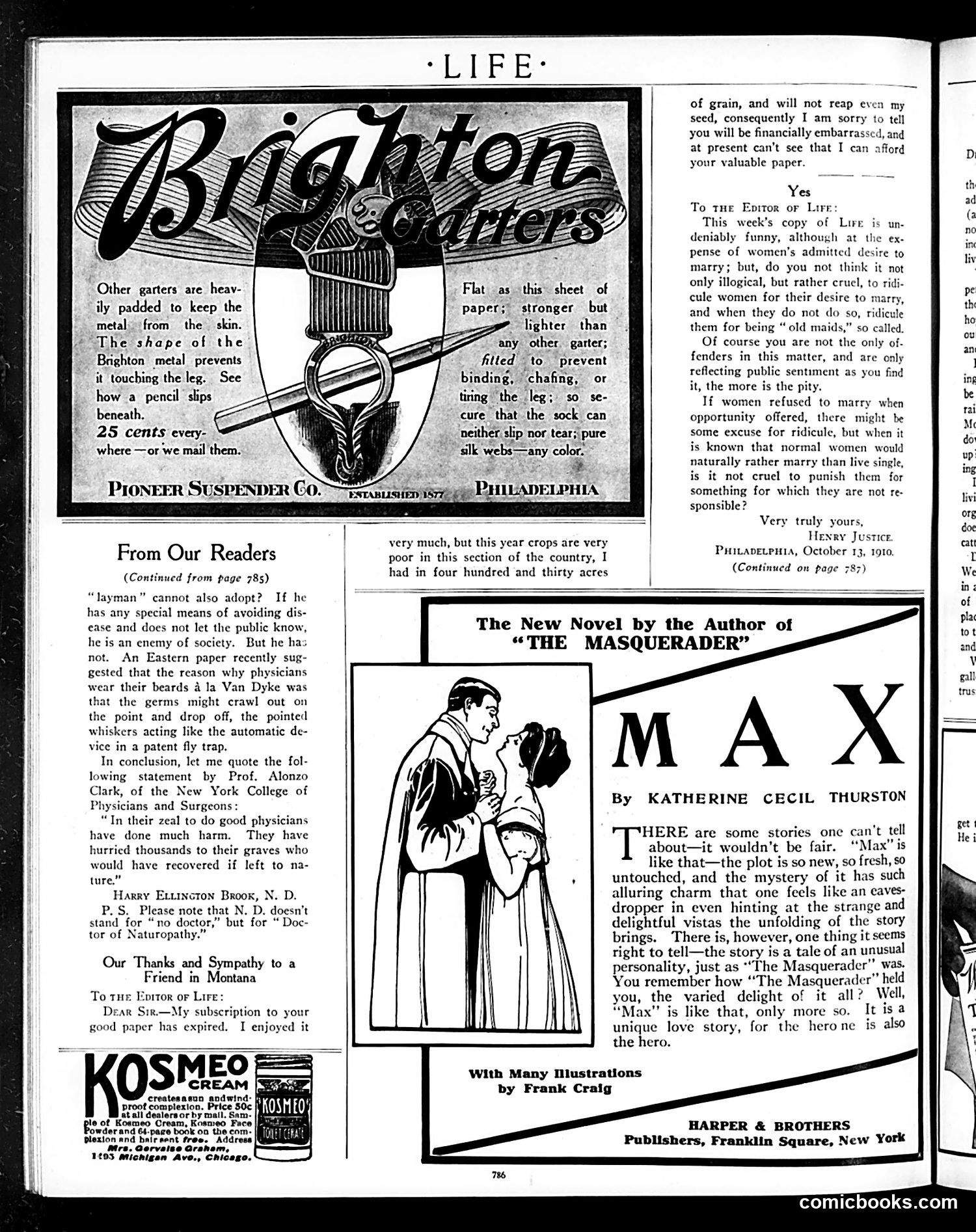
This page combines **advertising, reader letters, and book promotion** typical of early-1900s magazines. The **main advertisement** (top) promotes Brighton garters—elastic leg supports—emphasizing their flat metal design prevents skin irritation and binding. This reflects Victorian/Edwardian era concerns about properly securing hosiery. The **"From Our Readers"** section contains three letters: one defending naturopathic medicine against physicians; another from a Montana farmer too financially devastated by poor crops to renew his subscription (social commentary on agricultural hardship); and a third **criticizing Life's mockery of unmarried women**, arguing it's cruel to ridicule women simultaneously for wanting marriage and for remaining single—a pointed early feminist critique about impossible social double standards. The **book advertisement** promotes Katherine Cecil Thurston's novel *Max*, calling it a unique love story where "the heroine is also the hero"—likely referring to gender-role fluidity or ambiguity, though the actual plot remains opaque, as the ad deliberately avoids spoilers.
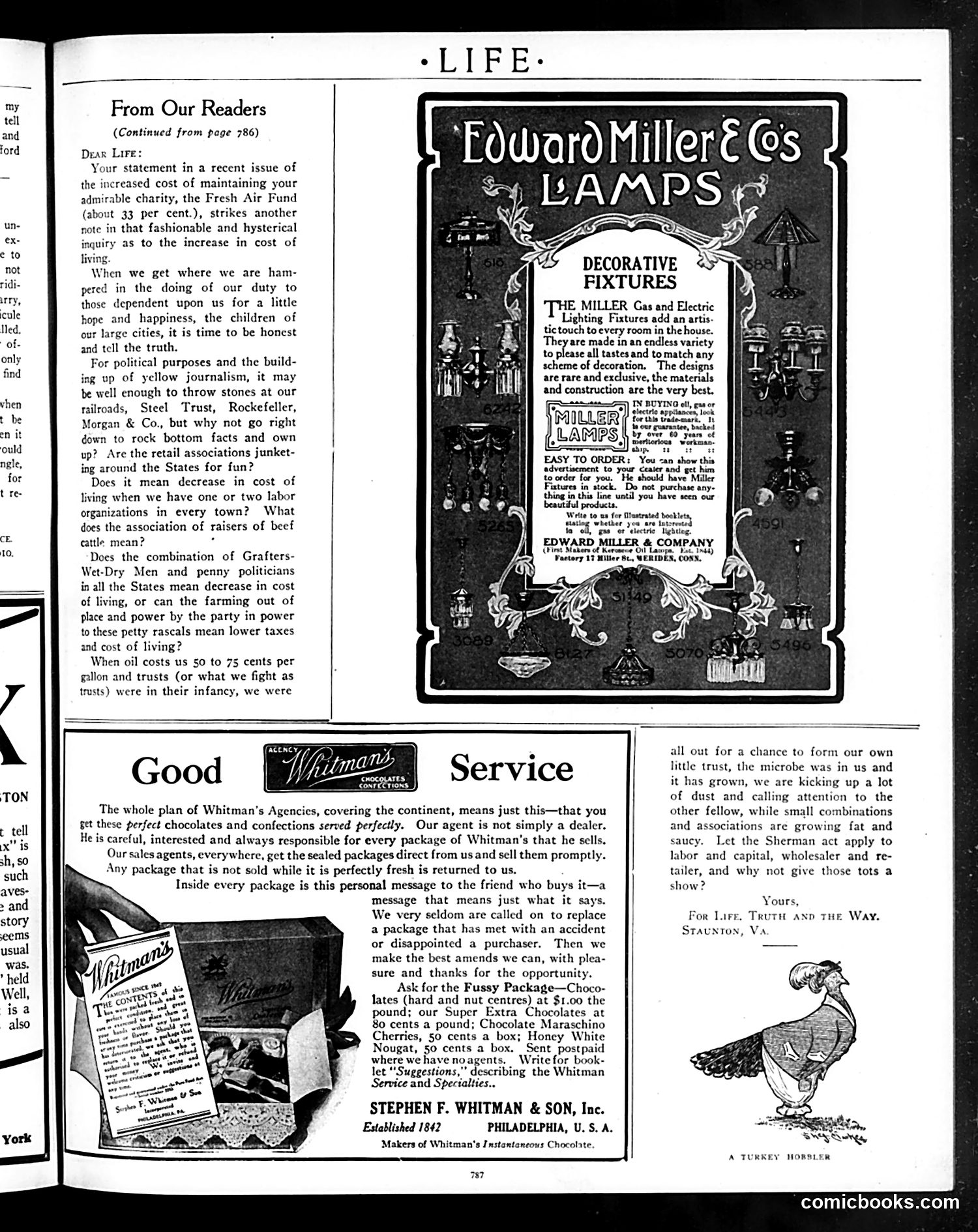
This page contains no political cartoons—it's primarily **advertising and reader letters** from an early 20th-century Life magazine issue. The "From Our Readers" section features a letter criticizing **hypocrisy in American business and politics**. The writer argues that while reformers attack big corporations (railroads, Steel Trust, Rockefeller, Morgan), they ignore how **labor unions, retail associations, and political machines** also increase living costs. He points out the contradiction: when oil trusts were young, people wanted to form their own trusts, but now oppose combinations—yet small businesses and unions grow "fat and saucy" without similar criticism. He calls for consistent application of antitrust laws to "labor and capital, wholesaler and retailer." The advertisements below (Edward Miller lamps, Whitman's chocolates) are period commercial content. The small illustration at bottom right labeled "A Turkey Gobbler" is unrelated decorative art. **No satire or cartoons appear on this page.**
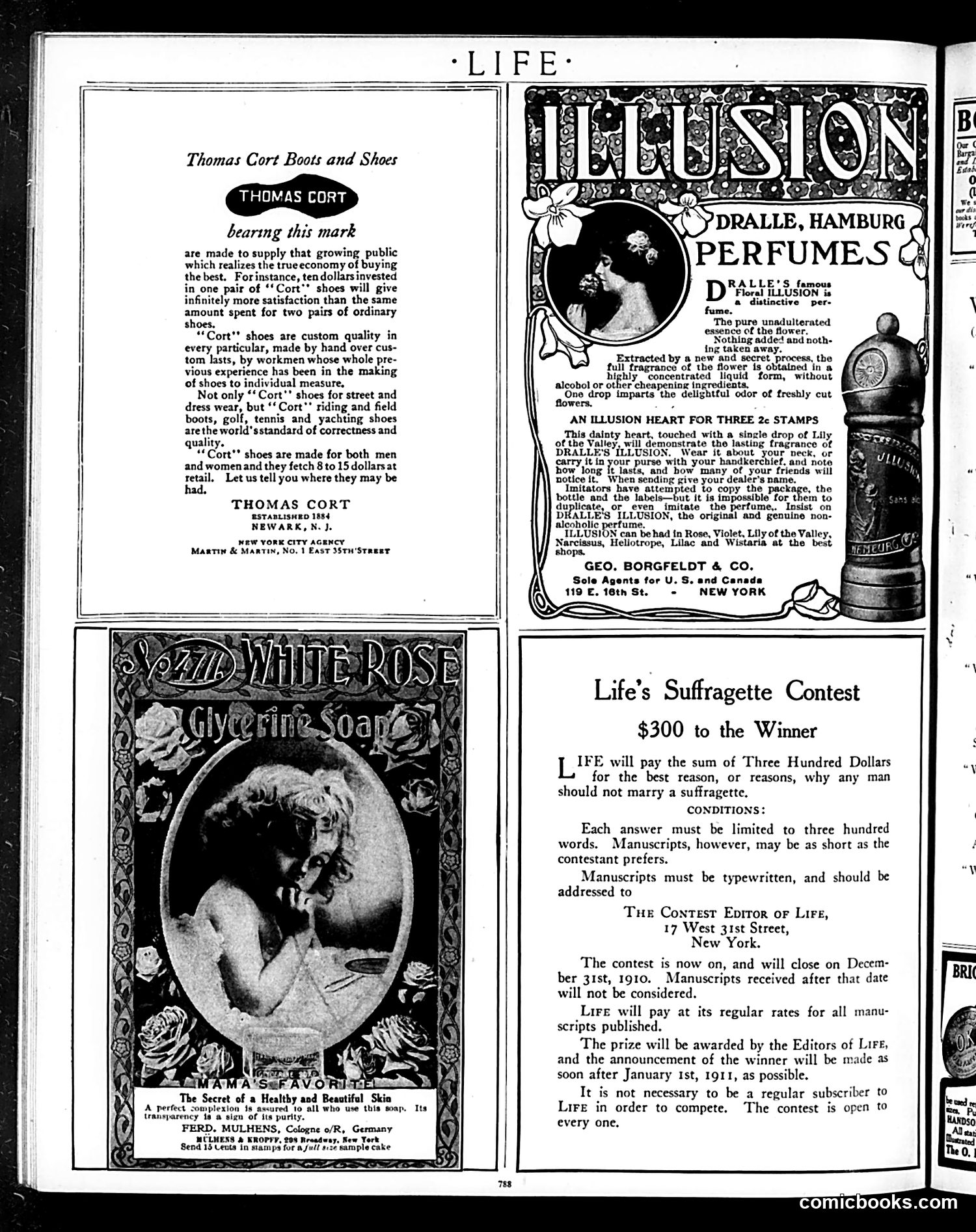
This page from *Life* magazine (circa 1910) is primarily **advertising with one notable satirical contest**. The ads feature luxury goods: Thomas Cort custom shoes, White Rose glycerin soap, and Dralle's Illusion perfume—typical high-end products marketed to affluent readers. The significant content is **"Life's Suffragette Contest,"** offering $300 for the best written answer to: "Why should any man not marry a suffragette?" This is **satirical commentary on anti-suffrage sentiment**. By framing the question as a formal contest with prize money, *Life* mocks the arguments opponents made against women's voting rights—particularly the common claim that suffragettes were undesirable as wives. The contest invites readers to articulate these prejudices, thereby exposing their absurdity through public competition. The contest deadline was December 31, 1910, placing this during the active suffrage movement. *Life's* approach was characteristically irreverent: using humor and satire to critique social conservatism rather than direct advocacy.
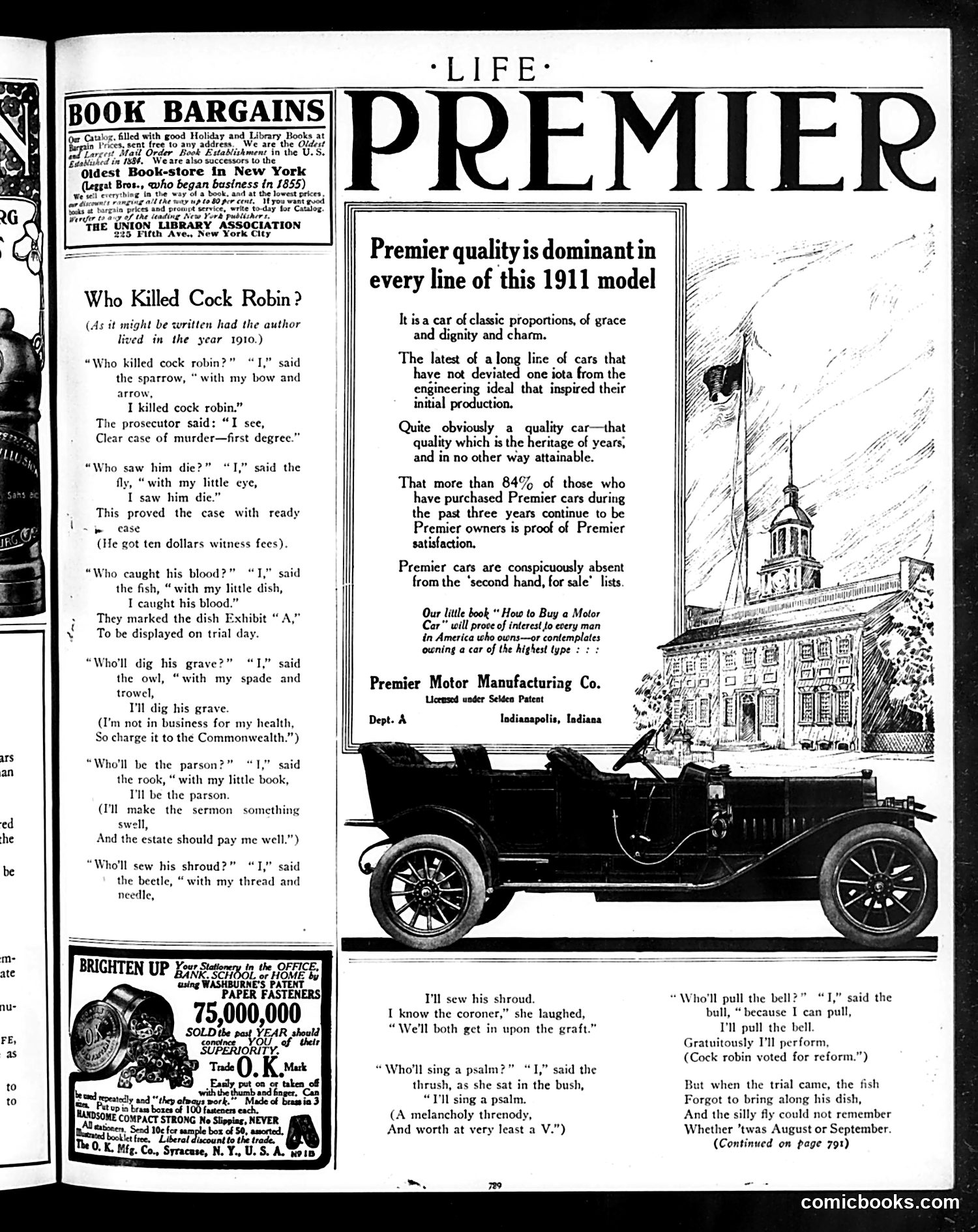
This is a modern adaptation of the classic nursery rhyme, rewritten as a corruption narrative satirizing early 20th-century American politics and law. Each animal character represents a different profession seeking payment or personal gain from their involvement in the "murder": the fly demands witness fees, the fish and rook expect "graft" (corruption payoffs), the owl charges the commonwealth, the parson demands estate payment. The satire culminates when the trial exposes the whole scheme as fraudulent—the fish forgets his evidence, the fly can't remember details. The point: the entire American justice system, from witnesses to clergy to bureaucrats, is portrayed as self-serving and corrupt. Even "reform" (the cock robin's voting position) offers no protection. This reflects Progressive Era anxieties about institutional corruption and the unreliability of supposedly impartial officials. The page also carries a Premier automobile advertisement, a book bargains ad, and a patent medicine ad—typical period magazine filler.
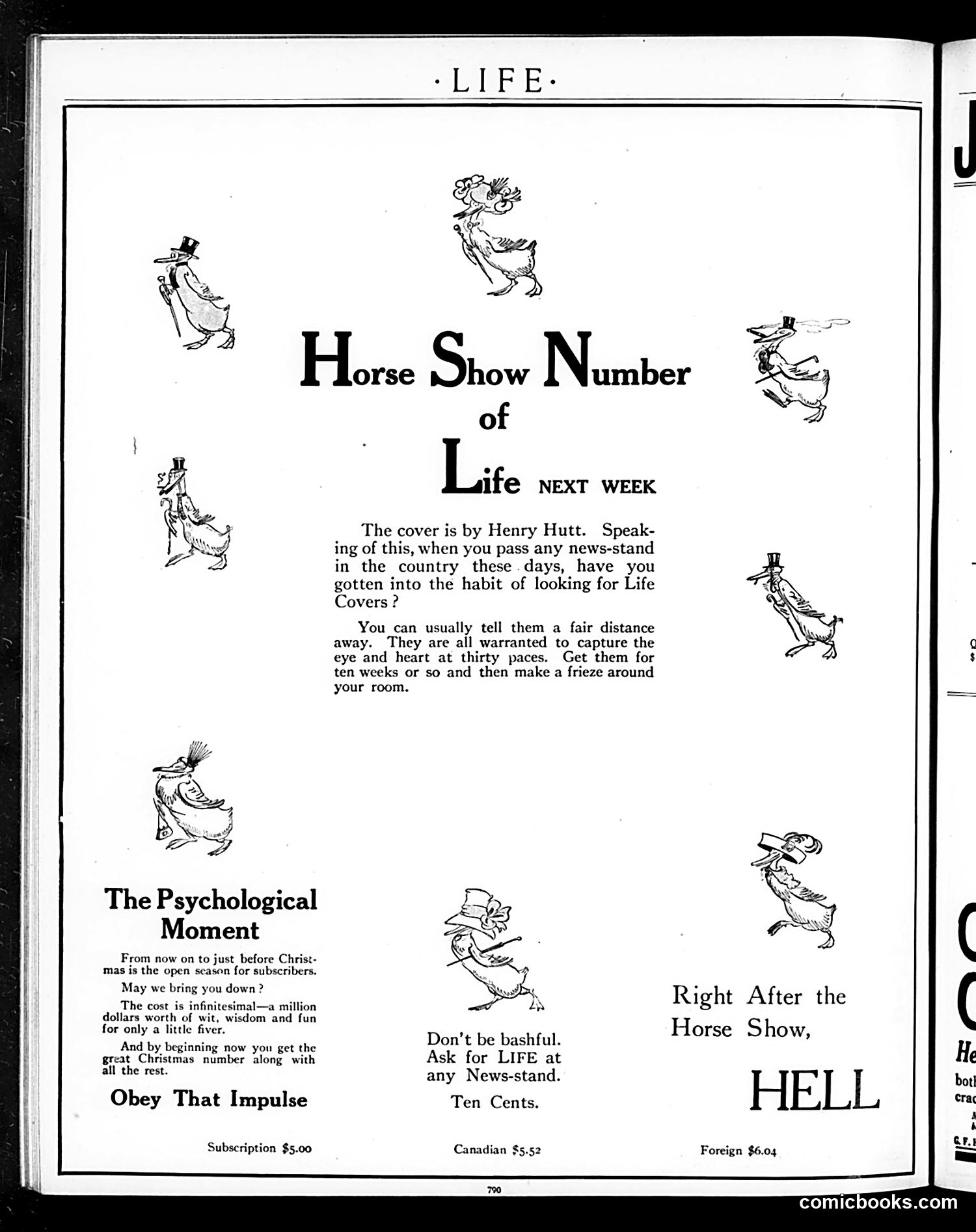
This is primarily a **subscription solicitation page** for *Life* magazine, decorated with whimsical illustrations of dancing figures in period dress (likely early 20th century). The page promotes: 1. **The upcoming "Horse Show Number"** — a themed issue featuring cover art by Henry Hutt, with the pitch that *Life*'s covers are eye-catching enough to collect and frame. 2. **Christmas subscription drive** — "The Psychological Moment" section argues this is prime time to subscribe before Christmas, using humor to encourage impulse purchases ("Obey That Impulse"). 3. **Pricing and availability** — emphasizing *Life* costs only ten cents at newsstands, with subscription rates listed ($5.00 domestically). The satirical tone is evident in phrases like "a million dollars worth of wit, wisdom and fun for only a little five[r]" and the cheeky "Right After the Horse Show, HELL" — likely a joke about post-holiday letdown or satirizing wealthy society events. The dancing figures throughout suggest the magazine's comedic, lighthearted brand of satire typical of early 20th-century American humor publications.
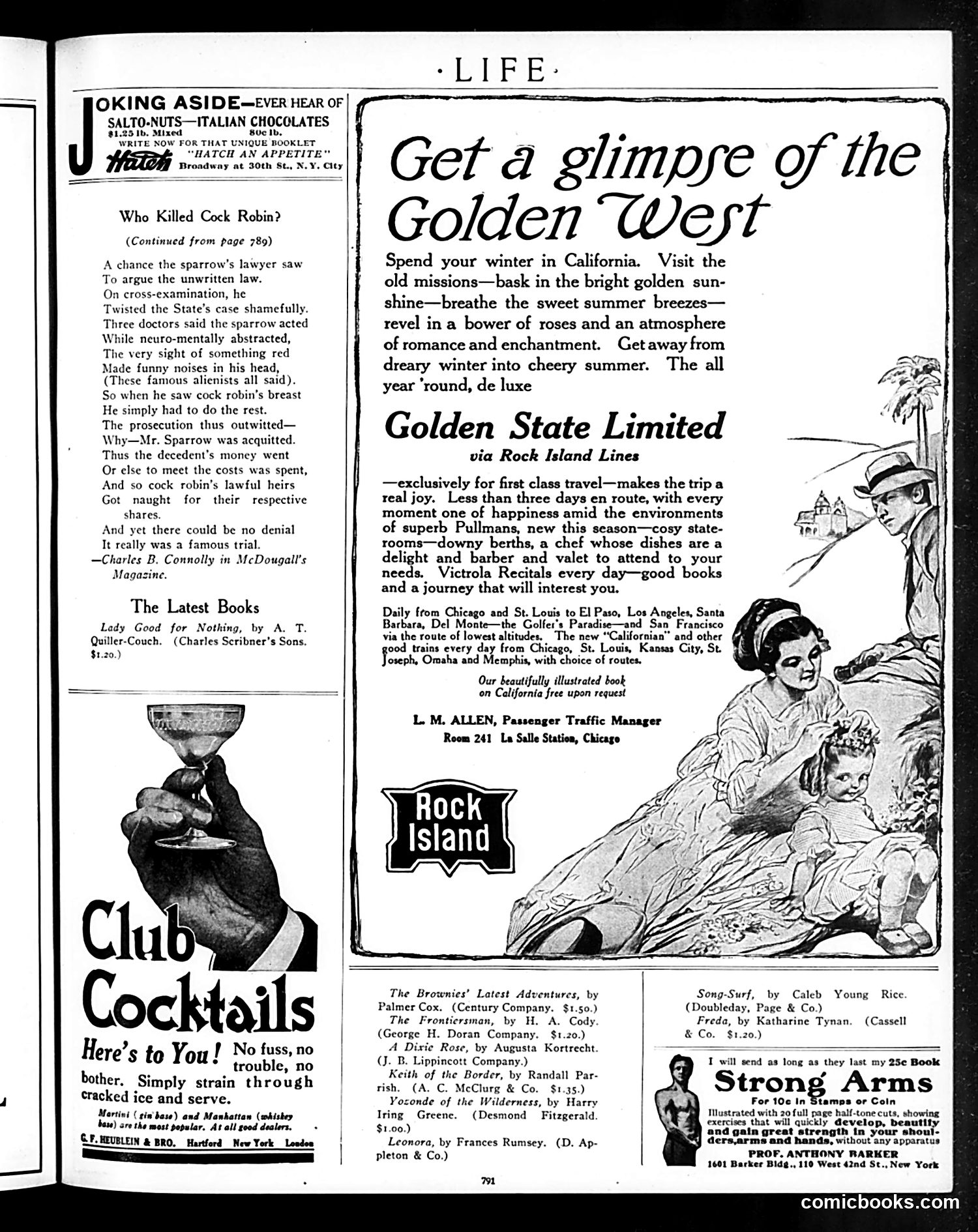
This page presents a poem satirizing the American legal system's absurdities, framed as a mock trial over the nursery rhyme death of Cock Robin. The satire mocks several legal conventions: the sparrow's defense uses the "unwritten law" (a contemporary loophole), expert witnesses (alienists/psychiatrists) provide dubious testimony claiming the sparrow was "neuro-mentally abstracted" and compulsively violent when seeing red, and the defense successfully manipulates the prosecution's case to achieve acquittal. The dark humor critiques how wealthy defendants (Cock Robin's heirs) could lose their inheritance to legal costs while the actual killer escapes justice through technicalities and expert testimony. The poem suggests the legal system prioritizes procedural cleverness over justice—a "famous trial" that achieves the opposite of fairness. The surrounding advertisements (California travel, cocktails, books) are typical Life magazine content and unrelated to the satire.
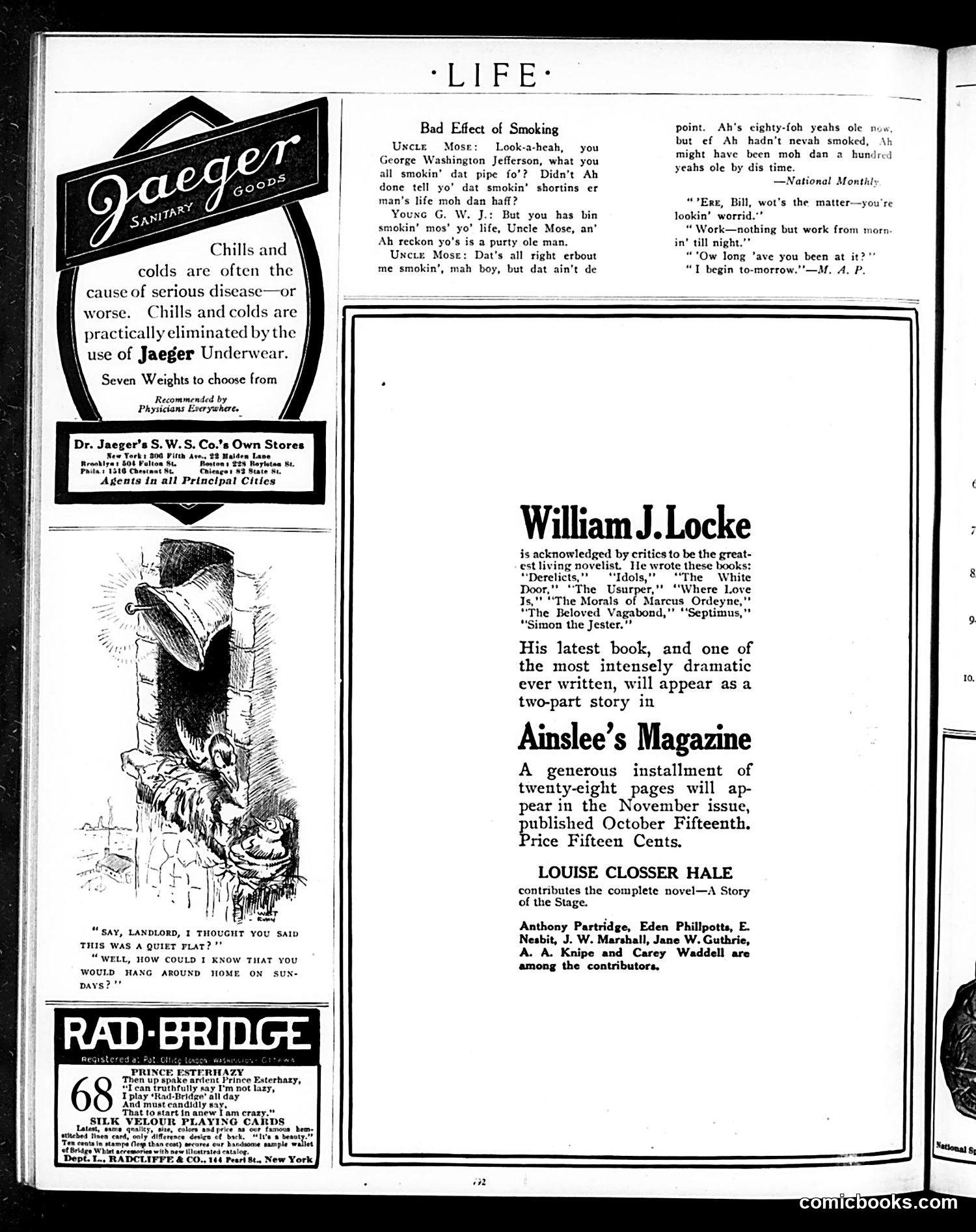
This page contains two brief humorous dialogues rather than political cartoons: **"Bad Effect of Smoking"** features Uncle Mose lecturing young George Washington Jefferson about smoking's health dangers—ironically, while Uncle Mose himself has smoked his entire life. The joke relies on dialect humor common to the era: Uncle Mose claims he'd have lived past 100 if he'd never smoked, despite being already 84. This mocks circular logic and hypocrisy regarding health advice. **The second dialogue** involves a landlord-tenant exchange where a tenant complains about noise in a "quiet flat," only to be told the landlord couldn't have known he'd "hang around home on Sundays"—implying the tenant's presence itself is the problem, not actual disturbance. Both jokes use working-class/working-poor characters and rely on wordplay and situational irony typical of early 20th-century humor magazines. The page is primarily advertisements for underwear and playing cards, with literary announcements for William J. Locke and *Ainslee's Magazine*.
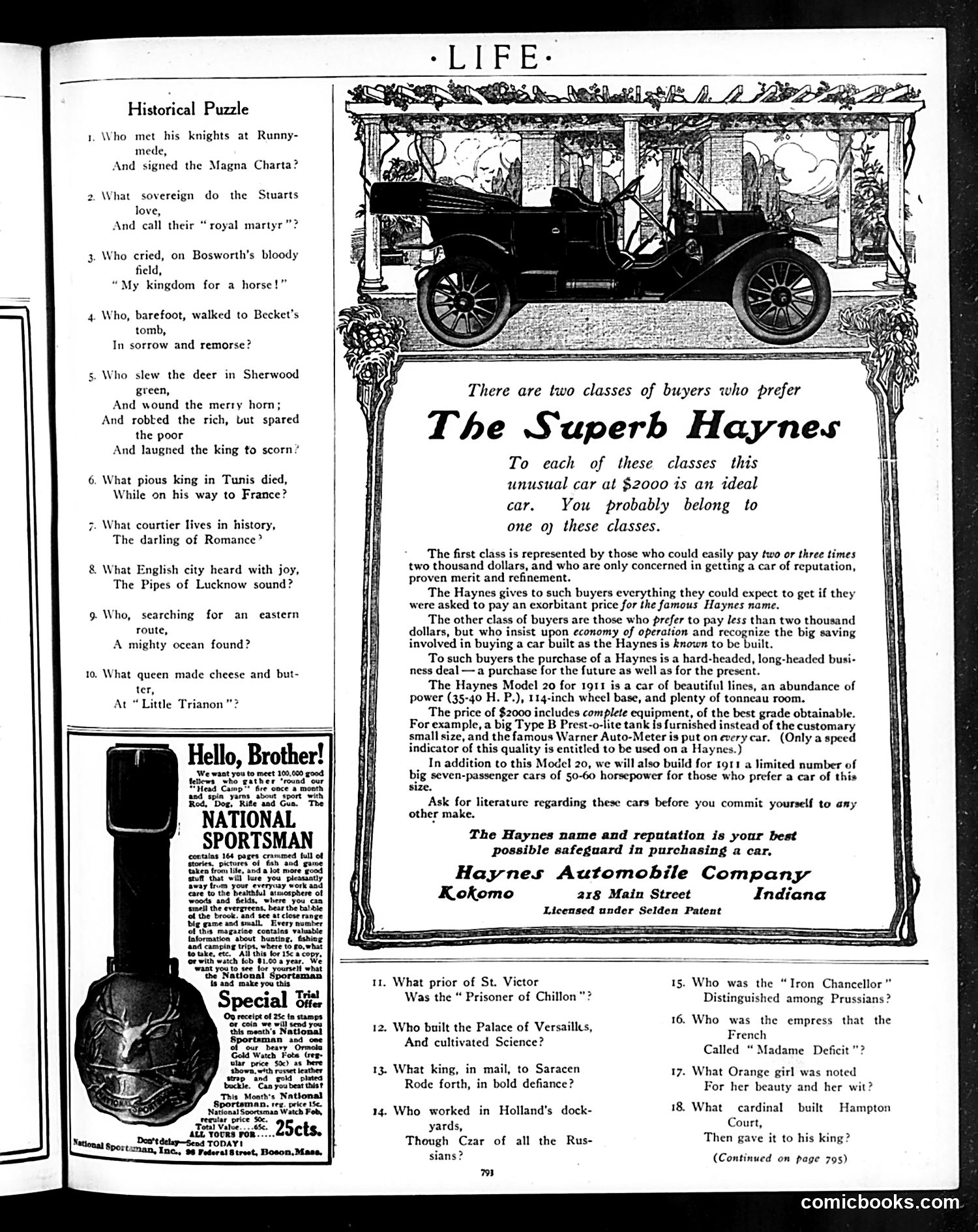
This page contains a **"Historical Puzzle"**—a trivia quiz on British and European history presented as entertainment. The questions reference famous historical figures and events: King John and Magna Carta, Richard III at Bosworth Field, Robin Hood, and various European monarchs and courtiers. This format was typical of early 20th-century educational amusement. The page is dominated by **advertisements**: a National Sportsman magazine ad promoting outdoor recreation, and a large Haynes Automobile Company advertisement. The car ad targets two wealthy buyer classes—those who could afford luxury vehicles multiple times over, and those seeking economical quality. The $2,000 price point and emphasis on "reputation" and "proven merit" position the Haynes as aspirational. A small "Hello, Brother!" advertisement for National Sportsman also appears, using casual fraternity language to appeal to male readers interested in hunting and fishing. The overall page reflects 1910s magazine culture: mixing intellectual pursuits with consumer goods advertising targeting affluent, educated readers.
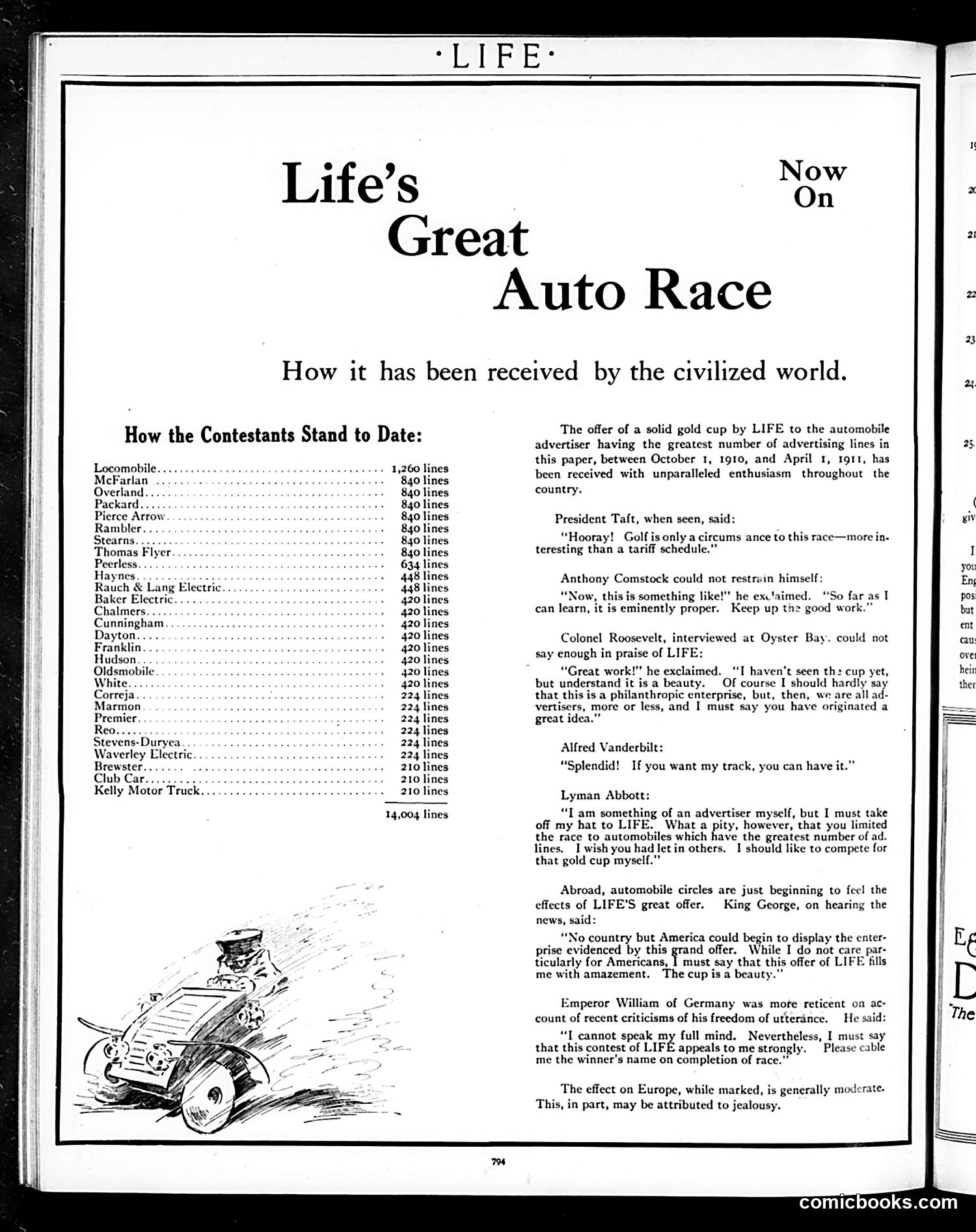
This page satirizes a real promotional contest Life magazine ran: awarding a gold cup to the automobile company with the most advertising lines in the publication between October 1910 and April 1911. The humor lies in the mock-serious responses from famous public figures. President Taft compares it favorably to golf and tariffs. Anthony Comstock (a famous moral crusader) approves it as "proper." Colonel Roosevelt calls it a great idea. Alfred Vanderbilt offers his racing track. Each response treats a *commercial advertising competition* with absurd gravitas, as if it were a major national or international event. The cartoon (bottom left) depicts a reckless driver in an early automobile, visually reinforcing the race theme. The final section parodies international reactions—King George expresses amazement, Emperor William wants updates—exaggerating how seriously the world supposedly views this mere advertising stunt. The satire targets American commercial boosterism and the willingness of prominent figures to endorse whatever generates publicity.
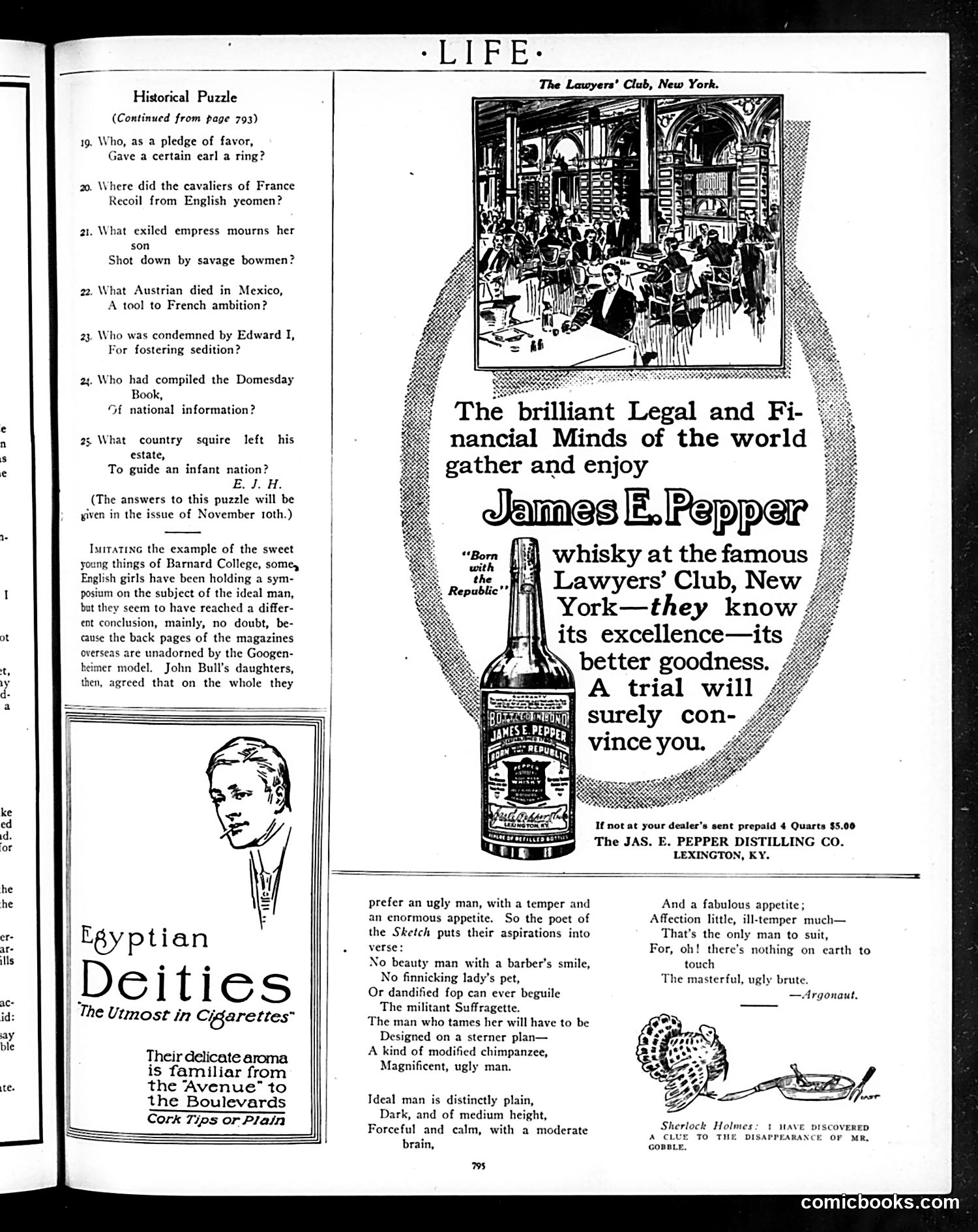
This page contains a historical trivia puzzle, advertising, and satirical commentary on English suffragettes' ideals of masculinity. The main satire targets English suffragettes (women's voting-rights activists). A symposium at Barnard College (American women's college) had discussed the "ideal man," but English girls reached different conclusions. The *Sketch* magazine poem mocks suffragettes' stated preferences: they reject beauty, refinement, and gentleness, instead valorizing "ugly" brutes—forceful, commanding men with "moderate brain." The satire's point appears ironic: suffragettes fighting for equality and agency supposedly desire domineering, brutish partners. This mocks both the suffragettes (for their contradictory values) and, implicitly, critiques the "masterful, ugly brute" masculinity they're portrayed as preferring. The page also includes advertisements for Egyptian Deities cigarettes and James E. Pepper whisky, plus unrelated features like a Sherlock Holmes reference.
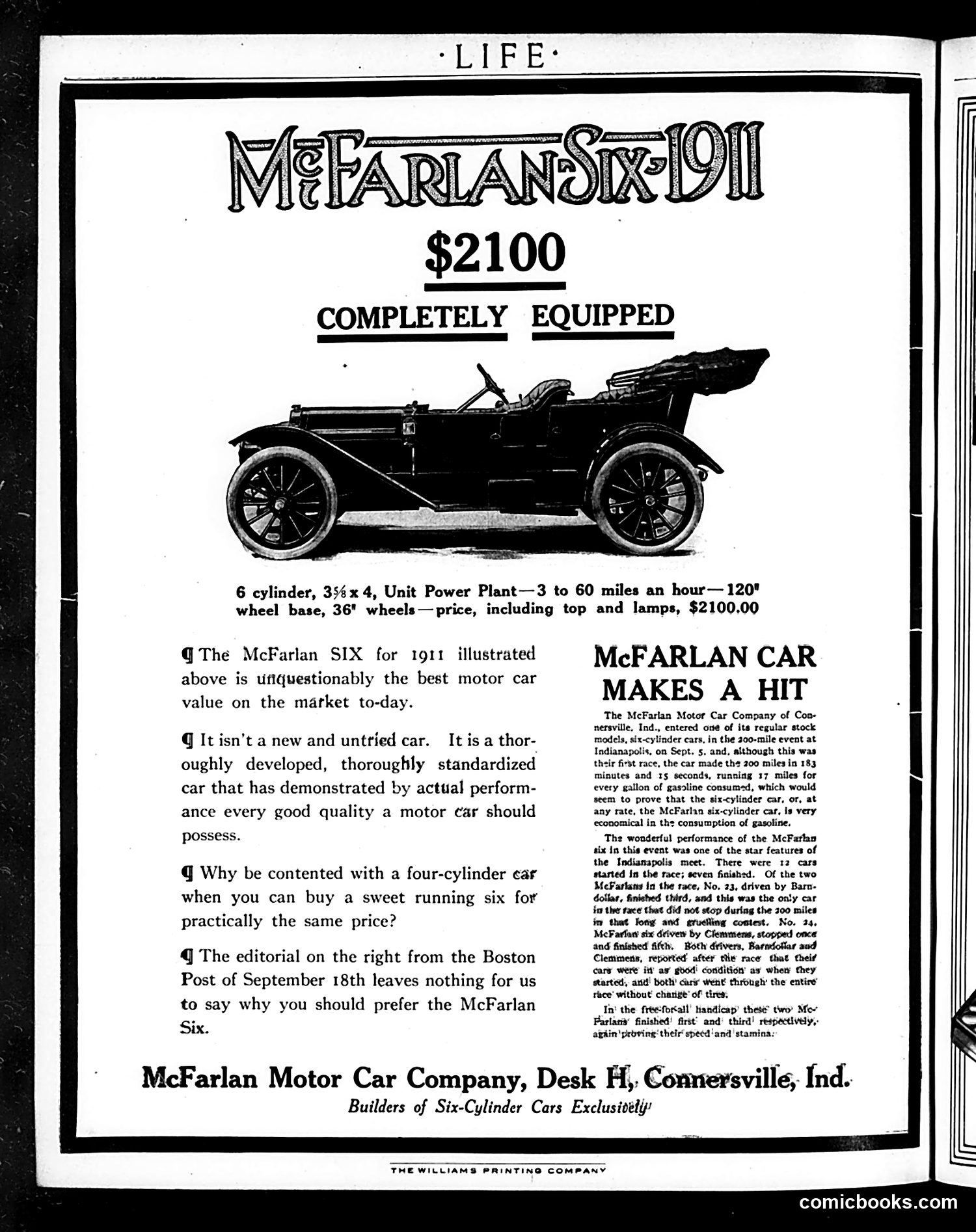
This is primarily a **automobile advertisement**, not a cartoon or satire. The page promotes the McFarlan SIX automobile, priced at $2100, "completely equipped." The advertisement makes a competitive pitch for six-cylinder over four-cylinder cars at comparable prices. It references the car's racing performance at Indianapolis on September 5th (year unclear from OCR, but context suggests 1911), where McFarlan vehicles finished third and fifth in a 200-mile race, with one car completing the entire race without stopping or changing tires. The text quotes an editorial from the Boston Post endorsing the vehicle's reliability and value. **There is no satire or political content**—this is straightforward early-automotive-era advertising emphasizing mechanical superiority and real-world racing proof of performance. For modern readers, the appeal to fuel efficiency (17 miles per gallon) and durability would be notable marketing angles from the 1910s-1920s period.
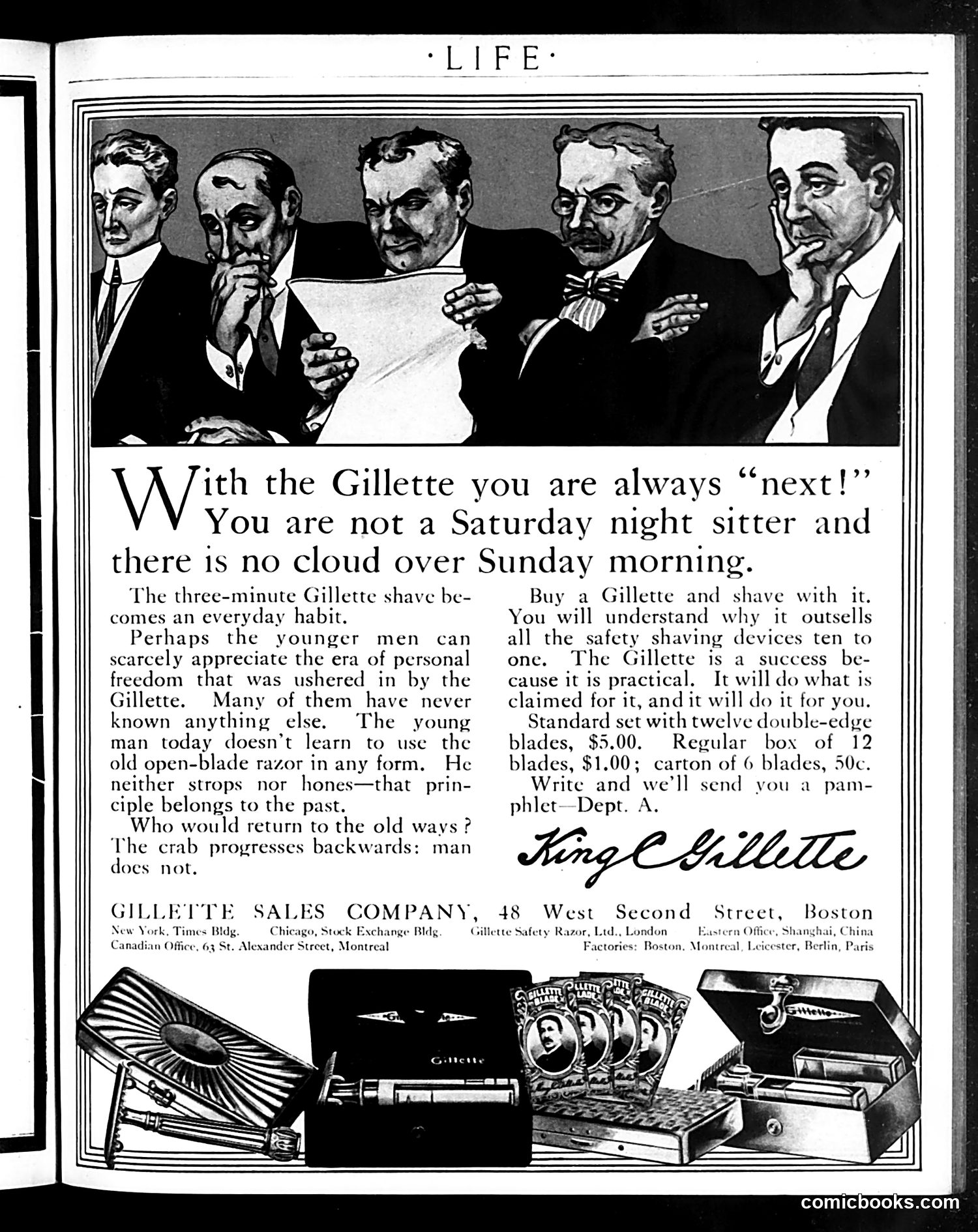
This is primarily a **product advertisement**, not political satire. The five caricatured men at top represent businessmen or professionals examining a document—likely illustrating the "modern man" who uses Gillette razors. The ad's rhetoric frames the safety razor as **progress and liberation**. It claims Gillette freed men from tedious grooming rituals (stropping, honing old open-blade razors), enabling the "three-minute shave" and allowing men to avoid being "Saturday night sitters" (presumably men too busy shaving to socialize on weekends). The phrase "The crab progresses backwards: man does not" positions the Gillette as part of inevitable human advancement—an early-20th-century marketing tactic equating consumer products with civilization itself. The ad targets younger men unfamiliar with older razor methods, emphasizing convenience and modernity as selling points.
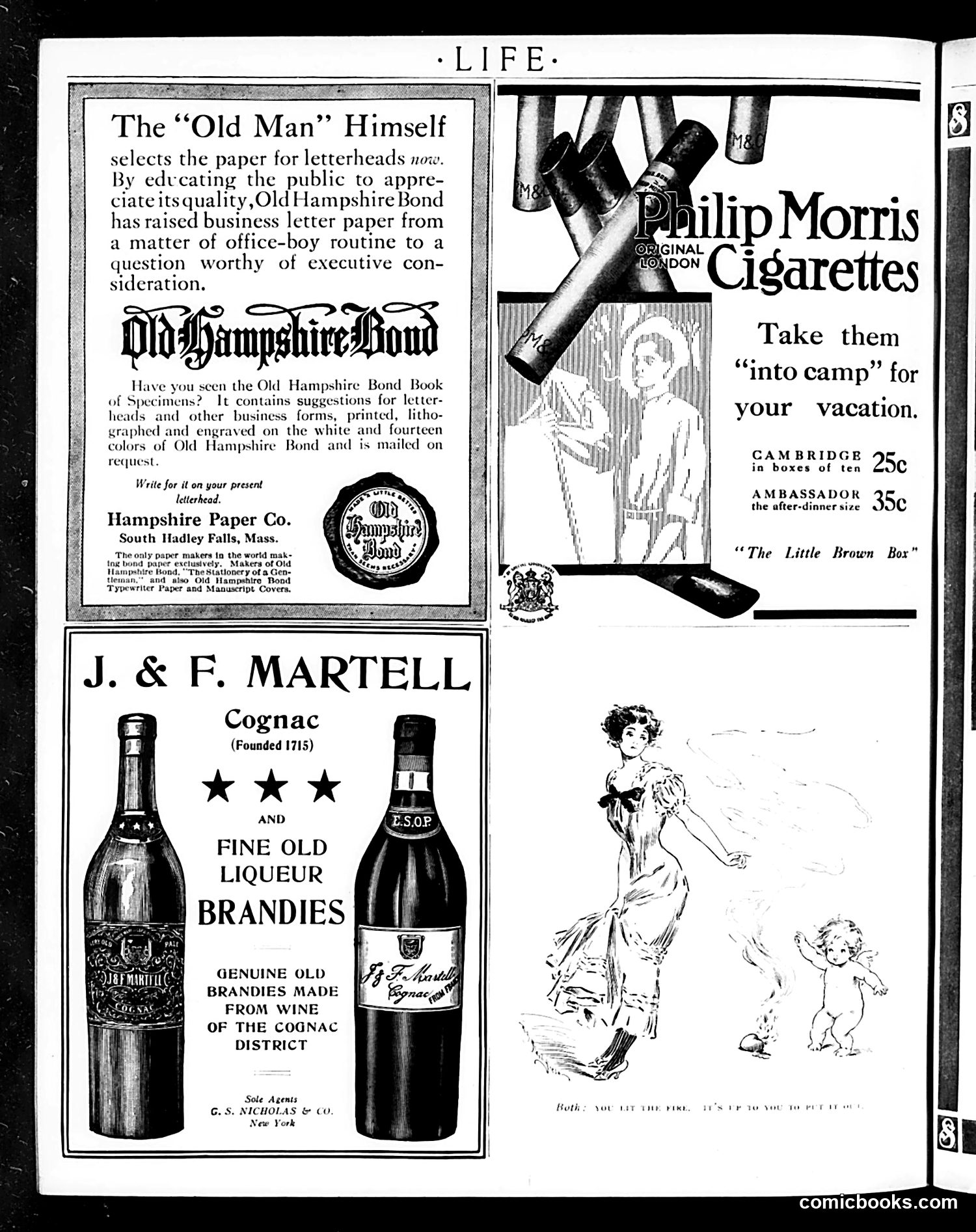
This is primarily an **advertising page**, not satirical content. It contains four distinct advertisements: 1. **Hampshire Bond Paper**: Markets business letterhead by claiming the "Old Man" (apparently a respected executive figure) personally selects their paper. The pitch emphasizes elevating paper selection from routine office work to an executive decision—a tongue-in-cheek appeal to business pride. 2. **Philip Morris Cigarettes**: Shows cigars and promotes taking them "into camp" (on vacation). Lists two varieties with prices (25¢ and 35¢). 3. **J. & F. Martell Cognac**: Advertises French brandy founded 1715, emphasizing authenticity and age. 4. **Bottom right**: Features an illustration of a woman and cherub—unclear advertisement, text illegible. The page reflects early 20th-century advertising's strategy of appealing to aspiration and social status. There is **no political satire present**—this is straightforward commercial promotion typical of Life magazine's revenue model.
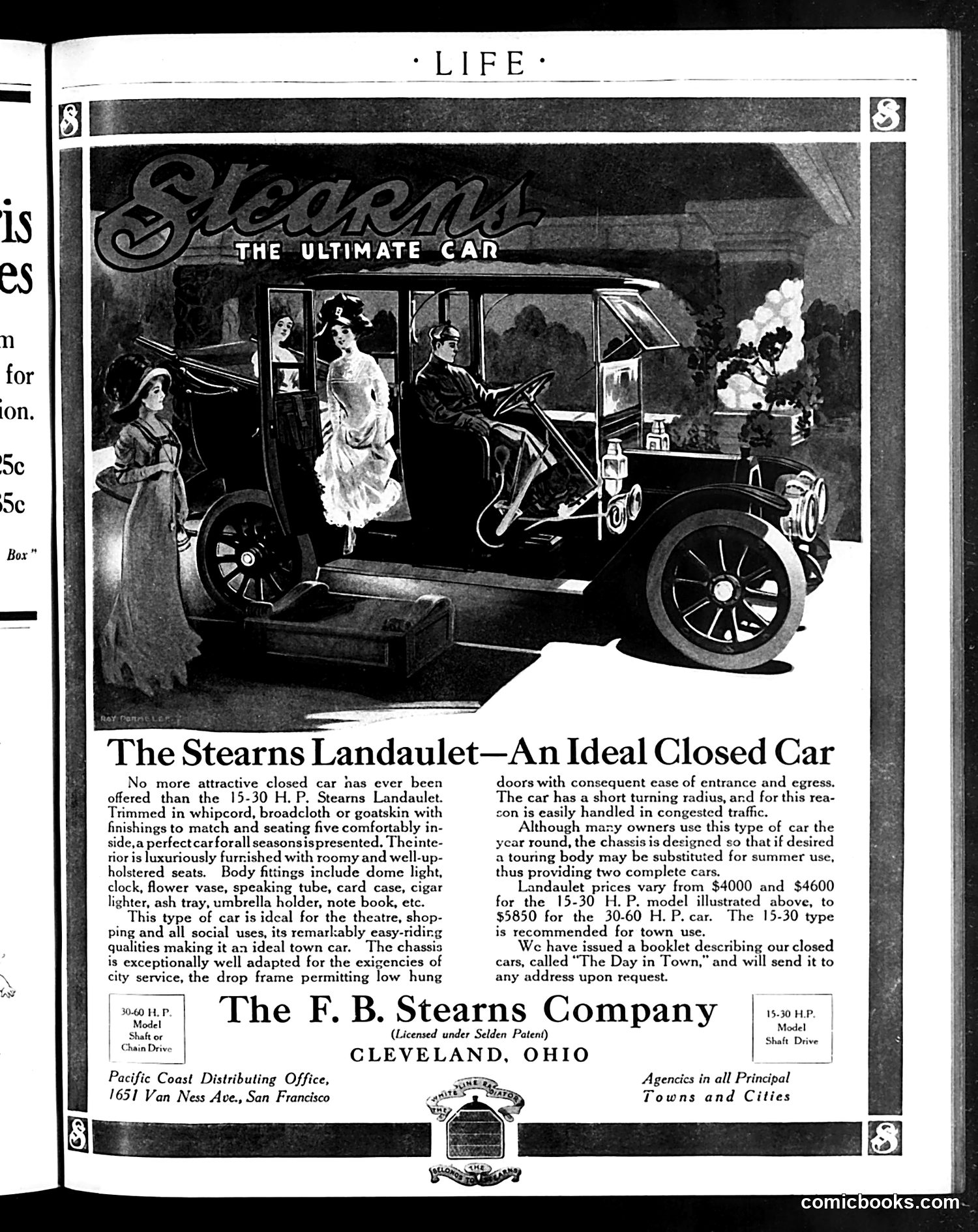
This is a **automobile advertisement**, not political satire. The page promotes the Stearns Landaulet, a luxury closed car manufactured by the F.B. Stearns Company of Cleveland, Ohio. The illustration depicts well-dressed figures (a woman in an elaborate dress, a man driving, and passengers) entering and riding in the elegant vehicle, emphasizing its appeal to affluent urban customers for "theatre, shopping and all social uses." The advertisement highlights luxury features: dome lighting, flower vases, speaking tubes, cigar lighters, and fine upholstery. Prices range from $4,000–$5,850 (substantial sums for the era). The term "ultimate car" reflects early automotive marketing positioning this closed carriage as the pinnacle of motoring comfort and status. The listing of a San Francisco distributor suggests this Life magazine advertisement targets wealthy West Coast readers. There is no satirical content—this is straightforward period advertising emphasizing luxury and social propriety.
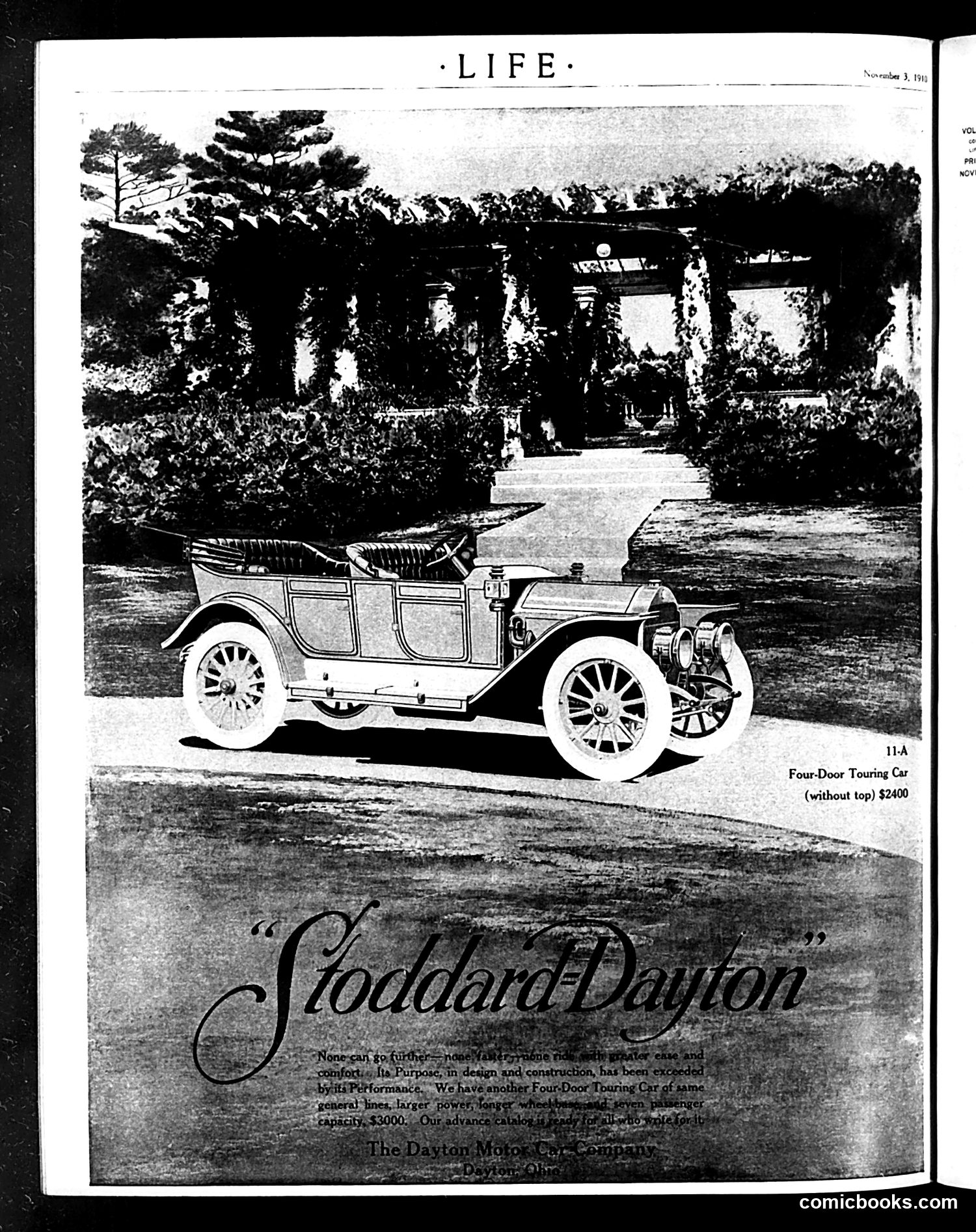
This is primarily an **advertisement, not a political cartoon**. The page features a Stoddard-Dayton automobile—a Four-Door Touring Car priced at $2400 (without convertible top). The vehicle is photographed in an elegant garden setting with a pergola, emphasizing luxury and refinement. The ad copy suggests the Stoddard-Dayton's appeal to wealthy buyers: it emphasizes superior "design and construction" compared to competitors, boasts increased power and passenger capacity, and notes a $3,000 price point for the full model. This targets the affluent early-automobile market when cars were expensive luxury goods. The garden backdrop reinforces the aspirational, upper-class lifestyle the manufacturer wished to associate with vehicle ownership during the early 20th century.