
Life, 1910-11-03 · page 32 of 72
Life — November 3, 1910 — page 32: what you’re looking at
What you’re looking at
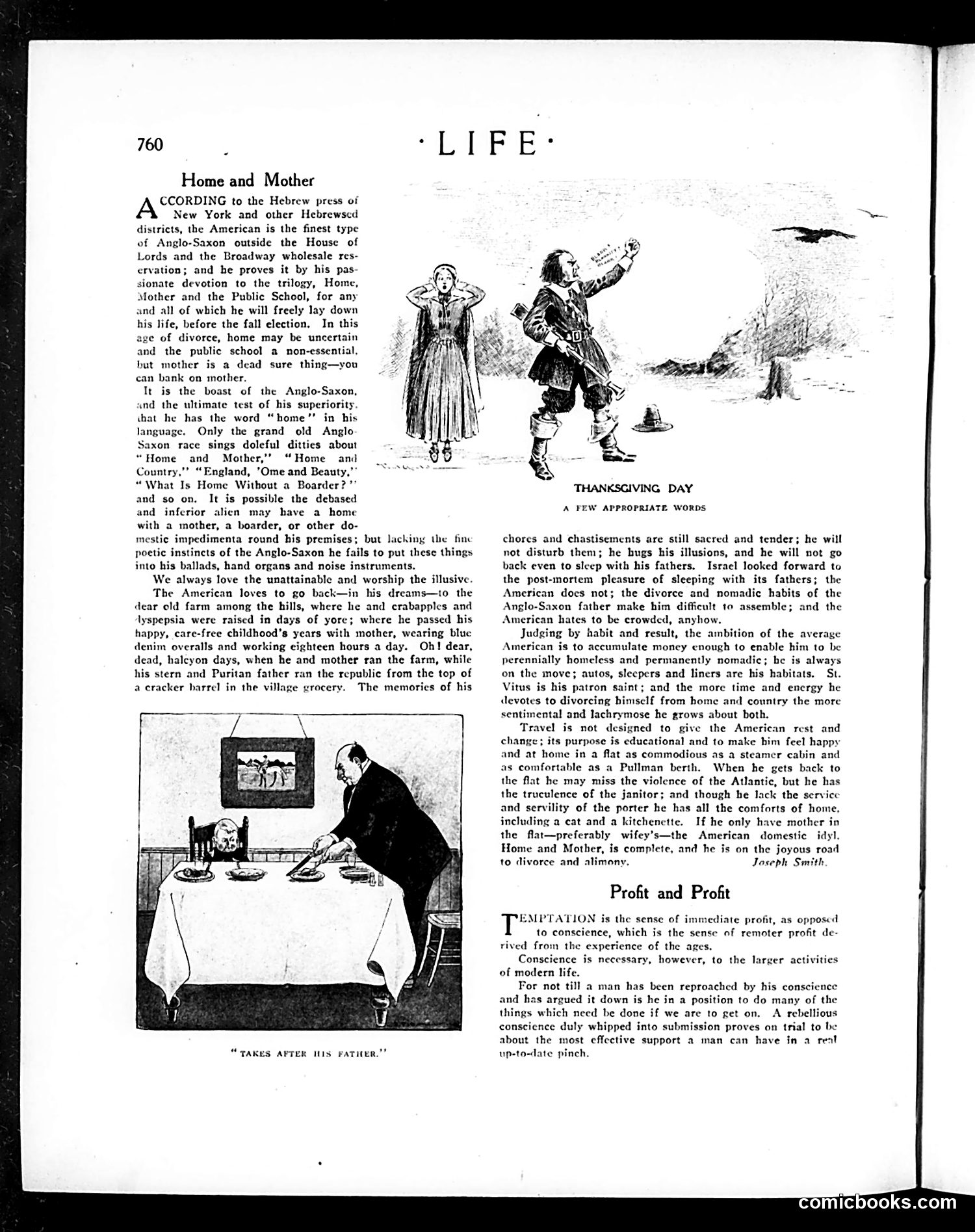
This satirical piece mocks American reverence for "Home and Mother" as hollow sentiment disconnected from actual behavior. The author argues that Anglo-Saxons boast about devotion to home, yet Americans are perpetually nomadic—constantly moving via autos, trains, and ships—while romanticizing an idealized farm childhood that no longer exists. The accompanying illustration "Takes After His Father" depicts a domestic scene where a man dines while a woman serves, likely satirizing the gap between sentimental family ideals and actual domestic arrangements. The satire targets American hypocrisy: citizens claim to cherish home and family stability while pursuing divorce, relocation, and rootlessness. The critique extends to ethnic stereotyping—contrasting Anglo-Saxon "poetic" sensibilities about home with supposedly inferior immigrant cultures, which Life then undercuts by suggesting Americans actually embody restlessness and emotional dishonesty. The tone is biting social commentary on American materialism masquerading as sentimentality.
📄 Transcribed text from this page (OCR, searchable)
Machine-transcribed from the original scan — historical spelling and the odd misread are preserved.
760 Home and Mother CCORDING to the Hebrew press of New York and other Hebrewscd districts, the American is the finest type of Anglo-Saxon outside the House of Lords and the Broadway wholesale res- ervation; and he proves it by his pas- sionate devotion to the trilogy, Home, Mother and the Public School, for any and all of which he will freely lay down his life, before the fall election. In this age of divorce, home may be uncertain nd the public school a non-essential, but mother is a dead sure thing—you can bank on mother. It is the boast of the Anglo-Saxon, and the ultimate test of his superiority that he has the word “home'’ in his language. Only the grand old Anglo on race sings doleful ditties about Home and Mother,’ “Home and Country,”’ “England, ’Ome and Beauty,” “What Is Home Without a Boarder? ’’ and so on. It is possible the debased and inferior alien may have a home with a mother, a boarder, or other do- mestic impedimenta round his premises; but lacking the fine poetic instincts of the Anglo-Saxon he fails to put these things into his ballads, hand organs and noise instruments. We always love the unattainable and worship the illusive. The American loves to go back—in his dreams—io the dear old farm among the hills, where he and crabapples and lyspepsia were raised in days of yore; where he passed his happy, care-free childhood’s years with mother, wearing bluc denim overalls and working eighteen hours a day. Oh! dear, dead, halcyon days, when he and mother ran the farm, while his stern and Puritan father ran the republic from the top of a cracker barrel in the village grocery. The memorics of his “TAKES APTER Is FATIIER.”* THANKSGIVING DAY A FEW APPROPRIATE WORDS chores and chastisements are still sacred and tender; he will not disturb them; he bugs his illusions, and he will not go back even to sleep with his fathers. Israel looked forward to the post-mortem pleasure of sleeping with its fathers; the American docs not; the divorce and nomadic habits of the Anglo-Saxon father make him difficult to assemble; and the American hates to be crowded, anyhow. Judging by habit and result, the ambition of the average American is to accumulate moncy enough to enable him to be perennially homeless and permanently nomadic; he is always on the move; autos, sleepers and liners are his habitats. St. Vitus is his patron saint; and the more time and energy he devotes to divorcing himself from home and country the more sentimental and lachrymose he grows about both. Travel is not designed to give the American rest and change; its purpose is educational and to make him feel happy and at home in a flat as commodious as a steamer cabin and as comfortable as a Pullman berth. When he gets back to the flat he may miss the violence of the Atlantic, but he has the truculence of the janitor; and though he lack the service and servility of the porter he has all the comforts of home, including a cat and a kitchenette. If he only have mother in the flat—preferably wifey’s—the American domestic idyl. Home and Mother, is complete, and he is on the joyous road to divorce and alimony, Joseph Smith Profit and Profit EMPTATION is the sense of immediate profit, as opposed to conscience, which is the sense of remoter profit de- rived from the experience of the ages. Conscience is necessary, however, to the larger activities of modern Ii For not till a man has been reproached by his conscience and has argued it down is he in a position to do many of the things which need be done if we are to get on. A rebellious conscience duly whipped into submission proves on trial to be about the most effective support a man can have in a rent up-to-date pinch. comicbooks.com