
Life, 1910-11-03 · page 58 of 72
Life — November 3, 1910 — page 58: what you’re looking at
What you’re looking at
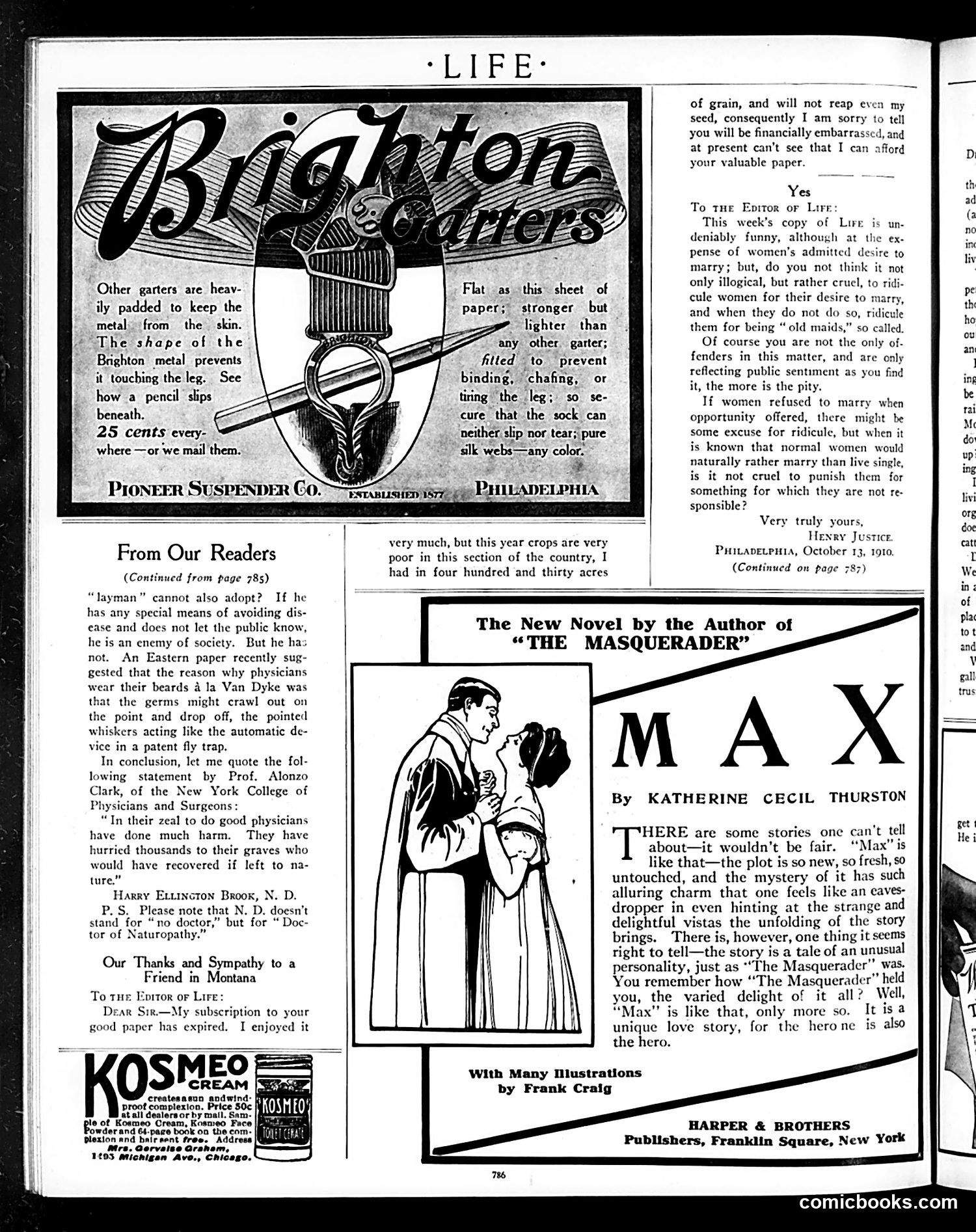
This page combines **advertising, reader letters, and book promotion** typical of early-1900s magazines. The **main advertisement** (top) promotes Brighton garters—elastic leg supports—emphasizing their flat metal design prevents skin irritation and binding. This reflects Victorian/Edwardian era concerns about properly securing hosiery. The **"From Our Readers"** section contains three letters: one defending naturopathic medicine against physicians; another from a Montana farmer too financially devastated by poor crops to renew his subscription (social commentary on agricultural hardship); and a third **criticizing Life's mockery of unmarried women**, arguing it's cruel to ridicule women simultaneously for wanting marriage and for remaining single—a pointed early feminist critique about impossible social double standards. The **book advertisement** promotes Katherine Cecil Thurston's novel *Max*, calling it a unique love story where "the heroine is also the hero"—likely referring to gender-role fluidity or ambiguity, though the actual plot remains opaque, as the ad deliberately avoids spoilers.
📄 Transcribed text from this page (OCR, searchable)
Machine-transcribed from the original scan — historical spelling and the odd misread are preserved.
Other garters are heav- ily padded to keep the metal from the _ skin. The shape of the Brghton metal prevents it touching the leg. See how a pencil slips beneath. 25 cents every- where —or we mail them. paper; stronger but lighter than ~ any other. garter; filted to prevent binding, ‘chafing, or tinng ‘the ‘leg; so. se- cure that the sock can neither. slip nor tear;\pure silk webs—any color: é as From Our Readers (Continued from page 785) “layman” cannot also adopt? If he has any special means of avoiding dis- ease and does not let the public know, he is an enemy of society. But he has not. An Eastern paper recently gested that the reason why physi wear their beards 4 la Van Dyke was that the germs might crawl out on the point and drop off, the pointed whiskers acting like the automatic de- vice in a patent fly trap. In conclusion, let me quote the fol- lowing statement by Prof. Alonzo Clark, of the New York College of Physicians and Surgeons: “In their zeal to do good physicians have done much harm. They have hurried thousands to their graves who would have recovered if left to na- ture.” Harry Extincton Brook, N. D. P. S. Please note that N. D. doesn’t stand for “no doctor,” but for “ Doc- tor of Naturopathy.” Our Thanks and Sympathy to a Friend in Montana To tHe Eprtor or Lire: Dear Sir.—My subscription to your good paper has expired. I enjoyed it proot complexion. Price. at all dealersor by mail. Sam- am Lud 1403 Michigan Avo., Chicago. very much, but this year crops are very poor in this section of the country, I had in four hundred and thirty acres of grain, and will not reap even my seed, consequently I am sorry to tell you will be financially embarrassed, and at present can’t see that I can afford your valuable paper. Yes To tHe Epitor or Lire: This week’s copy of Lire is un- deniably funny, although at the ex- pense of women’s admitted desire to marry; but, do you not think it not only illogical, but rather cruel, to ridi- cule women for their desire to marry, and when they do not do so, ridicule them for being “ old maids,” so called. Of course you are not the only of- fenders in this matter, and are only reflecting public sentiment as you find it, the more is the pity. If women refused to marry when opportunity offered, there might be some excuse for ridicule, but when it is known that normal women would naturally rather marry than live single, is it not cruel to punish them for something for which they are not re- sponsible? Very truly yours, Henry Justice. Puivavecenia, October 13, 1910. (Continued on page 787) The New Novel by the Author of “THE MASQUERADER” By KATHERINE CECIL THURSTON about—it wouldn't be fair. ‘Max’ is like that—the plot is so new, so fresh, so untouched, and the mystery of it has such alluring charm that one feels like an eaves- dropper in even hinting at the strange and delightful vistas the unfolding of the story brings. There is, however, one thing it seems right to tell—the story is a tale of an unusual personality, just as “The Masquerader"’ was. You remember how ‘The Masquerader” held you, the varied delight of it all? Well, *“Max"’ is like that, only more so. It is @ unique love story, for the herone is also the hero. u | ‘HERE are some stories one can't tell With Many Illustrations by Frank Craig HARPER & BROTHERS Publishers, Franklin Square, New York comicbooks.com