
Life, 1910-11-03 · page 35 of 72
Life — November 3, 1910 — page 35: what you’re looking at
What you’re looking at
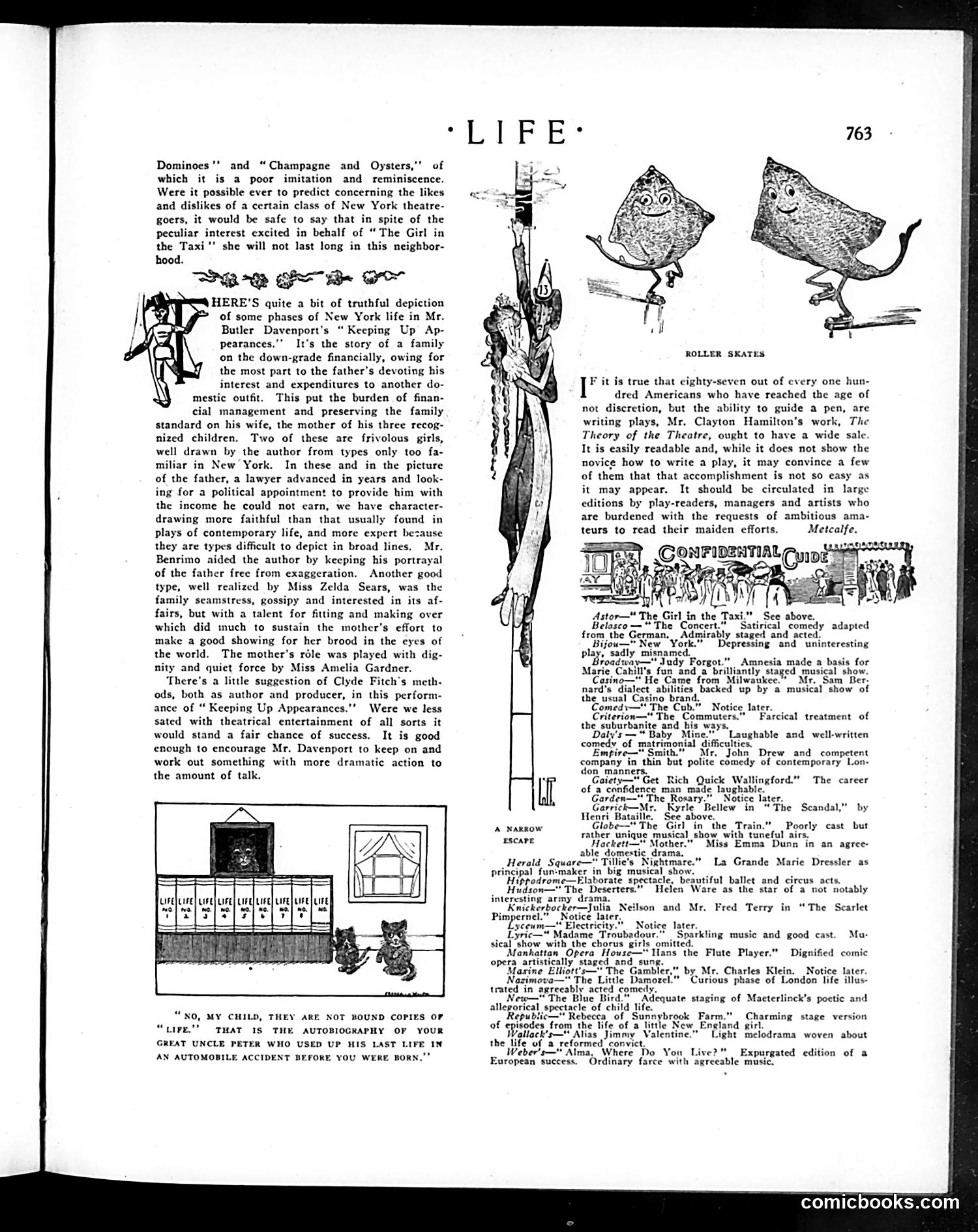
This page from *Life* magazine contains theatre reviews and two cartoons satirizing American culture circa the early 1900s. The **top cartoon** depicts roller skates—likely mocking a fad or frivolous leisure activity among the wealthy or fashionable set. The **bottom cartoon** shows stacks of *Life* magazines labeled as "the autobiography of your Great Uncle Peter," humorously suggesting that this uncle exhausted his nine lives in an automobile accident before the child was born. This is dark humor about early automobile fatalities, which were common and shocking to society at the time. The joke implies *Life* magazine itself documents the reckless modern age. The text reviews theatre productions, critiquing contemporary plays like "The Girl in the Taxi" and "Keeping Up Appearances"—works dealing with New York society, financial decline, and domestic life. The reviewer praises realistic character-drawing while lamenting theatrical oversaturation.
📄 Transcribed text from this page (OCR, searchable)
Machine-transcribed from the original scan — historical spelling and the odd misread are preserved.
Dominoes’? and “Champagne and Oysters,’ of which it is a poor imitation and reminiscence. Were it possible ever to predict concerning the likes and dislikes of a certain class of New York theatre- goers, it would be safe to say that in spite of the peculiar interest excited in behalf of “ The Girl in the Taxi'’ she will not last long in this neighbor- hood. See GR Oo HERE'S quite a bit of truthful depiction of some phases of New York life in Mr. Butler Davenport's “Keeping Up Ap- pearances.’’ It's the story of a family on the down-grade financially, owing for the most part to the father’s devoting his interest and expenditures to another do- mestic outfit. This put the burden of finan- cial management and preserving the family standard on his wife, the mother of his three recog- nized children. Two of these are frivolous girls, well drawn by the author from types only too fa- miliar in New York. In these and in the picture of the father, a lawyer advanced in years and look- ing for a political appointment to provide him with the income he could not carn, we have character- drawing more faithful than that usually found in plays of contemporary life, and more expert bezause they are types difficult to depict in broad lines. Mr. Benrimo aided the author by keeping his portrayal of the father free from exaggeration. Another good type, well realized by Miss Zelda Sears, was the family seamstress, gossipy and interested in af- fairs, but with a talent for fitting and making over which did much to sustain the mother’s effort to make a good showing for her brood in the cyes of the world. The mother’s réle was played with dig- nity and quict force by Miss Amelia Gardner. There's a little suggestion of Clyde Fitch's meth. ods, both as author and producer, in this perform- ance of “ Keeping Up Appearances.’ Were we less sated with theatrical entertainment of all sorts it would stand a fair chance of success. It is good enough to encourage Mr. Davenport to keep on and work out something with more dramatic action to the amount of talk. “NO, MY CHILD, THEY ARE NOT BOUND COPIES OF “Lire.” THAT IS THE AUTOBIOGRAPHY OF YOUR GREAT UNCLE PETER WHO USED UP HIS LAST LIFE IN AN AUTOMOBILE ACCIDENT BEFORE YOU WERE BORN. ROLLER SKATES F it is true that eighty-seven out of every one hun- dred Americans who have reached the age of not discretion, but the ability to guide a pen, are writing plays, Mr. Clayton Hamilton’s work, The Theory of the Theatre, ought to have a wide sale It is easily readable and, while it does not show the novice how to write a play, it may convince a few of them that that accomplishment is not so easy as it may appear. It should be circulated in large editions by play-readers, managers and artists who are burdened with the requests of ambitious ama- teurs to read their maiden efforts. Metcalfe. CoQnriDeaviAaL@no?s Astor—" The Girl in the Taxi.” See above. Belasco—* The Concert.” Satirical comedy adapted from the German, Admirably staged and acted. ; Bijou—" New York.” Depressing and uninteresting play, sadly mignamed, roadway" Judy Forgot.” Amnesia made a basis for Marie Cahill’s fun and_a brilliantly staged musical show. Cosino—" He Came from Milwaukee.” Mr. Sam Ber: nard’s dialect abilities backed up by a musical show of the usual Casino bran Comedy—"* The Cub.” Notice later. Criterion—“ The Commuters.” Farcical treatment of the suburbanite and his ways, Daly's —“ Baby Mine." Laughable and well-written comedy of matrimo difficulties. Empire—" Smith.” Mr, John’ Drew and competent company in thin but polite comedy of contemporary Lon- don manners. Gaiety—" Get Rich Quick Wallingford.” The career of a confidence man made laughable. Garden—" The Rosary.” Notice later. Garrick—Mr. Kyrle Bellew in “The Scandal,” by Henri Bataille. See above. . ik weow Globe—" The Girl in the Train.” Poorly cast but rather unique musical show with tuneful airs, wacare Hackett—" Mother.” Miss Emma Dunn in an agree- able domesti Herald Square—" Tillie’s N principal fun‘maker in big musical sho Hippodrome—Elaborate spectacle, beautiful ballet and circus acts. Hudson—" The Deserters.” Helen Ware as the star of a not notably interesting army drama. Knickerbocker—Julia Neilson and Mr. Fred Terry in “The Scarlet Pimpernel. tice late Lyceum—" Electricity.” Notice later. . Lyric—* Madame Troubadour.” | Sparkling music and good cast. Mu- sical ‘show with the chorus girls omitted. Mankattan Opera House—" Hans the Flute Player. opera artistically staged and_sung. Marine Elliott’s—" The Gambler,” by, Mr. Charles Klein. Notice later. Nazimova—" The Little Damozel Curious phase of London life illus- trated in agreeably acted comedy. : “ New—" The Blue Bird.” Adequate staging of Maeterlinck’s poetic and allegorical acle of child life. Rebecca of Sunnybrook Farm.” Charming stage version the life of a little New England girl. ’s—"* Alias Jimmy Valenti Light melodrama woven about the life of a reformed convict. = Weber’: Ima, Where Do You Live?" Expurgated edition of a European success. Ordinary farce with agreeable music, La Grande Marie Dressler as " Dignified comic -comicbooks.com