
Life, 1910-11-03 · page 27 of 72
Life — November 3, 1910 — page 27: what you’re looking at
What you’re looking at
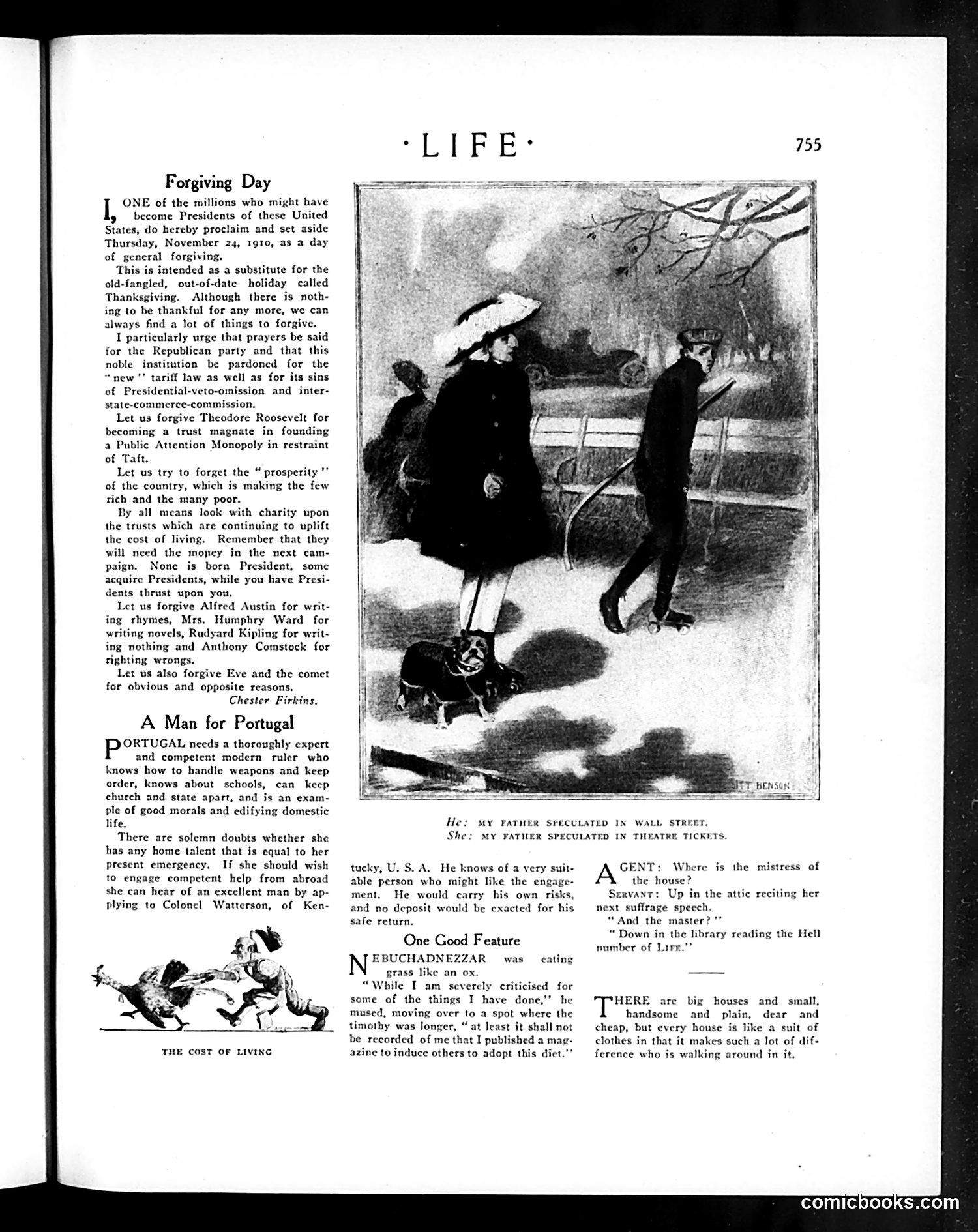
This page satirizes American politics and social issues of 1910. The main article, "Forgiving Day," is a mock proclamation replacing Thanksgiving with a day to forgive society's failures. It mocks President Taft's administration, criticizing the Republican party's tariff law, and references Theodore Roosevelt's recent political activities as creating a "Public Attention Monopoly." The piece sarcastically urges forgiveness for trusts raising the cost of living, and jokes that presidents are "thrust upon you" rather than earned. The cartoon below depicts two figures discussing parental financial speculation: one's father speculated in Wall Street; the other's in theater tickets—a visual joke about different forms of financial risk-taking among the wealthy. "A Man for Portugal" humorously suggests hiring an American expert to rule Portugal, likely referencing contemporary debates about American interventionism abroad. The page reflects 1910 Progressive Era frustrations with corporate monopolies, wealth inequality, and political corruption.
📄 Transcribed text from this page (OCR, searchable)
Machine-transcribed from the original scan — historical spelling and the odd misread are preserved.
Forgiving Day ONE of the millions who might have 9 become Presidents of these United States, do hereby proclaim and set aside Thursday, November 23, 1910, as a day of general forgiving. This is intended as a substitute for the old-fangled, out-of-date holiday called Thanksgiving. Although there is noth- ing to be thankful for any more, we can always find a lot of things to forgive. I particularly urge that prayers be said for the Republican party and that this noble institution be pardoned for the “new '’ tariff law as well as for its sins of Presidential-veto-omission and inter- state-commerce-commission. Let us forgive Theodore Roosevelt for becoming a trust magnate in founding a Public Attention Monopoly in restraint of Taft. Let us try to forget the “ prosperity "’ of the country, which is making the few rich and the many poor. By all means look with charity upon the trusts which are continuing to uplift the cost of living. Remember that they will need the money in the next cam- paign, None is born President, some acquire Presidents, while you have Presi- dents thrust upon you. Let us forgive Alfred Austin for writ- ing rhymes, Mrs. Humphry Ward for writing novels, Rudyard Kipling for writ- ing nothing and Anthony Comstock for righting wrongs. Let us also forgive Eve and the comet for obvious and opposite reasons. Chester Firkins. A Man for Portugal ORTUGAL needs a thoroughly expert and competent modern ruler who knows how to handle weapons and keep order, knows about schools, can keep church and state apart, and is an exam- ple of good morals and edifying domestic life. There are solemn doubts whether she has any home talent that is equal to her present emergency. If she should wish to engage competent help from abroad she can hear of an excellent man by ap- plying to Colonel Watterson, of Ken- THE COST OF LIVING He: MY FATHER SPECULATED IN WALL MY FATHER SPECULATED IN THEATRE TICKETS. She: tucky, U.S. A, He knows of a very suit- able person who might like the engage- ment. He would carry his own risks, and no deposit would be exacted for his safe return. One Good Feature EBUCHADNEZZAR_ was grass like an ox. “While I am severcly criticised for some of the things I have done,’’ he mused, moving over to a spot where the timothy was longer, “at least it shall not be recorded of me that I published a mag- azine to induce others to adopt this dict."” eating STREET. A® T: Where is the mistress the house? Servant: Up in the attic reciting her next suffrage speech. “And the master?" “ Down in the library reading the Hell number of Lire.” HERE are big houses and small, handsome and plain, dear and cheap, but every house is like a suit of clothes in that it makes such a lot of dif- ference who is walking around in it. comicbooks.com