
Life, 1910-11-03 · page 28 of 72
Life — November 3, 1910 — page 28: what you’re looking at
What you’re looking at
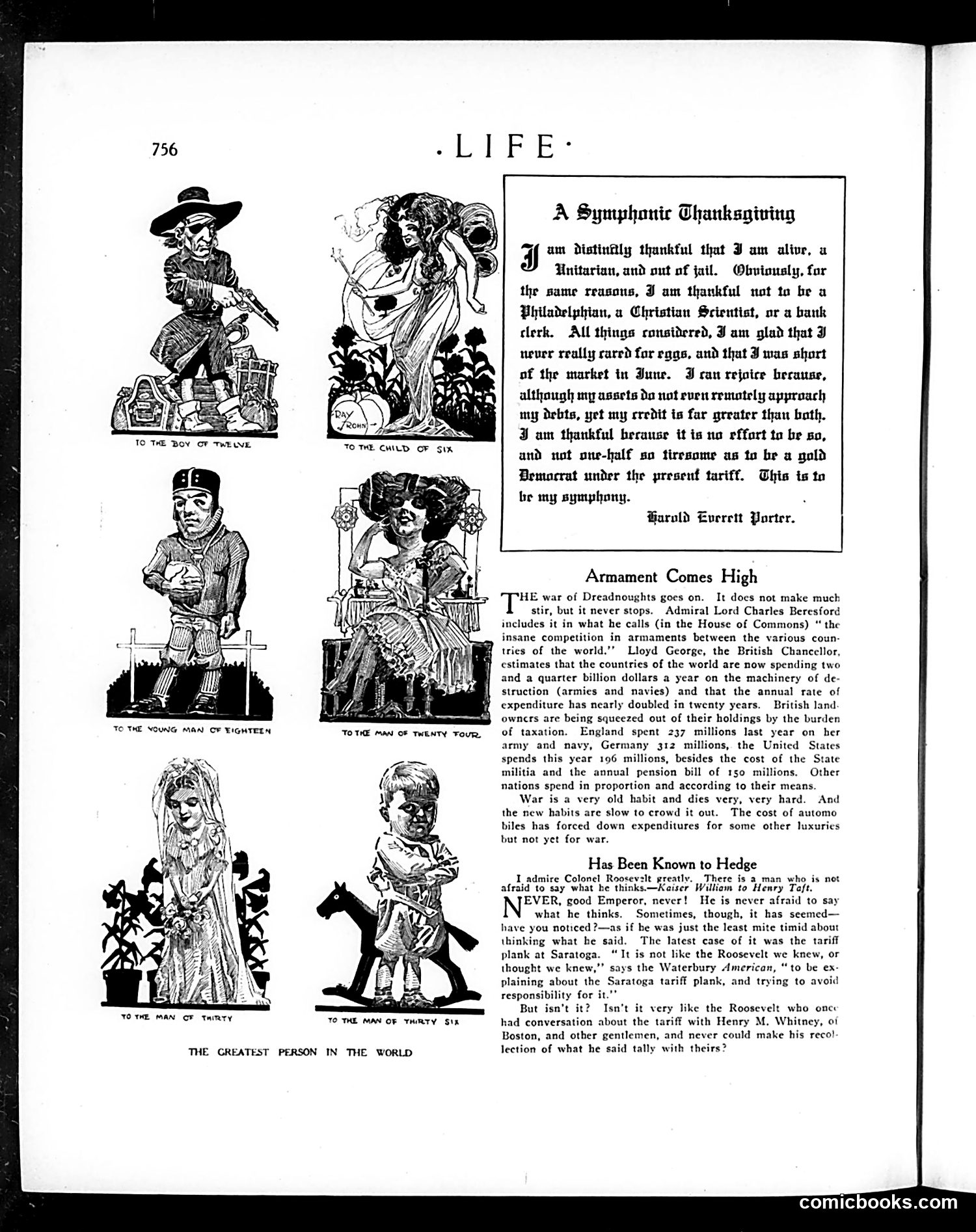
This page satirizes early 1900s American politics and social issues. The left side features six caricatured figures labeled "The Greatest Person in the World"—likely representing different social stereotypes or political figures of the era, though specific identities are unclear from the image alone. The main articles target: 1. **"Armament Comes High"**: Critiques the escalating global arms race, citing specific military spending figures (Britain £237 million, Germany £312 million, U.S. $196 million annually). The satire suggests nations are bankrupting themselves on weapons while ordinary citizens suffer taxation. 2. **"Has Been Known to Hedge"**: Mocks Theodore Roosevelt's inconsistency, particularly regarding his tariff policy at Saratoga. The joke: Roosevelt claims to always speak his mind frankly, yet conveniently "forgets" past statements when convenient—suggesting political dishonesty masked by bluster. The opening piece is a humorous Thanksgiving essay by Harold Everett Porter offering ironic thanks for being outside jail and avoiding certain professions.
📄 Transcribed text from this page (OCR, searchable)
Machine-transcribed from the original scan — historical spelling and the odd misread are preserved.
A Symphonic Thanksgiving r am Distinflly thankful that J am alive, a Rnitarian, and ont of jail. Obviously, for the same reasous, J am thankful not to be a Philadelphian, a Christian Scientist, or a bank clerk. All things considered, Jam glad that J never really cared for eggs, and that J was short of the market in June. J can rejoice because, although my assets do not even remotely approach my debts, yet my credit is far greater than both. ¥ am thankful berause it is no effort ta be so, and not one-half so tiresome as to be a gold Democrat under the present tariff. This ts to be my symphony. Garold Everett Porter. Armament Comes High HE war of Dreadnoughts goes on. It docs not make much stir, but it never stops. Admiral Lord Charles Beresford includes it in what he calls (in the House of Commons) “ the insane competition in armaments between the various coun- tries of the world.’ Lloyd George, the British Chancellor, stimates that the countries of the world are now spending two and a quarter billion dollars a year on the machinery of de- struction (armies and navies) and that the annual rate of expenditure has nearly doubled in twenty years. British land owners are being squeezed out of their holdings by the burden of taxation. England spent 237 millions last year on her army and navy, Germany 312 millions, the United States spends this year 196 millions, besides the cost of the State militia and the annual pension bill of 150 millions. Other nations spend in proportion and according to their means. War is a very old habit and dies very, very hard. And the new habits are slow to crowd it out. The cost of automo biles bas forced down expenditures for some other luxuries but not yet for war. Has Been Known to Hedge I admire Colonel Roosevelt greatly. There is a man who is not afraid to say what he thinks.—Kaiser William to Henry Taft. EVER, good Emperor, never! He is never afraid to say what he thinks. Sometimes, though, it has seemed— have you noticed ?—as if he was just the least mite timid about thinking what he said. The latest case of it was the tariff plank at Saratoga. “It is not like the Roosevelt we knew, or thought we knew,”’ says the Waterbury American, “to be ex- plaining about the Saratoga tariff plank, and trying to avoid responsibility for it.’’ - But isn't it? Isn't it very like the Roosevelt who once YOIWE MAN CF THIRTY TO THE MAN OF THIRTY Six had conversation about the tariff with Henry M. Whitney, of Boston, and other gentlemen, and never could make his reco! THE GREATEST PERSON IN THE WORLD lection of what he said tally with theirs? comicbooks.com