
Life, 1910-11-03 · page 23 of 72
Life — November 3, 1910 — page 23: what you’re looking at
What you’re looking at
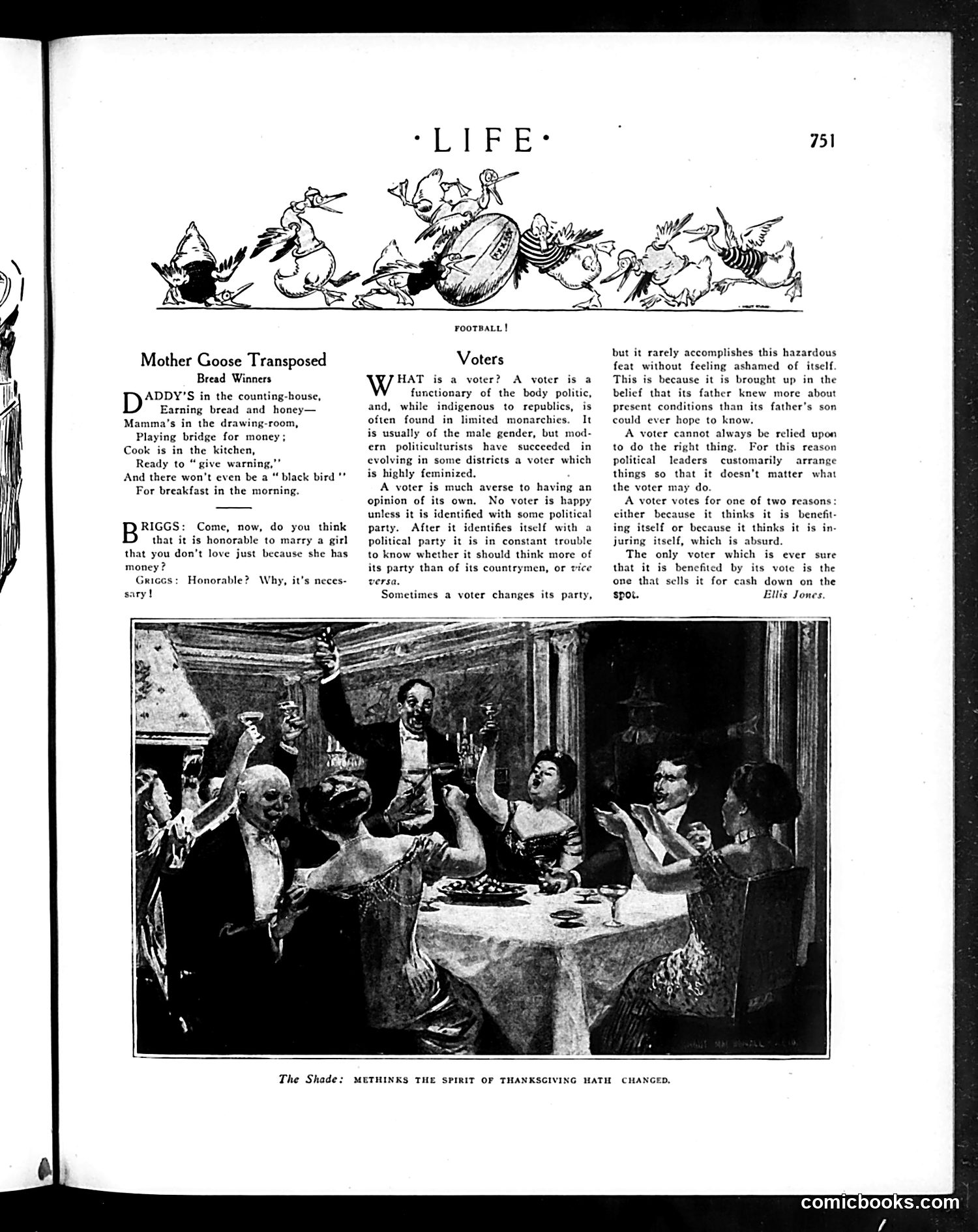
This page contains satirical commentary on early 20th-century American social issues: **"Mother Goose Transposed"** parodies the nursery rhyme, satirizing changing domestic roles. It depicts a wife playing bridge for money (gambling) while the husband earns wages and the cook threatens to quit—mocking the erosion of traditional household order and proper domestic hierarchy. **The Riggs dialogue** is a brief joke about marrying for money despite lack of love, suggesting this was an accepted (if cynical) practice among the wealthy. **"Voters"** is a lengthy satirical essay defining voters as creatures who lack independent thought, blindly follow political parties, and are easily manipulated by leaders. It mocks voter susceptibility to corruption ("sells it for cash") and suggests electoral outcomes don't actually depend on voter choice—a pessimistic commentary on democratic process. **"The Shade"** illustration depicts a holiday gathering, with the caption suggesting Thanksgiving's spiritual meaning has been corrupted, likely by commercialism or materialism. The overall tone is caustic social criticism typical of *Life*'s satirical mission.
📄 Transcribed text from this page (OCR, searchable)
Machine-transcribed from the original scan — historical spelling and the odd misread are preserved.
Mother Goose Transposed Bread Winners ADDY’S in the counting-house, Earning bread and honey— Mamma’s in the drawing-room, Playing bridge for money ; Cook is in the kitche Ready to “give warning,” And there won't even be a “ black bird "* For breakfast in the morning. RIGGS: Come, now, do you think that it is honorable to marry a girl that you don’t love just because she has money? Griccs: Honorable? Why, FOOTBALL! Voters HAT is a voter? A voter is a functionary of the body politic, and, while indigenous to republics, is often found in limited monarchies. It is usually of the male gender, but mod- ern politiculturists have succeeded in evolving in some districts a voter which is highly feminized. A voter is much averse to having an opinion of its own. No voter is happy unless it is identified with some political party. After it identifies itself with a political party it is in constant trouble to know whether it should think more of its party than of its countrymen, or vice versa. Sometimes a voter changes its party, but it rarely accomplishes this hazardous feat without feeling ashamed of itself. This is because it is brought up in the belief that its father knew more about present conditions than its father’s son could ever hope to know, A voter cannot always be relied upon to do the right thing. For this reason political leaders customarily arrange things so that it doesn’t matter what the voter may do. A voter votes for one of two reasons: either because it thinks it is benefit- g itself or because it thinks it is in- juring itself, which is absurd. The only voter which is ever sure that it is benefited by its vote is the one that sells it for cash down on the Spot. Ellis Jones. The Shade: METHINKS THE SPIRIT OF THANKSGIVING MATH CHANGED, comicbooks.com ff