
Life, 1910-11-03 · page 20 of 72
Life — November 3, 1910 — page 20: what you’re looking at
What you’re looking at
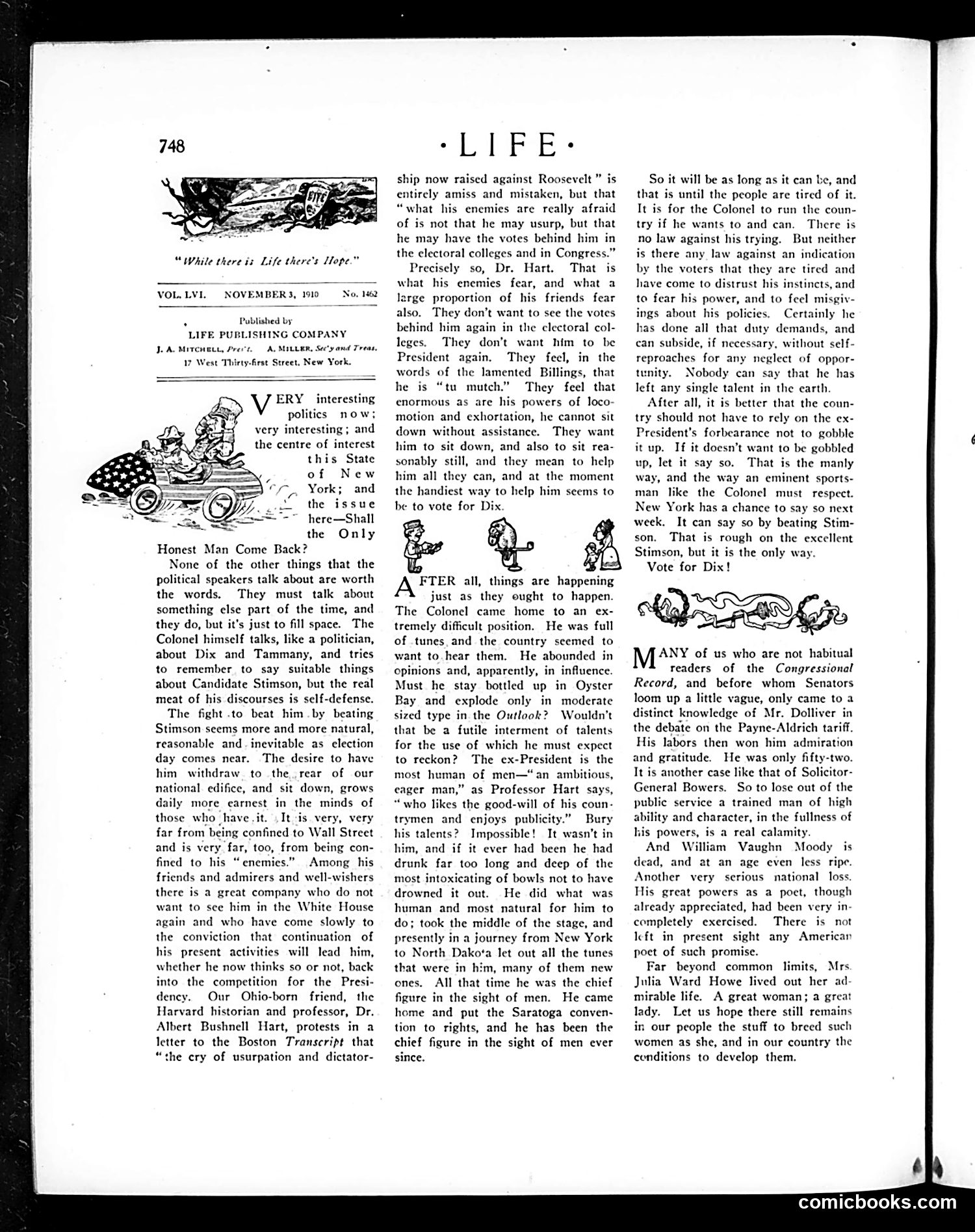
This page discusses Theodore Roosevelt's potential return to politics following his presidency (1901-1909). The central question—"Shall the Only Honest Man Come Back?"—refers to Roosevelt's possible re-entry into electoral politics. The text reveals that Roosevelt's enemies and even some allies fear he'll secure enough electoral votes and congressional support to become President again. The piece acknowledges Roosevelt's natural charisma and ambition: he cannot remain quietly retired but instead has been actively campaigning and giving speeches across the country (notably a journey to North Dakota). The article references New York State politics, particularly the gubernatorial race involving candidate Stimson and Tammany Hall, with voters apparently hoping to support alternative candidate "Dix" to prevent Roosevelt's political resurgence. The commentary suggests Roosevelt's continued public prominence makes another presidential bid increasingly inevitable, despite widespread efforts to discourage it. The tone is sardonic about Roosevelt's inability to remain politically inactive.
📄 Transcribed text from this page (OCR, searchable)
Machine-transcribed from the original scan — historical spelling and the odd misread are preserved.
NOVEMBER3, 1910 No, 1462 . Published by LIFE PUBLISHING COMPANY JA MITCHELL, Pree AL MILLER, See'y and Treas, 17 West Thirty-first Street, New York. VOL. LVI. ERY interesting politics now: very interesting ; and the centre of interest this State of New York; and the issue here—Shall the Only Honest Man Come Back? None of the other things that the political speakers talk about are worth the words, They must talk about something else part of the time, and they do, but it's just to fill space. The Colonel himself talks, like a politician, about Dix and Tammany, and tries to remember to say suitable things about Candidate Stimson, but the real meat of his discourses is self-defense. The fight .to beat him. by beating Stimson seems more and more natural, reasonable and. inevitable as election day comes near. The desire to have him withdraw to the rear of our national edifice, and sit down, grows daily more earnest in the minds of those who have .it. .It-is very, very far from being confined to Wall Street and is very far, too, from being con- fined to his “enemies.” Among his friends and admirers and well-wishers there is a great company who do not want to sce him in the White House again and who have come slowly to the conviction that continuation of his present activities will lead him, whether he now thinks so or not, back into the competition for the Presi- dency. Our Ohio-born friend, the Harvard historian and professor, Dr. Albert Bushnell Hart, protests in a letter to the Boston Transcript that “the ery of usurpation and dictator- *>LIPE« ship now raised against Roosevelt” is entirely amiss and mistaken, but that “what his enemies are really afraid of is not that he may usurp, but that he may have the votes behind him in the electoral colleges and in Congress.” Precisely so, Dr. Hart. That is what his enemies fear, and what a large proportion of his friends fear also. They don’t want to see the votes behind him again in the electoral col- leges. They don’t want him to be President again. They feel, in the words of the lamented Billings, that he is “tu mutch.” They feel that enormous as are his powers of loco- motion and exhortation, he cannot sit down without assistance. They want him to sit down, and also to sit rea- sonably still, and they mean to help him all they can, and at the moment the handiest way to help him seems to be to vote for Dix. FTER all, things are happening just as they ought to happen. The Colonel came home to an ex- tremely difficult position. He was full of tunes.and the country seemed to want to.hear them. He abounded in opinions and, apparently, in influence. Must he stay bottled up in Oyster Bay and explode only in moderate sized type in the Outlook? Wouldn't that be a futile interment of talents for the use of which he must expect to reckon? The ex-President is the most human of men—“an ambitious, eager man,” as Professor Hart says, “who likes the good-will of his coun- trymen and enjoys publicity.” Bury his talents? Impossible! It wasn’t in him, and if it ever had been he had drunk far too long and deep of the most intoxicating of bowls not to have drowned it out. He did what was human and most natural for him to do; took the middle of the stage, and presently in a journey from New York to North Dakota let out all the tunes that were in him, many of them new ones. All that time he was the chief figure in the sight of men. He came home and put the Saratoga conven- tion to rights, and he has been the chief figure in the sight of men ever since. So it will be as long as it can be, and that is until the people are tired of it. It is for the Colonel to run the coun- try if he wants to and can. There is no law against his trying. But neither is there any law against an indication by the voters that they are tired and have come to distrust his instincts, and to fear his power, and to feel misgiv- ings about his policies, Certainly he has done all that duty demands, and can subside, if nece: . without self- reproaches for any neglect of oppor- tunity. Nobody can say that he has left any single talent in the earth. After all, it is better that the coun- try should not have to rely on the ex- President’s forbearance not to gobble it up. If it doesn’t want to be gobbled up, let it say so. That is the manly way, and the way an eminent sports- man like the Colonel must respect. New York has a chance to say so next week. It can say so by beating Stim- son. That is rough on the excellent Stimson, but it is the only way. Vote for Dix! NSDL oe M** of us who are not habitual readers of the Congressional Record, and before whom Senators loom up a little vague, only came to a distinct knowledge of Mr. Dolliver in the debate on the Payne-Aldrich tariff. His labors then won him admiration and gratitude. He was only fifty-two. It is another case like that of Solicitor- General Bowers. So to lose out of the public service a trained man of high ability and character, in the fullness of his powers, is a real calamity. And William Vaughn Moody is dead, and at an age even less ripe. Another very serious national loss. His great powers as a poet, though already appreciated, had been very in- completely exercised. There is not left in’ present sight any American poet of such promise. Far beyond common limits, Mrs. Julia Ward Howe lived out her ad- mirable life. A great woman; a great lady. Let us hope there still remains in our people the stuff to breed such women as she, and in our country the conditions to develop them. comicbooks.com